Year: 2018

08 Nov 2018

81% of VC firms don’t have a single black investor — BLCK VC wants to change that

Venture capital has a diversity problem.

BLCK VC, a new organization founded by Storm Ventures associate Frederik Groce and NEA associate Sydney Sykes meant to connect, engage and advance black venture capitalists, is ready for a new era in the industry.

Their mission: Turn 200 black investors into 400 black investors by 2024.

“We think of ourselves as an organization formed by black VCs for blacks VCs to increase the representation of black investors,” Sykes told TechCrunch.

“You can look around and say ‘well, I know five black VCs,’ but you can also say this firm does not have a single black VC, they may not even have a single underrepresented minority … We want to make firms reckon with the fact that there is a racial diversity problem; there is a lack of black VCs and every firm should really care about it.”

BLCK VC has been at work since the beginning of 2018, building and expanding a network of black investors in the San Francisco area, Los Angeles and New York. They seek to provide a community for black investors, a space for honest conversations and questions and a resource for VC firms looking to make more diverse hires. Today at AfroTech, the organization is taking the wraps off its plan to diversify the VC industry.

“There’s an incredible need to ensure there are resources in place so people don’t churn out of the community; getting people in the door is only half the battle,” Groce told TechCrunch. “This is us saying ‘hey, get involved.’ It’s time to broaden and give others access to what we are doing. It takes a village if we really want to see things start to shift.”

According to data collected by Richard Kerby, a partner at Equal Ventures, 81 percent of VC firms don’t have a single black investor. Roughly 50 percent of black investors in the industry are at the associate level, or the lowest level at a firm; only 2 percent of black investors are partners at a firm.

“It takes a village if we really want to see things start to shift.” — BLCK VC co-chair Frederik Groce.

The lack of representation, especially in powerful positions, has made it difficult for black aspiring investors to enter the industry, as well as for black investors to stay in VC.

“VC, more than a lot of industries, is very network driven in the way that they hire,” Sykes said. “The network started 40 or 50 years ago with a lot of white men who had the wealth at the time to invest in companies. As VC has grown, a lot of the people who started it hired people they knew, there wasn’t an effort to recruit from outside of their network. That has made VC this very homogenous industry.”

Aside from Kerby’s data and a Harvard Business School study on diversity in innovation, there is limited data available on black VCs and funding for black founders. Digitalundivided‘s research arm ProjectDiane is one of the few organizations to report on funding for black female founders, for example. According to its latest report, black women have raised just .0006 percent of all tech venture funding since 2009.

BLCK VC’s board includes Adina Tecklu, a venture investor at Canaan Partners; Brian Hollins, a growth equity investor at Goldman Sachs; Earnest Sweat, an investment manager at Prologis Ventures; and Elliott Robinson, a partner at M12 Ventures.
08 Nov 2018

Material Impact, a new fund focused on materials technology, just closed its debut fund with $110 million

Material Impact, a Waltham, Mass.-based firm that says it “transforms materials into companies that make an impact,” has closed its debut fund with $110 million in capital commitments from a range of university endowments, foundations, family offices and fund-of-funds.

In a sea of fundraising announcements, it’s tempting to shrug off the development. Another new venture outfit? Big deal. But Material Impact isn’t exactly typical, both because of its founders, and because of its thesis, which stands out amid many other firms that seem to be chasing almost exactly the same opportunities.

Co-founder Carmichael Roberts spent nearly a dozen years with the firm North Bridge Venture Partners, where he led deals and helped build companies that create new products by applying chemistry, materials science or materials engineering. He moved on to launch Material Impact a couple of years ago, when North Bridge was beginning to wind itself down.

Roberts’s partner in Material Impact, Adam Sharkawy, had meanwhile served in recent years as an executive at numerous  biopharmaceutical and medical equipment companies, including Abbott, Smith & Nephew and The Medicines Company.

Sharkawy and Roberts, who both received PhDs from Duke University, first met back in 1999, when they found themselves on the school’s biomedical engineering advisory board together. (They maintain they were the “only entrepreneurs” in the mix.) The men say they’ve been collaborating ever since, but Material Impact is among their biggest undertakings to date.

Though it has closed on just four investments to date, the firm has a few approaches to supporting startups. First and foremost, it spends time with big and small companies from a wide range of industries — from agtech to automotive to e-commerce — to learn about their pain points, then it scours universities with which it has ties so see if they are, literally in some cases, cooking up anything that might address these issues.

Many of these schools are in Boston, a stone’s throw from the firm — think Harvard and MIT — though Roberts and Michaels say they have relationships with universities elsewhere, too, including Northern California. “That’s largely the algorithm,” says Sharkawy.

In other cases, Material Impact is looking for ways to use products or ideas that its corporate friends have spent millions of dollars to develop but don’t know how to put to good use. Sharkawy points to one example of a material developed for feminine hygiene products whose properties lend itself to another use and thus is at the center of a new spin-out that Material Impact is behind (this deal is in process, so we were asked not to disclose much more here).

A third way that Material Impact is approaching startups is by taking ideas that universities have been tinkering with and turning them into companies, giving the universities a stake in the company and the promise of upside if the companies take off. Soft Robotics, a Cambridge, Mass.-based startup that’s constructing robots from highly compliant materials, including grippers capable of handling fragile objects, is a prime example. The outfit piggybacks off the work of Harvard professor George Whitesides, under whom Roberts studied as a post-doctoral student (and who is also a co-founder of the company, along with Roberts). “I feel old in saying this,” laughs Roberts, but “we have friends who are professors who are 30 years older than us, and we have professors who are friends who are 20 years younger than us.”

Ultimately, the idea is to incubate between 12 and 15 companies with the fund through these three avenues. And Material Impact is targeting 20 percent on average, but that number could also be as low as 5 percent and as high as 50 percent, depending on exactly how involved the firm is.

As for Roberts and Sharkawy being nervous about working so closely with students who may have great ideas but little to no industry experience, Roberts insists that both men “remember being that person, so we know exactly how they think about their work.” In fact, another aspect of their fund, they say, is pairing students with a network of product development experts inside of companies who they’ve known for years. “We give them access to people who they might be nervous to talk with, or who they wouldn’t have access to typically, and we start a dialogue.”

Bigger picture, says Sharkawy, the firm’s biggest differentiator may simply be its relentless focus on materials science: “If you trace back any quantum leap, whether in electronics or healthcare or aerospace, you can trace back those advancements to material science innovation,” he notes. “We all talk about the iPhone, for example. But the reality is that if it weren’t for advances in underlying electronic materials and sensory reactive glass materials, the iPhone wouldn’t have been possible.”

08 Nov 2018

Abbyy looks to RPA to breathe new life in to scanning and workflow

Abbyy has been around for a long time helping companies with scanning and workflow tools, but like many older vendors it has been looking for ways to extend its traditional business model. One way to do that is by teaming up with robotics process automation companies like UIPath. Today, the company announced it has launched the Abbyy FlexiCapture Connector in the UiPath Go! App store.

Bruce Orcutt, senior vice president for product marketing at Abbyy says the connector provides the ability to pull content into UIPath or to take Abbyy content and push it to another part of the automated workflow in UIPath.

UIPath is on a tear these days. Just two months ago, it scored a $225 million Series C investment on a $3 billion valuation. It was able to grow from $1 million to $100 million in annual recurring revenue in just 21 months. As I wrote at the time of the funding, “[UIPath] allows companies to bring a level of automation to legacy processes like accounts payable, employee onboarding, procurement and reconciliation without actually having to replace legacy systems.”

Orcutt sees a natural connection to his company’s workflow roots, bringing it into a more modern context. “RPA simplifies the user experience. Abbyy brings content and context,” he told TechCrunch. He says that while they are still doing OCR to scrape unstructured content, it can do this in fully automated digital process and UIPath can take that content and move it through other parts of an automated workflow.

For Abbyy, UIPath is a big partner, but it’s part of a broader strategy to expand the company’s capabilities to RPA. He says they are working with a variety of RPA vendors beyond UIPath and also with systems integrators as they look to breathe new life into the company’s brand and products.

Orcutt says this is part of significant focus and investment on the part of the company. RPA is clearly a natural fit for Abbyy, but he wasn’t willing to speculate on any deeper partnership. “We’re focusing on what we can do the best we can, and they can focus on merits of their platform. Abbyy can compliment those capabilities.”

08 Nov 2018

Facebook Dating arrives in Canada and Thailand

On the heels of Tinder’s plans to go more casual, Facebook is today expanding access to its own dating service, Facebook Dating. First launched two months ago in Colombia for testing purposes, the social network is today rolling out Facebook Dating to Canada and Thailand. The company is also adding a few new features to coincide with the launch, including the ability to re-review people you passed on and take a break by putting the service on pause, among other things.

If that latter feature sounds familiar, it’s because it’s also something dating app Bumble recently announced, as well.

Bumble in September launched a Snooze button for its own app, which addressed the problem many online daters have – the need for a detox from dating apps for a bit. Sometimes that’s due to frustration or just being busy; while other times it’s because they’ve matched with someone and want to give them a chance.

Facebook says you can still message people you already matched while on pause.

Meanwhile, offering daters a chance to give someone a second look is also common among dating apps, though it’s presented in different ways. For example, OKCupid may resurface people you’ve passed on, while Tinder’s newer “Feed” feature lets you keep track of updates from matches that you had earlier decided to ignore.

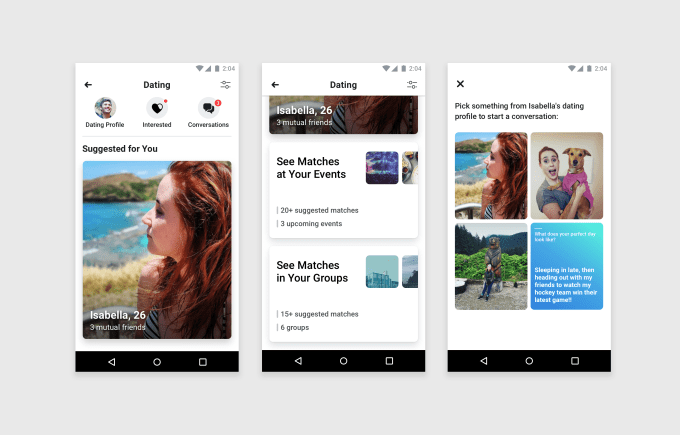
Second Look will be in Facebook Dating’s Settings, and show people in reverse chronological order. You can go back through your Suggested Matches and even review people you may have accidentally passed on – features other dating apps charge for.

Also new today is the ability to review a blocked list, support for non-metric units (for things like range and height), and more interactive profile content, including tappable entry points for conversations – like a shared hometown or school.

These features will arrive in the new version of Facebook Dating, rolling out today, the company says.

It has tweaked the user interface a bit, too. Now, when scrolling through Groups and Events to unlock, these will appear vertically, instead of horizontally as before.

Facebook says it’s also working now on a pre-emptive block list, based on user feedback.

This would let you search for people who are not already your Facebook friends in Facebook Dating that you know you don’t want to see – for example, an ex you’ve unfriended but not blocked on Facebook, a family member, etc., the company tells TechCrunch.

You’ll be able to search for specific people regardless of whether or not you know they have a Dating profile, and doing so won’t reveal to you if that person has a profile on Facebook Dating or not.

Pre-emptive blocking is actually fairly clever, given that many dating apps today surprise you with people you’d rather not see.

Originally announced at F8 this May, Facebook has already figured out some of the larger details about how it wants its dating service to operate. That includes its decision to limit users from expressing interest in no more than 100 people per day, and other settings to open the service to matching with strangers or with friend-of-friends.

There’s a certain (evil) genius in launching a Facebook Dating service, given that Facebook is already the place people go – along with Instagram – to research their new matches and potential dates, once things progress to that point. Plus, the service can leverage Facebook’s data. After all, if anyone knows who you are and what you’re like, it’s them. That could save users time in answering the ‘getting to know you’ questions some apps pose to their users to help perfect their matching algorithms.

It also helps that Facebook is positioning the service for those who want relationships, given the leading dating app – Tinder – is known for the opposite. Match is preparing to focus Tinder more on young, casual dating then build out Hinge for those interested in serious dating.

Facebook’s challenge is that user trust in the company today is lacking. And dating is something many considerate very private – not something they’d want exposed on a network where they’re connected with work colleagues, industry peers, and extended family. While Facebook vows to maintain user privacy, its track record on this front is poor, which could limit the service’s growth.

Facebook has not said when the service will launch in the U.S., nor has it detailed the number of signups to date.

“We don’t have any specific metrics to share, but we’ve been pleased with the response in Colombia thus far and are excited to roll it out to Thailand and Canada,” a spokesperson said.

08 Nov 2018

Google CEO highlights corporate changes following walkouts

This time last week, Google employees held massive walkouts across the country to protest the company’s handling of sexual harassment in the wake of a damning New York Times piece. This morning, CEO Sundar Pichai sent a note to employees about the events that was also shared via the company’s blog.

“We recognize that we have not always gotten everything right in the past and we are sincerely sorry for that,” the executive says in the letter. “It’s clear we need to make some changes.” The memo follows another recent letter, in which Pichai noted the termination of 48 employees for sexual harassment over the past two years.

This latest letter also makes note of a private “action plan.” While not spelled out in its entirety, Pichai breaks down a  handful of policy changes, including  mandatory training for employees and the ways in which the company will handle sexual harassment claims going forward. Here are the bullet points:

  • We will make arbitration optional for individual sexual harassment and sexual assault claims. Google has never required confidentiality in the arbitration process and arbitration still may be the best path for a number of reasons (e.g. personal privacy) but, we recognize that choice should be up to you.
  • We will provide more granularity around sexual harassment investigations and outcomes at the company as part of our Investigations Report.
  • We’re revamping the way we handle and look into your concerns in three ways: We’re overhauling our reporting channels by bringing them together on one dedicated site and including live support. We will enhance the processes we use to handle concerns—including the ability for Googlers to be accompanied by a support person. And we will offer extra care and resources for Googlers during and after the process. This includes extended counseling and career support,
  • We will update and expand our mandatory sexual harassment training. From now on if you don’t complete your training, you’ll receive a one-rating dock in Perf (editor’s note: Perf is our performance review system).
  • We will recommit to our company-wide OKR around diversity, equity and inclusion again in 2019, focused on improving representation—through hiring, progression and retention—and creating a more inclusive culture for everyone. Our Chief Diversity Officer will continue to provide monthly progress updates to me and my leadership team.

Of course, all of this only arrives in the wake of both a serious piece highlighting disturbing complaints about former employees, along with a very high-profile walkout on the part of Google employees. It never bodes well for a company’s underlying culture when these sorts of actions are required to induce a fundamental change.

08 Nov 2018

YouTube arrives on the Nintendo Switch

Nintendo has sold over 22 million Switch consoles since launch, with plans to sell another 20 million this financial year.

That said, Nintendo hasn’t seemed too focused on building out its portfolio of non-gaming apps.

Thus far, only Hulu has managed to get aboard the Switch train. But today, YouTube joins the mix. Switch owners can download the YouTube app here. Also of note: the YouTube app on Nintendo Switch supports 360-degree video.

Given Nintendo’s portfolio of Switch-compatible games, including Zelda, Super Mario Odyssey, Pokemon, and Fortnite, YouTube’s integration with the console makes sense. Both the Switch and YouTube skew towards younger demographics.

Part of the reason that it’s taken so long for streaming apps to make their way to the Switch is because of Nintendo’s focus on growing its gaming library for the console.

“We’ve said that other services will come in due time,” said Reggie Fils-Aimé, Nintendo’s chief operations officer, in an interview from last month. “For us, we want to make sure that continue driving the install base for Nintendo Switch, continue to have great games for the platform.”

08 Nov 2018

Self-driving Mercedes-Benz S Class sedans are coming to San Jose

Another autonomous ride-hailing test project has popped up in the U.S. This time, Daimler and Bosch, one of the largest automotive tech and hardware suppliers in the world, are partnering to pilot a robotaxi service in San Jose, California.

The program will use automated Mercedes-Benz S Class vehicles, the German automaker’s full-sized luxury flagship sedans, the company announced Thursday. The robotaxi trials will begin in the second half of 2019 in a geofenced area in the San Carlos and Stevens Creek corridor between downtown and west San Jose.

The pilot will use an on-demand ride-hailing service app operated by Daimler Mobility Services.

Select members of the public will be given access to the app and be able to hail a self-driving car from a designated pick-up location. The rides will all be monitored by a safety driver.

“The pilot project is an opportunity to explore how autonomous vehicles can help us better meet future transportation needs,” says San Jose mayor Sam Liccardo said in a statement.

For Daimler, it’s a chance to bring together several of its businesses under an autonomous vehicle trial and see if they can work in concert. Daimler owns car-sharing company car2go, ride-hailing company mytaxi as well as its mobility unit moovel. The intent, Daimler says, is provide a seamless digital experience.

Daimler and Bosch formed a partnership in 2017 to bring fully autonomous vehicles to urban roads “by the start of the next decade.”

Since then, the two companies launched an automated valet system at the parking garage for the Mercedes-Benz Museum in Stuttgart, Germany. Meanwhile, Bosch is building a $1.1 billion facility that will produce semiconductors uses in self-driving cars, smart homes and smart city infrastructure. The Dresden-based chip fab is set to start producing silicon commercially in 2021, and construction is supposed to be completed in 2019.

“We have to rethink urban transportation. Automated driving will help us complete the picture of future urban traffic,” said Dr. Stephan Hönle, senior vice president of the Automated Driving business unit at Robert Bosch GmbH.

08 Nov 2018

Amazon launches Alexa app for Windows 10 PCs

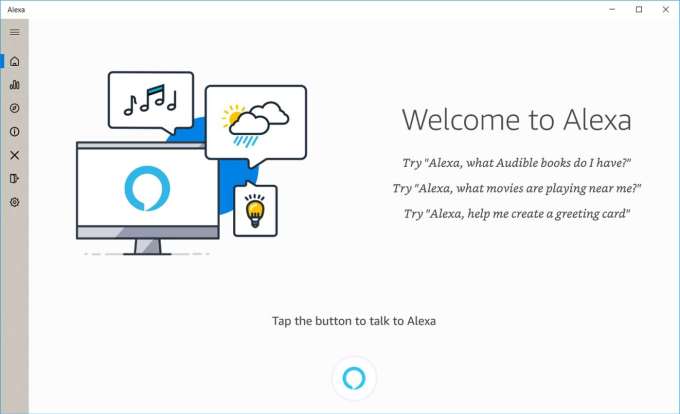
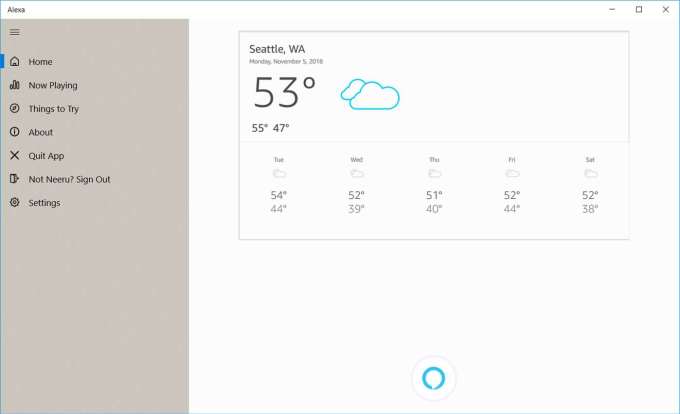
Amazon today launched an Alexa app for Windows 10 PCs on the Microsoft Store. The voice application allows PC owners to speak to Alexa to set reminders, timers, alarms; create lists and to-dos; track their calendar appointments; get news, weather and other information; play music; listen to podcasts and audiobooks; control the smart home, and more.

The app is another way that Alexa is being unhitched from Echo speakers and other devices that generally stay in the home. Similar to the Alexa app for mobile devices, the Windows 10 app means you can use Alexa when you’re traveling for access to content and information, as well as to do things like lock your doors or check your security cameras, for example.

The app also offers access to tens of thousands of Alexa skills, says Amazon.

However, some features – including video, communications, Spotify and Pandora – are not supported on the Alexa app for Windows 10 at launch.

The app’s arrival comes shortly after Amazon and Microsoft opened up the Alexa-Cortana integration into public preview, which lets customers call up Cortana through their Echo devices and enable Amazon’s Alexa on Windows 10 devices and on Harman Kardon Invoke speakers.

Some PCs are designated as “Alexa Built-In,” meaning they’re already tuned for Alexa and you’ll be able to speak to Alexa hands-free. These include several PCs form Acer, Asus, Dell, HP, and Lenovo.

The Alexa app is available for Windows 10 PCs in the US, UK, and Germany, and will be coming to more locations in 2019.

08 Nov 2018

Datacoral raises $10M Series A for its data infrastructure service

Datacoral aims to make it easier for enterprises to build data products by abstracting away all of the complex infrastructure to organize and process data. The company today announced that it has raised a $10 million Series A financing round led by Madrona Venture Group, with participation from Social Capital, which also led its $4 million seed round in 2017.

Datacoral CEO Raghu Murthy tells me that the company plans to use the new funding to grow its business team in order to be able to reach more potential customers and to expand its engineering team.

The promise of Datacoral is to offer enterprises an end-to-end data infrastructure that will allow businesses and their data scientists to focus on generating insights over having to manage and integrate their data sources. Because nobody wants to move large amounts of data between clouds — and take the performance hit that comes with that — Datacoral sits right inside a company’s AWS systems. It’s still a fully managed service, though, but the data is encrypted and never leaves a customer’s virtual private cloud.

“As companies look to their data to deliver value – data practitioners are finding that configuring and managing their own data infrastructure is a time-consuming job that is expensive and fraught with errors,” said Murthy. “We have built a platform that easily and automatically brings together data from different applications and databases, organizes that data in any query engine and acts on insights that are critical to running their business. A crucial component is that it works securely and privately within the customer’s cloud, instead of us ingesting data from their systems.”

Murthy was an early engineer at Facebook and part of the team that was in charge of scaling that company’s data infrastructure and ran a part of the engineering team at Bebop, Diane Greene’s startup that was later acquired by Google.

To scale Datacoral, the team is betting on a serverless platform itself. It’s making extensive use of AWS Lambda and other PaaS solutions on Amazon’s cloud computing platform. That doesn’t mean Datacoral plans to only support AWS, though. Murthy tells me that Azure support is next. “We plan to work across all of the top cloud providers by leveraging their unique services and provide a consistent ‘data-centric interface’ to our customers — essentially be ‘cloud best’ instead of ‘cloud agnostic.'”

Current Datacoral users include Greenhouse, Front, Ezetap, Swing Education, mPharma and Mason Finance.

08 Nov 2018

Google Cloud wants to make it easier for data scientists to share models

Today, Google Cloud announced Kubeflow pipelines and AI Hub, two tools designed to help data scientists put to work across their organizations the models they create.

Rajen Sheth, director of product management for Google Cloud’s AI and ML products, says that the company recognized that data scientists too often build models that never get used. He says that if machine learning is really a team sport, as Google believes, models must get passed from data scientists to data engineers and developers who can build applications based on them.

To help fix that, Google is announcing Kubeflow pipelines, which are an extension of Kubeflow, an open-source framework built on top of Kubernetes designed specifically for machine learning. Pipelines are essentially containerized building blocks that people in the machine learning ecosystem can string together to build and manage machine learning workflows.

By placing the model in a container, data scientists can simply adjust the underlying model as needed and relaunch in a continuous delivery kind of approach. Sheth says this opens up even more possibilities for model usage in a company.

“[Kubeflow pipelines] also give users a way to experiment with different pipeline variants to identify which ones produce the best outcomes in a reliable and reproducible environment,” Sheth wrote in a blog post announcing the new machine learning features.

The company is also announcing AI Hub, which, as the name implies, is a central place where data scientists can go to find different kinds of ML content, including Kubeflow pipelines, Jupyter notebooks, TensorFlow modules and so forth. This will be a public repository seeded with resources developed by Google Cloud AI, Google Research and other teams across Google, allowing data scientists to take advantage of Google’s own research and development expertise.

But Google wanted the hub to be more than a public library — it also sees it as a place where teams can share information privately inside their organizations, giving it a dual purpose. This should provide another way to extend model usage by making essential building blocks available in a central repository.

AI Hub will be available in Alpha starting today with some initial components from Google, as well as tools for sharing some internal resources, but the plan is to keep expanding the offerings and capabilities over time.

Google believes if it provides easier ways to share model building blocks across an organization, the more likely they will be put to work. These tools are a step toward achieving that.