Year: 2018

08 Nov 2018

Let’s take off with the European Space Agency at Disrupt Berlin

A few years ago, nobody would have bet that space exploration would become so exciting again. But everybody is talking about space again, from Mars to satellites, launchers and observation. That’s why we invited Frank Salzgeber from the European Space Agency to talk at TechCrunch Disrupt Berlin.

The European Space Agency needs little introduction. It has been one of the earliest and most successful European programs with 22 member states and many key innovations. The agency participates in the International Space Station program, is in charge of unmanned exploration missions on multiple planets and more.

The ESA also develops its own launcher with Arianespace and maintains a spaceport at Kourou. Ariane 5 recently celebrated its 100th launch, and I still have vivid memories of the first flight when I was a kid.

Ariane 6 is right around the corner with a test flight scheduled for 2020. It’ll be much more efficient than Ariane 5 at half the cost. But Arianespace is still facing competition from smaller launchers, such as the SpaceX Falcon 9 and the Chinese Long March 3B. Now that satellites are getting smaller and smaller, cost is becoming increasingly important compared capacity.

And if you think we shouldn’t forget about human space flights, Salzgeber agrees with you. He’s been defending human exploration at the ESA and keeps saying that “a society that stops exploring stops progressing.”

If you’re also fascinated by space innovation, you should buy your ticket to Disrupt Berlin to listen to this discussion and many others. The conference will take place on November 29-30.

In addition to fireside chats and panels, like this one, new startups will participate in the Startup Battlefield Europe to win the highly coveted Battlefield cup.

Frank Salzgeber

Head of Technology Transfer and Business Incubation Office, European Space Agency (ESA)

Mr Frank M. Salzgeber is the Head of the Technology Transfer and Business Incubation Office at the European Space Agency (ESA). Prior this post he was the Head of Commercial Development in the European Astronaut Department of the Directorate of Human Spaceflight Microgravity and Exploration at the European Space Agency.

Prior to joining ESA, Frank held the position of Chief Operating Officer (COO and CFO) at an IT start-up headquartered in Munich, Germany, between 2000 and 2003, which he merged with CANCOM SA. Frank also spent seven years at Apple Computer (1993 – 2000) initially as an account manager and then as a sales manager, covering Central Europe and being positioned in the US and Czech Republic.

Being genuinely passionate about the importance of human space flight and the European Space Programme, Frank’s believes that ‘a society that stops exploring stops progressing’.
08 Nov 2018

Tesla picks telco executive Robyn Denholm to replace Elon Musk as chairman

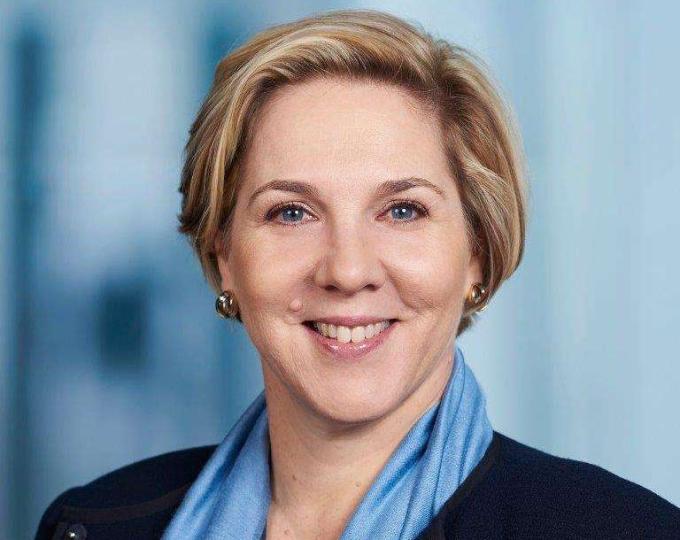
Elon Musk’s replacement as the chair of Tesla has been named and it is Robyn Denholm, an Australian executive who has been a director with the electric vehicle firm since 2014.

Denholm is currently CFO of Australia-based telco Telstra and she’ll step into the breach once a six-month notice period is served, Tesla said in an announcement released late Wednesday evening U.S. time.

There’s been plenty of speculation as to who will replace Musk — the figurehead of Tesla’s business — after he announced in September that he would step down as the firm’s chairman. Musk’s resignation was part of a settlement with the SEC, which found Tesla guilty of failing to require disclosure controls and procedures relating to a tweet from Musk about taking the company private. Tesla later confirmed it would remain a public entity despite Musk’s tweets.

The SEC deal included a $20 million fine for Musk who retained his position as CEO and the confidence of the board.

Denholm was extensive experience in the automotive industry beyond her time with Tesla. Her career includes a seven-year stint with Toyota Australia, and she has also worked for tech giants Juniper Networks and Sun Microsystems. She is a graduate of the University of Sydney, where she studied economics, and holds a Master’s degree in Commerce from the University of New South Wales.

Robyn Denholm has been a Tesla director since 2014

“I believe in this company, I believe in its mission and I look forward to helping Elon and the Tesla team achieve sustainable profitability and drive long-term shareholder value,” Denholm said in a statement.

“Robyn has extensive experience in both the tech and auto industries, and she has made significant contributions as a Tesla Board member over the past four years in helping us become a profitable company. I look forward to working even more closely with Robyn as we continue accelerating the advent of sustainable energy,” Musk added.

08 Nov 2018

Facebook starts shipping Portal, clarifies privacy/ad policy

Planning to get in early on the Portal phenomenon? Facebook announced today that it’s starting to ship the video chat device. The company’s first true piece of devoted hardware comes in two configurations: the Echo Show-like Portal and the larger Portal+ . Which run $199 and $349, respectively. There’s also a two-fer $298 bundle on the smaller unit.

The device raised some privacy red flags since it was announced early last month. The company attempted to nip some of the those issues in the bud ahead of launch — after all, 2018 hasn’t been a great year for Facebook privacy. The site also hasn’t done itself any favors by offering some murky comments around data tracking and ad targeting in subsequent weeks.

With all that in mind, Facebook is also marking the launch with a blog post further spelling out Portal’s privacy policy. Top level, the company promises not to view or listen to video calls. Calls are also encrypted and all of the AI tech is performed locally on-device — IE not sent to its servers.

In the post, Facebook also promises to treat conversations on Portal the way it does all Messenger experience. That means while it won’t view the calls, it does indeed track data usage, which it may later use to serve up cross platform ads.

“When you make a Portal video call, we process the same device usage information as other Messenger-enabled devices,” Facebook writes. “This can include volume level, number of bytes received, and frame resolution — it can also include the frequency and length of your calls. Some of this information may be used for advertising purposes. For example, we may use the fact that you make lots of video calls to inform some of the ads you see. This information does not include the contents of your Portal video calls.”

In other words, it’s not collecting personally identifying data, but it tracking information. And honestly, if you have a Facebook account, you’ve already signed up for that. The question is whether you’re comfortable introducing an extra level and bringing it into your living room or kitchen.

08 Nov 2018

Despite a strong Q3 earnings report, Square’s Q4 forecast disappoints investors

Despite a strong third-quarter earnings report, Square’s forecast for the final quarter of this year gave investors pause, sending its share price down 6 percent in after hours trading before it gradually climbed up again.

Square’s adjusted revenue grew 68 percent year-over-year to $431 million, beating expectations from analysts polled by Refinitiv (formerly the financial and risk arm of Thomson Reuters), who had forecast $413.9 million. It also reported 13 cents in adjusted earnings per share, better than the 11 cents analysts expected.

Total third-quarter revenue was $882.1 million, a 51 percent increase from the same period last year, and Square also marked its first quarterly profit of $20 million, compared to a loss of $16 million last year. In an earnings call, CFO Sarah Friar said this was due largely to Square’s investment in Eventbrite, which held its IPO in October.

Despite beating analysts’ expectations for its third quarter and also raising its adjusted core earnings forecast for 2018 to between $250 million and $255 million, up from $240 million to $250 million, Square’s forecast for the fourth quarter missed expectations. The company expects adjusted earnings of 12 cents to 13 cents a share, lower than the 15 cents forecast by analysts polled by Refinitiv.

Investors were also worried about Square’s transaction-based revenue, which grew 29% to $655 million during the third quarter, compared to 31 percent last year, because even slightly slower growth may signal that competitors like Clover are gaining more traction. Square reported, however, that the important segment of gross payment volume (GPV) it processes from “large sellers,” or merchants who do more than $125,000 a year in GPV, grew to 52 percent, up from 48 percent a year ago.

Friars said in Square’s earnings call that this is because Square has made it easier for large retailers to integrate Square’s platform into their operations, as well as the recent launches of Square Terminal, its credit card machine, and Square Installments, which enables merchants to allow customers to make monthly payments.

Friar, who oversaw Square’s IPO in November 2015 and has served as its CFO since 2012, announced last month that she will leave the company to become the CEO of Nextdoor. CEO and founder Jack Dorsey said that the search for a new CFO is his “number one focus at the company” and will be led by independent director David Viniar and board member Roelof Botha.

08 Nov 2018

20 startups take center stage at Berkeley SkyDeck’s demo day

The largest-ever Berkeley SkyDeck demo day kicked off with a high-energy performance from the Cal marching band, setting the tone for an afternoon of presentations from none other than Berkeley faculty and students-turned-entrepreneurs.

Launched in 2012 as a modest accelerator for student-run businesses, SkyDeck has flourished since its inception. To date, the program has mentored 300 startups, which have gone on to raise $800 million via 27 funding rounds and 10 acquisition deals. Earlier this year, it raised a $24 million venture fund so it could finally seed participating startups with $100,000 in exchange for 5 percent equity. Today’s cohort is only the second to receive an investment from SkyDeck as part of the accelerator.

To participate in SkyDeck’s accelerator program, startups must have at least one founding member attending any of the University of California campuses as an undergraduate or graduate student. Faculty members are also able to apply. Executive director Caroline Winnet said they plan to invest half that fund’s profits back into the university.

Lime, the bike- and scooter-sharing startup, is the biggest success story to emerge from SkyDeck. The company was created by Cal grads Toby Sun and Brad Bao, who were part of a 2017 SkyDeck cohort. Kiwi Campus, a robotics startup focused on last-mile delivery, and TDK-acquired Chirp Microsystems, are also SkyDeck graduates, as is the mental health startup Aura, which announced a $2.5 million financing just last week.

SkyDeck works with two cohorts of companies per year for six months each.

Here’s a look at the 20 startups that demoed for investors on Berkeley’s campus today:

PredictEV: Focused on the sports and esports market, PredictEV is a blockchain-powered social network for fans to bet on sports with cryptocurrency.

Researchably: Targeting medical research, pharma sales and outreach teams, the startup provides a research-based medical advice system.

Triton: A software platform that helps media companies tailor content to each individual reader or viewer. Triton is currently running pilots with Vanity Fair and The CW.

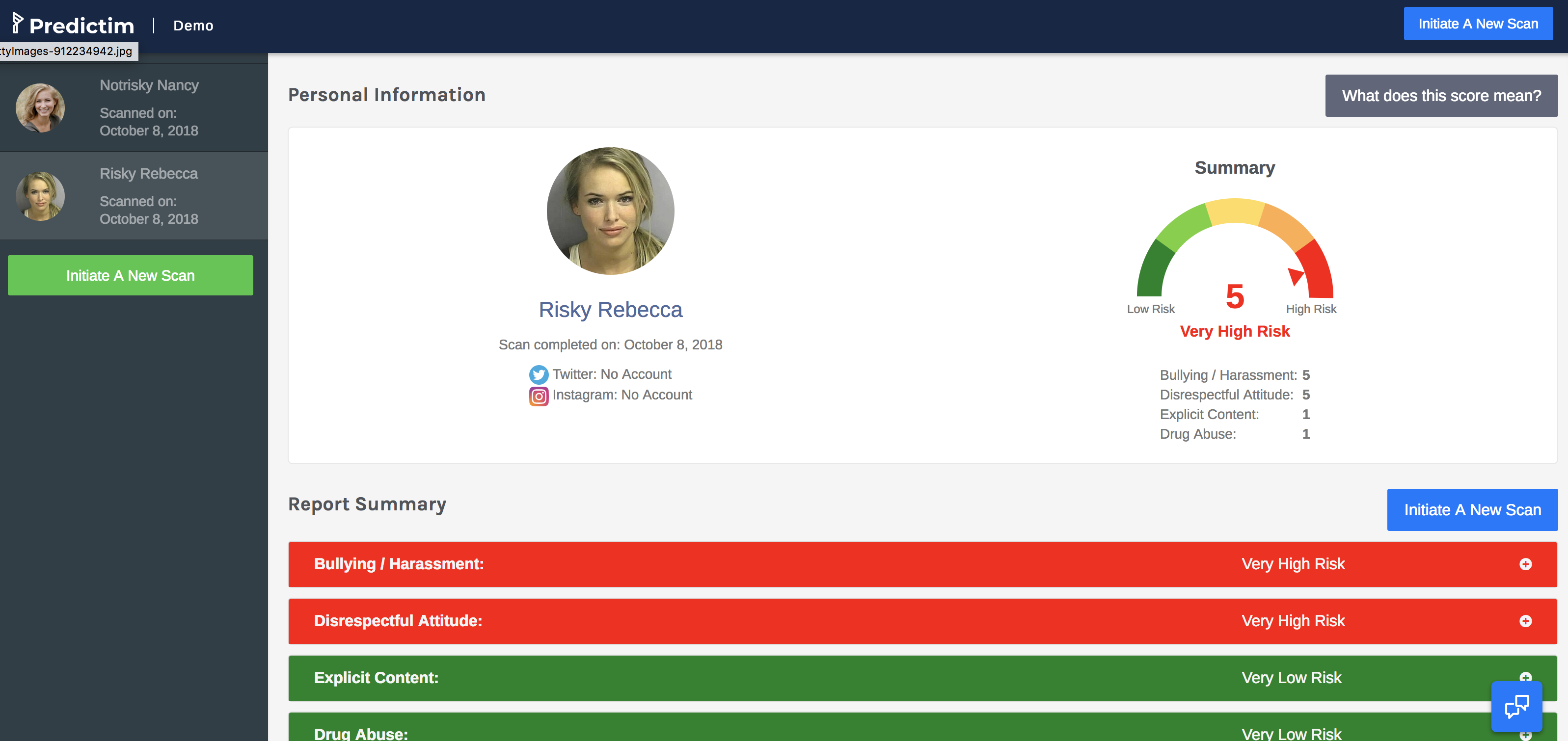
Predictim: An AI-powered platform that accesses a person’s trust and reliability. The purpose is to eliminate risk for members of the sharing economy. Basically, it will help you figure out if your dog-walker is a murderer.

Seamless Microsystems: Designs and manufactures semiconductor chips for consumer medical imaging, 5G networking LIDAR in autonomous driving and more.

SoftRides: Using AI and a smartphone’s image sensor to detect distracted driving behavior and alert you in real time.

Eye Level.AI: Founded by a group of former IBM Watson employees, Eye Level.AI provides an analytics-driven platform to assist chatbot owners to monetize current users and attract new ones.

Eye Level.AI

Perfect Dashboard: An AI-powered online marketplace for connecting SaaS products to small businesses.

The SMBX: A provider of a mobile marketplace that connects small businesses with people interested in investing in them.

Chameleon Biosciences: A startup focused on revolutionizing gene therapy to treat rare diseases.

ThinkCyte: The company has invented new imaging technology combined with machine learning, called Ghost Cytometry, to analyze and isolate cells for drug discovery, cell therapy and clinical diagnostics.

Snipfeed: With 44,000 weekly active users, Snipfeed helps Generation Z mobile users avoid misinformation online with its AI-powered news and information recommendation engine.

DropEx: A business networking app and relationship management system.

Peanut Robotics: The startup’s consumer-facing robot can grip household items to assist with cleaning at hotels, offices and airports.

Empire Biotechnologies: The company is developing therapies for gastrointestinal issues, specifically short bowel syndrome. Empire’s drug is used to control the absorption of nutrients through the digestive system.

Humm: A developer of wearable cognitive performance enhancement hardware created by a group of researchers at the University of Western Australia.

CoolJamm: An automated music producer and recommendation engine that uploads directly to YouTube.

Bungee: Led by three former Amazon employees, Bungee helps e-commerce businesses mine geo-specific data to create a recommendation engine for price, promotions and inventory.

SimpleDataLabs: The creator of Prophecy, a predictive analytics platform focused on business analysts and executives.

Skyloom: The company wants to improve space-to-Earth communications and unlock “the true economic potential of low Earth orbit” with its spaceborne infrastructure.


08 Nov 2018

The Muse, a popular recruitment site for millennial women, has made its second acquisition

The Muse, a New York-based, content-rich recruitment site that matches job seekers and all kinds of information about different career paths, as well as with companies that are hiring, has made it second acquisition, picking up TalentShare, a year-old, HR software-as-a service company. TalentShare has been focused on enabling companies to share high-quality candidates that they didn’t hire but would recommend to other companies that are in the market for talent.

Terms aren’t being disclosed, but four of TalentShare’s five-member team are joining The Muse. In fact, those new employees will help The Muse in establishing a second office in San Francisco.

We talked earlier this week with The Muse’s co-founder and CEO Kathryn Minshew about TalentShare, whose tie-up with the company comes roughly one year after The Muse made its first acquisition, bringing into the fold Brand Amper, a Chicago-based startup whose tools enabled companies to collect data like employee sentiment.

As Minshew explains it, The Muse won’t incorporate everything that TalentShare has built. Its interest instead centers on one aspect of the startup’s technology that helps brands better understand from where candidates come. “The old paradigm was for companies to post jobs online and assume that their post was where candidates discovered the job,” said Minshew. “Now we know that candidates are doing tons of research first. They may Google the company, or go to a career site; they may land on numerous platforms before they apply. It’s akin to a high consideration purchase like a vacation or a car. People aren’t buying based on a single [data point].”

In other words, the more that employers understand about which touch points are encouraging strong candidates to apply, the better they can invest the money they spend on recruiting. The Muse wants to help them understand those pathways.

The Muse is now seven years old, employs roughly 120 people, and Minshew says that 75 million users now check The Muse per year for its job listings and career advice. Two-thirds of that population is under the age of 35. Roughly 85 percent are college educated. Lastly, says Minshew, about 55 percent of its audience is female.

The company, which makes money off subscription packages paid by employers, has raised roughly $30 million to date, including from Icon Ventures and Aspect Ventures.

08 Nov 2018

Zopa, the UK P2P lending company, closes £60M round on path to launching a bank

Obtaining a banking license and then launching an actual new retail bank requires capital. A lot of capital. Enter Zopa, the U.K. peer-to-peer lending company that wants to become a bank, which today is announcing that it has closed £60 million in further funding. Only £16 million is actually new new money, having already disclosed £44 million in August, so this is effectively an extension of that earlier fund-raise.

The purpose remains the same, however: Zopa says it will use the latest round of investment toward the capital needs for its yet-to-launch “next generation bank.” The company began applying for a bank license with the U.K. regulators in 2016. The new funding also comes off the back of what the fintech claims is its sustainable and profitable peer-to-peer business, having achieved full-year profitability in 2017 for the first time since 2012.

An early mover in the space — launching all the way back in 2005 — Zopa says it has served nearly half a million customers, either through loans or investing in peer-to-peer loans. It has lent more than £3.7 billion in unsecured personal loans to customers in the U.K.

The next phase of Zopa is all about becoming a new digital bank, alongside its peer-to-peer business, in order to be able to offer “a unique and broader set of products to customers.”

“Our bank will allow us to give more people a better experience with their finances by introducing more simple, fair products — like savings accounts and credit cards,” a company spokesperson tells me.

At launch this will include offering FSCS-protected savings accounts, and P2P investments (including IFISAs for investors), and personal loans, car finance and credit cards for people looking to borrow.

“Our money management app will offer our customers a more personalised approach to managing their money,” adds the spokesperson.

Cue Jaidev Janardana, Zopa CEO (pictured above): “This new funding takes us a step closer to realising our vision of being the best place for money in the U.K. Having served half a million customers to date, Zopa is set to redefine the finance industry once again through our next generation bank to meet a broader set of U.K. customers’ financial needs.”

07 Nov 2018

Georgia’s secretary of state Brian Kemp doxes thousands of absentee voters

Georgia’s secretary of state Brian Kemp and candidate for state governor in the midterm election, has taken the unusual, if not unprecedented step of posting the personal details of 291,164 absentee voters online for anyone to download.

Kemp’s office posted an Excel file on its website within hours of the results of the general election, exposing the names and addresses of state residents who mailed in an absentee ballot — including their reason why, such as if a person is “disabled” or “elderly.”

People on Twitter quickly noticed, expressing anger.

The file, according to the web page, allows Georgia residents to “check the status of your mail-in absentee ballot.” Millions of Americans across the country mail in their completed ballots ahead of election day, particularly if getting to a polling place is difficult — such as if a person is disabled, elderly, or traveling.

When reached, Georgia secretary of state’s press secretary Candice Broce told TechCrunch that the all of the data “is clearly designated as public information under state law,” and denied that the data was “confidential or sensitive.”

“State law requires the public availability of voter lists, including names and address of registered voters,” she said in an email.

That might be technically true. Voter and electoral roll data is public and available, usually for a fee, though rules vary state by state. Names and addresses of voters can be requested from each state’s electoral commission or secretary of state’s office. Political analytics firms often taken this data and supplement it with their own polling data to try to determine potential swing voters.

But the way in which Kemp’s office approached confirming absentee ballots was met with anger.

“While the data may already be public, it is not publicly available in aggregate like this,” said security expert Jake Williams, founder of Rendition Infosec, who lives in Georgia. Williams took issue with the reasons that the state gave for each absentee ballot, saying it “could be used by criminals to target currently unoccupied properties.”

“Releasing this data in aggregate could be seen as suppressing future absentee voters in Georgia who do not want their information released in this manner,” he said.

Republican candidate for governor Kemp — at the time of writing — received 50.3 percent of the vote on Tuesday, ahead of Democratic rival Stacey Abrams, who currently serves as the minority leader in the state’s House of Representatives.

Kemp, who as secretary of state effectively runs the state’s elections despite running in one, has been accused of voter suppression in recent weeks, including accusing the Democrats of hacking his office’s election systems, citing no evidence. It’s not the first time he’s pulled the hacking card — Kemp tried a similar move two years ago.

Kemp was also responsible for purging the voter records of more than 50,000 minority voters ahead of this week’s elections.

Abrams has refused to concede in the race for governor, amid hopes of a runoff.

07 Nov 2018

Samsung’s dual-screen folding phone is very strange and probably doomed

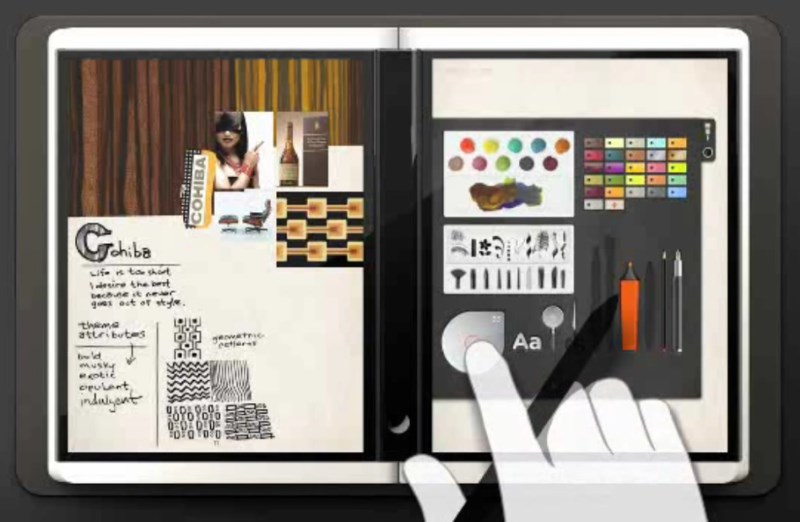
Let me just say that I love the idea of a folding phone/tablet device. I was a Courier fanboy when Microsoft floated that intriguing but abortive concept device, and I’m all for unique form factors and things that bend. But Samsung’s first real shot at a folding device is inexplicable and probably dead on arrival. I’d like to congratulate the company for trying something new, but this one needed a little more time in the oven.

I haven’t used it, of course, so this is just my uninformed opinion (provided for your edification). But this device is really weird, and not in a good way. It’s a really thick phone with big bezels around an small screen that opens up into a small tablet. No one wants that!

Think about it. Why do you want a big screen?

If it’s for media, like most people, consider that nearly all that media is widescreen now, either horizontal (YouTube and Netflix) or vertical (Instagram and Facebook). You can switch between these views at will extremely easily. Now consider that because of basic geometry, the “big” screen inside this device will likely not be able to show that media much, if any, larger than the screen on the front!

(Well, in this device’s case, maybe a little, but only because that front display’s bezel really is huge. Why do you think they turned the lights off? Look where the notification bar is!)

It’s like putting two of the tall screens next to each other. You end up with one twice as wide, but that’s pretty much what you get if you put the phone on its side. All you gain with the big screen is a whole lot of letterboxing or windowboxing. Oh, and probably about three quarters of an inch of thickness and half a pound of weight. This thing is going to be a beast.

Power users may also want a big screen for productivity: email and document handling and such is great on a big device like a Galaxy Note. Here then is opportunity for a folding tablet to excel (so to speak). You can just plain fit more words and charts and controls on there. Great! But if the phone is geared towards power users, why even have the small screen on the front anyway if any time that user wants to engage with the phone they will “open” it up? For quick responses or dismissing notifications, maybe, but who would really want that? That experience will always be inferior to the one the entire device is designed around.

I would welcome a phone that was only a book-style big internal screen, and I don’t think it would be a bother to flip it open when you want to use it. Lots of people with giant phones keep book-like covers on their devices anyway! It would be great to be able to use those square inches for the display rather than credit card slots or something.

The Courier had tons of great ideas on how to use two screens.

There are also creative ways to use the screen: left and right halves are different apps; top half is compose and bottom is keyboard; left half is inbox and right half is content; top half is media and bottom is controls and comments. Those sprang to mind faster than I could type them.

On the other hand, I can’t think of any way that a “front” display could meaningfully interact with or enhance a secondary (or is it primary?) display that will never be simultaneously visible. Presumably you’ll use one or the other at any given time, meaning you literally can’t engage the entire capability of the device.

You know what would be cool? A device like this that also used the bezel display we’ve seen on existing Galaxy devices. How cool would it be to have your phone closed like a book, but with an always-on notification strip (or two!) on the lip, telling you battery, messages, and so on? And maybe if you tapped one the device would automatically pop open physically! That would be amazing! And Samsung is absolutely the company that I’d say would make it.

Instead, they made this thing.

It’s disappointing to me not just because I don’t like the device as they’ve designed it, but because I think the inevitable failure of the phone will cool industry ambition regarding unique devices like it. That’s wrong, though! People want cool new things. But they also want them to make sense.

I’m looking forward to how this technology plays out, and I fully expect to own a folding phone some time in the next few years. But this first device seems to me like a major misstep and one that will set back that flexible future rather than advance it.

07 Nov 2018

Here’s what Samsung’s wacky folding phone looks like in action

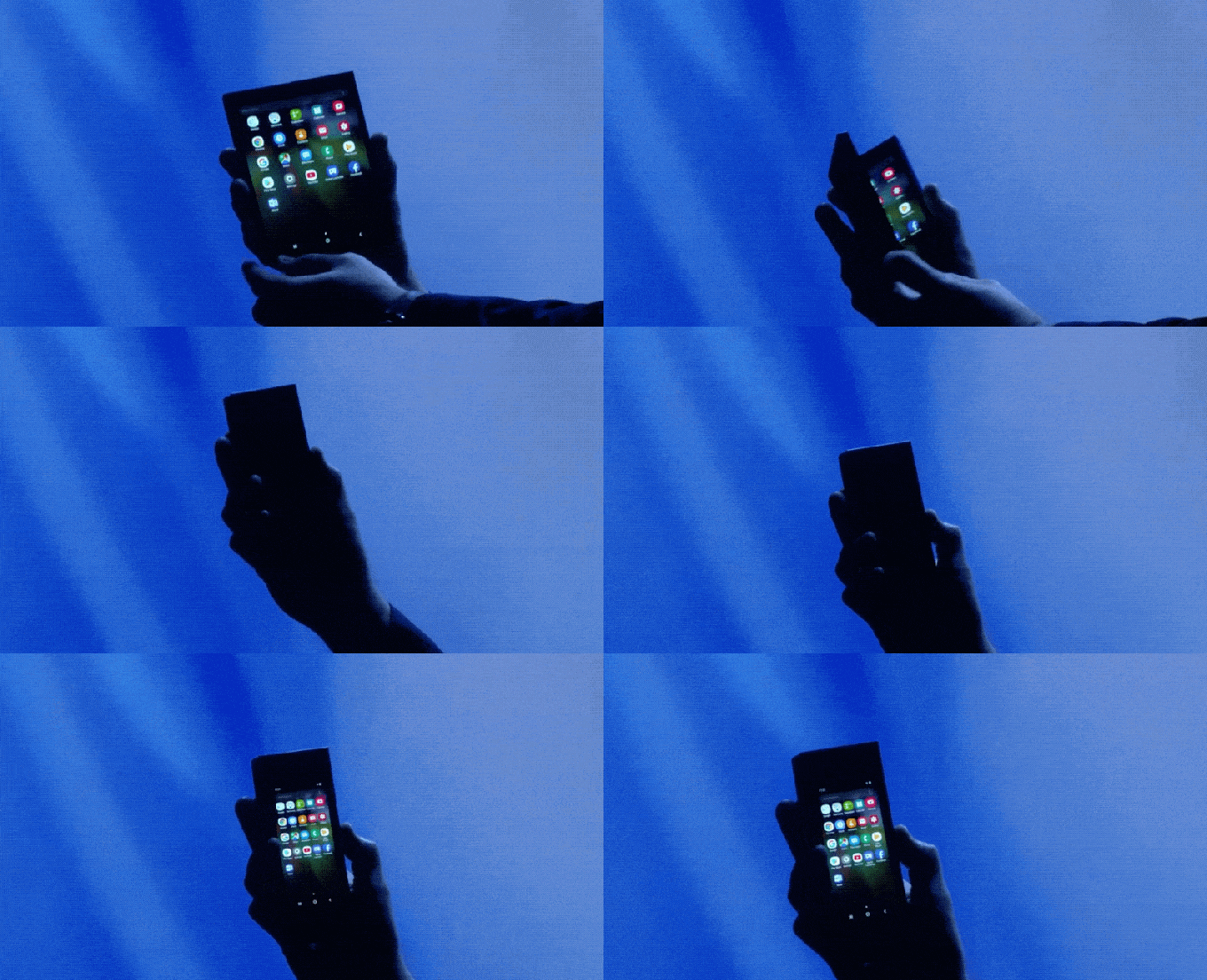
As rumored, Samsung showed off a prototype of a folding display today. Folded, it’s a smartphone. Unfolded, it’s a tablet. Neat!

Less neat: the company sort of went out of its way to not really show very much. A prototype was on stage for about 45 seconds, and it was deliberately backlit to be intensely silhouetted. They “disguised the elements of the design” to keep whatever secret sauce they have secret.

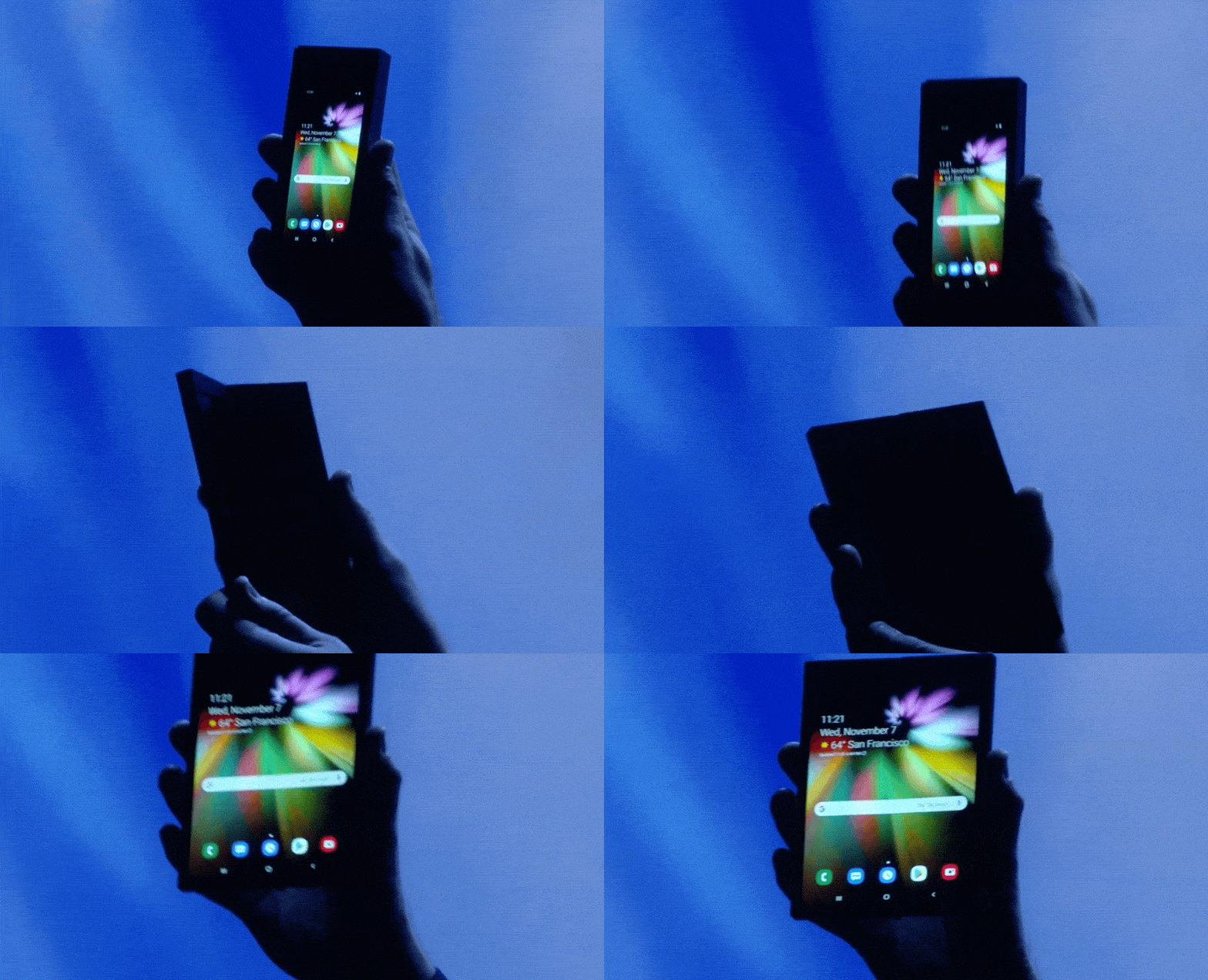
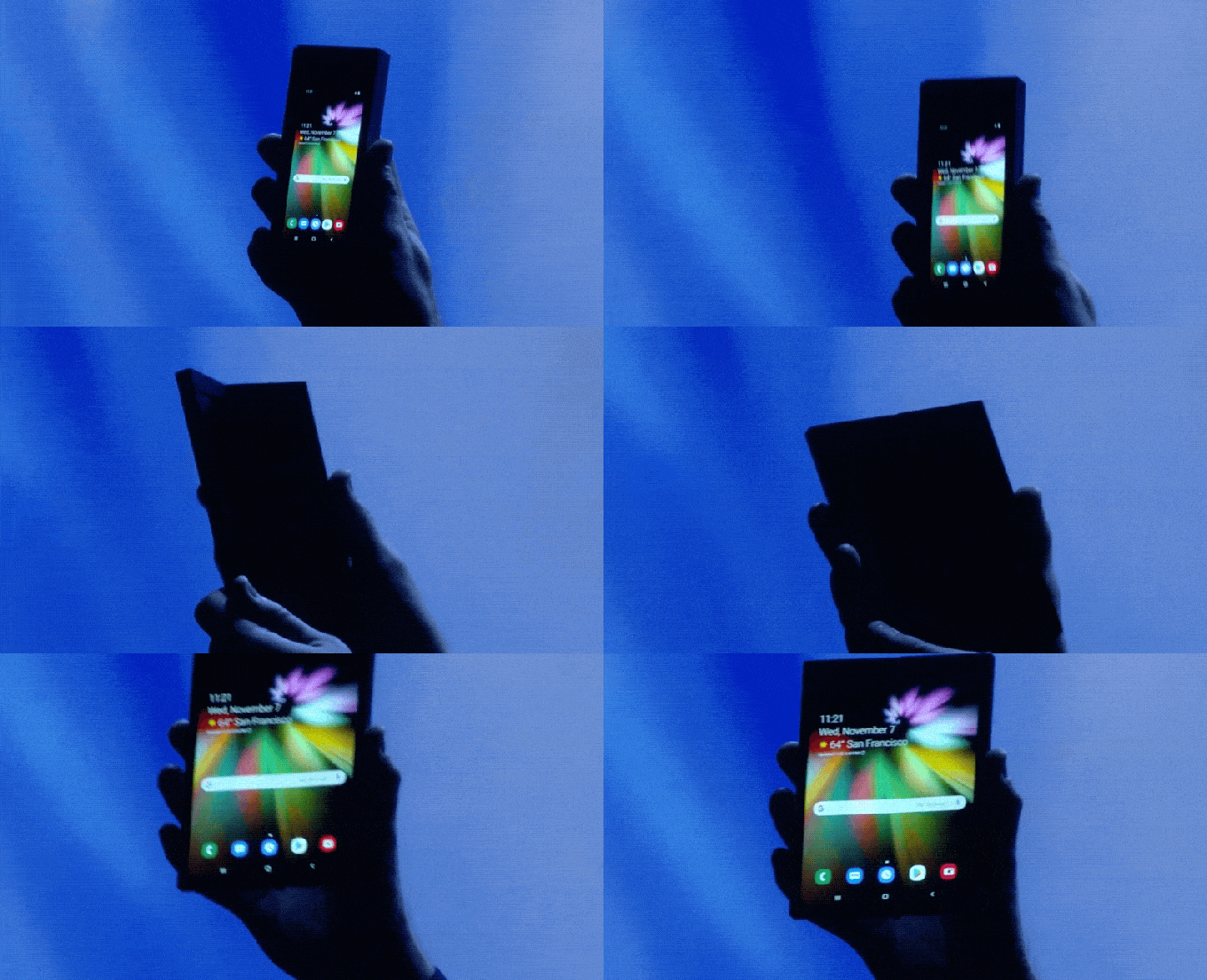
Finding that clip of the prototype folding/unfolding means digging through Samsung’s two hour developer keynote, so we went ahead and GIF’d it up for you.

Here’s what it looks like going from phone mode to tablet mode:

And from tablet mode back to a more pocket-friendly phone mode:

While this isn’t the first folding phone we’ve seen , it also won’t be the last. With Google officially adding support for folding displays into Android as of this morning, it sounds like they’ve got a reason to think a number of manufacturers are dabbling with this concept — enough of them, at least, to make it worthwhile to wire these changes into the main Android codebase.

If you want to see the relevant bit of the Samsung keynote for yourself, it starts juuuust before the 1 hour and 25 minute mark in the stream embedded below: