Year: 2018

07 Nov 2018

Ford buys electric scooter startup Spin

Ford is buying electric scooter startup Spin, Axios reports.

Spin currently operates its scooters in Coral Gables, Fla., Washington, D.C., Charlotte, N.C., Durham, N.C., Lexington, Ky., Denver, Colo., Detroit, Mich. and Long Beach, Calif. In addition to operating throughout specific cities, Spin is live on five college campuses.

Spin was one of the three companies that initially deployed its scooters in San Francisco back in March. Along with Bird and Lime, Spin was forced to remove its electric scooters from the city until the city determined a permitting process. Since failing to receive a permit to operate, Spin has been one of the more quiet scooter startups in the industry. Though, next week, Spin is meeting with the city of San Francisco to appeal the denial of its permit to operate electric scooters in the city.

As of June, Spin had a contract with electric scooter manufacturer Ninebot, owned by Segway, to purchase 30,000 scooters a month through the end of this year, according to a source. It’s not completely clear why Ford feels the need to acquire Spin — let alone any electric scooter company — instead of just forming partnerships with scooter manufacturers to launch its own service.

That same month, Spin was in the process of finalizing a $125 million security token. The idea with Spin’s security token offering is to raise money from accredited investors, who will then be entitled to a portion of the revenue from Spin’s electric scooter operations, according to a source close to Spin. With STOs, investors can buy tokens that are linked to real-world financial instruments. In the case of Spin’s offering, the tokens are linked to its revenue. Spin had previously raised $8 million in traditional venture funding.

In recent years, Ford has also purchased commuter shuttle service Chariot, as well as Autonomic and TransLoc.

In February, Spin officially entered the electric scooter space after first deploying stationless bikes in South San Francisco and Seattle. Spin had previously only operated a bike-share platform. Last August, Spin brought its stationless bike-share program to South San Francisco after launching in Seattle earlier that year. Then, in January, Spin unveiled its stationless electric bike. However, Spin is now solely focused on electric scooters, according to a source close to Spin.

Over the last year or so, shared electric scooter services have gone from being non-existent to almost everywhere, operated by nearly everyone you would and would not expect. That includes Bird, the Santa Monica-based scooter startup worth north of $2 billion, Lime, another electric scooter unicorn that recently formed a partnership with Uber, Uber’s JUMP, Boosted Board co-founder Sanjay Dastoor’s new startup Skip, Lyft and so many others.

I’ve reached out to Ford and Spin and will update this story if I hear back.
07 Nov 2018

Samsung shares a glimpse of its folding ‘Infinity Flex Display’ smartphone

After hyping its unveil of its long-rumored folding smartphone, Samsung kind of delivered an announcement, revealing a dual-screen folding phone prototype.

“How can we make the screen bigger without actually increasing the size of the device itself?” a Samsung exec posited onstage.

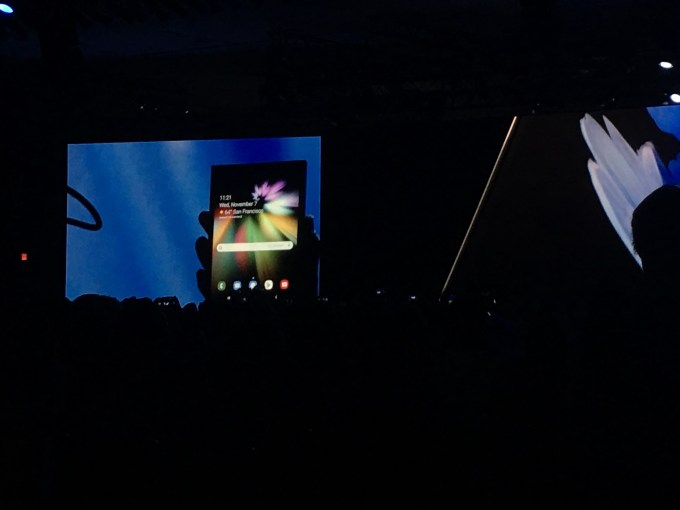
The company showcased a prototype of its “Infinity Flex Display,” a device that can be unfolded. In a pitch black room, a company exec showcased the device, which was housed in a larger case to “obscure the form factor.” There’s a conventional outer display on the front with a fairly low screen-to-body ration, but when you unfold the phone, there’s a massive 7.3″ display on the inside.

It’s a bit surprising that the folding display is on the inside of the phone rather than the outside edge, though I’m sure it’s much easier for the company to build a reliable display if the actual folding part of the screen doesn’t have to account for the entire side of the phone.

When you open the phone, your open apps will move from the front display to the tablet-sized display, functionality only possible thanks to some updates to Android.

It’s clear that despite hyping this “innovation,” Samsung isn’t quite ready to release a device of this type yet. The company says it will start mass production of the new display type in the coming months. The company teased more announcements surrounding the device at the next Samsung Unpacked event in 2019.

Whether this is the future of the phablet or not, it’s certainly an evolution of the smartphone form factor. Samsung believes that the folding display is the “foundation of the smartphone of tomorrow,” but whether there’s more beyond the gimmick certainly wasn’t clarified today.

07 Nov 2018

Netflix’s hackathon produces a way to navigate its iOS app with ARKit and Face ID

Netflix’s internal hackathons have consistently produced fun and often silly hacks, from that “Netflixtendo” hack a few years ago that let you run Netflix on the original NES to the more recent “audiobook mode” that turned Netflix series into old-school radio shows by way of Audio Descriptions. This year’s hackathon doesn’t disappoint either, with new hacks that are both as goofy and interesting as in years past, including an AR and Face ID-powered hack that lets you navigate Netflix with just your eyes, another designed for “Sharknado” fans and more.

“Jump to Shark” lets viewers skip right to the good parts of the so-bad-it’s-good “Sharknado,” so they can watch the bloody action sequences with sharks, instead of having to sit through the movie’s actual plot. It’s pretty great, as the video shows.

The AR hack, Eye Nav, is fairly impressive, too.

The hack uses Apple’s ARKit and the technology that enables Face ID for tracking eye position and facial expressions. It tracks your eye position to move a pointer around the screen, then measures the time spent on the same area to trigger a “tap.”

If you want to dismiss a screen, you can just stick your tongue out.

While the resulting hack is definitely fun, there are also implications for accessibility use cases in the future.

The hack was produced in 24 hours, so it may not be stable enough for real-world use, but it’s definitely an interesting idea.

A third hack doesn’t involve Netflix, but rather the productivity software Slack, used by Netflix employees.

“LunchBot” connects co-workers who are too busy to go to lunch, by inviting them to eat lunch together — virtually, while in a Slack chat. The app also checks everyone’s calendars to make sure they’re free.

Other hacks this year included those for product improvements, enhancements to its internal tools and some that were just for fun. A few of these were showcased in its Hackday 2018 video, such as a map for locating studio production resources, an “easy login” system and a version of Animoji using Netflix characters.

But the larger goal of Netflix’s hackathon, as you can probably tell, isn’t necessarily about creating features that will later be productized (although, c’mon…Jump to Shark!), but they sometimes serve as inspiration for features further down the road, the company says.

07 Nov 2018

Harley-Davidson bets its future on the LiveWire electric motorcycle

It’s been a four-year wait since Harley-Davidson first showed off a concept electric motorcycle. Now, the production-ready bike — called the Harley-Davidson LiveWire — is finally here. Well, almost.

The Milwaukee, Wisconsin-based company unveiled the production-ready electric motorcycle Tuesday at the EICMA motorcycle show in Italy. It won’t be available, though, until next year.

harley livewire- electric bike side

Harley is placing a big bet on electrification in hopes that it will revive the brand, which has struggled in recent years. LiveWire is supposed to be the first in what will be a portfolio of electric Harley-Davidson motorcycles that will be available by 2022.

To encourage the switch to electric, Harley will install Level 2 public chargers at dealer locations that sell the electric bikes.

Harley didn’t release pricing or range and performance information on LiveWire. There were some new (and of course some rehashed) details on the specs of the bike though.

The bike will be powered by a permanent magnet electric motor that is located low in the motorcycle to lower the center of gravity and improve handling at different speeds and make it easier to control when stopped, the company said. The LiveWire will have two batteries: the main battery, composed of lithium-ion cells surrounded by a finned, cast-aluminum housing, and a small 12-volt lithium-ion battery that powers the lights, controls, horn and instrument display.

harley livewire battery

The bike can be charged with a Level 1 charger that plugs into a standard household outlet with a power cord that stores below the motorcycle seat. For faster charging, it can also be charged via Level 2 and Level 3, or DC Fast Charge (DCFC), through a SAE J1772 connector in the U.S., or CCS2 – IEC type 2 charging connector in international markets. 

LiveWire will have seven riding modes, three of which are rider-defined. The modes will be tuned with adjustable high-specification Showa suspension. The bike will also have an adjustable color touchscreen display located above the handlebar. The screen gives riders access to the interface for Bluetooth connectivity, navigation, music and other features.

The bike won’t have that trademark gas-powered sound, so Harley has given it a tone that will increase in pitch and volume with speed. The company says the new sound “represents the smooth, electric power of the LiveWire motorcycle.”

harley livewire electric motorycycle

The bike is fitted with Brembo Monoblock front-brake calipers gripping dual 300 mm-diameter discs. It also has an anti-lock braking system and traction control system, which will come standard.

The company says it will reveal more product information on LiveWire, as well as details about the pre-ordering process, in January 2019.

07 Nov 2018

With a new deal for customers and a fresh $23 million, Mayvenn extends its hair care business

Pitching customers a new, all-inclusive service for buying and installing hair, Mayvenn is looking to significantly expand its haircare business and just raised $23 million in a new round of funding to do it.

The new financing was led by Essence Ventures — and it represents the first outside investment by the  holding company owned by serial entrepreneur Richelieu Dennis .

A millionaire many times over, Dennis was the founder and chief executive of SunDial brands — a line of skin and haircare products which sold to Unilever for $240 million. He used that exit to create Essence Ventures with the acquisition of Essence magazine from Time Inc. and has now, with Mayvenn, is working to create a media and investment powerhouse.

Dennis joins a clutch of celebrity investors and venture capital firms in backing Mayvenn. Previous investors include Andreessen Horowitz, Cross Culture Ventures, Trinity Ventures along with a clutch of super famous athletes and music moguls like Serena Williams, Andre Iguodala, and Jimmy Iovine.

Dennis says the new capital infusion for Mayvenn is a testament to the vision of its founder and chief executive Diishan Imira.

Diishan’s vision is very big,” Dennis said. “He’s building a platform to service a space and a consumer that has not been served and certainly not in this way.”

With the new cash in hand Mayvenn is going to market with a new value proposition for its network of stylists and their customers. Before, Mayvenn would sell hair direct to consumers and then provide those consumers with a marketplace of stylists that would install the hair.

That’s a costly proposition for customers who can spend as much as $250 for the hair and another $250 for the service.

Now, Mayvenn is going to make it so customers can buy the hair directly from the company, and Mayvenn will match that customer with a hair stylist who will install the hair. All for the cost of the hair itself

“Customers will be able to buy hair and the installation service for probably 40% less than what they normally would have paid,” says Imira.

Imira first got started selling hair while he was living overseas in Shenzhen in Shanghai from 2003 to 2005. A world traveler who has spent time in Brazil, Ethiopia, France, Japan and China, Imira always had an entrepreneurial spirit, but it was after his stint in business school that he returned to Oakland with the idea for Mayvenn.

The company was accelerated through 500 Startups in 2013 and before that Imira was buying and selling hair for relatives who worked at salons and barbershops.

“I’m just a kid from Oakland selling hair out of the trunk of my car,” Imira says, laughing. “I always saw these barbershops and hair salons as points of commercial distribution. When I started selling hair i said, ‘This is crazy. How come you guys are not making any money off of selling this product?'”

There are $6 billion worth of haircare products sold in the African American community annually and Mayvenn is grabbing an increasingly larger share of that pie since its launch. Imira says the company has done $80 million in revenue in the five years since it graduated from 500 Startups. And the company has paid out over $20 million in commissions to its hairstylists.

Mayvenn chief executive officer Diishan Imira

“Now we really want to increase that number. Our number one metric is that number. How much are we paying hair stylists?” Imira says.

For Imira, Mayvenn is about developing entrepreneurial talent from within the black community. “Black women are buying $9 billion of hair products in general and they’re buying it from these corner stores and 90% of those are owned by people not in the community,” he says. “All of those dollars flow out of the community and nobody is getting a piece.”

With its new offering, Mayvenn is giving more money back to consumers, getting more money out to stylists and cutting the middleman out of the equation,” he says.

Along with co-founder Taylor Wang, who serves as the company’s chief operating officer, Imira says Mayvenn has built a business whose only real online competitor is the Chinese wholesale service AliExpress.

Indeed, what separates Mayvenn fom the other startups that are trying to sell hair and beauty products directly to consumers is the network of stylists that the company has built.

“The biggest competitor for selling direct to consumers is AliExpress,” and now, with its network and the ability to combine products and services at a wider scale, Mayvenn can provide better service for less, Imira says. “They can’t bundle the hair with the service. We can take the margin out of the hair we can bundle the package. We can be more price competitive than AliExpress and give you better hair and better service.”


07 Nov 2018

Google is adding Android support for foldable screens

Big day for developer events. As Samsung was onstage getting ready to talk about its upcoming foldable phone, Google spilled the beans a bit at its own Android Developer Summit. The company briefly detailed plans to bake support for folding phones into the mobile operating system.

Support for the nascent technology is going to be tough, given what’s expected to be a variety of different form factors, so Google’s been working with hardware partners. Its first, naturally, is Samsung. The two companies have been working closely on a device it plans to launch “early next year,” according to Google. That device is expected to debut moments from now on Samsung’s own stage.

Google is referring to the category as “Foldables.”

“You can think of the device as both a phone and a tablet,” Android VP of Engineering Dave Burke explained. “Broadly, there are two variants — two-screen devices and one-screen devices. When folded, it looks like a phone, fitting in your pocket or purse. The defining feature for this form factor is something we call screen continuity.”

Among the additions here is the ability to flag the app to respond to the screen as it folds and unfolds — the effect would likely be similar to the response of applications as handsets switch between portrait and landscape modes.

While Samsung’s is the most prominent, the company’s Foldable isn’t expected to be the first to market. That honor will likely go to Royole’s FlexPai device, though that handset has already been knocked for build quality ahead of launch. Whatever the case, Samsung’s certainly not going to be alone here, but it will almost certainly be a market leader.

07 Nov 2018

Samsung opens its Bixby assistant to developers

Samsung has been suffering through a lot of catch-up in the voice assistant race, but at its annual developer conference the company placed a major emphasis on how it’s expanding the scale and effectiveness of its Bixby assistant.

The company announced that Bixby would be coming to more devices and more languages with third-party developers finally gaining access to building functionality for the AI assistant.

“For the first time we are opening Bixby to all of you, our developers,” Samsung EVP Eui-Suk Chung announced onstage.

The company is pledging to bring the assistant to watches, refrigerators, tablets, washing machines and more, and in the coming months will be adding support for five additional languages. While these promises seemed to sit a bit further down the line, the company was ready to talk about their Bixby developer kit during the keynote.

The company announced the release of the Bixby Developer Studio, a set of dev tools that’s “way ahead of the other guys,” Viv Labs CEO/ Siri co-founder Dag Kittlaus told the crowd. The company will also be introducing Bixby Marketplace, a home for users to discover the new functionality of their voice assistant.

Bixby may have a long road ahead to catch up with other companies, but third-party integrations are something that none of the major voice assistant platforms have nailed. If Samsung can continue to invest in the platform and court developers with sophisticated tools, they may have better luck in gaining third-party integrations that feel more ancillary.

07 Nov 2018

Android developers can now force users to update their apps

At its Android Dev Summit, Google today announced a number of new tools and features for developers that write apps for its mobile operating system. Some of those are no surprise, including support for the latest release of the Kotlin language, which is becoming increasingly popular in the Android developer ecosystem, as well as new features for the Android Jetpack tools and APIs, as well as the Android Studio IDE. The biggest surprise, though, is likely the launch of the In-app Updates API.

While the name doesn’t exactly make it sound like a break-through feature, it’s actually a big deal. With this new API, developers now get two new ways to push users to update their app.

“This is something that developers have asked us for a long time is — say you own an app and you want to make sure the user is running the latest version,” Google senior director for Android product management and developer relations Stephanie Saad Cuthbertson told me. “This is something developers really fret.”

Say you shipped your application with a major bug (it happens…) and want to make sure that every user upgrades immediately; you will soon be able to show them a full-screen blocking message that will be displayed when they first start the app again and while the update is applied. That’s obviously only meant for major bugs. The second option allows for more flexibility and allows the user to continue using the app while the update is downloaded. Developers can fully customize these update flows.

Right now, the new updates API is in early testing with a few partners and the plan is to open it to more developers soon.

As Cuthbertson stressed, the team’s focus in recent years has been on giving developers what they want. The poster child for that, she noted, is the Kotlin languages. “It wasn’t a Google-designed language and maybe not the obvious choice — but it really was the best choice,” she told me. “When you look at the past several years, you can really see an investment that started with the IDE. It’s actually only five years old and since then, we’ve been building it out, completely based on developer feedback.”

Today, the company announced that 46 percent of professional developers now use Kotlin and more than 118,000 new Kotlin projects were started in Android Studio in the last month alone (and that’s just from users who opt in to share metrics with Google), so that investment is definitely paying off.
One thing developers have lately been complaining about, though, is that build times in Android Studio have slowed down. “What we saw internally was that build times are getting faster, but what we heard from developers externally is that they are getting slower,” Cuthbertson said. “So we started benchmarking, both internally in controlled circumstances, but also for anybody who opted in, we started benchmarking the whole ecosystem.” What the team found was that Gradle, the core of the Android Studio build system, is getting a lot faster, but the system and platform you build on also has a major impact. Cuthbertson noted that the Spectre and Meltdown fixes had a major impact on Windows and Linux users, for example, as do custom plugins. So going forward, the team is building new profiling and analysis tools to allow developers to get more insights into their build times and Google will build more of its own plugins to accelerate performance.

Most of this isn’t in the current Android Studio 3.3 beta yet (and beta 3 of version 3.3 is launching today, too), but one thing Android Studio users will likely be happy to hear is that Chrome OS will get official support for the IDE early next year, using Chrome OS’s new ability to run Linux applications.

Other updates the company announced today are new Jetpack Architecture Component libraries for Navigation and Work Manager, making it easier for developers to add Android’s navigation principles into their apps and perform background tasks without having to write a lot of boilerplate code. Android App Bundles, which allow developers to modularize their applications and ship parts of them on demand, are also getting some updates, as are Instant Apps, which users can run without installing them. Using web URLs for Instant Apps is now optional and building them in Android Studio has become easier.

07 Nov 2018

Flickr says it won’t delete Creative Commons photos

Flickr will spare both the Flickr Commons and Creative Commons photos from deletion, the now SmugMug-owned company announced today. However, its new storage limitations on free accounts may impact its use as a home for photos with a Creative Commons license in the future.

When the company unveiled its big revamp last week, one of the immediate concerns among users was what the changes meant for the Creative Commons photos hosted on Flickr.

Under its new management, Flickr decided to stop offering free users a terabyte of storage, and instead will begin charging users who want to host more than 1,000 photos on its site. Users with more than 1,000 photos either had to choose to upgrade to a Pro account to retain those photos on the site, or see them deleted.

Ryan Merkley, CEO at Creative Commons, expressed some concern last week over what this meant for the millions of CC images hosted on Flickr.

Would they be gone, too?

Flickr today says the answer is “no.”

It vows not to delete either its own Flickr Commons archive or any photos uploaded with a Creative Commons license before November 1, 2018.

The Flickr Commons is a resource consisting of photos from institutions that want to share their digital collections with the world, such as NASA, the National Parks Service, the UK National Archives, and The British Library, for example. These organizations were either already Pro account holders or have now received a free Pro account from Flickr, the company says.

If any of these photos disappear from Flickr, it will be because the organization itself chose to delete them.

Meanwhile, any photos (or videos) licensed before November 1, will also remain, even if the photographer has more than 1,000 under their account. But users who want to continue to upload photos – Creative Commons or otherwise – past the 1,000 mark going forward will have to upgrade to a Pro account.

Flickr is also carving out an exception for non-profits  – aka 501(c)(3) charitable organizations – to offer them free storage, like SmugMug does. It’s already working with the United Nations Children’s Fund (UNICEF), 350.org, and Second Harvest, on this front.

“Freely licensed photos are deeply important to us. After SmugMug acquired Flickr, one of the first meetings we had was with Ryan Merkley, the CEO of Creative Commons. We want to keep that partnership alive and strong, and we are actively working on how to grow it for the future,” wrote SmugMug CEO Don MacAskill in a blog post. 

However, the move to limit free storage on any uploads, including CC photos, could impact Flickr’s use as a home to this sort of content in the future.

It’s possible that some photographers will opt for another service like 500px’s $3.99/month tier with unlimited uploads, instead of Flickr’s $5.99/month Pro plan. Or perhaps, they’ll publish photos in public albums on Google Photos, under one of its affordable TB plans or on newcomer Unsplash’s website, where they’re licensed under its own free-to-use license type. Or maybe they’ll just host photos on their own sites instead.

Merkley, however, promises to focus on continuing to grow the Commons and finding solutions.

“We’ll be working with Flickr to look for ways to continue growing and archiving the commons,” Merkley said. “When Flickr users apply CC licenses to their works, they are inviting everyone to use their works freely and with very few restrictions. That’s an incredible gift to the world, and that generosity should be acknowledged and preserved into perpetuity for everyone to enjoy,” he said.


07 Nov 2018

CircleCI launches Orbs, a package manager for software delivery automation

DevOps platform CircleCI today announced a new partner program that will open up its platform and allow third-party tools to integrate with it. In addition, the company is launching Orbs, which it describes as “the world’s first package manager designed specifically for configuration of software delivery automation.”

Fresh off its $31 million funding round earlier this year, CircleCI is clearly on a mission to firmly plant its stake in the increasingly competitive continuous integration and delivery space. Its launch partners today include the likes of Cypress, JFrog, Pulumi, Sauce Labs, Sonatype and WhiteSource.

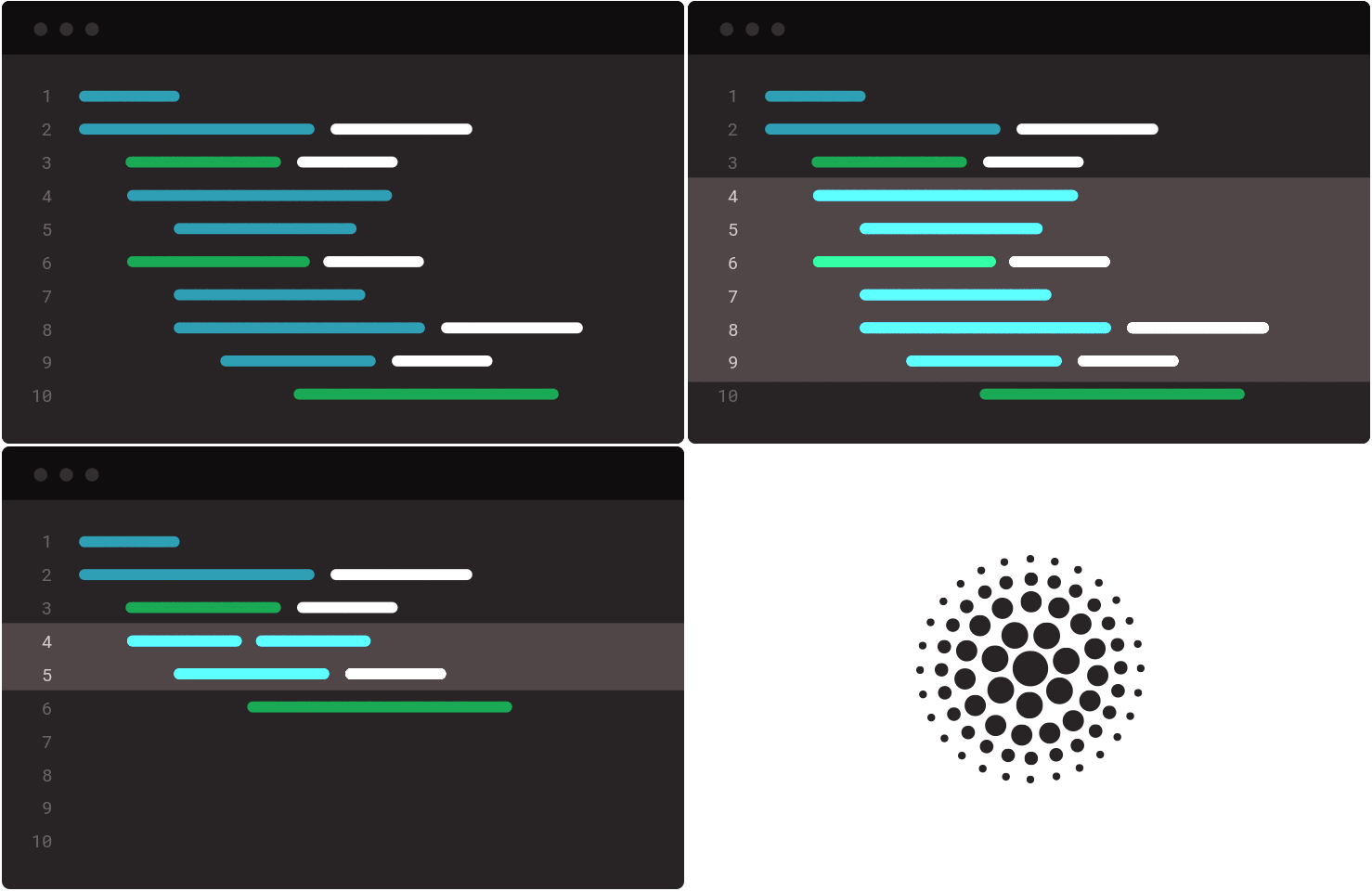
That partner program, though, mostly sets the stage for Orbs. The idea behind Orbs is to give the company’s users the ability to share their preferred CI/CD configuration across teams and projects by allowing them to package their commands, executors and jobs into a few lines of code. It’s basically a way to allow teams to automate more of their build/test/deploy workflow and share their best practices for configuring their software pipelines. For new users, these Orbs will also make it easier to get started without having to write a lot of boilerplate code.
CircleCI will offer its own set of certified Orbs, as well as those written by its partners. Currently, there are Orbs for working with Heroku and Amazon’s S3 and CodeDeploy, for example, as well as the obligatory Slack notification Orb. In total, CircleCI is launching 25 packages today.

“CircleCI Orbs are the most exciting thing in the CI world since Docker containers,” said Gleb Bahmutov, VP of Engineering at Cypress and an early-access orbs customer and contributor. “From a developer’s standpoint, orbs are a much-needed improvement from the regular ‘read the docs, copy/paste example, tweak for 30 minutes until CI passes’ — an outdated workflow. It’s an absolutely incredible experience.”