
Year: 2018

07 Nov 2018

The cost of energy storage has stalled adoption of renewable power. Energy Vault has a solution.

Since solar and wind power are now cheaper to produce than energy from fossil fuels, the only obstacle that remains to the mass adoption of renewable power is the amount of money utilities need to spend to store the energy those systems produce.

Right now, storing 100 megawatts of renewable energy (enough to power roughly 600,000 homes) means spending roughly $65.6 million on massive batteries like the kind made by Tesla, or relying on huge pumped hydro-electric storage projects that essentially create man-made dams where the release of water spins turbines to generate energy (those projects are typically far larger than 100 megawatts).

A new company called Energy Vault, launched from Bill Gross’ Idealab incubator in Pasadena, Calif., has developed a technology, based on the principles of pumped hydro storage, that it claims can slash the cost of energy storage to a fraction of the current price and make renewable energy cost-effective all day, every day. 

As climate change worries mount, finding a solution that can make renewables even more compelling and cost effective isn’t just a good business — it’s a global priority.

Energy Vault’s technology consists of a 33 story high, six-armed crane with booms extending to nearly the length of a football field (about 87 yards). That crane is surrounded by 5,000 huge cement blocks weighing roughly 35 metric tons (or around 172,000 pounds).

“These would typically be built out near wind farms or solar plants,” said Piconi. “This is not something that you’d drop in the middle of the city.”

The cranes are controlled by a software system that manages the movement of the cement blocks to either store the energy generated by solar or wind farms, or discharge that energy onto the power grid.

According to Robert Piconi, the chief executive of Energy Vault, each of the company’s systems will have 35 megawatt hours of nominal energy capacity and 4 megawatts of peak power capacity. Ramp times occur in as little as a millisecond with 100 percent power achieved in 2.9 seconds.

The systems have roundtrip efficiencies of roughly 90 percent and there’s no energy loss since the technology relies on mechanical energy from incredibly durable materials that have a roughly 30-year lifetime.

And all of this at a price tag of around $7 million to $8 million per system, according to Piconi. What makes the system even more sustainable, according to Piconi, is the use of recycled cement that was only going to be landfilled — instead of new cement construction.

Energy Vault has already set up a demonstration system in Biasca, Switzerland, next to the company’s Lugarno headquarters. That demonstration plant likely had a role in the company’s ability to sign up a clutch of initial customers including The Tata Power Company Limited, India’s largest integrated power company, to deploy an initial 35 MWh Energy Vault system by 2019. 

“Innovation in energy storage represents the largest and most near term opportunity to accelerate renewable deployments and bring us closer to replacing fossil fuels as the primary source to meet the world’s continual growth in energy demand”, said Bill Gross, co-founder, Energy Vault and founder, Idealab.  “We’re excited to support Energy Vault in bringing this groundbreaking technology to the market.”

Indeed, over the next two years, Energy Vault expects customers to build between 500 megawatts and one gigawatt of storage capacity using its systems, according to Piconi.

“We have customers on every continent to build these units,” he said. 

Piconi, a former Danaher executive, met Gross twelve years ago as the idealab founder was beginning his push into renewable energy technologies. The two men stayed in touch and began seriously contemplating the creation of Energy Vault after nearly a decade of collaboration and contact.

It was back in 2017 that Piconi, Gross, and fellow co-founder and chief technical officer Andrea Pedretti hit upon the idea for Energy Vault’s novel approach to energy storage.

“It became clear to him a few years ago how important storage was going to be,” said Piconi. 

The three men started looking at the efficiencies available through pumped hydroelectric storage, and began brainstorming ways to mimic that process using mechanical energy. “We looked at a steel tower first, but that was too expensive. We thought about water in a tower pumped up, but there were efficiency issues there,” Piconi said. “Then we got to the concrete bricks and the crane.”

The concrete was important for the cost of materials, and because of the energy intensity and pollution that’s involved with manufacturing cement, the team decided to use recycled cement to make the blocks that its energy storage system would use.

Enter, Cemex, one of the largest cement manufacturers in the world, which has joined with Energy Vault as a partner.

Energy Vault has already raised capital through several “seed” rounds to develop its technology and get the prototype in Switzerland up and running.

“Energy Vault’s team has developed a disruptive platform, and we are enthusiastic to work with their team to deploy an environmentally efficient and cost-effective energy storage solution that is highly viable,” said Dr. Davide Zampini, Head of CEMEX Global R&D and IP. “We share a common commitment to enable a future where resources are used responsibly, which is paramount to CEMEX’s strategy for sustainable development.”

07 Nov 2018

Instacart expands a pickup option for grocery orders across the US

Online grocery delivery service Instacart has expanded the availability of a ‘click and collect’ pickup service it’s been trialing for a few months in the U.S. — now offering it in stores across the nation.

It says the collect in person Instacart Pickup option is now available in nearly 200 stores — across 25 “key markets” near Atlanta, Boston, Charlotte, Minneapolis, Nashville, San Francisco, and Washington D.C.

The Pickup service is intended to offer customers more flexibility by letting them choose a time to drive by and grab their groceries, rather than wait in for a delivery.

Customers are offered a range of partner stores to choose for collecting their order. While pick ups can be made on the same day.

Instacart says it’s expanded its partnerships for the now expanded Pickup service — saying it’s working with the likes of ALDI, Cub Foods, Food Lion, Price Chopper, Publix, Schnucks, Smart & Final, Sprouts, Tops Friendly Markets and Wegmans.

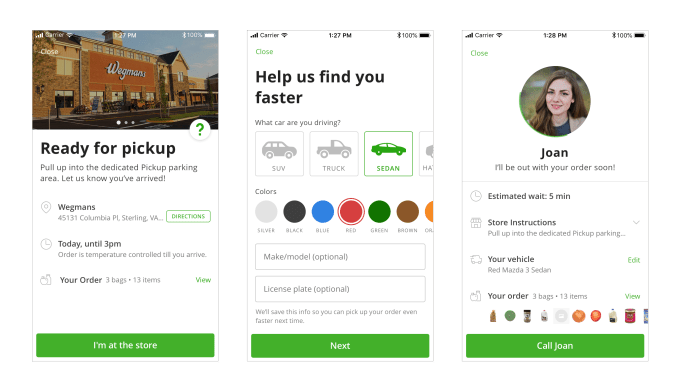
To access the Pickup service, customers can use Instacart’s website or mobile app, selecting their city and store. After they add groceries to their cart they get to choose either a delivery window or pickup window before they check out.

If picking up, they’ll get an in-app notification when their groceries are ready to collect.

But that’s not the end of the process; Pickup customers are supposed to send an in-app notification to their Instacart personal shopper to let them know they’re on the way.

Then, once they arrive, Instacart says one of its shoppers or a retailer employee will bring the groceries out to their car. Assuming the car has been described accurately enough in the app…

Instacart says the service is free for its Express members.

For non-members there is a cost involved — though Instacart says this is lower relative to paying for delivery (which also varies depending on factors like location/time of day etc). The Pickup cost can also vary depending on the retail partner selected.

For its main grocery delivery service, Instacart says it’s currently accessible to more than 70% of U.S. households, in all 50 states, and more than 50% of Canadian households — available in more than 15,000 different grocery stores across 4,000 cities overall.

While it has partnerships with more than 300 retailers at this point.

On the gig economy side, its service is powered by some 70,000 personal shoppers.

07 Nov 2018

This tiny house grows with your family

Tiny houses are all the rage but once you put more than a few people in one you have a problem: Where can you go from there?

Nowhere. Exactly.

What you do is, if you need that extra push over the cliff, you know what you do? Talk to Brian Gaudio. Gaudio is the founder of Module Housing, an incremental building startup from Pittsburgh. Gaudio, formerly of Walt Disney Imagineering, has an architecture background and saw firsthand the need for incremental housing in his work in Biloxi and Latin America. His idea is simple: create a little house that grows with you over time, allowing a single room to turn into a mansion with a few turns of a wrench.

“We think of the home as a recurring revenue stream – buy a starter home today, purchase additions and upgrades in the future. All our homes are designed to change over time – as a homebuyers family grows, income grows, or needs change,” he said. “We are capital light compared to other prefab startups in that we don’t own the manufacturing facilities where our homes are built. We leverage existing network of high-performance prefab manufacturers on the east coast.”

The service does it all: they offer multiple room dwellings and work with you to order the modules, find land that lets you add on over time, and assemble the houses. Like the Craftsman houses of old, you have a few basic styles but in this case you can buy a one bedroom Nook house for $212,000 and then add on over time instead of buying a house with seven rooms and realizing you only needed two.

Additional costs include building a foundation and land preparation. It’s also dead easy to add onto your house when your ready, said Gaudio, thanks to work they’ve done in modularizing the houses.

“We have patents pending on a removable roof and wall system that simplifies the addition process when a customer is ready to add-on,” he said.

The company raised $1.2 million so far and they have prototype houses in Pittsburgh. They already have orders and they’ve created a Tesla-like reservation system for the folks who want to try out their product.

“I moved back to Pittsburgh to start Module with the goal of making good design accessible to everyone,” he said. “Affordable housing is one of the most critical issues our country faces today. Module is a vehicle to promote responsible, equitable development in cities. We are reimagining housing to be more sustainable, adaptable, and better designed.”

07 Nov 2018

Brooklinen launches a pop-up shop in NYC

Brooklinen, the direct-to-consumer bed linens brand, has today announced the opening of a four-month pop-up shop in NYC.

The company has been around for four years thus far, and recently hit $100 million in revenue after raising just $10 million in funding.

Part of the company’s success comes down to its attention to detail. The process of shopping for sheets is often difficult for new adults who don’t understand how to weigh quality and price, and usually don’t get much help in stores like Bed Bath & Beyond.

Brooklinen isn’t necessarily inexpensive — 270 thread count sheets start at $129 for a queen, and 480 thread count sheets start at $149 for a queen — but the process of purchasing quality sheets is leaps and bounds more convenient. Brooklinen handles fulfillment, including the packaging, and has invested in customer service to ensure that there are no hiccups from the point of purchase to the point of making the bed.

Moreover, Brooklinen has designed many of their sheets to easily mix and match with other sets, creating an environment that begs for repeat purchases.

That said, there are still customers who either need the instant gratification of a purchase or to touch and feel the product before converting. Which is why Brooklinen is launching the pop-up shop on Spring Street in Soho.

Cofounder and CEO Rich Fulop explained to TechCrunch that the timing of the pop-up was very intentional.


“We’re doing a four-month pop-up to learn as much as we can and talk to customers,” said Fulop. “We understand that shopping picks up ahead of the holidays, so we set it up to go through the holidays and then into the slower time following the holidays. We want to see the difference between holiday season and through to February so we don’t get a false positive in terms of the model.”

Interestingly, Brooklinen is opting to hold inventory in the store so that purchasing customers can take home their wares. Many pop-up shops offer portals to purchase items and have them shipped as opposed to holding inventory. The company wants to capitalize on any customer who’s flirting with the idea of purchasing and believes holding inventory is the best way to do that.

However, Brooklinen expressed no interest in going the wholesale route, selling inventory to other retailers. Controlling every step of the process, from design all the way to fulfillment, is part of what makes Brooklinen successful, according to the founders.

The 2,000 square-foot space is at 119 Spring St and officially opens on Friday.

07 Nov 2018

Anti-fraud startup Fraugster score $14M Series B

Fraugster, the Berlin-based startup that uses artificial intelligence to prevent fraud for online retailers, has raised $14 million in a Series B funding. The round is led by CommerzVentures, the venture capital subsidiary of Commerzbank, alongside early Fraugster investors Earlybird, Speedinvest, Seedcamp, and Rancilio Cube.

Notably, Munich Re/HSB Ventures, the VC arm of global reinsurer Munich Re, also participated in the round. That’s because Munich Re is insuring Fraugster’s “Fraud Free” product, which takes on the full liability for each transaction to ensure retailers utilising Fraugster’s fraud detection technology never lose out — a sign that the company is pretty confident in its machine learning.

Selling its wares to payments companies — including Ingenico ePayments, and Six Payments — the Fraugster AI technology takes data from multiple sources, analyses and cross-checks it in a fraction of a second, to determine whether a transaction is fraudulent or not.

The idea isn’t just to block any potential fraud, which rules-based systems can already do, but to actually let more transactions through. That’s because false-positives (ie accidentally preventing perfectly valid purchases) is the real bane of the industry.

Citing industry average stats of false positives, Fraugster CEO and co-founder CEO Max Laemmle tells me that for every dollar lost to fraud, $17 is lost through transactions that are wrongly turned down, leading to lower revenues for merchants. He says that Fraugster’s technology has already got that down to $2.

Meanwhile, the anti-fraud startup says it will use the new funds to continue expansion into new markets. This includes the U.S., Asia and Europe, where retailers are facing “an accelerating battle against fraud”.

07 Nov 2018

Storyblocks makes it easier for developers to integrate its stock media services

Storyblocks, formerly known as Videoblocks, is a stock media service that offers videos, images and audio for creatives. One feature that always made it stand out from the competition is its flat-rate model that gives you unlimited access to all of the media files in its library (though there’s also a pay-as-you-go marketplace). Last year, Storyblocks started making similar flat-rate deals with developers who wanted to integrate its library into their own creative applications. Those were pretty bespoke integrations, but starting today, developers will be able to take the Storyblocks library for a test drive and try it in their apps without having to pay a fee or talk to a salesperson.

The new Storyblocks developer portal, which is launching today, allows developers to generate an API key, integrate the Storyblocks API and then, when they are ready, talk to the company to set up a commercial partnership. Developers who want to integrate the service will get full access to the Storyblocks library and since they are paying the flat fee for that service, users won’t have to get a Storyblocks account or worry about the licensing.

Many of the developers who would most likely be interested in using this service likely find themselves in competition with Adobe, which offers a rich set of creative tools and an integration with its own Adobe Stock service. With the Storyblocks API, developers will be able to offer similar integrations to their users, something Storyblocks CEO TJ Leonard also acknowledged when I talked to him ahead of today’s announcement.

“You’ve got the changing profile of the content creator and they are demanding a more integrated workflow,” he said. “You’re seeing that materialize as Adobe Stock is integrated with Premiere and Photoshop — and Adobe launching [its new video editor] Rush. These are all about producing shorter form content, distributing it quickly, but also without lowering the bar on the overall quality.” Leonard believes that what he described as “closed ecosystems” will own a large portion of the market, but he obviously also believes that there is room for a player like Storyblocks to offer an alternative. And indeed, Leonard told me that API access already drives a double-digit amount of revenue for Storyblocks right now and unsurprisingly, he expects that number to go up over time.


07 Nov 2018

WeChat reaches 1M mini programs, half the size of Apple’s App Store

They may not be widely known outside of China, but Tencent’s mini program initiative to develop ‘apps’ that live outside of app stores is bearing fruit after it clocked two notable landmarks: 200 million daily users and one million apps.

In recent years, Tencent’s WeChat messaging app has blossomed into a universe of its own with a myriad of services that span from food delivery to getting loans. But the Chinese messaging app wants to lock users in for longer — and its mini program scheme appears to show promise.

Back in January 2017, Tencent introduced “mini programs,” which are essentially lightweight apps that run inside WeChat. When you need to hail a cab, for example, instead of downloading the standalone Didi Chuxing app, you can summon its mini program on WeChat in the blink of an eye.

WeChat has now clocked over one million such mini programs, Tencent founder and CEO Pony Ma revealed today at the World Internet Conference in Wuzhen, China. That makes its ecosystem half the size of the Apple App Store, which recorded 2.1 million apps in April.

Meanwhile, 200 million users are active on WeChat mini programs every day. That’s an impressive number when you consider that China has a total of 800 million internet users.

Feel like shopping on JD.com but don’t have the app installed? Simply pull up its WeChat mini program

Developers of all kinds rush to mini programs as they covet WeChat’s one billion monthly active users worldwide. Furthermore, they can be cheaper and easier to build compared to native apps, making them ideal for low-budget startups, independent game developers, or services that lack a substantial reach in general.

But they can always be useful for tech’s biggest names. That includes e-commerce titan JD.com, second in China to Alibaba with over 300 million annual users and local services giant Meituan Dianping, which has over 350 million annual users. Both operate mini apps on WeChat.

But these slimmer apps don’t always work for everyone. Leisure games have proven to be equally sticky on both app systems, but other more heavyweight apps, such as JD, see a mere 18.2-day user retention rate on WeChat, according to research firm QuestMobile. That’s dwarfed by 53.4 percent on JD’s full-fledge app.

That discrepancy is partly a result of size. As their names imply, mini programs allow files up to only 2MB. They load faster than native apps – which means users may tend to reinstall them in the future – but they also compromise certain features which could undermine user experience.

Of the hundreds of app verticals, games take up 28 percent of all mini programs, followed by life services and ecommerce, according to QuestMobile.

For WeChat, mini programs have much promise. They’ve been an important driver for the social giant’s growing DAUs and advertising revenues, said the firm in its most recent Q2 earnings report.

Other tech giants have climbed on the mini-program bandwagon, with Alibaba and Baidu both rolling out their own versions of mini programs on their major apps over the past few months but Tencent, the originator, has developed the strongest community.

07 Nov 2018

Monashees raises $150 million for its eighth Latin American fund

As technology investment and exits continue to rise across Brazil, early stage venture capital firm monashees today announced that it has closed on $150 million for its eighth investment fund.

Commitments came from Temasek, the sovereign wealth fund affiliated with the Singaporean government, China’s financial technology company, CreditEase; Instagram co-founder Mike Krieger, the University of Minnesota endowment; and fund-of-funds investor Horsley Bridge Partners.

S-Cubed Capital, the family office of former Sequoia Capital partner, Mark Stevens, and fifteen high net worth Brazilian families and investment groups also invested in the firm’s latest fund.

As one of the largest venture capital firms in Latin America with over $430 million in capital under management, monashees has been involved in some of the most successful investments to come from the region. Altogether, monashees portfolio companies have gone on to raise roughly $2 billion from global investors after raising money from the Sao Paulo-based venture capital firm.

“We are excited to further advance our partnership with the monashees team,” said Du Chai, Managing Director at Horsley Bridge Partners . “Over the course of our partnership, we have continued to be impressed by monashees’ strong team, platform and their ability to attract the region’s leading entrepreneurs.”

In the past year, investment in Latin American startup companies has exploded.  The ride-hailing service 99 was acquired for $1 billion and Rappi, a delivery service, managed to raise $200 million at a $1 billion valuation. Another delivery service, Loggi, caught the attention of SoftBank, which invested $100 million into the Brazilian company.

Public markets are also rewarding Latin American startups with continued investment and high valuations. Stone Pagamentos, a provider of payment hardware technology, raised $1.1 billion in its public offering on the Nasdaq with an initial market capitalization of $6.6 billion.

“monashees brings a truly unique set of skills to the table, with a disciplined investment strategy, as well as the unmatched local expertise and knowledge that leads the team to identify and invest in the region’s best founders,” said Stuart Mason, Chief Investment Officer at the University of Minnesota . “The recent billion-dollar acquisition of 99 by DiDi is not only a milestone for the local ecosystem, but validation of this sentiment and suggests that there’s no liquidity hurdle for great companies in Latin America. We are excited to partner with monashees as it continues to find and nurture the best opportunities going forward.”


07 Nov 2018

Social media content and analytics startup PressLogic raises $10M from popular Chinese selfie app Meitu

PressLogic founders Ryan Cheung and Edward Chow

PressLogic, a Hong Kong-based social media content and data analytics startup, announced today that it has raised a $10 million Series A+ round from Meitu, developer of the popular Chinese selfie app. PressLogic will use the funds to launch its new lifestyle brand GirlStyle and enter e-commerce with its proprietary algorithms, which predict what topics will trend on social media among specific groups.

The new round brings PressLogic’s total raised to $15 million. Meitu first acquired a minority stake in PressLogic last year.

After launching a data-analytics service for social media managers called MediaLens in 2016, founders Ryan Cheung and Edward Chow began creating social media publishing and marketing brands in order to show potential clients how their technology could boost audience engagement. PressLogic, their social media publishing platform, now claims a total of 8 million Facebook and Instagram followers and over 700 million monthly content impressions across its social media profiles and websites, with about 75 percent of its visitors aged 18 to 34.

MediaLens still serves as PressLogic’s core technology, underpinning its content brands, as well as the insights it provides to partners in order to increase their social media engagement and return on investment. CEO Cheung (Chow serves as PressLogic’s CTO) told TechCrunch that MediaLens “creates a pipeline from data sourcing to content suggestion to optimization” and has an edge against its competitors because it is able to make more granular suggestions about what content is likely to be popular among specific groups based on trending topics.

With its new round of funding, PressLogic will launch GirlStyle, a lifestyle and fashion-based social network targeted to young women, as an app and website in Hong Kong, Taiwan, Singapore, India, Korea, and Malaysia by the end of this year. In terms of e-commerce, CEO Cheung (Chow serves as PressLogic’s CTO) says the company will start by focusing on skincare and cosmetics by leveraging data from its online traffic and readers.

PressLogic hasn’t revealed if Meitu’s photo imaging technology will be integrated into its platform, but Cheung says it would like to extend MediaLens’ analytics to images, too, since data from photos and videos shared on social media is potentially valuable, but still difficult to transform into the kind of insights that help predict what content will go viral next.

07 Nov 2018

China can apparently now identify citizens based on the way they walk

China is home to the world’s largest network of CCTV cameras — over 170 million — and its police have adopted Google Glass-like ‘smart specs’ to seek out suspects in crowds, but now its surveillance efforts have hit a new level with technology that can apparently identify individuals based on their body shape and the way they walk.

The ‘gait recognition’ technology is already being used by police in Beijing and Shanghai where it can identify individuals even when their face is obscured or their back is turned, according to an AP report.

The technology is developed by Chinese AI startup Watrix, which recently picked up a $14.5 million funding round to further develop its systems. CEO Huang Yongzhen told the AP that it can ID individuals at up to 50 meters (165 feet) which, in conjunction with existing facial recognition technology, can help police and surveillance systems operate more efficiently in busy areas.

The positive impact is in finding criminals but there’s a less savory edge. Besides law enforcement, media reports have shown that China has deployed surveillance technology for more sinister purposes that include controlling its people.

In particular, the government has been criticized for the way it uses its databases and facial recognition tech to police China’s ethnic minorities. A system deployed in Xinjiang — a Western province with a population of some 10 million ‘Uighur’ Muslims — is reportedly designed to notify authorities when “target” individuals go beyond their home or place of work, according to Bloomberg.

China stands accused of detaining as many of one million Muslims in ‘re-education’ camps in Xinjiang. The province, which includes a number of cities that are located closer to Baghdad than to Beijing, has been the scene of unrest and ethnic tension in the past, and that’s one reason why the government has deployed these systems. It isn’t clear, however, whether the gait analysis tech has made its way to Xinjiang at this point. If not yet, you’d imagine it will soon.