Year: 2018

06 Nov 2018

FCC tells carriers they must adopt a system to detect scam robocalls by next year

The U.S. Federal Communications Commission is calling on the telecom industry to help put an end to scam robocalls. On Monday, FCC chairman Ajit Pai sent letters to the heads of voice providers, including AT&T, Charter, Comcast, Cox, Frontier, Google, Sprint, T-Mobile, Verizon* and others, urging them to adopt a call authentication system that would combat illegal caller ID spoofing and get that system up and running no later than next year.

The FCC stressed the system was critical to protecting Americans from scam robocalls.

Pai also said the FCC would take action if the companies were unable to comply.

“Combatting illegal robocalls is our top consumer priority at the FCC. That’s why we need call authentication to become a reality—it’s the best way to ensure that consumers can answer their phones with confidence. By this time next year, I expect that consumers will begin to see this on their phones,” said Chairman Pai, in a statement.

“Carriers need to continue working together to make this happen and I am calling on those falling behind to catch up. I also thank the many providers that are well on their way toward implementation. Greater participation will ensure the system works for consumers, who expect real progress in combatting malicious spoofing and scam robocalls. If it does not appear that this system is on track to get up and running next
year, then we will take action to make sure that it does,” he said.

The letters focused on those voice providers that had not yet established concrete plans to protect their customers using the “Signature-based Handling of Asserted Information Using toKENs (SHAKEN)” and the
“Secure Telephone Identity Revisited (STIR)” standards.

Under this framework, calls traveling through interconnected phone networks would be “signed” as legitimate by the originating carriers, then validated by other carriers before reaching consumers. This would give consumers the ability to verify the call is actually from the person supposedly making it, the FCC explained.

Today, spam robocalls are becoming such a scourge that people are suspicious now every time the phone rings and it’s not a call from someone in their contacts. Plus, scammers have been spoofing caller IDs to hide their numbers in order to make it seem like calls are local and to make it more difficult to track them down.

The FCC’s letters additionally asked providers questions about their implementation plans, and thanked those in the industry who had committed to implementing a call authentication framework in the near-term. It didn’t specify what sort of action it would take against those who don’t get on board, but the organization has been fining robocallers directly in recent months.

The FCC had begun its work on a call authentication framework in July 2017, when it sought public input. In May 2018, Pai accepted the recommendations of the North American Numbering Council for implementing the SHAKEN/STIR standards, it also noted.

* Disclosure: TechCrunch parent Verizon Media Group/Oath is owned by Verizon. 

06 Nov 2018

This 3D printer squirts out wet paper pulp

Like a kid shooting spitballs, designer Beer Holthuis has figured out that sopping wet paper is the best material for making mischief. His 3D printer, a primitive RepRap clone that literally squirts out huge lines of paper pulp, is designed to allow artists and designers to create more sustainable 3D objects.

According to 3DPrint.com, Holthuis was searching for material that wouldn’t create waste or increase plastic pollution. He settled on ground-up paper. By extruding the wet paper he is able to create a thick bead of pulp that he can then build up to create decorative objects.

“The design of the printed objects are using the possibilities and beauty of this technique,” said Holthuis. “The tactile experience, bold lines and print speed results in distinctive shapes. The objects are also durable: Printed paper is surprisingly strong.”

The interesting thing is that he uses natural binder to stick the layers together, ensuring that the entire system is recyclable. You could even feed paper into the machine and let it product the pulp automatically, thereby creating a self-feeding recycling system. Best of all, however, the objects look like something a super intelligent wasp colony would produce to trade with other cultures. Fascinating stuff.

06 Nov 2018

Vimeo adds a channel exclusively for holograms

Vimeo has long regarded itself as the video-sharing site for those that want to get experimental. Well, the company has found a new medium to get creators pumped about, and I think it’s fair to say they’re near the forefront of this one: holograms.

Vimeo has partnered with Brooklyn-based Looking Glass Factory to combine volumetric video with a medium that can display the content without a headset. Looking Glass Factory’s lenticular display is intensely cool, with a particular depth impression of 3D that really offers something interesting. The startup just raked in $844,000 in pre-orders from a Kickstarter campaign; they’ve already released a few products.

The partnership is by way of Vimeo Creator Labs, a group inside the company aiming to approach new technologies and carry out some early experiments. For Vimeo, this work with “holograms” is more a mark of the group’s interest in volumetric video capture. The medium has lived in plenty of VR headsets, but Looking Glass Factory’s device allows multiple viewers to simultaneously experience content, a new twist.

“We focus a lot on trying to make these things accessible and web-first,” said Casey Pugh, Vimeo’s Creator Lab head. “I think the problem with volumetric video right now is that it hasn’t been very accessible.”

The channel is live now, though you’ll need Looking Glass Factory’s hardware before you can really check anything out. The company does have some resources available for creators interested in recording their 3D assets and getting some holograms up onto the world wide web.

06 Nov 2018

Photomath raises $6 million for its math-solving app

Photomath just raised a $6 million funding round from Goodwater Capital, with Learn Capital also participating. Photomath has created a hugely successful mobile app for iOS and Android with 100 million downloads so far.

Photomath first launched at TechCrunch Disrupt London back in 2014. The company was working on text recognition technology. Photomath was just a demo app to promote that technology.

But the startup accidentally created a consumer success. The app instantly attracted millions of downloads from many desperate students willing to learn math with their phones.

Years later it is still one of the most downloaded apps in the App Store and Play Store. And the reason it’s been so successful is that it’s a simple concept.

After downloading the app, you just have to point your phone at a math problem. It can be in a book, or it can recognize your own handwriting. The app then gives you a step-by-step explanation to solve the problem.

Combining these two things is what makes Photomath useful. WolframAlpha can solve equations, and Evernote can recognize your handwriting. But nobody thought about combining these things.

Typing an equation can be hard, so it makes a ton of sense to bridge the gap between the physical world and smartphones. Before everybody started talking about augmented reality, Photomath was already taking advantage of the system-on-a-chip in your phone.

Photomath is also capable of generating graphs and supports advanced problems, such as limits, integrations, complex numbers, etc. The app solves around 1.2 billion math problems per month.

06 Nov 2018

Luminar nabs former Uber executive to lead LiDAR startup’s business development

Luminar, the buzzy LiDAR startup founded by Austin Russell, has added another high-profile executive to its ranks. This time, Luminar has hired Uber executive Brent Schwarz as its head of business development.

Schwarz, who has been at Luminar for about two months now, comes from Uber by way of self-driving truck startup Otto, which acquired his own LiDAR startup.

Schwarz is a veteran in the LiDAR sensor industry. He was vice president of sales and marketing at Velodyne from 2009 to 2012 and helped turn it into a startup that was hand-building LiDAR units into a commercial enterprise. Velodyne has become a major supplier of LiDAR sensors to companies testing autonomous vehicles. Before Velodyne, Schwarz worked at Intel and Magellan Navigation.

Schwarz would later launch his own company, Tyto LiDAR, which was purchased by self-driving truck company Otto. Uber acquired Otto in 2016. Schwarz stayed on with Uber after the acquisition, and most recently led the effort to build Uber Freight’s financial systems.

“This is a rocket ship I had to be a part of,” Schwarz explaining his reasons for joining Luminar.

LiDAR, or light detection and ranging radar, measures distance using laser light to generate a highly accurate 3D map of the world around the car. LiDAR is considered by many automakers and tech companies an essential piece of technology to safely roll out self-driving cars.

Luminar aims to take LiDAR to the next level, in both technical capabilities and scale. After years of operating in stealth, Luminar made its public debut in the autonomous vehicle startup scene in April 2017.

Luminar built its LiDAR from scratch, a lengthy process that resulted in a simpler design and better performance. It made a leap forward in April 2018 with the introduction of a new LiDAR unit that performs better, is cheaper and is able to be assembled in minutes rather than hours. Luminar’s acquisition of Black Forest Engineering was a big part of its plan to improve the quality along with efficiency. So was the addition of its 136,000-square-foot manufacturing center in Orlando, Florida.

“This is the fundamental shift, when we went from having optics PhDs hand assemble these systems to having proper production to where we can actually scale up and take on new customers beyond the four we’ve been working with the past year,” Russell told TechCrunch, referring to partners that use Luminar sensors in their AV test and development fleets.

The company has disclosed Volvo and Toyota Research Institute as customers. Volvo invested in Luminar earlier this year and became a commercial customer of its new perception development platform.

“We’ve had some massive progress on the business development front, both with bringing Brent on board and scaling up a number of customers,” Russell told TechCrunch in a recent interview. “We’re now able to really address the immediate needs of these various autonomous test and development programs that are now starting translate into volume production, real-world systems for consumers.”

In the past four months, Luminar has quadrupled the number test and development customers. The company now has contracts with 16 OEMs (a combination of automaker, trucking, tech and ride-sharing type companies) and is in negotiations with another 16 or so, Russell said.

Bringing in testing and development customers is a good first step. But locking them in as commercial customers, meaning they’re integrating the sensor into volume production products, is the ultimate target. Schwarz will be a big part of that effort.

Right now, Schwarz says he is focused on hiring to create the teams that will manage the pipeline of new customers as well as help bring those using Luminar sensors for testing and development into series production.

In June, the company hired Fitbit executive Bill Zerella as its chief financial officer and Tami Rosen as chief people officer. Rosen was at Goldman Sachs for 16 years, a senior director of human resources at Apple and most recently vice president of people at Quora.

Earlier this year, Luminar released a new “perception development platform” for which Volvo is the first customer. Luminar’s perception development platform detects and labels what its LiDAR hardware sees and then delivers that data to the car’s self-driving system. The platform is not making decisions. It’s just meant to provide more robust data to help the car’s “brain” make the right ones.

06 Nov 2018

Google launches Cloud Scheduler, a managed cron service

Google Cloud is getting a managed cron service for running batch jobs. Cloud Scheduler, as the new service is called, provides all the functionality of the kind of standard command-line cron service you probably love to hate, but with the reliability and ease of use of running a managed service in the cloud.

The targets for Cloud Scheduler jobs can be any HTTP/S endpoints and Google’s own Cloud Pub/Sub topics and App Engine applications. Developers can manage these jobs through a UI in the Google Cloud Console, a command-line interface and through an API.

“Job schedulers like cron are a mainstay of any developer’s arsenal, helping run scheduled tasks and automating system maintenance,” Google product manager Vinod Ramachandran notes in today’s announcement. “But job schedulers have the same challenges as other traditional IT services: the need to manage the underlying infrastructure, operational overhead of manually restarting failed jobs and lack of visibility into a job’s status.”

As Ramachandran also notes, Cloud Scheduler, which is currently in beta, guarantees the delivery of a job to the target, which ensures that important jobs are indeed started and if you’re sending the job to AppEngine or Pub/Sub, those services will also return a success code — or an error code, if things go awry. The company stresses that Cloud Scheduler also makes it easy to automate retries when things go wrong.

Google is obviously not the first company to hit upon this concept. There are a few startups that also offer a similar service, and Google’s competitors like Microsoft also offer comparable tools.

Google provides developers with a free quota of three (3) jobs per month. Additional jobs cost $0.10 per month.

06 Nov 2018

Fantasmo pivots to scooter cameras that keep them off sidewalks

GPS is too inaccurate to tell if a scooter is being driven or parked in off-limits areas. But as scooter startups compete for permits from city governments, they need a way to prove their riders play by the rules. That’s where Fantasmo’s new scooter positioning camera comes in.

The augmented reality mapping startup had been building the Camera Positioning Standard to give self-driving cars, robots and AR games a dynamically updated understanding of the real world around them. But now Fantasmo is focusing on the urgent use case of scooter accountability.

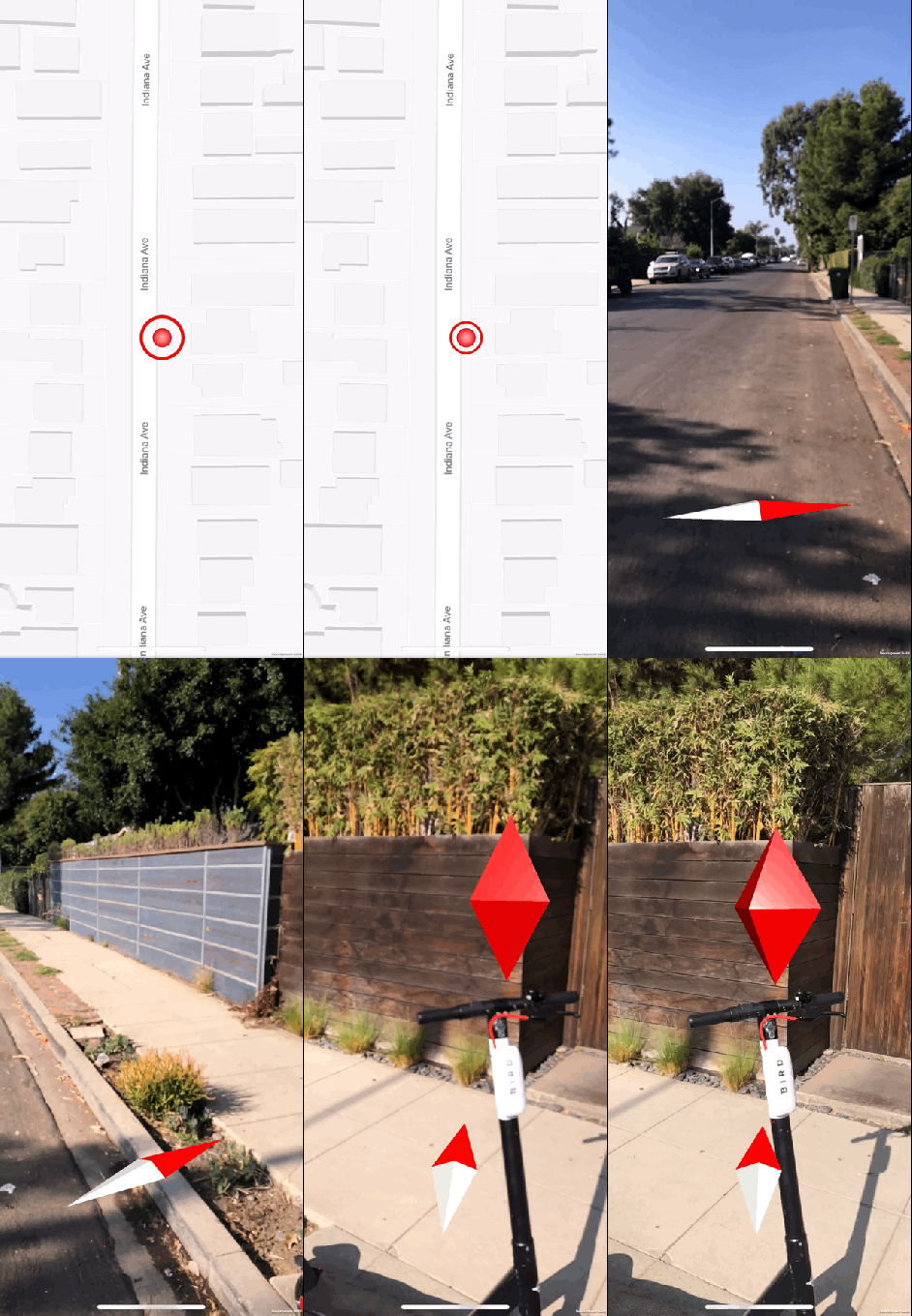
Its camera attaches to personal electric vehicles, captures video and matches that against Fantasmo’s map to reliably identify if a scooter is being illegally ridden on the sidewalk or parked in the middle of the walkway. Scooter companies could make their vehicles beep and slowly lose acceleration where not allowed, issue fines for parking in the wrong spot, notify redistribution teams to move errant vehicles or ban riders who consistently break their terms.

The tech could even make maps of available scooters more precise so you’re not wandering around searching. And scooter companies could use Fantasmo’s data to demonstrate that their riders are the most respectful.

“Scooters are under threat unless they find ways to work with cities to prevent sidewalk riding and make sure they’re parked in places the cities deem appropriate. 2D image capture can be leveraged to build out semantic, 3D maps of cities and provide a hyper-accurate position of the scooter,” says Fantasmo co-founder Jameson Detweiler. “So-called visual positioning is more precise than GPS and has centimeter level accuracy in dense urban environments — a notoriously bad environment for GPS. Visual positioning is accurate enough that a scooter can know when it is in a prohibited zone even if the zone is only as wide as a sidewalk.”

You can see in the video below how GPS can’t tell the difference, while Fantasmo shows green icons when the scooter is on the street and red ones when on sidewalks.

Originally founded in 2014 to build AR games, Fantasmo was started by Detweiler, who’d previously built startup website builder LaunchRock, and electrical engineering PhD Dr. Ryan Measel. Fantasmo has raised $2.2 million in funding, led by TenOneTen Ventures, to build decentralized 3D maps of the world. Instead of expensive LIDAR sensors like for autonomous vehicles, a simple 2D camera with the right software is sufficient for positioning.

So why wouldn’t scooter companies just launch their own camera systems? Well, beyond Fantasmo’s specialized expertise from years working on AR positioning, it benefits from network effect. Each client from across industry verticals contributes data they collect to Fantasmo’s collaborative maps. That means if construction or an event changes a street’s layout, the first Fantasmo camera that comes across it updates everyone else’s maps. An individual mobility startup might end up with less accurate maps while wasting resources far outside their core purpose. Developers and personal vehicle companies that want to work with Fantasmo can apply for beta access on its website.

The vision is to build “a next-generation Open Street Map that gets all the inputs to work together,” Detweiler explains. “Eventually you’ll have self-driving scooters to do redistribution,” he says, rather than having humans load them in trucks and place them where they’ll get rented next. Without super accurate maps, the idea of passenger-less scooters rampaging through cities is terrifying. “There’s definitely a horror movie or three in that concept right there.”

If a more open AR map like Fantasmo’s doesn’t win, we could end up with a tech giant like Google hoarding this data. “I think the crowd of all these devices will be more powerful,” Detweiler concludes. “It might take time, but that network effect would be hard to beat.

06 Nov 2018

$30 wireless earbuds? Sure, why not?

I mean, I can think of a few reasons why not, but Xiaomi generally makes pretty reliable consumer electronics, and the company’s rock-bottom prices have disrupted other markets, like fitness trackers.

Spotted by Engadget, the Chinese smartphone maker’s $30 AirDots are completely wireless earbuds, designed to compete with the likes of AirPods and Pixel Buds, but at a fraction of the price. Price has long been one of the key factors slowing the more widespread adoption of the technology, and, if nothing else, Xiaomi proves it can be done on the very cheap.

The AirDots appear to be China-only for now, priced at 199 yuan, or around $29. The buds themselves should give you five hours of life, courtesy of Bluetooth 5.0, with a total of 12 including the charging case.

Honestly, that’s not bad at all for the price. Sound quality is another question entirely, of course. But the availability of $29 wireless earbuds could help justify a move away from the headphone jack for even budget handsets at this point.

06 Nov 2018

GV partner Joe Kraus named Lime’s first COO

Lime announced more big hiring news this morning with the appointment of Joe Kraus, a general partner at Alphabet’s venture arm GV and an existing member of the bike- and scooter-sharing startup’s board of directors, as its first chief operating officer.

Kraus joined GV 12 years ago from the Google -acquired software startup JotSpot, where he served as the chief executive officer from 2003 to 2006. Before that, he co-founded Excite, an early internet search engine.

Earlier this year, Kraus helped lead GV’s first investment in Lime. In joining the company’s C-suite, Kraus will relinquish his board seat to another GV partner, as well as his GP title at the firm. He will stay on as a venture partner and will keep his existing board seats, per Bloomberg. Kraus is also on the board of Peerspace, a marketplace for booking space for events, and fintech startup Spruce Finance, among others. In his tenure at GV, he’s backed startups including Modsy, ClassPass, KeepTruckin and HomeAway.

“Joe brings years of operational experience combined with a strong venture background to Lime,” the company’s CEO and co-founder Toby Sun said in a statement provided to TechCrunch. “His keen sense of policy and local governments is an important asset as we continue our collaboration with cities around the globe.”

San Francisco-based Lime, valued at more than $1 billion, brought on former Uber chief business officer David Richter just last week as its first-ever chief business officer. The company is filling up its C-suite as it gears up to expand its portfolio of micro-mobility services into car-sharing.

More news will inevitably come from Lime soon as the company is said to be fundraising at a $3 billion valuation. Founded in 2017, the startup has raised a total of $467 million to date from GV, Andreessen Horowitz, IVP, Section 32, GGV Capital and more.

Among other projects in the works, Lime is planning a launch of brick-and-mortar scooter lifestyle stores in the U.S., beginning with Santa Monica, California, the headquarters of its biggest competitor, e-scooter startup Bird. Meanwhile, Lime, which has recorded 11.5 million rides as of September, is actively expanding in the U.S. and overseas.

06 Nov 2018

Facebook’s GraphQL gets its own open-source foundation

GraphQL, the Facebook -incubated data query language, is moving into its own open-source foundation. Like so many other similar open-source foundations, the aptly named GraphQL Foundation will be hosted by the Linux Foundation.

Facebook announced GraphQL back in 2012 and open sourced it in 2015. Today, it’s being used by companies that range from Airbnb to Audi, GitHub, Netflix, Shopify, Twitter and The New York Times . At Facebook itself, the GraphQL API powers billions of API calls every day. At its core, GraphQL is basically a language for querying databases from client-side applications and a set of specifications for how the API on the backend should present this data to the client. It presents an alternative to REST-based APIs and promises to offer developers more flexibility and the ability to write faster and more secure applications. Virtually every major programming language now supports it through a variety of libraries.

“GraphQL has redefined how developers work with APIs and client-server interactions. We look forward to working with the GraphQL community to become an independent foundation, draft their governance and continue to foster the growth and adoption of GraphQL,” said Chris Aniszczyk, vice president of Developer Relations at the Linux Foundation.

As Aniszczyk noted, the new foundation will have an open governance model, similar to that of other Linux Foundation projects. The exact details are still a work in progress, though. The list of founding members is also still in flux, but for now, it includes Airbnb, Apollo, Coursera, Elementl, Facebook, GitHub, Hasura, Prisma, Shopify and Twitter.

“We are thrilled to welcome the GraphQL Foundation into the Linux Foundation,” said Jim Zemlin, the executive director of the Linux Foundation. “This advancement is important because it allows for long-term support and accelerated growth of this essential and groundbreaking technology that is changing the approach to API design for cloud-connected applications in any language.”

For now, the founding members expect that the GraphQL specificationGraphQL.js reference implementation, DataLoader library and GraphiQL developer tool will become the core technical projects of the foundation, but that, too, could still change.

At this point, the Linux Foundation is essentially a foundation for foundations. It provides support for dozens of projects now, with Linux itself being just one of those. Those other foundations include the likes of the Cloud Native Computing Foundation (the home of Kubernetes), the Cloud Foundry Foundation, Automotive Grade Linux, the JS Foundation (which is about to merge with the Node.js Foundation) and more.

As more large companies release open-source projects, those projects that become popular often get to the point where having a single company govern the project’s life cycle is neither feasible nor in the best interest of the community. Spinnaker, the continuous delivery platform backed by Netflix and Google, recently reached this point, for example. Surely, GraphQL is also now at this point, where it’s stable and has wide adoption but could benefit from being separated from the mothership and get its own vendor-neutral foundation.