Year: 2018

05 Nov 2018

Credit Karma acquires Noddle from TransUnion and expands to the UK

Credit Karma, the US startup with 85 million users that offers credit reports and a platform to browse and buy other financial services, has made an acquisition to help it kick-start its first overseas expansion beyond the US and Canada: it has acquired Noddle, a UK-based credit reporting service with 4 million users, from TransUnion.

Terms of the deal are not being disclosed, but Valerie Wagoner, Credit Karma’s VP of International (who had previously been at Twitter), said that it will be a full acquisition of tech and employees — 35 in all — and TransUnion is not taking any stake in Credit Karma as part of this deal although the two will continue to work together with TransUnion providing data to Credit Karma, as it had done before.

Credit Karma raised $500 million in a secondary round earlier this year that valued it at $4 billion, specifically to help fuel its growth, and that’s what it has been doing. (It also acquired mortgage platform Approved in August.)

For TransUnion, this is a cleaning of house, of sorts. The company, a credit reporting agency that competes against Equifax and Experian — and thus, in part, with Credit Karma, too — acquired CallCredit in the UK earlier this year for $1.4 billion, and Noddle had been a part of CallCredit that overlapped with existing operations at the bigger company: hence the divestment.

“We are proud to have partnered with Credit Karma from its inception to empower tens of millions of consumers with the information they need to make smarter financial decisions,” said John Danaher, TransUnion’s president of Consumer Interactive, in a statement. “This deal represents an expansion of our mission to the United Kingdom, and we look forward to supporting Credit Karma as they continue to expand globally.”

In an interview, Wagoner said that the first thing that Credit Karma is doing is making Noddle’s previously paid credit scoring services free to use from now on, to align it closer with Credit Karma’s business model of offering all credit scoring and monitoring services for free, and making money when a user purchases (not just clicks through to) other financial services on its site from partners.

“We will make sure 100 percent of the business is free and accessible to everyone,” she said.

This will be the first step in integrating the two businesses and their customer bases, she said: the next will be to start to off Credit Karma’s wider range of offerings — which cover things like automotive loans and mortgages, credit cards and refinancing offers — to Noddle’s users.

Although most of the integration will involve using Noddle’s existing base and established market presence in the UK to bring in Credit Karma products, there will be come features of Noddle’s coming to Credit Karma as well.

The US startup launched a credit monitoring tool six months ago — in part a response to the many data breaches that we have seen hit the Equifaxes of the world in recent times — and it will be expanding that to do more with identity monitoring.

This is an area where Noddle has been developing products, Wagoner said, and the plan longer term will be to use some of that development in Credit Karma’s wider business.

“We never want data breaches to happen but we know they are inevitable in this day and age,” she said, “not just at credit bureaus but all businesses, so it’s important for us to be able to deliver services to members that affect them and their credit around ID monitoring and services that help monitor breeches.”

She noted that Noddle’s ID monitoring product — which had been one of its paid products — today has relatively little usage, but “it is a sign that Noddle cares about that mission and is a great fit for the Credit Karma family family.”  No word on when that product will make its way to the Credit Karma service elsewhere, but that is on the roadmap she said.


05 Nov 2018

Credit Karma acquires Noddle from TransUnion and expands to the UK

Credit Karma, the US startup with 85 million users that offers credit reports and a platform to browse and buy other financial services, has made an acquisition to help it kick-start its first overseas expansion beyond the US and Canada: it has acquired Noddle, a UK-based credit reporting service with 4 million users, from TransUnion.

Terms of the deal are not being disclosed, but Valerie Wagoner, Credit Karma’s VP of International (who had previously been at Twitter), said that it will be a full acquisition of tech and employees — 35 in all — and TransUnion is not taking any stake in Credit Karma as part of this deal although the two will continue to work together with TransUnion providing data to Credit Karma, as it had done before.

Credit Karma raised $500 million in a secondary round earlier this year that valued it at $4 billion, specifically to help fuel its growth, and that’s what it has been doing. (It also acquired mortgage platform Approved in August.)

For TransUnion, this is a cleaning of house, of sorts. The company, a credit reporting agency that competes against Equifax and Experian — and thus, in part, with Credit Karma, too — acquired CallCredit in the UK earlier this year for $1.4 billion, and Noddle had been a part of CallCredit that overlapped with existing operations at the bigger company: hence the divestment.

“We are proud to have partnered with Credit Karma from its inception to empower tens of millions of consumers with the information they need to make smarter financial decisions,” said John Danaher, TransUnion’s president of Consumer Interactive, in a statement. “This deal represents an expansion of our mission to the United Kingdom, and we look forward to supporting Credit Karma as they continue to expand globally.”

In an interview, Wagoner said that the first thing that Credit Karma is doing is making Noddle’s previously paid credit scoring services free to use from now on, to align it closer with Credit Karma’s business model of offering all credit scoring and monitoring services for free, and making money when a user purchases (not just clicks through to) other financial services on its site from partners.

“We will make sure 100 percent of the business is free and accessible to everyone,” she said.

This will be the first step in integrating the two businesses and their customer bases, she said: the next will be to start to off Credit Karma’s wider range of offerings — which cover things like automotive loans and mortgages, credit cards and refinancing offers — to Noddle’s users.

Although most of the integration will involve using Noddle’s existing base and established market presence in the UK to bring in Credit Karma products, there will be come features of Noddle’s coming to Credit Karma as well.

The US startup launched a credit monitoring tool six months ago — in part a response to the many data breaches that we have seen hit the Equifaxes of the world in recent times — and it will be expanding that to do more with identity monitoring.

This is an area where Noddle has been developing products, Wagoner said, and the plan longer term will be to use some of that development in Credit Karma’s wider business.

“We never want data breaches to happen but we know they are inevitable in this day and age,” she said, “not just at credit bureaus but all businesses, so it’s important for us to be able to deliver services to members that affect them and their credit around ID monitoring and services that help monitor breeches.”

She noted that Noddle’s ID monitoring product — which had been one of its paid products — today has relatively little usage, but “it is a sign that Noddle cares about that mission and is a great fit for the Credit Karma family family.”  No word on when that product will make its way to the Credit Karma service elsewhere, but that is on the roadmap she said.


05 Nov 2018

Korean AI startup Skelter Labs raises $10M to expand to Southeast Asia

Korean AI startup Skelter Labs is expanding to Southeast Asia after it pulled in $10 million in new funding led by Singapore-based VC firm Golden Gate Ventures.

Skelter Labs was founded in 2015 by founded by Ted Cho, the former engineering site director at Google Korea. It started out developing apps and services that made use of AI but then it pivoted to focus fully on AI tech, which it licenses out to companies and corporations that it works with. This new money is aimed at enabling it to move into Japan and parts of Southeast Asia, with Vietnam, Thailand and Malaysia specifically mentioned

The startup raised a $9 million seed round earlier this year, and those investors have returned to join Golden Gate this time around. They include KakaoBrain — the AI unit of Korean messaging giant Kakao — Kakao’s K-Cute venture arm, Stonebridge Ventures and Lotte Homeshopping, the TV and internet shopping business owned by multi-billion dollar retail giant Lotte.

More specifically, Seoul-based Skelter Labs works on AI in the context of vision and speech, conversation, and context recognition, while it goes after customers in areas that include manufacturing, customer operations, device interaction, and consumer marketing.

The startup doesn’t disclose specific customers, but it previously told TechCrunch that its vision is to bring its machine learning technology to daily life and schedules. Possible examples of that might be could include “intelligent virtual assistant technology that can be widely applied to various areas including smart speakers, smartphones, home appliances, automobiles and wearable devices.”

Golden Gate is one of Southeast Asia’s longest running tech VC firms. This deal is part of its recently announced third fund, which is $100 million in size.

In a statement, Skelter Labs CEO Cho paid tribute to the VC’s strong footprint in Southeast Asia that he said could open doors for the company. Startups in Golden Gate’s portfolio that might be of particular interest could include mobile listings startup Carousell, auto portal Carro, fashion commerce site Grana and online furnishings seller Hipvan.

04 Nov 2018

Make people valuable again

There is a disconnection between the pace and progress of the technical achievements made by innovators and entrepreneurs and the ways in which those technologies have added to human happiness.

We have increased our technological powers many times and still we are not happier; we do not have more time for the things we find meaningful.

We could use our powers for making each other — and thereby ourselves — more valuable, but instead we are fearing to lose our jobs to machines and be considered worthless by the economy.  The link between better technology and better lives overall has become so confusing that many people no longer reflect upon its existence.

We are co-founders of i4j — Innovation for Jobs, an eclectic community of thought leaders that has been exchanging ideas since 2012 about how innovation can disrupt unemployment and create better jobs. We believe we have found an approach for doing so that we lay forth in our new book, “The people centered economy – the new ecosystem for work.” The book presents a system of ideas, ranging from helicopter perspective down to details of scenarios. It puts theory in perspective with a number of relevant real-life case examples written by i4j members, founders of major companies, such as LinkedIn, startup CEOs, investors, foundation directors and social entrepreneurs.

The problem today, we suggest, is that our innovation economy is not primarily about making people more valuable; it is instead about reducing costs.

The main danger is easy to summarize: when workers are seen as a cost (which is now the case), cost-saving, efficient technologies will compete to lower their cost and thereby their value. The “better” the innovation, the lower their value. People are struggling to stay valuable in a changing world, and innovation is not helping them, except for the chosen few. The need to be valued and to be in demand are part of our human nature. Innovation can, and should, make people more valuable.

The economy is about people who need, want, and value each other. When we need each other more, the economy can grow. When we need each other less, it shrinks. We need innovation that makes people need each other more.

The purpose of innovation should be a sustainable economy, where we work with people we like, are valued by people we do not know and provide for the people we love

If innovation does this, we will prosper.

The present “task-centered “economy that sees people as cost is plagued by many symptoms of its lethal illness. We present several in the book, here is one of them.

The rise of the working middle class boosted by Roosevelt’s “New Deal” has been all but wiped out. People like blaming their political opponents for these kinds of things but the wealth gap has been growing steadily, since 1980, under Republicans and Democrats alike. No, this is beyond politics.
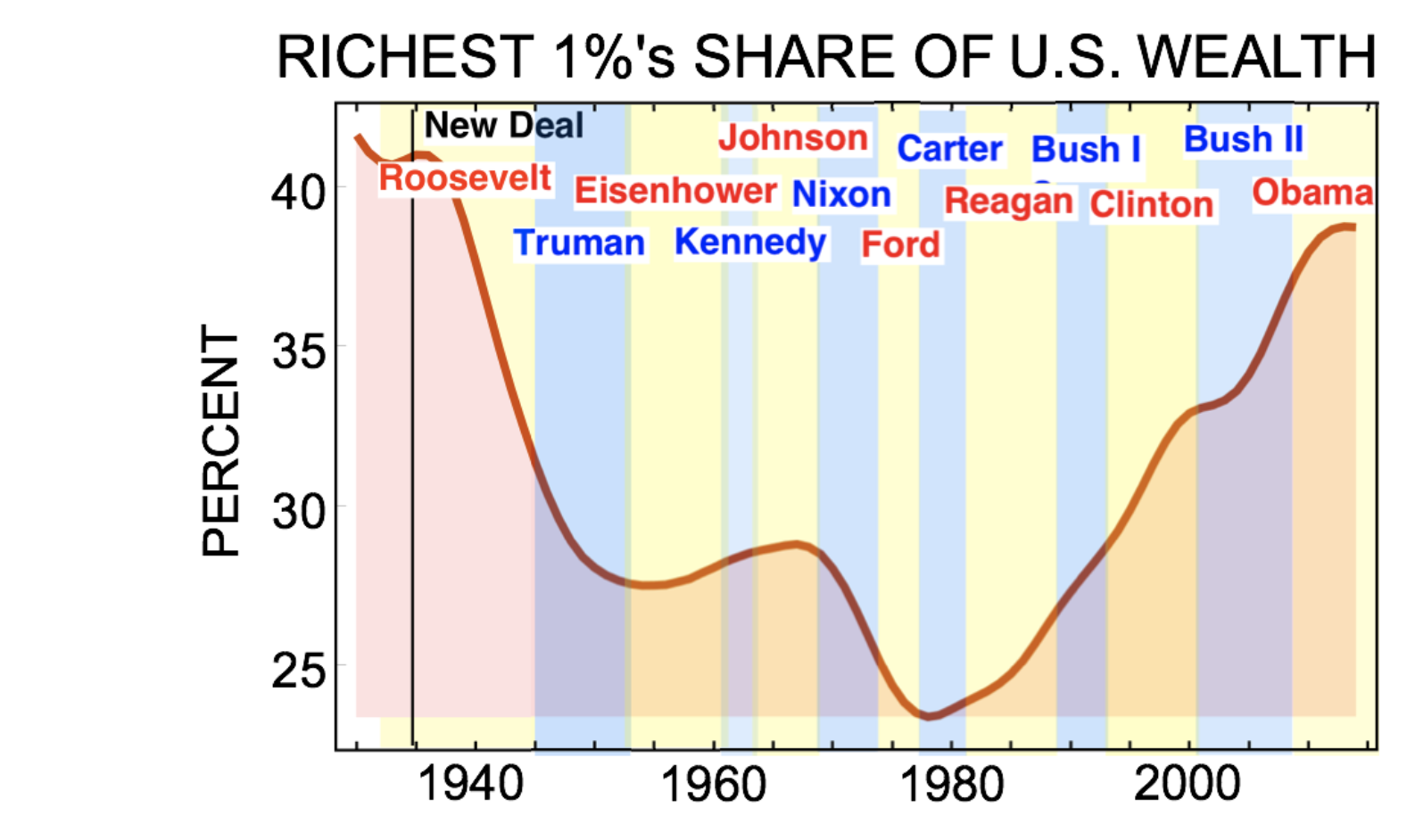
The root cause for all this is the very essence of our task-centered economy: placing tasks, products and other things at the center of the value proposition instead of people. It seems very natural to see it this way, because, after all,  you want your house painted and there are painters who want to paint it – how can it work any other way? Yet, wanting things done better and cheaper, combined with innovation that makes that happen, is the cause of the troubles.

Companies will cut labor costs, as automation and offshoring lets them. When people earn less they will have less money to spend. The companies adapt to their shrinking purses by innovating still cheaper products and services and cutting labor costs even more. It is a spiral pointing downward toward a point zero where people earn and spend zero.

At the heart of this problem is the old saying, “A dollar saved is a dollar earned.” This maxim rings true to you and me in daily life, and it applies to companies. But paradoxically, in the economy, the opposite is true: a dollar saved is actually a dollar lost.

One person’s earning is always other people’s spending and if everyone spends less, people earn – on average – less.  Economies run on the spending and re-spending of the same money. Velocity counts. Economic growth is killed by companies that are competing solely for profits. We are not saying it’s wrong to save and not be wasteful, it’s good and necessary, but that is not earning. Saying that saving and earning are the same introduces the paradox and is a recipe for a failed economy.

It might not be possible to solve the growth-profit paradox in a task-centered economy, because it is inherent in the mindset. This mindset always looks at work and asks what is the most cost-efficient way of doing it. What keeps the economy from collapsing is the inherent limits of automating work. Workers have remained a necessary, if undesired, cost. But what will be the outcome if artificial intelligence allows almost all work to be automated? Now the task-centered mindset creates an implosion. With a task-centered mindset, innovation is set to kill economies.

Is the AI and machine learning revolution that seem to threaten our jobs different from previous industrial revolutions? The times are different but you may be shocked by the similarity in the patterns of change. Read the following excerpt of original text from the Communist Manifesto, where Bourgeoisie is replaced with Internet Entrepreneurs, Proletariat with On-Demand Workers, Civilization with Digital Economy, and Revolution with Disruption.
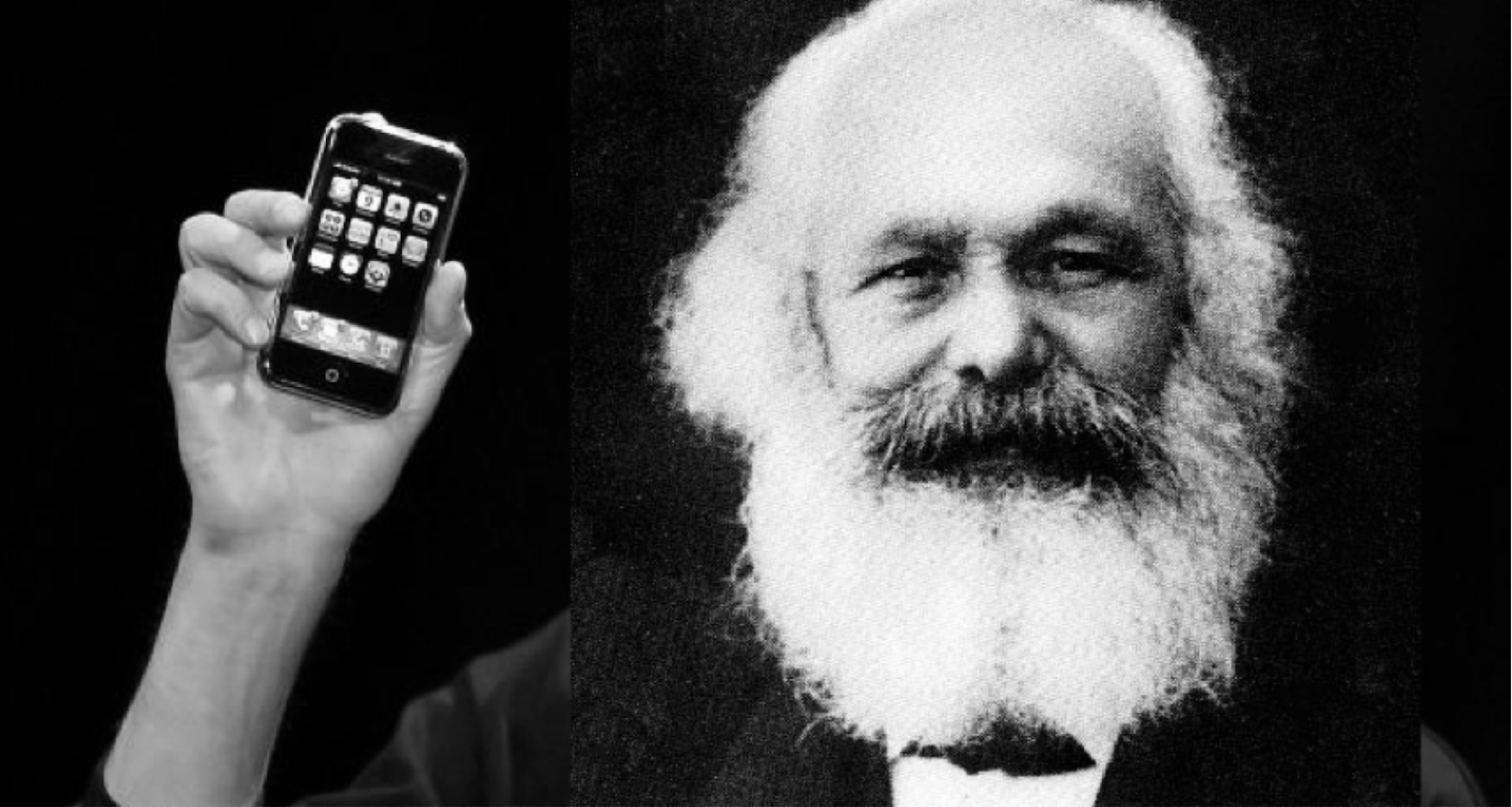
“Internet entrepreneurship cannot exist without constant disruption of markets, bringing uninterrupted disturbance of all social conditions. Internet entrepreneurship has created the modern working class — the on-demand workers, who must sell themselves in bits and pieces. They have become a commodity, exposed to the whims of the market. Their work has lost all individual character, and all charm. It is only the most simple and most easily acquired work that is required of them. The on-demand worker’s production cost is limited almost entirely to his living costs. But the price of a commodity is in the long run equal to its production cost. Therefore, the more the individual character disappears from his work, the wage decreases in proportion. The lower middle class will gradually become on-demand workers, partly because their specialized skills are rendered worthless by new methods of production.”

The accuracy of this message from the grave is nothing less than spooky. The analogy is clear, as is the message it sends: Internet entrepreneurship is the new bourgeoisie.

Universal Basic Income (UBI) can provide basic security, but it can’t replace work. People will always need to be able to depend on strangers — even adversaries. The day people no longer need to work, why should they want to depend on people they don’t know or don’t like? Utopian ideas about UBI don’t provide an answer. Meaningful paid work does and is the glue that holds societies together. The utopian UBI discussion is just another symptom of lost bearings. We start debating which jobs can’t be done by machines, whether machines can become exactly like people, whether machines should pay taxes, and so on. These are all interesting philosophical questions, but discussing them will hardly solve the practical problem: innovation is disrupting society. We need practical solutions. The first requirement is to be able to see them.

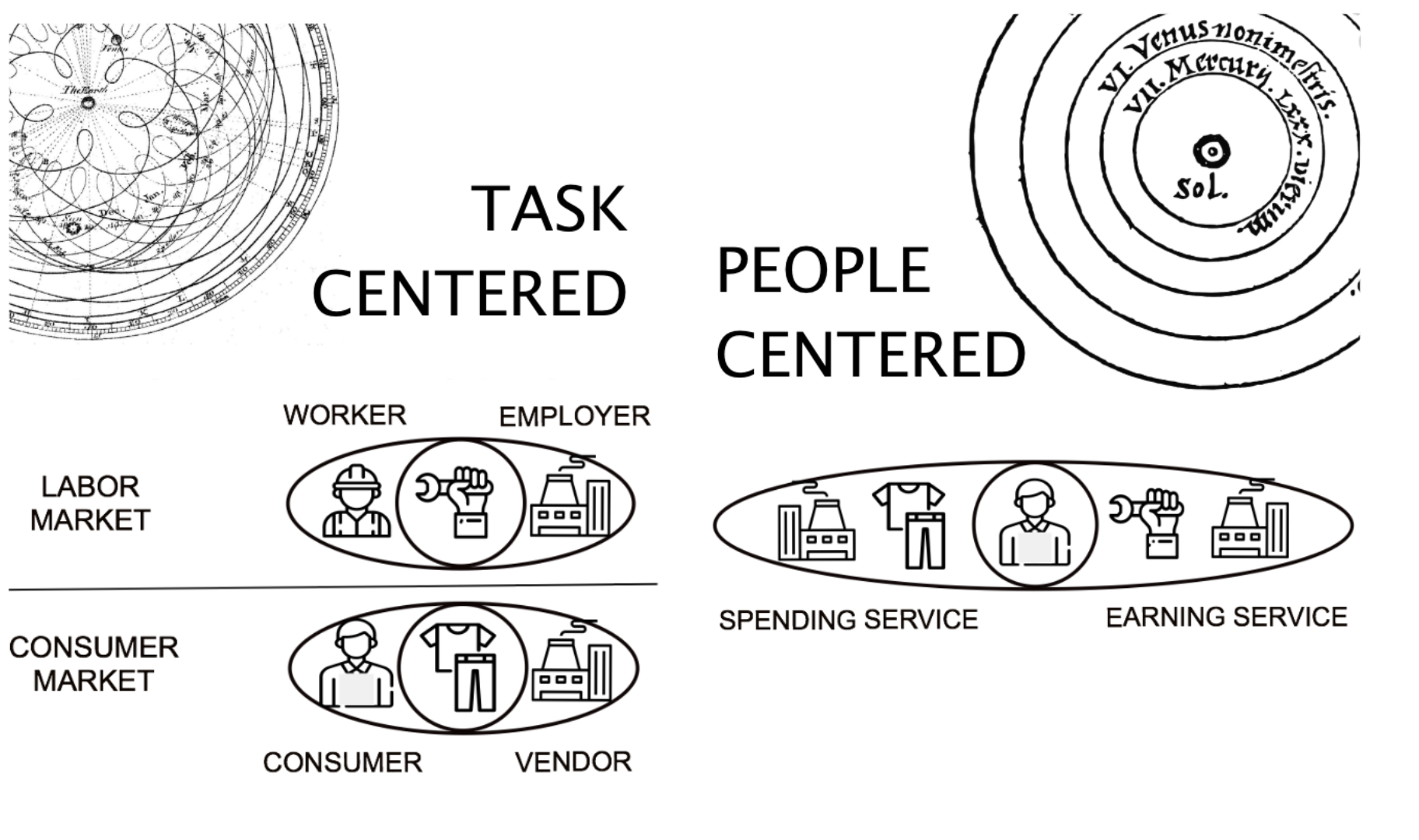
A key reason behind the confusion is that lack of perspective; reality needs a new lens. We can’t explain what we see because the good old ideas that once made things understandable are now making the world unintelligible instead. This happens often in history — for example, people in the middle ages had long thought that the earth was the center of the universe, but as scientists traced their movements in the sky, the more complex and incomprehensible their orbits became. But simply by switching perspective, placing the sun at the center, complicated orbits were transformed into nearly-circular ellipses of great simplicity. This was the “Copernican Revolution”.

We suggest that doing a similar switch: that moving people to the center can be equally constructive. A “people-centered economy” view could enable us to simplify the innovation economy and engineer it better just as the “Copernican revolution” did for physics and astronomy. The economy is all about people, after all, so it seems only natural to place us at the center. And it does indeed make the economy look simpler, as shown in the figure.

Our present task-centered view splits people in two: a worker-persona who earns money on a labor market, and a consumer persona who spends the money on a consumer market: a disconnected reality in which we are living double lives! It might seem like the time- tested and obvious view, but it is actually complex, disconnected, and wrong.

Switch to the people-centered lens and we are whole again. The labor and consumer markets are replaced by a single market where people are offered two kinds of services, one for earning money and another for spending it. It is a less confusing picture. By definition, organizations serve us, not the other way around. They are the ecosystem in which we are embedded, which helps us create and exchange value between each other.

Just by switching to a people-centered lens, things fall more neatly into place around us:  

A people centered economy has a simple and handy definition of the economy: People create and exchange value, served by organizations.

Seen through the people-centered lens, the thorny question of the future of work is rephrased: “Is AI-innovation being applied more to earning or to spending?” The simple answer is “spending” and the straightforward conclusion is that we need more innovation that helps people earn. Through the people-centered lens an obvious “rule number one” of a sustainable innovation economy becomes clear to see:

We need as much innovation that helps us earn as there is innovation that helps us spend.

Today, we are surrounded by excellent innovation for spending, but there is very little good innovation for earning and none for earning a livelihood.  

We need startups that compete to innovate a really good earning-service, perhaps something like this:

“Dear Customer, we offer to help you earn a better living in more meaningful ways.
We will use AI to tailor a job to your unique skills, talents, and passions.
We will match you in teams with people you like working with.
You can choose between kinds of meaningful work.
You will earn more than you do today.  
We will charge a commission.
Do you want our service?”

The good news is that the world’s labor market is ready to be disrupted by innovative new ways to satisfy the customers’ needs and wants to earn a good livelihood.
And the market opportunity for this is huge! Here is an estimate: According to Gallup’s chairman Jim Clifton, of some five billion people in the world who are of working age, three billion want to work and earn income. Most of them want a full-time job with steady pay, but only 1.3 billion have one. Out of these 1.3 billion people with jobs, only 200 million are “engaged” in what they do for a living — i.e., they enjoy what they do and look forward to each working day. These lucky few, however, are outnumbered 2:1 by those who are disengaged, expressing displeasure and even undermining the work of others. The remainder of the population are simply disengaged from what they are doing, dragging their feet through the work day.

This is the sad state of the global workforce that creates roughly a hundred trillion dollars’ worth of products and services every year. Humanity is running at a fraction of its capacity. Imagine using modern information technology to tailor jobs to every one of the three billion people wanting to work — work that is well matched with their unique skills, talents, and passions; work in which they are assigned to valuable tasks and partnered with people they like to work with. In such a world, the average world citizen would be able to generate several times the per-person value created today. How much more value would they create than the unhappy, mismatched workforce of today?

A doubling of value creation is surely low, but even that figure adds $100 trillion in value to the world economy. If the job providers charged the same commission as Uber does, 25 percent, on the incomes people earned through their services, this would generate revenues of $50 trillion from commissions alone, plus additional revenues from add-on services, such as liability insurance and health benefits.

At this size, tailoring better ways for people to earn their livelihood would be the single largest market in the world. Even at only one percent commission, hardly noticeable for the earners, the potential market size is two trillion dollars. We think this should be an attractive opportunity for entrepreneurs, investors and governments to explore.

“Tailoring jobs” is a virgin market waiting to happen, because previously we did not have the technology for it. But now, since only a year or two, we have good enough tools. Increasing smartphone penetration and new capacities like cloud computing and big data analytics could, in principle, tailor rewarding jobs for every person on earth. Even if this is unrealistic today, it is still a huge potential market, even if it is applied to only a fraction of the world population looking for a good job. It will be wrong to assume that the workers must belong the well-educated elite, because they are already well served with good job offers. Quite the opposite, The big market for AI-tailored jobs is the vast majority of excluded, un- and underemployed people who are lacking the opportunity to live up to their abilities.

A simple innovation that helps many millions of these people can be a much better business than something advanced that helps the already well-served. It is similar to how, before the first industrial revolution, the most successful manufacturers sold expensive things to rich people.

With the introduction of mass production this changed in an, at the time, surprising and unforeseeable way, when selling cheap things to the masses became the new highway to success. Back then, the people running the old economies could hardly imagine how selling crafted goods to people with thin wallets could be better business than selling them to kings.

Today, as we are introducing mass-personalized goods and services, many business leaders will have great difficulties imagining how creating special jobs for people with little income can be better business than tailoring jobs for the engineers that companies compete for.  

We are at the beginning of a revolution in strength finding, education, matchmaking, HR, and new opportunities in a long-tail labor market.

The i4j community includes entrepreneurs and investors who are interested in exploring this opportunity and we are welcoming more to join. An ecosystem of critical mass can open the doors to a people-centered economy and we intend to help it happen.


 

04 Nov 2018

Female founders have brought in just 2.2% of US VC this year (yes, again)

Despite efforts to level the playing field for female entrepreneurs, U.S. female-founded startups have raised just 2.2 percent of venture capital investment in 2018.

That statistic may sound familiar; it’s the exact same portion of capital startups founded by a solo female founder or an all-female team secured last year, too, according to PitchBook.

That figure has become a sort-of rallying cry for female founders and their advocates as they try to develop solutions to a long-standing problem: female entrepreneurs raise significantly less private capital than their male counterparts. Several new efforts and entire organizations, like All Raise, for example, have cropped up to ameliorate this through mentorship and programming, but it’s clearly going to take more than one year for that increase in resources to effect change.

Currently, less than 10 percent of decision-makers at VC firms are women and 74 percent of U.S. VC firms have zero female investors. Until those numbers begin to transform, it’s likely little progress will be made on closing the funding gap.

The good news is women have raised a record amount of VC this year with two months still remaining in 2018. In the last ten months, female-founded startups have closed 391 deals worth $2.3 billion, up from $2 billion in 2017. Mixed-gender teams have raised $13.2 billion this year across 1,346 deals, an increase from $12.7 billion last year.

For context, U.S. startups have raised a total of $96.7 billion in 2018, a number that’s expected to surpass $100 billion before the year is through. Female-founded companies have raised just 2.2 percent of that total; mixed-gender teams have raised about 12.8 percent, up from roughly 10.4 percent last year.

Last year, U.S. startups raised a total of $82 billion across more than 9,000 deals in what was similarly an impressive year for the venture industry.

04 Nov 2018

James Patterson released a work of interactive fiction on Facebook Messenger

One of the world’s best-selling authors is experimenting with a new form of digital-first storytelling.

James Patterson has partnered with Facebook to release his latest novel,‘The Chef’, on its messaging app. The thriller has been available to read on Facebook Messenger since Tuesday and will make its print debut in February. Interested readers just have to send a message to “The Chef by James Patterson” on Messenger to get started with the immersive reading experience.

Facebook Messenger counts 1.3 billion monthly users. Patterson, known for the Alex Cross series, ‘The President is Missing,’ ‘Witch & Wizard,’ and others, has sold some 375 million books worldwide.

The story follows Caleb Rooney, a New Orleans police detective by day and food truck chef by night that’s been accused of murder. The short novel is formatted like a series of text messages, with video, audio, photos and documents interspersed. Rooney and the book’s other leading characters have Instagram accounts for fans to interact with.

The novel’s social media play taps into the new generation of content consumers — those accustomed to layered, multi-media experiences.

Patterson told Cheddar he considers the project a “bookie,” or a book meets a movie. The author is no stranger to innovative experiments, he’s previously released a line of super-short, $4 books and was an early pioneer of e-books.

“It’s so important to me that books … keep up — that they enter the modern age,” Patterson said.

04 Nov 2018

What does SoftBank’s Masayoshi Son plan to say or do about its ties to Saudi Arabia? We’re about to find out

Throughout October, it seemed that among others in tech, SoftBank might be forced to rethink its cozy relationship with Saudi Arabia’s Crown Prince Mohammad bin Salman, or MBS, who has charmed many captains of industry since rising to power, but whose dark side came into abrupt view over the murder and gruesome disposal of journalist Jamal Khashoggi. (MBS has steered Saudi Arabia into plenty of other terribleness, but the brutal end of Khashoggi, a resident of Virginia, a Washington Post columnist, and a critic of MBS, managed to capture the West’s attention in a way that tens of thousands of dead Yemeni children have not.)

Certainly, parting ways with MBS wouldn’t be easy for SoftBank, whose CEO, Masayoshi Son, has said that his ambitious Vision Fund, which finally closed this past May with $100 billion in commitments, is anchored by MBS. In fact, Son has said that MBS committed $45 billion to the effort in 45 minutes time, and MBS more recently revealed his intention to give SoftBank a separate $45 billion for a second Vision Fund.

That’s a lot of money to turn down. Still, for a minute, it seemed that SoftBank might legitimately be having second thoughts about whether it’s good to be in business with MBS. According to the Financial Times, SoftBank’s COO Marcelo Claure said publicly two weeks ago that there was “no certainty” that SoftBank will launch another Vision Fund.

Another week passed however. Some of the public’s outrage was directed elsewhere. And by the end of this past week, it seemed to be all systems go for SoftBank, which took its finger off the pause button to strike two big deals:  plugging $375 million into the robotic food-prep company Zume (with reported plans to invest another $375 million into the company at a later date), and announcing on Friday that it has sunk $1.1 billion into View, a maker of glass used in internet-connected windowpanes.

Apparently, both companies’ management teams see more to gain from partnering with SoftBank than trying to find other funding sources.

The question is whether SoftBank itself will make the same decision as it maps out its own future. And we’re about to find out, seemingly. As the Financial Times notes, Son is reporting SoftBank’s second-quarter results tomorrow, and there’s no question he will be posed a long list of questions about SoftBank’s ties to the Public Investment Fund, the sovereign-wealth fund that MBS controls.

Some answers would be helpful, to say the least. To date, Son has said nothing about the Khashoggi case. And though Son skipped an appearance at investment conference organized the week before last by MBS in Riyadh, he met with the prince privately before the event. Our sources say this was to privately express his concern over Khashoggi, but we also get the impression that there was no talk about breaking up the band.

We’ll should find out imminently whether that’s right or wrong. Either way, SoftBank’s association with MBS isn’t going to be forgotten anytime soon. Indeed, as the FT notes, SoftBank’s shares have fallen fully 26 percent since Khashoggi disappeared in early October.

04 Nov 2018

Why we lie to ourselves, every day

Human action requires motivation, but what exactly are those motivations? Donating money to a charity might be motivated by altruism, and yet, only 1% of donations are anonymous. Donors don’t just want to be altruistic, they also want credit for that altruism plus badges to signal to others about their altruistic ways.

Worse, we aren’t even aware of our true motivations — in fact, we often strategically deceive ourselves to make our behavior appear more pure than it really is. It’s a pattern that manifests itself across all kinds of arenas, including consumption, politics, education, medicine, religion and more.

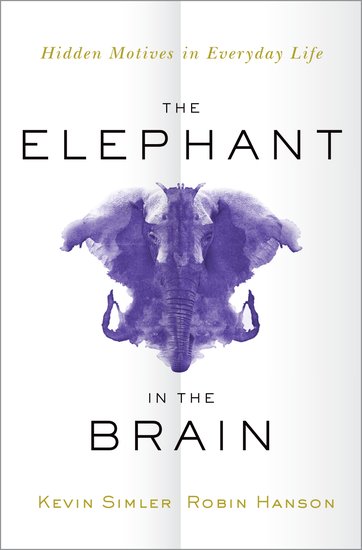
In their book Elephant in the Brain, Kevin Simler, formerly a long-time engineer at Palantir, and Robin Hanson, an associate professor of economics at George Mason University, take the most dismal parts of the dismal science of economics and weave them together into a story of humans acting badly (but believing they are great!) As the authors write in their intro, “The line between cynicism and misanthropy — between thinking ill of human motives and thinking ill of humans — is often blurry.” No kidding.

Elephant in the Brain by Kevin Simler and Robin Hanson. Oxford University Press, 2018

The eponymous elephant in the brain is essentially our self-deception and hidden motivations regarding the actions we take in everyday life. Like the proverbial elephant in the room, this elephant in the brain is visible to those who search for it, but we often avoid looking at it lest we get discouraged at our selfish behavior.

Humans care deeply about being perceived as prosocial, but we are also locked into constant competition, over status attainment, careers, and spouses. We want to signal our community spirit, but we also want to selfishly benefit from our work. We solve for this dichotomy by creating rationalizations and excuses to do both simultaneously. We give to charity for the status as well as the altruism, much as we get a college degree to learn, but also to earn a degree which signals to employers that we will be hard workers.

The key is that we self-deceive: we don’t realize we are taking advantage of the duality of our actions. We truly believe we are being altruistic, just as much as we truly believe we are in college to learn and explore the arts and humanities. That self-deception is critical, since it lowers the cost of demonstrating our prosocial bona fides: we would be heavily cognitively taxed if we had to constantly pretend as if we cared about the environment when what we really care about is being perceived as an ethical consumer.

Elephant in the Brain is a bold yet synthetic thesis. Simler and Hanson build upon a number of research advances, such as Jonathan Haidt’s work on the righteous mind and Robert Trivers work on evolutionary psychology to undergird their thesis in the first few chapters, and then they apply that thesis to a series of other fields (ten, in fact) in relatively brief and facile chapters to describe how the elephant in the brain affects us in every sphere of human activity.

Refreshingly, far from being polemicists, the authors are quite curious and investigatory about this pattern of human behavior, and they realize they are pushing at least some of their readers into uncomfortable territory. They even begin the book by stating that “we expect the typical reader to accept roughly two-thirds of our claims about human motives and institutions.”

Yet, the book is essentially making one claim, just applied in a myriad of ways. It’s unclear to me who the reader would be who accepts only parts of the book’s premise. Either you have come around to the cynical view of humans (pre or post book), or you haven’t — there doesn’t seem to me to be a middle point between those two perspectives.

Worse, even after reading the book, I am left completely unaware of what exactly to do with the thesis now that I have read it. There is something of a lukewarm conclusion in which the authors push for us to have greater situational awareness, and a short albeit excellent section on designing better institutions to account for hidden motivations. The book’s observations ultimately don’t lead to any greater project, no path toward a more enlightened society. That’s fine, but disappointing.

Indeed, for a book that arguably strives to be optimistic, I fear its results will be nothing more than cynical fodder for Silicon Valley product designers. Don’t design products for what humans say they want, but design them to punch the buttons of their hidden motivations. Viewed in this light, Elephant in the Brain is perhaps a more academic version of the Facebook product manual.

The dismal science is dismal precisely because of this cynicism: because as a project, as a set of values, it leads pretty much nowhere. Everyone is secretly selfish and obsessed with status, and they don’t even know it. As the authors conclude in their final line, “We may be competitive social animals, self-interested and self-deceived, but we cooperated our way to the god-damned moon.” Yes we did, and it is precisely that surprise from such a dreary species that we should take solace in. There is indeed an elephant in our brain, but its influence can wax and wane — and ultimately humans hold their agency in their own hands.

04 Nov 2018

Boring Tunnel is on track for an “opening party” next month

Last night, super entrepreneur and Twitter addict Elon Musk posted some mesmerizing footage of the tunnel that his nearly two-year-old infrastructure company, Boring Company, is creating in Los Angeles right now, the first of four planned projects that Musk promises will reduce congestion in car-choked city cities.

Musk also tweeted — not for the first time — that the company will unveil to the public the stretch of rapid-transit tunnel in the southern L.A. suburb of Hawthorne on December 10th, roughly five weeks from now. The idea, per Musk, is to host an opening event that night, followed by free rides for the public next day — though only the brave need apply. Musk has said previously that the system will be capable of whisking pedestrians, cyclists and private vehicles at speeds of up to 155 mph.

Eventually, if all goes as planned, they will travel via an electric-powered platform called a skate that will comprise either a vehicle itself carrying up to 16 passengers or that will support a car that has been driven onto it. Elevators will move between these skates and the street level.

Musk did not say how long a stretch has been built yet, only calling it “disturbingly long.”

04 Nov 2018

What if Google unionized?

Last week more than 20,000 Google employees walked out of their workplace to protest, and demand major changes in, how the company handles harassment and discrimination. Mass employee organization, demands made of management — doesn’t that all vaguely remind you of some kind of old-fashioned twentieth-century concept? What was it called again? The name’s on the tip of my tongue, I swear…

A participant said, “Just the threat of us walking out was enough for the company to remove DeVaul from the payroll,” referring to Richard DeVaul, the Google executive who resigned this week amid a swirling storm of accusations of sexual harassment and worse. Meanwhile, an organizer of the walkout said, plaintively, “I hope I still have a career in Silicon Valley after this” … while other organizers declined to go on the record.

If only there were some formal, structured way in which tech employees could bring grievances to their management, and negotiate with them as a group, via, say, elected representatives, for whom protection from retaliation could be established. Surely the disruptors and out-of-the-box thinkers of Silicon Valley could come up with some revolutionary new system for that. Imagine — and I know this sounds like science fiction but bear with me — one day, such a structure might even achieve some kind of special legal recognition and protections.

But what would they call it? I don’t know. Maybe, and I’m just spitballing here, they could call it a “union” or something crazy like that. After the set operation, get it? They like math entendres down at Google, after all…

I am not necessarily saying such a concept is all benefit and no cost. I’m not even saying I think it would necessarily be a net good idea. But it is striking to me how nobody seems to have even publicly considered the possibility, under the circumstances.

I get that the Valley idea of a union is basically that of a terrible hidebound boa constrictor which chokes off all hope of speed and/or innovation. That might well be true, if one were to simply try to apply twentieth-century union notions, ones which tried to control hours worked and physical conditions, because those were the primary concerns of the manufacturing and/or otherwise physical laborers of that era. But it surprises me greatly that nobody seems to even be talking about a “Union 2.0” concept, one built for 21st-century software engineers rather than 20th-century auto workers, one which didn’t necessarily sacrifice speed, flexibility, or openness to experimentation.

Not least because such could have important repercussions beyond the companies in question. Big tech companies have become among the most powerful entities in the world, at least indirectly. An argument about government regulation of tech is often that it is both heavy-handed and so slow that by the time it finally happens it applies to the tech of several years ago and is already essentially obsolete. This is often a fair criticism, and often applies to legal restitution too.

So what are the checks and balances for Big Tech? What forces and people can keep them honest? The obvious answer is: their employees. Google and Facebook and company fear unrest among their tens of thousands of employees far more than they do the anger of a few hundred million users around the world. It’s by no means a perfect lever of influence, but it’s better than nothing. Whether you want to call it a union or not, I can’t help but think that a more formal structure for grievances, collective negotiation, and protection from reprisal, among employees of major tech companies, might just be a pretty good idea for everyone.