Year: 2018

03 Nov 2018

A blockchain firm bought asteroid mining company Planetary Resources

Here’s a match made in…I don’t know, somewhere on the blockchain, I guess. Pioneering space startup Planetary Resources was acquired by, of all things, a blockchain firm this week. ConsenSys, a Brooklyn based firm that specializes in all things Ethereum issued an announcement noting that it has snagged the asteroid mining  company.

It’s not entirely clear how the two companies will work together, though ConsenSys founder Joe Lubin (who also helped author Ethereum) did manage to mention “decentralizing space endeavors,” which is certainly on-brand for the head of a blockchain company.

“I admire Planetary Resources for its world class talent, its record of innovation, and for inspiring people across our planet in support of its bold vision for the future,” Lubin said in a statement tied to the news. “Bringing deep space capabilities into the ConsenSys ecosystem reflects our belief in the potential for Ethereum to help humanity craft new societal rule systems through automated trust and guaranteed execution. And it reflects our belief in democratizing and decentralizing space endeavors to unite our species and unlock untapped human potential.”

Lubin also promised to offer up more information in the coming months. Meantime, Planetary Resources CEO Chris Lewicki (formerly of NASA JPL) and General Counsel Brian Israel will both be joining ConsenSys. Here’s what Lewicki had to say about the matter, “I am proud of our team’s extraordinary accomplishments, grateful to our visionary supporters, and delighted to join ConsenSys in building atop our work to expand humanity’s economic sphere of influence into the Solar System.”

Founded in 2010 as Arkyd Astronautics, Planetary Resources was considered a bright light in the world of privatized space companies, with X Prize founder Peter Diamandis on-board as director. Earlier this year, however, the company noted that it was rethinking its approach and making cutbacks after failing to secure its most recent funding round.

03 Nov 2018

Facebook reorganizes Oculus for AR/VR’s long-haul

Facebook is again looking to whip Oculus into shape for its 10-year journey towards making virtual reality mainstream. According to two sources, Facebook reorganized its AR and VR team this week from a divisional structure focused around products to a functional structure focused around technology areas of expertise. While no one was laid off, the change could eliminate redundancies by uniting specialists so they can iterate towards long-term progress rather than being separated into groups dedicated to particular gadgets.

Facebook confirmed the reorg to TechCrunch, with a spokesperson providing this statement: “We made some changes to the AR/VR organization earlier this week. These were internal changes and won’t impact consumers or our partners in the developer community.” Oculus CTO John Carmack and Oculus co-founder/newly-promoted Head of PC VR Nate Mitchell will remain in their leadership positions within VP of AR/VR Andrew ‘Boz’ Bosworth’s hardware wing of the company.

The shift obviously communicates that Facebook believes Oculus could be running more effectively. Organizing the company around areas of expertise rather than broader divisions is probably more appropriate for a moonshot effort that can’t afford redundancies, on the other hand, keeping expertise siloed could isolate new approaches and advancements from reaching other teams. As the company builds out its first full lineup of headsets, there seems to be significant overlap in the tech problems and products bring tackled by those working on mobile and PC products.

TechCrunch reported earlier this week that the company is planning to release a new Rift headset as early as 2019, possibly called the Rift S, which will featured upgraded displays and an inside-out tracking system. The company’s “Rift 2” project, codenamed Caspar, was left behind in the reorganization, a source tells us. We can’t confirm whether any other products or concepts have been shelved.

While an immersive virtual world that users can hang out and communicate in certainly seems to fit Facebook’s broader mission, the company has spent the better part of the past few years deciding how a costly, ambitious venture like Oculus fits into its corporate structure.

First, things went smoothly. The company and its empowered co-founders were building out a developer network and prepping for the launch of their Rift headset after creating a successful partnership with Samsung for the Gear VR. Then, the company’s good fortune turned as the Rift headset was racked by expensive delays and Oculus failed to ship the company’s Touch motion controllers at launch losing some initial ground to HTC. 

By the end of 2016, it was announced that co-founder Brendan Iribe was out as CEO and that the company would be reorganizing around divisions focused on things like PC VR, mobile and content with Xiaomi exec Hugo Barra coming aboard as VP of VR to lead the new effort working directly beneath CEO Mark Zuckerberg. An additional layer of oversight has been built in since then, with Bosworth was put in charge of the company’s consumer hardware ambitions with Oculus as a central pillar. His title is now VP of AR/VR.

The absorption of Oculus deeper into Facebook’s corporate structure was a trend that soon replicated itself as the company looked to rein in the independent teams under a more cohesive vision. The culmination of this was a major executive reshuffle earlier this year that changed the landscape for how divisions within the company were managed.

Now, they’re changing things up even more.

Oculus Go

The new structure sounds like it could coordinate efforts around more general lines like hardware and software allowing insights to flow more intuitively across Facebook’s planned devices.

Given the slow adoption of VR and engineering challenges of AR headsets, which at TechCrunch’s LA conference last month Facebook’s head of AR Ficus Kirkpatrick confirmed it was building, this structure could help Oculus iterate its way to long-term success rather than just getting the next product out the door.

If Facebook is going to beat companies solely focused on AR like Magic Leap, and potential incumbent invaders like Apple if it so chooses, it needs to maximize efficiency. And if it’s going to get both developers and users excited about these next-generation computing platforms, it will have to produce products that make cutting-edge technologies feel unified and accessible. That’s a lot easier when everyone’s not stepping on each other’s virtual shoes.

03 Nov 2018

In a court filing, Edward Snowden says a report critical to an NSA lawsuit is authentic

An unexpected declaration by whistleblower Edward Snowden filed in court this week adds a new twist in a long-running lawsuit against the National Security Agency’s surveillance programs.

The case, filed by the Electronic Frontier Foundation a decade ago, seeks to challenge the government’s alleged illegal and unconstitutional surveillance of Americans, who are largely covered under the Fourth Amendment’s protections against warrantless searches and seizures.

It’s a big step forward for the case, which had stalled largely because the government refused to confirm that a leaked document was authentic or accurate.

News of the surveillance broke in 2006 when an AT&T technician Mark Klein revealed that the NSA was tapping into AT&T’s network backbone. He alleged that a secret, locked room — dubbed Room 641A — in an AT&T facility in San Francisco where he worked was one of many around the U.S. used by the government to monitor communications — domestic and overseas. President George W. Bush authorized the NSA to secretly wiretap Americans’ communications shortly after the September 11 terrorist attacks in 2001.

Much of the EFF’s complaint relied on Klein’s testimony until 2013, when Snowden, a former NSA contractor, came forward with new revelations that described and detailed the vast scope of the U.S. government’s surveillance capabilities, which included participation from other phone giants — including Verizon (TechCrunch’s parent company).

Snowden’s signed declaration, filed on October 31, confirms that one of the documents he leaked, which the EFF relied heavily on for its case, is an authentic draft document written by the then-NSA inspector general in 2009, which exposed concerns about the legality of the Bush’s warrantless surveillance program — Stellar Wind — particularly the collection of bulk email records on Americans.

The draft top-secret document was never published, and the NSA had refused to confirm or deny the authenticity of the 2009 inspector general report, ST-09-0002 — despite that it’s been public for many years.

Snowden, as one of the few former NSA staffers who can speak more freely than former government employees about the agency’s surveillance, confirmed that the document is “authentic.”

“I read its contents carefully during my employment,” he said in his declaration. “I have a specific and strong recollection of this document because it indicated to me that the government had been conducting illegal surveillance.”

Snowden left his home in Hawaii for Hong Kong in 2013 when he gave tens of thousand of documents to reporters. His passport was cancelled as he travelled to Moscow to take another onward flight. He later claimed political asylum in Russia, where he currently lives with his partner.

U.S. prosecutors charged Snowden with espionage.

EFF executive director Cindy Cohn said that the NSA’s refusal to authenticate the leaked documents “is just another step in its practice of falling back on weak technicalities to prevent the public courts from ruling on whether our Constitution allows this kind of mass surveillance of hundreds of millions of nonsuspect people.”

The EFF said in another filing that the draft report “further confirms” the participation of phone companies in the government’s surveillance programs.

The case continues — though, a court hearing has not been set.

03 Nov 2018

Amazon reportedly in ‘advanced talks’ to open HQ2 in Virginia

These sorts of major decision no doubt take some time. And, of course, Amazon is clearly milking the decision making process for all it’s worth as cities across the States roll out the red carpet. According to a new report from The Washington Post, however, the big news surrounding where the company opens its second headquarters may come sooner than later.

The Bezos-owned paper is reporting that the retail giant is in “advanced talks” with Crystal City, a neighborhood in North Virginia that lies just south of the Washington D.C. Those conversations are reportedly further along and “more detailed” than any of the other Amazon has had with fellow top contenders. Nearby metro stops and proximity to a major airport are all requirements that are fulfilled by Crystal City.

Among the topics broached during the talks are questions around building capacity and how quickly the company can start moving in. In fact, a local top real estate developer has apparently unlisted some of its buildings in the past month, in anticipation of an announcement. Buildings for the initial move of hundreds of employees could be occupied by Amazon employees within nine months.

No specifics on when exactly the announcement would arrive, though the paper notes that it’s being held until after the midterm elections, meaning it could potentially occur as soon as Wednesday.

03 Nov 2018

The iPhone is reportedly getting 5G in 2020

The first 5G phones are set to start arriving next year. Motorola plans to bring next-gen connectivity via a Mod for the Z3, and companies like LG and OnePlus have promised to deliver the tech baked into handsets at some point in 2019. iPhone users, on the other hand, may have to wait a bit longer.

The technology is, of course, an inevitability for Apple (along with everyone else, really), so it’s just a question of when. A new report from Fast Company (via the Verge) puts the timing around a year and half out.

The “source with knowledge of Apple’s plans” put the 5G iPhone’s arrival at some point in 2020, with Intel supplying the tech this time out. Apparently Apple and Intel are going through a bit of a rough patch of late, courtesy of heat/battery issues with the 8060 5G modem. Of course, things aren’t rough enough for the company to hit up Qualcomm again.

Given the on-going battle between the two companies, that’s probably a bridge too far. Instead, Apple’s holding out for Intel’s 8161 chip. 5G presents a solid opportunity for Intel to regain some of the substantial ground it ceded to Qualcomm in the mobile market the last time out.

03 Nov 2018

A long and winding road to new copyright legislation

Back in May, as part of a settlement, Spotify agreed to pay more than $112 million to clean up some copyright problems. Even for a service with millions of users, that had to leave a mark. No one wants to be dragged into court all the time, not even bold, disruptive technology start-ups.

On October 11th, the President signed the Hatch-Goodlatte Music Modernization Act (the “Act”, or “MMA”). The MMA goes back, legislatively, to at least 2013, when Chairman Goodlatte (R-VA) announced that, as Chairman of the House Judiciary Committee, he planned to conduct a “comprehensive” review of issues in US copyright law. Ranking Member Jerry Nadler (D-NY) was also deeply involved in this process, as were Senators Hatch (R-UT) Leahy (D-VT), and Wyden (D-OR). But this legislation didn’t fall from the sky; far from it.

After many hearings, several “roadshow” panels around the country, and a couple of elections, in early 2018 Goodlatte announced his intent to move forward on addressing several looming issues in music copyright before his planned retirement from Congress at the end of his current term (January 2019).  With that deadline in place, the push was on, and through the spring and summer, the House Judiciary Committee and their colleagues in the Senate worked to complete the text of the legislation and move it through to process. By late September, the House and Senate versions had been reconciled and the bill moved to the President’s desk.

What’s all this about streaming?

As enacted, the Act instantiates several changes to music copyright in the US, especially as regards streaming music services. What does “streaming” refer to in this context? Basically, it occurs when a provider makes music available to listeners, over the internet, without creating a downloadable or storable copy: “Streaming differs from downloads in that no copy of the music is saved to your hard drive.”
“It’s all about the Benjamins.”

One part, by far the largest change in terms of money, provides that a new royalty regime be created for digital streaming of musical works, e.g. by services like Spotify and Apple Music. Pre-1972 recordings — and the creators involved in making them (including, for the first time, for audio engineers, studio mixers and record producers) — are also brought under this royalty umbrella.

These are significant, generally beneficial results for a piece of legislation. But to make this revenue bounty fully effective, a to-be-created licensing entity will have to be set up with the ability to first collect, and then distribute, the money. Think “ASCAP/BMI for streaming.” This new non-profit will be the first such “collective licensing” copyright organization set up in the US in quite some time.

Collective Licensing: It’s not “Money for Nothing”, right?

What do we mean by “collective licensing” in this context, and how will this new organization be created and organized to engage in it? Collective licensing is primarily an economically efficient mechanism for (A) gathering up monies due for certain uses of works under copyright– in this case, digital streaming of musical recordings, and (B) distributing the royalty checks back to the rights-holding parties ( e.g. recording artists, their estates in some cases, and record labels).  Generally speaking, in collective licensing:

 “…rights holders collect money that would otherwise be in tiny little bits that they could not afford to collect, and in that way they are able to protect their copyright rights. On the flip side, substantial users of lots of other people’s copyrighted materials are prepared to pay for it, as long as the transaction costs are not extreme.”

—Fred Haber, VP and Corporate Counsel, Copyright Clearance Center

The Act envisions the new organization as setting up and implementing a new, extensive —and, publicly accessible —database of musical works and the rights attached to them. Nothing quite like this is currently available, although resources like SONY’s Gracenote suggest a good start along those lines. After it is set up and the initial database has a sufficient number of records, the new collective licensing agency will then get down to the business of offering licenses:

“…a blanket statutory license administered by a nonprofit mechanical licensing collective. This collective will collect and distribute royalties, work to identify songs and their owners for payment, and maintain a comprehensive, publicly accessible database for music ownership information.”

— Regan A. Smith, General Counsel and Associate Register of Copyrights

(AP Photo) The Liverpool beat group The Beatles, with John Lennon, Paul McCartney, George Harrison and Ringo Starr, take it easy resting their feet on a table, during a break in rehearsals for the Royal variety show at the Prince of Wales Theater, London, England, November 4, 1963. (AP Photo)

You “Can’t Buy Me Love”, so who is all this going to benefit?

In theory, the listening public should be the primary beneficiary. More music available through digital streaming services means more exposure —and potentially more money —for recording artists. For students of music, the new database of recorded works and licenses will serve to clarify who is (or was) responsible for what. Another public benefit will be fewer actions on digital streaming issues clogging up the courts.

There’s an interesting wrinkle in the Act providing for the otherwise authorized use of “orphaned” musical works such that these can now be played in library or archival (i.e. non-profit) contexts. “Orphan works” are those which may still protected under copyright, but for which the legitimate rights holders are unknown, and, sometimes, undiscoverable. This is the first implementation of orphan works authorization in US copyright law.  Cultural services – like Open Culture – can look forward to being able to stream more musical works without incurring risk or hindrance (provided that the proper forms are filled out) and this implies that some great music is now more likely to find new audiences and thereby be preserved for posterity. Even the Electronic Frontier Foundation (EFF), generally no great fan of new copyright legislation, finds something to like in the Act.

In the land of copyright wonks, and in another line of infringement suits, this resolution of the copyright status of musical recordings released before 1972 seems, in my opinion, fair and workable. In order to accomplish that, the Act also had to address the matter of the duration of these new copyright protections, which is always (post-1998) a touchy subject:

  • For recordings first published before 1923, the additional time period ends on December 31, 2021.
  • For recordings created between 1923-1946, the additional time period is 5 years after the general 95-year term.
  • For recordings created between 1947-1956, the additional time period is 15 years after the general 95-year term.
  • For works first published between 1957-February 15, 1972 the additional time period ends on February 15, 2067.

(Source: US Copyright Office)
 (Photo by Theo Wargo/Getty Images for Live Nation)

Money (That’s What I Want – and lots and lots of listeners, too.)

For the digital music services themselves, this statutory or ‘blanket’ license arrangement should mean fewer infringement actions being brought; this might even help their prospects for investment and encourage  new and more innovative services to come into the mix.

“And, in The End…”

This new legislation, now the law of the land, extends the history of American copyright law in new and substantial ways. Its actual implementation is only now beginning. Although five years might seem like a lifetime in popular culture, in politics it amounts to several eons. And let’s not lose sight of the fact that the industry got over its perceived short-term self-interests enough, this time, to agree to support something that Congress could pass. That’s rare enough to take note of and applaud.

This law lacks perfection, as all laws do. The licensing regime it envisions will not satisfy everyone, but every constituent, every stakeholder, got something. From the perspective of right now, chances seem good that, a few years from now, the achievement of the Hatch-Goodlatte Music Modernization Act will be viewed as a net positive for creators of music, for the distributors of music, for scholars, fans of ‘open culture’, and for the listening public. In copyright, you can’t do better than that.


03 Nov 2018

Amazon is letting users choose the day packages are delivered

Amazon Day looks like one of those options you’ll wonder how you ever managed to live without. The new feature, which is currently being tested for select Prime users, offers up a choice of deliver day during the check out process.

In addition to the standard options (one and two day, et al), most two-day delivery items will also come with the option to tick the day of the week you want them to show up at your front door. It’s a potential life (or at least package) saver for those of us who live in tricky apartment buildings and aren’t able to be home all of the time.

Amazon confirmed the feature with CNET this week, writing in a statement, “We’re excited to be testing a new service aimed at making the delivery experience more convenient for customers.”

As to why the option hasn’t been available until now, one imagines every new moving part further complicates the already complex world of shipping logistics. No word on when the rest of us will get access to the feature, but the company started testing it on a select group late this week — just in time, it seems, for the Black Friday shipocalypse.

03 Nov 2018

GM is getting into the electric bike business

General Motors said it plans to bring two new electric bikes to market next year — one folding and one compact — as the automaker makes a broader push into electrification and other ideas that try to move beyond its traditional business model of producing and selling gas-power vehicles.

The automaker didn’t have a lot of information to share about the e-bikes or its ultimate plans. For instance, Hannah Parish, director of General Motors Urban Mobility Solutions, wouldn’t say if GM plans to launch a bike-sharing service as a result of these two new products.  “I can’t say anything is on or off the table at this point,” she added.

Here’s what is on the menu. The bikes will be “smart” and “connected” and somehow inspired by GM’s OnStar, the company’s subscription-based communications, in-vehicle security and emergency services feature found in cars. Parish wouldn’t elaborate what that might look like. We’ll have to wait until next year.

The bikes are also equipped with safety features including rechargeable front and rear LED lights. And the electric propulsion on the bikes were designed by GM engineers who created a proprietary drive system. 

“We know that people who live in urban areas, like myself in downtown Toronto need different opportunities to use different types of transportation when they going and doing different things. We know that congestion in cities is a problem and the e-bikes feed right into our efforts,” Parish, director of General Motors Urban Mobility Solutions told TechCrunch.


GM revealed two eBikes – one folding and one compact.

For now, GM is focused on naming the e-bikes. And it’s turning to the public to help. The company launched a brand-naming campaign Friday as part of its broader e-bike announcement. Folks who want to name the e-bikes can go to www.eBikeBrandChallenge.com. The participant with the winning selection will receive $10,000. Nine other runners-up will each receive $1,000.

Entries will be accepted until November 26. The winning submissions will be announced January 31, 2019.

02 Nov 2018

Twitter removes thousands of accounts that tried to dissuade Democrats from voting

Twitter has deleted thousands of automated accounts posting messages that tried to discourage and dissuade voters from casting their ballot in the upcoming election next week.

Some 10,000 accounts were removed across late September and early October after they were first flagged by staff at the Democratic Party, the company has confirmed.

“We removed a series of accounts for engaging in attempts to share disinformation in an automated fashion – a violation of our policies,” said a Twitter spokesperson in an email to TechCrunch. “We stopped this quickly and at its source.” But the company did not provide examples of the kinds of accounts it removed, or say who or what might have been behind the activity.

The accounts posed as Democrats and try to convince key demographics to stay at home and not vote, likely as an attempt to sway the results in key election battlegrounds, according to Reuters, which first reported the news.

A spokesperson for the Democratic National Committee did not return a request for comment outside its business hours.

The removals are a drop in the ocean to the wider threats that Twitter faces. Earlier this year, the social networking giant deleted 1.2 million accounts for sharing and promoting terrorist content. In May alone, the company deleted just shy of 10 million accounts each week for sending malicious, automated messages.

Twitter had 335 million monthly active users as of its latest earnings report in July.

But the company has faced criticism from lawmakers for not doing more to proactively remove content that violates its rules or spreads disinformation and false news. With just days before Americans are set to vote in the U.S. midterms, this latest batch of takedowns is likely to spark further concern that Twitter did not automatically detect the malicious accounts.

Following the publication of Reuters’ report, Yoel Roth, Twitter’s head of site integrity, said in a tweet thread that public research identifying bots is often “deeply flawed” and that many are identifying bots “based on probability, not certainty,” since “nobody other than Twitter can see non-public, internal account data.”

Twitter does not have a strict policy on the spread of disinformation in the run-up to election season, unlike Facebook, which recently banned content that tried to suppress voters with false and misleading information. Instead, Twitter said last year that its “open and real-time nature” is a “powerful antidote to the spreading of all types of false information.” But researchers have been critical of that approach. Research published last month found that more than 700,000 accounts that were active during the 2016 presidential election are still active to this day — pushing a million tweets each day.

A Twitter spokesperson added that for the election this year, the company has “established open lines of communication and direct, easy escalation paths for state election officials, Homeland Security, and campaign organizations from both major parties to help us enforce our policies vigorously and protect conversational health on our service.”

02 Nov 2018

Sequoia leads $10M round for home improvement negotiator Setter

You probably don’t know how much it should cost to get your home’s windows washed, yard landscaped or countertops replaced. But Setter does. The startup pairs you with a home improvement concierge familiar with all the vendors, prices and common screwups that plague these jobs. Setter finds the best contractors across handiwork, plumbing, electrical, carpentry and more. It researches options, negotiates a bulk rate and, with its added markup, you pay a competitive price with none of the hassle.

One of the most reliable startup investing strategies is looking at where people spend a ton of money but hate the experience. That makes home improvement a prime target for disruption, and attracted a $10 million Series A round for Setter co-led by Sequoia Capital and NFX. “The main issue is that contractors and homeowners speak different languages,” Setter co-founder and CEO Guillaume Laliberté tells me, “which results in unclear scopes of work, frustrated homeowners who don’t know enough to set up the contractors for success, and frustrated contractors who have to come back multiple times.”

Setter is now available in Toronto and San Francisco, with seven-plus jobs booked per customer per year costing an average of over $500 each, with 70 percent repeat customers. With the fresh cash, it can grow into a household name in those cities, expand to new markets and hire up to build new products for clients and contractors.

I asked Laliberté why he cared to start Setter, and he told me “because human lives are made better when you can make essential human activities invisible.” Growing up, his mom wouldn’t let him buy video games or watch TV so he taught himself to code his own games and build his own toys. “I’d saved money to fix consoles and resell them, make beautiful foam swords for real live-action games, buy and resell headphones — anything that people around me wanted really!” he recalls, teaching him the value of taking the work out of other people’s lives.

Meanwhile, his co-founder David Steckel was building high-end homes for the wealthy when he discovered they often had ‘home managers’ that everyone would want but couldn’t afford. What if a startup let multiple homeowners share a manager? Laliberté says Steckel describes it as “I kid you not, the clouds parted, rays of sunlight began to shine through and angels started to sing.” Four days after getting the pitch from Steckel, Laliberté was moving to Toronto to co-found Setter.

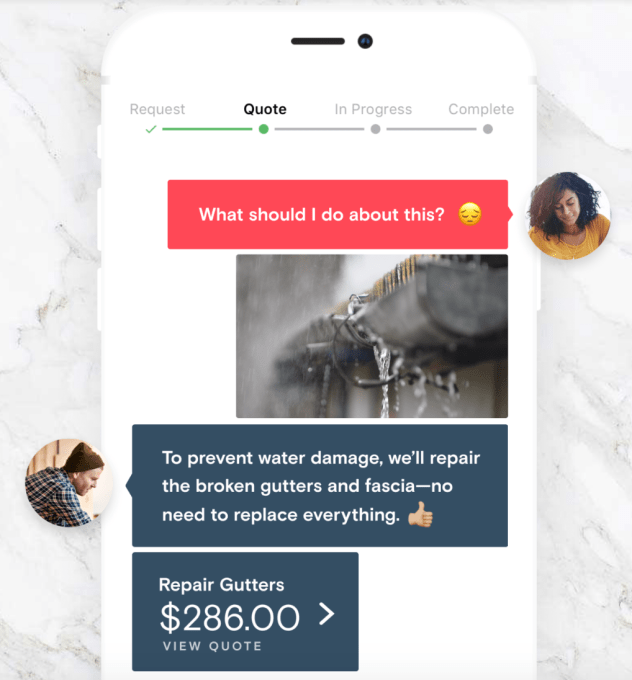
Users fire up the app, browse a list of common services, get connected to a concierge over chat and tell them about their home maintenance needs while sending photos if necessary. The concierge then scours the best vendors and communicates the job in detail so things get done right the first time, on time. They come back in a few minutes with either a full price quote, or a diagnostic quote that gets refined after an in-home visit. Customers can schedule visits through the app, and stay in touch with their concierge to make sure everything is completed to their specifications.

The follow-through is what sets Setter apart from directory-style services like Yelp or Thumbtack . “Other companies either take your request and assign it to the next available contractor or simply share a list of available contractors and you need to complete everything yourself,” a Setter spokesperson tells me. They might start the job quicker, but you don’t always get exactly what you want. Everyone in the space will have to compete to source the best pros.

Though potentially less scalable than Thumbtack’s leaner approach, Setter is hoping for better retention as customers shift off of the Yellow Pages and random web searches. Thumbtack rocketed to a $1.2 billion valuation and had raised $273 million by 2015, some from Sequoia (presenting a curious potential conflict of interest). That same ascent may have lined up the investors behind Setter’s $2 million seed round from Sequoia, Hustle Fund and Avichal Garg last year. Today’s $10 million Series A also included Hustle Fund and Maple VC. 

The toughest challenge for Setter will be changing the status quo for how people shop for home improvement away from ruthless bargain hunting. It will have to educate users about the pitfalls and potential long-term costs of getting slapdash service. If Laliberté wants to fulfill his childhood mission, he’ll have to figure out how to make homeowners value satisfaction over the lowest sticker price.