Year: 2018

02 Nov 2018

Match says Bumble is dropping its $400M lawsuit, but this battle isn’t over

Bumble and Match’s ongoing legal battles are continuing today. According to a statement released by Match Group this morning, Bumble is dropping its $400 million lawsuit against Match, which had claimed Match fraudulently obtained trade secrets during acquisition talks. However, Bumble is preparing to refile its suit at the state level, we’re hearing.

If you haven’t been following, the two companies have been doing battle in the court system for some time after Match Group failed to acquire Bumble twice – once in a deal that would have valued it at over $1 billion.

Bumble claimed Match then filed a lawsuit against it to make Bumble appear less attractive to other potential acquirers. Match’s suit claims Bumble infringed on patents around things like its use of a stack of profile cards, mutual opt-in, and its swiped-based gestures – things Tinder had popularized in dating apps.

Bumble subsequently filed its own lawsuit in March 2018, this one claiming that Match used acquisition talks to fraudulently obtaining trade secrets. It says this is not a countersuit, but its own separate suit. (This is the one being discussed today by the companies.)

Match says it wasn’t served papers for Bumble’s suit. But Bumble CEO Whitney Wolfe had said they delayed serving papers to give Match a chance to settle.

After a failure to settle, Bumble announced on September 24, 2018 that it would be serving Match, and shared news of its IPO plans. The $400 million suit claims Match had asked for “confidential and trade secret information” in order to make a higher acquisition offer for Bumble, but that no subsequent offer came as result.

Match says Bumble asked the courts to drop its lawsuit just a few weeks after this announcement, and believes the whole thing is just a PR stunt around Bumble’s IPO.

Match today says it’s not opposed to the lawsuit being dropped. But it is now seeking declaratory judgements that will force these issues to be litigated in the right forums, it says.

It points out that Bumble had filed its state petition in Dallas County, rather than respond with counterclaims to Match’s suit in the Western District of Texas – “less than 100 miles from Bumble’s Austin headquarters.”

It asked the case to be transferred to federal courts in the Western District, where its IP case is pending.

Now, Match says that Bumble is asking the courts to drop its claims against Tinder’s parent company.

“We’re not opposing their request to dismiss their own claims, but we’re seeking declaratory judgements that will force these issues to be litigated in the right forums,” says a Match spokesperson. “As we say in section 132 of the amended counterclaim: ‘Match will not simply wait until Bumble decides whether or not it wants to pursue these claims – likely in connection with Bumble’s next media blitz. Match intends to litigate these baseless allegations now, and Match intends to conclusively disprove them.'”

Bumble responded this morning, by saying it plans to continue to defend its business against Match.

“Match’s latest litigation filings are part of its ongoing campaign to slow down Bumble’s momentum in the market. Having tried and failed to acquire Bumble, Match now seems bent on trying to impair the very business it was so desperate to buy,” a Bumble spokesperson says. “Bumble is not intimidated and will continue to defend its business and users against Match’s misguided claims.”

It declined to comment on how, but we understand that the change from a state court system to federal courts is in play here. Bumble wanted to litigate at the state level, which means it has to dismiss its claims in the federal courts. Match could then accurately say Bumble’s lawsuit is being dropped, but that doesn’t necessarily mean Bumble’s plans have changed.

We understand that Bumble is now preparing to refile its case in the state court system, but it hasn’t done so yet.

02 Nov 2018

Vince Staples has fun with Google Maps in new video

Vince Staples’ latest record, FM!, drops today on Def Jam records — that’s some very good news from one of the best and brightest rappers in the game today. Staples is celebrating the release by giving us a glimpse into his home of North Long Beach, California (Norfy, as it were) the same way we all experience the world these days: Google Maps.

The video for the single “Fun” — which also features Oakland hip-hop mainstay E-40 — captures the idiosyncrasies of Google’s Street View right down to the blurry transitions. The novel execution aside, things captured by the fictional Street View car are tellingly not always as positive as the track’s three-letter title implies. The shots culminate with the arrest of three youths on bicycles and retaliation against the camera that brings to mind a recent Douglas Rushkoff title.

It’s a well-executed video for a great track from one of the most dynamic voices in hip-hop today. Just maybe don’t listen with the sound on at work.

02 Nov 2018

The final season of House of Cards is out now

The ultimate chapter of the political drama House of Cards is officially out.

The Netflix original series is in its sixth and final season, and without a new lead.

Following sexual misconduct allegations against Kevin Spacey last year, Netflix halted production on Season 6 to review the matter. Shortly thereafter, Spacey was fired from the series and the final season was rewritten.

Claire Underwood (Robin Wright) takes center stage to close out the series, assuming the Presidency following the resignation of her husband.

House of Cards has been nominated for 50 Emmys thus far, and won six, including Outstanding Lead Actress in a Drama, and Directing for a Drama Series.

The final season has eight episodes, and early reviews have been generally positive.

02 Nov 2018

Samsung’s Bixby may finally get more third-party integration soon

Poor Bixby. We admittedly haven’t had a lot of nice things to about Samsung’s smart assistant since launch — but that’s not for lack of potential. The company has promised great things since day one, but has been slow to deliver on, well, just about everything.

Third-party integration was supposed to be one of Bixby’s biggest selling points, but in the year and a half since launch, Samsung hasn’t offered a lot on that front. According to a new report from the Wall Street Journal, the hardware giant will shed more light on its plans at next week’s Samsung Developer Conference, with the launch of third-party “capsules.”

On the face of it, at least, the offerings sound fairly similar to the skills and actions we’ve seen on the competition, letting devs build their own custom responses. It’s something Samsung will really need to push if products like the upcoming Galaxy Home premium smart speaker are going to find any sort of market.

The HomePod competitor already looks like a tough sell as Samsung makes a steep climb further into the burgeoning smart home market, and high profile partnerships are going to be an important key to breaking in. Speaking of tricky propositions, the Journal story also reconfirms previous rumors Samsung will be showing off a folding phone at next week’s event.

02 Nov 2018

‘World of Warcraft: Classic’ demo limited to 60 minutes of playtime

Put away the Jolt, Blizzard is limiting the time gamers will be able to play the World of Warcraft: Classic demo. Basically, after playing for an hour, players will be logged off and will have to wait 60 minutes before resuming for another hour. The goal is to ensure a mass of players do not crash the servers, which, honestly, if the services crashed randomly, would be the most classic thing Blizzard could do to recreate the original WoW experience.

In a forum posting Blizzard says it hopes to lift the session limits as soon as possible.

Here’s some examples Blizzard provided to illustrate the session limits.

• If you play for 30 minutes and then log off for 60 minutes, when you come back you’ll have a fresh 60 minutes.
• If you play for 60 minutes, you’ll be disconnected and then have to wait 30 minutes before you can play again.
• If you play for 20 minutes, log off for 20 minutes, then play 40 more minutes, you’ll be logged off and wait 10 more minutes.

Blizzard previously stated the demo players would start out at level 15. The goal is to provide players ample time to feel out the different classes and the best way to do that is with a character with an established skill tree. However, characters are capped at level 19 and will not roll over to the full game once the demo is complete so enjoy it while it lasts.

02 Nov 2018

MyPart finds that next def jam

Picture it: you have the perfect song for Kelly Clarkson. It’s a mix of genres and styles best described as “Since U Been Gone” meets “911 Is A Joke.” How do you get it in front of Kelly so she can add it to her next album (imagine her singing “My heart is on fire when you’re not there/But the Austin fire department doesn’t care”)? You talk to MyPart.

MyPart lets aspiring creators and musicians submit stuff to their favorite artists. A vetting system separates the hits from the chaff and, by ensuring the artist doesn’t see unsolicited content, reduces lawsuits. MyPart, founded in 2016, has added a number of interesting features to its platform thanks to AI and machine learning.

“MyPart has recently finalized our seed round with $1M, and were named a MassChallenge 2018 top 10 startup award finalist,” said co-founder Matan Kollnescher. “This followed a $150k pre-seed round that enabled us to achieve an MVP, strategic industry partnerships and legal validation.”

Kollnescher was a former member of the Israeli Intelligence Corps and the other co-founder, Ariel Toli Gadilov, spent time inside Intel as a finance and legal advisor. Both are skilled musicians. They’ve also hired Evan Bogart, writer of Beyoncé’s “Halo” and Rihanna’s “SOS.”

The team soft-launched and have 2,030 users and hundreds of uploads. The platform is designed to ensure that good music floats to the top and not so good music doesn’t create false positives. In fact, say the founders, MyPart can even “read” a piece of music to see if it is stylistically relevant.

“Crowdsourcing art by conducting competitions is a problematic approach due to the multiple losers (since everyone are competing over the same project) and the need for active involvement and initiative defining exact projects,” said Kollnescher. “The publishing industry barely utilizes technology at all and most conservative competitors don’t have not will be able to easily develop differentiating technology to solve quality, quantity, and relevance issues – thus continuing to have immense scaling issues.”

The platform lets good musicians get discovered, a product that could truly be useful in today’s saturated media market.

“MyPart’s A.I. approach to the industry is the first of its kind; our platform sifts through thousands of data points and looks into the ‘soul’ of a song to then sort by relevance to the famous performing artist of our user’s choice,” he said. Luckily, Kelly Clarkson loves songs about reducing state budgets due to the inability of the Austin Police Department to get these squirrels out of my back yard.

02 Nov 2018

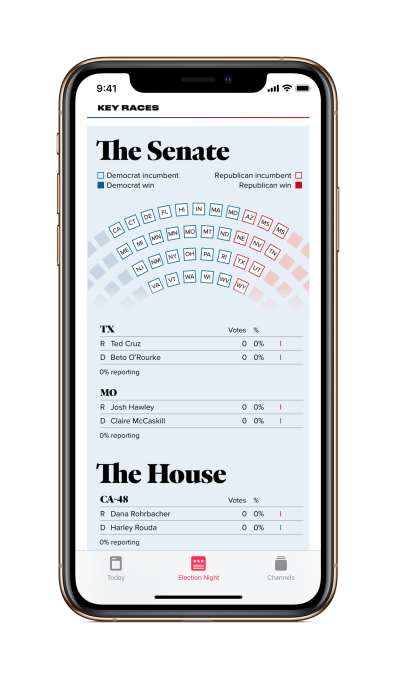
Apple News will launch a real-time election results hub on November 6

Apple is preparing to launch a new way for its customers to track election results. The company, on 8 PM ET on November 6, will swap out the existing Midterm Elections section in the Apple News app, and replace it with a new Election Night section instead. This section will also replace Apple News’ Digest tab at the bottom-center of the app, in order to lead users directly to the special section where they’ll be able to track the live results, updates on key races, latest developments and more.

The company is partnering with the Associated Press for its real-time election results, as do many news organizations thanks to AP’s history and experience with verifying results.

Here, Apple will use that AP data to inform a number of dynamic infographics as well as offer a complete list of federal election results in every state, including House and Senate seats.

These results will update every minute, or you can just “refresh” the page manually to force the update at any time.

If the balance of power in either the House or the Senate is determined by way of the incoming results, Apple News will publish a special alert at the top of the feed and a pop up notification, as well.

The Key Races section, meanwhile, offers another set of live updating infographics, showing the live results from the most interesting House, Senate or Gubernatorial races.

Another section will focus on the latest developments – meaning breaking news headlines and stories related to election night coverage. This will feature news from a variety of sources including Axios, Politico, The Washington Post, Fox News, CNN, The New York Times, CBS, and others.

CBS News, CNN, and Fox News will also contribute video clips to the Election Night hub, while ABC will offer a live video feed. Another live video feed from NBC News will appear in a widget alongside the Live Results infographic.

Apple says users won’t have to authenticate with their TV provider on election night to watch the videos in the hub.

A diversity of news sources was important to Apple, which wanted to have a range of options for people to read, as well as a way to present the news so people could see how it’s being processed across the ideological spectrum.

More importantly, all the news coverage in the hub isn’t being driven by algorithms. For Apple News’ team, Election Night is an all-hands-on-deck type of situation involving real human editors. In fact, human editorial oversight is a key difference between Apple’s approach to news aggregation and curation, compared with competitors like Google, Twitter and Facebook – all of which have come under fire for their outsized roles in the spread of information, and, at times, disinformation.

Apple has been taking the opposite approach, by staffing up an editorial team of former journalists, insteading of leaving news curation to technology.

Apple News is available across iPhone, iPad, and as of this year, Mac devices.


02 Nov 2018

Fortnight’s funding royale, China struggles, and Coinbase gets a boost to $8 billion

Hello and welcome back to Equity, TechCrunch’s venture capital-focused podcast, where we unpack the numbers behind the headlines. This week, we missed Alex Wilhelm, who was sunning himself somewhere (vitamin D deficit), but we had a rollicking time nonetheless with TC’s very excellent VC reporter Kate Clark, along with our always dependable co-host Danny Crichton and, in a bit of perfect timing, investor Brad Twohig of Lightspeed Venture Partners, whose firm participated in one of the week’s biggest financings, a $1.25 billion round for Epic Games, maker of the gaming smash hit “Fortnite.”

It wasn’t just a lot of moolah for Epic, which was founded roughly 25 years ago but unleashed “Fortnite” on the world roughly a year ago. The deal is fascinating because Epic is one of the hottest stories of the year and, as Twohig allowed, probably also one of most the most oversubscribed fundings of 2018, so we wanted to talk with him about how it all went down.

Also on the docket this week: sinking stock prices in China. Video games and the politics behind them are causing huge problems in the country, and Tencent (which conveniently owns a sizable stake in Epic Games), has lost almost 40 percent of its value this year over fears about China’s crackdown on the sector. In fact, huge losses across the board for Chinese stocks are putting enormous pressure on IPOs;  we took a lot at whether that contagion could possibly hit Silicon Valley.

And we talked about Coinbase, which is now valued at a whopping $8 billion by investors that provided the company with $300 million in new funding, even as the value of most cryptocurrencies continues to fall through the floor.

What will Coinbase look like when it’s all grown up? Investors like Tiger Global, Wellington Management and Y Combinator clearly have a better idea than we do, but we took at a stab at it anyway!

Last but not least, we definitely dished about IBM and the major feat it pulled off last weekend, which was to close the largest software acquisition in history by announcing its intention to acquire open source cloud provider Red Hat for $34 billion. Not only does it change the dynamics of the cloud wars between IBM, Google, Amazon and Microsoft, but the deal is also very much about open source, as Twohig noted.

Not discussed, but still interesting: how deeply satisfying the deal must be for Red Hat’s founders, one of whom, former CEO Bob Young, was reportedly unemployed and working out of his wife’s sewing closet when he started Red Hat in 1993.

We think/hope you’ll enjoy this one.

Also, we were kidding about Alex. He has a surplus of personality, not a deficit of vitamin D. (Also, he was stuck in a meeting when we were recording.)

See you next week, everyone.

Equity drops every Friday at 6:00 am PT, so subscribe to us on Apple PodcastsOvercast, Pocket Casts, Downcast and all the casts.

02 Nov 2018

The Zortrax Apoller safely smooths 3D prints

The Zortrax Apoller, a Smart Vapor Smoothing device that uses solvents to smooth the surface of 3D-printed objects. The resulting products look like they are injection molded and all of the little lines associated with FDM printing will disappear.

The system uses a microwave-like chamber that can hold multiple parts at once. The chamber atomizes the solvent, covering the parts, and lets the solvent do its work. Once its done it then sucks the excess vapor back into a collection chamber. The system won’t open until all of the solvent is gone, ensuring you don’t get a face full of acetone. This is an important consideration since this is sold as a desktop device and having clouds of solvent in the air at the office Christmas party could be messy.

“Vapor-smoothed models get the look of injection-molded parts with a glossy or matte finish depending on the filament used. With a dual condensation process, a 300ml bottle of solvent can be used for smoothing multiple prints instead of just one. This efficiency means that the combined weekly output of four typical FDM 3D printers can be automatically smoothed within one day without loss of quality,” the company wrote.

Given the often flimsy structural quality of FDM prints, this smoothing is more cosmetic and allows you, in theory, to create molds from 3D printed parts. In reality these glossy, acetone smoothed parts just look better and give you a better idea what the finished product – injection-molded or milled – will look like when all is said and done.

02 Nov 2018

Alibaba cuts its revenue forecast as growth slackens

Alibaba’s long stretch of growth finally broke after the Chinese e-commerce giant reported somewhat underwhelming financial results for its Q2 2019 quarter. (A little confusing but Alibaba’s quarters are actually a little ahead of the actual date and time.)

The company fell short of market expectation as it rang up RMB 85.15 billion ($12.4 billion) in revenue during Q2 2019, coming in slightly below Bloomberg’s estimate of RMB 86.58 billion. The company has also cut its forecasted annual revenue target by four to six percent — within a range of RMB375 billion to RMB383 billion — although it did not provide an explanation for this adjustment. Possible reasons may include China’s slowing economy, negative sentiment around the U.S. trade war and more.

The company may see its revenue bounce back overtime as it explores novel ways to book more advertising revenues. It says in the report that it “decided not to monetize, in the near term, incremental inventory generated from growing users and engagement on our China retail marketplaces.” 

TechCrunch has come to understand that Alibaba is testing out a new AI-driven advertising system that could create more “inventory”, i.e. advertising space, but it’s delaying monetization as its mainly small and medium-sized merchants undergo an economic slowdown.

But this is far from doom and gloom — and Alibaba proudly trumpeted its results as “industry-leading” in case you wondered.

The e-commerce giant’s revenue is still growing at a decent rate of 54 percent year-over-year, but this quarter marks the first time its revenue growth has fallen under 55 percent since its 3Q 2017 — that was some seven quarters ago in January 2017.

The company posted a net income of RMB18.2 billion ($2.66 billion) for the period, which was up five percent year-over-year.

Alibaba’s commerce business, its most lucrative division, grew 56 percent year-over-year to reach RMB72.48 billion ($10.55 billion) in revenue, down from a 61 percent growth the previous quarter, but factors influencing this quarter can be found elsewhere.

One major reason for the so-so financial result, Alibaba said, is that it has been investing heavily in logistics, entertainment, international expansion, and neighborhood services. In August, it officially consolidated its online-to-offline (O2O) play when it merged its Koubei local services platform with Ele.me, the food delivery network it acquired in a deal that also saw Alibaba and SoftBank pump a $3 billion investment.

Some other notable figures: mobile monthly active users rose by 32 million in three months to hit 666 million while active annual consumers (a figure that shows how many people have bought on Alibaba over the last year) went up by 25 million to reach 601 million.

Fast-growing segments cloud and international e-commerce continue to develop at speed, growing at 90 percent and 55 percent annually, respectively, although both figures were down slightly on the previous quarter’s growth.

Shares of the e-commerce behemoth are trading up five percent in the pre-market. The company is bracing for Singles Day, an annual event that has turned into the world’s largest shopping spree since it started ten years ago.

This year will see Alibaba continue to drive growth offline with a plan to deploy retail solutions to 200,000 stores across China, while it is also putting more emphasis on expanding the festival into its international markets. In particular, that’s likely to be India, where it is an investor in Paytm, Southeast Asia, where it owns and operates Lazada, and Russia, where it recently launched a joint venture focused on e-commerce, games and social services.