Year: 2018

01 Nov 2018

Campaign tool supplied to UK’s governing party by Trump-Pence app dev quietly taken out of service

An app that the UK’s governing party launched last year — for Conservative Party activists to gamify, ‘socialize’ and co-ordinate their campaigning activity — has been quietly pulled from app stores.

Its vanishing was flagged to us earlier today, by Twitter user Sarah Parks, who noticed that, when loaded, the Campaigner app now displays a message informing users the supplier is “no longer supporting clients based in Europe”.

“So we’re taking this opportunity to refresh our campaigning app,” it adds. “We will be back with a new and improved app early next year – well in time for the local elections.”

(Bad luck, then, should there end up being another very snap, Brexit-induced UK General Election in the meanwhile, as some have suggested may yet come to pass. But I digress… )

The supplier of the Conservative Campaigner app is — or was — a US-based add developer called uCampaign, which had also built branded apps for Trump-Pence 2016; the Republican National Committee; and the UK’s Vote Leave Brexit campaign, to name a few of the political campaigns it has counted as customers.

Here’s a few more: The (pro-gun) National Rife Association and the (anti-abortion) SBA List.

We know the name of the Conservative Campaigner app’s supplier because this summer we raised privacy concerns about the app — on account of its use of uCampaign’s boilerplate privacy policy, if you clicked to read the app’s privacy policy earlier this year.

The wording of uCampaign’s privacy policy suggested the Conservative Campaigner app could be harvesting users’ mobile phone contacts — if they chose to sync their contacts book with it.

The privacy policy for the app was subsequently changed to point to the Conservative Party’s own privacy policy — with the change of privacy policy taking place just before a tough new EU-wide data protection framework, GDPR, came into force on May 25 this year.

Prior to May 23, the privacy policy of the Conservatives’ digital campaigning app suggests it was harvesting contacts data from users — and potentially sharing non-users’ personal information with entities of uCampaign’s choosing (given, for example, the company’s privacy policy gave itself the right to “share your Personal Information with other organizations, groups, causes, campaigns, political organizations, and our clients that we believe have similar viewpoints, principles or objectives as us”).

This sort of consentless scraping of large amounts of networked personal data — by sucking up information on users’ friend groups and other personal connections — has of course had a massive spotlight thrown on it this year, as a result of the Facebook Cambridge Analytica data misuse scandal in which the personal data of tens of millions of Facebook users was extracted from the social network via a quiz app that used a (now defunct) Facebook friends API to grab data on non-users who would not have even had the chance to agree to the app’s terms.

Safe to say, this modus operandi wasn’t cool then — and it’s certainly not cool now.

Politicians all over the globe have been shaken awake by the Cambridge Analytica scandal, and are now raising all sorts of concerns about how data and digital tools are being used (and or misused and abused).

The EU parliament recently called for an independent audit of Facebook, for example.

In the UK, a committee that’s been probing the impact of social media-accelerated disinformation on democratic processes published a report this summer calling for a levy on social media to defend democracy. Its lengthy preliminary report also suggested urgent amendments to domestic electoral law to reflect the use of digital technologies for political campaigning.

Though the UK’s Conservative minority government — and the party behind the now on-pause Conservative Campaigner app — apparently disagrees on the need for speed, declining in its response last week to accept most of the committee’s laundry list of recommended changes.

The DCMS committee’s inquiry into political campaigns’ use (and misuse) of personal data continues — now at a transnational level.

An ethical pause?

Shortly after we published our privacy concerns about the Conservative Campaigner app, the UK’s data protection watchdog issued its own a lengthy report detailing extensive concerns about how UK political parties were misusing personal data — and calling for an ethical pause on the use of microtargeting for election campaigning purposes.

Which does rather beg the question whether the Conservative Campaigner app going AWOL now, until a reboot under a new supplier (presumably) next year, might not represent just such an ‘ethical pause’.

The app is, after all, only just over a year old.

We asked the Conservative Party a number of questions about the Campaigner app via email — after a press office spokeswoman declined to discuss the matter on the telephone.

Five hours later it emailed the following brief statement, attributed to a Conservative spokesperson:

We work with a number of different suppliers and all Conservative party campaigning is compliant with the relevant data protection legislation including GDPR.

The spokesperson did not engage with the substance of the vast majority of our concerns — such as those relating to the app’s handling of people’s data and the legal bases for any transfers of UK voter data to the US.

Instead the spokesperson reiterated the in-app notification which claims “the supplier” is no longer supporting clients based in Europe.

They also said the party is currently reviewing its campaigning tools, without providing any further detail.

We’ve included our full list of questions at the bottom of this post.

We’ve also reached out to the ICO to ask if it had any concerns related to how the Conservative Campaigner app was handling people’s data.

Similarly, the former deputy director & head of digital strategy for the Conservative party, Anthony Hind, declined to engage with the same data protection concerns when we raised them with him directly, back in July.

According to his LinkedIn profile he’s since moved on from the Conservatives to head up social media for the Confederation of British Industry.

For this report we also reached out to uCampaign’s founder and CEO, Thomas Peters, to ask for confirmation on the company’s situation vis-a-vis European clients.

At the time of writing Peters had not responded to our emails. We’ll update this story with any uCampaign response.

The company’s website still includes the UK Conservative Party listed as a client — though the language used on the webpage does not make it explicit whether or not the party is a current client…
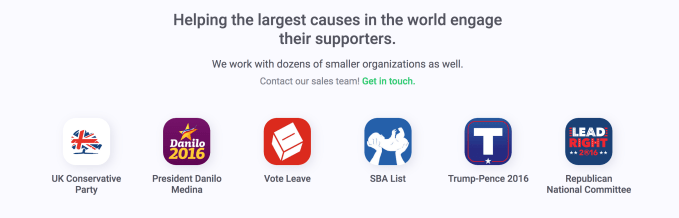
Another graphic on the same page plots the UK flag on a world map depicting what uCampaign dubs its “global platform”, where it’s marked along with several other European flags — including Ireland, France, Germany and Malta, suggesting uCampaign has — or had — multiple European clients.

Here’s the full list of questions we put to the Conservatives about their campaigner app. To our eye it has answered just one of them:

Can you confirm — on the record — the reasons for the app being pulled?

Does the Conservative Party intend to continue working with uCampaign for the new campaign app that will relaunch next year? Or does the party have a new supplier?

If the latter, where is the new supplier based? In the UK or in the US?

Did the Conservative Party have any concerns at all related to using uCampaigner as a supplier? (Given, for example, concerns flagged about its data privacy practices by one of the DCMS committee’s recent reports — following an inquiry investigating digital campaigning.)

If the Conservative Party was aware of data privacy concerns pertaining to uCampaign’s practices can you confirm when the party became aware of such concerns?

Was the party aware that the privacy policy it used for the app prior to May 23, 2018 was uCampaign’s own privacy policy?

This privacy policy stated that the app could harvest data from users’ mobile phone contacts and share that data with unknown third parties of the developer’s choosing — including other political campaigns. Is the Conservative Party comfortable with having its supporters’ data shared with other political campaigns?

What due diligence did the Conservative Party carry out before it selected uCampaign as its app supplier?

After signing up the supplier, did the Conservative Party carry out a privacy impact assessment related to how the app operates?

Please confirm all the data points that the app was collecting from users, and what each of those data points was being used for

Where was app user data being processed? In the US, where uCampaign is based, or in the UK where potential voters live?

If the US, what was the legal basis for any transfer of data from UK users to the US?

Is the Conservative Party confident its use of the campaigner app did not breach UK data protection law?

Earlier this year the former Cabinet Minister Dominic Grieve suggested that the bosses of tech giants involved in the Cambridge Analytica data misuse scandal should be jailed for their part in abusing online data for political and financial gain. Does the Conservative Party support Grieve’s position on online data abuse?

Has anyone been sacked or sanctioned for their part in procuring uCampaign as the app supplier — and/or overseeing the operation of the Conservative Campaigner app itself?

Will the Conservative Party commit to notifying all individuals whose data was shared with uCampaign without their explicit consent?

Can the Conservative Party confirm how many individuals had their personal data shared with uCampaign?

Has the Information Commissioner’s Office raised any concerns with the Conservative Party about the Campaigner app?

Has the Conservative Party itself reported any concerns about the app/uCampaign to the ICO?

01 Nov 2018

Soyuz bounces back after failure: Crewed mission to Space Station launches early next month

The high profile but fortunately non-lethal failure of a crewed mission atop a Soyuz rocket in October has been investigated thoroughly enough that American, European, and Russian space agencies are willing to ride aboard the venerable launch system. Roscosmos announced that a crewed mission will fly to the International Space Station on December 3, less than two months after the anomaly.

It was clear from the moment of the accident, from which Astronaut Nick Hague and Cosmonaut Alexey Ovchinin drifted down to a safe landing, that whatever the global space community decided to do, they needed to do it fast. Soyuz is the only rated and tested crew launch system out there, and if it were to be grounded for long the ISS would soon be untenanted.

Fortunately Roscosmos made the investigation of the failure a priority and today issued its findings:

The launch ended up with a launcher failure caused by abnormal separation of one of the strap-on boosters (Block D) that hit with its nose the core stage (Block A) in the fuel tank area. It resulted in its decompression and, as consequence, the space rocket lost its attitude control.

The abnormal separation was caused by the non-opening of the lid of the nozzle intended to separate aside Block D oxidizer tank due to the deformation of the separation sensor pin (bended by 6˚45‘). It was damaged during the assembling of the strap-on boosters with the core stage (the Packet) at the Baikonur Cosmodrome.

So basically one of the boosters got stuck and the stages couldn’t separate properly. You can see it happen in the footage released by Roscosmos today. I’ve made a gif of the relevant part; the booster on the left clearly doesn’t come off properly like the others, and that causes the whole rocket to change attitude.

There would have been no doubt inside the capsule that things had gone totally sideways, literally and figuratively.

The issue was identified by investigators and other possibly affected rocket assemblies isolated, and already another Soyuz rocket (though a different model; there are several with very similar names) has taken off.

More importantly the authorities are confident enough in this explanation and in the Soyuz system that two missions have already been scheduled: a cargo mission on November 16 and a crewed one on December 3.

Cosmonaut Oleg Kononenko, NASA’s Anne McClain, and the Canadian Space Agency’s David Saint-Jacques will be on board. Will they be more nervous because of the recent failure, or less nervous because of the excess scrutiny to which their vehicle will have been subjected? Probably a little bit of both.

01 Nov 2018

Super Smash Bros. Ultimate gets new characters and a social video platform

Super Smash Bros. Ultimate isn’t out until December 7, but Nintendo’s been doing an admirable job milking the fighting game for announcements since it was unveiled back at E3. The company held another Nintendo Direct this morning, to offer up a few more morsels without about a month out from launch.

The biggest piece of news here is the launch of Smash World. The platform continues the gaming giant’s recent pivots toward mobile with a video posting service available through the Switch app.

Details are still pretty thin, with the promise of more to be “revealed in the future,” but Nintendo says it will allow players a place to “post and watch videos, as well as other fun features.” Essentially, it’s a way to dip a toe into the smartphone market without going all-in by way of a Smash Bros. mobile game.

The other big reveal are two additions to the massive 74 starting characters available at launch. Street Fighter’s Ken will be joining sparring buddy, Ryu, along with Pokemon, Incineroar. Oh, and for good measure, Nintendo’s also tossing in the familiar Mario baddie, Piranha Plant via download code for those who order early.

01 Nov 2018

Foursquare partners with TripAdvisor

Foursquare, the former location-based social network turned enterprise location data platform, has today announced a new partnership with TripAdvisor.

TripAdvisor will be using Foursquare’s Pilgrim SDK, launched in March 2017, to help the platform better serve users with contextually relevant, real-time information based on their location.

Alongside the 13 billion check-ins accumulated on Foursquare’s apps since inception, the company also has analytics based on a consumer panel of more than 70 million people in the U.S. — 10 million of whom that have opted into always-on location sharing. This data is the same data that powers Foursquare’s own apps, like, for example, when you get a push notification with a menu tip as you sit down for dinner at a restaurant.

Pilgrim SDK and Foursquare’s other enterprise products give other apps the ability to communicate with users with contextual relevance, and that’s what TripAdvisor is looking to do through this partnership.

TripAdvisor recently launched a new app and website that focuses on social sharing and personalized recommendations. Foursquare’s Pilgrim SDK compliments TripAdvisor technology, ensuring that hyper-personalized recommendations are truly accurate.

TripAdvisor reaches more than half a billion users worldwide, which significantly increases the pool of user data Foursquare can potentially access.

This comes on the heels of Foursquare’s Series F financing round, which was announced last month.

01 Nov 2018

Hulu launches add-on bundles focused on entertainment and Spanish programming

Earlier this month, Hulu CEO Randy Freer said the company would be revamping its Live TV service by dropping some entertainment channels and adding on smaller bundles. Now, that change has come about. The streaming service announced this week the launch of two new add-ons which focus on entertainment and Spanish programming.

The add-ons are actually small bundles of channels instead of individual networks.

A new $4.99 per month “Español” add-on will offer live news and sports networks, including ESPN Deportes, NBC Universo, CNN En Español and History Channel En Español.

Another $7.99 per month “Entertainment” add-on will offer the live feeds from the live network feeds of LMN (Lifetime Movie Network), FYI, DIY Network, Cooking Channel and CNBC World.

And, later this year, Hulu will bring Discovery Networks to its service, where its channels will also join one of these two add-ons. Those channels include Discovery en Español, Discovery Familia, Discovery Family, Science and Destination America.

While Hulu with Live TV today already offers premium add-ons including HBO, Cinemax, Showtime, and Starz, this is the first time its sold add-on channel bundles outside of its core lineup.

The additions make Hulu seem more like Sling TV, the competitor from Dish that has for a long time marketed itself as a low-cost way to stream live TV, starting at $25 per month. Users customize their Sling lineup through various add-on packages that start at $5 per month for bundles like a “lifestyle extra” or “kids extra,” for example.

“This is just another way we are providing viewers with more choice and options in creating their own personal, complete TV experience, all in one place,” a Hulu spokesperson said. “With these new Español and Entertainment package add-ons — and the addition of the STARZ premium add-on last week— we’re giving Hulu with Live TV subscribers easy access to even more of the content they love.”

However, the addition of the add-ons did impact Hulu’s core package on a couple of fronts.

The company emailed subscribers to inform them that, as of October 30, it has moved FYI and Lifetime Movies from Hulu with Live TV to the new Entertainment add-on instead. Users are being given a one-month free trial as a part of this transition, the email also says. If they take no action, the Entertainment add-on will be removed from their account on November 30.

Freer had told The Information earlier in October that the changes to Hulu will allow it to reduce costs and free up more funds to spend on original content.

Hulu has just recently made a name for itself on that front. It won its first Emmy last year for “The Handmaid’s Tale,” and picked up a few more this year, as well. But it’s nowhere near beating streaming rivals HBO, Netflix and Amazon, as of yet. It hopes that selling customers more add-ons bundles will help it to grow revenues and invest in other areas.


01 Nov 2018

Retail-as-a-service provider Leap raises $3M and launches first store

The past decade in retail has been the golden age of direct-to-consumer (D2C) and digitally native vertical brands (DNVBs) that use the internet to communicate with customers, execute transactions, handle distribution and offer better economics.

But as small independent startups have scaled into unicorn territory and as countless brands have saturated digital channels, customer acquisition has gotten harder and costlier.  Companies are now trying to meet customers with different purchase habits by developing physical stores. 

However, building an effective brick-and-mortar presence can be expensive and risky for DNVBs, requiring resources outside their core competencies.  Chicago-based startup, Leap, is hoping to make it easier for digital brands to grow physical retail footprints without the typical risks of store development by taking care of the entire process for them.

Leap offers a full-service platform covering the complete life cycle of a brand’s brick-and-mortar launch.  In addition to owning the lease and the financial commitments that come with it, Leap covers everything from staffing, experiential design, tech integration, and even day-to-day operations. 

(Photo by Alexander Scheuber/Getty Images)

Less than a year since its founding, Leap announced today the launch of its first store and the close of a $3 million seed round, led by Costanoa Ventures, with participation from Equal Ventures and Brand Foundry Ventures.

The debut store will act as the first Chicago location for Koio, the high-end D2C sneaker brand backed by headline-grabbing names like the Winklevoss twins, director Simon Kinberg and actor Miles Teller. 

Instead of paying a monthly lease fee, along with all the other variable costs associated with operating a physical store, companies like Koio pay Leap on a percent of sales basis, effectively minimizing risk and incentivizing performance. 

On top of minimizing development expense for brands, Leap believes its customer insights and intelligent logistics platform can help improve shopper engagement, increase customer traffic and drive brand lift.  If the startup’s thesis proves true, brands can improve both sides of their brick-and-mortar unit economics by reducing customer acquisition costs and amplifying customer value.

At its core, Leap simplifies a DNVB’s physical retail operations into a single line item on its P&L, allowing the company to focus on brand building and supply chain rather than retail strategy, while also allowing them to scale faster. 

With the latest fundraise, the company hopes to build out its team and continue new location expansion.  Longer-term, Leap’s co-founders hope to build a vast network of sites, that can help provide intelligence around new store development and shopper preference.

“We want to be the platform to help brands go to market in the offline space”, said co-founder Amish Tolia.  “We want to help brands build direct-to-consumer relationships in local neighborhoods across the country and enable them to focus on what they’re best at.  Enable them to focus on product innovation, supply chain management, great marketing and brand building.”

A glimpse into the future retail

While Leap’s value proposition is straightforward, its business model points to a bigger trend in the world of retail.  

By opting to sell its software and brick-and-mortar services rather than creating its own brands, Leap effectively acts as a “retail-as-a-service” platform.  The as-a-service strategy is already quietly growing in popularity in the retail space, with companies like b8ta, the Internet of Things gadget retailer, launching its hardware-oriented “Built by b8ta” platform earlier this year.

Though likely heavy in upfront capital costs, retail-as-a-service businesses don’t have the same constant concern around supply chain, manufacturing, consumer acquisition and marketing spend.  And in certain pricing models based on a monthly fee or percent of square footage basis, platforms can see more stable revenues relative to pure retail startups.

From a brand perspective, DNVBs have been looking for ways to extend growth runways while minimizing the cost and uncertainty that deterred them from physical stores in the first place.  The as-a-service model can make brick-and-mortar retail a much more scalable engine, possibly even cooling rising concern around bubbling consumer valuations.

As more of the young digitally-born D2C giants resort to as-a-service companies to find marginal customers, we may see the rise of a new set of startups fighting to establish themselves as the platform on which brands operate.

If the last decade was defined by retail online, it’s possible that the next decade will be defined by retail-as-a-service.

And if you find yourself in Chicago, feel free to check out the Leap-enabled Koio Store at 924 W Armitage in Lincoln Park.

01 Nov 2018

The Autoblow A.I. brings machine learning to your lap

Dearest Martha,

I write to you from the cold wastes of Earth on the first day of the New Year, 2023, the third year of war, and so close to your own child’s decanting date that it pains me to think on thee. The machines have been unkind to this planet and I hope you are well situated on Mars where it is safe. The men in the platoon – Dutch, Brooklyn, Dandy, and French – all send a cheerful “Hello.” I think they are jealous that you are human.

I must tell you something, dearest Martha, as I feel I’ve been remiss in maintaining our marriage smart contract. I met here a machine, an Autoblow A.I., with which I had the briefest of dalliances. The robot, made by humans in the last century, approached me in a time of great pain. Zimmerman had just been destroyed by an ion cannon and I saw his flesh burn and his lungs become a meaty particulate. I could still taste him when the Autoblow offered me a night of solace and, Martha, I’m sorry to say I took it.

It was more human than human, Martha, but my shame will never end. The product, which cost $129 in original Earth dollars, came with two sleeves that simulated different parts of human anatomy. The robot had a unique system that grasped and pulled at my turgidity in ways that simulated real human contact. My body wracked with fear, pain, and guilt, I let it stroke me to issue with its A.I.-powered smarts. Then, face burning, I escaped back to barracks and slept fitfully, exhausted and morally broken.

And so I pray, Martha, that you will forgive me. I know that the robots killed your parents and that your hatred for them knows no bounds. But Martha, dear, understand that in that moment, on the streets of Old Singapore where the lights flicker with each cannon blast and the radiation rises like steam from the old sewers, I did not think of anything but my own loss and the deep sadness I feel for having left you and our embryo. This war will be over soon and we will soon return to each other’s arms. I will forget this scandalous experience and I hope you will be able to as well. Until then, Martha, look to this far blue star and think of me as I was before this disgusting behavior. I dream of the happiness we will share. The Autoblow meant nothing to me and you mean everything.

Your husband,
Miso Kale Post Malone

01 Nov 2018

Asana launches $19.99 Business tier to help managers handle multiple projects

Asana, the platform where people can create and track the progress of work projects, made its name originally as a place where individuals and smaller teams can create and track the progress of a specific project. Now, as the startup courts bigger organizations among its 50,000 paying organizations and millions of (paying and free) users globally, it is adding another tier for enterprises that are using Asana for multiple projects: Asana Business, priced at $19.95 per user, per month.

Aimed primarily at teams that have managers or executives overseeing multiple projects simultaneously — sometimes in the thousands for a single organization — the idea is that Business will have extra features to help designated people handle and triage that workload more effectively.

Asana co-founder and CEO Dustin Moskovitz

“Our role is to help leaders understand where their attention can be most useful and what to be focused on,” Dustin Moskovitz, pictured, the co-founder and CEO of Asana, said to me in an interview recently.

That focus on executives and managers is one part of the company’s bigger vision of where it sees its own place in the range of productivity tools that a business might use, alongside other areas like efficient storage (a la Dropbox, Box or another cloud-based service) or communication (eg, Slack, Workplace, Teams, etc.).

Asana is also not alone in its category: other alternatives include Airtable, Write, Trello, and Basecamp, another reason the company is on the path to continue innovating and finding ways to make its service more sticky.

The new Asana Business tier includes a couple of specific new tools that will differentiate it from Teams (Asana’s $9.99/user/month tier for groups of more than five) and Enterprise (the tier that you need to speak to an account manager to determine pricing). In all cases the pricing is based on buying an annual subscription: prices are higher if you pay by the month.

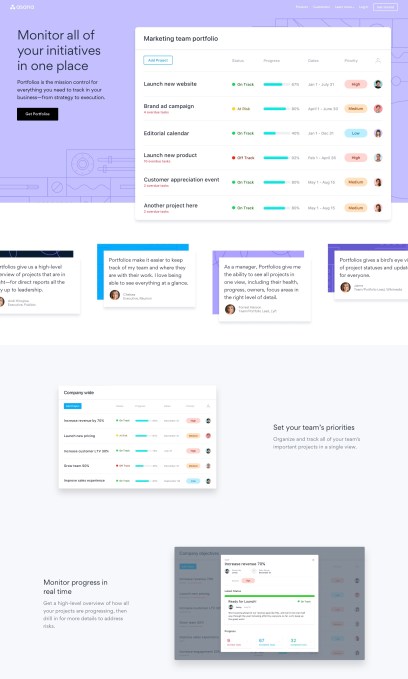
The first, Portfolio, will give a manager a way of viewing what everyone in an organization is working on in Asana — a “mission control” that provides a single view of what is going on, which can be useful for figuring out more big-picture progress or to oversee a larger project that has multiple streams of work within it.


Alongside that, it’s also soon going to launch another feature in Business called Workloads, which will let managers then assign people to projects or redeploy them, based on what they are seeing progress through the Portfolios tool.

The two features, Asana hopes, will mean that organizations will not only get better insights into their current projects on the platform, but might be enticed to buy into using it for more of them. Alex Hood, the company’s head of product (who joined a year ago after many years at Intuit) noted that it’s something that companies had already been trying to address themselves to some degree. “We’ve seen customers hack solutions together,” he said. So, it seemed like time to make it into a more formal tool, Hood said.

The company’s move to add another tier to generate more revenue comes on the heels of Asana raising $75 million on a $900 million valuation earlier this year — money that Moskovitz told TechCrunch is still largely in the bank.

“We’re not yet profitable, but we’re rapidly approaching it,” he said, describing Asana to me as a “high volume SaaS business, very efficient and very successful.” The company is not in sight of an IPO, he added, but it seems that it is just getting started on what more it might add to the platform to make it more sticky and useful to the average business user. 

Key on that roadmap, Hood said, is the use of more machine learning and other artificial intelligence tools in the creation of new features — something that the company first introduced through Timeline, introduced in March, which knits together different project threads to start creating a bigger overview of what is going on.

One new feature that Asana is working on is a way to highlight when projects might not be going to plan, or that there are areas that have yet to be addressed; and then to suggest ways of helping to fix things through the redeployment of people.

Another area that Asana is exploring is how to use AI to match people better to projects. Hood said that it’s now working on a system that might be able to suggest where an employee or team member might get assigned — for example, using the profile of a person that invited you into a team as an indicator of where you might be working.


01 Nov 2018

Peak Theory lines up media partners and funding as Cubcoats becomes a phenomenon

With a planned cartoon series coming up, partnerships in place with Major League Baseball, NBCUniversal and other media companies of heroic proportions, the founders creating the kids clothing phenomenon, Cubcoats, are on a roll.

Peak Theory, launched by longtime friends Zac Park (who’s 29) and 35-year-old Spencer Markel, is the company behind Cubcoats, a hoodie that transforms into a puppet (or a puppet that transforms into a hoodie?). With their first product, the two founders have achieved the kind of viral success in its first year that most companies only dream of.

Markel, a former mergers and acquisitions lawyer with DLA Piper, and Park, a product director at the design agency AKQA, first met in San Francisco through a mutual friend, and almost immediately began planning their escape from the corporate world.

Peak Theory founders Zac Park and Spencer Markel

“We thought to ourselves, what can we create that would bring over a novel and sticky concept that could sell well to parents and create a lasting brand relationship with kids,” Park said, in a statement. “We wanted a product that a child would get attached too, grow up with, and want to gift to their future kids.”

The two self-described kids at heart hit upon the idea of Cubcoats through a mutual love of Transformers and Mighty Morphin Power Rangers as children (and maybe as adults as well).

“We don’t have any kids, we were just big kids,” said Markel. 

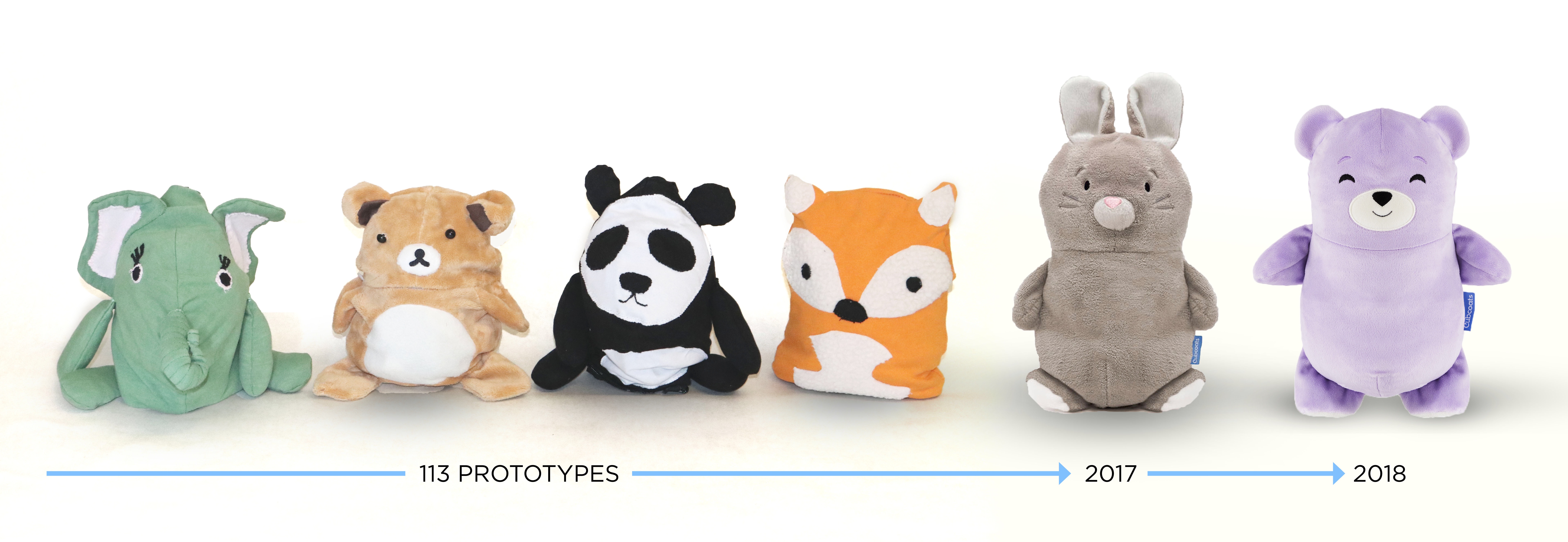
They started the process of creating hundreds of prototypes in September 2016, and by November of 2017 had hit upon the final designs for eight different puppets that turned into zippered hoodies for children. Each animal-inspired puppet had different characteristics and personalities and each came with a story tied to it.

The two-in-one clothes went viral. In its first full year, Cubcoats expects to pull in somewhere between $2 million and $5 million in revenue, according to the two founders. By July, 2018, the company had sewn up $5 million in financing from a who’s who of entrepreneurs and celebrity investors.

Institutional investors, including strategic partner Major League Baseball and celebrity investor Will Smith’s Dreamers Fund, came on board. So did individual angel investors like FabFitFun co-founders Daniel and Michael Broukhim, the actress Hilary Duff, Schwarzenegger scion, Patrick Schwarzenegger and Jen Rubio, the co-founder of Away.

The Harmon Brothers video production company, which is behind a number of direct-to-consumer marketing hits like the mattress company Purple and others is collaborating on a series of videos with the Peak Theory team and investing in the company, as well.

The idea of the company is to create a brand that’s not just the two-in-one Cubcoat,” said Markel.  “We’re trailblazing a new area of consumer products that we think will be pretty hot. There’s a burgeoning space in two-in-one products. We’re uniquely situated to design these two-in-one products and build our own IP in terms of content.”

Big media and entertainment companies are already clamoring to work with Peak Theory, the company said. Professional sports teams and leagues like Major League Baseball are only the first companies to publicly disclose their interest in the company.

“We’re two big kids at heart with very whimsical dreams,” said Markel. “We’ve tried very hard to be two people who are not necessarily from the industry to come in and create a novel industry and rethink some of the way we do consumer products… it’s been really fun.”

The company plans to expand the Cubcoats line to Canada, Australia and across Asia in 2019 — meaning popular favorites like Kali the kitty and Tim the puppy will be popping up in cities from Sydney to Seoul in addition to Seattle.

Peak Theory has partnered with Nordstrom for the holiday season to sell its Cubcoats in roughly 100 of its locations and will have pop-up shops of its own at The Grove mall in Los Angeles and the Americana mall in Glendale, Calif.

01 Nov 2018

Tool up for the midterms with this Facebook junk news aggregator

With the US midterms fast approaching purveyors of online disinformation are very busy indeed spreading their hyper-partisan junk on Facebook .

Their goal: Skewing democratic outcomes by putting out misleading, deceptive or incorrect information that’s packaged as real news about politics, economics or culture — yet presented in a way that panders to prejudices and is more likely to get virally spread on mainstream social media platforms where it has the chance to influence people’s views.

This has happened before; is still happening; and will keep on happening unless or until social media platforms get properly regulated.

In the meanwhile, what’s to be done? Arming yourselves and your friends with smart digital and news literacy tools to help shine a light on the kind of ridiculously over-inflated political nonsense that’s being passed around on all sides (albeit, not necessarily equally) seems like a good place to start.

Step forward, Oxford University’s Oxford Internet Institute (OII), which has just launched an aggregator tool which tracks what it terms “junk” political views being shared on Facebook — doing so in near real-time and offering various ways to visualize and explore the junk heap.

What’s “junk news” in this context? The OII says this type of political content can include “ideologically extreme, hyper-partisan, or conspiratorial news and information, as well as various forms of propaganda”.

This sort of stuff might elsewhere get badged ‘fake news’, although that label is problematical — and has itself been hijacked by known muck spreaders. (So ‘online disinformation’ tends to be the label of choice in academic and policy circles, these days.)

The OII is here using its own political propaganda content categorization — i.e. this term “junk news” — which is based on what it describes as “a grounded typology” derived through analyzing a large amount of political communications shared by US social media users.

Specifically it’s based on an analysis of 21.8 million tweets sent during the 2016 Presidential campaign period up til the 2018 State of the Union Address in the United States — applying what the Institute dubs “rigorous coding and content analysis techniques to define the new phenomenon”.

This involved labelling the source websites of shared links based on “a grounded typology that has been tested over several elections around the world in 2016-2018”, with a content source getting coded as a purveyor of junk news if it failed on 3 out of 5 of criteria of the typology.

(Examples of sources that are being judged junk via this method include the likes of Breitbart, Dailycaller and Dailywire to name just a few.)

Now to the tool itself:

The Visual Junk News Aggregator does what it says on the tin, aggregating popular junk news posts into a bipartisan thumbnail wall of over-inflated (or just out and out) BS.

Complete with a trigger warning for the risk of graphic images and language. Mousing over the thumbnails brings up any title and description that’s been scraped for the post in question, plus a date stamp and full Facebook reaction data.

Another tool — the Top 10 Junk News Aggregator — shows the most engaged with English language junk news stories posted to Facebook in the last 24 hours, in the context of the 2018 US midterm elections. (With engagement being based on total Facebook reactions per second of the post’s life.)

While the full aggregator tool supports keyword searches of the junk heap (by content and/or publisher), and also by time — allowing for sifting of junk posts published to public Facebook pages as recently as the last hour or up to a full month old.

Returned search results can be further sorted by time and reaction — across all eight types of possible Facebook reactions.

“The Junk News Aggregator is an interactive tool for exploring junk news stories posted on Facebook, particularly useful right now in the lead-up to the US midterms,” the Institute writes. “It is a  unique tool for systematically studying misinformation on Facebook in real time. It make visible the depth of the junk news problem, displaying the quantity and the content of junk news, as well as the levels of engagement with it.

“Junk news content can be sorted by time and by engagement numbers, as well as via keyword search (such as for a candidate, district, or specific issue). It also offers a visual overview and a top-10 snapshot of the day’s most engaged-with junk news.

“Our goal is to help shed light on the problem of junk news on social media, to make this issue more transparent, and to help improve the public’s media literacy. It also aims to help journalists, researchers, policy-makers, and social media platforms understand the impact of junk news on public life.”

It sent us a case study example to help demonstrate the “functionality and usefulness” of the tool (based on a search it conducted at 11:00am GMT, October 31, 2018).

For this example it used the search keyword “caravan”, selecting posts from the last day and filtering for the most shared posts — which served up several posts.

The most shared post was this one, below, from junk news source Chicks on the Right:

The Institute doesn’t make any comment on why it chose to track junk news on Facebook, specifically, vs other social media platforms (e.g. Twitter) — though there’s little doubt that Facebook’s platform remains the kingpin where skewing political views is concerned, given its massive user-base.

Meanwhile the company’s ongoing attempts to dampen the virality of democracy-denting junk shared on its platform continue — and continue to yield underwhelming results, given the size and gravity of the problem.

Also unconvincing: Facebook’s extremely recent attempts to install systems that verify the actual identity of political advertisers on its platform. Yet these self-imposed checks look to be off to a terrible start — as Facebook has just been shown hosting (and spreading) yet more fake information… ouch…

Putting your faith in Facebook to sort its shit out on the political front — and fast — looks about as sensible as trusting your pet turtle to a shark to babysit.

Much better to tool up and seek to stay on top of the junk heap yourself — at least until the world’s political representatives sort their shit out and get a proper handle on regulating social media.

In the meanwhile, don’t forget to vote.