Year: 2018

01 Nov 2018

Sonos delays Google Assistant integration until 2019, private beta to launch in 2018

Sonos today announced that Google Assistant will not be available on its products until at least 2019. The service was supposed to launch in 2018 but the company said in a blog posting it needs a bit more time. Additional information about timing will be released in early 2019, Sonos says.

Eager customers can sign up for a private beta as long as they agree to use the service extensively and respond to surveys within a few days.

Sonos products already have access to Amazon Alexa. Given Sonos’s longstanding notion of supporting all platforms, it makes sense that the company would want customers to have access to both Alexa and Google Assistant. That’s what makes Sonos compelling: They provide the hardware, and owners use whichever software platform they want.

This is clearly critical for Sonos. For a long time, Sonos provided the best-sounding smart speaker system on the market, but Amazon, Google and traditional speaker brands are quickly introducing speakers that provide similar sound quality. To keep up and justify the higher price of its hardware, Sonos needs to offer owners the best sound and the best software, and offering Google Assistant on its products is a key part of that goal.

01 Nov 2018

Folding screens are here, and they look crappy

I dunno, man. Maybe it’s 2018 getting me down. Maybe I’ve just been at this for too long. Maybe it’s the flu shot I just got. Whatever the case, count me among the unsurprised when some long awaited finally hits the market and, well, it looks rough.

The Royole Corporation (What they call the Quarter-Pounder Corporation in France) looks like a strong contender to be the first to market with a foldable display phone. And if these demos are to be believed, it’s not pretty. As ever, the gulf between official render (above) and real world execution (below) is pretty large.

The FlexPai is expected to ship in December for a starting price of ¥8,999 (which puts it around $1,300). That’s notably right around the same price as the similarly gimmicky/futuristic Red Hydrogen One, which, well, wasn’t great.

As has been noted by those who’ve actually experienced the phone, the execution looks rough, likely the result of a company pushing to make a name for itself by being first. Of course, being first to technology isn’t an instant recipe for success — just ask Pebble and a million other pioneering hardware makers.

And, of course, Samsung is expect to at least reveal its implementation for a folding phone in the next couple of weeks. That likely won’t be out before the end of year, however, as the company is reportedly going back and forth on different aspects of design — probably a good thing, to be honest.

It’s a bummer, but, then, life is pain. And like the FlexPai itself, everything breaks down if you fold it enough. That said, this Nubia X is a pretty cool take on the dual-screen from an established (if virtually unknown in the U.S.) company. So maybe there’s hope for us, after all.

I mean, probably not, but for now, maybe will have to suffice. Anyway, happy November. 

01 Nov 2018

How to build STEM toys

On chilly Saturday mornings my father would fire up the kerosene heater and get the back of our garage warm. He’d turn on the old radio, constantly tuned to the local public radio station, and Wait, Wait, Don’t Tell Me or Harry Shearer would come on, clearing away the static like gust of wind through cobwebs.

“Get your old clothes on,” he’d say, sticking his head into the warm kitchen. I’d still be in my pajamas. I’d grunt and grumble. I wanted to watch TV or play with my computer or read or do anything other than sit on a milk crate in a cold garage and fix the car.

But that’s what you did. If there was something to be done on the car back in 1985 – back when I was ten and my Dad was still alive – we did it ourselves. Everything in those old engines was accessible. Nothing was packed in, nothing was covered in plastic cowlings, hidden away and out of sight. Back then you could follow the brake lines through the car just by laying underneath it. You could see which belts needed tightening, which seals were leaking, and what was going on with the spark plugs. So that’s what we did. We replaced brake pads. We pulled out the oil plug and let black crude flow from the little hole like a solid thing into a cut off milk jug. We turned little screws to fix the idle. We gapped spark plugs, changed tires, and generally did everything we could do that didn’t require a mechanic’s lift.

Sometimes the fix was easy. We’d jack up each side and put on his studded snow tires in November, just after Thanksgiving, so we could drive, the road sizzling under us, to the Ohio River Valley and up slick hills to visit our cousins. We’d check fluids and top things off. We’d replace an air or oil filter.

And other times, when the problem was too big, he’d consult the Chilton repair manual. This manual held deep arcana about the Ford Fairmont or the VW Vanagon he owned. They made a manual for almost any car, like an O’Reilly book for mechanics. The books remained pristine in that grubby garage because that book held everything we needed to know about fixing everything in the car. He took good care of them.

When we pulled the manual I knew we’d be out there for a while. The kerosene heater would hiss as I rumbled my dad’s stuff, pulling out old copper wire and magazines, avoiding the places I knew he hid guns or old copies of Mayfair. I’d try to build my own things until he needed me. One year I was working on a banjo (it never played right) and another year I made a shoulder-mounted rocket launcher (I didn’t shoot my eye out). He’d call out for tools. Monkey wrench. Needle nose. 11mm. No, the other one. The jar full of bolts he collected over the years, unsorted. He knew where everything was and he knew when he needed it. I was his assistant in the slow surgery he performed.

And I’d take part. I’d hold something while he twisted. I’d get my small hands in where his big hands didn’t fit. I’d hold the trouble light, a yellow caged thing that burned you if you touched the metal bulb cage.

Once I sprinkled water on the hot bulb. It exploded and he explained thermodynamics to me as he picked glass out of the cage and screwed in a new light.

When we were done, after hours of slow, methodical work, he’d fire up the car and we’d go for a drive. The knock would be gone (or sometimes it would be worse). The brakes would work better, the steering would be stronger, the engine would purr instead of lope. We’d drive down the street to White Castle or BW3 or just down to the highway to open the thing up and see if still drove. It always did.

Tools, not toys

The last time I did my own work on a car was in Fairfax, Virginia. My brake pads were going and I figured I’d replace them. I knew how. I bought the Chilton, bought the pads, and sat in a parking structure, jacking up the car with a little screw jack that threatened to buckle.

I put them on backwards. Front pads in the back, back pads in the front. The car drove like crap.

I gave up and took it to the Sears repair center around the corner. That was in 1999 or so, back when Sears still ruled the malls around DC.

“Missssster BIGGS,” yelled the service guy over the din of daytime TV and pneumatic tools. He was laughing.

“We fixed it, man. You did a great job, though, really,” he said. He handed me a bill.

And that was that. An entire body of knowledge lost in a heartbeat. I haven’t cracked the hood except to top up my washer fluid in two decades. Why, when the car is more robot than mechanical horse?

But those cold weekends weren’t a waste. I learned to riddle out problems, to dig through old books for good answers, to accept nothing at face value. The broken part is always out of sight – a seal, a cracked hose, a fracture in a piece of cast steel – and it’s great fun to suss it out. So I did learn something. I learned to think through physical problems by solving physical problems. I learned electronics by replacing wires. I learned patience.

Fast forward to today’s fashion for STEM toys. These toys are supposed to do all the work that my father did with me on those cold Saturdays. A little robot that runs around on the floor is supposed to replace building and learning. A box of parts that fit together like Lego and animated with a few lines of code should be enough for any kid to get a body of knowledge so deep that we won’t be plunged into a dark pit of ignorance come 2040.

But they toys don’t work. I’ve been very critical of modern STEM toys because they are just toys. The only things I’ve found remotely education are Scratch, with its BASIC-like mental syntax, and Adafruit products that require actual soldering. Every other one, from the Nintendo Labo to the broken robot at the bottom of our basement stairs, are junk.

It’s our responsibility as parents to educate. There’s not much opportunity to do that anymore. Education without a goal is empty. I learned by tearing down and building up. It’s hard to do that these days when everything is deeply disposable. But maybe there’s hope. I’ve vowed to show my kids the command line, the protocols, and the code behind their favorite games. My son owns Bitcoin and he follows the price like a stock trader. My daughter builds Raspberry Pi things on a regular basis, understanding that she holds a computer, not a toy, in her small hand. We learn how to fix broken things, opening old gadgets from my childhood, cleaning the contacts, replacing the batteries. One of our favorite games is the Dungeons & Dragons Computer Labyrinth, a game we resurrected with a little careful troubleshooting.

This fiddling is obviously not the same as what I did with my dad. I doubt I’ll be able to recreate those mornings, as much as I hated them then and love them now. Maybe my days of cold garages and NPR are over. And maybe all our children deserve are Logo Turtles made out of injection-molded plastic. But I’m willing to bet that somewhere out there there’s a kid who wants to do, not be told to do, and at the end of the project wants to feel the wind in her hair and smell a cold snap coming across the plains, crisp and clear and full of the future. And it’s our job to provide that feeling, no matter what. We can’t offload that onto a toy.


01 Nov 2018

Microsoft’s game streaming service Mixer adds more ways for streamers to make money

Microsoft today is rolling out a new version of its game streaming service, Mixer, which it’s calling “Season 2” to reflect the fact that the changes are ongoing, not a one-day release. The company says it’s specifically investing in new areas around expression, monetization, and creator communities.

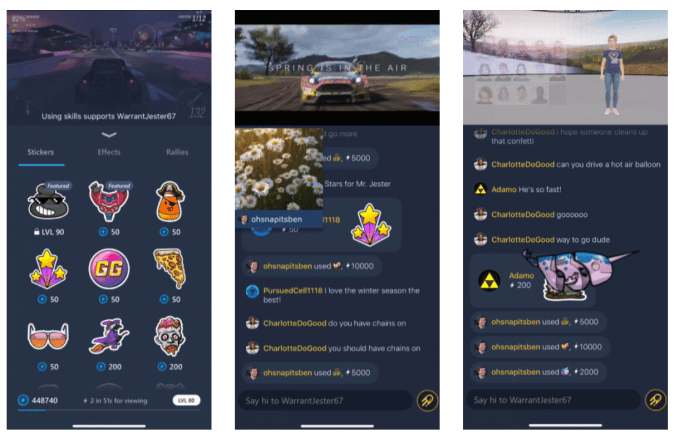
The first of these, called Skills, are focused on giving users more ways to participate in chats with stickers and GIFs, and other screen effects that remind you a bit of those you’d find on iMessage. For example, there are celebratory fireworks and confetti to be tossed around, as well as a beachball that the community members can keep bouncing.

Streamers will like these, too, as it helps them to make money.

“Every time you use a Skill on a partner’s channel, it supports that partner financially,” Microsoft says.

It also says the selection of Skills will be updated regularly, going forward.

Another addition is a way to support favorite streamers via “Sparks,” which are earned by watching streams. These can then be spent on Skills and help partnered streamers reach milestones that translate to cash payouts.

Some high-value Skills will be purchased using a new virtual currency, Mixer Embers. These are the next step up from Sparks, and gives fans’ favorite streamers direct financial rewards.

In 2019, Microsoft says it will also introduce the Mixer progression system, to better reflect a community member’s status, beyond just how much they’ve contributed financially. The system will reward a viewer’s engagement with a streamer’s community and Mixer as a whole, and allows members to “level up” by participating in chat, using Skills, and earning Applause from others.


Mixer is also rolling out improved video capabilities with the enabling of automatic bitrate switching, more options for use of FTL streaming, and the addition of a feature for reporting any video-specific issues.

Skills and Sparks Patronage on Mixer are live now, with Mixer Embers and Progression arriving in the weeks and months ahead.

The changes fall on the heels of Twitch’s annual conference, Twitchcon, where it announced its own set of new features, including new ways for streamers to grow, connect with their community, monetize. Standouts included the launch of group streaming and a karaoke game, as well as changes to badges, new moderation tools, and the expansion of sponsored opportunities.

01 Nov 2018

Defakto releases the stunning Mitternacht minimalist watch

Last year, Defakto released the limited edition Stille Nacht (Silent Night) in collaboration with artist Friederike Bellman. The watch featured a hand-painted star field throughout the dial. Now, the independent German watchmaker is back with the successor to the original: the Mitternacht (or in English, the Midnight). It’s even better than the original.

Like the original each time piece features a star field airbrushed by hand making each watch unique. But this time, the dial is even darker allowing the stars, painted in Superluminova, to shine even brighter. The new version’s hands are now also coated in lume to make it easier to read in the dark of midnight.

The watch features a 40mm face, a sapphire crystal and a Swiss-made Ronda 712 Quartz movement. It retails for around $400 US after conversion from EUR, without import duties.

As detailed in John’s excellent piece on the modern state of timepieces, traditional watches have survived the smart watch onslaught and some brands are seeing sales increase. Defakto is among the growing number of independent watch makers emerging without the massive might behind the biggest names in watches. While technology has paved the way for a smartwatch, it has also allowed independent companies to access parts and services traditionally guarded by legacy watchmakers.

01 Nov 2018

Spoke enhances AI engine to power help desk ticketing system

Spoke, a startup that wants to simplify the way companies add and process help desk tickets using artificial intelligence underpinnings, announced it has enhanced its AI engine to allow for more complex queries.

The company founders were working at Google after a previous startup had been sold to the search giant when they encountered a problem with help desk ticket processing. It was spread across different tools and generally more complicated than they thought it needed to be.

Like all good entrepreneurs, when they left Google in 2016, they were looking for their next challenge, and they decided to attack this pain point which they felt acutely in their time at Google. Like many startups, that pain point gave rise to a new company and they started Spoke .

The product launched last March and the company already 150 customers. The idea with the service is to provide an intelligent internal ticketing system, whether that’s for HR, IT or other internal help desk.

They wanted to make the tool as conversational as possible, so you simply enter a question or statement such as ‘the WiFi is down in my conference room’ or ‘how much vacation do I have left.’ The system generally recognizes the type of request — WiFi would go to IT and vacation to HR — and it moves the ticket through the system accordingly. If there is a relevant knowledge base article available, it might pull that as suggested reading. They say they have gotten to the point that 50 percent of requests can be resolved automatically without routing to a human.

Along the way, it keeps asking for feedback so that that the artificial intelligence engine underlying the tool can learn what it got right and wrong and adjust accordingly in the future.

While the tool has its own complete interface, the founders recognized that people work in different ways, so they have also built integrations with Zapier (the workflow tool) and Slack, allowing customers to take that Spoke functionality and use it inside the tools they commonly use at work without explicitly having to open the Spoke tool.

The company has 20 full time employees at the moment. Customers include DoorDash, Evernote and Charitywater. They have raised $28 million.

01 Nov 2018

Monzo launches interest-earning savings accounts

Well, you have to admire a staggered PR plan. Monzo, the U.K. challenger bank that just announced £85 million in Series E funding and its entrance into the fintech unicorn club, is rolling out a new feature today. The banking upstart is adding interest-earning savings accounts as an upgrade to its existing “Pots” functionality that launched last November.

The new “Savings Pots” feature is being offered in partnership with third party bank Investec Corporate & Investment Banking and lets you earn 1 percent interest on the money you specifically allocate to a Savings Pot. It is the first time Monzo customers have been able to earn interest on their savings through the Monzo app, and is part of wider “marketplace banking” strategy that will see Monzo increasingly offer various financial products via third party fintech startups or incumbent providers.

The idea behind Pots is to let you set money aside for specific things, such as a planned holiday, preparing for Christmas, or simply saving for a rainy day. You can create up to 10 Pots, each with their own name, and then add money to them manually, schedule payments in and out, or round up your day-to-day transactions to the nearest pound and add the additional change to a Pot, piggybank style.

To that end, you’ll need a minimum of £1,000 to open a Savings Pot, and above this can put as much money as you want in a Savings Pot. The savings accounts are flexible, so you can take money out of your Savings Pots at any time, where it will arrive back in your main Monzo account the next working day. Investec will hold the money in your Savings Pots and pay the 1 percent interest.

Savings Pots are covered by the Financial Services Compensation Scheme (FSCS), meaning up to £85,000 of customers’ savings are protected (ie £85,000 across all of your Savings Pots as well as any other money you’ve deposited with Investec. Money you have banked with Monzo outside of Savings Pots is protected by the FSCS separately, again up to £85,000.

Monzo says it will be gradually rolling the feature out to its more than one million customers, and that the bank will email customers once they’re able to start using Savings Pots. I had the feature from yesterday and it is pretty self-explanatory to use.

01 Nov 2018

Anti-fraud startup Shape Security raises $26M in Series E round to drive global expansion

Shape Security, a fraud-fighting cybersecurity company, has closed a $26 million round of Series E funding.

This will be the fifth round of funding — more than $130 million — since the Mountain View, Calif.-based company was founded in 2011. This latest round was led by Norwest Venture Partners, Kleiner Perkins, Allegis Capital and others — including JetBlue Ventures and Singtel.

Shape Security said that the addition of JetBlue’s investment was because it has benefitted first-hand from its fraud-fighting technology.

The company’s primary focus is on preventing imitation attacks — such as when hackers use stolen logins or malware to walk in through the front door. Shape’s enterprise defense technology protects web and mobile apps against automated attacks by utilizing artificial intelligence to differentiate ordinary customers from hackers. Using its massive trove of data, including geolocation and even mouse movements, combined with Shape’s machine learning technology, the company says it can shut down suspicious activity and attacks in real time. The company’s flagship service Blackfish also protects against credential stuffing — where attackers use your stolen credentials to break into other sites.

In total, Shape says it protects 150 million logins each day, and covers one-fifth of the consumer brands in the Fortune 500.

With its $26 million cash injection, Shape said it plans a greater international expansion across the U.K., Europe and the Middle East and Asia to support its growing user base — about half of its customers are located outside of the U.S. And, the company will be bolstering its product development work with new products set to be announced down the pike.

Shape declined to say what it was valued at, but PitchBook puts the company’s valuation now at $495 million.

01 Nov 2018

Men’s wellness startup HIMS has launched a line of women’s health products called HERS

Exactly one year to the day since it launched its line of men’s health products, HIMS is announcing its foray into women’s wellness.

The company is using its mountain of venture capital to support the new brand, called HERS. In September, HIMS raised another $50 million in a round led by IVP.  The financing valued the startup, which has brought in $97 million to date, at $500 million, according to PitchBook.

“Our goal is to help women make the most informed choices about their health at every stage of their healthcare journey,” HERS brand lead Hilary Coles told TechCrunch.

[gallery ids="1740364,1740363,1740365,1740366,1740362"]

Upon launch, HERS is offering three categories of products: sexual wellness, skin care and hair loss treatments. Its line of sexual health products includes a prescription-based birth control pill and Addyi, the only FDA-approved medication for women with hypoactive sexual desire disorder.

“We thought it was offensive really that there have been 26 options out there for men to get hard and this is the first thing offered for women,” Coles said, referring to Addyi — the ‘female viagra.’ “It’s another area that has been super stigmatized.”

HERS will also sell a hair, skin and nails vitamin supplement and shampoo & conditioner that protects against damaged hair that sheds. For the skin, HERS will offer a prescription topical cream to treat acne, an anti-aging cream and a melasma corrector for hyperpigmentation.

The company will also begin selling women Minoxidil, a treatment for hair thinning usually prescribed to men, in January. With the exception of birth control and Addyi, the products range from $15 to $75 per month.

HIMS is known for selling erectile dysfunction medication, oral hygiene and skin care products to men. Founded in 2017, the San Francisco-based company is backed by Founders Fund, Redpoint Ventures, Forerunner Ventures, SV Angel, 8VC and more.

2018 is a record year for funding in the femtech space, which has included fundings for fertility and birth control startups like Nurx, Future Family and Maven. North of $400 million is expected to be funneled into the sector this year — a more than 10 percent increase than the $354 million raised by femtech startups in 2017.


01 Nov 2018

VICIS completes $28.5M Series B and launches its first youth helmet

VICIS has closed its Series B on $28.5 million, with participation from NFL quarterback Aaron Rodgers via Rx3 Ventures. Rodgers joins a list of other pro footballers to back the helmet startup, including Roger Staubach, Jerry Rice, Russell Wilson and Doug Baldwin.

VICIS is known for its $950 Zero1 football helmet designed for adult players. The company spent $20 million over the course of three years collaborating with athletes, engineers and neuroscientists to design and finetune the high-tech head shield, which protects against impact forces and mitigates the effects of collisions through a soft outer shell and several underlying protective layers.

With the fresh funding, which brings total investment in the company to $84 million, VICIS is bringing its youth helmet to market. Founded in 2013, the Seattle-based company says its mission from the get-go was to protect kids and teens playing football.

“There are 2 million kids in the U.S. playing youth football and they deserve the best possible protection,” VICIS co-founder and chief executive officer Dave Marver told TechCrunch. “To be able to offer this technology to kids; it’s our mission fully realized.”

The youth helmet, which retails at $495, is the first-ever to be designed for kids. Most youth helmets are miniaturized versions of adult helmets and fail to take into account the specific needs of a youth player.

VICIS’ youth helmet is tuned for the impact velocities expected in youth play; its the lightest helmet available for kids at uner 4 pounds; and it has the widest field of view of any kids’ helmet currently available.

“We feel like we have the opportunity to catalyze innovation in the youth space,” Marver said.

According to the National SAFE KIDS Campaign and the American Academy of Pediatrics, sports are the cause of 21 percent of traumatic brain injuries per year. Football, in particular, is responsible for the majority of the between 1.6 million and 3.8 million sports-related concussions found annually.

Research linking football to CTE, a degenerative brain disease, has proven that the sport can, in fact, be deadly, yet millions flock to the field every year. VICIS’ smart, tech-enabled helmets could help usher in a new era for safety in the popular sport.

VICIS plans to bring its technology to other sports in the future. It’s also recently inked a contract with the U.S. Army, with plans to provide the Army and Marine Corps a version of its helmet, tailored specifically for combat.