Year: 2018

01 Nov 2018

Carpooling startup Scoop partners with Lyft

Lyft is partnering with carpooling service Scoop to supplement Scoop’s offering to its customers from companies like LinkedIn, Workday, Samsung T-Mobile and Symantec.

With Scoop, trips are pre-scheduled, so you can select from one or more times you’d be willing to leave in the morning and afternoon, and have up until 9pm the night before for morning trips and 3:30pm the day of for afternoon trips to schedule your ride. After the deadline, Scoop’s algorithms work to automatically create the most efficient carpools based on routes, detours, company preference, favorites and more.

“Improving the commute is not just about getting people to where they need to go efficiently,” Scoop co-founder and chief product officer Jon Sadow (pictured above on right) said in a statement to TechCrunch “By partnering with Lyft, Scoop is ensuring that commuters not only gain a stronger sense of community by carpooling to work with co-workers and neighbors, but that they also feel supported in the event of last-second schedule changes and know they have guaranteed transportation home. We’re excited about our partnership and its positive impact on making the commute more enjoyable and efficient for carpoolers everywhere.”

In the event someone can’t find a carpool ride via Scoop, they’ll be able to easily request a Lyft from within the app.

“We look forward to partnering with Scoop to make it as easy as possible for carpoolers to find guaranteed transportation home,” Lyft Chief Business Officer David Baga said in a statement.

Back in April, Scoop launched its corporate carpooling service in Portland. Since launching in 2015, Scoop has facilitated more than four million carpool trips. Scoop has raised a total of $46 million in funding from investors like BMW iVentures, Signia, Index Ventures and others.

01 Nov 2018

HPE and NASA make supercomputer on ISS available for experiments

Last year, HPE successfully built and installed a supercomputer on the International Space Station that could withstand the rigors of being in space. Today, the company announced that it is making that computer available for earth-based developers and scientists to conduct experiments.

Mark Fernandez, who has the lofty title of America’s HPC Technology Officer at HPE, says that the project was born with the idea that if we eventually go to Mars, we will need computers that can withstand the travel conditions of being in space for extended periods of time.

What’s more, because space computers have traditionally lacked the sophistication of earth-based computers, they conduct some of the work in space and then complete the calculations on earth. With an eye toward a Mars trip, this approach would not be feasible due to the distances and latency that would be involved. They needed a computer that could handle processing at the edge (in place) without sending data back to earth.

The original idea was to build a supercomputer with the state of the art off-the-shelf parts as and install it on the ISS as an experiment to see if this could work. They built the one teraflop computer in the summer of 2017 and launched it into space on a SpaceX rocket. The computer was built with Intel Broadwell processors, which Fernandez says were the best available at the time.

The first step was to see if the computer they built could handle the launch, the cold temperatures of waiting to be on-boarded, the solar radiation and generally uncommon conditions of being in space.

Once installed, they needed to figure out if this computer could operate in the power and cooling environment available onboard the ISS, which is not close to what you would have in earth-based datacenter with a highly controlled environment. Finally, once installed, would the computer operate correctly and give accurate answers.

The special sauce here was a package of software they call Hardened with Software. “We wrote a thin, lightweight way suite of software to quote-unquote, harden our systems of software, so you can take state of the art with you,” he said.

The computer was launched in August 2017 and has been operating ever since, and Fernandez says that it has worked according to plan. “So we’ve achieved our signed, dated and contracted mission. We have a one teraflop supercomputer on board the International Space Station with Intel Broadwell processors.” He says that supercomputer has flown around the earth 6000 times since launch.

The company now wants to open this computer up as a kind of service to earth-based developers and scientists to experiment with high-latency jobs that would have required some processing on earth. With the HPE Spaceborne Computer available to use, they can see what processing this information at the edge would be like (and if it would work). The computer will be in operation until some time next year, and in the meantime interested parties need to apply to HPE and NASA to get involved.

01 Nov 2018

Custom eyewear startup King Children raises $2 million

Eyewear can be a statement-making, attention-grabbing fashion accessory — if done right. King Children, a custom eyewear startup emerging from stealth today, aims to give everyone unique, custom designs made for them, by them.

Harnessing the power of 3D scanning and printing technology, in addition to augmented reality, King Children aims to create custom frames that fit your face perfectly.

“One of the things we felt strongly about is there are so many consumer brands that don’t treat people of diverse backgrounds equally,” King Children co-founder and CEO Sahir Zaveri told TechCrunch. “They make products designed for these imaginary, average people. They don’t end up fitting diverse people as well. What we started to think about was creating a brand and platform that by definition would treat every single person equally.”

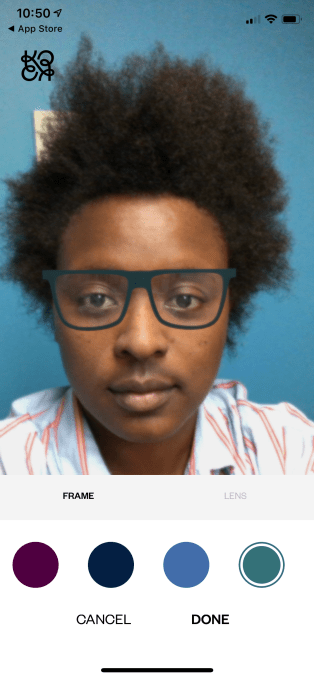
To get started, you use the KC app to take a 3D scan of your face. From there, you can design your own pair of glasses based on the shape of your face, structure and hairstyle. Then, you can adjust the lens height and width, nose bridge, nose pad position, pantoscopic tilt, frame wrap and more. Next, you select whether they’ll be sunglasses, prescription or blue blocker lens. You can also add an inscription up to ten characters. Within two weeks, you’ll have your new pair of glasses.

“One thing I personally love about our model is we run a zero-inventory model, which is a huge change in the world of consumer retail,” Zaveri said. “We own no stock whatsoever. When trends change, we have no retail we have to get rid of.”

The part where I try on some glasses via AR

In total, King Children costs $125 for a pair of glasses. In the event you don’t like the way the glasses turnout, King Children offers free returns.

“An extremely important aspect of this was that we needed to make sure we were able to deliver this product to the mass market,” Zaveri said. “It can’t be prohibitively expensive so that we would lose the point of what we were trying to achieve.”

But while Zaveri stressed the importance of diversity and access, King Children only works with the latest iPhones — the iPhone X, XS, XS Max and XR. The cheapest one, the XR, has a starting price of $749. Eventually, King Children will look to support all devices that enable facial scanning with accuracy down to the millimeter.

King Children uses “engineering-grade plastic” for its glasses, Zaveri said, which enables the company to “make high-quality frames that are exceptionally light but strong.”

“As you can imagine, eyewear for us is only the beginning,” Zaveri said. “But I would like to stress that we’re really focused on eyewear. We’re not actively working on any other products.”

01 Nov 2018

Baidu hits the gas on autonomous vehicles with Volvo and Ford deals

China’s search engine giant Baidu is continuing its partnership spree for Apollo, its open development platform for autonomous driving, after it inked a deal with Swedish automaker Volvo to develop level four self-driving passenger cars.

“Autonomous driving has been our dream, but it’s coming true,” said Li Zhenyu, vice president and general manager of Baidu’s intelligent driving group, at the company’s annual conference today. Level four means the vehicles can drive on pre-mapped roads with little or no human intervention.

The agreement came a day after Baidu and Ford forged an agreement to test self-driving vehicles on Chinese roads for two years. The American car giant’s self-driving system has already been fitted into Apollo, according to the duo’s joint statement.

baidu autonomous car

The Baidu-Red Flag autonomous passenger car

Baidu and Volvo, which is owned by China’s Geely, said they plan to mass produce the vehicles for the Chinese market, although there is no timeline for the promise. The deal marks Volvo’s first partnership to jointly develop autonomous vehicles in China. This is also the first time for Baidu to work with a non-Chinese automaker to mass produce level four passenger cars.

Over the past few months, Baidu has signed a number of Chinese carmakers including BAIC and Red Flag onto Apollo amid a global race to mass produce autonomous vehicles. As of July, the Apollo ecosystem counted 116 partners, up from 50 a year ago.

Baidu previously said its first batch of level four autonomous driving vehicles through the BAIC deal would be ready by 2021. Its level four minibuses with Xiamen King Long are already running in over ten locations throughout China, Baidu’s CEO Robin Li said during its Q3 earnings call on Tuesday.

Baidu has also been expanding its Apollo network by linking up with the government. On Tuesday, it announced a collaboration with the Chinese city of Changsha, which has over seven million residents, to apply self-driving solutions to the city’s roads. Baidu is also in talks with Beijing and Shanghai for a similar tie-up.

01 Nov 2018

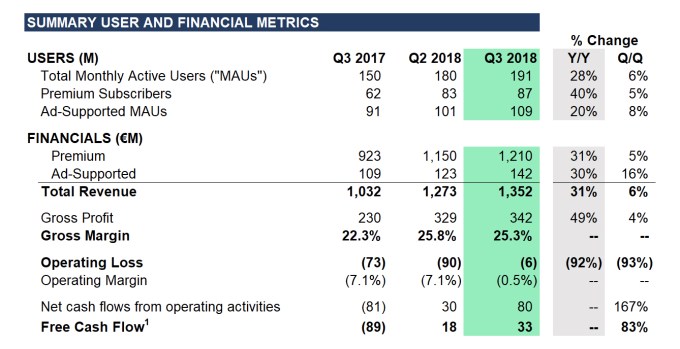
Spotify posts $1.35B in Q3 sales; MAUs up 28% to 191M with 87M paying users

Spotify, the streaming music company that went public earlier this year, posted its quarterly results today, and while it’s continuing to grow, it appears to just about be meeting analyst expectations when it comes to its financials. The company said that it made €1.352 billion in revenues for the quarter that ended in September, which is just ahead of analysts’ average estimates of $1.51 billion, or €1.33 billion.

Those numbers are up 31 percent on a year ago; its operating loss is now at €6 million, a 92 percent improvement on a year ago; and its margins are now at 25 percent, “outperforming” its expectations. With Spotify’s monthly active users now at 191 million — up 28 percent on last year — it will be interesting to see if investors will remain patient as Spotify tries to tip the scales in its favor.

In the meantime, the stock has been getting hammered and this week fell to an all-time low of $139/share. Currently, it’s at $145 and down 3 percent in pre-market trading — a sign that even with the modest rises, investors are not hugely impressed. (Its market cap as of yesterday’s close was $26.9 billion.)

One reason for skepticism despite meeting expectations, might be that Spotify has already warned that there will, indeed, be some dings to that margin in the quarters ahead. This week the company announced a partnership with Google where it will offer Google Home Mini speaks to people taking its Family plan as a holiday season promotion. “We anticipate that this partnership will have an adverse impact of approximately 50 basis points on our Gross Margin profile in Q4,” the company noted.

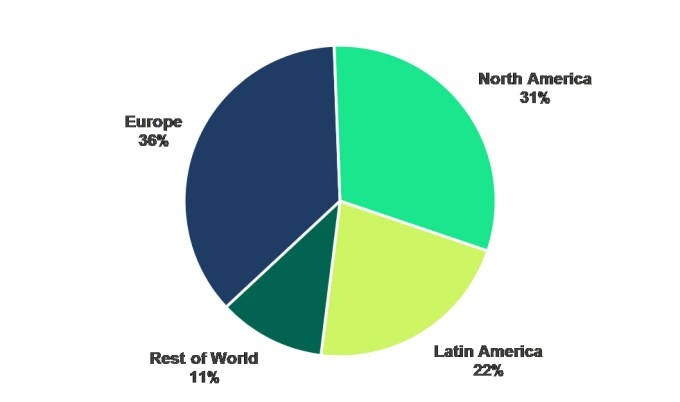
The US continues to be the biggest part of Spotify’s user base, although the company said that Latin America and Rest of World are growing the fastest (which is often the case with newer markets for consumer companies).

Within its user base, paying premium subscribers now total 87 million, keeping it well ahead of Apple Music’s 50 million (which it reported this past summer). That figure is up 40 percent and Spotify said it was fuelled by the company’s Family and Student plans. The company is now working with other streaming providers like Hulu and Showtime to offer bundles of entertainment, with a Student tier it introduced this quarter priced at $4.99, which has helped the company lock in more users who are less likely to churn.

However, the company continues to rely heavily on the “free” part of its freemium model for growth: it now has 109 million ad-supported MAUs, up 20 percent. The company has been expanding the kinds of advertising it serves to these users, so while it doesn’t monetise them with subscriptions, it will be getting its pound of flesh in other ways. Its programmatic ad platform, Ad Studio, is currently only live in the US, UK, Canada, and Australia, so there is still a lot of room for growth both in those markets and in others.

That will also mean that it needs to get its house in order. Specifically, Spotify has been facing — like many others that allow for easy and quick registrations to access services — a longer-term issue of weeding out bots and other fake users on the platform in order to get to a more accurate audience number. Spotify does not say how many users it’s identified through this process but says that it has been continuing that work.

The free users and the ad model that supports them, in any case, remain a relatively untapped part of Spotify’s business: the company said that premium revenue accounted for €1,210 million in Q3, up 31 percent on a year ago. That means ads are making only about €140 million at the moment.

01 Nov 2018

Neo4j nabs $80M Series E as graph database tech flourishes

Neo4j has helped popularize the graph database. Today it was rewarded with an $80 million Series E to bring their products to a wider market in what could be the company’s last private fundraise.

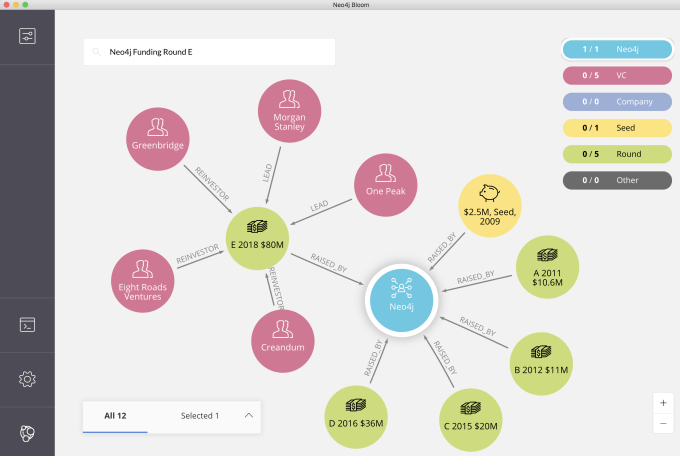
The round was led by One Peak Partners and Morgan Stanley Expansion Capital with participation from existing investors Creandum, Eight Roads and Greenbridge Partners. Today’s investment exactly doubles their previous amount bringing the total raised to $160 million.

Neo4j founder and CEO Emil Eifrem didn’t want to discuss valuation, calling it essentially a vanity metric. “We’re not sharing that. I never understood that. It’s just weird bragging rights. It makes no sense to customers, and makes no sense to anyone,” he said referring to the valuation.

Graph view of Neo4j funding rounds. Graphic: Neo4j

When you bring a company like Morgan Stanley on as an investor, it could be interpreted as a kind of signal that the company is thinking ahead to going public. While Eifrem wasn’t ready to commit to anything, he suggested that this is very likely the last time he raises funds privately. He says that he doesn’t like to think in terms of how he will exit so much as building a good company and seeing where that takes him. “If your mental framework is around building a great company, you’re going to have all kinds of options along the way. So that’s what I’m completely focused on,” Eifrem explained.

In 2016, when his company got a $36 million Series D investment, Eifrem says that they were working to expand in the enterprise. They have been successful with around 200 enterprise customers to their credit including Walmart, UBS, IBM and NASA. He says their customers include 20 of the top 25 banks and 7 of the top 10 retailers.

This year, the company began expanding into artificial intelligence. It makes sense. Graph databases help companies understand the connections in large datasets and AI usually involves large amounts of data to drive the learning models.

Two common graph database use case examples are the social graph on a social site like Facebook, which lets you see the connections between you and your friends or the purchase graph on an Ecommerce site like Amazon which lets you see if you bought one product, chances are you’ll also be interested in these others (based on your purchase history and what other consumers have done who have bought similar products).

Eifrem wants to use the money to expand the company internationally and provide localized service in terms of language and culture wherever their customers happen to be. As an example, he says today European customers might get an English speaking customer service agent if they called in for help. He wants to provide service and the website in the local language and the money should help accomplish that.

Neo4j was founded in 2007 as an open source project. Companies and individuals can still download the base product for free, but the company has also built a successful and growing commercial business on top of that open source project. With an $80 million runway, the next stop could be Wall Street.

01 Nov 2018

Only half of the Fortune 500 use DMARC for email security

When Homeland Security told all federal government departments last year to roll out a new email security policy to cut down on incoming spam and phishing emails, three-quarters of all federal domains were compliant by the time of their deadline just a few weeks ago.

That’s far more than what the Fortune 500 accomplished in the same period.

New data from Agari shows that just half of the Fortune 500 have deployed DMARC — or domain-based message authentication, reporting, and conformance policy. Email systems use DMARC policies to verify the identity of an email sender, ensuring that it’s not impersonating another domain. Depending on the DMARC settings, an email system can either monitor, quarantine or entirely reject spoofed emails, helping to cut down on the number of phishing emails that land in your corporate inbox.

The data shows 51 percent of the Fortune 500 — the world’s wealthiest companies — are now using DMARC. That’s an improvement from about one-third a year ago, but it still trails behind the federal government’s DMARC adoption.

But only 13 percent of those companies are employing a quarantine or reject policy — which actively intercepts spoofed emails and marks them as spam or bounces them from a user’s inbox altogether.

According to Agari’s breakdown: Aetna, American Express, Bank of America, Capital One, Facebook, Fedex, Microsoft, Netflix, PayPal, UPS and Wells Fargo ranked among the companies with the strongest DMARC policy.

Boeing, CBS, Discovery, Exxon Mobil, Frontier, JetBlue, NetApp, Time Warner Cable (Spectrum), Prudential, Viacom and Xerox are some of the worst contenders with no record whatsoever.

Agari, which has a commercial stake in the email security business, said that having a well-configured DMARC policy “cannot be overstated.”

Scammers often use spoofed emails to try to trick companies into sending back sensitive taxpayer information or other corporate secrets. Known as the “W-2 phishing scam,” legitimate-looking emails try to obtain W-2 tax forms of employees so that the scammers can file fraudulent forms during tax season in order to obtain hefty refunds. The FBI says these scams cost businesses $12 billion a year.

But DMARC is meant to weed out the bulk of those spoofed emails. According to Agari, one of its customers — a global e-commerce firm — was getting millions of impersonated emails per day, spoofing the company’s “from” domain to make it look like the real deal. After the company implemented its new DMARC policy to reject spoofed emails, the number went down by 99 percent.

“The damage from these attacks has ballooned into billions of dollars annually—however the real cost is the erosion of trust in digital business,” said Agari’s Armen Najarian.

01 Nov 2018

Don’t miss out on tickets to Startup Battlefield Africa 2018

On December 11, just slightly more than a month away, up to 15 exceptional startups will arrive in Lagos, Nigeria to compete in Startup Battlefield Africa 2018. Don’t miss your opportunity to watch founders of Africa’s best early-stage tech startups as they launch on a global stage to vie for a cash infusion, investor attention and serious bragging rights.

We have a limited number of spectator tickets, and they’re selling fast, so be sure to grab yours while you still can. Buy your ticket here today for just $10 + VAT.

The price of admission provides a full day packed with action. We’re interspersing three rounds of Startup Battlefield competition with an amazing roster of speakers and panel discussions addressing the continent’s rapidly expanding startup scene.

You’ll hear from speakers like Marième Diop, an investor at Orange Digital Ventures Africa. Diop focuses on early-stage African startups (like a $16 million round for South African fintech startup, Yoco, and an $8.6 million round to business enterprise software startup, Africa’s Talking), and she’ll discuss venture capital in Africa.

We also have on tap Shikoh Gitau, the head of product at Safaricom’s Alpha incubator. Gitau led a Pan-African and global search for candidates to form the incubator team, and she’ll share her perspective on the talent and innovation within Africa’s expanding startup landscape. She’ll also talk about repatriating entrepreneurs.

If you haven’t ever experienced a Startup Battlefield, you’re in for a huge adrenaline rush. The competing founders have been honing their pitch skills with coaching help from seasoned TechCrunch editors, and they’ll be fired up and ready to make their case. Here’s how the Battlefield works.

Startup Battlefield consists of three preliminary rounds with up to five startups in each round. Startup teams get six minutes to pitch and present a live demo to a panel of judges consisting of top tech founders and VCs. Those judges then have six minutes to question each team thoroughly.

No more than five teams move to the finals for another round of pitches and more challenging questions. Only one startup will claim the auspicious title of Startup Battlefield Africa 2018 champion.

The winning founders receive US$25,000 in no-equity cash, plus a trip for two to compete in Startup Battlefield in San Francisco at TechCrunch Disrupt 2019 (assuming the company still qualifies to compete at the time).

Startup Battlefield Africa 2018 takes place December 11 in Lagos, Nigeria, and spectator tickets are limited and going fast. Buy your tickets now and join us for an exciting day focused on the very best that Africa’s startup ecosystem has to offer.

01 Nov 2018

Faraday Future loses the last of its founding executive team as problems deepen

There were five. And now, there are none.

Faraday Future, the once-buzzy Chinese electric vehicle startup that has delivered lots of promises and fanfare, but has struggled to deliver an actual product, suffered back-to-back departures this week of the remaining five founding members of its executive team. Nick Sampson, a co-founder and senior vice president of product strategy, and Dag Reckhorn, the company’s senior vice president of global manufacturing, resigned this week.

The departures were first reported by The Verge, which has closely followed the company’s numerous problems. Sampson confirmed his resignation to TechCrunch. Faraday Future has not responded to a request for comment. (We’ll update if that happens).

Faraday Future initially launched with the backing of Jia Yueting, who co-founded the company with Sampson, a former Tesla director, and Tony Nie, a former Lotus executive. Nie left earlier this year. The founding executive team included Reckhorn, Sampson, Richard Kim as well as two other Tesla veterans Alan Cherry and Tom Wessner.

Sampson and Reckhorn were the last of the founding executive team. Only Jia Yueting, the company’s initial backer, co-founder and CEO, remains.

It’s been more than four years of drama for the company that has been trying to begin production of an ultra luxury electric SUV called the FF91 by the end of the year.

It’s most recent setback may sound the death knell for Faraday Future.  The company is quickly running out of money, a problem that accelerated during a fight with its main financial backer, Chinese real estate giant Evergrande Group. Evergrande came to Faraday’s rescue just as it was running out of cash in 2017 and took a 45 percent stake in the company for $2 billion.

That relationship has since soured. Faraday had spent $800 million by July 2018 as it pushed to complete a pre-production version of the FF91 vehicle at its Hanford, California factory. Evergrande has denied an advance of any more capital and accused Jia of trying to back out of its investor deal. The case went to arbitration and Faraday Future is allowed to seek up to $500 million in new investment — if it can find a willing investor. Even then, Evergrande must still approve any deal.

Now, as Faraday Future seeks other investments, the company has laid off employees, cut salaries and most recently shut down some operations at its Hanford factory and Gardena, California headquarters.

01 Nov 2018

Rafal Modrzewski to talk about launching microsatellites at Disrupt Berlin

ICEYE CEO Rafal Modrzewski is obsessed with SAR satellites. He’s so obsessed that his company plans to launch dozens of satellites into space. According to him, ICEYE satellites should be much better than existing SAR satellites — call it the Tesla or satellites if you want. That’s why I’m excited to announce that Modrzewski is coming to TechCrunch Disrupt Berlin to speak.

SAR stands for synthetic-aperture radar. There are already many SAR satellites around the earth, observing the surface of the planet. But they weigh hundreds of kilograms and cost a small fortune to put into space.

While consumer electronics have greatly benefited from miniaturization, the same can’t be said about space. But ICEYE thinks it’s time to make satellites smaller.

The company’s SAR satellites only weigh around 70 to 80 kilograms. It’s a cost-effective solution, which means it’s much cheaper to build a complete constellation. The company is aiming for 18 fully operational satellites around the planet.

In many ways, ICEYE is a tech achievement. And the fact that the company operates like a startup makes the venture even more interesting.

If you want to hear Modrzewski tell you more about what they’ve been working on, you should come to Disrupt Berlin. The conference will take place on November 29-30 and you can buy your ticket right now.

In addition to fireside chats and panels, like this one, new startups will participate in the Startup Battlefield Europe to win the highly coveted Battlefield cup.

Rafal Modrzewski

Co-founder & CEO, ICEYE

Rafal Modrzewski is the Chief Executive Officer and co-founder of ICEYE. ICEYE aims to launch and operate a constellation of micro-SAR satellites providing access to timely and reliable Earth observation data. ICEYE is the first company that has successfully miniaturized a SAR satellite, creating a unit that is 100x more cost-effective than traditional counterparts. With its 18 satellite constellation, ICEYE offers its partners a set of unprecedented satellite imaging capabilities, accessing any area of interest faster, more frequently and at lower cost.

Since co-founding the project in 2012, which became the company in 2014, with Pekka Laurila, Modrzewski is responsible for overseeing the organization’s growth and implementing ICEYE’s overall vision. Modrzewski brings with him deep domain expertise in SAR engineering, and he has received the 2018 Forbes 30 under 30 Technology award based on the world-first achievements of ICEYE.

Prior to co-founding ICEYE, Modrzewski researched innovative products at VTT (Technical Research Centre of Finland) in the RFID and wireless sensing group. He attended Warsaw University of Technology in Poland, where he studied Electrical Engineering and co-founded the Multimedia Technologies Science Group. Modrzewski continued his studies in Radio Science and Engineering at Aalto University where he led the on-board data handling team working on Aalto-1, Finland’s flagship satellite project.