Year: 2018

31 Oct 2018

Some law enforcement drones are dropping out of the sky

The U.K.’s Civil Aviation Authority is cautioning police departments and other emergency services to suspend operations of a specific drone model after some of the devices lost power unexpectedly and fell while in flight.

The Civil Aviation Authority (CAA) safety warning applies to DJI Matrice 200 series drones, used by some emergency services in the U.K. The failures were first reported by West Midlands police department, though law enforcement in Norfolk, Devon, Cornwall and the West Midlands also uses DJI drones. Devon and Cornwall have grounded two affected drones out of their fleet of 20, according to the BBC.

According to the CAA, “A small number of incidents have been recently reported where the aircraft has suffered a complete loss of power during flight, despite indications that there was sufficient battery time still remaining.” No injuries have been reported, despite “immediate loss of lift with the remote pilot unable to control its subsequent flight path.”

While no reports have surfaced in the U.S. so far, a study by Bard College noted that 61 U.S. public safety agencies (law enforcement, fire departments, EMS, etc.) use the specific model of Mavic drone affected. Collectively, drone models by DJI dominate the space, though the Matrice is not the most popular model.

The manufacturer has responded to the reports, urging Matrice operators to push a firmware update that resolves the issue. “When prompted on the DJI Pilot App, we recommend all customers to connect to the internet on the app or DJI Assistant 2 and update the firmware for their aircraft and all batteries to ensure a safe flight with their drone,” the company wrote in a product warning.

DJI faced a similar issue last year when some of its DJI Spark consumer-grade drones suddenly lost power and fell from the sky.

31 Oct 2018

Influencer marketing startup Mavrck raises another $5.8M

Mavrck has raised another $5.8 million in funding, bringing its total raised to $13.8 million.

When the company raised its Series A back in 2015, it was focused on helping brands work with “micro-influencers” who were already using their products. Now it describes itself as an “all-in-one” influencer marketing platform, offering a number of tools to automate and measure the process.

Last month, Mavrck announced new features for Pinterest, where it’s now an official marketing partner. It also says it’s been doing more to improve measurement and detect fraud — on the fraud side, it promises to analyze a “statistically significant sample” of an Instagram account’s followers, and of the accounts that engage with their content, to determine if they’re bots.

Customers include P&G, Godiva and PepsiCo, and the company says recurring revenue has grown 400 percent year-over-year.

“Everything that we have done at Mavrck this year has been done with the intention to drive the influencer industry forward,” said co-founder and CEO Lyle Stevens in the funding announcement. “Every new capability that we’ve introduced, every partner that we’ve started working with, every influencer behavior that we’ve tracked was part of our mission to help marketers harness the power of content that people trust to drive tangible business value for their brands.”

The new funding comes from GrandBanks Capital and Kepha Partners. A spokesperson said this isn’t a Series B, but rather additional capital raised to support increased demand and channel partnerships.

31 Oct 2018

Fitbit earnings beat expectations on strength of smartwatch sales

Fitbit is slowly righting its financial ship, courtesy of a successful push into smartwatch category. The wearable company reported a profit (when adjusted for items such as stock-based compensation) thanks to growing sales in the new category.   

Total revenues rose slightly to $393.6 million in the third quarter compared with the same period last year. The company did report a loss this quarter under generally accepted accounting principles (GAAP). But it was rosier than in previous quarters and showed that Fitbit is moving in the right direction. Net losses narrowed considerably to $2.1 million from $113.4 million this time last year. A good deal of the company’s revenue is being driven by the shift to smartwatches, which now comprise around half of Fitbit’s total revenue.

It’s a gamble that’s finally starting to pay off for the company. Fitbit launched its first smartwatch in August of last year. The Ionic was the result of three high-profile acquisitions: Pebble, Coin and Vector. It was an ambitious product that found the company embracing the one bright spot in an otherwise stagnant wearables market.

What felt like an extremely expensive Hail Mary for the company was ultimately bogged down by poor reviews (including one on this site), thanks to poor industrial design, among other issues. In an interview with TechCrunch earlier this year, CEO James Park admitted that the Ionic ultimately wasn’t a mainstream device. “It was a performance-oriented product,” Park said at the time. “That audience is much smaller than a mass appeal device.”

Its followup, the Versa, however, address many of the biggest complaints plaguing the Ionic, and has clearly proven a hit for Fitbit.

This is the first time the company has posted adjusted profitability since Q3 of 2016. Of the 3.5 million wearables it sold this quarter, 49 percent were smartwatches. Fitbit’s combined smartwatch sales currently put it in the number two position in the U.S., behind only Apple. It seems the company’s gamble is beginning to pay off.

31 Oct 2018

Xiaomi doesn’t want Lyft using its electric scooters

Xiaomi, the electric scooter manufacturer that a handful of the shared electric scooter services in the U.S. (like ones from Uber, Lyft, Spin and Bird) rely on, has sent a cease-and-desist letter to Lyft. In the letter, obtained by TechCrunch, Xiaomi says it did not consent to associate its brand with Lyft.

Xiaomi alleges Lyft has referenced Xiaomi’s brand in its advertisements and other documentation referring to its shared electric scooter business.

“We also do not condone Lyft’s unauthorized modification or retrofitting of our electric scooters for general public use,” Xiaomi wrote in its letter.

If Lyft does not cease to use, purchase and modify its scooters, Xiaomi says it will pursue legal action against Lyft. Xiaomi also demands that Lyft must stop deploying its scooters “that have been modified without our consent in public scooter rentals.”

But Lyft says it has no knowledge of using Xiaomi’s trademarks in its advertising.

“We have no intention of using any other company’s trademarks in advertising our scooters, and are not aware of any instance of having done so with our existing suppliers,” a Lyft spokesperson said in a statement to TechCrunch. “We will address these concerns with them directly. Safety modifications, including slowing scooter speeds, have been made to satisfy local regulatory guidelines.”

Lyft currently operates its shared electric scooter service in Santa Monica, Calif., Washington, D.C. and Denver, Colo.

“Lyft’s modification to any scooters originally manufactured by Xiaomi without our knowledge, participation, or approval undoubtedly exposes Xiaomi to serious legal risks and liabilities for consumer safety and product liability,” the letter states.

But, as mentioned earlier, Lyft is not the only company that uses Xiaomi scooters. Uber, Spin and Bird also use scooters from Xiaomi. Bird, however, has a partnership of sorts with Xiaomi. In May, Bird said it made an exclusive deal with Xiaomi for rights to its supply of scooters for shared services in the U.S. But one scooter executive told TC’s Jonathan Shieber at the time that their company also had a contract with Xiaomi.

TechCrunch has reached out to Uber and Spin to clarify their respective relationships with Xiaomi. I’ve also reached out to Xiaomi and will update this story if I hear back.

In the meantime, you can read the full letter from Xiaomi to Lyft below.

Xiaomi cease-and-desist let… by on Scribd

31 Oct 2018

Snapchat’s PR firm sues influencer for not promoting Spectacles on Instagram

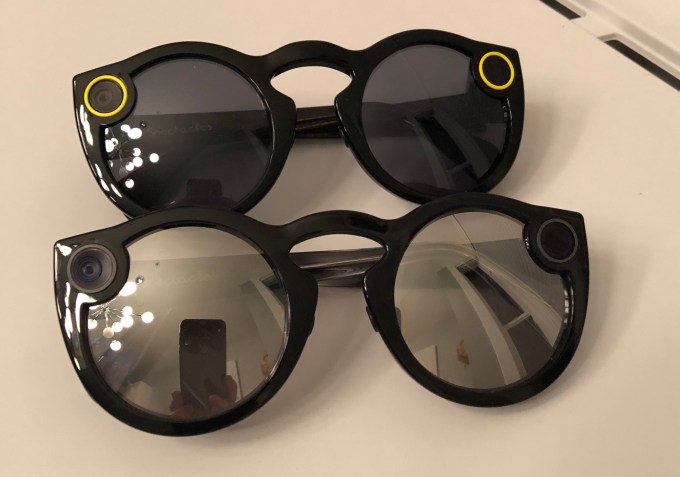
Influcencer marketing could get a lot more accountable if Snapchat’s PR firm wins this lawsuit. Snapchat hoped that social media stars promoting v2 of its Spectacles camera sunglasses on its biggest competitor could boost interest after it only sold 220,000 of v1 and had to take a $40 million write-off. Instead Snap comes off looking a little desperate to make Spectacles seem cool.

Snap Inc comissioned its public relations firm PR Consulting (real imaginative) to buy its an influencer marketing campaign on Instagram . The firm struck a deal with Grown-ish actor Luka Sabbat after he was seen cavorting with Kourtney Kardashian. Sabbat got paid $45,000 up front with the promise of another $15,000 to post himself donning Spectacles on Instagram.

He was contracted to make one Instagram feed post and three Stories posts with him wearing Specs, plus be photographed wearing them in public at Paris and Milan Fashion Weeks. He was supposed to add swipe-up-to-buy links to two of those Story posts, get all the posts pre-approved with PRC, and send it analytics metrics about their performance.

But Sabbat skipped out on two of the Stories, one of the swipe-ups, the photo shoots, the pre-approvals, and the analytics. So as Variety’s Gene Maddaus first reported, PRC is suing Sabbat to recoup the $45,000 it already paid plus another $45,000 in damages.

TechCrunch has attained a copy of the lawsuit filing, embedded below, that states “Sabbat has been unjustly enriched and PRC is entitled to damages.” Snap confirms to us that it hired PRC to run the campaign, and that it also contracted a campaign with fashion blog Man Repeller founder Leandra Medine Cohen. And as a courtesy, I Photoshopped some Spectacles onto Sabbat above.

But interestingly, Snap says it was not involved in the decision to sue Sabbat. The debacle brings unwanted attention to the pay-for-promotion deal that brands typically tried to avoid when commissioning influencer marketing. The whole thing is supposed to feel subtle and natural. Instead, PRC’s suit probably cost Snapchat more than $90,000 in reputation.

The case could solidify the need for influencer marketing contracts to come with prorated payment terms where stars are paid fractions of the total purse after each post rather than getting any upfront, as The Fashion Law writes. PRC’s choice to chase Sabbat even despite the problematic publicity for its client Snap might convince other influencers to abide more closely to the details of their contracts. If social media creators want to keep turning their passion into their profession, they’re going to have to prove they’re accountable. Otherwise brands will slide back to traditional ads.

31 Oct 2018

The tactics behind The Athletic’s breakout success in sports subscriptions

Local newspapers may be shuttering and people may be consuming most news on social media, but don’t tell Alex Mather that a subscription news publication can’t grow like a unicorn startup. His 2-year-old sports publisher The Athletic has gained over 100,000 paid subscribers (60% under age 34) and has a 90% retention rate.

Having already raised $30 million in its short life, the company announced a new $40 million Series C yesterday, led by Founders Fund and Bedrock Capital. It reportedly values The Athletic around $200 million.

I interviewed Alex Mather (The Athletic’s CEO) and Eric Stomberg (Partner at Bedrock Capital) to understand what’s behind the breakout success and why they think this publishing startup can scale to become a multi-billion dollar company.

EP: Bedrock makes concentrated, contrarian bets. Explain how The Athletic fits that.

ES: I first met Alex and Adam in 2016 during Y Combinator. The popular view then, as it remains now, was that people just aren’t willing to pay for content online and that to win in media you have to put out a high volume of free articles on social.

The Athletic took the opposite approach. It’s a narrative violation. Everything is part of a paid subscription, with the belief that instead of writers needing to post 3-4 pieces per day, they should focus on deeper stories that add value to paid subscribers over time. That worldview resonated with us. If you can create content at scale that people are willing to pay for, that’s a powerful economic engine.

There’s so much sports coverage already out there, by professionals and amateurs alike, so why are people willing to pay for The Athletic?

AM: While there appears to be an abundance of content, most of it is aggregated, shallow content for a broad audience. We produce fewer stories and target a diehard fan. Our subscribers consistently tell us that no one else produces the same depth on a daily basis.

How did you determine the $60/year price point?

AM: We think of $60/year ($5/month) as less than the average NBA ticket. It’s a meaningful price but not prohibitive, especially when we do discounts in the first year. Like all subscription companies, whether we like it or not, we have to consider how our pricing stacks up against Netflix. For $10/month, you can subscribe to Netflix which is spending $8 billion per year in content.

Is The Athletic profitable?

AM: We expand by launching in local markets. We are in 47 thus far. The operational focus is on building a local team and becoming profitable in each local market. I can tell you that most markets are profitable in the first year–currently all of our markets over one year old are profitable and most of those over 6 months old are profitable.
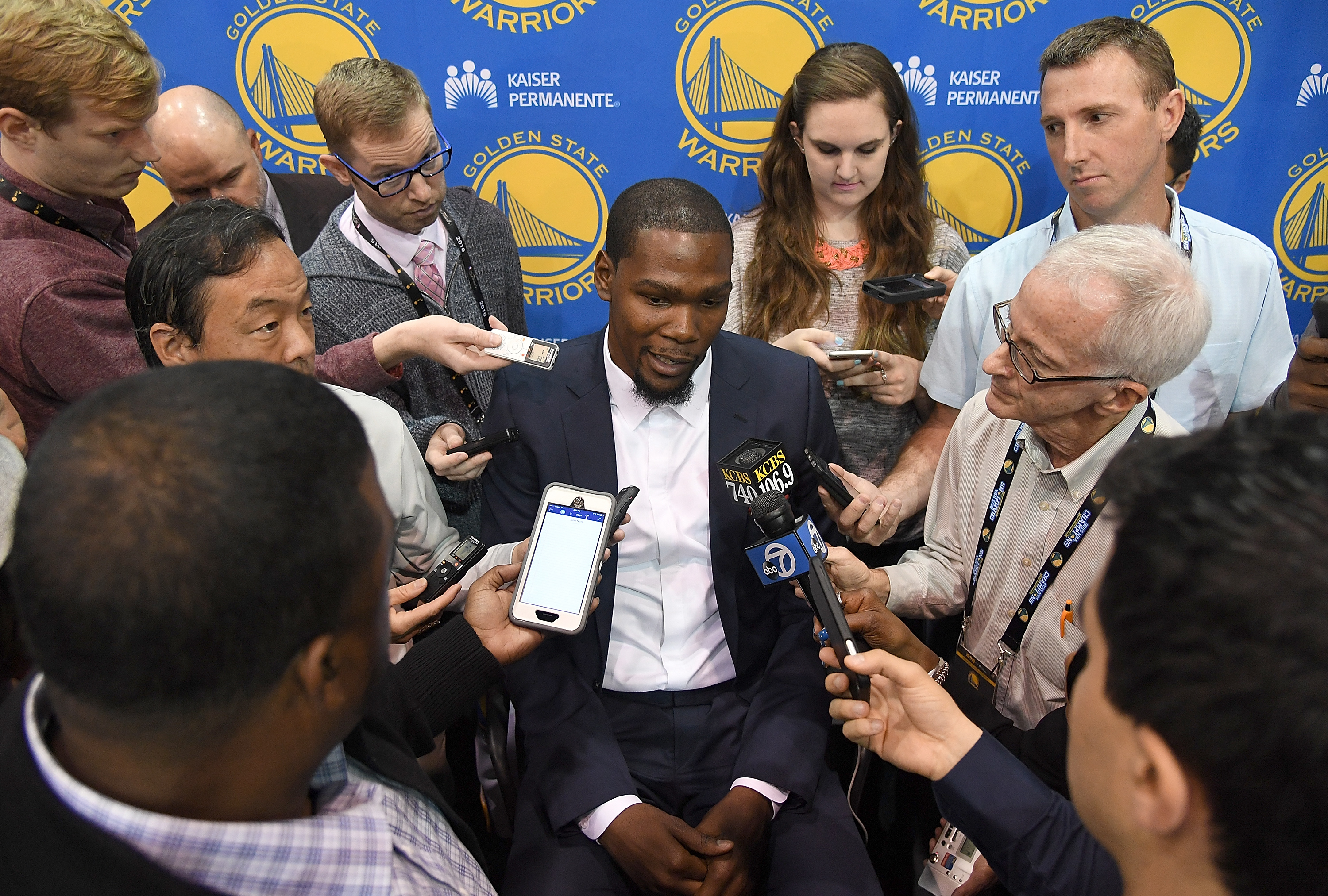
(Photo by Thearon W. Henderson/Getty Images)

Explain your growth strategy in terms of coverage: which sports did you start with and at which level (local vs national)?

AM: Direct-to-consumer businesses have to work really to earn their subscribers’ hard-earned money. We have to obsess over where we can be different. In the beginning, that was with hockey and baseball, because those have been de-prioritized by the bigger players. That shifted as we gained more subscribers: we needed to become comprehensive. We hired folks to cover the NBA, to cover the NFL, to cover soccer.

Do subscribers usually come just for one local sport or for the broader bundle?

AM: We’ve built a powerful bundle. A local newspaper has local politics, local restaurants, and then local sports. We have just the sports, but add a national perspective and a nationwide bundle. Most of our subscribers are “super bundlers,” meaning they subscribe to content from multiple cities plus at least one national product and usually a college product that’s not local. We provide all that for significantly less than competitors.

Eric — as a VC looking for multi-billion dollar exits, how are you analyzing the potential scale of a subscription publication like this? Even most people who are bullish on subscriptions believe it’s a choice of going for a niche audience and staying small.

ES: There are two things we look for in a subscription business: retention and a positive flywheel.

Retention. In any subscription business, the key question is: can they maintain their subscribers over time? Most of them don’t. Spotify does, Netflix does, and The Athletic does as well. The Athletic is off the charts, which sets it up for scale. You want to see deep engagement over a very, very long period of time — years.

A positive flywheel. The more you build your subscriber base, the more you build your revenue base. That allows you to get better content, to hire unique writers, to build greater depth. In doing so, you attract people who weren’t ready to subscribe in the early days but now you have writers they follow and content they want. Technology is important here too: as you build a bigger platform with more content, serving the right content at the right time to each user is a key advantage. When this flywheel is working it’s actually quite hard to put a ceiling on the business.

Most publishers did a so-called “pivot to video” over the last couple of years. You’re anchored in writing. Why not more video at the start?

AM: We’re obsessed with the consumer and all our research in the beginning said that people still like to read books and articles. Advertising with text may not be as good as with video, which may be why so many other companies “pivoted to video,” but we think the written word is still the best way to convey certain types of stories. It’s straightforward, it doesn’t require headphones.

There’s an incredible amount of talent out there that can produce these stories and that has been cast aside by many entities. We saw it as an opportunity to give them great jobs and bring value to our subscribers. That has paid off for us.
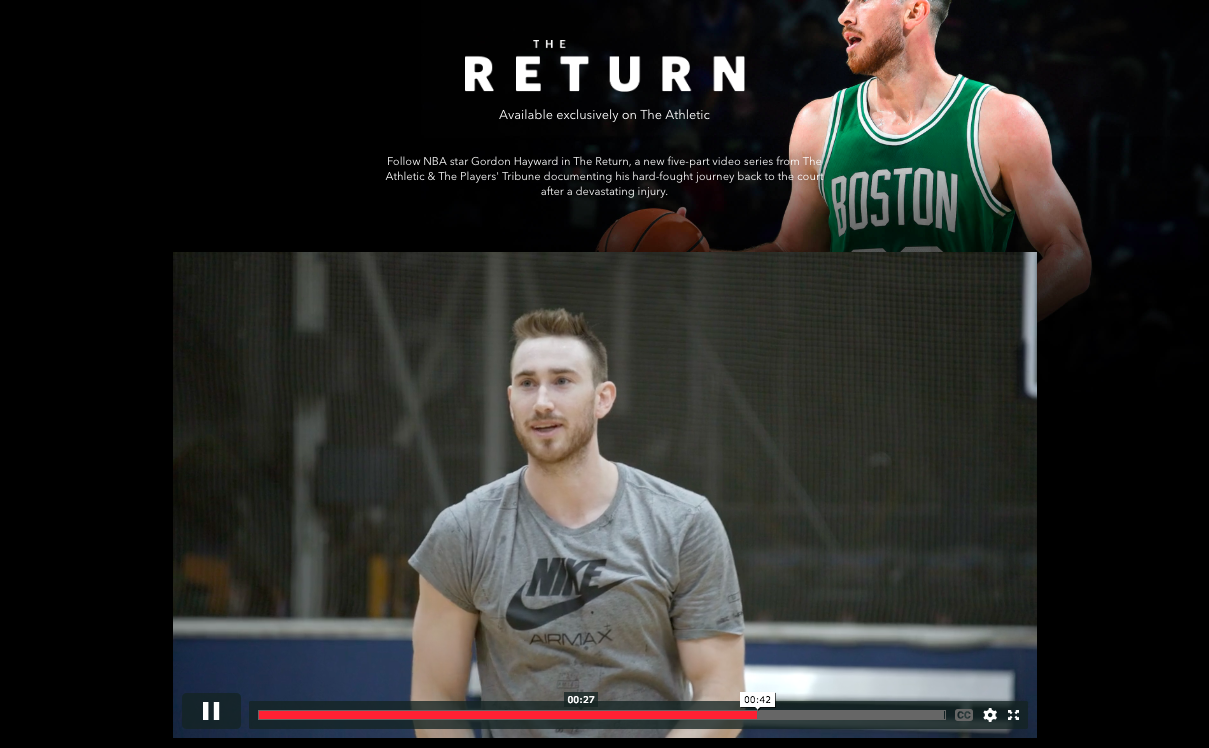
 

What are your plans for video or other content formats in the future?

AM: We raised this Series C with audio and video in mind. We can tell even more stories when we add in audio and video possibilities. Our goal is to serve the subscriber: some love to read, some love to listen, others prefer to watch. We look up to things like The Ringer, Andre the Giant on HBO, VICE News, Gimlet, and The Daily by the New York Times all as incredible storytelling, and we ask ourselves “how can we do sports versions of those?”.

Why focus on hiring experienced, full-time writers rather than a stable of contributors or curating from the vast pool of content by fans? Lots of amateurs pay close attention to sports.

AM: What’s really important to us is a growth mentality — that by Day 100 on our team a writer is thinking very differently. We’re providing lots of data, lots of feedback. We invest in great people who will figure this out with us over time. Also, scaling so quickly from 0 to 300 editorial staff was possible because we recruited experienced talent who know what to do already.

We do have about 400 contributors as well. These are folks who may be lawyers or accountants but are passionate about the teams they cover. We are a way for them to reach a premium audience. We can pay them really well and give them world-class editors formerly with Sports Illustrated and ESPN.

How are you acquiring your subscribers?

AM: When we expand into a new market, we gain new subscribers by hiring writers who have a following already and by word of mouth from existing subscribers. Then like any direct-to-consumer brand, we are acquiring subscribers through Google, Facebook, and Twitter.

You financially incentivize your writers based on them acquiring new subscribers through their articles or by promoting The Athletic with their followers online. That is very uncommon in publishing. Explain that strategy.

AM: It ties back to our focus on building for the long term and investing in talent that will grow with us. We like to assign incentives that give us the best chance of building a sustainable business and we think about compensation in that way. We give our team equity in the company and for many, we tie a portion of their comp to the performance of their team, sport, city. It’s a great way to share in the responsibility and success of the business.
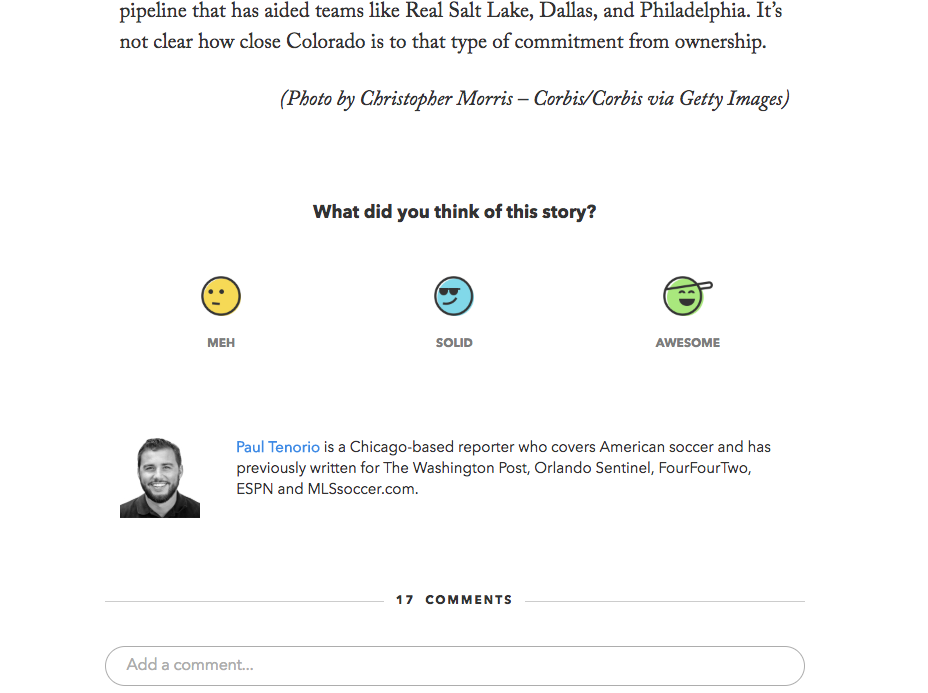
At the bottom of articles, you ask readers to rate each story as “Meh”, “Solid”, or “Awesome”. I wish every publisher did this. How do you use this data? How do a writer’s scores impact them?

AM: It’s about feedback loops. Our writers gauge feedback when they share on Twitter. This is another data point. It helps paint a more complete picture. NPS alone isn’t enough of course though. We look at whether articles drive new subscribers, drive deep engagement, drive comments, etc. We don’t use pageviews, but we certainly use metrics. Usually, this results in a writer producing very different work on Day 100 than they were on Day 0.

Explain the interaction between subscribers. It’s not unique to have a comments section: there are bad comments sections, good comments sections, and comments sections that go unused. At a tactical level, how do you think about building community?

AM: My co-founder and I met at Strava, the social network for endurance athletes. I ran the product team and we were obsessed with community. We see an incredible connection between community engagement and subscriber retention. The question that drives us is how can we connect users in an authentic way, how can we connect users to our staff in an authentic way, how can we connect users to athletes in an authentic way. We’re doing a lot of experimentation here. We have a distinct opportunity because of our paywall: most of the comments on The Athletic are saying substantive things.


31 Oct 2018

A look at all the companies participating in 500 Startups’ 24th accelerator program

TechCrunch has an exclusive look at the companies participating in 500 Startups‘ 24th startup accelerator batch, which kicked off last week.

Through its four-month seed program, the Silicon Valley seed fund invests $150,000 in exchange for 6 percent equity. The companies below include a mix of industries from cryptocurrency to digital health to e-commerce. 500 Startups says 40 percent of the companies have a female founder, 50 percent have a black, mixed-race or Latinx founder and 31 percent are headquartered outside the U.S.

Here’s a closer look at the 22 companies, which will demo their tech to investors on February 28:

  • Alba: A Santiago, Chile-based mobile marketplace for babysitters in emerging markets.
  • Assemble: A Los Angeles-based digital platform for automating video content production.
  • Back Office: A Palm Beach, Florida-based financial software provider focused on streamlining personal bookkeeping.
  • BlockVigil: A San Francisco-based platform for building and scaling blockchain applications.
  • Cambridgene: A Cambridge-based developer of clinical-genomic software for personalizing cancer therapy in hospitals.
  • Celer Network: A platform for building and scaling decentralized applications.
  • Crowdz: Headquartered in Sunnyvale, the blockchain-based B2B marketplace builds digitized supply chains.
  • HAMAMA: A San Francisco-based provider of microgreen kits for growing healthy food at home.
  • IOTW: A Hong Kong-based IoT-connected cryptocurrency mining platform.
  • Kura Tech: A San Francisco-based developer of augmented reality glasses with micro-display and variable focus.
  • Memoir Health: A Boston-based behavioral health startup providing physical and virtual mental wellness and substance use services.
  • MessageCube: Headquartered in Sunnyvale, the company is building an integration for people to discuss and purchase shared experiences over chat.
  • Ovation: A Provo, Utah-based online portal for restaurant reviews meant to help businesses measure customer experience.
  • PantyProp: A New York-based seller of underwear and swimwear for women to wear while menstruating.
  • Pilleve: A Winston-Salem, North Carolina-based startup using data to help care providers lower the costs associated with opioid addiction.
  • Savion: A Livermore-based aviation company bringing green, long-range private jets to the middle class.
  • SnapShyft: Headquartered in Indianapolis, the startup provides an on-demand labor marketplace focused on the food and beverage industry.
  • Thrive Agric: An Abuja, Nigeria-based crowdfunding platform for farms and farmers in Africa.
  • TripAfrique: Headquartered in Paris, the online booking platform helps travelers arrange trips to Africa.
  • UTRUST: A Zurich-based cryptocurrency payments platform that offers buyers protection, instant transactions and more.
  • Zeuss Tech: Headquartered in Palo Alto, the blockchain-based anti-money-laundering platform targets cash-intensive industries.
  • No information is available on the final company, which is in stealth mode.

Here’s a look at 500 Startups batch 23, 22 and 21.

31 Oct 2018

After canceling ‘Rift 2’ overhaul, Oculus plans a modest update to flagship VR headset

Facebook’s virtual reality arm may soon find itself in the unfamiliar position of playing catch-up with hardware competitors.

Last week, TechCrunch reported that Oculus co-founder Brendan Iribe had decided to leave Facebook partially due to his “fundamentally different views on the future of Oculus” and decisions surrounding the cancellation of a next-generation “Rift 2” project.

The company’s prototype “Rift 2” device, codenamed Caspar, was a “complete redesign” of the original Rift headset, a source familiar with the matter tells us. Its cancellation signified an interest by Facebook leadership to focus on more accessible improvements to the core Rift experience that wouldn’t require the latest PC hardware to function. Iribe did not agree with the direction, with a source telling us that he was specifically not interested in “offering compromised experiences that provided short-term user growth but sacrificed on comfort and performance.”

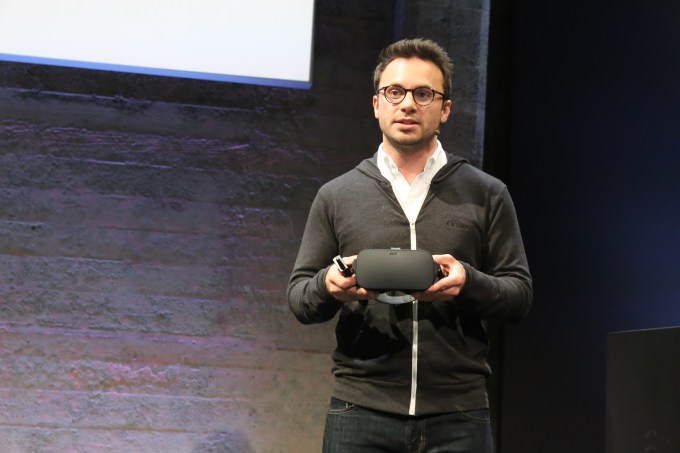
Former Oculus CEO Brendan Iribe sharing details on the Oculus Rift in 2015

In the wake of the overhaul’s cancellation, the company will be pursuing a more modest product update — possibly called the “Rift S” — to be released as early as next year, which makes minor upgrades to the device’s display resolution while more notably getting rid of the external sensor-tracking system, sources tell us. Instead, the headset will utilize the integrated “inside-out” Insight tracking system, which is core to Facebook’s recently announced Oculus Quest standalone headset.

The “Constellation” tracking system on the current-generation Rift offers precise accuracy thanks to the static external sensors that track the headset and Touch controllers. While the Insight system would likely offer users a much more simplified setup process, a clear pain point of the first-generation product, “inside-out” tracking systems have greater limitations when it comes to the lighting conditions they work in and are generally less accurate than systems with external trackers.

While Oculus has long led the way on hardware advances, this release could be seen as the company playing catch-up with competitors like Microsoft, which has partnered with OEMs including Samsung, Lenovo and LG to release headsets on its Windows Mixed Reality platform that also feature inside-out tracking as well as higher resolution displays than the Oculus Rift.

“While we don’t comment on rumors/speculation about our future products, as we shared last week, PC VR remains a part of our strategy and is a category we will continue to invest in. In addition to hardware, we have a robust software roadmap and are funding content well into 2020,” an Oculus spokesperson told TechCrunch.

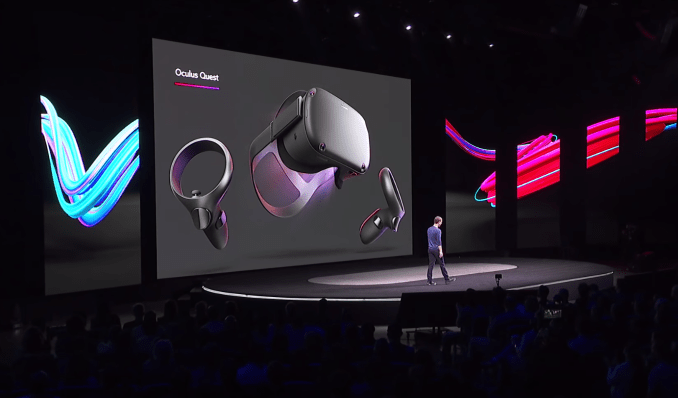
Facebook CEO Mark Zuckerberg introducing the $399 Oculus Quest

There are some clear benefits for Oculus pushing iterative hardware in an iPhone-like “S” manner, especially around affordability, as a more drawn-out device life cycle gives both Oculus and PC component manufacturers time to reduce VR’s high barrier to entry in terms of cost.

The cancellation of its Caspar “Rift 2” project does suggest a less aggressive pace of innovation for the company with its flagship premium VR product. The move away from a redesign could alienate early adopters and send them to other platforms. It also could lead Oculus into a situation where new titles that take advantage of the latest systems aren’t compatible with Rift hardware.

At its Oculus Connect developer conference, Facebook CEO Mark Zuckerberg shared that the Oculus Rift, Quest and Go represented “the completion of its first-generation of VR products.” As Zuckerberg continues to double-down on his long-term goal to bring 1 billion users into VR, the need to build the Oculus user base is growing more important, but it’s unclear how essential the company believes leading the high-end PC VR market is to defining that early mainstream success.

31 Oct 2018

SpaceX shuffles Starlink leadership, hoping to accelerate launch

SpaceX is changing the lineup at the Seattle-based offices of Starlink, the company’s nascent satellite broadband division. A Reuters report depicts a whirlwind visit by CEO Elon Musk as a middle management bloodbath, but SpaceX says it’s just the usual fast-moving space company stuff.

Starlink plans to put thousands of satellites into space with which to blanket the world in broadband — SpaceX isn’t the only aspirant to this plan, but it is farther along than some. It launched a pair of prototype satellites in February, Tintin A and B, which are reportedly working perfectly well as ongoing test platforms.

Space is no place to rush into, however, but that clashed with aggressive timelines set by Musk years ago and apparently not quite being met. Reuters reported that several leads on the project were pushing for more testing, and Musk visited Seattle to provide a kick in the pants.

Among those reported fired were VP of satellites Rajeev Badyal and designer Mark Krebs, both of whom have overseen the project through and after launch. SpaceX did not directly confirm their departures, but confirmed that Starlink had seen significant restructuring.

“We have incorporated lessons learned and re-organized to allow for the next design iteration to be flown in short order,” a SpaceX representative told TechCrunch, saying the move was consistent with the “rapid iteration design and testing” the company is known for.

Will it be enough to put more birds in the air by mid-2019, as Musk hopes? That remains to be seen, but the SpaceX strategy of launching early and often has so far paid off in the long run, so perhaps this maneuver will as well.

31 Oct 2018

CBS launches a streaming entertainment network, ET Live

CBS is today launching another streaming network, this time focused on entertainment news. The service, which is called ET Live, was developed by CBS Interactive and CBS TV’s “Entertainment Tonight” news magazine, and will be available both as a standalone app as well as a part of the CBS streaming app aimed at cord cutters, CBS All Access.

The new service will deliver 24/7 coverage of entertainment news, including breaking news, celebrity interviews, features, behind-the-scenes, red carpet coverage, plus trends stories across celebrity fashion, beauty and lifestyle.

The content isn’t just a rehash of the “Entertainment Tonight” on-air broadcast, the network claims. Instead, it will feature original programming and a roster of new hosts, including Lauren Zima, Denny Directo, Cassie DiLaura, Tanner Thomason, Jason Carter and Melicia Johnson.

The flagship show’s current hosts – Nancy O’Dell, Kevin Frazier, Nischelle Turner and Keltie Knight – will make regular appearances, however, to promote what’s up next and other exclusives.

At launch, the service is available on its own website at ETLive.com and through an ET Live app on iOS, Android, Apple TV, and Amazon Fire TV, with more platforms expected in the future.

It’s also being integrated into CBS All Access’s live feed across platforms, and as feed within CBSN, the network’s 24/7 streaming news service.

The new streaming network is the latest of several launches aimed at bringing more CBS content to a new generation of viewers who no longer tune in to traditional pay TV.

A few months ago, CBS debuted a portfolio of streaming services under the brand CBS Local. These help deliver local news to cord cutters and other digital media consumers, including its CBS All Access subscribers. It also operates news network CBSN, which it added to CBS All Access last year. And it launched streaming sports news service, CBS Sports HQ, earlier this year. This can now also be found in CBS All Access.

Like CBSN, CBS Sports HQ, and your local CBS News (where available), the new ET Live feed is available in the “Live” section of the CBS All Access app. Users can toggle between the various live streams with a tap, then can choose to watch live or jump back to watch previous segments on-demand.

ET’s brand made sense to be the next to transition to reach over-the-top viewers because of its existing reach, including on digital platforms. The TV show has nearly 5 million daily viewers, while the ETonline.com website averages 20 million monthly U.S. uniques, per comScore. Its social audience is even larger, with over 70 million U.S. users monthly, the network says.

“From CBS All Access to CBSN and CBS Sports HQ, we are dedicated to bringing consumers best-in-class streaming services,” said Rob Gelick, Executive Vice President and General Manager, CBS Entertainment Digital for CBS Interactive, in a statement about the launch.

“ET Live is a natural expansion of our strategy and expertise in this area. We have the great advantage of being able to apply key learnings from our leading digital entertainment properties and marry that with the #1 entertainment brand in ‘Entertainment Tonight’ to create a new offering for the next generation of entertainment consumers, those that are platform-agnostic and expect content to be accessible anytime, anywhere,” he said.