Year: 2018

30 Oct 2018

Coinbase is now worth more than all but three cryptocurrencies

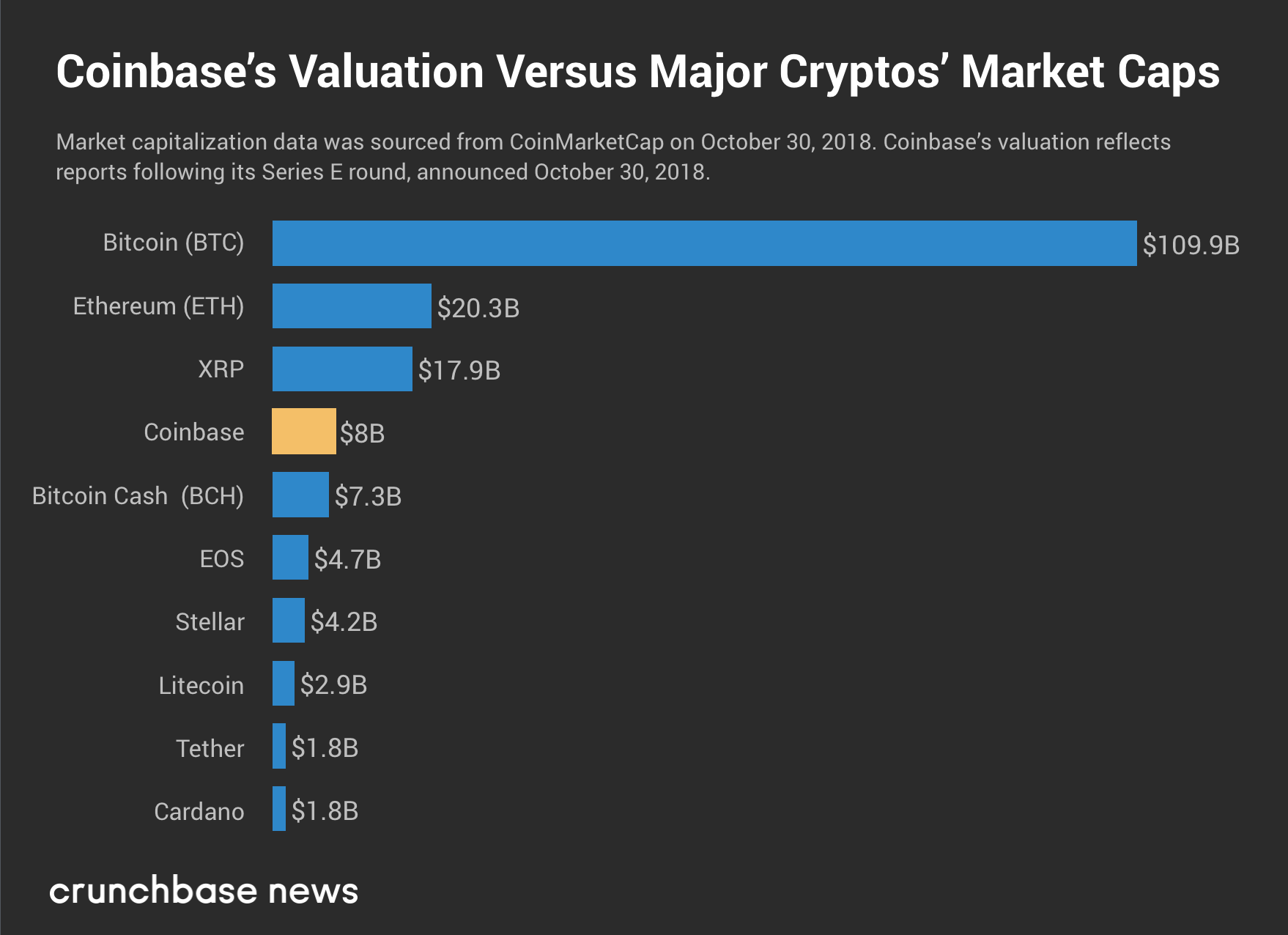
With its shiny new $8 billion valuation, Coinbase is now worth more than all but the top three cryptocurrencies that trade on the platform.

That’s right, the only cryptocurrency assets that are worth more than the platform that trades them are Bitcoin, Ethereum and Ripple. Bitcoin Cash, the currency forked from Bitcoin, is a distant fourth in valuation at $7.3 billion.
Coinbase’s Series E is nearly three times as much as the company raised in its Series D, and the fresh cash brings Coinbase’s total-capital-raised-to-date to over $520 million.

That’s a lot of money. Indeed, if Coinbase’s capital raised figured is compared to the market cap of the world’s various cryptocurrencies and other similar assets, it would rank around 20th.

But the bet for investors is, and should be, that if cryptocurrencies are indeed the next big idea in the ways that humans determine value, then Coinbase should be worth far more than any of the assets that trade on its exchange.

The fact that it’s neither indicates how much farther the company has to grow, or the limits of the thesis that cryptocurrencies will take over the world.

It shows that the wager on a particular crypto company is looking like a better investment than putting money to work in nearly any of the other crypto assets that are for sale. During the last few crypto booms, some investors said that it was probably simpler to just invest in various tokens instead of companies working on blockchains — faster returns and your money would be more liquid, to boot.

However, at least in the case of Coinbase, that wager likely wouldn’t have worked. Coinbase is also the company that every investor has wanted to invest in; it’s been a known winner for a while now, so its performance isn’t a huge surprise.

And now with $300 million, Coinbase is well-capitalized to survive either a market downturn (one will come eventually), and the current Crypto Interregnum.

Coinbase’s chief executive certainly thinks the market will grow. As we noted, Coinbase currently allows trading to just a handful of cryptocurrencies, but it has long harbored ambitions to expand beyond that.

Speaking at TechCrunch Disrupt SF in September, CEO Brian Armstrong revealed that he sees a future in which every cap table will have its own token. Based on that, he said he believes that Coinbase could host hundreds of tokens within “years” and even potentially “millions” in the future.
30 Oct 2018

Facebook shares climb despite weak Q3 user growth and revenue

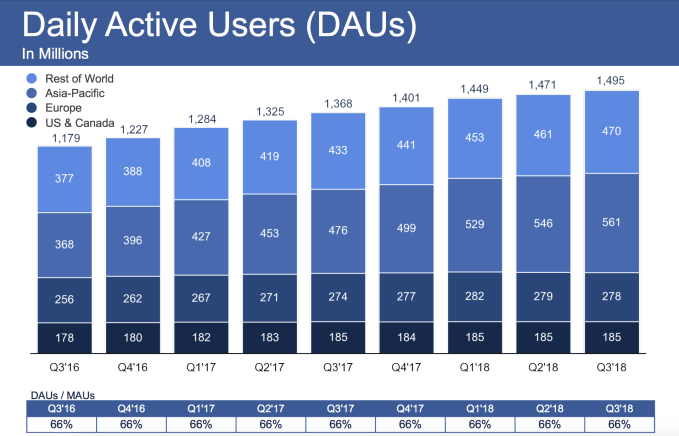
After last quarter’s bloodbath earnings report that cut 20 percent from Facebook’s share price, the social network stumbled in Q3 2018, reaching 2.27 billion monthly users, up 37 million users or 1.79 percent — only slightly better than Q1’s slowest-ever growth rate of just 1.54 percent, and compared to an 2.29 billion Wall Street estimate. It added 24 million daily active users hit 1.49 billion, up 1.36 percent compared to Q1’s 1.44 percent, missing the 1.51 billion estimate.

But the real growth story depends on its core US/Canada and Europe markets where Facebook saw zero growth and lost 1 million users respectively last quarter. In Q3, Facebook added 1 million monthly users to reach 242 million in the US/Canada region, but held flat at 185 million dailies there. It lost 1 million users in Europe in both dailies and monthlies. Those markets make up over 70 percent of its revenue, which is scaring Wall Street.

As for Facebook’s business, the company earned $13.73 in revenue, compared to Refinitiv’s consensus estimate of $13.78 billion, and saw $1.76 EPS compared to an estimate of $1.47, making for a mixed report. Facebook blamed foreign exchange headwings for $159 million in Q3, which was the difference between its miss and a beat on revenue.

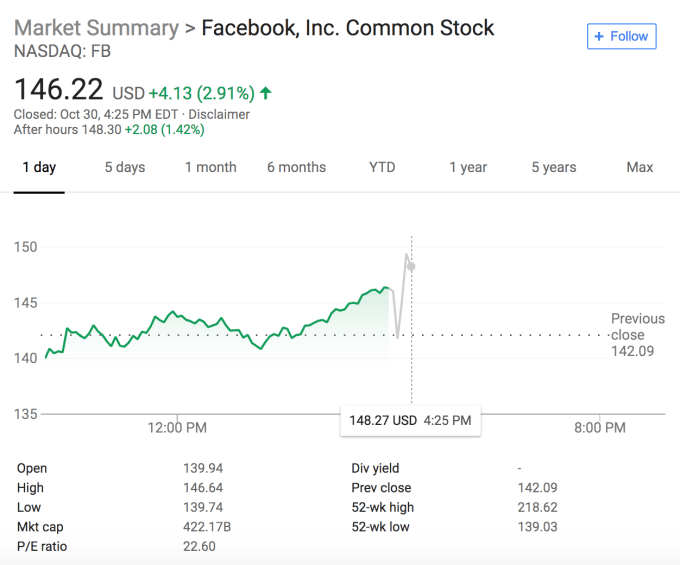
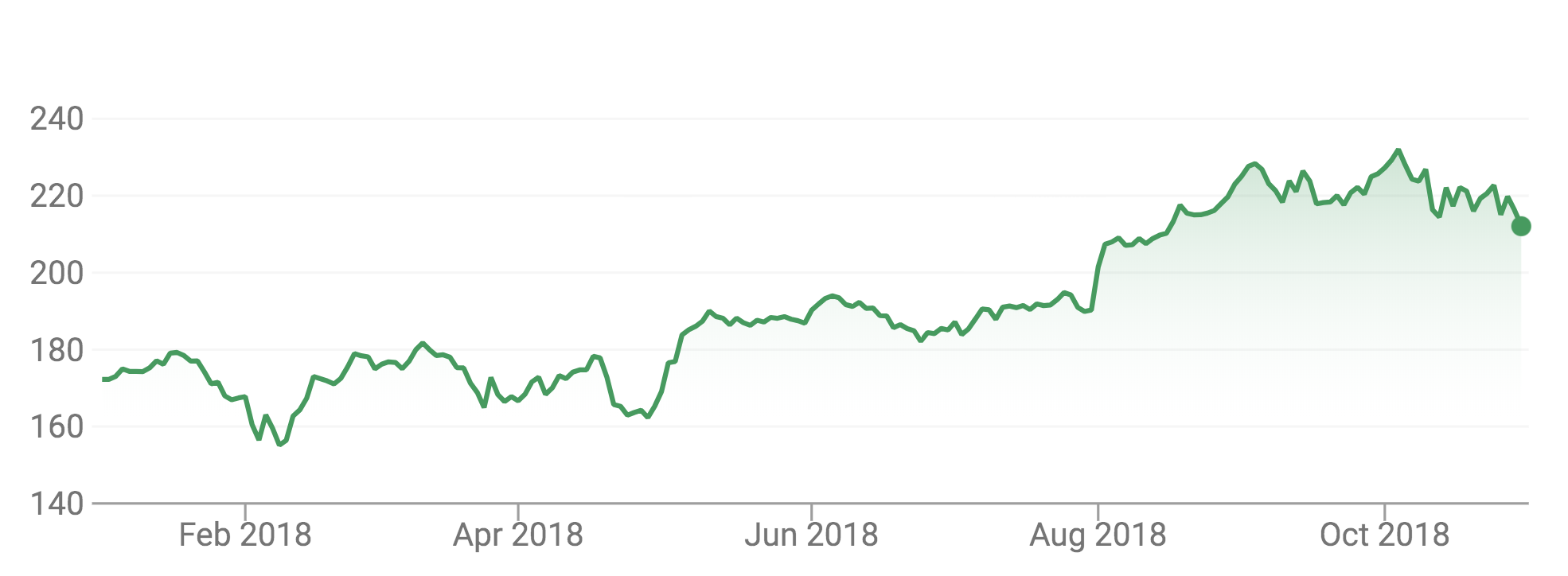
Facebook’s share price closed at $146.22 before earnings were released, still massively down from its $217 peak for before it announced user growth troubles and slowing revenue growth in Q2’s earnings report. Facebook shares climbed 2 percent upon the announcement of earnings, in part thanks to Facebook pulling in $5.14 billion in profit

Facebook hoped to show that its business can keep growing even as it spent massively to double its security and content moderation team from 10,000 to 20,000 this year. It did note that “more than 2.6 billion people now use Facebook, WhatsApp, Instagram, or Messenger each month, and more than 2 billionpeople use at least one of our Family of services every day on average.”

But the company’s revenues and profits have been overshadowed by the non-stop parade of scandals ranging from election interference to its biggest security breach ever. Next quarter we’ll see if the breach scared users away or if Facebook logging them out for safety led some to never log back in.

30 Oct 2018

To actually change the world, Big Tech needs to grow up

“Fierce competitor” is one of the biggest, and most culturally ingrained, compliments that exists in sports. The same is true in the technology world. However, as competitors originating from outside of Silicon Valley rise, so do the stakes for previously unchallenged tech firms, like Uber, Facebook and Google, to enter new markets responsibly. Companies that were once earnest startups helmed by say-anything, hoodie-wearing twenty-somethings are now big corporations with boards, stakeholders and tremendous impacts on society.

They need to start acting like it.

Amid mounting government and public pressures, tech firms famous for pushing far beyond boundaries now need to play by the rules when they enter new cities and towns. They now have to embrace more humble methods of conducting business and admit defeat when younger upstarts create better, faster innovations. Freshly relocated tech companies need to respect the indigenous innovation scene in a chosen location — not simply conduct headquarter operations somewhere else. They need to bring to every new market entrepreneurial thinking, jobs and a willingness to develop strong connections with public and private sector leaders.

The good news is that it’s not too late for tech giants to learn to be responsible, self-aware competitors. However, a few central questions need to be answered: Will big tech companies begin to bring more to cities than they take? Will they become responsible community partners building smart technologies in a way that respects new market values — especially around diversity, privacy and respect for people’s data? Or will they use their heft to out-maneuver municipal authorities, outbid local startups for engineering talent and ship intellectual property and data back to headquarters?

As Uber’s rebrand takes hold, for instance, CEO Dara Khosrowshahi needs to guide his organization toward working with municipal and community leaders — rather than coexisting with them at best. He and his team need to deepen their understanding of regulatory environments at the city level, play within the rules governing specific places and work to encourage homegrown tech talent in Uber’s new markets to pursue career opportunities with international reach. Uber needs to back up the company’s newly rolled out softer, safer image with concrete efforts to complement the innovation ecosystems already flourishing in cities outside of its hometown of San Francisco — and compete collaboratively in markets around the world.

Other tech giant founders, CEOs and executive teams around the world need to follow suit — regardless of whether actual suits are involved.

Success requires a balance of fierce competitiveness and humble respect.

Indeed, there’s a right way for tech companies to contribute to local causes and be good corporate citizens in general. The process starts with bigger tech companies establishing information exchanges with new communities that build trust and prioritize learning. After establishing operations and understanding the needs of communities surrounding them, tech companies need to prove their genuine interest in local innovation ecosystems. One way to do this is by donating money to a relevant charity or nonprofit organization that provides useful skill development to underserved communities.

Another, more humbling, option for tech giants is to invest in native startups building innovations that help them improve corporate citizenship — a technology that reduces their global carbon footprint, for example — and complement their own capabilities.

I am a serial entrepreneur and optimist. That’s why I believe that technology companies like Uber, Google and Facebook have a unique opportunity to deliver more than monetary investment into communities around the world. They need to assume responsibility for advancing innovation and talent upon arrival in a new city — and actively build programs that bridge location-specific digital, skill and transportation gaps.

Tech giants need to work with government and community peers to connect with local competitors already building the next generation of technology platforms. Success requires a balance of fierce competitiveness and humble respect. The entry of a tech giant to a new place should inspire connectivity, understanding and competition that lifts a community’s entire innovation ecosystem.

30 Oct 2018

Can Apple finish 2018 on a high note? We’ll find out Thursday

Apple (NASDAQ: APPL) has had a great 2018.

Even as the other FAANG stocks slumped, the trillion-dollar electronics company has continually satisfied Wall Street with quarter-over-quarter revenue growth. But will Apple’s momentum continue after it reports its fourth-quarter earnings on Thursday?

The consensus, so far, is yes. Apple is expected to post revenue of $61.43 billion (earnings per share of $2.78), an increase of 17 percent year-over-year and GAAP EPS of $2.78, according to analysts polled by FactSet. Investors will be paying close attention to iPhone unit sales, which account for the majority of Apple’s revenue, as well as Mac sales, which accounted for roughly 10 percent of the company’s revenue in Q3.

The company reported its Q3 earnings on July 31, posting $53.3 billion in revenue, its best June quarter ever and fourth consecutive quarter of double-digit revenue growth, the company said.

At today’s hardware event in Brooklyn, Apple’s chief executive officer Tim Cook shared that the company’s Mac business had grown to 100 million monthly active users — a big accomplishment for the nearly 10-year-old product. Cook also showcased the new MacBook Air and introduced the new iPad Pro and Mac Mini.

Not even Lana Del Rey’s surprise performance at the event was enough to rile up Wall Street. Apple’s stock was unreactive today, as is typically the case with hardware spectacles like these. Apple ultimately closed up about .5 percent. That’s a better outcome than its last hardware event in September, which despite the highly anticipated announcements of the iPhone XS and Apple Watch Series 4, forced the company’s stock down about 1.2 percent on the news.

Apple’s stock performance year to date

Year to date, Apple’s stock has risen more than 30 percent from a February low of $155 per share to an October high of $229.

If it fails to meet analyst expectations on Thursday, it’s bad news for the stock market: “Apple is the last domino standing,” Market Watch wrote earlier today. “Its FAANG brethren have all crashed, even the mighty Amazon, which has slumped about 25% from all-time highs.”

If you missed today’s event, we live-blogged the whole thing here and detailed all the new hardware here.

Apple Fall Event 2018

30 Oct 2018

WeWork-owned Meetup brings on David Siegel as CEO

Late this past summer, Meetup founder and CEO Scott Heiferman moved into the chairman position, leaving the CEO role vacant. Today, Meetup has announced that David Siegel will be taking the helm at the 15-year-old company.

Siegel hails from Investopedia, where he served as CEO for three years, tripling the company’s revenue and doubling its traffic in that period. Before his time at Investopedia, Siegel was president of Seeking Alpha, overseeing U.S.-based functions including sales, marketing, product and bizdev.

At the end of 2017, co-working behemoth WeWork acquired Meetup for a reported $200 million. Meetup’s entire premise is based on the idea of community — use the internet to get people off the internet and talking in real life. That’s a central theme in the WeWork strategy.

Here’s what Siegel had to say about the transition:

In a world where technology often drives greater distances between people, Meetup uses technology to bring real, in-person and life-changing connections to millions of people globally. Together with WeWork, Meetup is reinventing how people work, live, learn, play, and create community every day. I am thrilled to be a be a part of this incredibly exciting venture to bring more people together.

Meetup currently has more than 40 million members, 320,000 Meetup groups and facilitates 12,000 meetups per day around the world.

30 Oct 2018

Even Financial acquires Birch Finance, a credit card rewards startup

On the heels of a funding round to the tune of $18.8 million, Even Financial has acquired Birch Finance for an undisclosed sum.

Even offers products like a pre-approval API, real-time pricing, machine learning optimization, a product comparison and recommendation engine for consumers and more. Birch Finance, a TC Startup Battlefield alum that raised $1 million earlier this year, aims to help people make the most of the credit cards in their wallets by telling them which cards will earn them the most points. It works by analyzing your transaction history to identify missed rewards opportunities. Even’s plan with this acquisition is for Even to expand its offerings within the credit card space.

“The credit card market continues to expand with millions of consumers opening up hundreds of different types of credit cards every year for countless reasons,” Rosen said in a statement. “Birch already has one of the largest credit card databases and their technology perfectly complements our existing platform as we expand our offering to the credit card space. This acquisition will allow our partners to optimize the process of getting the right cards to the right consumers.”

Even’s slate of partners includes Credit.com, a personal loans marketplace, The Penny Hoarder and Transunion. With the Birch team on board, Even will enable its partners to save on consumer acquisition while also scaling its credit card recommendation platform. At Even, Birch co-founder Cohen will serve as senior director of the credit card marketplace.

In a statement, Cohen said, “We saw a clear synergy with Even’s business strategy and growth plans, and I’m thrilled to join Even’s team as we expand and scale our offerings into new areas.”

30 Oct 2018

Google Pixel 3 XL users are getting twice the notch, thanks to a bug

Over the past two years, the notch move from anomaly to fact of life, and no company has proven itself more pro-notch than Google. From its embrace of #notchlife in Android Pie to the downright gigantic one found up top on the Pixel 3 XL, Google’s really notchin’ it up.

In fact, as noted by Android Police the Pixel 3 XL has a notch so nice, Google’s delivering it twice. A number of owners have reported an (admittedly hilariously bug) that’s causing the massive headset to double up on the notch, with a second cutout appear on the side of the device.

Google has acknowledge (acknotchleged?) the issue and noted that it’s working on a fix, which should be coming soon. The company hasn’t offered a reason behind the issue, but it appears to stem from Pie’s built-in notch feature, and likely has something to do with how the background adjusts when the handset changes from portrait to landscape mode.

It seems even in 2018, that’s a notch too far.

30 Oct 2018

ZypMedia raises $5.6M to help traditional media companies embrace online ads

Local advertising startup ZypMedia is announcing that it has raised $5.6 million in Series C funding.

That’s relatively small amount of money for a Series C (the company had previously raised $6.9 million total, according to Crunchbase), but co-founder Aman Sareen said, “We had the opportunity to raise a lot more, but we chose not to.” In fact, Sareen said ZypMedia became profitable last year.

So the new funding round should allow the company to continue expanding its product lineup and its team — it has plans to double its headcount in the United States and India over the next year — while still leaving room for organic growth.

“We didn’t want to be a cautionary tale [like] other previous adtech companies,” Sareen said. “We are buckling down for the long haul … We didn’t want to necessarily raise money just for the sake of it.”

Sareen founded ZypMedia with his former college roommate Ramandeep Ahuja, as well as former Current TV executive Mark Goldman, with the aim of helping local broadcasters move into programmatic advertising.

The idea is to help those media companies offer campaigns that can reach advertisers’ desired audiences across traditional and digital channels, such as display, video (including over-the-top), social media and native advertising.

“Local digital advertising has been very neglected,” Sareen said. “It’s a huge market, and our goal was to be one of the leaders. I’ll be honest, it wasn’t an easy to task, but we have been decently successful in our mission.”

“Decently successful” means signing up partners like Sinclair Broadcast Group and Univision. It also means enlisting Archer Venture Capital as the lead investor in the new round. (Existing investors US Venture Partners and Sinclair also participated.)

“Not only have Aman and Ramandeep created a superior tech stack for delivering local advertising, they’ve also developed a really smart and defensible business model, partnering with local media companies to act as their direct sales force,” said Archer Managing Director John Hadl in the funding announcement.

And ultimately, the vision goes beyond bringing incremental revenue to traditional media companies. Sareen argued that ZypMedia’s model positions it right at the intersection of traditional and digital advertising.

“Within next two-to-five years, digital or linear, over-the-top or over-the-air, it will jump through one platform,” he said. “Everything will use the same technology and currency.”

30 Oct 2018

Gmail’s iOS app gets a unified inbox

Gmail users on iOS are getting a notable upgrade today: a unified inbox. While Android users have had the option to see multiple inboxes in a single view, iOS users – until now – have had to switch accounts by tapping between them in the app’s navigation.

Many people today have more than one email account, often using one for work, another for personal, and one to give out more publicly – their “junk” inbox, so to speak. Some have multiple inboxes for multiple jobs or job roles. And some access a shared inbox along with others on a work team.

But moving among accounts has required a bit of tapping around, if you used Gmail on iOS.

With today’s iOS update, there’s instead the option to use the new “All Inboxes” view from the left-hand side drawer. This will show all your emails in a single list, Google says.

The option works with both G Suite and non-G Suite accounts, including third-party IMAP accounts, the company notes.

Though a unified inbox is a seemingly minor feature, it’s the sort of thing that has driven many Gmail iOS users to third-party apps, since Gmail itself was lacking. That may now change.

The feature is rolling out to Gmail and G Suite users over the next 15 days.

30 Oct 2018

Google’s Gboard now lets you create a set of emoji that look like you

Last summer, Google introduced its own take on Bitmoji with the launch of “Mini” stickers in its keyboard app, Gboard, which leverage machine learning to create illustrated stickers based on your selfie. Today, Google is expanding the Mini Stickers with the launch of what it calls “Emoji Minis” – meaning, emoji-sized stickers that look like you.

Similar to the initial launch of Mini stickers, the new emoji are also created using machine learning techniques, Google says.

The company said the idea is to give people a way to use emoji they feel better represent who they really are.

“Emoji Minis are designed for those who may have stared into the eyes of emoji and not seen yourself staring back,” explained Google, in a blog post. “These sticker versions of the emoji you use every day are customizable so you can make them look just like you.”

That means your emoji can have differently colored hair – like green or blue or gray, for example – or piercings. It can be wearing a hat, head covering, or glasses.

Google says it uses neural networks to suggest skin tones, hairstyles, and accessories that you can then fine tune. You can choose a color for your hair, facial hair, or select different types of head covering and eyewear. You can also add freckles or wrinkles, if you want.

The result is a not just a single emoji, but a selection of options. For example, you can use your custom emoji as a zombie, mage, heart eyes, crying eyes, shruggie, and all the others.

This the third style of Mini stickers, first introduced last year. Already, these stickers come in two other styles – a more expressive “bold” and a nicer “sweet.”

While it may seem like a minor thing, creative emoji – and specifically, personalized emoji – can be a big draw for messaging apps. Apple advertises its clever Animoji and personalized Memoji as flagship features of its newer Face ID-powered phones. Snapchat bought Bitmoji (Bitstrips) to give its users access to more tools for creative expression. Samsung lets you make your own AR emoji that look like you. And people celebrated when the Unicode Consortium diversified to include more skin tones, and added, at long last, redheads.

Gboard, whose app has been downloaded over a billion times on Google Play, has a similar draw, thanks to its selfie-based stickers.

The company says the new Emoji Minis are available in all Gboard languages and countries, on both iOS and Android, starting today.