Year: 2018

30 Oct 2018

Apple’s new iPads delete the home button for good

Apple drove the final nails in the home button’s coffin on Tuesday, removing the once ubiquitous feature from its new line of iPad devices.

The new iPad Pro devices, revealed at Tuesday’s Apple event in New York, no longer have a home button. The design move, which is meant to make room for a bigger, more compelling display, follows the home button’s removal on the iPhone. Apple also dropped the Lightning port with the new iPad Pro and moved to the USB-C.

The new iPad Pro, which comes in two sizes, is now unlocked with face ID. It’s been redesigned to work in any direction too, so there’s no “wrong way” to unlock it.

Once the device is unlocked, users will be able to perform actions using on-screen gesture controls to access the feature they need. For instance, users can swipe down from the upper right hand corner to get to the control center, or swipe up from the bottom to access to the dock.  In short, it’s going to be the same kind of gestures used for the new iPhone 10.

Apple started phasing out the home button in 2017, beginning with its premium iPhone X handset. It kept the physical home buttons on cheaper iPhones. But we all knew their time would come.

That hammer dropped in 2018 and Apple cleared the home button from its new iPhone XS, iPhone XS Max or iPhone XR.

30 Oct 2018

Apple ditches the headphone jack on latest iPad Pro models

The headphone jack is missing from the latest versions of the iPad Pro. It’s gone. Dead. Worse yet, the headphones that come with the iPhone will not work either. Apple ditched Lightning for USB-C. Instead, Apple is selling a USB-C to 3.5mm dongle for $9.

The latest iPad Pro models follows the trend lines set by the iPhone. Just like on the iPhone, the Home Button is missing, and the headphone jack is gone. It’s a concession some users might find surprising. On the iPhone, there’s obviously less real estate to integrate a large port but that’s, in theory, less of an issue in a large device like a tablet. But it makes sense. Apple tends to maximize margins by ensuring different products use a similar set of hardware. And since the iPhone hasn’t had a headphone port since 2016, it’s about time the trend hits Apple’s other mobile device.

Headphone users are not the only users left in the dark. The iPad has long been a great device for a stationary audio controller. Now, instead of simply connecting the tablet to a stereo with a 3.5mm cable, a $9 dongle is required. Want to use headphones? Apple would obviously prefer if owners use $159 AirPods though there are a handful of USB-C headphones including these from Google.

Apple Fall Event 2018

30 Oct 2018

Freebird flies off with $8M to rescue passengers after flight cancellations

There are few things more irritating than a canceled flight, whether it’s on your way to a friend’s wedding, a conference or to celebrate a holiday back home. Wouldn’t it be nifty if technology could put an end to our travel woes? Freebird, a travel rebooking service, has raised an $8 million Series A to do just that.

The startup charges a minimum of $19 per flight — more depending on distance, time of year, location and more — to independent travelers and companies that partner with the service to help travelers rebook flights after cancellations or other “disruption events.” Most of the time, flights are on-time and without issue, which means that most of the time, Freebird pockets all of its customer’s cash. But if there is a disruption event, Freebird guarantees it will rebook you with just three taps of your phone and without any additional charge.

American Express Ventures has led the round, with support from Citi Ventures, PAR Capital Ventures, General Catalyst and Accomplice. Freebird is currently in discussions with Amex and Citi, as well as other banks, to roll its travel benefits into their corporate card services. To date, the startup works with 100 corporate clients and 10 corporate travel agency partners, including BCD Travel. Freebird says it expects to support 250,000 travelers this year.

Founded in 2015 by Ethan Bernstein, Cambridge, Mass.-based Freebird aggregates data on flight patterns to predict the probability of a flight disruption. If the probability is high, Freebird chargers more for access to its mobile rebooking tool.

“If you’re flying out of Buffalo in the winter, it’s going to be a higher risk flight,” Freebird chief executive officer Bernstein told TechCrunch. “If you’re flying out of Phoenix in the summer, you’re at a very low risk of being disrupted. We understand those risks and we are able to price our product differently based on those factors.”

Freebird has raised a total of $16.5 million in funding to date. It’s one of many travel technology startups to bring in venture capital this year. IfOnly, a marketplace for experiences, secured $20 million in April; luggage startup Away brought in a $50 million in June; and travel activities platform Klook raised $200 million in August, to name a few.

Freebird, though focused specifically on flights, says its experiences are at the forefront of its business model.

“There are a million different products that will help you automate your life but one of the things we are focused on is transforming personal experiences,” Bernstein said. “Do they go through these disruption events tearing their hair out or do they go through it knowing that they have control, agency, support and information? It’s funny what happens when people deal with uncertainty; uncertainty is the worst. As soon you give people information, human support and technology to help them solve their problems, they experience the event so much differently.”

30 Oct 2018

Get your free tickets to Startup Battlefield Latin America 2018

We’re 10 short days away from making TechCrunch history, and we couldn’t be more excited. On 8 November, we kick off our first Startup Battlefield Latin America 2018 at the Tomie Ohtake Institute in São Paulo, Brazil. We can’t wait to add up to 15 of the region’s exceptional early-stage startup founders to our Startup Battlefield alumni community.

The only thing more exciting than competing in the Battlefield is being there up-close and personal to watch and cheer as these startups go head-to-head for cash, serious bragging rights and potentially life-changing investor and media attention. We invite you to apply for a free spectator pass. Tickets are limited, and we’ll select people in the Latin American startup scene on a first-come-first-served basis.

In addition to witnessing an epic pitch competition, you’ll also enjoy presentations and panel discussions from our outstanding roster of speakers. More on that in a moment. First, here’s how Startup Battlefield works.

During three preliminary rounds, up to five startups per round will each have six minutes to pitch and present their demo before a panel of expert tech and VC judges. The judges have six minutes following each pitch to ask teams probing questions. Five of the competing startups will move on to the finals and pitch again to a new set of judges.

The judges confer and will ultimately name one startup to be Latin America’s first Startup Battlefield champion. The winning founders receive a $25,000 non-equity cash prize and a trip for two to the next Disrupt, where they can exhibit free of charge in the Startup Alley — and possibly qualify to participate in the Startup Battlefield at Disrupt.

Now, about those presentations we mentioned. We’ve invited a range of experts familiar with the region to host a series of discussions between Battlefield rounds. Here’s a small sample of what to expect:

  • Keynote: Rodrigo Schmidt (Instagram) will talk about the popular photo-sharing app’s rapid growth and development.
  • Venture Investing in Latin America Today: Eric Acher (Monashees), Veronica Allende Serra (Innova Capital), Hernan Kazah (Kaszek) and Fernando Lelo de Larrea (ALLVP) will discuss the accelerating pace and scale of venture investing in Latin America. How will the ecosystem adapt?
  • 20 Years Ahead of the Curve: Fabricio Bloisi (Movile) will discuss the company’s journey from SMS and ringtones in 1998 to digital businesses on mobile platforms.

As we said, that’s just a taste of what’s in store. You can read the full agenda right here.

The epic event that is Startup Battlefield Latin America 2018 takes place 8 November in São Paulo, Brazil. Come join the startup community for an exciting, action-packed day of competition, collaboration and connection. Apply for your free spectator ticket today. We can’t wait to see you!

30 Oct 2018

Here’s everything Apple announced today at its big hardware event

From new iPads to new MacBook Airs, Apple had a bunch of hardware refreshes to debut this morning. Here’s everything they showed off.

New MacBook Air
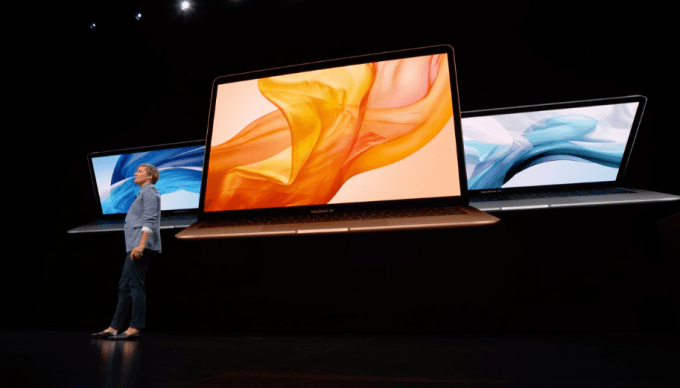
The MacBook Air is, at last, getting a Retina display. Roughly six years after the MacBook Pro went high-res, Apple’s slim line is following suit.

It has a 13.3″ screen, with a slimmer bezel (now black, rather than aluminum.) There’s a TouchID fingerprint sensor near the upper right corner of the keyboard — a keyboard which, by the way, has been shifted over to Apple’s butterfly mechanism keys. Oh, and it’s got actual function keys. No goofy TouchBar here.

It’s got a 20% larger Force Touch trackpad. The speakers are 25% louder than the previous generation with, the company claims, double the bass. Apple says the bodies of the new MacBook Airs are made of 100% recycled aluminum.

It’s got two Thunderbolt ports, and crams an Intel i5 CPU, up to 16GB of 2133Mhz RAM, and up to 1.5 TB of storage into its 2.75lb body. It’ll start at $1199. Orders start today, and will ship out starting November 7th.

New Mac Mini
Given that it’s been four years since the last Mac Mini refresh, you might’ve assumed Apple was done with the line. Nope!

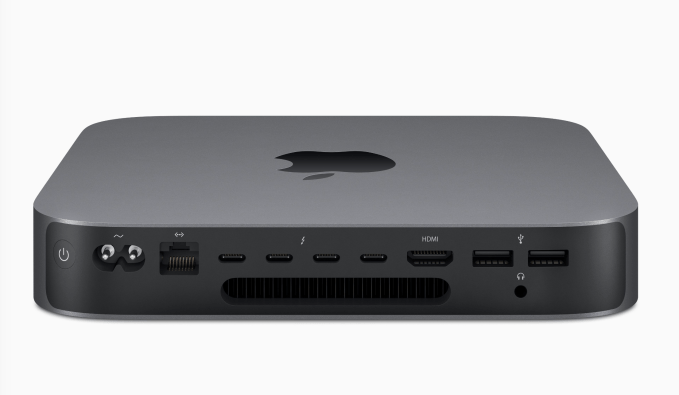
The new Mac Mini will come in 4-core or 6-core models, up to 2TB of SSD storage, and up to 64GB of memory. It’s got a new thermal system that doubles the airflow to keep things cool. It’s got gigabit ethernet (or 10 gigabit ethernet, as an upgrade), 4 thunderbolt ports, HDMI, and 2 USB-A ports. Like the new MacBook air, it’s made of 100% recycled aluminum.

The base model starts at $799, and will start shipping out on November 7th.

New iPad Pro
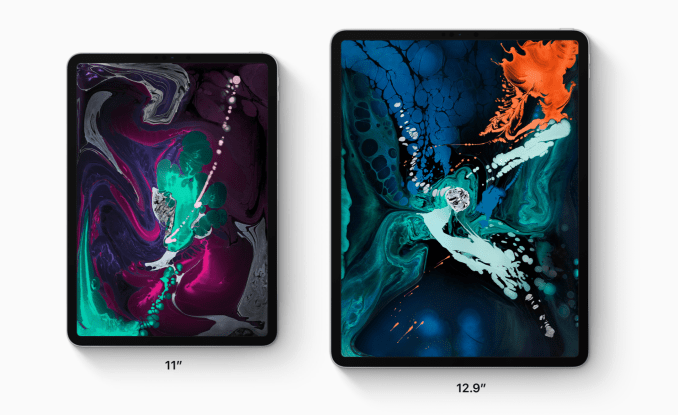
Goodbye home button! Like many an iPhone before it, the new iPad Pro ditches the home button in favor of a much slimmer bezel.

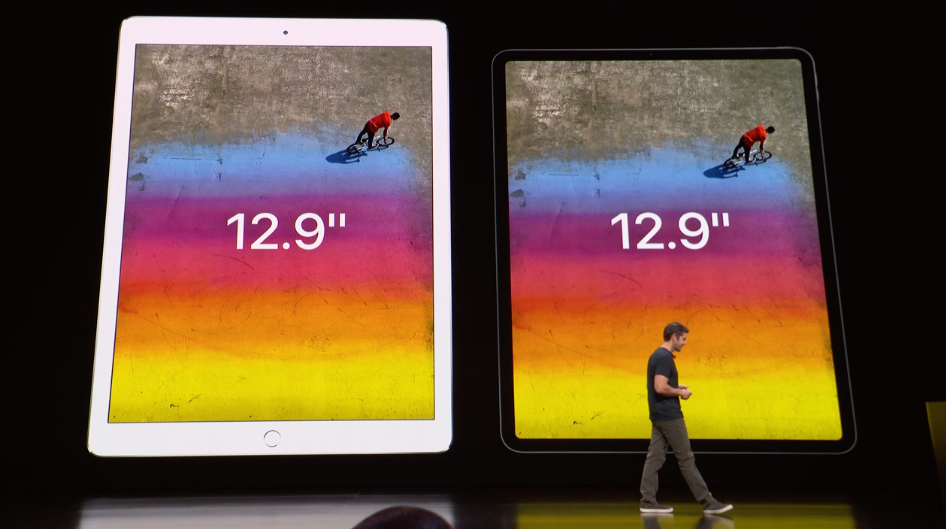
By slimming down the bezel, they’re able to cram an 11″ screen into the same body that previously fit a 10.5″ screen. They’ll also continue to offer an even larger model with a massive 12.9″ display.

On the inside, it’s running Apple’s new A12X Bionic chip — a chip packing an 8-core CPU, a 7-core GPU, Apple’s secure enclave, and a storage controller that lets the new iPads handle up to 1TB of storage. Apple claims this new iPad Pro is faster than “92% of portable PCs.”

It’s got FaceID for unlocking your iPad with just your ol’ noggin, with a 7 megapixel camera on the front and a 12 megapixel camera on the back.

Perhaps most notably, the iPad Pro is dropping the Lightning port in favor of USB-C. That USB-C port can drive an external 5K display — or, in a pinch, charge your phone.

The 11-inch iPad Pro will start at $799, while the 12.9 inch model starts at $999. Orders start today, shipping out starting November 7th.

New Apple Pencil
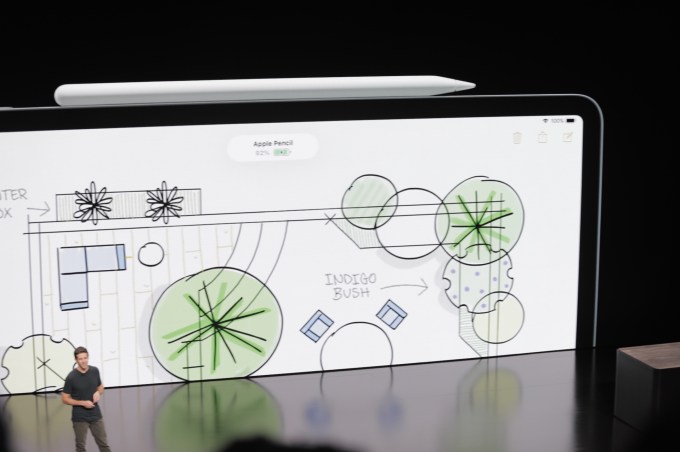
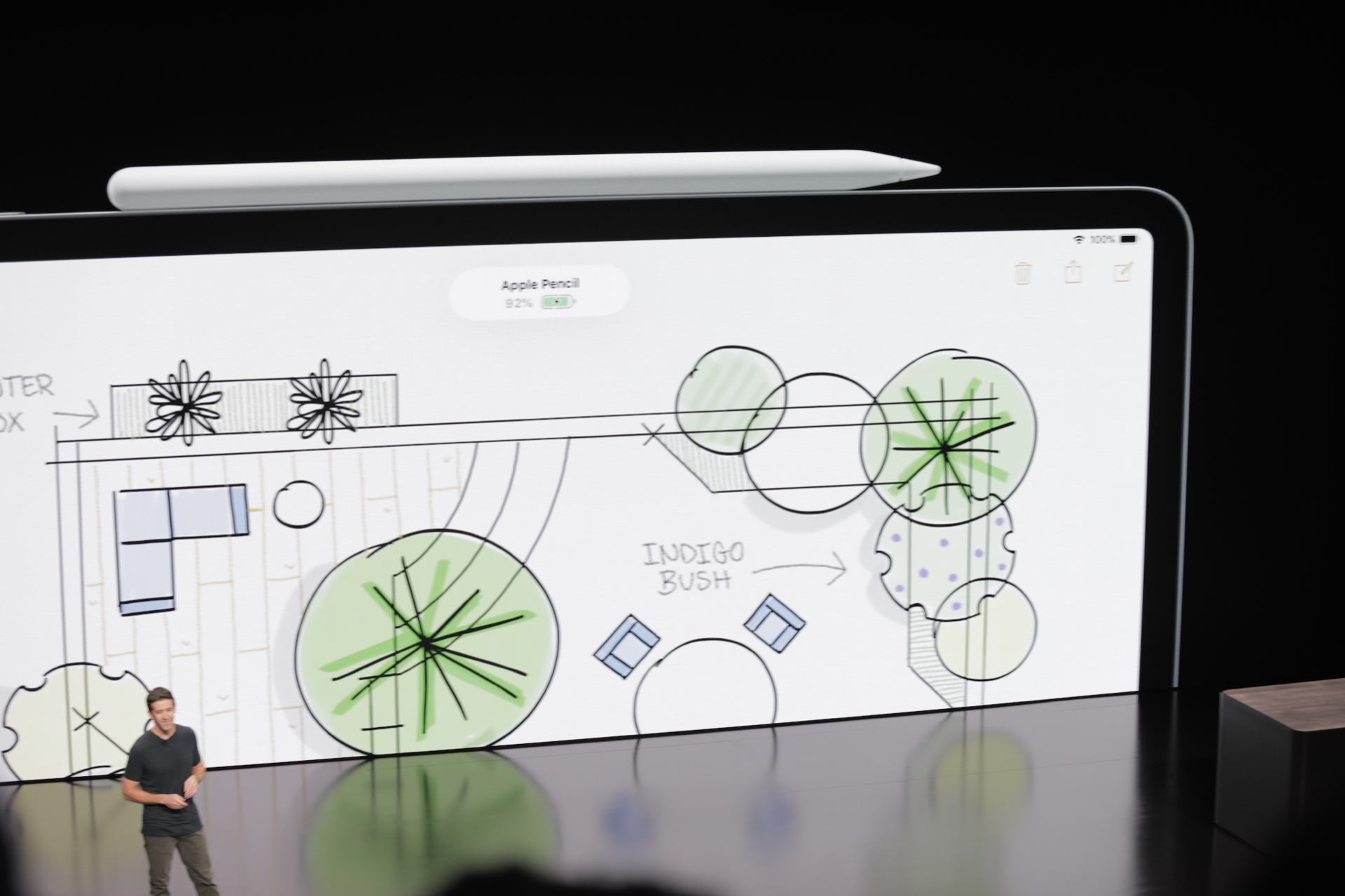
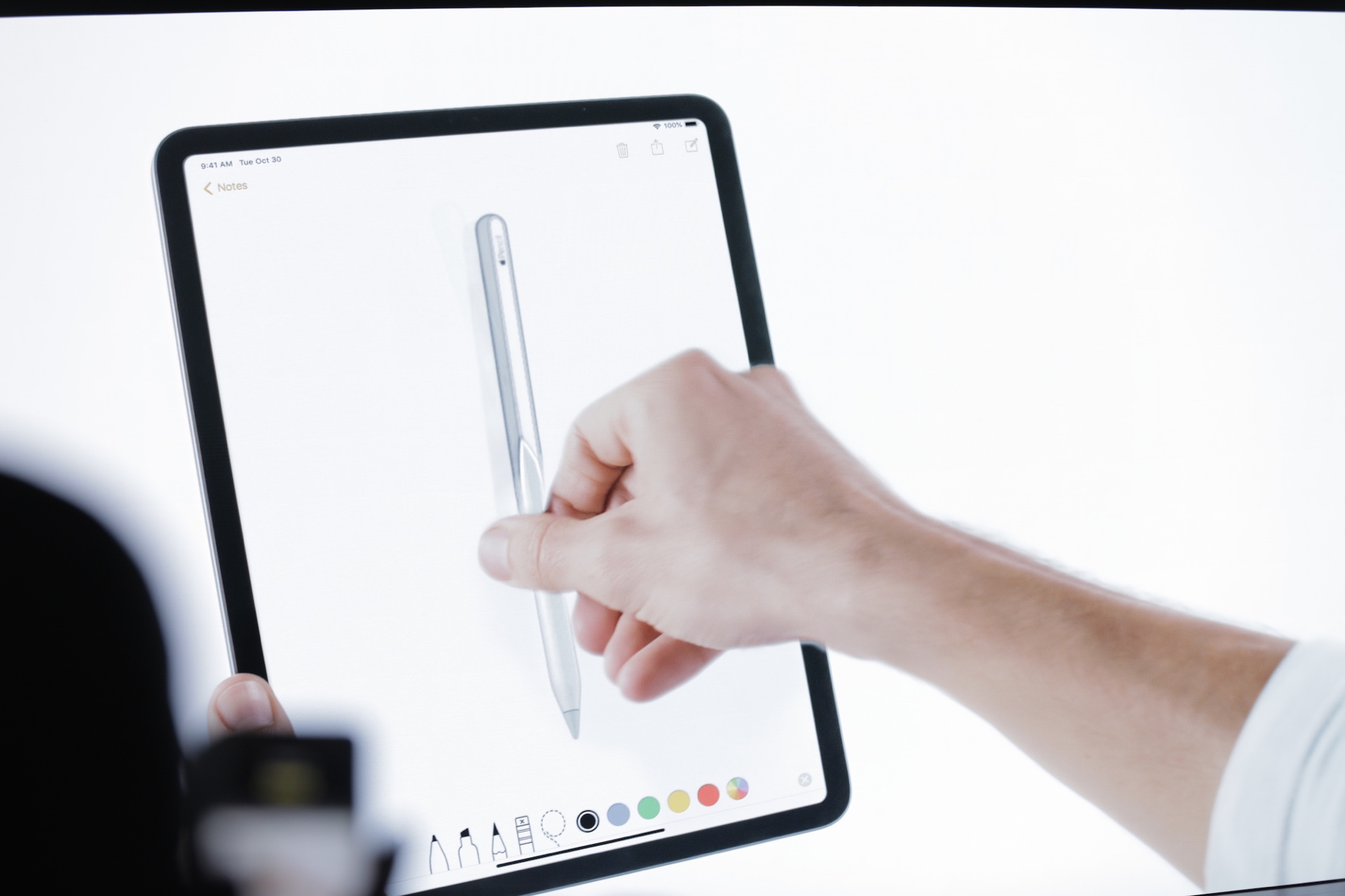
The new Apple Pencil is built to snap magnetically to the edge of the new iPad Pro. Once snapped, it automatically pairs and starts wirelessly charging. No more goofy pencil sticking out of your iPad! Tap the Pencil to the Pro, and the iPad wakes up and launches right into Notes. It’s got support for gestures now, like double tapping the edge of the pencil to zoom way in or out in Photoshop.

iOS 12.1

As expected, the first big update to iOS 12 ships today, its biggest feature being Group Facetime for chatting with up to 32 people at once. It’s also got 70 new emoji, and brings dual SIM support to the iPhone XS, iPhone Xs Max, and iPhone Xr.

Apple Fall Event 2018

30 Oct 2018

The iPad finally moves to USB-C

Lightning had a good run, but it’s time to switch everything to USB-C. Apple finally dropped the Lightning port with the new iPad Pro. And the USB-C port is much more versatile than Lightning.

For instance, you can plug a 5K display to your iPad Pro and show some video on the external display. It’s still unclear how it’s going to work when it comes to software, but it opens up a lot possibilities.

You can also use USB-C dongles to plus all sort of data accessories. SD card readers, Ethernet cables, etc. The iPad Pro is looking more and more like a traditional laptop. Many third-party accessory makers will probably use this opportunity to develop docks and other hubs.

Finally, the good thing about USB-C is that you can theoretically turn any device into an external battery pack. Using a USB-C to Lightning, you can now charge an iPhone from your iPad. It’s an expensive battery pack, but it can be useful for those who always carry both at the same time.

Now let’s hope this is the first sign that USB-C is coming to the iPhone. I can’t wait to use my laptop charger to charge my phone, or my iPhone charger to charge my Nintendo Switch.

Apple Fall Event 2018

30 Oct 2018

Sentieo raises $19M to be the AI-powered Bloomberg Terminal

To get an edge on the market, investors must look beyond traditional financial info like revenue and profits. Our every online activity generates data exhaust like web traffic, Twitter mentions, app downloads, and search trends. It’s the ability to overlay the old and new data sets to spot surprising trends that will set the best traders apart. Sentieo wants to be their tool.

Sentieo is an investment research software suite that uses AI to scan financial documents, analyze alternative data sets, and create visualizations. The fintech SAAS startup now has 700 customers including top hedge funds plus mutual funds, Fortune 500s, and investment banks who pay around $500 to $1000 per year per license. That’s a lot cheaper than a $21,000 Bloomberg Terminal subscription.

Now Sentieo is ready to crank up its name recognition with a sales and marketing blitz fueled by a new $19 million Series A round led by Centana, a $250 million growth equity firm focused on fintech SAAS. Now with $30 million in total funding, the 160-person startup plans to “Educate [traders] that ‘hey, this product is built by people who sat in your seats'” says CEO Alap Shah.

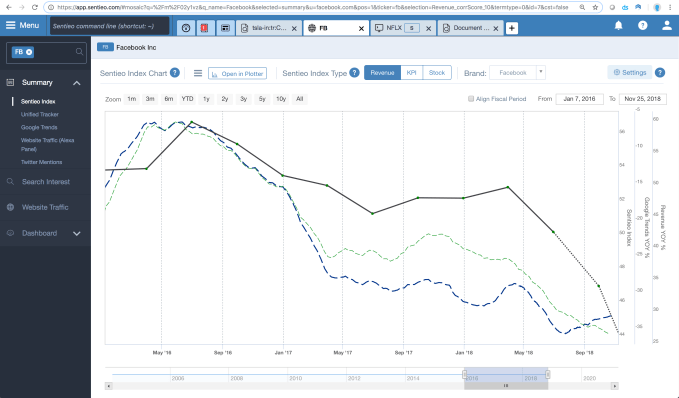
Sentieo charts Search Trends data and Sentieo Index data on Facebook vs the social network’s revenue

10 year ago, Shah was making the Wall Street rounds after graduating from Harvard in economics. He was an analyst in consulting at Novantas, private equity at Castanea, and worked for hedges funds VIking Global and Citadel. “It became clear that there were some really big holes in my process where software wasn’t meeting my needs. Importantly, there was a hole around search” Shah tells me. “We’ve grown accustomed to going to Google. But unfortunately that’s just not the way the old-school financial data programs are structured.”

Sentieo co-founder and CEO Alap Shah

So he built his own. “I used all the financial tools out there: Capital IQ, FactSet, Bloomberg — each had their strengths and weaknesses. But they were all over 20 years old, so they pre-date the cloud, pre-date SAAS, pre-date mobile!” With Sentieo, he wanted to develop a tool that could understand the nuances of business momentum before it showed up in the balance sheets.

Sentieo does have a traditional financial equity data terminal with real-time pricing. But there’s also a machine learning and natural language processing-powered document search tool that can sort through SEC documents, earnings call transcripts, press releases, and more. It taps Alexa web traffic data, Apptopia app download rates, and Twitter chatter, as well as Thomson Reuters analyst estimates and fundamentals. Customers can annotate files, organize ideas, generate visualizations, and share their insights through Sentieo’s Notebook.

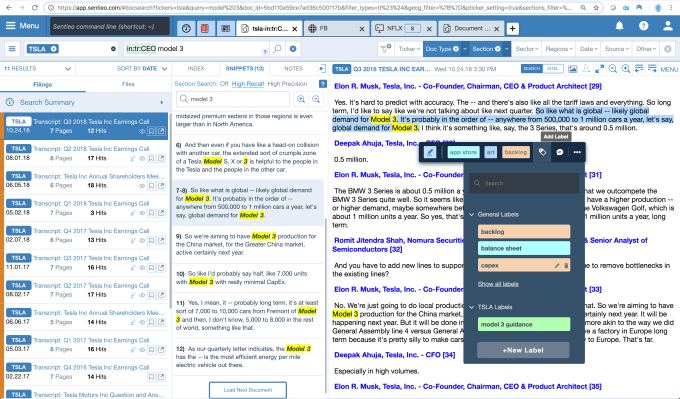
For example, Sentieo could look through all of Tesla’s earnings calls and financial documents for mentions of guidance on Model 3 production volume. It could highlight them all, analyze the sentiment of those mentions, and chart them against Tesla’s share price. Or you could search for all the companies starting to list President Trump as a risk factor for their business, which would surface how the medical cannabis companies are concerned about his Attorney General Jeff Sessions’ stance on legalization.


Sentieo’s synonym library allows it to hunt down different ways of saying the same thing with the goal of not forcing investors — or their dutiful analysts — to read through 100 page 10-Q documents manually. “You can get the same information at 10x the speed with something like Sentieo” Shah claims. It wants to a be a “research management system”, like a Salesforce CRM for tracking investment ideas.

But Sentieo’s 65-person India-based engineering must keep data from all 50 feeds, 25 million documents, and 64,000 equities flowing to keep customers satisfied. There are a ton of moving parts, and Sentieo is competing with much bigger companies. Beyond Bloomberg, there are lots of alternative data providers out there. And Microsoft’s software suite also has plenty of info management tools.

Sentieo’s hope is to emerge as an aggregator of information sources and an annotation tool that benefits from being purposefully designed for what analysts need. If Robinhood is on one side of the spectrum making investing easy for novice traders, Sentieo is on the other end making investing smarter for experts. “It’s really at the bleeding edge of how you get the data today” Shah concludes. “For every company driven by consumer demand, there are all these little breadcrumbs being left all over the internet.”

[Disclosure: I briefly rented a room in an apartment where Shah lived five years ago and I know him from the San Francisco social scene frequented by many Silicon Valley figures.]

30 Oct 2018

Apple adds 60 more ‘Today at Apple’ sessions covering Pro tools, Siri Shortcuts, AR and more

Apple is expanding the number and types of classes it hosts at its retail stores, under the banner of “Today at Apple.” The company says it’s adding 60 more sessions at its stores, including those focused on using its newer apps, like Siri Shortcuts and Clips, as well as those focused on AR, art, music, family photo-taking and more.

According to Apple SVP of Retail, Angela Ahrendts, Apple has hosted over 18,000 sessions per week, since the launch of the “Today at Apple” program 18 months ago. It also updated the Apple Store app in the latest release to better highlight sessions tailored to individual users based on the devices they own, as well as other signature programs.

Now, it’s expanding the program lineup.

“Today we’re announcing 60 newly designed sessions,” said Ahrendts. “Video, music and design have all been expanded and we’re adding walks and labs to most categories. And of course, we’re using Apple’s latest technologies like AR and Siri Shortcuts,” she added.

Apple is also creating its first video lab called “Small Screen Magic” in partnership with video creator Zach King where people will learn how to shoot and edit videos using Apple’s Clips app.

Another session will be a photo lab called “Fun Family Portraits,” which will feature the use of Live Photos, filters and Apple Pencil.

Meanwhile, a new design lab called “Drawing Treehouses” has been co-created with architects Foster + Partners – which collaborated with Apple on Apple Park. The course will teach architectural principles through the lens of fantasy.

A new Pro series will cover skills for Mac owners, like a video lab that teaches Final Cut Pro and a music lab involving Logic Pro.

The company says it’s also expanding spaces for sessions, by adding Forums at over 70 stores per year.

Ahrendts offered an update on existing initiatives, too, noting that Apple had hosted over 2,000 coding sessions throughout Europe as part of EU Code Week, and now holds sessions at all 505 retail locations.

Apple Fall Event 2018

30 Oct 2018

Apple introduces a new magnetic Apple Pencil

Apple is borrowing some ideas from the competition with the second-generation Apple Pencil with a flat edge. The most exciting thing is that you won’t lose it in your backpack anymore as it uses magnets just like your smart cover.

You can attach it to the tablet and it won’t get in the way if you’re using it in landscape. Even better, you no longer need to remove a cap to plug it to the Lightning port. The Apple Pencil charges when it’s attached to the iPad. It works pretty much like a regular wireless charger.

When you first attach it to your iPad, it automatically pairs with the iPad. Finally, Apple added a gesture on the Pencil so that you can change the color or the shape of your strokes. You just need to tap twice with your finger. Tapping the screen with the Pencil lets you wake up the iPad as well.

The new Pencil seems to work only with the new iPad Pro given that it requires magnetic edges. It will be available for $129. The new Smart Keyboard Folio will cost $179 for the 11-inch iPad Pro and $199 for the 12.9-inch iPad Pro.

Apple Fall Event 2018

30 Oct 2018

The new iPad Pro features less bezel, larger screens and USB-C

Here it is, the latest iPad Pro. A refreshed version of Apple’s highest-end tablet is, as anticipated, the centerpiece for today’s big event in Brooklyn. The new tablet marks what is arguable the most radical departure for the line from a design perspective, since the line rolled out some eight and a half years ago.

The “all new” iPad takes more than a few design cues from the iPhone line, continuing Apple’s single-minded focus of eliminating the world’s bezels. To achieve this, the company has dropped the home button, leaving only room for the front-facing camera along the top. Like the iPhone, the new Pro logs you in via FaceID using the depth-sensing, front-facing camera. There are four stereo speakers flanking the device, as well. Of course, a little bezel is require — after all, you’re going to need a place to put your hands.

The new tablets are thinner than their predecessors  (5.9 mm) and feature larger screen sizes at either 11 or 12.9 inches. The thinner design does mean the real camera pops out a bit from the rear. Inside, you’ll find the company’s latest chip, the A12X bionic, a step up from the iPhone’s 12.

It features an 8 core CPU and a 7 core GPU. Performance is up 35 percent faster for single core and up to 90 percent faster for multi-core programs. Graphical performance is around double its predecessor. The new chip also brings the neural engine found on the company’s phones, which should help more intelligently perform tasks like editing photos.

The company is working to position the device as a serious gaming platform — even going so far as comparing favorably it to the new Xbox, demoing a Warriors vs. Nets game on NBA 2k. The graphics were certainly solid for a tablet gaming demo. Ditto for the ability to run a full version of Photoshop on the device. Adobe is also one of the companies helping push Apple’s ARKit augmented reality platform. The company also demoed a sneak peak of a file created on its Project Aero AR app.

Of course, controls are still very much a question when pitting a touchscreen slate against a devoted gaming platform. That said, the Pencil does interact pretty well with the Adobe demo, and the souped up, 8-core product handles images with several layers pretty admirably.

Perhaps the biggest surprise of here is the addition of USB-C. That’s right, the company just ditched its longstanding Lightning port, in favor of the far more ubiquitous connector. And, get this, the iPad can actually be used as an external battery pack to key your iPhone alive.

[gallery ids="1739297,1739293,1739291,1739290,1739289,1739288,1739285,1739262,1739263,1739265,1739260"]

The Apple Pencil now snaps to the side of the tablet magnetically — and charges while it does so. The redesigned peripheral also features a few new tricks, like the ability to switch modes simply back tapping the side. There’s an upgraded version of the bluetooth folio keyboard case arriving for the redesigned device, as well.

All in all, a pretty solid redesign for the top-level iPad, with a number of updates that will likely trickle down to the rest of the line in coming years. After all, the Pro has become something of a proving ground for the rest of the iPad line.

Like the Mac Mini, the 11 inch iPad Pro starts at $799. The 12.9 inch version starts at $999. Both versions will come in LTE configurations. Pre-order starts today and the devices will begin shipping on November 7.

Apple Fall Event 2018