Year: 2018

29 Oct 2018

A digital revolution is reshaping Democratic campaigns

Two weeks before the 2016 election, Bloomberg’s Joshua Green and Sasha Issenberg published a story about Trump’s brash, self-aggrandizing digital team. Democrats treated the story as evidence of the Trump campaign’s utter cluelessness, until he won.

For months after, coverage of the Trump’s tech and digital strategy dominated headlines. Those stories had consequences: Facebook locked down its user data; Cambridge Analytica folded; and a wave of startups, including my own, emerged to help progressives mobilize online.

A change is coming to the Democratic Party, and for some campaigns, it’s already here. I’ve seen it firsthand. As part of my job I’ve personally visited dozens of the most competitive and best-staffed races in the country, giving me a unique perspective on the state of the party. With a few notable exceptions, like Obama’s campaigns, Democratic campaigns have treated digital media exclusively as a way to acquire new emails for fundraising lists and to advertise in the same way they do on TV. Digital media has been detached from the practice of ‘organizing’ (i.e., direct voter contact). A handful of innovative House, Senate, and governor’s campaigns are changing this.

These campaigns treat digital not just as a place to spam eyeballs, but as a space for organizing. The rest of the party would benefit from following their lead. In your own life, is it more meaningful to get a fundraising email and see an ad on Facebook, or to have a real conversation with someone you know?

These campaigns have made that switch by taking responsibility for engaging voters and volunteers online away from an isolated “digital” department and putting it at the core of their Field team’s strategy.

The Field team on a campaign is responsible for recruiting volunteers to knock doors and call you during dinner. Field organizers are the underpaid, overworked foot soldiers of Democratic organizing. By giving them license to engage online, and the tools to do so effectively, successful Democratic campaigns are meeting their constituents where they are today: on their smartphones via text and social media.

(Photo by Alberto Pezzali/NurPhoto via Getty Images)

One of the most remarkable examples of this model is the Casten for Congress operation, in Illinois’s 6th District. When I stopped by the office, I saw the campaign stream a Sean Casten speech through Facebook Live to his supporters. The campaign’s field team had brought together hundreds of supporters to mingle at thirty different “house parties” around the district, and everyone tuned into the live video. Their digital team worked hand-in-hand with field organizers to develop a livestream designed to motivate volunteers to sign up for more canvassing shifts.

It worked unambiguously. I watched supporters go from diffident to bold, excited to feel part of something bigger than themselves. This single event, a hybrid of the digital and physical, brought volunteers together from across the district, and motivated them to sign up for thousands of additional canvassing shifts.

Digital isn’t just a powerful way to supercharge traditional organizing by driving more canvassing or phone banking shifts. It also helps campaigns harness the power of relational organizing. ‘Relational organizing,’ or the practice of asking volunteers to speak specifically to voters they know, is the most effective type of voter contact we know of for reaching critical Democratic constituencies, like young people, communities of color, and working class people.

In California’s 49th District, the Field team supporting Mike Levin for Congress in CA-49 is running a fast-growing and successful relational organizing program through digital channels. They’re using a new tool designed to scale up relational contact, prompting their volunteers  to contact friends almost exclusively through Facebook Messenger and text messages. They’re being asked to recruit their friends to volunteer, and to verify their friends have a plan to vote.

Digital is also powerful for expanding volunteer communities and reducing attrition, when combined with a focus on “community organizing” strategies. These include sharing stories (“I’m here because I care about X, why are you here?”), explaining why certain tasks are important to the campaign (“Cold calls suck, but they’re important because…”), and deliberately introducing volunteers to one another based on mutual interests.

Several sophisticated statewide and House campaigns are running very effective Facebook Groups or Slack channels based on these principles. Each platform provides unique opportunities, as well as challenges for Field staff.

Slack is extremely useful for coordinating already-committed volunteers. Slack’s higher barrier to entry – volunteers must download Slack and get an invitation to join from an administrator – means fewer intergroup problems and less moderation. However, unlike with Facebook Groups, individual volunteers are not empowered to recruit their friends to the campaigns. Because Facebook Groups are a now-highly privileged piece of the Facebook Feed, activity inside of a campaign’s Facebook Group is effectively mainlined into volunteer brains. This stimulates growth of the group. For many new volunteers, being added to a Facebook Group by a motivated friend is their first step into a campaign’s Field operation.

Not all campaigns have shifted their thinking from “digital equals ads and fundraising spam” approach. But the campaigns that encourage their field organizers to adopt digital media as a way to harness political energy, engage volunteers, and contact voters are thriving. Their work this cycle will lay the foundation for the 2020 presidential primaries, for which these innovative staffers will be coveted.

29 Oct 2018

Hidden files hint at a possible PC version of Red Dead Redemption 2

At launch, the long-awaited (and much hyped) western adventure that is Red Dead Redemption 2 is only available on the PS4 and Xbox One.

That might not be the case forever, though. Code hidden within the game’s mobile companion app suggest that a PC version could be in the works.

Last week, we wrote about Red Dead Redemption 2’s companion app, which lets you rip the in-game map off the TV and put it on a nearby tablet, instead. No more pausing just to figure out if you and your horse are still headed in the right direction.

Some tinkerers over at GTAForums (as spotted by RockstarIntel) have been poking around that very app, and have unearthed a few interesting parameters left behind.

Two unused parameters tucked into the app (“PARAM_companionAutoConnectIpPC” and “CommandIsPcVersion”) mention the PC platform by name, but there are also dozens of different parameters referencing advanced graphic settings that generally don’t exist on consoles.

While the original Red Dead Redemption never made it beyond the console, this wouldn’t be Rockstar’s first foray into the PC world. Many of their most popular games landed on PC… eventually. GTAV, for example, launched on consoles in September of 2013 and made its way to Windows in April of 2015. L.A. Noire shipped for consoles in May of 2011, and hit PCs near the end of the same year.

Adding fuel to the fire: a few months back, a mention of a PC build reportedly popped up in a Rockstar designer’s LinkedIn profile.

With all that said: as with all things relating to video game releases, don’t get your hopes up too high until you hear it straight from the developer’s mouth. While the signs point to a PC build having existed in some form at some point, there’s always the possibility that these parameters are left over from the company’s own internal testing, or that plans will change.

29 Oct 2018

Hidden files hint at a possible PC version of Red Dead Redemption 2

At launch, the long-awaited (and much hyped) western adventure that is Red Dead Redemption 2 is only available on the PS4 and Xbox One.

That might not be the case forever, though. Code hidden within the game’s mobile companion app suggest that a PC version could be in the works.

Last week, we wrote about Red Dead Redemption 2’s companion app, which lets you rip the in-game map off the TV and put it on a nearby tablet, instead. No more pausing just to figure out if you and your horse are still headed in the right direction.

Some tinkerers over at GTAForums (as spotted by RockstarIntel) have been poking around that very app, and have unearthed a few interesting parameters left behind.

Two unused parameters tucked into the app (“PARAM_companionAutoConnectIpPC” and “CommandIsPcVersion”) mention the PC platform by name, but there are also dozens of different parameters referencing advanced graphic settings that generally don’t exist on consoles.

While the original Red Dead Redemption never made it beyond the console, this wouldn’t be Rockstar’s first foray into the PC world. Many of their most popular games landed on PC… eventually. GTAV, for example, launched on consoles in September of 2013 and made its way to Windows in April of 2015. L.A. Noire shipped for consoles in May of 2011, and hit PCs near the end of the same year.

Adding fuel to the fire: a few months back, a mention of a PC build reportedly popped up in a Rockstar designer’s LinkedIn profile.

With all that said: as with all things relating to video game releases, don’t get your hopes up too high until you hear it straight from the developer’s mouth. While the signs point to a PC build having existed in some form at some point, there’s always the possibility that these parameters are left over from the company’s own internal testing, or that plans will change.

29 Oct 2018

Unu raises $12 million to build new electric scooter

German startup Unu raised a $12 million funding round led by Ponooc with existing investors Capnamic Ventures, Iris Capital, Michael Baum and NRW.BANK also participating. The company has been building electric scooters (the motorcycle kind) and is working on new products and services.

For the past five years, Unu has sold 10,000 scooters. The market for electric scooter is quite different depending on your country. In parts of Asia, they are massively popular and are slowly overtaking gas-powered scooters. You can see more and more electric scooters in Europe, but it’s still uncharted territories for the most part.

Unu is one of the successful European manufacturers with Govecs, BMW and others. Compared to electric cars, electric scooters present a massive advantage — weight. It’s much more energy-efficient to power a scooter compared to a full-fledged car.

That’s why batteries remain relatively small. You can open the battery compartment, pull the battery and plug it at home. It’s quite heavy as Unu’s battery weighs around 9 kg (nearly 20 pounds). But it’s fine if you just need to carry your battery to your home and plug it overnight every now and then.

Up next, the company plans to release a second generation of its product. The company doesn’t have much to say just yet. But it sounds like Unu is working on connected vehicles so that Unu could work with scooter-sharing services.

There’s a huge market opportunity as scooter-sharing companies are booming in Europe. In Paris alone, Cityscoot and Coup have flooded the streets with scooters from Govecs and Gogoro. There are many other companies working on similar services across Europe.

If Unu could convince a company to buy some of their scooters for their fleet, that could lead to thousands of sales in no time. The company is working on multiple partnerships. Now let’s see if Unu plans to create its own service in the future and work on other types of vehicles.

29 Oct 2018

Unu raises $12 million to build new electric scooter

German startup Unu raised a $12 million funding round led by Ponooc with existing investors Capnamic Ventures, Iris Capital, Michael Baum and NRW.BANK also participating. The company has been building electric scooters (the motorcycle kind) and is working on new products and services.

For the past five years, Unu has sold 10,000 scooters. The market for electric scooter is quite different depending on your country. In parts of Asia, they are massively popular and are slowly overtaking gas-powered scooters. You can see more and more electric scooters in Europe, but it’s still uncharted territories for the most part.

Unu is one of the successful European manufacturers with Govecs, BMW and others. Compared to electric cars, electric scooters present a massive advantage — weight. It’s much more energy-efficient to power a scooter compared to a full-fledged car.

That’s why batteries remain relatively small. You can open the battery compartment, pull the battery and plug it at home. It’s quite heavy as Unu’s battery weighs around 9 kg (nearly 20 pounds). But it’s fine if you just need to carry your battery to your home and plug it overnight every now and then.

Up next, the company plans to release a second generation of its product. The company doesn’t have much to say just yet. But it sounds like Unu is working on connected vehicles so that Unu could work with scooter-sharing services.

There’s a huge market opportunity as scooter-sharing companies are booming in Europe. In Paris alone, Cityscoot and Coup have flooded the streets with scooters from Govecs and Gogoro. There are many other companies working on similar services across Europe.

If Unu could convince a company to buy some of their scooters for their fleet, that could lead to thousands of sales in no time. The company is working on multiple partnerships. Now let’s see if Unu plans to create its own service in the future and work on other types of vehicles.

29 Oct 2018

Google Discover begins to replace the iconic search box on mobile

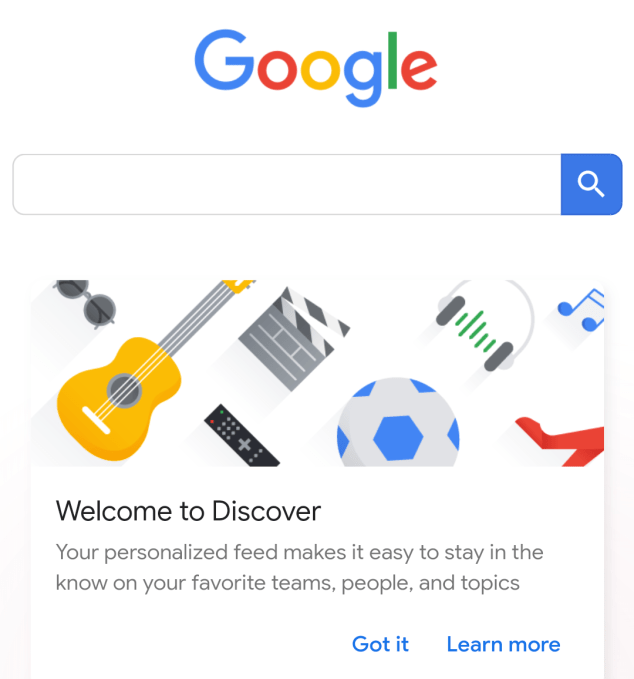
It’s not broke, but Google is fixing it. As it announced last month, Google is rebranding Google Feed, its news landing page on Android and in the Google app, to be called Google Discover. Throwing minimalism out the window, Google Discover will replace the iconically spartan Google.com homepage on mobile.

Discover is rolling out now on Google.com across both iOS and Android devices. For Android users, Discover is already baked into the interface, accessible by swiping right from the home screen. Anyone using the Google app on iOS or Android will also be met with the Discover homepage, which should be familiar at this point. We’ve reached out to Google for more details on who will see Discover when.

For a company that at times struggles with filtering disinformation out of its search results, making Discover so prominent might not be a well timed choice. The Discover results generally resurface stuff that a user has already expressed interest in, but those results are culled from a broad enough pool of sources that they don’t always feel relevant. Hopefully Google has enough sentient humans on its teams to avert future algorithmic catastrophy, though we’re not holding our breath for Google or any social platform on that count.

If you’re using Discover through the Google app, you can customize your feed further, adding topics to subscribe to, weather, commute info and more. If you’re a sports fan, the “teams” feature is genuinely useful. If Google’s vast collective knowledge of your predilections creeps you out (and it should) but you still like the Google app, you can disable “Web & App Activity” for a bit more peace of mind by following these instructions — just do them backward.

29 Oct 2018

Google Discover begins to replace the iconic search box on mobile

It’s not broke, but Google is fixing it. As it announced last month, Google is rebranding Google Feed, its news landing page on Android and in the Google app, to be called Google Discover. Throwing minimalism out the window, Google Discover will replace the iconically spartan Google.com homepage on mobile.

Discover is rolling out now on Google.com across both iOS and Android devices. For Android users, Discover is already baked into the interface, accessible by swiping right from the home screen. Anyone using the Google app on iOS or Android will also be met with the Discover homepage, which should be familiar at this point. We’ve reached out to Google for more details on who will see Discover when.

For a company that at times struggles with filtering disinformation out of its search results, making Discover so prominent might not be a well timed choice. The Discover results generally resurface stuff that a user has already expressed interest in, but those results are culled from a broad enough pool of sources that they don’t always feel relevant. Hopefully Google has enough sentient humans on its teams to avert future algorithmic catastrophy, though we’re not holding our breath for Google or any social platform on that count.

If you’re using Discover through the Google app, you can customize your feed further, adding topics to subscribe to, weather, commute info and more. If you’re a sports fan, the “teams” feature is genuinely useful. If Google’s vast collective knowledge of your predilections creeps you out (and it should) but you still like the Google app, you can disable “Web & App Activity” for a bit more peace of mind by following these instructions — just do them backward.

29 Oct 2018

Assessing IBM’s $34 billion Red Hat acquisition

As you look at the $34 billion IBM-Red Hat deal announced yesterday, if you follow the enterprise closely, it seems like a good move, at least on its face. It could be years before we understand the true value of it for IBM (or lack thereof, depending on how it ultimately goes). The questions stands then, is this a savvy move, a desperate one or perhaps a bit of both. It turns out, it depends on whom you ask.

For starters, there is the sheer amount of money involved, a 63 percent premium on Friday’s closing price of just under $117 a share. IBM spent $190 a share, but as Ray Wang, founder and chief analyst at Constellation Research said, Red Hat didn’t necessarily want to be sold, so IBM had to overpay to get their company.

Wang sees cloud, Linux and security as the big drivers on IBM’s part. “IBM is doubling down on the cloud, but they also are going for a grab in Linux for their largest and most important open source communities and some of the newer tech on Red Hat security,” he told TechCrunch. He acknowledges that it’s a huge premium for the stock, but he believes IBM needs the M&A action to drive down customer acquisition costs and drive up cross sell.

Photo: Ron Miller

IBM is placing a big bet here says Dharmesh Thakker, general partner at Battery Ventures, believing it to be worth 30x its current earnings in the next 12 months. “Needless to say, the hybrid cloud opportunity that we have been working on the last few years, is real and IBM/Cisco/HP/Dell all want a piece of this action going forward as the $300B in datacenter spend gets dislocated by public and hybrid cloud vendors,” Thakker explained in a statement.

He believes this deal could actually trigger a new set of mega mergers between the traditional tech vendors and cloud native, container and DevOps companies over the next few months.

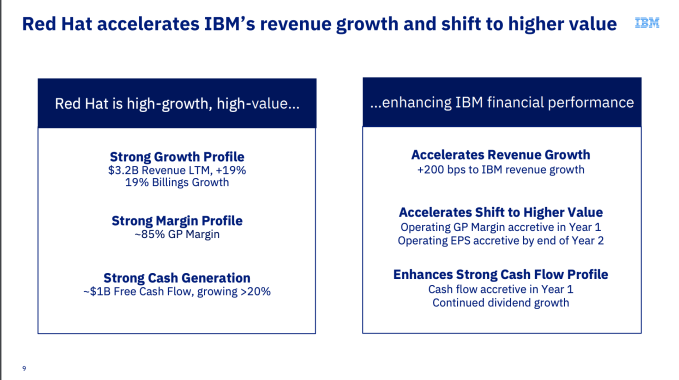
IBM CEO Ginni Rometty was positively giddy at the prospects of a combined IBM-Red Hat in a call with analysts and press this morning, pointing out that only 20 percent of enterprise workloads have been moved to the cloud. She sees a big opportunity, one she projects to be worth $1 trillion by 2020. Keeping in mind you should take market projections with a grain of salt, this is undoubtedly a big market and one that Oracle and Microsoft have also targeted.

She said that Red Hat was a rare company indeed. “Red Hat on its own has been a high value company and has done a great job with strong growth, is highly profitable and generates cash. There are not many companies out there that look like that in this area,” Rometty said.

Slide: IBM

Dan Scholnick, general partner at Trinity Ventures, whose investments have included New Relic and Docker, was not terribly impressed with the deal, believing it smacked of desperation on IBM’s part.

“IBM is a declining business that somehow needs to become relevant in the cloud era. Red Hat is not the answer. Red Hat’s business centers around an operating system, which is a layer of the technology stack that has been completely commoditized by cloud. (If you use AWS, you can get Amazon’s OS for free, so why would you pay Red Hat?) Red Hat has NO story for cloud,” he claimed in a statement.

That might not be an entirely fair assessment. While Red Hat Enterprise Linux is a big part of the company’s revenue, it’s not the only piece. Over the last couple of years it has moved into Kubernetes and containerization and has grown the cloud native side of the business alongside RHEL.

In fact, Forrester analyst Dave Bartoletti sees the cloud native piece as being key here. “The combined company has a leading Kubernetes and container-based cloud-native development platform, and a much broader open source middleware and developer tools portfolio than either company separately. While any acquisition of this size will take time to play out, the combined company will be sure to reshape the open source and cloud platforms market for years to come,” he said.

Photo: IBM

Wang believes the deal could hinge on how long Red Hat CEO Jim Whitehurst, who had led the company for over a decade, stays with the unit. According to IBM, they will maintain the Red Hat brand and operate it as an independent entity inside Big Blue. “If Whitehurst doesn’t stick around for awhile, the deal could go south,” he said. But the company could dangle the CEO job when Rometty decides to leave as incentive to stay.

Regardless, Wall Street was not entirely happy with IBM’s move with their stock down all day. Needless to say the 63 percent premium IBM paid for the stock has driven Red Hat higher today.

The deal must pass shareholder muster, but given the premium IBM has offered, it’s hard to believe they would turn it down. In addition, since these companies operate across the world, they are subject to the global regulatory approval process. They won’t officially come together until at least the second half of next year at the soonest. That’s when we might begin to learn whether this was a brilliant or desperate move by IBM.

29 Oct 2018

Assessing IBM’s $34 billion Red Hat acquisition

As you look at the $34 billion IBM-Red Hat deal announced yesterday, if you follow the enterprise closely, it seems like a good move, at least on its face. It could be years before we understand the true value of it for IBM (or lack thereof, depending on how it ultimately goes). The questions stands then, is this a savvy move, a desperate one or perhaps a bit of both. It turns out, it depends on whom you ask.

For starters, there is the sheer amount of money involved, a 63 percent premium on Friday’s closing price of just under $117 a share. IBM spent $190 a share, but as Ray Wang, founder and chief analyst at Constellation Research said, Red Hat didn’t necessarily want to be sold, so IBM had to overpay to get their company.

Wang sees cloud, Linux and security as the big drivers on IBM’s part. “IBM is doubling down on the cloud, but they also are going for a grab in Linux for their largest and most important open source communities and some of the newer tech on Red Hat security,” he told TechCrunch. He acknowledges that it’s a huge premium for the stock, but he believes IBM needs the M&A action to drive down customer acquisition costs and drive up cross sell.

Photo: Ron Miller

IBM is placing a big bet here says Dharmesh Thakker, general partner at Battery Ventures, believing it to be worth 30x its current earnings in the next 12 months. “Needless to say, the hybrid cloud opportunity that we have been working on the last few years, is real and IBM/Cisco/HP/Dell all want a piece of this action going forward as the $300B in datacenter spend gets dislocated by public and hybrid cloud vendors,” Thakker explained in a statement.

He believes this deal could actually trigger a new set of mega mergers between the traditional tech vendors and cloud native, container and DevOps companies over the next few months.

IBM CEO Ginni Rometty was positively giddy at the prospects of a combined IBM-Red Hat in a call with analysts and press this morning, pointing out that only 20 percent of enterprise workloads have been moved to the cloud. She sees a big opportunity, one she projects to be worth $1 trillion by 2020. Keeping in mind you should take market projections with a grain of salt, this is undoubtedly a big market and one that Oracle and Microsoft have also targeted.

She said that Red Hat was a rare company indeed. “Red Hat on its own has been a high value company and has done a great job with strong growth, is highly profitable and generates cash. There are not many companies out there that look like that in this area,” Rometty said.

Slide: IBM

Dan Scholnick, general partner at Trinity Ventures, whose investments have included New Relic and Docker, was not terribly impressed with the deal, believing it smacked of desperation on IBM’s part.

“IBM is a declining business that somehow needs to become relevant in the cloud era. Red Hat is not the answer. Red Hat’s business centers around an operating system, which is a layer of the technology stack that has been completely commoditized by cloud. (If you use AWS, you can get Amazon’s OS for free, so why would you pay Red Hat?) Red Hat has NO story for cloud,” he claimed in a statement.

That might not be an entirely fair assessment. While Red Hat Enterprise Linux is a big part of the company’s revenue, it’s not the only piece. Over the last couple of years it has moved into Kubernetes and containerization and has grown the cloud native side of the business alongside RHEL.

In fact, Forrester analyst Dave Bartoletti sees the cloud native piece as being key here. “The combined company has a leading Kubernetes and container-based cloud-native development platform, and a much broader open source middleware and developer tools portfolio than either company separately. While any acquisition of this size will take time to play out, the combined company will be sure to reshape the open source and cloud platforms market for years to come,” he said.

Photo: IBM

Wang believes the deal could hinge on how long Red Hat CEO Jim Whitehurst, who had led the company for over a decade, stays with the unit. According to IBM, they will maintain the Red Hat brand and operate it as an independent entity inside Big Blue. “If Whitehurst doesn’t stick around for awhile, the deal could go south,” he said. But the company could dangle the CEO job when Rometty decides to leave as incentive to stay.

Regardless, Wall Street was not entirely happy with IBM’s move with their stock down all day. Needless to say the 63 percent premium IBM paid for the stock has driven Red Hat higher today.

The deal must pass shareholder muster, but given the premium IBM has offered, it’s hard to believe they would turn it down. In addition, since these companies operate across the world, they are subject to the global regulatory approval process. They won’t officially come together until at least the second half of next year at the soonest. That’s when we might begin to learn whether this was a brilliant or desperate move by IBM.

29 Oct 2018

Google looks to AI interactions and cats to power its latest AR feature

Of all the features and hardware that dropped at Google’s event earlier this month, one that felt particularly glossed over was Playground, the new augmented reality mode that’s arrived on the Pixel 3 camera. For a company that has been investing in phone-based AR for quite a while, it launched rather quietly and in a fairly hidden spot amongst other photo modes in the Pixel 3 camera app.

I got to venture over to the company’s offices to take a closer look at the cute little stickers and 3D character “Playmojis” and hear how Google is aiming to ensure that the AR world has a deeper understanding of your environment than just its geometry.

Google has long flirted with letting users capture moments that bring virtual characters into their daily life. Since the days of Project Tango, Google has been working to create characters that can live in the virtual space at appropriate scale, responding to boundaries of the room and different lighting conditions. With this release, the company challenged themselves on interactivity, trying to get the 3D characters to not only react to what was happening with other Playground objects in the space, but with elements of the real world, as well, so when you smile, the virtual character posed behind you can toss up a grin as well.

“We thought, let’s think deeper into it and start making these stickers smarter and see if we can actually use AR and machine learning to help users be more creative,” Joe Bose, a product manager at Google working on AR, told TechCrunch.

Interactivity is ultimately what makes Playground different from the one-off AR sticker packs Google has dropped with past partnerships with Star Wars or Stranger Things. Playground also showcases a wider swath of Google’s AR efforts than just placing objects into environments. There’s some clear work being done by the live image recognition engine that powers Google Lens, bringing about a cool feature that suggests stickers and playmojis for you to drop into the world. If your camera is focused on a sunny meadow, Playground suggests some more nature-centric AR stickers; when a dog jumped into view while I was demoing, some pooch recommendations popped up.

For now there’s a hefty amount of stickers and some Marvel superheroes and dogs. As part of National Cat Day today, Google is bringing some AR kitties into the action, I’m told, which by all accounts should more than ensure the feature’s success — or at least boost sharability — among lovers of cats real and virtual.

For now Playground is just available on the Pixel 3, but the team is looking to bring the feature to past Pixel phones in the near future.

In the end, Playground is a hilarious amount of sophisticated tech just to add some added pizzazz to your photos, but that’s augmented reality tech in a snapshot. The bullish folks may say it represents a new computing platform, but in 2018 it’s ensuring that your cat has a virtual pal in your photos and videos.