Year: 2018

29 Oct 2018

Google and Disney launch interactive Little Golden Books that work with Google Home

Today’s kids are too young to remember Disney’s read-along books and records, which combined narration and sounds with physical books to make reading more entertaining. But they may have laid their hands on more modern sound books that have buttons you press at various parts of the story to punctuate the action. Now, Google is launching the 2018 version of this “storytime + sounds” experience. In partnership with Disney, the company is introducing an interactive storytelling feature for Google Home devices which combines real world books with voice recognition technology.

The new storytime experiences will work with a selection of Little Golden Books, as they’re read out loud, explains Google.

Currently, Google supports titles like Moana, Toy Story 3, Coco, Jack Jack Attack, along with classics like Peter Pan, Cinderella, Alice in Wonderland, The Three Little Pigs, Mickey Mouse and his Spaceship, and Mickey’s Christmas Carol. 

These new Little Golden Books will be on sale this week alongside Google Home Mini devices in stores like Walmart, Target and Barnes & Noble, the company says.

To get started, you say, “Hey Google, let’s read along with Disney.”

As the child – or parent – reads the book out loud, Google Home will play relevant sound effects and music to bring the story to life.

But unlike those spinning records kids played in past decades, Google Assistant is much smarter about knowing when to chime in. It knows, for example, if you’ve skipped ahead in the book, or if you’ve taken a break from reading because of an interruption – like when the child asks a question or inserts their own commentary.

At this point, the assistant will play ambient music in the background until you begin reading again.

At launch, the feature is available on Google Home / Home Mini devices, but the company says it will come to other smart speakers and Smart Displays that have Google Assistant built-in by the end of the year.

The new storytelling feature isn’t Disney’s first foray into voice assistant-based entertainment on smart speakers. It also offers a variety of other Disney games on Google Home. And Disney works with Amazon on its Echo devices, too.

It has launched publicly available Alexa skills for kids, and it partnered with Amazon on the Echo Dot Kids edition for specialized content, including exclusive skills like “Disney Plot Twist,” and “Disney Stories,” among other things. However, the Amazon version of “Disney’s Stories” is just a skill where kids can listen to audible stories – it’s not designed to work with accompanying physical books.

The initial titles are on sale starting this week at local stores, but Google says more will be released before year-end.

29 Oct 2018

LoopMe closes $17M growth investment led by BGF to expand further into the US

In 2013 LoopMe was a start-up which started out trying to solve the problem of intrusive ads on a mobile screen by consolidating them into an “ad inbox”. In 2014 they dumped that idea to become a mobile video ad business, using AI to retarget ad campaigns instead of ad teams. The pivot worked and in 2015 they raised $7M to expand.

They’ve now expanded again to become a business offering AI-driven brand advertising solutions using mobile data to optimize ad campaigns to things like purchase intent, store visits or sales. Today they’ve closed a new $17M investment led by BGF, a UK growth investor, alongside existing VC investors. The funding will be used to boost the platform and focus on the US market. The investment was led for BGF by Sarah Ledwidge, Tom McDonnell and Tim Rea.

The new investment takes the company’s total to $32M funding from global investors including HV Holtzbrinck Ventures, Harbert European Growth Capital, Open Ocean and Impulse VC.

LoopMe’s analytics suite is aimed at brands delving into customer audiences and planning across the marketing mix.

CEO Stephen Upstone said in a statement that: “Brands need marketing solutions which deliver a business impact – sales, customers in stores and strong brand sentiment. This additional funding will allow us to bring our award-winning technology, which is proven to move the needle on these KPIs, to brands and agencies worldwide”.

LoopMe’s technology has been used by brands including Norwegian Air, Jockey, Ben & Jerry’s, Microsoft and Audi, who use it to run mobile ad campaigns in the US, Europe and Asia.

29 Oct 2018

UK chancellor announces 2% ‘digital services tax’ on tech giants’ revenues starting in April 2020

The UK government has announced a new “digital services” tax of two percent that it plans to start levying on the UK revenues of tech giants like Amazon, Google and Apple based on the money they make on digital services like advertising and streaming entertainment (but not online sales).

Announced as part of the 2018 Budget by UK Chancellor of the Exchequer Philip Hammond, the tax is due to come into effect in April 2020. Hammond said that the government expects to raise more than £400 million ($512 million) annually based on current revenues.

“The rules of the game must evolve now if they are to keep up with the digital economy,” Hammond said in Parliament today. “Digital platforms delivering search engines, social media and online marketplaces have changed our lives, our society and our economy, mostly for the better. [But] they also pose a real challenge for the sustainability and fairness for our tax system… the rules have not kept pace.

“The UK has been leading attempts for international corporate tax reform.. but progress is painfully slow,” he continued. “We cannot talk forever so we will now introduce a UK digital services tax.” You can see an excerpt of the speech here.

He went on to say that the tax is “narrowly targeted” on specific models. “This is not an online sales tax on goods ordered over the internet,” he said, saying that such a tax would end up getting passed down to users. The digital services tax will be paid by companies that are profitable, he said, and making at least £500 million ($640 million) per year in global revenues.

To be clear, the UK government expects large companies, and not startups, to “shoulder the burden” of the tax, the Treasury noted.

The tax would represent a shift in how these companies are taxed today: up to now, taxes have been calculated on profits, but that is problematic because of how companies report profits, and in many cases they are not recorded in the UK, even if the purchases of digital services are in the UK.

At the same time, companies like Amazon and Apple are some of the biggest in the world and have grown tremendously in recent years, as people rush to purchasing products from them online.

It also lays out an interesting landscape for how the UK plans to raise money in a post-Brexit country after it leaves the European Union and the wider tax code that exists around it. However, Hammond also noted that the UK is currently working with the G20 and the OECD also to consider how best to tax digital companies, and if those talks reach an agreement, the UK might consider that instead of its own plans. “This shows we are serious about this reform,” he said. “It is only right that these global giants pay their fair share.”

However, many are already already criticising the tax as too low, describing only £400 million and two percent as almost nothing to these companies, which are some of the most profitable and wealthiest in the world, with Amazon and Apple the first two companies to ever reach trillion dollar market caps.

More pragmatically, a UK tax has been talked about for years already, so this is just the start of how this might develop.

29 Oct 2018

Red Dead Redemption 2: Five tips for being the best outlaw you can be

Red Dead Redemption 2 has set a high bar for the next generation of open world games, and as much as we’ve already discussed it, we’ll be addressing the deeper themes of the story as we continue to work through the game. However, there are a few points that I got hung up on in the game, and would love to advise you on the best way to avoid those mistakes yourself.

So without any further ado, here are a few tips and tricks to help you make decisions in the Wild West.

Money is easy to come by, if you know where to look

Unlike Red Dead Redemption or Grand Auto V, money is relatively easy to come by in RDR2. Story missions and side missions often result in sizable fiscal rewards for Arthur, although some story missions do require upfront investments and sometimes result in a bounty on Arthur’s head. That said, there’s no reason to live frugally. Use your money to upgrade your horse or your guns as a priority, and then feel free to go shopping at the tailor or play a few rounds of high-stakes poker.

For the most part, selling wares will also net you a good amount. The easiest way to cushion the game’s already generous income is to loot as much as you can stand it. Bad guys often have pocket watches, belt buckles, or even jewelry on them that can be sold for a pretty penny. If shootouts go down near or inside buildings, search those buildings for provisions, cash and other valuable items. Offload these items at a local Fence to keep plenty of space in your satchel and generate some extra dough.

And don’t pass up bounty hunting. It’s easy cash.

Use your unique gifts

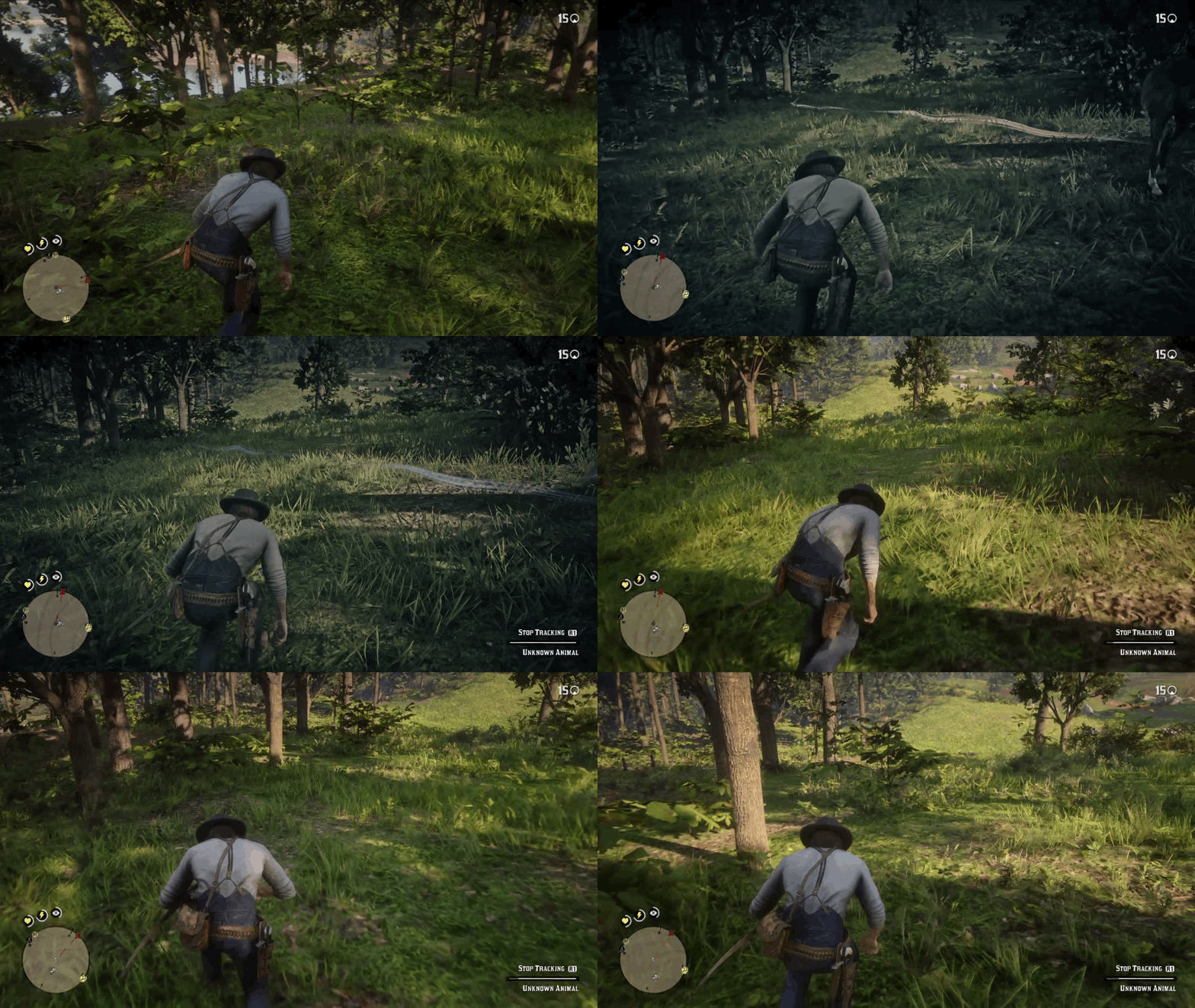
Eagle Eye and Dead Eye are blessings. There is no obvious time limit to Eagle Eye use, so there’s no reason not to use it constantly while hunting or searching for herbs, plants, etc. Paired with some Scent Blocking Lotion and bait, you’re sure to see success in your hunting endeavors.

Dead Eye does have a time limit, but there’s no shortage of tonics or provisions that can replenish your Dead Eye core in a jam. So use it. It makes shootouts far more manageable, but it also makes them way more fun. I particularly enjoy using R1 to mark several targets in a single go.

Dead Eye also helps immensely with hunting.

The best stuff is earned, not bought

Hunting has been prioritized in RDR2. There are legendary animals across the map that can be skinned to craft some of the best clothes and items in the game, which are not available for purchase without the pelt. Perfect pelts can also be used to craft badass clothing. But it’s not entirely obvious how to obtain a perfect pelt in the game.

There are a number of factors that play into obtaining a perfect pelt. The first is the size of the animal. This will determine which weapon and ammunition you should use. The second is the quality of the animal. You can press R1 to study the animal, which will also display its condition: poor, good, or pristine. Only pristine animals will result in a perfect pelt. Large animals like bears and elk require a rifle, preferably with high velocity or split point ammo, whereas it’s nearly impossible to yield a perfect pelt on a small critter without using the Varmint Rifle. Midrange animals like foxes and beavers require a Repeater or bow and arrow with improved arrows.

This guide proved incredibly helpful for me.

Also important: even a pristine animal hunted with the right weapon can drop from perfect pelt to good pelt if you shoot it more than once. Use Dead Eye to locate the vulnerable parts of the animal and deliver a fatal blow.

You can take these pelts to Pearson at camp to craft cosmetic upgrades to the furniture, but it’s probably best to prioritize taking perfect and legendary pelts to the trapper where you can craft clothes, saddles, etc. It’s worth noting that you must first sell the pelts to the trapper before you can purchase the items he crafts with them.

Camp donations are dumb, but upgrades aren’t

RDR2’s is very different from Red Dead Redemption’s in one core way: John Marsten was a lone wolf, whereas Arthur Morgan is very much a player in an ensemble cast. That doesn’t mean you can’t fly solo and head to another part of the map for a few game days. But many of the story missions involve other members of the Dutch Van Der Linde gang, and home base for Arthur is the gang’s camp, where many of those characters are hanging around.

Because of this shift, RDR2 introduces the idea of camp donations. You can donate money, food, or items that can be sold for camp funds. These donations are more or less useless. They are money or food that you won’t see again. However, alongside the box for donations is a ledger that allows you to check out how the rest of the gang is donating and also make purchases to upgrade the camp.

Provisions, ammunition, medicine, and lodging are all upgrades worth purchasing, in my opinion. Upgrading them ensures that the best food and ammunition are simply sitting around camp. It’s a way to turn camp into a convenience store carrying most of the equipment you’d otherwise need to purchase by bopping around a town. Upgrading lodging unlocks the fast travel map, which becomes more and more necessary as the map opens up.

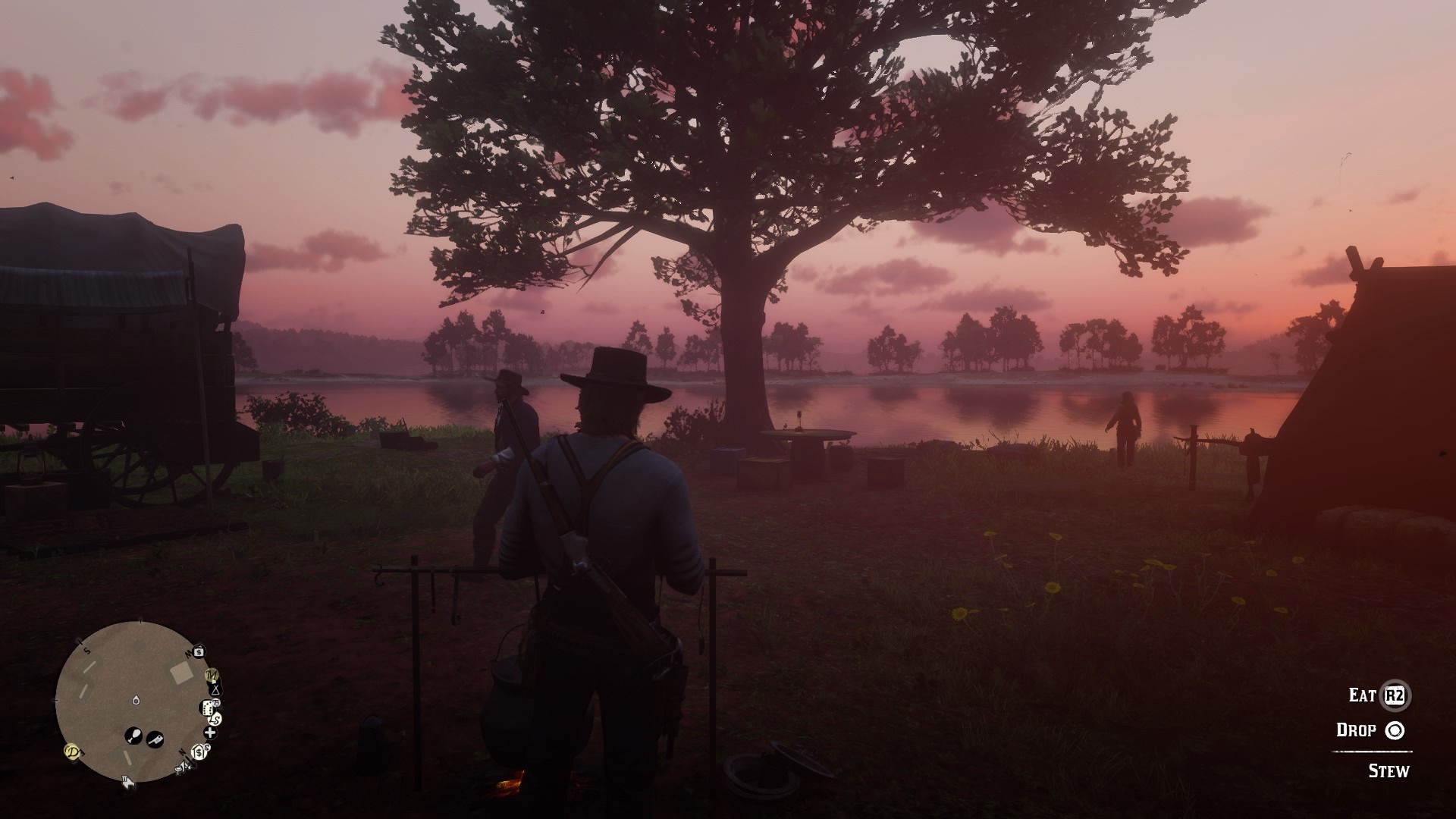
Eating stew with a beautiful view

Given that there are usually missions that originate from camp, I visit it often as a way to reset. I donate anything of lesser value to camp to clear out space in my satchel, restock on provisions, tonics, and ammo, and help myself to a free bowl of stew to replenish my health cores. Camp also features a poker table, which happens to be one of my favorite pastimes in this game.

Timing is everything

Just assume that if you’re doing a Dutch story mission, you’ll end up with a bounty on your head. Sometimes these are cheap, and sometimes the bounty is upwards of $100. The game more than makes up for the money it asks from you, doling it out in myriad ways, but dealing with a bounty in a bigger city or town can make side missions and other tasks incredibly annoying. If you’re not into constant shootouts and running from the police, do your side missions and mundane errands in a town before firing up the Story Mission.

29 Oct 2018

The OnePlus 6T is launching on T-Mobile

This year marks an interesting turning point for OnePlus. In December, it will hit the five year mark. The Oppo-backed company has managed to grow significantly in that relatively short window. Back in June, it noted that it had sold one million units of its latest smartphone in the first 22 days.

Continued growth will require some strategic partnerships. In the States, that means partnering with a carrier — after all, most smartphone users still purchase devices through those channels here. Fittingly, along today’s launch of the 6T, OnePlus is announcing its first U.S. carrier partner, T-Mobile.

Why choose the third largest carrier? Here’s what CEO Pete Lau says of the deal, “T-Mobile is the perfect wireless partner for us in the US. The OnePlus 6T clocks some serious speed, and we wanted our customers to unleash it on the fastest network in the nation.”

T-Mobile’s foul mouthed CEO John Legere also notes that somewhere in the neighborhood of 200k OnePlus owners are using their unlocked handsets with the carrier. In addition to whatever sort of deals were worked out between the two companies, T-Mobile’s size offers a good opportunity to help OnePlus grow at a manageable rate. That kind of modest expansion has long been a key to the company’s success.

While other smartphone manufacturers are falling over themselves to one up the competition, OnePlus has focused on offering a solid handset at a decent price. But even $549 looks intimidating to users accustom to purchasing phones at carrier subsidized rates.

The 6T will be available from T-Mobile on November 1 — though folks in New York City can pick one up starting tonight at the T-Mobile store in Times Square.

29 Oct 2018

OnePlus edges toward mainstream with the 6T

This could be OnePlus’s moment. Back in June, the Oppo-backed Chinese smartphone maker announced that it had sold one million units of its latest handset in 22 days.

These aren’t Apple or Samsung numbers we’re talking about here, of course. But they’re impressive for a less than five-year-old company odds are pretty good you’ve never even heard of. And in a sense, it’s precisely Apple and Samsung that have indirectly driven that growth.

Over the past few generations, the leading handset manufacturers have made $1,000+ flagships routine. OnePlus, meanwhile, has remained steadfast, clinging to a “Never Settle” slogan that’s less about grasping for the latest innovation than it is embracing the whole picture. It’s a motto that, ironically, sometimes means settling for slightly behind the curve.

But it’s the same smartphone war that’s pushing innovation that is also driving up price tags and incentivizing companies to adopt technologies that aren’t quite ready for prime time. OnePlus’s approach, meanwhile, has allowed the company to offer remarkable consistency since pretty much day one — and to do so at a price that’s near half that of high-end competitors.
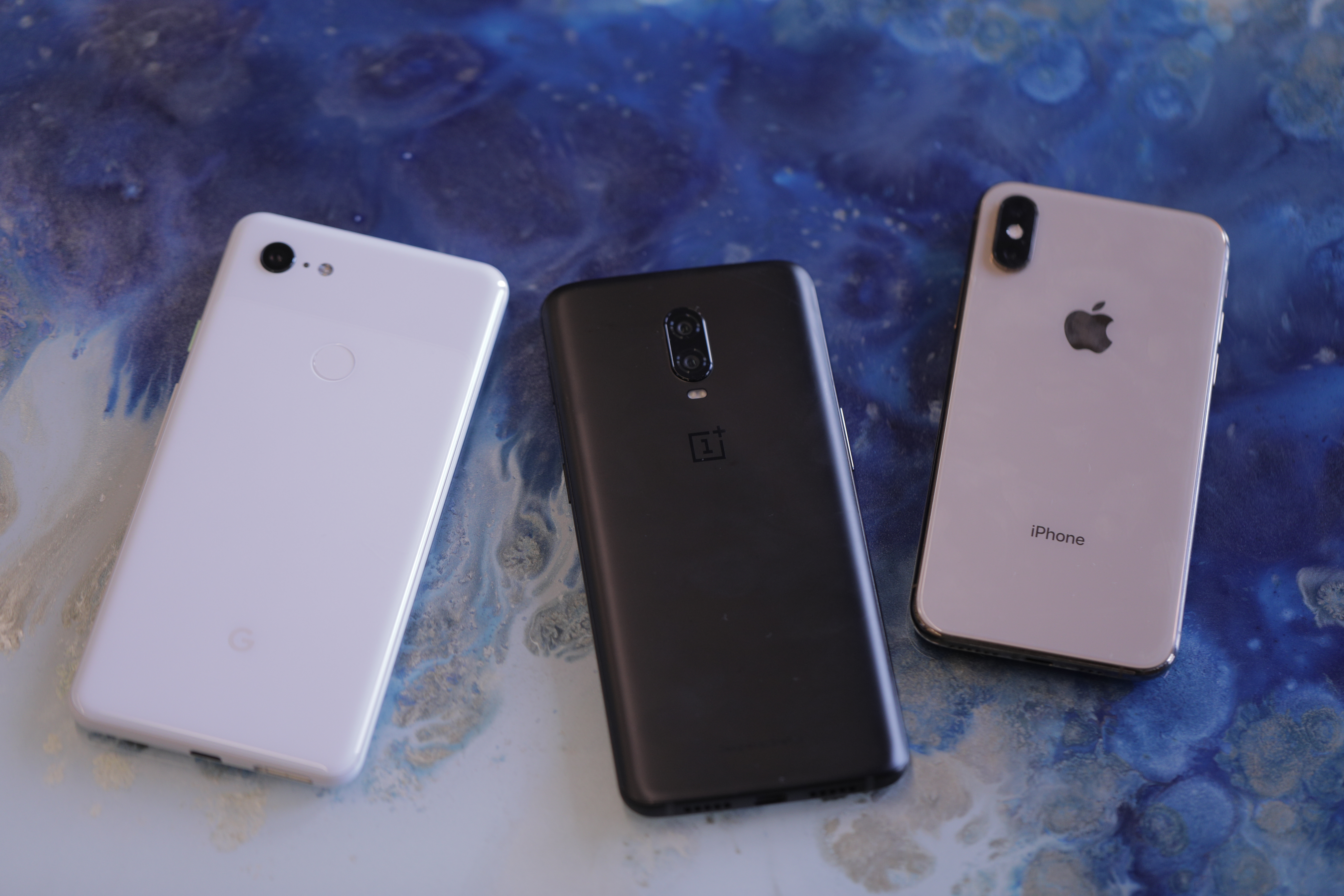
That holds for the new 6T, which starts at $549. That’s $20 more than where the OnePlus 6 started, mind, but that’s largely due to the decision to drop the low-end 64GB model and start things at 128GB. Likely there will be some who balk at that small choice. And $20 is $20, certainly, but as far as growing pains go, it’s a pretty small one.

That said, the company does find itself making some uncharacteristic decisions as it edges toward its fifth birthday. The first seemed like an inevitability, with the company finally settling down with a carrier partner here in the States. The Magenta carrier seems like a strange partner, perhaps, at first glance. “We found a kindred spirit with T-Mobile,” the company writes in the attached press release.

The simple fact of the matter, however, is that you still need carriers to grow here in the States. OnePlus is, naturally, looking to do that here — but it’s trying to do so at a measured pace. It’s an admirable approach in an industry where the majority of companies are more interested in growing as quickly as possible, often sacrificing things like quality and customer service in the process.

It’s been a part of OnePlus’s approach from the beginning, through things like its invite-only releases dating back to the early days. Assuming the company’s backers continue to be on-board with the approach, good on it.

There’s another key flank to the company’s new approach. If you’ve heard anything about the OnePlus 6T up to this point, it’s probably this about this. The handset is one of the first to hit the U.S. market sporting an in-screen fingerprint reader, beating the Samsung Galaxy S10 by several months.

We’ve seen some international handsets sport some version of the technology, but this is a win for OnePlus and a change of pace for the company. Among other things, it’s a way to stand out from the crowd. In a perfect world, building a solid product for a good price would be more than enough, but perfect this world isn’t. Turn on your TV for like 10 seconds (I’ll wait).

It’s a novelty, for sure, but it’s one that makes sense in the broader context of the phone. OnePlus has had face unlock for a while, but it’s a less secure version than the one found on the iPhone, which means you’ll want a second layer of security on the device.
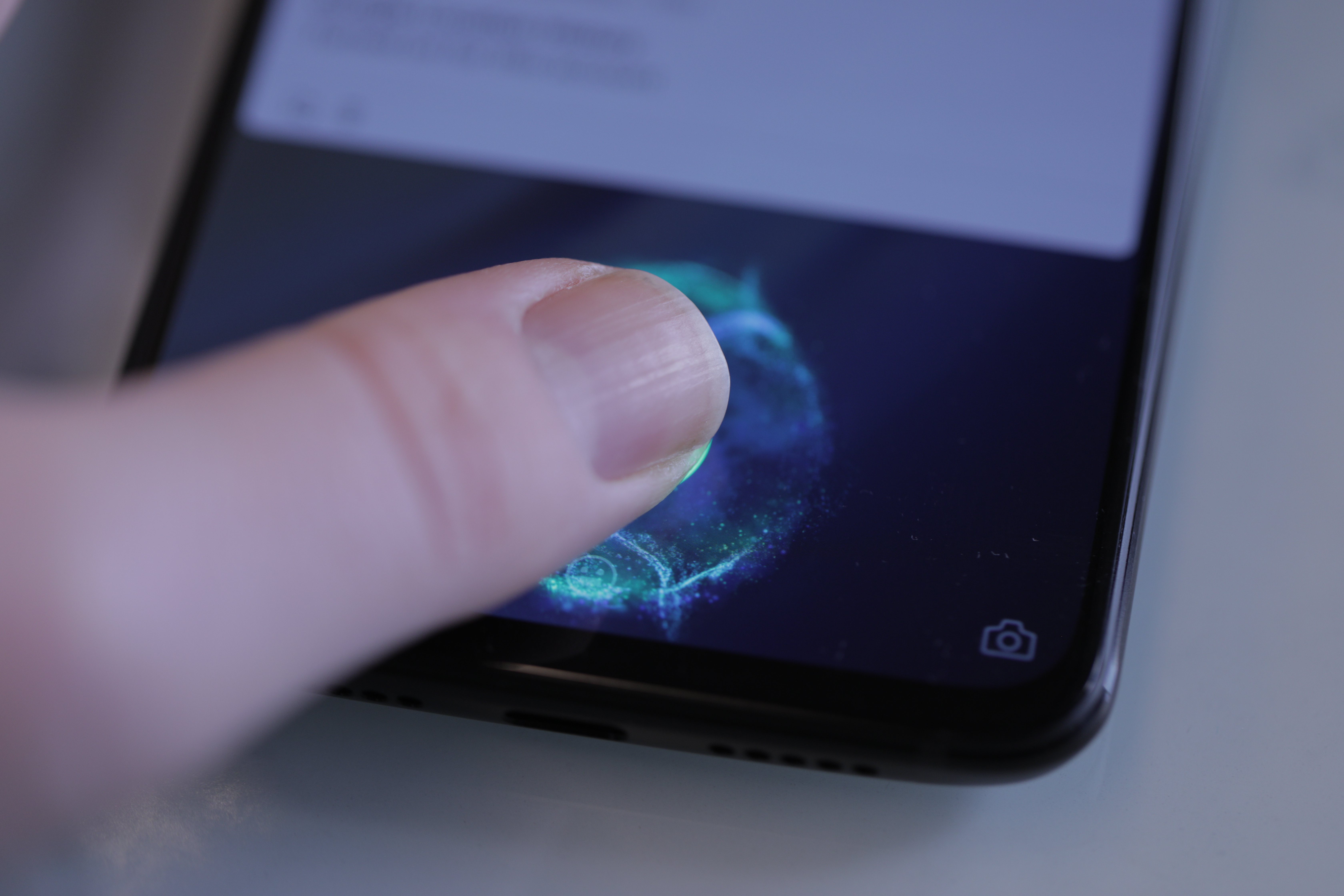
Adding a module beneath the screen brings the authentication back to the front of the device without having to increase the footprint or sacrificing precious screen space. It also comes with the added bonus of being able to check your phone without having to lift it up to your face — one of the main annoyances of Apple’s Face ID feature.

The feature works fairly well. When the screen is locked, a fingerprint icon pops up, showing you where to press. When the finger is in the right spot, the AMOLED display flashes a bright light to capture a scan of the surface from the reflected light. The company says it takes around a third of a second, though in my own testing, that number was closer to one second or sometimes longer as I negotiated my thumb into the right spot.

Perhaps, unsurprisingly, the addition comes with a compromise. In order to fit the scanner beneath the screen, the company had to ditch the headphone jack, bringing it kicking and screaming into 2018. OnePlus was one of the remaining few companies to take the leap.

This time back in 2016, co-founder Carl Pei asked Twitter whether they supported keeping the headphone jack. The answer was overwhelmingly yes. So the company kept it. Two years later, however, a new innovation has forced the company’s hand. And OnePlus isn’t stopping there. Last week, we noted that the company has fully committed itself to bringing out a 5G phone in 2019, making it one of the first in the U.S. to do so.

The next couple of years will find the company making a lot of difficult changes as it looks to expand while maintaining the core audience that helped it grow in the first place. As a kind of small consolation, the package includes a note from Pei.

It’s a nice little nod to OnePlus’s roots, though it tellingly opens, “Friend, Let me be the first to welcome you to the OnePlus community.” It’s an acknowledgement that the company is growing and also a promise not to betray its roots. We’ll see, I suppose.

At 6.41 inches, the 6T has the largest display offered on a OnePlus device. That’s helped along by the hidden fingerprint sensor, of course, along with a tiny notch up top. In spite of the excessively large screen, the phone itself doesn’t feel huge — especially after carrying the downright massive Google Pixel 3 XL around for a while.
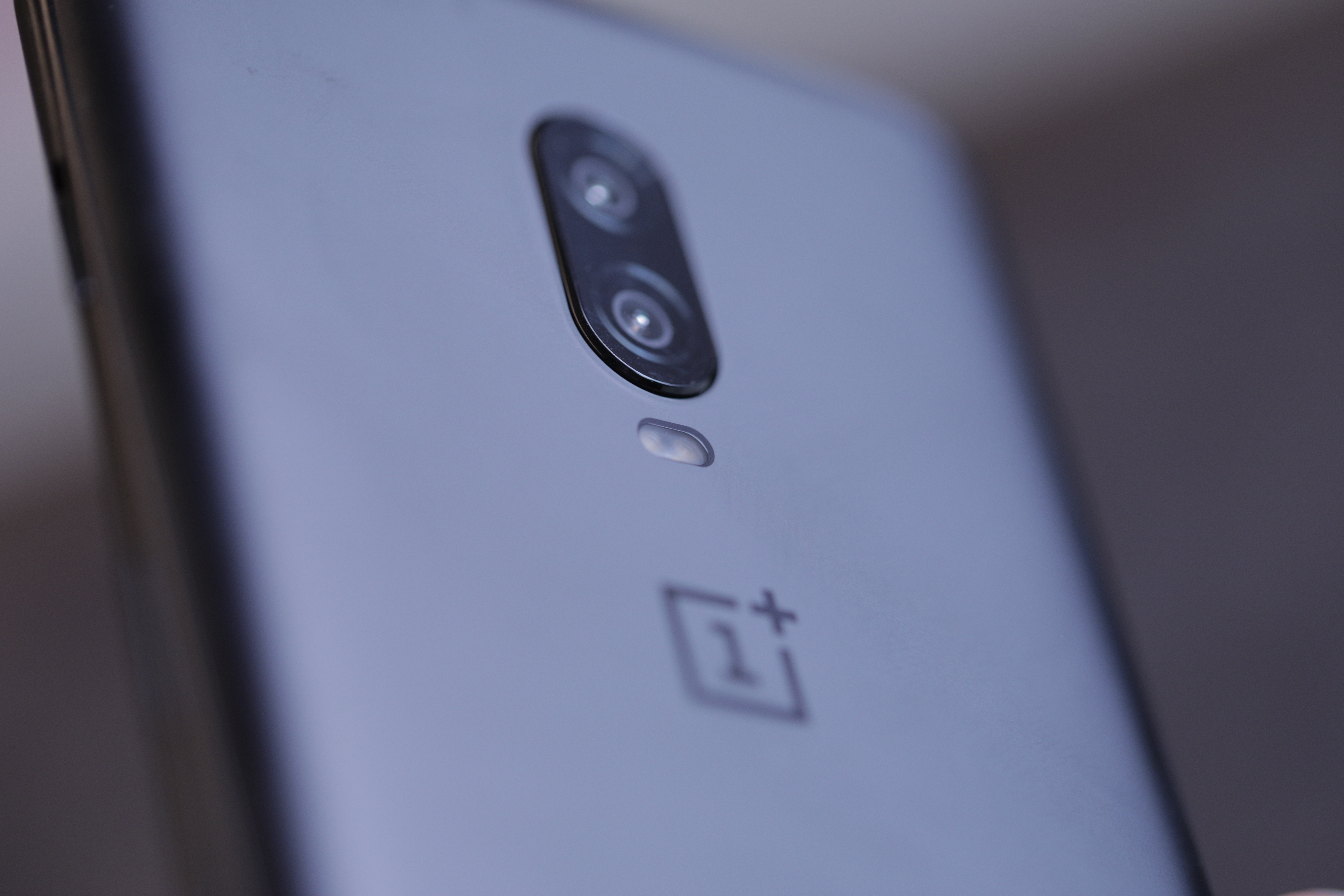
The design language is pretty standard OnePlus — and that’s a good thing. The company’s phones are solidly built and nice to look at, without focusing too much on the kind of flash that defines products like the Galaxy line.

Inside, you’ve got a Snapdragon 845, 6 or 8GB of RAM and 128 or 256GB or RAM. Solid enough specs, particularly given the price point. The company has also beefed up the battery by 20 percent, up to a healthy 3,700 mAh. That will give you well over a day of use.

The phone arrives November 1, starting at $549 — still the best deal in smartphones.

29 Oct 2018

You can now control the Nvidia Shield TV with Alexa

Shield TV, Nvidia’s streaming media set-top box introduced last year, is going hands-free by way of Alexa. The company announced this morning the launch of a new Amazon Alexa skill which will enable Shield TV owners in the U.S. to navigate their device with voice commands, including those to turn on or off the Shield, adjust the volume, play, pause, fast-forward, or rewind content, or even move around to various sections, like the Home screen or Settings.

With the addition, Shield TV owners can now choose between Alexa or Google Home Assistant devices, in terms of hands-free voice control.

To use Alexa voice commands, you’ll first have to pair an Echo with the Shield from within the Alexa app. Then, you’ll need to enable the new “Nvidia Shield TV” skill from Amazon’s skill store. After accepting the terms, you’ll link the skill to your Nvidia account. The last step is to select the Shield and the Echo devices you’d like to connect to work together.

Once set up, you can say things like “Alexa, turn on Shield,” “Alexa, play (on Shield),” “Alexa, fast-forward 10 minutes (on Shield),” “Alexa go to control settings (on Shield),” and more.

(Following the first command, Alexa will assume subsequent relevant commands are for Shield. Where “on Shield” is noted in parentheses, you can continue controlling the device with just the command.)

The company says the Alexa support will come to other non-U.S. regions over time, and the list of supported commands will grow, as well.

Alongside the launch, Nvidia also announced Dolby Atmos passthrough support for Prime Video, and a promotion that will give customers buying a Shield TV from Amazon or Best Buy a free Echo Dot (3rd Gen). Current owners can buy a discounted Echo Dot.

Alexa already interoperates with a number of set-top boxes, including Amazon’s own Fire TV line (where the Cube recently added in-app navigation, too); plus TiVo’s devices, Dish’s Hopper, Xbox, DirecTV’s set-top box, and others.

29 Oct 2018

No, Twitter is not removing its like button ‘soon’, but it is considering it

Twitter’s like button — the heart at the bottom of a Tweet — is one of the most enduring and popular parts of the Twitter experience. So it took some by surprise to see a story published earlier today claiming that Twitter would “soon” be removing the feature.

Not so soon, it seems. Twitter today said that while it’s been “considering” a move to remove the “Like” button for a while now, there is no timeline for the move, and it is not happening in the near future.

“As we’ve been saying for a while, we are rethinking everything about the service to ensure we are incentivizing healthy conversation, that includes the like button,” the Twitter Comms account noted. “We are in the early stages of the work and have no plans to share right now.”

What’s the backstory here? Twitter’s heart button — which controversially replaced a star back in 2015 — gets used by millions as a quick way of sending an acknowledgement of what someone else has written, without the full force of a re-tweet. It also can be a way to help you track things you found interesting but are otherwise likely to forget.

But nothing is sacred on social media, and so it seems that even the simple heart has become subject to abuse. As with any Tweet, one that is harassing or harmful, or that might contain incendiary content, will go viral when it gets Re-Tweeted. But a large amount of people — or, perhaps just as likely on Twitter, bots — liking it can also help push it along in Twitter’s algorithms, where it gets surfaced in lists and in people’s timelines because of its popularity. When a Tweet might have a nefarious intention, hearts can lead to heartbreak.

In the meantime, the company has been expanding options it gives users to save Tweets that are less ‘social’, such as the creation of Bookmarks, which are private to the user creating them.

Removing ways of responding to Tweets seems anathema to the idea of a conversational platform, although there are many options for what Twitter might consider before removing the heart (or whatever shape its fave/like takes) altogether: they could include a variety of responses similar to Facebook’s, or changing how a like affects a Tweet’s position in Twitter’s wider algorithms.

Twitter’s move to reconsider the like button and what it does isn’t ridiculous in that context, although abandoning it abruptly would be odd, and potentially controversial in itself. Or perhaps not: the company’s stock is up nearly four percent in trading this morning.

29 Oct 2018

Vimeo subscribers can now publish videos directly to LinkedIn

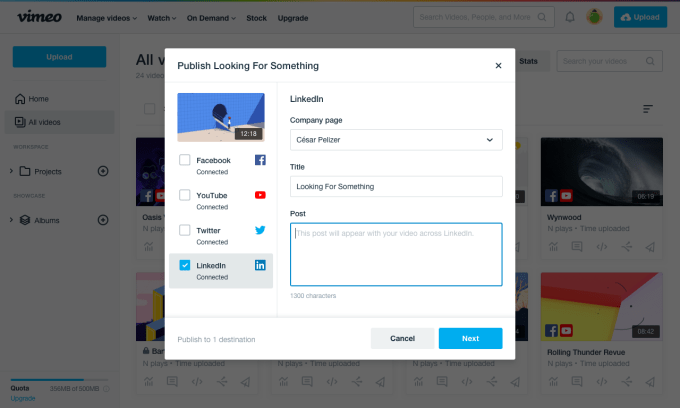
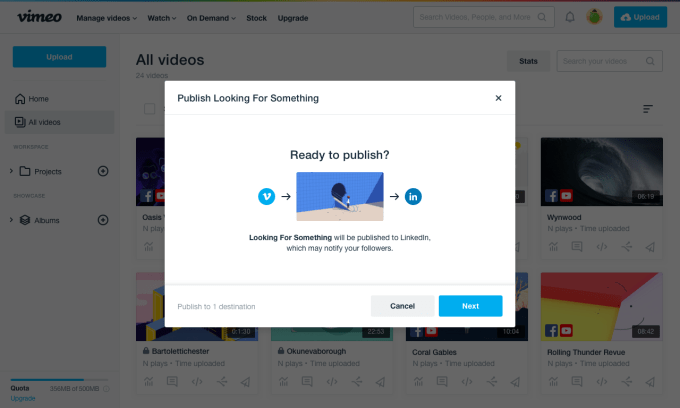
Vimeo announced today a new feature that will allow videos to be published directly to LinkedIn. The added support is a part of the company’s “Publish to Social” feature, which already offers publishing to Facebook, Twitter, and YouTube, and is available to paid subscribers. The expansion to LinkedIn is another example of the company’s shift in focus from being a video destination site to one that sells tools and services to professional and semi-professional video creators.

The company last year scrapped its plans for a subscription video-on-demand service, promoted its creator business lead Anjali Sud to CEO, and acquired live video streaming platform Livestream, as a part of its broader plan to serve the video creator community through services.

Earlier this year, it announced “Publish to Social,” a tool that support uploading videos to multiple sites at once, as a part of all Plus, PRO, Business, and live plans.

Now it’s adding LinkedIn to its list of supported sites, which makes it the first video platform to integrate with LinkedIn, the company says.

The move also follows Microsoft’s earlier announcement that LinkedIn would open to video uploads as part of a larger video push on its part. Last summer, LinkedIn launched a new feature that allowed users to upload videos to the site from its iOS or Android mobile app – the idea being that users could highlight their work  projects or demonstration products, for example.

With Vimeo’s integration, however, the focus is on uploading to Company Pages, where businesses may be using video in a variety of ways to connect with their customers, prospective employees, and others.

Video has become one of the key drivers for member engagement on LinkedIn, and businesses who want to start a conversation with their audiences are increasingly turning to Company Page videos,” said Peter Roybal, principal product manager at LinkedIn, in a statement about the partnership with Vimeo. “Our new integration with Vimeo is an exciting step for anyone who wants to gain more exposure, and understand their reach to LinkedIn’s highly-engaged professional audiences,” he added.

In addition to the ability to publish to LinkedIn, Vimeo will also provide creators with analytics on the videos, including things like video viewership, engagement, and performance stats. These are available on the Vimeo dashboard, alongside the metrics for other social platforms, as well as other websites and blogs, allowing creators to compare their campaigns’ performance across various destinations.

Creators can also take advantage of Vimeo’s other marketing tools from this dashboard to further customize and monetize their content, the company says.

Using video on LinkedIn can be a big boost for businesses. According to LinkedIn’s own data, LinkedIn Company Page videos see 5x the engagement than any other type of post. And because today’s social platforms favor native uploads, the ability to push a video from Vimeo to sites like LinkedIn, Facebook, Twitter and YouTube in that same manner means creators are likely also expanding their reach, rather than using embeds or links.


29 Oct 2018

AmazonSmile has raised $100 million for charity

A little good press goes a long way for a company like Amazon. The company routinely gets knocked for things like warehouse conditions, tax breaks and impact on smaller retail outlets. AmazonSmile’s helped to counteract that a bit, raising money for legitimately good causes, skimmed off purchases from the site.

The online retail giant announced this morning that it’s made $100 million in charitable donations through the program, since launching almost exactly five years ago.

Amazon hasn’t broken down how much each participating charity has raised through the campaign, only that “hundreds of thousands of charities have been able to expand their meaningful work thanks to the donations they’ve received through AmazonSmile,” according to Amazon CEO Worldwide Consumer, Jeff Wilke.

Amazon’s also pumping up the incentives for this week. Purchases between now and November 2 will quality for a donation of five-percent of eligible products. That’s apparently around 10 times the normal donation rate, according to the company.

The are currently north of one million charities to chose from.