
Year: 2018

29 Oct 2018

Atlassian sells Jitsi, an open-source videoconferencing tool it acquired in 2015, to 8×8

After announcing earlier this year that it planned to shut down HipChat and Stride and sell the IP of both to Slack, today enterprise software company Atlassian made another move related to its retreat from enterprise chat. It is selling Jitsi, a popular open-source chat and videoconferencing tool, to 8X8, a provider of cloud-based business phone and internal communications services. 8X8 says it plans to integrate Jitsi with its current conferencing solutions, specifically a product called 8X8 Meetings, and to keep it open source.

Terms of this latest sale to 8×8 have not been disclosed. Both the tech and the engineering team working on Jitsi, led by Emil Ivov, are coming with the acquisition.

Atlassian originally acquired Jitsi and its owner BlueJimp for an undisclosed sum in 2015 with the intention of adding video communications to HipChat, and later Stride (which launched in 2017).

But now those two products are headed for the graveyard — they are both being discontinued on February 15, 2019 — and that made Jitsi less core to Atlassian’s new direction, where it is focusing less on enterprise chat, and more on tools for developers and customer care, including Jira, Trello, and Bitbucket (a competitor to GitHub).

The deal is one of the final moves for Atlassian as it focuses more on its business building and operating productivity tools that are not direct competitors in the crowded field of enterprise chat applications. It seems that in any case, Jitsi is hoping for more investment under its new owner.

“This is a great thing and will only help to keep Jitsi’s momentum with renewed investment,” writes Ivov in a blog post announcing the news. “The Jitsi team will remain 100 percent intact and will continue to be an independent group. Operationally things will work much the same way as they did under Atlassian. Jitsi users and developers won’t see any impact, though we do expect with continued funding and support you will see even more new features and capabilities from the project!”

Technology in the acquisition includes Jitsi’s modular open-source projects for businesses to build and deploy secure video communication solutions based around WebRTC; the Jitsi Videobridge conferencing server; and the Jitsi Meet conferencing and collaboration application.

“The best video communications solutions are so intuitive and reliable that they help employees conduct shorter, more productive meetings. 8×8 has already developed a world-class meetings solution for enterprises, and we’re focused on maintaining leadership in delivering reliable, crystal-clear video and audio conferencing quality across mobile and desktop applications,” said Dejan Deklich, Chief Product Officer at 8×8, in a statement. “Incorporating Jitsi’s open-source technology into our video communications technology platform, and having Jitsi’s talented engineering team play a role in leading our development of dedicated conferencing applications and WebRTC, will open new paths for our customers and further enhance our meetings solution.”

Jitsi’s tools are used by a variety of platforms and businesses that want to include videoconferencing but would rather use an independent third-party service rather than incorporate one from a would-be competitor or build it themselves. Customers include Comcast and Symphony, the chat app used by the financial services industry.

“Some of the most innovative WebRTC products and companies use Jitsi to support millions of minutes of daily usage as part of their meetings, messaging and collaboration product ecosystems. The open source community has played a critical role in advancing Jitsi’s projects by validating its use in a diverse set of environments and complementing the core team’s development. As part of this acquisition, 8×8 is committed to continuing to support the growing developer community, and we are excited to engage even more,” commented Bryan Martin, Chairman and Chief Technology Officer at 8×8.

This past weekend’s big news of IBM acquiring Red Hat for $34 million has emphasised just how central open source and cloud-based software are in today’s enterprise IT market. This purchase is far smaller, but is also part of that bigger trend.

“8×8 sees tremendous value in the open source community and is committed to helping grow the community even larger,” Ivov notes. “With a major, high-motivated backer like 8×8 behind the project, we are confident about our ability to continue building great open source products.”
29 Oct 2018

Here are the 20 games shipping with the PlayStation Classic

The PlayStation Classic already has a release date (December 3) and price ($100), but before today, Sony’s neglected to announce one key bit of information: games. The electronics giant has finally seen fit to reveal the full list of 20 titles for its answer to the wildly popular NES Classic edition.

It’s a pretty solid list, all told, including some of the console’s truly classic titles and representing a wide range of genres, from fighting to racing to RPG to, well, carjacking. The miniature console is available for preorder now, hitting the U.S. and Canada on December 3. The system also ships with two controllers.

Here’s the full list of titles.

  • Battle Arena Toshinden
  • Cool Boarders 2
  • Destruction Derby
  • Final Fantasy VII
  • Grand Theft Auto
  • Intelligent Qube
  • Jumping Flash
  • Metal Gear Solid
  • Mr Driller
  • Oddworld: Abe’s Oddysee
  • Rayman
  • Resident Evil Director’s Cut
  • Revelations: Persona
  • Ridge Racer Type 4
  • Super Puzzle Fighter II Turbo
  • Syphon Filter
  • Tekken 3
  • Tom Clancy’s Rainbow Six
  • Twisted Metal
  • Wild Arms
29 Oct 2018

Here are the 20 games shipping with the PlayStation Classic

The PlayStation Classic already has a release date (December 3) and price ($100), but before today, Sony’s neglected to announce one key bit of information: games. The electronics giant has finally seen fit to reveal the full list of 20 titles for its answer to the wildly popular NES Classic edition.

It’s a pretty solid list, all told, including some of the console’s truly classic titles and representing a wide range of genres, from fighting to racing to RPG to, well, carjacking. The miniature console is available for preorder now, hitting the U.S. and Canada on December 3. The system also ships with two controllers.

Here’s the full list of titles.

  • Battle Arena Toshinden
  • Cool Boarders 2
  • Destruction Derby
  • Final Fantasy VII
  • Grand Theft Auto
  • Intelligent Qube
  • Jumping Flash
  • Metal Gear Solid
  • Mr Driller
  • Oddworld: Abe’s Oddysee
  • Rayman
  • Resident Evil Director’s Cut
  • Revelations: Persona
  • Ridge Racer Type 4
  • Super Puzzle Fighter II Turbo
  • Syphon Filter
  • Tekken 3
  • Tom Clancy’s Rainbow Six
  • Twisted Metal
  • Wild Arms
29 Oct 2018

DJI releases a modified Mavic 2 drone aimed at enterprise

DJI announced today at an event in Texas a modified version of its well-received Mavic 2 aimed squarely at business ranging from government to education. The base of the folding drone is the same as the commercial one that launched a few months back, but there are a few updates on-board aimed specifically at enterprise customers.

The most interesting of the bunch of a new modular mount for adding-on a handful of new accessories controllable through the DJI app. The group includes a dual spotlight for night flights, a speaker for transmitting information and a beacon with a flashing strobe, so the device can be spotted in emergency conditions.

The drone sports 24GB of on-board, password protected storage, and all images captured on the drone are labeled with a GPS timestamp featuring the date, time and location the shots were taken. DJI’s also added a self-heating battery to product, making it possible to fly it in temperatures as low as 14 degrees.

The enterprise version of the drone runs $2,000 — a price that includes the Mavic 2, remote, battery, the above mount accessories and a case. It’s available starting today.

29 Oct 2018

DJI releases a modified Mavic 2 drone aimed at enterprise

DJI announced today at an event in Texas a modified version of its well-received Mavic 2 aimed squarely at business ranging from government to education. The base of the folding drone is the same as the commercial one that launched a few months back, but there are a few updates on-board aimed specifically at enterprise customers.

The most interesting of the bunch of a new modular mount for adding-on a handful of new accessories controllable through the DJI app. The group includes a dual spotlight for night flights, a speaker for transmitting information and a beacon with a flashing strobe, so the device can be spotted in emergency conditions.

The drone sports 24GB of on-board, password protected storage, and all images captured on the drone are labeled with a GPS timestamp featuring the date, time and location the shots were taken. DJI’s also added a self-heating battery to product, making it possible to fly it in temperatures as low as 14 degrees.

The enterprise version of the drone runs $2,000 — a price that includes the Mavic 2, remote, battery, the above mount accessories and a case. It’s available starting today.

29 Oct 2018

Blue Apron gets a much-needed boost with Jet.com partnership

The enemy of my enemy is my friend. That explains a coming-together between two startups today after Jet.com announced it will give beleaguered Blue Apron a leg-up by introducing its meal kits for customers in New York.

The deal will an initially rotating selection of four meal kits from Blue Apron made available as part of Jet’s ‘City Grocery’ experience. The kits — which will rotate every six weeks — will be available for same-day or next-day order in Manhattan, Brooklyn, Queens, the Bronx, as well as Jersey City and Hoboken.

Jet — which is the first e-tailer partner for Blue Apron — said the kits are designed specifically for its customers based on “extensive feedback” based around what they want to eat, how they want to make it, etc. As a part of that focus, all of the kits take less than 30 minutes to prepare.

The initial selection includes the following:

  • Seared Steaks & Peperonata with Fregola Sarda Pasta & Grana Padano Cheese (2 servings, 28 oz) – $22.99
  • Dukkah-Spiced Beef & Couscous with Tahini-Dressed Broccoli (2 servings, 41 oz.) – $20.99
  • Togarashi Popcorn Chicken with Sweet Chili Slaw & Jasmine Rice (2 servings, 32 oz.) – $18.99
  • Italian Farro Bowl with Roasted Vegetables & Mozzarella (2 servings, 32 oz.) – $16.99

“We are delighted to be the first e-retailer to offer the Blue Apron on-demand kits, kicking off in NYC,” said Jet President Simon Belsham in a statement. “Adding the on-demand kits to our newly launched City Grocery experience provides another layer of convenient services and products that helps make people’s lives easier, and it’s a great example of how Jet will continue to differentiate itself.”

That was echoed by Brad Dickerson, who become CEO late last year. Dickerson hinted that the company has more planned for its “channel expansion strategy.”

Despite going public in June, 2017 was a tough year for Blue Apron.

The company listed at $10 per share after originally hoping to go public between $15 and $17. But, more significantly, Amazon threw a spanner in the works when it purchased Whole Foods just days before Blue Apron’s debut, giving investors concerned the alliance would negatively impact the company, piling on more doubt that had surfaced around the viability of its customer retention strategy.

Things have only gotten worse for Blue Apron since then, with its shares currently valued at just $1.14 as of the close of market on Friday. But there is some positive sentiment around the Jet deal with the share price up nearly 22 percent in pre-trading, according to Yahoo Finance.

29 Oct 2018

Blue Apron gets a much-needed boost with Jet.com partnership

The enemy of my enemy is my friend. That explains a coming-together between two startups today after Jet.com announced it will give beleaguered Blue Apron a leg-up by introducing its meal kits for customers in New York.

The deal will an initially rotating selection of four meal kits from Blue Apron made available as part of Jet’s ‘City Grocery’ experience. The kits — which will rotate every six weeks — will be available for same-day or next-day order in Manhattan, Brooklyn, Queens, the Bronx, as well as Jersey City and Hoboken.

Jet — which is the first e-tailer partner for Blue Apron — said the kits are designed specifically for its customers based on “extensive feedback” based around what they want to eat, how they want to make it, etc. As a part of that focus, all of the kits take less than 30 minutes to prepare.

The initial selection includes the following:

  • Seared Steaks & Peperonata with Fregola Sarda Pasta & Grana Padano Cheese (2 servings, 28 oz) – $22.99
  • Dukkah-Spiced Beef & Couscous with Tahini-Dressed Broccoli (2 servings, 41 oz.) – $20.99
  • Togarashi Popcorn Chicken with Sweet Chili Slaw & Jasmine Rice (2 servings, 32 oz.) – $18.99
  • Italian Farro Bowl with Roasted Vegetables & Mozzarella (2 servings, 32 oz.) – $16.99

“We are delighted to be the first e-retailer to offer the Blue Apron on-demand kits, kicking off in NYC,” said Jet President Simon Belsham in a statement. “Adding the on-demand kits to our newly launched City Grocery experience provides another layer of convenient services and products that helps make people’s lives easier, and it’s a great example of how Jet will continue to differentiate itself.”

That was echoed by Brad Dickerson, who become CEO late last year. Dickerson hinted that the company has more planned for its “channel expansion strategy.”

Despite going public in June, 2017 was a tough year for Blue Apron.

The company listed at $10 per share after originally hoping to go public between $15 and $17. But, more significantly, Amazon threw a spanner in the works when it purchased Whole Foods just days before Blue Apron’s debut, giving investors concerned the alliance would negatively impact the company, piling on more doubt that had surfaced around the viability of its customer retention strategy.

Things have only gotten worse for Blue Apron since then, with its shares currently valued at just $1.14 as of the close of market on Friday. But there is some positive sentiment around the Jet deal with the share price up nearly 22 percent in pre-trading, according to Yahoo Finance.

29 Oct 2018

IBM is betting the farm on Red Hat — and it better not mess up

Who expects a $34 billion deal involving two enterprise powerhouses to drop on a Sunday afternoon, but IBM and Red Hat surprised us yesterday when they pulled the trigger on a historically large deal.

IBM has been a poster child for a company moving through a painful transformation. As Box CEO (and IBM business partner) Aaron Levie put it on Twitter, sometimes a company has to make a bold move to push that kind of initiative forward:

They believe they can take their complex mix of infrastructure/software/platform services and emerging technologies like artificial intelligence, blockchain and analytics, and blend all of that with Red Hat’s profitable fusion of enterprise open source tools, cloud native, hybrid cloud and a keen understanding of the enterprise.

As Jon Shieber pointed out yesterday, it was a tacit acknowledgement that company was not going to get the results it was hoping for with emerging technologies like Watson artificial intelligence. It needed something that translated more directly into sales.

Red Hat can be that enterprise sales engine. It already is a company on a $3 billion revenue run rate, and it has a goal of hitting $5 billion. While that’s somewhat small potatoes for a company like IBM that generates $19 billion a quarter, it represents a crucial addition.

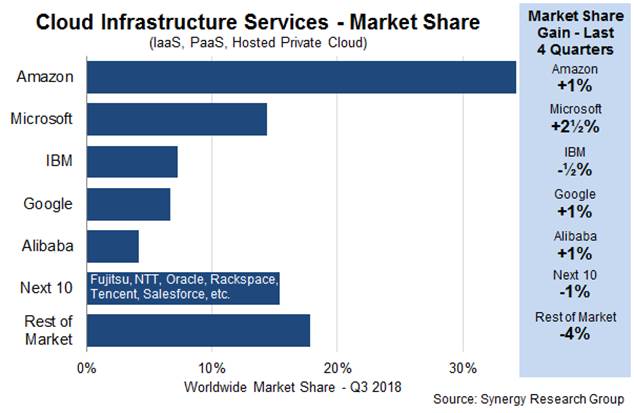
That’s because in spite of its iffy earnings reports over the last five years, Synergy Research reported that IBM had 7 percent of the cloud infrastructure market in its most recent report, which it defines as Infrastructure as a Service, Platform as a Service and hosted private cloud. It is the latter that IBM is particularly good at.

The company has the pieces in place now and a decent amount of marketshare, but Red Hat gives it a much more solid hybrid cloud story to tell. They can potentially bridge that hosted private cloud business with their own public cloud (and presumably even those of their competitors) and use Red Hat as a cloud native and open source springboard, giving their sales teams a solid story to tell.

IBM already has a lot of enterprise credibility on its own, of course. It sells on top of many of the same open source tools as Red Hat, but it hasn’t been getting the sales and revenue momentum that Red Hat has enjoyed. If you combine the enormous IBM sales engine and their services business with that of Red Hat, you have the potential to crank this into a huge business.

Photo: Ron Mller

It’s worth noting that the deal needs to pass shareholder muster and clear global regulatory hurdles before they can combine the two organizations. IBM has predicted that it will take at least until the second half of next year to close this deal and it could take even longer.

IBM has to use that time wisely and well to make sure when they pull the trigger, these two companies blend as smoothly as possible across technology and culture. It’s never easy to make these mega deals work with so much money and pressure involved, but it is imperative that Big Blue not screw this up. This could very well represent its last best chance to right the ship once and for all.

29 Oct 2018

China’s Didi Chuxing is poised to expand into hotel bookings

China’s largest ride-hailing app Didi Chuxing is entering the hotel-booking business as it strives to recover from two highly publicized murders of female passengers by drivers on its platform.

That’s according to Chinese business magazine Caijing and tech news site 36kr (links in Chinese). R-Lab, the unit in charge of Didi’s new venture, is aptly named to signify the company’s effort to “rebuild” its boundaries beyond on-demand car services. The lab has also been responsible for hatching Didi’s food delivery business, according to Caijing.

A Didi representative told TechCrunch that the company has “no plans to launch new businesses in the near future” and that it’s currently focusing its resources on “safety and operational upgrades.”

Nonetheless, the $56 billion startup has already shown interest in the hospitality industry – mainly through fostering partnerships. In July, Didi nabbed $500 million in strategic investment from Booking Holdings. The deal allows Didi users to reserve hotels on Booking services and, in turn, offer its on-demand car services to Booking users.

In September, Times of India reported that the transportation startup may be backing India’s hotel booking platform Oyo Rooms. The rumor has yet to receive any official confirmation.

Diversification appears to be a logical move given the Chinese ride-hailing giant has yet to turn a profit and its core car services are under regulatory pressure and public scrutiny following the passenger safety crisis. The company has already spun off its asset-heavy premium car unit ahead of a likely IPO.

But the hotel space isn’t an easy target either, with Baidu -backed online travel agency Ctrip being one of the dominant forces.

When contacted by TechCrunch to comment on Didi’s new endeavor, Ctrip’s vice president of corporate affairs Victor Tseng pointed to the industry’s challenges. “The hotel business is fragmented and unstandaridized.”

That means Didi would have to work on consolidating its services into the traveller’s planning journey, which spans booking hotels, transportation, experiences, and so on, as well as invest heavily in service keeping capacities.

Ctrip isn’t Didi’s only potential rival. Meituan Dianping, the Tencent-backed neighborhood services behemoth that went public in Hong Kong last month, has thrived on budget-hotel booking and outraced Ctrip (link in Chinese) in terms of the number of hotel nights booked, according to data analytics firm Trustdata.

29 Oct 2018

Southeast Asia’s Grab pulls in $200M from travel giant Booking

Fresh from a strategic investment from Microsoft, Southeast Asia’s ride-hailing leader Grab is back in the money again after it closed $200 million in fresh capital from Booking Holdings, the travel firm formerly known as Priceline.

The investment is part of an ongoing round of funding that Grab said is on course to reach $3 billion before the end of the year. Grab raised $2 billion for the round — including a $1 billion check from Totoya — but it continues to add strategic partners, like Microsoft and Booking. Grab — which bought Uber’s regional business in March and is present in eight countries — is valued at $11 billion and we understand that hasn’t changed with this round.

The deal — which mimics Booking’s recent $500 million investment in China’s Didi — will lead to the two companies team up to offer reciprocal services. That’ll see Grab’s transportation services integrated into Booking’s apps and services with support for Grab Pay. On the other side, Grab said that Booking’s travel accommodation services will come to its app sometime in 2019, although Grab customers in “multiple markets” will get rewards and offers in the app before the end of this year.

Besides Booking.com and Agoda, Booking also operates Kayak, Priceline.com, Rentacars.com and OpenTable. The firm rebranded from Priceline in February 2018.

The tie-in makes sense on both sides. Ride-hailing services are a prime channel for travel companies — Didi and Grab both dominate their respective markets, Grab claims over 110 million downloads — while the idea of pre-ordering a Grab to meet you after a flight has landed, or having one take you to your hotel will be logical for many.

Grab started out offering taxis, but it has since expanded to private car vehicles, motorbikes and a range of non-transportation services that include payments and food delivery. In addition, the company opened its platform to third-parties this summer in an effort to develop a ‘super app’ for Southeast Asia’s rapidly growing internet population, which is already larger than the entire U.S. population.

It hasn’t all been plain-sailing for Grab in its post-Uber world. Both Uber and Grab were fined a collective $9.5 million by Singapore’s watchdog for the merger — they got a lighter rap on the knuckles in the Philippines — while some users have complained about a bloated app, inferior service quality and higher fees in recent months. Grab disputes the latter claim that it has increased prices, but it has pledged to do better by its customers.

Grab’s chief rival is Indonesia Go-Jek, which is said to be raising $2 billion more to support a regional expansion plan. Go-Jek has already moved into Vietnam and Thailand, while this week it opened sign-ups for drivers in Singapore.