Year: 2018

29 Oct 2018

The Red Hydrogen One phone exists — but should it?

The Red Hydrogen One is real. I’ve held it in my hands. It’s sitting face down on my desk right now as I type these words.

None of this is to say, of course, that it needs to or even should exist. The Hydrogen One is less a phone than an idea that manifested its way into existence through sheer force of will. It’s a testament to the fact that just because a concept is potentially disruptive doesn’t necessarily make it good. Not with a starting price of $1,299 (and $1,599 for the titanium version), at least.

The handset functions best as a conversation piece. It’s big and it’s bold and it’s bizarre, sporting a massive footprint that dwarfs even the Pixel 3 XL, flanked by serrated edges that bring nothing to mind more than John Rambo’s hunting knife. And certainly the size, weight and build of the product should leave little question that the thing could double as a weapon, should you find yourself in a tight spot.

Of course, in this crowded smartphone market, getting noticed is half the battle. And the Hydrogen One has no problem on that front. I got a lot of “what’s that?” when I took the handset for a spin, capturing friends and food in 3D courtesy of the dual stereo rear-facing 12-megapixel cameras.

The next question is usually something in the area of “why?” That one is a bit more difficult to answer. After a few days with the phone, I’m still struggling with a justification for the front-facing Holographic 4-View display that doesn’t lean heavily on novelty. There’s no denying that it’s neat — or at the very least interesting. But I’m struggling to imagine a future in which most or even some of my picture or video viewing is done on this sort of device.

Red has leveraged a new take on the sort of 3D displays we’ve seen on products like Nintendo’s bygone 3DS. Created in partnership with a company called Leia, the technology works thusly:

Leia leverages recent breakthroughs in Nano-Photonic design and manufacturing to provide a complete lightfield “holographic” display solution for mobile devices, through proprietary hardware and software. The Silicon Valley firm commercializes LCD-based mobile screens able to synthesize lightfield holographic content while preserving the normal operation of the display.

All of that results in an image that provides a sense of depth to the viewer, without the sort of eyestrain found in similar tech. On the face of it, however, it looks pretty similar to those old holographic baseball cards they made back in the day. It also means that, in spite of the 515ppi 5.7-inch display, images can sometimes feel fuzzy. Another interesting side effect is a fair amount of light bleed from the top and bottom of the screen while in four-view mode.

Content will certainly be an issue going forward. That’s always an issue with these sorts of formats. Right now, the phone offers a slew of short nature photos, along with free access to a pair of movies (“Fantastic Beasts and Where to Find Them” and “Ready Player One”) available as an exclusive to AT&T subscribers.

Then there’s the content you capture yourself. I will say I was surprised at some of what the rear-facing cameras could do. Turns out they handled low light fairly well. That said, my amateur photography skills ended up with my capturing some pretty wonky shots with uneven depths. But even if I were a better photographer, I can’t really imagine looking at my own images in 3D is a compelling enough use case to make the considerable investment required.

I realize I’ve been pretty harsh on this $1,300 phone. And there are, indeed, things to like here. The build quality is at the top of the list. It’s certainly not to everyone’s taste — the Hydrogen One is big and garish and won’t fit in the pockets of your yoga pants. But it’s definitely solid. Red’s always had that going for it. The thing is built like a goddamn tank.

And while, again, I can’t imagine the technology having a lot of stickiness (we can meet back here in five years and you can make fun of me when every phone has some version of the tech), it’s utterly fascinating. It’s probably even more so when, let’s be honest, you’ve got a little bit of that sticky icky in your system. Also, shout out to the company for not cutting other corners here, including battery — 4,500 mAh is downright absurd.

Another little-discussed feature (because we’ve gotten plenty of other things to focus on) is its modularity. Like an SLR, the rear camera can be swapped out. Of course, those modules aren’t coming until next year, so it’s not exactly a selling point at launch. When it does arrive, it will include things like an extended battery. It does look like the company’s painted itself into a bit of a corner with regards to module size, similar to what Motorola did with its Z line.

The Hydrogen One is available November 2. It’s easily one of the most ambitious, bold and fascinating smartphones I’ve ever seen. If the device does, indeed, flop, it will have done so with the sort of audacity rarely seen in a space full of me-too devices. If you’re going to fail, fail big. At least that way you won’t be forgotten.
29 Oct 2018

Google beefs up Firebase platform for the enterprise

Today at the Firebase Summit in Prague, Google announced a number of updates to its Firebase app development platform designed to help it shift from an environment for individuals or small teams into a full-blown enterprise development tool.

Google acquired Firebase 4 years ago to help developers connect to key cloud tools like a database or storage via a set of software development kits (SDKs). Over time, it has layered on sophisticated functionality like monitoring to fix performance issues and access to analytics to see how users are engaging with the app, among other things. But the toolkit hasn’t necessarily been geared towards larger organizations until now.

“[Today’s announcements] are going to be around a set of features and updates that are catered more towards enterprises and sophisticated app teams that are looking to build and grow their mobile apps,” Francis Ma, head of product at Firebase told TechCrunch.

Perhaps the biggest piece of news was that they were adding corporate support. While the company boasts 1.5 million apps per month running on Firebase, in order to move deeper into the enterprise, it needed to have a place corporate IT could call when they run into issues. That is coming with the company expected to announce various support packages in Beta by the end of the year. These will be tied to broader Google Cloud Platform support.

“With this launch, if you already have a paid GCP Support package, you will be able to get your Firebase questions answered through the Google Cloud Platform (GCP) Support Console. Once the change is fully launched, Firebase support will be included at no additional charge with paid GCP Support packages, which includes target response times, a dedicated technical account manager (if you are enrolled in Enterprise Support) and more,” Ma explained in a blog post.

In addition, larger teams and organizations need more management tools and the company announced the Firebase Management API. This allows programmatic access to manage project workflows from IDE to Firebase. Ma says this includes direct integration with StackBlitz and Glitch, two web-based IDEs. “Their platforms will now automatically detect when you are creating a Firebase app and allow you to deploy to Firebase Hosting with the click of a button, without ever leaving their platforms,” Ma wrote.

There were a bushel of other announcements including access to better facial recognition tools in the Google ML kit announced last spring. There were also improvements to Crashlytics performance monitoring, which includes integration with PagerDuty now, and Firebase Predictions, its analytics tool, which is now generally available after graduating from Beta.

All of these announcements and more, are part of a maturation of the Firebase platform as Google aims to move it from a tool aimed directly at developers to one that can be integrated at the enterprise level.

29 Oct 2018

Five days left to reap big early-bird savings for Disrupt Berlin 2018

This is it, startup fans. We’re in the homestretch for big savings on tickets to Disrupt Berlin 2018. That means you have just five days left to save up to €500 on two action- and opportunity-packed days with some of the best and brightest minds in the tech startup world. The early-bird price becomes extinct on Friday, 2 November. Haven’t you waited long enough? Buy your ticket today.

We’ve recruited a killer line-up of Main Stage speakers — tech luminaries, business legends and game-changing investors — to share their perspective, experience and insight. Here’s a quick peek at what we have in store for you — and be sure to take a gander at the Disrupt Berlin agenda:

  • Kaidi Ruusalepp, founder and CEO of Funderbeam, will discuss how her company’s shaking up the traditional startup funding model by using a marketplace approach, a modern syndication system and a blockchain-based platform.
  • Pieter van der Does, CEO of payments company Adyen, will share how the startup quietly built its empire and took a profitable company public.
  • Denys Zhadanov, VP at Readdle, will talk about the mobile app company’s bootstrapped success — 100 million downloads and counting.

Opportunity at Disrupt Berlin abounds at every turn, but it shifts into overdrive once you enter Startup Alley, our exhibition floor. You’ll find more than 400 early-stage startups showcasing the latest technology products, platforms and services. Collaborate, recruit, invest, connect — it all happens in Startup Alley.

While you’re in the Alley, be sure to check out this year’s TC Top Picks — our curated cohort of exceptional startups spanning these categories: AI/Machine Learning, Blockchain, CRM/Enterprise, E-commerce, Education, Fintech, Healthtech/Biotech, Hardware, Robotics, IoT, Mobility and Gaming. Here are just a few fine examples:

  • Nuzzera: Your Spotify for news — the first two-sided market for professional journalism.
  • MakerBrane: A digital and physical platform that lets anyone design, build and trade their own play worlds.
  • FinMarie: Germany’s first online financial platform for women.

And, of course, you don’t want to miss Startup Battlefield — the crown jewel of Disrupt. Watch up to 15 outstanding early-stage startups go head-to-head to win $50,000 cash, hoist the coveted Disrupt Cup, earn invaluable investor and media attention and launch their companies on a global stage.

Disrupt Berlin 2018 takes place on 29-30 November, and the finish line for saving up to €500 is Friday 2 November — just five days left. Buy your pass today, and join us in Berlin at the best possible price.

29 Oct 2018

Robby Stein to talk about Instagram beyond Systrom at Disrupt Berlin

Last month, Instagram co-founders CEO Kevin Systrom and CTO Mike Krieger announced that they would be leaving Instagram and Facebook. All eyes are now on Instagram to figure out what’s going to happen to the photo and video app. That’s why I’m excited to announce that Instagram Product Director Robby Stein is joining us at TechCrunch Disrupt Berlin.

Instagram is Facebook’s next big bet. Facebook’s growth has slowed down, which puts even more pressure on Instagram. Compared to Facebook, Instagram is still a relatively young platform. More and more people are joining Instagram and stories are boosting engagement.

Facebook currently has 2.23 billion monthly users while Instagram has 1 billion users. Many people have an active account on both platforms. But does Instagram have what it takes to reach Facebook’s scale?

When it comes to product, Instagram has relentlessly released new features over the past few years. Stories have become a creative playground, stars can share longer videos on IGTV and you can now start group video chats from the app.

It’s impressive to see that such a big platform keeps releasing radical changes that will affect over a billion users. Instagram has been moving incredibly fast. And it’s been key when it comes to fostering growth.

Stein will tell us more about Instagram’s product design strategy and what’s coming up. It’s always interesting to hear the perspective of an insider to analyze product decisions and discuss them.

Before joining Instagram, he was the co-founder and CEO of Stamped, which was acquired by Yahoo back in 2012. Stein started his career at Google. In a short period of time, he managed to work for Google, Facebook and Yahoo, and he also founded his own startup. Quite an impressive resume.

And if you want to hear what it feels like to work for Instagram at a pivotal moment, you should come to Disrupt Berlin. The conference will take place on November 29-30 and you can buy your ticket right now.

In addition to fireside chats and panels, like this one, new startups will participate in the Startup Battlefield Europe to win the highly coveted Battlefield cup.

Robby Stein

Product Director, Instagram

Robby Stein is Product Director at Instagram, where he leads the consumer product team for sharing, which includes Stories, Feed, Live and Direct Messaging. Previously he was the Co-Founder and CEO of Stamped, which was acquired by Yahoo in 2012. At Yahoo, Robby led mobile video products focused around recommended content. He started his career at Google, where he worked to bring new features to market for Gmail and Ad Exchange. He has been recognized on the Forbes 30 under 30 and graduated summa cum laude from Northwestern University.

29 Oct 2018

AnyMind, which uses AI for advertising, marketing and HR, raises $13.4M

AnyMind Group, a Singapore-based company that uses AI in online advertising, HR and marketing, has pulled in a strategic $13.4 million investment to go after growth in Japan and other Asian markets.

This Series B round was led by Line, the Japanese messaging app firm, and Mirai Creation Fund, which is backed by Toyota among others. Previous backers JAFCO and Dream Incubator also took part.

AnyMind Group is a holding group formed this year to manage its initial venture AdAsia — which uses AI to offer ad solutions to publishers and advertisers — and its newer businesses TalentMind (HR) and CastingAsia, influencer marketing. AdAsia previously raised $12 million last year before it added a strategic investment from Japanese news app Gunosy three months later.

The business was founded in April 2016 by Japanese duo CEO Kosuke Sogo, the former managing director of Japan’s MicroAd in APAC, and COO Otohiko Kozutsumi, who had been with MicroAd Vietnam — and both men are ambitious with their plans to grow.

Indeed, despite being less than three years old, AnyMind says it has been profitable since early 2017. It said total revenue for 2017 was $26 million, up from $12.9 million one year previous.

Today, the company has 12 offices — including a product development center in Vietnam — and its services are present in 11 markets across Asia. It has some 330 staff, up from 90 just 18 months ago.

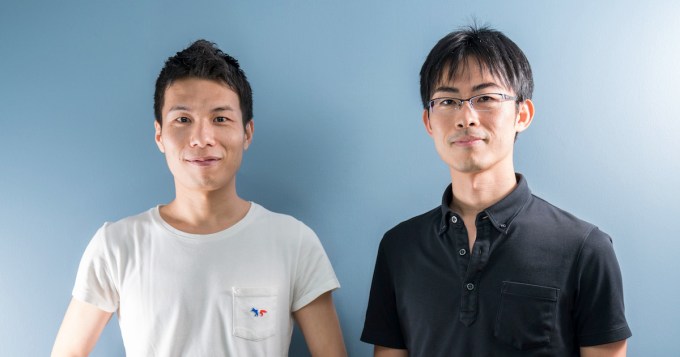
AnyMind founders Kosuke Sogo (left) and Otohiko Koztusumi (right)

While it doesn’t appear to need the money, AnyMind said it is keen on the connections that this investment can bring. That will include working with Line — which is Japan’s largest messaging app and popular across Southeast Asia — on digital advertising opportunities, and tapping into the Mirai fund’s portfolio companies to offer advertising and marketing programs.

“We have experienced great growth in the past 2.5 years, and are now looking to enter our next phase of progress — expanding market share in the geographies and industries we’re in. As we’ve been operating at a profit since January 2017, our focus for this round was to select investors that could take us to that next level,” Sogo, AnyMind’s CEO, said in a statement.

29 Oct 2018

Far-right social network Gab goes offline after GoDaddy tells it to find another domain registrar

Gab, the far-right social network that the suspect in Saturday’s mass shooting at Pittsburgh synagogue used to share anti-Semitic posts, has gone offline after GoDaddy gave it 24 hours to find a new domain provider. GoDaddy’s decision comes after PayPal, Medium, Stripe, and Joyent banned Gab’s accounts over the weekend.

Bowers may face the death penalty after being charged with 11 counts of murder and multiple hate crimes in connection to the attack on the Tree of Life synagogue in Pittsburgh, which the Anti-Defamation League said it believes is the deadliest against the Jewish community in U.S. history.

On his Gab profile, Bowers had written “jews are the children of satan” in his biography and repeatedly shared anti-Semitic content and other hate speech. Shortly before the shooting, Bowers allegedly wrote “HIAS [an organization that aids Jewish refugees] likes to bring invaders in that kill our people. I can’t sit by and watch my people get slaughtered. Screw your optics, I’m going in.”

In an emailed statement, a GoDaddy spokesperson said Gab was told to move after breaking the domain registrar’s rules against violent content:

“We have informed Gab.com that they have 24 hours to move the domain to another registrar, as they have violated our terms of service. In response to complaints received over the weekend, GoDaddy investigated and discovered numerous instances of content on the site that both promotes and encourages violence against people.”

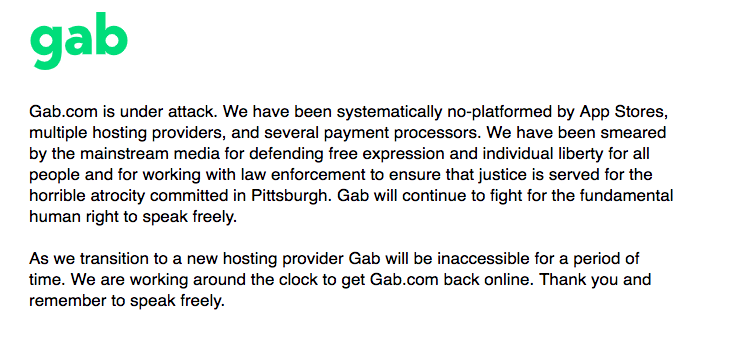
Gab now displays a message claiming it “is under attack” and has been “systematically no-platformed by App Stores, multiple hosting providers, and several payment processors.”

This is not the first time Gab has run afoul of its online service providers. Last year, Gab was banned from the Apple app store and Google Play for content violations. In August, Microsoft threatened to boot it from Azure web services if two anti-Semitic posts were not removed (the posts were taken down and Microsoft continued serving Gab).

After being suspended by Joyent, Gab said through its Twitter account that it would “likely be down for weeks,” but later tweeted that it would “be back soon.”

GoDaddy also stopped providing domain services to white supremacist site Daily Stormer in August 2017 after it posted an obscene article about Heather Heyer, who was killed while protesting last year’s Unite the Right rally in Charlottesville, Virginia.

29 Oct 2018

Walmart’s test store for new technology, Sam’s Club Now, opens next week in Dallas

Walmart’s warehouse club, Sam’s Club is preparing to open the doors at a new Dallas area store that will serve as a testbed for the latest in retail technology. Specifically, the retailer will test out new concepts like mobile checkout, an Amazon Go-like camera system for inventory management, electronic shelf labels, wayfinding technology for in-store navigation, augmented reality, and artificial intelligence-infused shopping, among other things.

The retailer first announced its plans to launch a concept store in Dallas back in June, which was then said to be a real-world test lab for technology-driven shopping experiences.

Today, the company is taking the wraps off the project and is detailing what it has planned for the new location, which goes by the name “Sam’s Club Now.”

Like other Sam’s Club stores, consumers will need a membership to shop at Sam’s Club Now. But how they shop will be remarkably different.

Instead of cashiers, the store is staffed with “Member Hosts,” who will act more like concierges, the company says.

And instead of scanning items at a point-of-sale cashier stand, customers will use a specialized Sam’s Club Now mobile app.

The app leverages Sam’s Club existing “Scan & Go” technology, which is used today across its retail locations to help speed up checkout. With the current Scan & Go mobile app, shoppers can opt to scan items as they place them in their cart, then pay right on their phone. At Sam’s Club Now, however, the use of mobile scan-and-pay is required, not optional.

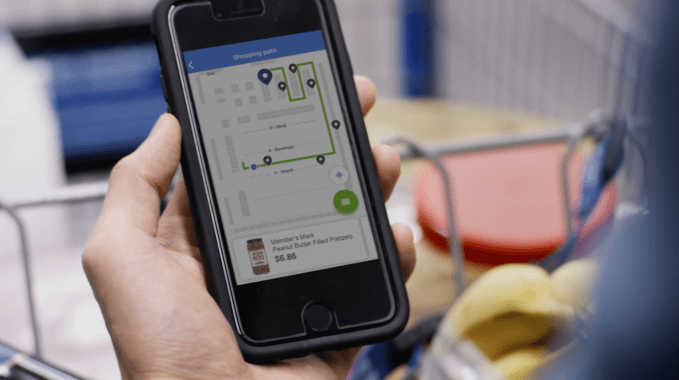
The Sam’s Club Now app will also be infused with other features the company wants to try out, including an integrated wayfinding and navigation system, augmented reality features, an A.I.-powered shopping list and more.

At launch the app will offer a built-in map for finding the right aisle for a given product, but over time, this mapping system will be upgraded to use beacon technology and will be tied to the customer’s shopping list to map their best route through the store.

The shopping list will also be powered by A.I. Using a combination of machine learning and customer purchase history, the list will be pre-populated with customers’ frequent purchases. Those items can be removed from the list, if not needed.

This way, customers won’t forget things they usually need to buy, the retailer says.

Meanwhile, the app will allow Sam’s Club to test augmented reality as a way of highlighting “stories’ about the products being sold and their features, as well as providing a way to find out how items are sourced. This seems more gimmicky, though, as it’s unlikely that customers are interested in this sort of “infotainment” when just trying to get their shopping done.

But at very least, the test store gives the retailer a chance to confirm that supposition with real world data.

The app will also allow members to place pickup orders that will be ready in just an hour, or place same-day delivery orders.

The lack of cashiers won’t be the only difference between this Sam’s Club Now and other locations. The store will also be just a quarter of the size of an average club, at 32,000 square feet. That means it will feature, in some cases, smaller pack sizes than at the other warehouse club locations.

Because of the smaller size, it will also feature a quarter of the usual staff at 44 associates. But the goal is not to eliminate staff and replace them with technology, the retailer claims.

“Eliminating friction doesn’t mean replacing exceptional member service with a digital experience,” said John Furner, Sam’s Club President and CEO. “We know our members expect both.”

The company says it will include a range of products like meats, fresh foods, frozen items, beer and wine and meal solutions.

More importantly, it will also include a new inventory management and tracking technology. Down the road, a system of over 700 cameras will be used to help the retailer manage the inventory and optimize the store layout.

On the shelves, it’s also testing electronic shelf labels that will instantly update prices, eliminating the need to print out paper signage.

These are not third-party systems, the retailer says.

“The vast majority of technologies that we’re building here are technologies that we’ve developed in house. There may be pieces of modules of things that we’re using from third parties. But the majority are systems that are building on the technology that we’ve developed here,” said Jamie Iannone, CEO of SamsClub.com and EVP of Membership & Technology. “That allows us to iterate and move pretty quickly with it,” he noted. 

By “quickly,” the retailer means things can change in a matter of weeks. The store plans to rapidly iterate on new and different experiences across computer vision, A.I., A.R., machine learning, and robotics.

The winners will then be rolled out to other Sam’s Club locations across the U.S.

The retailer says Dallas was selected as a test market because it’s an easy trip from Walmart’s headquarters in Bentonville, Arkansas, and because of Dallas’ tech talent and the recruiting potential. The company today has over 100 engineers in the area, and it plans to hire more in the areas of machine learning, A.I. and computer vision.

It’s worth noting, too, that Sam’s Club Now has been set up, developed and made ready for opening in just five months.

The store will officially open to on an invite basis to local members for testing as soon as next week. The grand opening to the public is tentatively scheduled for a couple weeks out.

29 Oct 2018

Silicon Valley’s sovereign wealth problem

It’s time to bring the conversation about where Silicon Valley gets its money from out into the open. Following recent revelations into Saudi Arabia’s extensive reach and influence in the US technology sector, the willful ignorance that has defined the relationship between venture capital firms and the limited partnerships (LPs) that fund them for years now isn’t going to cut it anymore.

According to the latest reports from the Wall Street Journal, Saudi Arabia is now the single-largest source of funding for US-based tech companies. Since 2016, the Saudi royal family has invested at least $11 billion into US startups directly, and in August, the Saudi Arabian government committed $45 billion to Softbank’s $92 billion Vision Fund. To put that into context, the total amount of funding deployed across all VC deals so far in 2018 is $84.3 billion — a record for the industry, but a paltry sum relative to the wealth of the Saudi Kingdom.

Backlash is rising — and that’s a good thing. With tech companies now capturing the lion’s share of global wealth creation, we should absolutely want to know where that money is going. For one, it’s a matter of ethics. The US tech industry generates billions of dollars in returns annually for investors. When that money is being funneled into the coffers of a country with a total lack of respect for basic human rights, that’s a problem. It’s not good for Silicon Valley entrepreneurs and it’s not good for the country as a whole.

That’s not to say all sovereign wealth is at issue. Not in the least bit. But when it comes to funds that support nation states with questionable track records on human rights, there’s no debate.

This is a critical moment for Silicon Valley. It’s a wake up call to venture capitalists and entrepreneurs alike to start being more mindful about their sources of funding. There are plenty of better institutions and more impactful causes you can be helping to enrich – research initiatives at top public children’s hospitals, financial aid programs at historically black colleges and universities, public pension funds, and the list goes on – you just have to make the effort and be intentional about it. As an industry, we can and should be doing more to support these groups. If fact, it’s one of the very reasons why Jyoti Bansal and I founded Unusual Ventures and raised our entire fund from a diverse set of LPs.

If history is any guide, however, it will take more than the better nature of entrepreneurs and their investors to make a real impact.

Gender parity in the tech industry is a fitting example: While advocates have been calling for greater gender diversity in senior leadership positions at tech companies for decades, gender inequality continues to pervade the entire sector. In September, California took steps to remedy the issue by passing a law requiring public companies to have at least two female directors on the executive board. Since then, we’ve seen some improvements – although there is still far, far more that needs to happen.

Similarly, what’s likely needed to move the needle on transparency in venture funding is common sense regulation. For instance, we should consider a law that requires – at a minimum – transparency around how much funding VC firms raise from foreign sources.

This already exists for VC funding raised from public US institutions. When VCs raise capital from public universities, endowments, pension funds and others, they are required to report it under the Freedom of Information Act (FOIA). Ironically, this mandate has contributed to the rise of sovereign wealth funds in the tech sector. That is, the additional reporting requirements that come along with raising money from public institutions drives VCs to “easier” sources of funding, such as sovereign wealth and billionaire family offices. Translation: transparency isn’t just common sense – it’s effective too – so let’s level the playing field.

Just like with any society-level issue though, fixing Silicon Valley’s sovereign wealth problem won’t happen overnight. For one, drafting legislation and enacting it into law takes time. It’s also extremely difficult for VCs to make changes around their investment base in the short term. If change is going to take root, the big moments to watch will be the start of the next funding cycle (ie. when VCs are out raising their next fund) and future legislative sessions, especially in the California state legislature.

In the meantime, entrepreneurs need to start asking VCs about where their money comes from. Nothing is going to happen without the industry’s best entrepreneurs stepping up and putting the pressure on VCs. So long as they are willing to accept funding without asking where it comes from, there is little incentive for the VC industry to change.

But if the entrepreneur community in Silicon Valley takes a stand on transparency in VC and starts asking the right questions, there is nothing stopping this moment from becoming more than just another news cycle. It will become a movement the VC industry cannot ignore.

29 Oct 2018

Silicon Valley’s sovereign wealth problem

It’s time to bring the conversation about where Silicon Valley gets its money from out into the open. Following recent revelations into Saudi Arabia’s extensive reach and influence in the US technology sector, the willful ignorance that has defined the relationship between venture capital firms and the limited partnerships (LPs) that fund them for years now isn’t going to cut it anymore.

According to the latest reports from the Wall Street Journal, Saudi Arabia is now the single-largest source of funding for US-based tech companies. Since 2016, the Saudi royal family has invested at least $11 billion into US startups directly, and in August, the Saudi Arabian government committed $45 billion to Softbank’s $92 billion Vision Fund. To put that into context, the total amount of funding deployed across all VC deals so far in 2018 is $84.3 billion — a record for the industry, but a paltry sum relative to the wealth of the Saudi Kingdom.

Backlash is rising — and that’s a good thing. With tech companies now capturing the lion’s share of global wealth creation, we should absolutely want to know where that money is going. For one, it’s a matter of ethics. The US tech industry generates billions of dollars in returns annually for investors. When that money is being funneled into the coffers of a country with a total lack of respect for basic human rights, that’s a problem. It’s not good for Silicon Valley entrepreneurs and it’s not good for the country as a whole.

That’s not to say all sovereign wealth is at issue. Not in the least bit. But when it comes to funds that support nation states with questionable track records on human rights, there’s no debate.

This is a critical moment for Silicon Valley. It’s a wake up call to venture capitalists and entrepreneurs alike to start being more mindful about their sources of funding. There are plenty of better institutions and more impactful causes you can be helping to enrich – research initiatives at top public children’s hospitals, financial aid programs at historically black colleges and universities, public pension funds, and the list goes on – you just have to make the effort and be intentional about it. As an industry, we can and should be doing more to support these groups. If fact, it’s one of the very reasons why Jyoti Bansal and I founded Unusual Ventures and raised our entire fund from a diverse set of LPs.

If history is any guide, however, it will take more than the better nature of entrepreneurs and their investors to make a real impact.

Gender parity in the tech industry is a fitting example: While advocates have been calling for greater gender diversity in senior leadership positions at tech companies for decades, gender inequality continues to pervade the entire sector. In September, California took steps to remedy the issue by passing a law requiring public companies to have at least two female directors on the executive board. Since then, we’ve seen some improvements – although there is still far, far more that needs to happen.

Similarly, what’s likely needed to move the needle on transparency in venture funding is common sense regulation. For instance, we should consider a law that requires – at a minimum – transparency around how much funding VC firms raise from foreign sources.

This already exists for VC funding raised from public US institutions. When VCs raise capital from public universities, endowments, pension funds and others, they are required to report it under the Freedom of Information Act (FOIA). Ironically, this mandate has contributed to the rise of sovereign wealth funds in the tech sector. That is, the additional reporting requirements that come along with raising money from public institutions drives VCs to “easier” sources of funding, such as sovereign wealth and billionaire family offices. Translation: transparency isn’t just common sense – it’s effective too – so let’s level the playing field.

Just like with any society-level issue though, fixing Silicon Valley’s sovereign wealth problem won’t happen overnight. For one, drafting legislation and enacting it into law takes time. It’s also extremely difficult for VCs to make changes around their investment base in the short term. If change is going to take root, the big moments to watch will be the start of the next funding cycle (ie. when VCs are out raising their next fund) and future legislative sessions, especially in the California state legislature.

In the meantime, entrepreneurs need to start asking VCs about where their money comes from. Nothing is going to happen without the industry’s best entrepreneurs stepping up and putting the pressure on VCs. So long as they are willing to accept funding without asking where it comes from, there is little incentive for the VC industry to change.

But if the entrepreneur community in Silicon Valley takes a stand on transparency in VC and starts asking the right questions, there is nothing stopping this moment from becoming more than just another news cycle. It will become a movement the VC industry cannot ignore.

28 Oct 2018

Forget Watson, the Red Hat acquisition may be the thing that saves IBM

With its latest $34 billion acquisition of Red Hat, IBM may have found something more elementary than “Watson” to save its flagging business.

Though the acquisition of Red Hat  is by no means a guaranteed victory for the Armonk, N.Y.-based computing company that has had more downs than ups over the five years, it seems to be a better bet for “Big Blue” than an artificial intelligence program that was always more hype than reality.

Indeed, commentators are already noting that this may be a case where IBM finally hangs up the Watson hat and returns to the enterprise software and services business that has always been its core competency (albeit one that has been weighted far more heavily on consulting services — to the detriment of the company’s business).

Watson, the business division focused on artificial intelligence whose public claims were always more marketing than actually market-driven, has not performed as well as IBM had hoped and investors were losing their patience.

Critics — including analysts at the investment bank Jefferies (as early as one year ago) — were skeptical of Watson’s ability to deliver IBM from its business woes.

As we wrote at the time:

Jefferies pulls from an audit of a partnership between IBM Watson and MD Anderson as a case study for IBM’s broader problems scaling Watson. MD Anderson cut its ties with IBM after wasting $60 million on a Watson project that was ultimately deemed, “not ready for human investigational or clinical use.”

The MD Anderson nightmare doesn’t stand on its own. I regularly hear from startup founders in the AI space that their own financial services and biotech clients have had similar experiences working with IBM.

The narrative isn’t the product of any single malfunction, but rather the result of overhyped marketing, deficiencies in operating with deep learning and GPUs and intensive data preparation demands.

That’s not the only trouble IBM has had with Watson’s healthcare results. Earlier this year, the online medical journal Stat reported that Watson was giving clinicians recommendations for cancer treatments that were “unsafe and incorrect” — based on the training data it had received from the company’s own engineers and doctors at Sloan-Kettering who were working with the technology.

All of these woes were reflected in the company’s latest earnings call where it reported falling revenues primarily from the Cognitive Solutions business, which includes Watson’s artificial intelligence and supercomputing services. Though IBM chief financial officer pointed to “mid-to-high” single digit growth from Watson’s health business in the quarter, transaction processing software business fell by 8% and the company’s suite of hosted software services is basically an afterthought for business gravitating to Microsoft, Alphabet, and Amazon for cloud services.

It’s this area of cloud computing where IBM hopes that Red Hat can help it gain ground.

“The acquisition of Red Hat is a game-changer. It changes everything about the cloud market,” said Ginni Rometty, IBM Chairman, President and Chief Executive Officer, in a statement announcing the acquisition. “IBM will become the world’s number-one hybrid cloud provider, offering companies the only open cloud solution that will unlock the full value of the cloud for their businesses.”

The acquisition also puts an incredible amount of marketing power behind Red Hat’s various open source services business — giving all of those IBM project managers and consultants new projects to pitch and maybe juicing open source software adoption a bit more aggressively in the enterprise.

As Red Hat chief executive Jim Whitehurst told TheStreet in September, “The big secular driver of Linux is that big data workloads run on Linux. AI workloads run on Linux. DevOps and those platforms, almost exclusively Linux,” he said. “So much of the net new workloads that are being built have an affinity for Linux.”