Year: 2018

28 Oct 2018

These 14 startups — endorsed by the seed-stage investment firm Pear — just hit the fundraising trail

Earlier this week, in a beautiful garden in Woodside, Ca., the team at the five-year-old, seed-stage venture firm Pear hosted it fifth annual demo day. It’s an event that’s limited to roughly 100 VCs who year after year happily fill the space to see what Pear — which has written early checks to the “unicorn” delivery service DoorDash and newly public Guardant Health, among others — has up its sleeve.

As with last year, what those investors wound up seeing on Tuesday was 15 teams, most of them six months old or younger and led by current students or recent graduates who’d been invited by Pear to build companies over ten weeks in its Palo Alto offices. These ranged from a startup with ambitious plans to build a new commercial space station, to a machine learning-powered cloud video platform that makes it far easier to edit video clips, to a startup that used AI to negotiate salary discussions on behalf of its clients.

But in a bit of a twist, this time around, Pear also featured a sprinkling of young companies that are now ready for Series A funding, including a solar design and sales platform for residential and commercial photovoltaic systems and a company that thinks its check-out free shopping technology could help all kinds of Amazon rivals compete with the giant’s growing number of surveillance-powered, no-checkout convenience stores.

In case you’re an investor or just someone interested in keeping your thumb on the pulse of what’s happening in emerging tech, herewith is a quick snapshot of each of the companies that were featured as part of the program. (Well, all but one that expressly us not to write about what it’s working on, though we’ll tell you it’s a kind of social network and, remarkably, it feels fresh.)

If you’re interested in reaching out to any of these folks, you can find of all of their email addresses here.

Pre-Seed / Seed

Orion Span

Tagline: The World’s Private Space Station

Describes itself as: What was once the domain of governments is now the domain of private industry. So it was with aviation and now, too, it is with space travel. SpaceX revolutionized the launch business and is worth $27 billion today. Orion Span will do the same with the destination business. Orion Span’s Aurora Station’s patented IP and operational concepts emphasize simplicity, cutting costs in extraordinary ways and improving accessibility in ways never seen before in space station design.

Location: San Mateo, Ca, and Houston, Tx.

Employees: 5

Metrics: Twenty-six space tourists have agreed to put $80,000 each to be on the waitlist; 1,578 media outlets worldwide have covered us; and four partners are signed with three more on the way.

Team: Orion Span includes some of the folks who built the International Space Station. Its CEO is a marketer and entrepreneur with a few startups under his belt. Its architect designed the ISS Enterprise module. It CTO designed and built spacecraft systems for the ISS. And its COO oversaw the build of NASA Orion spacecraft as a former general manager.

Young Alfred

Tagline: Home Insurance Marketplace

Describes itself as: Young Alfred turns the nightmare experience of shopping for home insurance online into an informed, 15-minute transaction. As a customer, you get your top three curated home insurance options from a list of more than 20 carriers and can purchase with just one click. A marketplace model drives transparency, saves money, and leads to five times higher purchase conversion than a single-carrier model.

Locations: Philadelphia and New York

Employees: 6

Metrics: Thousands of applications for home insurance a month, with 24 direct carrier relationships across 13 states.

Team: The founders met during their first week at Wharton Business School. David comes from private equity and has experience acquiring and growing businesses. Jason is an engineer turned high frequency trader who has built trading systems for the likes of Citadel and DRW.

Aligned Carbon

Tagline: Next 1000x computing revolution using carbon nanotube

Describes itself as: Aligned Carbon is the first company to sell carbon nanotube wafers in a way that seamlessly fit into the nanofabrication requirements of the integrated circuit industry. The large historical gains in performance due to continued shrinking of silicon transistors are now only realizing marginal improvements with exponentially increasing costs. This has come at a time with the push for faster and lower power computing capabilities continue to grow rapidly due to AI, AR, big-data analytics and other memory-starved workloads. Monolithic 3D integration is the nanoelectronics industry’s next paradigm for computing and the sequential integration of carbon nanotube logic with traditional silicon logic and memory is the leading technology. Performance and efficiency improvements of over 1000x are anticipated, and Aligned Carbon’s products solve the carbon nanotube materials problem to revolutionize a $500B industry.

Location: Silicon Valley

Employees: 3

Metrics: Aligned Carbon has worked with over a dozen companies and universities while developing their unique carbon nanotube products of interest to the largest chip manufacturers in the world.

Team: Co-founded in 2018 by J Provine, Greg Pitner, and Cara Beasley, three Stanford scientists who met over a shared love for nanotechnology. Collectively they have over 35 years of nanofabrication research experience with universities, start-ups, and corporate giants.

Mirra

Tagline: Mirra creates products and experiences to make no-bullshit skincare easily accessible.

Describes itself as: Mirra is a skincare platform of more than 100,000 beauty nerds who believe that the most important ingredient is transparency. By marrying content, community and commerce, Mirra empowers millennial women with the tools they need to decode the unregulated, $14 billion skincare industry. After releasing a weekly skincare newsletter that grew to more than 100,000 subscribers without ad spend, Mirra is now launching an exclusive line of skincare products.

Location: San Francisco

Employees: undisclosed

Metrics: Mirra’s first product is a weekly skincare newsletter which has grown exponentially without ad spend. Now, after listening to the holes in its readers’ routines, Mirra is launching its own exclusive line of skincare products next year.

Team: Mirra is founded by Katia Ameri, a 26-year-old Stanford alumna with a background in venture capital and consumer products.

Reduct

Tagline: AI-powered cloud video: the power of video, with the ease of text.

Describes itself as: Reduct makes a machine learning-powered cloud video platform that anyone can use. If you can write a text document, you can search, edit, and share video with Reduct. By making tools for video creation accessible to everyone, the company aims to turn everyone’s favorite medium of consumption (the average American watches six hours of video a day) into a ubiquitous mode of communication. The company is currently enabling design & UX research teams to incorporate video into workflows and will create a horizontal product targeting professionals whose profession isn’t video editing.

Location: San Francisco

Employees: 4

Metrics:  Since January, the company has acquired 35 paying business customers, including Fortune 500 companies and several technology companies valued at more than $1 billion. It says it has also processed more than 50,000 minutes of video, and customers report time savings of more than ten times what they experience when using traditional video tools.

Team: CEO Prabhas Pokharel studied computer science at Harvard and product design at Stanford, and has spent the last decade creating human-centered products. CTO Robert Ochshorn is a machine learning researcher who has given talks at Google Brian, Apple and Stanford. He is an alum of Cornell CS, and has held research positions at MIT, Harvard, and Alan Kay-initiated CDG Labs.
Zubale

Tagline: A platform that empowers companies to make better product decisions in emerging markets.

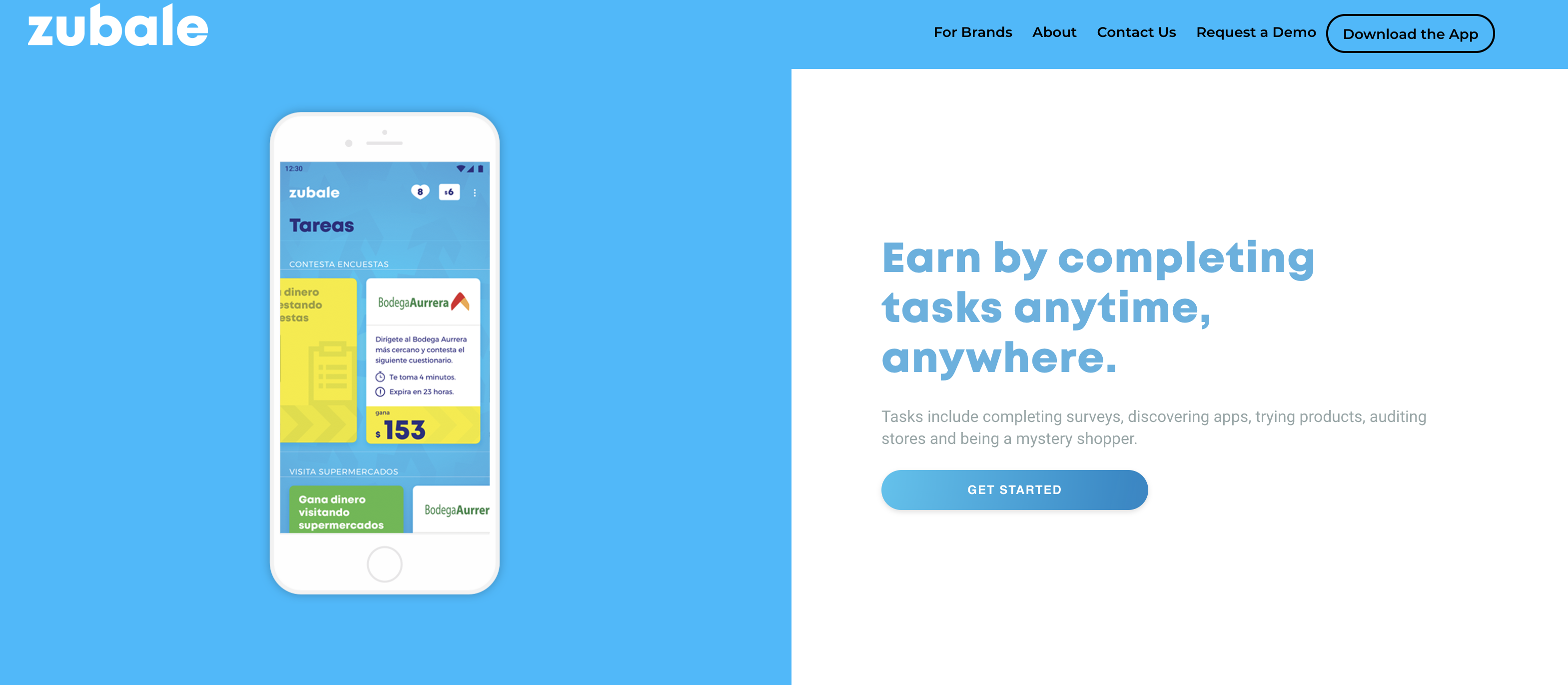
Describes itself as: Zubale connects companies directly with consumers on their smartphones to crowdsource multiple digital tasks in exchange for rewards. Companies can crowdsource tasks like in-store audits, product trial activations, and market research studies, and receive real-time intelligence from consumers to make faster and more confident decisions. Consumers complete tasks and earn mobile phone credit and other digital rewards that they can redeem through making online purchases.

Location: Mexico City, Mexico

Employees: 10

Metrics: Zubale launched its mobile app three weeks ago and says it has had more than 20,000 branded tasks completed already by consumers.

Team: The founders, Allison Campbell and Sebastian Monroy, have over 15 years of expertise developing and selling new products to consumers at Walmart and Procter and Gamble. Allison launched and ran businesses for Walmart in India and led strategic initiatives across 25 countries. Sebastian led sales teams for P&G in Mexico and across Latin America to distribute products to reach the millions of mom and pop shops that make up 50 percent of spend.
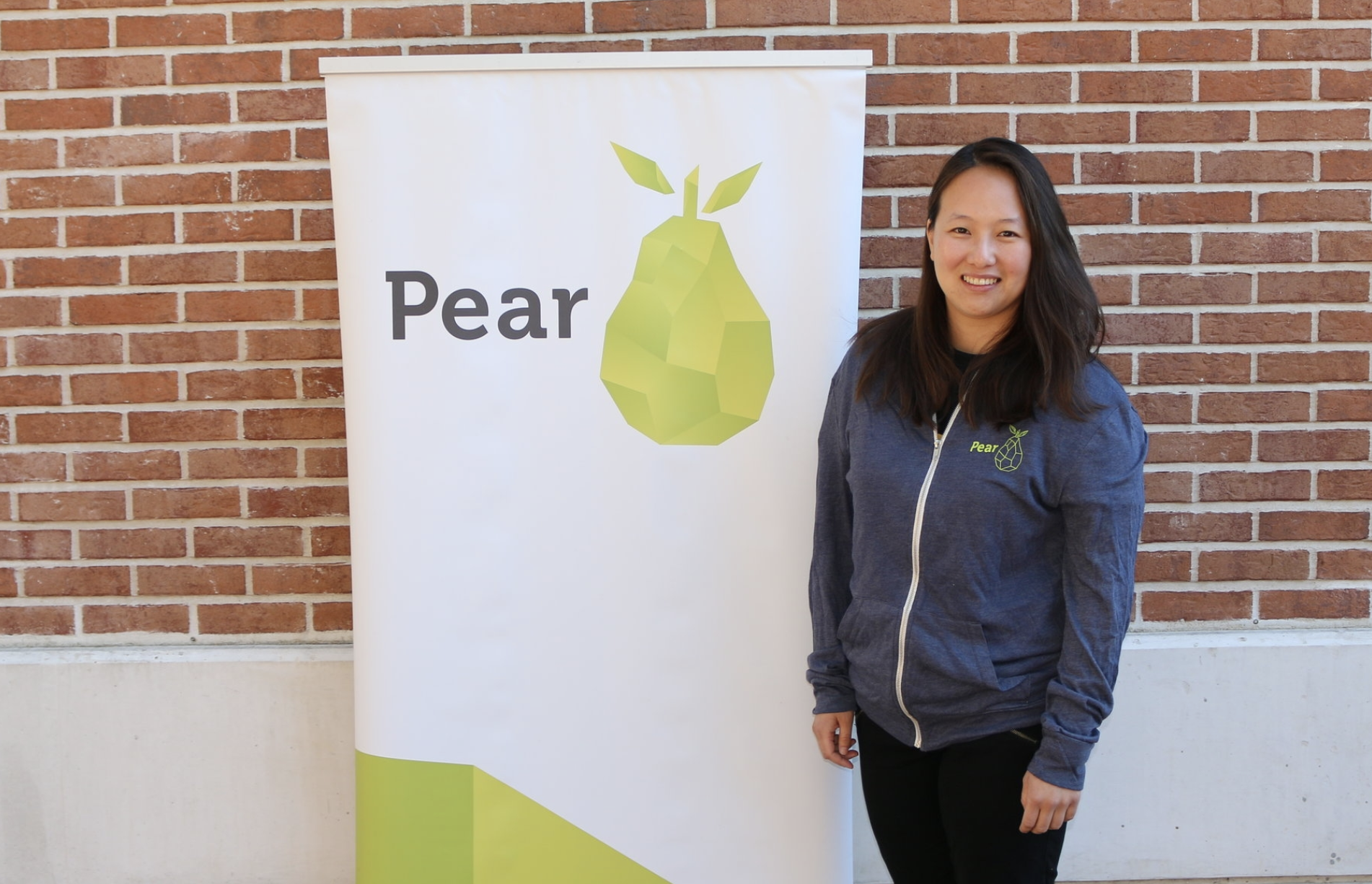
Riva

Tagline: Your career advocates – helping the $2.3T job changer market

Describes itself as: Riva builds automation to help the 41 million people who changing jobs every year — and the 5 million college seniors who graduate — negotiate their job offers. Nearly two-thirds of people do not negotiate their job offers. And research shows that women especially tend to suffer in the negotiation process, furthering the gender pay gap. Riva builds software that can predict an employee’s worth and generate negotiation emails and phone scripts that can be used by the employee to negotiate with the employer.

Location: Palo Alto, California

Employees: 7

Metrics: The average increase per negotiation is $23,000. The company is already working with several large partners including schools, engineering communities, and nursing associations to get its product to the mass market.

Team: CEO Stephanie Young has four degrees from Stanford, including an MBA and graduate degree in computer science. She previously helped launch Google AdWords Express’ first ever mobile app.

LivingLab

Tagline: A shared living community offering per-room leases in furnished property.

Describes itself as: LivingLab is a platform that enables co-living in any rental property, making it easy for professionals to find community in shared housing. Our technology matches individuals to bedrooms in beautiful homes and then configures those properties to include furnishings, WiFi, utilities, housekeeping and community events. We can complete this process in 48 hours. By individually pricing rooms and offering flexible lease lengths, LivingLab is able to collect 30 percent of rent for its services.

Location: Durham, North Carolina

Employees: 6

Metrics: LivingLab says it has placed 500 users into 45 residents across 10 properties, generating on average $2,280 in recurring revenue per customer per year.

Team: CEO Mitchel Gorecki, CTO Patrick Wickham, and COO Colin Tai.
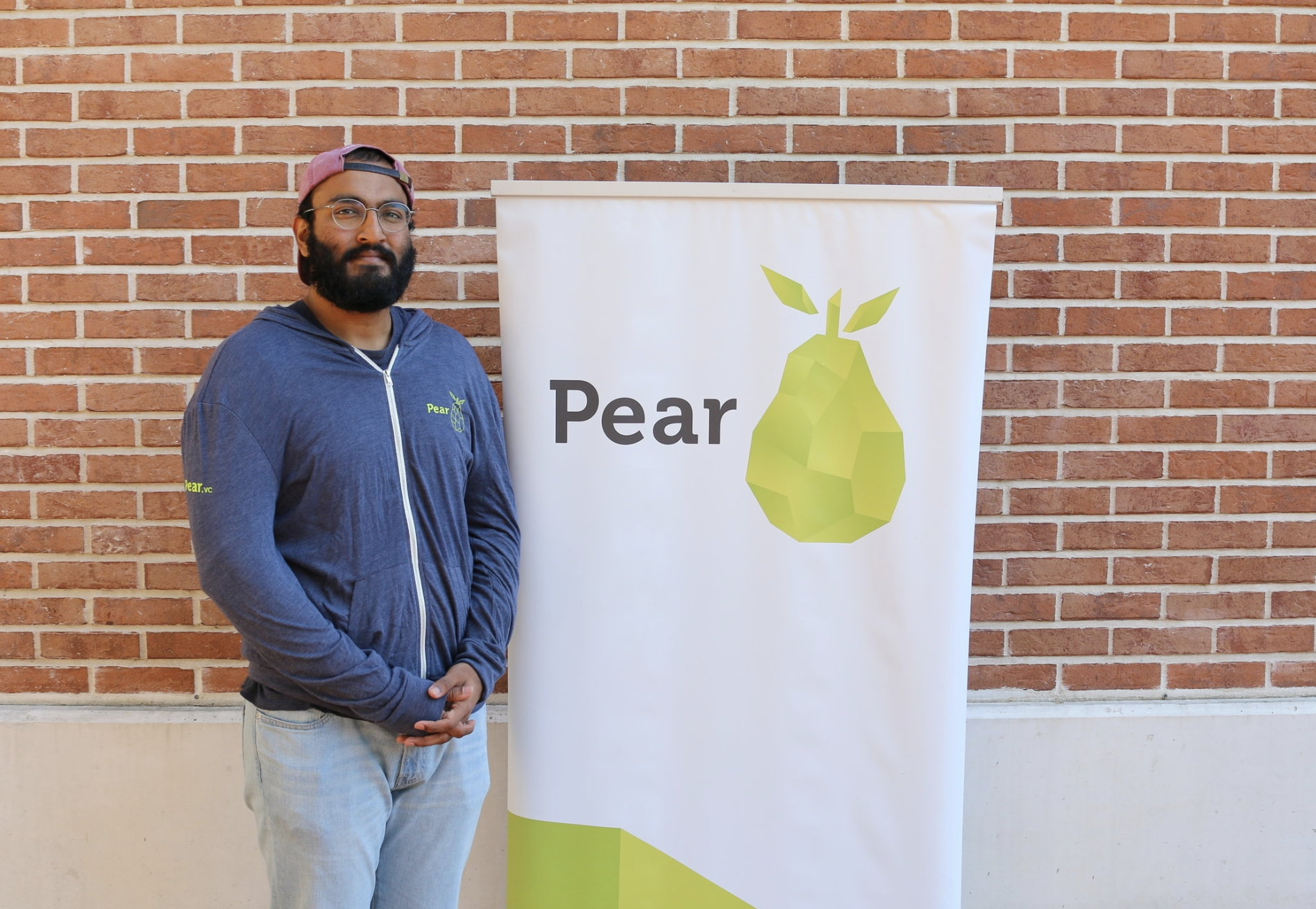
Kick It Labs

Tagline: Building consumer apps for high schoolers and college students inspired by youth culture.

Describes itself as: A creative lab that’s launching new consumer social experiences every week, inspired by youth culture, for high schoolers and college students in the pursuit of building the next billion person consumer product.

Location: Palo Alto

Employees: Undisclosed

Metrics: The company says its most promising and exciting experiments to date have centered around street wear, high school social products, and men’s fashion.

Team: Cofounders Akshar Bonu and Sathish Nagappan among others have graduated from Harvard, Cornell, and Stanford and have been building apps for high schoolers and college students for over a decade, they say. They have also spent time at Andrew Ng’s AI Lab, Nervana Systems, Amazon, Google and Intel.

Series A

Aurora Solar

Tagline: Building the operating system of the power source of the future.

Describes itself as: More than $200 billion per year is spent on developing solar projects through a fragmented network of solar installers, who work with financiers, equipment manufacturers, engineering service providers and more. Aurora’s software is used by thousands of solar installers to precisely quote, design and sell solar projects, without visiting the site. With the solar industry forecasted to grow over five times its curren size over the next decade, Aurora will be the platform through which every new solar project is designed, sold, financed and serviced.

Location: San Francisco, CA

Employees: 43

Metrics: More than 50,000 solar projects a month (totaling $3 billion in value) are created on the platform each month. More than1,500,000 solar projects have been created in the company’s software, it says.

Team: CEO/CTO: Christopher Hopper, is a Stanford MBA and MEng from Imperial College; COO/CRO Samuel Adeyemo, is a Stanford MBA/MSc and former portfolio manager for JPMorgan’s  Chief Investment Office.
Thinknum

Describes itself as: Thinknum creates datasets from a broad array of public online sources, capturing ephemeral information on the products, operating markets and labor markets of 400,000-plus global companies across sectors, and provides rich toolsets for extracting intelligence. Data sets include pricing trends for individual products at specific retailers, such as electronics and restaurant menu items, to hiring activity across macro industries and particular companies down to the location.

Location: New York, NY

Employees: 18

Metrics: The company says it’s currently seeing $3 million in ARR, thanks to its work with more than 150 corporations and investment firms.

Team: The founders met at Princeton University and worked at Goldman Sachs and a hedge fund before starting Thinknum.

EmCasa

Tagline: Real estate tech brokerage in Brazil

Describes itself as: EmCasa is the only brokerage in Brazil that offers 3D tours in the vast majority of its listings, helping buyers and sellers avoid unnecessary visits. Also, EmCasa is the only brokerage in Brazil that built a proprietary algorithm that offers online property valuations, better managing customer price expectations and providing more accurate listing recommendations. Finally, EmCasa is the only brokerage in Brazil that charges a 3 percent commission on full-service, which is half of what other companies charge.

Location: Rio de Janeiro, Brazil

Employees: 18

Metrics: The company says it has 650 active listings currently, versus just 20 in January; it also says its revenue growth rate of 118 percent CQGR.

Team: EmCasa’s CEO, Gustavo Vaz, is a Harvard MBA and was formerly COO of Easy Taxi and Chief Strategy of Frontier Car Group; Gabriel Laet, the company’s CTO/CPO, founded and sold Doubleleft, a gaming and software development company; and Lucas Cardozo, EmCasa’s COO, was a former Bain & Company consultant and the VP of strategy at Brasil Brokers, the second largest Brokerage firm in Brazil.

Polarr

Tagline: Big brains in small devices

Describes itself as: Polarr is a computational photography company that’s focused on computer graphics, computer vision and artificial intelligence. The company has created one of the most successful and two-time best of Apple App Store winning pro photography app; in the meantime, it’s developing its own Polarr Vision Engine for internal usage, as well as helping others to build immersive C.V. experiences on the edge.

Location: San Jose, CA, Beijing, China

Employees: 25

Metrics: Profitable, tripling revenue every year.

Team: Polarr’s CEO, Borui Wang has an M.S. in AI and HCI from Stanford, and is an ex-Googler at Youtube. Polarr’s CTO, Derek Yan, has an M.S. in EE from Stanford, and is an ex-Googler in ATAP.
Zippin

Tagline: Checkout-free shopping for every store.

Describes itself as: Zippin’s vision is to transform retail by banishing checkout lines and self-scanners for good using patent-pending AI, machine learning and sensor future technology. Its technology platform provides checkout-free shopping experience for retailers looking for a solution rivaling Amazon Go’s approach.

Location: San Francisco, CA

Employees: 10

Metrics: Working store in downtown San Francisco, and POCs with several globally recognized retail brands and real estate owners.

Team: CEO Krishna Motukuri has spent more3 than 20 years in retail and e-commerce, including with Amazon and Naspers. Chief Scientist Motilal Agrawal is a computer vision expert from SRI International, where he led and contributed to several products used by U.S. Defense and intelligence agencies. The company’s head of engineering, Abhinav Katiyar, previously spent more than 15 years with VMware.

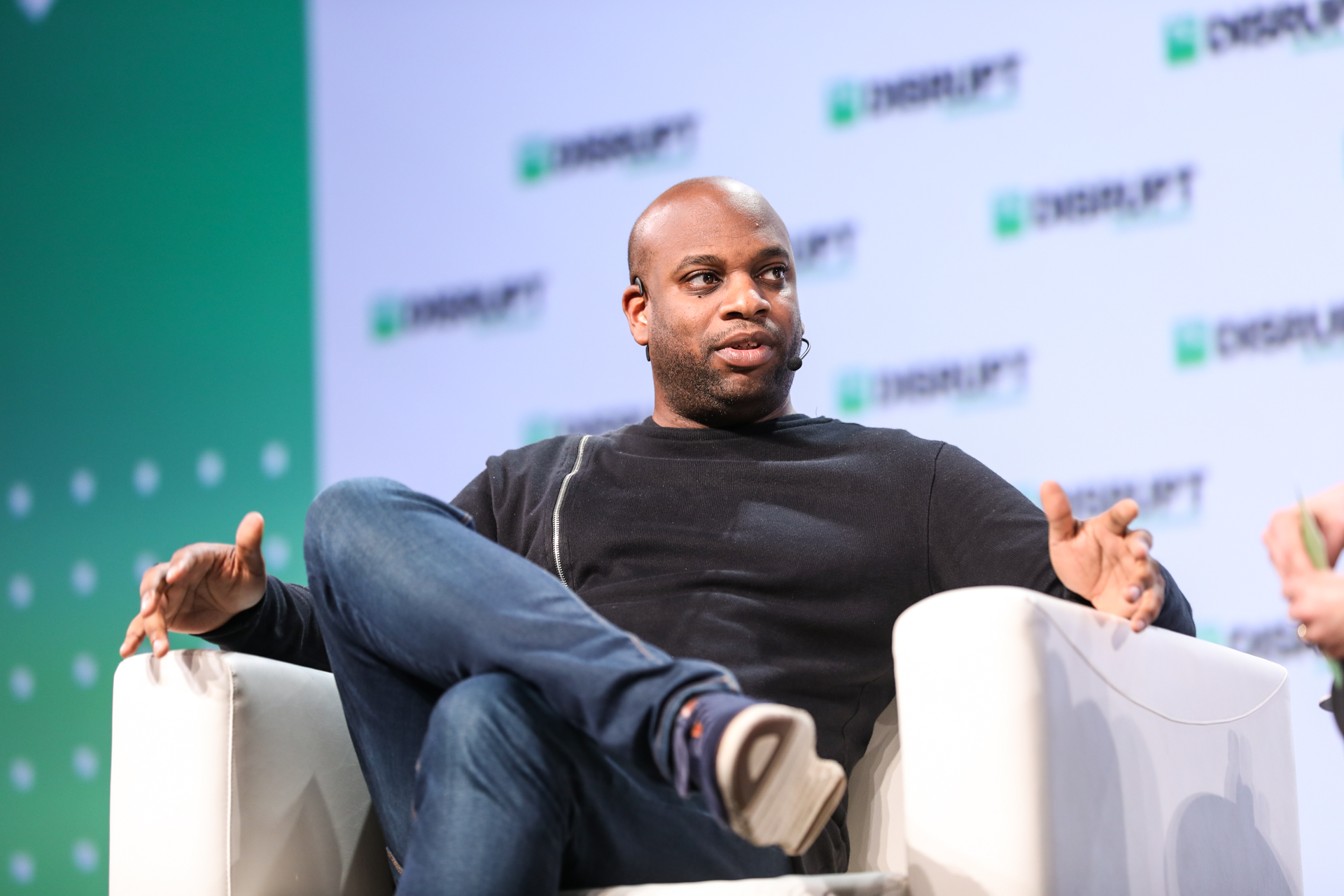
Pictured above: Pear founders Pejman Nozad and Mar Hershenson.
28 Oct 2018

The largest software acquisition ever: IBM to buy Red Hat for $34B

At a price typically reserved for semiconductor companies, telecoms, and pharmaceutical giants, IBM announced today it would pay a record $34 billion in cash and debt to acquire enterprise open source provider Red Hat. Eclipsing Microsoft’s $26.2 billion acquisition of LinkedIn, this is the biggest software acquisition in history. It’s not the biggest tech acquisition ever, though, as that title belongs to Dell’s $67 billion buyout of data storage business EMC.

You can learn about what IBM is buying Red Hat to become a hybrid cloud company in TechCrunch editor Ingrid Lunden’s deep dive here:

So how does the IBM-Red Hat deal (if it closes), stack up against the other largest acquisitions of all time?

Top Tech Acquisitions

  1. $67 billion – Personal computer company Dell buys EMC data storage
  2. $37 billion – Semiconductor company Avago Technologies buys and renames as semiconductor giant Broadcom
  3. $34 billion (pending) – IBM computers buys open source software provider Red Hat
  4. $31.4 billion – Japanese conglomerate SoftBank buys semiconductor company ARM Holdings
  5. $26.2 billion – Software company Microsoft buys professional social network Linkedin in 2016

Top Software Acquisitions

  1. $34 billion (pending) – IBM computers buys open source software provider Red Hat in 2018
  2. $26.2 billion – Software company Microsoft buys professional social network LinkedIn in 2016
  3. $22 billion – Social network Facebook buys messaging app WhatsApp in 2014
  4. $13.5 billion – Security software maker Symantec buys storage management software maker Veritas in 2004 ($18 billion adjusted for inflation)
  5.  $11 billion – Database company Oracle buys human resources software company PeopleSoft in 2004 ($14.7 billion adjusted for inflation)

Top Acquisitions Ever

  1. $202 billion – British telecom Vodafone buys German telecom Mannesmann in 2000 ($296 billion adjusted for inflation)
  2. $165 billion – ISP AOL buys media conglomerate Time Warner in 200 ($241 billion adjusted for inflation)
  3. $111.8 billion – Pharmaceutical giant Pfizer buys pharmaceutical company Warner Lambert in 1999 ($164 billion adjusted for inflation)
  4. $130 billion – Telecom Verizon Communications buys Vodafone and Bell Atlantic’s Verizon Wireless in 2013
  5. $130 billion – Dow Chemical buys chemical company DuPont in 2015

The Red Hat deal is proof that the scalability of software can massively concentrate wealth. Unlike industrial giants of old that split their fortunes with the physical resource providers that supplied and distributed their oil, chemical, or packaged good empires, software requires almost no material cost to create or distribute. The aggregation of value to software giants and their leaders offers both a great incentive to build a world-changing busines, but also a dangerous extraction of capital from the working class. While it’s fine to celebrate Red Hat’s accomplishment, society must inevitably grapple with the poverty and populism fueled by how software funnels money to the few.

28 Oct 2018

Original Content podcast: There’s spooky fun in Netflix’s ‘Haunting of Hill House’

The new Netflix series “The Haunting of Hill House” is based on the classic Shirley Jackson novel of the same name, but fans will probably have a better time if they put the book out of their mind.

Yes, the show opens with the same famous passage that begins the novel, and show and book characters have some similarities. But what writer-director Mike Flanagan has really done is use Jackson’s sinister house as the setting for a new story, focused the Crain family — driven from the house by mysterious events back in 1992, and drawn back there due to present-day tragedy.

On this episode of the Original Content podcast, we’re joined (just in time for Halloween) by Devin Coldewey just in time to offer our initial impressions of the show. While we had some reservations (get ready for the most extensive discussion of fill lights that you’ll ever hear on this podcast), it’s clear that “The Haunting of Hill House” managed to scare the heck out of all of us, and we were also impressed by the fact that each of the five Crain children becomes a distinct, memorable character in their own right.

If that’s not enough to convince you, it’s also worth watching the show for all the hidden ghosts, and for the formal ambition of episode six, with its long, single-take scenes that span the past and the present.

In addition to our review, we discuss the release of “Red Dead Redemption 2” and the announcement that WarnerMedia will be shutting down its FilmStruck service for classic films.

You can listen in the player below, subscribe using Apple Podcasts or find us in your podcast player of choice. If you like the show, please let us know by leaving a review on Apple. You also can send us feedback directly. (Or suggest shows and movies for us to review!)

28 Oct 2018

IBM to buy Red Hat for $34B in cash and debt, taking a bigger leap into hybrid cloud

After rumours flew around this weekend, IBM today confirmed that it would acquire open source, cloud software business Red Hat for $190 per share in cash, working out to a total value of $34 billion. IBM said the deal has already been approved by the boards of directors of both IBM and Red Hat but is still subject to Red Hat shareholder and regulatory approvals. If all goes as planned, the acquisition is expected to close in the latter half of 2019.

The deal is all about IBM — which has long continued to rely on its legacy server business — taking a bigger bet on the cloud, and very specifically cloud services that blend on-premises and cloud-based architectures — something that the two companies have already been working on together since May of this year (which now might be looked at as a test drive). Red Hat will be a distinct unit within IBM’s Hybrid Cloud team — which is already a $19 billion business for IBM, the company said — and it will continue to focus on open-source software. 

“The acquisition of Red Hat is a game-changer. It changes everything about the cloud market,” said Ginni Rometty, IBM Chairman, President and Chief Executive Officer, in a statement. “IBM will become the world’s number-one hybrid cloud provider, offering companies the only open cloud solution that will unlock the full value of the cloud for their businesses.”

The combined businesses will be able to offer software in services spanning Linux, containers, Kubernetes, multi-cloud management, and cloud management and automation, IBM said. IBM also added that together the companies will continue to build partnerships with multiple cloud providers, including AWS, Microsoft’s Azure, Google Cloud, Alibaba and others, alongside the IBM Cloud.

While companies like Amazon have gone all-in on cloud, in many cases, a lot of enterprises are making the move gradually — IBM cites stats that estimate that some 80 percent of business workloads “have yet to move to the cloud, held back by the proprietary nature of today’s cloud market.” Buying Red Hat will help IBM better tap into an opportunity to address that.

“Most companies today are only 20 percent along their cloud journey, renting compute power to cut costs,” she continued. “The next 80 percent is about unlocking real business value and driving growth. This is the next chapter of the cloud. It requires shifting business applications to hybrid cloud, extracting more data and optimizing every part of the business, from supply chains to sales.”

On top of that, it will give IBM a much stronger footing in open source software, the core of what Red Hat builds and deploys today.

“Open source is the default choice for modern IT solutions, and I’m incredibly proud of the role Red Hat has played in making that a reality in the enterprise,” said Jim Whitehurst, President and CEO, Red Hat, in a statement. “Joining forces with IBM will provide us with a greater level of scale, resources and capabilities to accelerate the impact of open source as the basis for digital transformation and bring Red Hat to an even wider audience –  all while preserving our unique culture and unwavering commitment to open source innovation.”

While IBM competes against the likes of Amazon, the companies will see to remain partners with them with this acquisition. “IBM is committed to being an authentic multi-cloud provider, and we will prioritize the use of Red Hat technology across multiple clouds” said Arvind Krishna, Senior Vice President, IBM Hybrid Cloud, in a statement. “In doing so, IBM will support open source technology wherever it runs, allowing it to scale significantly within commercial settings around the world.”

IBM said that Red Hat will add to its revenue growth, gross margin and free cash flow within 12 months of closing.

28 Oct 2018

Translating startup-speak for the corporate buyer

Startups salivate at the prospect of entering the enterprise – and for good reason. The enterprise is rife with legacy systems and circuitous processes that frustrate employees and hinder results — and the startup has just the perfect product to fix the problem.

Too often though, the pitch to the enterprise falls flat or a promising pilot gets sidelined. Sometimes there’s a clear obstacle, like a mismatch between product and problem to be solved, an inability to scale, or the loss of an internal sponsor. But more often than one would expect, the startup’s value is simply getting lost in translation.

Even the most forward-looking enterprise leaders are operating in an environment what I like to call “GAAP-based digital strategy.” The budgeting process supports only certain kinds of purchases, like renewable software licensing fees and support contracts with fixed costs. New models, like variable costs for open source development, require workarounds and explanation in the budget process and cause even the most eager internal champion to lose time and energy.

So what’s a startup to do? The more you can help your internal sponsor translate the cost model to adhere to the established norm, the more traction they are likely to get from the hydra of procurement and finance. Once the project has momentum, your champion can work to change the budgeting process – but that’s a tall order before your pilot is launched and showing results.

The concept of GAAP-based digital strategy extends well beyond accounting practices. Consider internal reporting: large organizations spend an inordinate amount of time reporting up, across, and down in an effort to improve transparency and inspire shared ownership of outcomes. What are the KPIs for the department you are serving? How easily will your results translate into their storytelling? Spend some time up front with your client to ensure your results align with (and show up in!) the existing framework for reporting.

Corporations are aware of how hard it is to navigate these control systems, and so they are increasingly creating “innovation departments” with dedicated funding for one-off experiments using new technology. This is often the start of the relationship between a startup and a new client.

For startups, this can be a beneficial approach, since it offers the opportunity to deliver value before wrangling with cumbersome procurement or IT requirements. But too often these divisions lurch from pilot to pilot, and struggle to find line-of-business champions willing to absorb startup technology into their operations. The biggest challenge here is that there’s often no enterprise template for the handoff from the innovation setting – where experiments can operate in a “clean room” apart from procedures and regulations – to ongoing operations.

Here’s how one startup providing augmented reality headsets and software to a complex pharma manufacturing environment crossed over. Their pilot showed clear results: testing with four-five headsets, their AR software measurably helped workers on the floor by augmenting the workflow with voice recording and hands-free capabilities.

The startup team then came on-site, and they partnered with the workers testing the solution to document the improvements and discuss how to ensure the process complied with regulations. This direct interaction fed into their results reporting to make the case for the 30-40 headsets needed on the shop floor. Rather than wait for middle management, the startup developed a grassroots-fortified case for moving into operations.

Similarly, a startup piloting an analytics product in a CPG enterprise was immediately pigeonholed into the IT department’s analytics budget. Surrounded by a range of solutions from business intelligence dashboards to marketing technology tools, their pilot was getting lost.

By closely analyzing results, the startup saw promising early findings in the trade promotions area. They worked through their contacts to reach the executive in charge of trade promotions who took the pilot under her wing – and into her budget. They avoided being locked into a GAAP-based bucket (analytics), and were connected with an executive to unlock a whole different conversation.

In addition to finding your internal champion and changing the GAAP conversation, spend time understanding the larger enterprise backdrop: the initiatives and themes that are driving this quarter’s shareholder value. Help your client position the solution not only in the context of the specific problem to solve, but the overall enterprise goals.

The annual report is your friend here. The focus may be digital transformation or global collaboration or risk management, and aligning to this priority may enable your client to get buy-in internally. Make sure you are fluent in the visible, budgeted, CEO-led, cross departmental initiatives — and how your solution plays a role here.

Take heart: this translation won’t always be a one-way street. The deeper your engagement, the more your enterprise clients will benefit from your startup’s perspective, and change technology, process, and language to reflect that understanding. Ideally, GAAP-based digital strategy recedes as long-established protocols reduce structural lag with how business is conducted today. In the meantime, consider the art of translation as important as pitching the outcome.

28 Oct 2018

The tools, they are a-changing

Building web services and smartphone apps, which is most of what I’ve been doing professionally at HappyFunCorp1 for the last decade or so used to be pretty straightforward. Not easy, but straightforward, especially when the client was a consumer startup, which so many of them were.

The more we did the better we got at it. Design and write two native apps, usually iOS first and Android second. Don’t skimp on the design. Connect them to a JSON API, usually written in Ruby on Rails, which also powered the web site. There’s always a web site; consumers might only see the side which is a minimal billboard for the app, but there’s essentially always also an admin site, to control features and aspects of the app.

Design isn’t as important for the admin site, so you can build that in something crude but effective like ActiveAdmin; why roll your own? Similarly, authentication is tricky and easy to get wrong, so use something like Devise, which comes with built-in hooks to Facebook and Twitter login. Design your database carefully. Use jQuery for dynamic in-browser manipulation since raw Javascript is such a nightmare. Argue about whether to use Rspec or Minitest for your server tests.

All there? OK, roll it out to your Heroku scaling environment, so you can simply “git push” to push to staging and production, with various levels of Postgres support, autoscaling, pipelines, Redis caching, Resque worker jobs, and so forth. If it’s a startup, keep them on Heroku to see if they catch on, if they find the fabled product-market fit, not least because it helps you iterate faster. If so, at some point you have to graduate them to AWS, because Heroku only scales so far and it does so very expensively. If not, well, “fail fast,” right?

Those were the days, my friends, those halcyon, long-gone days of (checks notes) five years ago. The days of a lot of grief, sure, but very little decision complexity. The smartphone boom was on, and the web boom was settling down, and everyone was still surfing those two tidal waves.

Today? Well, today we still are, neither of those waves have broken, per se, software is still eating the world, but things are … different. More of the world is being eaten, but it’s also happening more slowly, like growing 50% a year from a $1 billion base rather than 500% from $1 million. There are fewer starry-eyed founders with an app idea that they’re sure will change the world and funding enough to give it a shot. Those are still out there, sure, and more power to them, but the landscape is more complex, now.

Instead we see more big businesses, media and industrial and retail alike, realizing they must adapt and be devoured, experimenting with new tech projects with a combination of excitement and trepidation. Or requisitioning custom apps for very specific — but very useful — purposes, and requiring them to interface with their awkward pre-existing custom middleware just so. Or tech companies, even big household-name ones, outsourcing ancillary tools and projects in order to focus their in-house teams purely on their core competencies and business models. Our mix of clients has definitely shifted more towards enterprise in the last few years.

Which is not to say that startups don’t still come through our doors with bright ideas and inspiring PowerPoints on a fairly regular basis. As do super starry-eyed blockchain founders (granted, I’m sometimes a bit starry-eyed about blockchains myself) replacing the consumer-app founders of yore. I doubt we’re alone in having had a spate of blockchain startup projects late last year and early this, which has diminished to only a couple active at the moment. (Not least because the tooling is still so crude it reminds me of 90s command-line hacking.) But I strongly doubt that sphere is going away.

We haven’t dealt with as many AI projects as I would have expected by now, probably partly because AI talent is still so scarce and highly valued, and partly because it turns out a lot of seeming “AI” work can be done with simple linear regressions rather than by building and training and tuning deep-learning neural networks… although if you do those linear regressions with TensorFlow, it’s still “AI” buzzword-compliant, right? Right?

Most of all, though, the tools we use have changed. Nowadays when you want to build an app, you have to ask yourself: really native? (Java or Kotlin? Objective-C or Swift?) Or React Native? Or Xamarin? Or Google’s new Flutter thing? When you want to build a web site, you have to think: traditional? Or single-page, with React or Angular or Vue? As for the server — Go is a lot faster than Rails, you know, and oh, that elegant concurrency handling, but, oh, where is my map/filter/reduce? Javascript is still a clumsy language, but there are certain advantages to having one language across the stack, and Node is powerful and package-rich these days. And of course you’ll want it all containerized, because while Docker definitely adds another layer or two of configuration complexity, it’s usually worth it.

Unless you want to go fully “serverless,” at least for aspects, with Amazon Lambda or Google Firebase? Even if you don’t use Firebase for a datastore, how about for authentication, huh? And if you’re all containerized, and Kubernetized if/as appropriate, though maybe let’s not go the many-microservices route until you’re sure your product-market fit justifies it, then where do you want to roll it out, AWS or Azure or Google Cloud or Digital Ocean? Or do you want to use one of their PaaS services, like App Engine or Beanstalk, which, like Heroku, sorta kinda live between “serverless” and “bare metal virtual machines”?

I oversimplify, but you get my point. We’ve never had more options, as developers, more tools available to us … and we’ve never had to struggle more with analysis paralysis, because it’s awfully hard to determine which of the possible toolsets is the best one for any particular situation. Sometimes — often — we have to be happy with just selecting a good one. And that selection problem doesn’t look like it’s going to get easier anytime soon, I’m afraid. It’s a strange time to be a coder. We live and work all tangled up in an embarrassment of riches.


1Yes, that’s really our name. No, this TC column isn’t a full-time gig. (Which is something people frequently assume, because it’s so much more visible and to some people writing a column every week sounds like a lot of work, but no, I’m really a CTO.)

27 Oct 2018

Facial recognition startup Kairos founder continues to fight attempted takeover

There’s some turmoil brewing over at Miami-based facial recognition startup Kairos . Late last month, New World Angels President and Kairos board chairperson Steve O’Hara sent a letter to Kairos founder Brian Brackeen notifying him of his termination from the role of chief executive officer. The termination letter cited willful misconduct as the cause for Brackeen’s termination. Specifically, O’Hara said Brackeen misled shareholders and potential investors, misappropriated corporate funds, did not report to the board of directors and created a divisive atmosphere.

Kairos is trying to tackle the society-wide problem of discrimination in artificial intelligence. While that’s not the company’s explicit mission — it’s to provide authentication tools to businesses — algorithmic bias has long been a topic the company, especially Brackeen, has addressed.

Brackeen’s purported termination was followed by a lawsuit, on behalf of Kairos, against Brackeen, alleging theft, a breach of fiduciary duties — among other things. Brackeen, in an open letter sent a couple of days ago to shareholders — and one he shared with TechCrunch — about the “poorly constructed coup,” denies the allegations and details his side of the story. He hopes that the lawsuit will be dismissed and that he will officially be reinstated as CEO, he told TechCrunch. As it stands today, Melissa Doval who became CFO of Kairos in July, is acting as interim CEO.

“The Kairos team is amazing and resilient and has blown me away with their commitment to the brand,” Doval told TechCrunch. “I’m humbled by how everybody has just kind of stuck around in light of everything that has transpired.”

The lawsuit, filed on October 10 in Miami-Dade and spearheaded by Kairos COO Mary Wolff, alleges Brackeen “used his position as CEO and founder to further his own agenda of gaining personal notoriety, press, and a reputation in the global technology community” to the detriment of Kairos. The lawsuit describes how Brackeen spent less than 30 percent of his time in the company’s headquarters, “even though the Company was struggling financially.”

Other allegations detail how Brackeen used the company credit card to pay for personal expenses and had the company pay for a car he bought for his then-girlfriend. Kairos alleges Brackeen owes the company at least $60,000.

In his open letter, Brackeen says, “Steve, Melissa and Mary, as cause for my termination and their lawsuit against me, have accused me of stealing 60k from Kairos, comprised of non-work related travel, non-work related expenses, a laptop, and a beach club membership,” Brackeen wrote in a letter to shareholders. “Let’s talk about this. While I immediately found these accusations absurd, I had to consider that, to people on the outside of  ‘startup founder’ life— their claims could appear to be salacious, if not illegal.”

Brackeen goes on to say that none of the listed expenses — ranging from trips, meals, rides to iTunes purchases — were not “directly correlated to the business of selling Kairos to customers and investors, and growing Kairos to exit,” he wrote in the open letter. Though, he does note that there may be between $3,500 to $4,500 worth of charges that falls into a “grey area.”

“Conversely, I’ve personally invested, donated, or simply didn’t pay myself in order to make payroll for the rest of the team, to the tune of over $325,000 dollars,” he wrote. “That’s real money from my accounts.”

Regarding forcing Kairos to pay for his then-girlfriend’s car payments, Brackeen explains:

On my making Kairos ‘liable to make my girlfriend’s car payment’— in order to offset the cost of Uber rides to and from work, to meetings, the airport, etc, I determined it would be more cost effective to lease a car. Unfortunately, after having completely extended my personal credit to start and keep Kairos operating, it was necessary that the bank note on the car be obtained through her credit. The board approved the $700 per month per diem arrangement, which ended when I stopped driving the vehicle. Like their entire case— its not very sensational, when truthfully explained.

The company also claims Brackeen has interfered with the company and its affairs since his termination. Throughout his open letter, Brackeen refers to this as an “attempted termination” because, as advised by his lawyers, he has not been legally terminated. He also explains how, in the days leading up to his ouster, Brackeen was seeking to raise additional funding because in August, “we found ourselves in the position of running low on capital.” While he was presenting to potential investors in Singapore, Brackeen said that’s “when access to my email and documents was cut.”

He added, “I traveled to the other side of the world to work with my team on IP development and meet with the people who would commit to millions in investment— and was fired via voicemail the day after I returned.”

Despite the “termination” and lawsuit, O’Hara told TechCrunch via email that “in the interest of peaceful coexistence, we are open to reaching an agreement to allow Brian to remain part of the family as Founder, but not as CEO and with very limited responsibilities and no line authority.”

O’Hara also noted the company’s financials showed there was $44,000 in cash remaining at the end of September. He added, “Then reconcile it with the fact that Brian raised $6MM in 2018 and ask yourself, how does a company go through that kind of money in under 9 months.”

Within the next twelve days, there will be a shareholder vote to remove the board, as well as a vote to reinstate Brackeen as CEO, he told me. After that, Brackeen said he intends to countersue Doval, O’Hara and Wolff.

In addition to New World Angels, Kairos counts Kapor Capital, Backstage Capital and others as investors. At least one investor, Arlan Hamilton of Backstage Capital, has publicly come out in support of Brackeen.

As previously mentioned, Brackeen has been pretty outspoken about the ethical concerns of facial recognition technologies. In the case of law enforcement, no matter how accurate and unbiased these algorithms are, facial recognition software has no business in law enforcement, Brackeen said at TechCrunch Disrupt in early September. That’s because of the potential for unlawful, excessive surveillance of citizens.

Given the government already has our passport photos and identification photos, “they could put a camera on Main Street and know every single person driving by,” Brackeen said.

And that’s a real possibility. In the last couple of months, Brackeen said Kairos turned down a government request from Homeland Security, seeking facial recognition software for people behind moving cars.

“For us, that’s completely unacceptable,” Brackeen said.

Whether that’s entirely unacceptable for Doval, the interim CEO of Kairos, is not clear. In an interview with TechCrunch, Doval said, “we’re committed to being a responsible and ethical vendor” and that “we’re going to continue to champion the elimination of algorithmic bias in artificial intelligence.” While that’s not a horrific thing to say, it’s much vaguer than saying, “No, we will not ever sell to law enforcement.”

Selling to law enforcement could be lucrative, but that comes with ethical risks and concerns. But if the company is struggling financially, maybe the pros could outweigh the cons.

27 Oct 2018

The SaaS VC gap: China & other markets trail the US

Chinese startups rule the roost when it comes to total reported venture dollars raised so far in 2018. That is, mostly. In one key category at least — software-as-a-service, better known as SaaS — they do not.

Ant Financial raised the largest-ever VC round in June, a mind-boggling $14 billion in Series C funding. And nearly a dozen privately held Chinese companies, including SenseTimeDu Xiaoman FinancialJD Finance and ELEME, raised $1 billion (yes, with a “b”) or more in single venture rounds thus far in 2018.

But if there’s one thing to note from that shortlist of 2018’s largest China venture rounds, it’s this: almost all of them involve consumer apps and services. Despite being one of the largest economies in the world and currently holding the top spot in the national venture dollar ranks, China doesn’t seem to have too much in the way of enterprise-focused software funding.

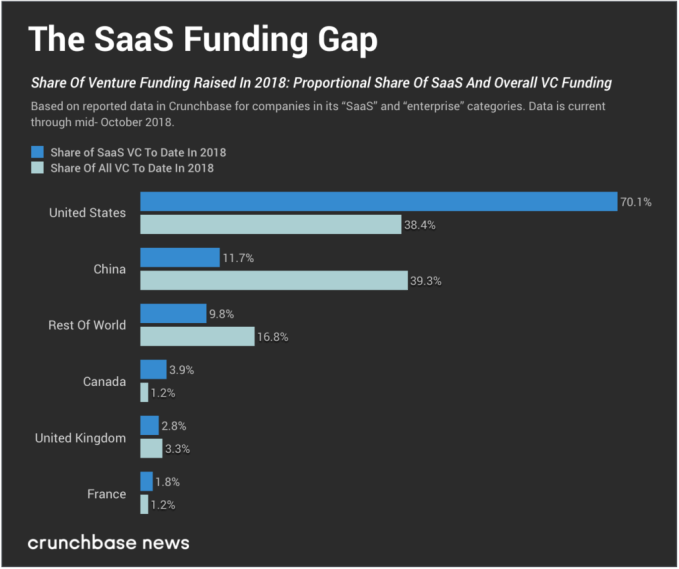
But why trust your gut when the trend is borne out in the numbers? In the chart below, we show the top five global markets for SaaS investment (plus the rest of the world). We compare each market’s share of SaaS-earmarked funding against their share of total venture dollars raised in 2018 so far.

As of mid-October (when we pulled the data for the above chart), Chinese companies accounted for about 39.3 percent of venture funding raised in 2018. Compare that to 38.4 percent for U.S.-based companies, overall. In this respect, the venture markets in the U.S. and China are running neck-and-neck.

Yet for SaaS funding, the China-U.S. gap is about as wide as the Pacific Ocean. The U.S. — top ranked by this measure — accounted for approximately 70.1 percent of known SaaS startup funding. China, by contrast, accounted for just 11.7 percent. No even matchup here. It’s not even close.

This asymmetry goes beyond just aggregate dollar figures. The contrast is starker when we use a slightly more exotic measure for the market.

One of our favorite (if somewhat arbitrary) metrics at Crunchbase News is the count of supergiant venture rounds. These VC deals weigh in at $100 million or more, and they’re reshaping both sides of the venture market for founders and funders alike.

Whereas the United States played host to at least 15 supergiant SaaS VC rounds so far this year, just four rounds raised by three different Chinese SaaS companies crossed the nine-figure mark:

Keep in mind that, in general, U.S. and Chinese markets are fairly even in their output of supergiant venture rounds. However, that’s not the case when we look specifically at SaaS rounds, where the counts and dollar volumes involved are so different.

These disparities suggest a structural difference, not just between the U.S. and Chinese markets, but between the U.S. and the rest of the world when it comes to building and backing SaaS businesses.

At this point it’s unclear, apart from funding metrics, what differentiates the U.S. SaaS market from the rest of the world’s. What conditions exist in this market that don’t exist elsewhere? And are those conditions replicable in a local market with a still-nascent SaaS ecosystem? These are questions meriting a follow-up. Even though its cause might be unclear, for now, it’s nonetheless important to mind the gap. ?

27 Oct 2018

Big tech must not reframe digital ethics in its image

Facebook founder Mark Zuckerberg’s visage loomed large over the European parliament this week, both literally and figuratively, as global privacy regulators gathered in Brussels to interrogate the human impacts of technologies that derive their power and persuasiveness from our data.

The eponymous social network has been at the center of a privacy storm this year. And every fresh Facebook content concern — be it about discrimination or hate speech or cultural insensitivity — adds to a damaging flood.

The overarching discussion topic at the privacy and data protection confab, both in the public sessions and behind closed doors, was ethics: How to ensure engineers, technologists and companies operate with a sense of civic duty and build products that serve the good of humanity.

So, in other words, how to ensure people’s information is used ethically — not just in compliance with the law. Fundamental rights are increasingly seen by European regulators as a floor not the ceiling. Ethics are needed to fill the gaps where new uses of data keep pushing in.

As the EU’s data protection supervisor, Giovanni Buttarelli, told delegates at the start of the public portion of the International Conference of Data Protection and Privacy Commissioners: “Not everything that is legally compliant and technically feasible is morally sustainable.”

As if on cue Zuckerberg kicked off a pre-recorded video message to the conference with another apology. Albeit this was only for not being there to give an address in person. Which is not the kind of regret many in the room are now looking for, as fresh data breaches and privacy incursions keep being stacked on top of Facebook’s Cambridge Analytica data misuse scandal like an unpalatable layer cake that never stops being baked.

Evidence of a radical shift of mindset is what champions of civic tech are looking for — from Facebook in particular and adtech in general.

But there was no sign of that in Zuckerberg’s potted spiel. Rather he displayed the kind of masterfully slick PR manoeuvering that’s associated with politicians on the campaign trail. It’s the natural patter for certain big tech CEOs too, these days, in a sign of our sociotechnical political times.

(See also: Facebook hiring ex-UK deputy PM, Nick Clegg, to further expand its contacts database of European lawmakers.)

And so the Facebook founder seized on the conference’s discussion topic of big data ethics and tried to zoom right back out again. Backing away from talk of tangible harms and damaging platform defaults — aka the actual conversational substance of the conference (from talk of how dating apps are impacting how much sex people have and with whom they’re doing it; to shiny new biometric identity systems that have rebooted discriminatory caste systems) — to push the idea of a need to “strike a balance between speech, security, privacy and safety”.

This was Facebook trying reframe the idea of digital ethics — to make it so very big-picture-y that it could embrace his people-tracking ad-funded business model as a fuzzily wide public good, with a sort of ‘oh go on then’ shrug.

“Every day people around the world use our services to speak up for things they believe in. More than 80 million small businesses use our services, supporting millions of jobs and creating a lot of opportunity,” said Zuckerberg, arguing for a ‘both sides’ view of digital ethics. “We believe we have an ethical responsibility to support these positive uses too.”

Indeed, he went further, saying Facebook believes it has an “ethical obligation to protect good uses of technology”.

And from that self-serving perspective almost anything becomes possible — as if Facebook is arguing that breaking data protection law might really be the ‘ethical’ thing to do. (Or, as the existentialists might put it: ‘If god is dead, then everything is permitted’.)

It’s an argument that radically elides some very bad things, though. And glosses over problems that are systemic to Facebook’s ad platform.

A little later, Google’s CEO Sundar Pichai also dropped into the conference in video form, bringing much the same message.

“The conversation about ethics is important. And we are happy to be a part of it,” he began, before an instant hard pivot into referencing Google’s founding mission of “organizing the world’s information — for everyone” (emphasis his), before segwaying — via “knowledge is empowering” — to asserting that “a society with more information is better off than one with less”.

Is having access to more information of unknown and dubious or even malicious provenance better than having access to some verified information? Google seems to think so.

SAN FRANCISCO, CA – OCTOBER 04: Pichai Sundararajan, known as Sundar Pichai, CEO of Google Inc. speaks during an event to introduce Google Pixel phone and other Google products on October 4, 2016 in San Francisco, California. The Google Pixel is intended to challenge the Apple iPhone in the premium smartphone category. (Photo by Ramin Talaie/Getty Images)

The pre-recorded Pichai didn’t have to concern himself with all the mental ellipses bubbling up in the thoughts of the privacy and rights experts in the room.

“Today that mission still applies to everything we do at Google,” his digital image droned on, without mentioning what Google is thinking of doing in China. “It’s clear that technology can be a positive force in our lives. It has the potential to give us back time and extend opportunity to people all over the world.

“But it’s equally clear that we need to be responsible in how we use technology. We want to make sound choices and build products that benefit society that’s why earlier this year we worked with our employees to develop a set of AI principles that clearly state what types of technology applications we will pursue.”

Of course it sounds fine. Yet Pichai made no mention of the staff who’ve actually left Google because of ethical misgivings. Nor the employees still there and still protesting its ‘ethical’ choices.

It’s not almost as if the Internet’s adtech duopoly is singing from the same ‘ads for greater good trumping the bad’ hymn sheet; the Internet’s adtech’s duopoly is doing exactly that.

The ‘we’re not perfect and have lots more to learn’ line that also came from both CEOs seems mostly intended to manage regulatory expectation vis-a-vis data protection — and indeed on the wider ethics front.

They’re not promising to do no harm. Nor to always protect people’s data. They’re literally saying they can’t promise that. Ouch.

Meanwhile, another common FaceGoog message — an intent to introduce ‘more granular user controls’ — just means they’re piling even more responsibility onto individuals to proactively check (and keep checking) that their information is not being horribly abused.

This is a burden neither company can speak to in any other fashion. Because the solution is that their platforms not hoard people’s data in the first place.

The other ginormous elephant in the room is big tech’s massive size; which is itself skewing the market and far more besides.

Neither Zuckerberg nor Pichai directly addressed the notion of overly powerful platforms themselves causing structural societal harms, such as by eroding the civically minded institutions that are essential to defend free societies and indeed uphold the rule of law.

Of course it’s an awkward conversation topic for tech giants if vital institutions and societal norms are being undermined because of your cut-throat profiteering on the unregulated cyber seas.

A great tech fix to avoid answering awkward questions is to send a video message in your CEO’s stead. And/or a few minions. Facebook VP and chief privacy officer, Erin Egan, and Google’s SVP of global affairs Kent Walker, were duly dispatched and gave speeches in person.

They also had a handful of audience questions put to them by an on stage moderator. So it fell to Walker, not Pichai, to speak to Google’s contradictory involvement in China in light of its foundational claim to be a champion of the free flow of information.

“We absolutely believe in the maximum amount of information available to people around the world,” Walker said on that topic, after being allowed to intone on Google’s goodness for almost half an hour. “We have said that we are exploring the possibility of ways of engaging in China to see if there are ways to follow that mission while complying with laws in China.

“That’s an exploratory project — and we are not in a position at this point to have an answer to the question yet. But we continue to work.”

Egan, meanwhile, batted away her trio of audience concerns — about Facebook’s lack of privacy by design/default; and how the company could ever address ethical concerns without dramatically changing its business model — by saying it has a new privacy and data use team sitting horizontally across the business, as well as a data protection officer (an oversight role mandated by the EU’s GDPR; into which Facebook plugged its former global deputy chief privacy officer, Stephen Deadman, earlier this year).

She also said the company continues to invest in AI for content moderation purposes. So, essentially, more trust us. And trust our tech.

She also replied in the affirmative when asked whether Facebook will “unequivocally” support a strong federal privacy law in the US — with protections “equivalent” to those in Europe’s data protection framework.

But of course Zuckerberg has said much the same thing before — while simultaneously advocating for weaker privacy standards domestically. So who now really wants to take Facebook at its word on that? Or indeed on anything of human substance.

Not the EU parliament, for one. MEPs sitting in the parliament’s other building, in Strasbourg, this week adopted a resolution calling for Facebook to agree to an external audit by regional oversight bodies.

But of course Facebook prefers to run its own audit. And in a response statement the company claims it’s “working relentlessly to ensure the transparency, safety and security” of people who use its service (so bad luck if you’re one of those non-users it also tracks then). Which is a very long-winded way of saying ‘no, we’re not going to voluntarily let the inspectors in’.

Facebook’s problem now is that trust, once burnt, takes years and mountains’ worth of effort to restore.

This is the flip side of ‘move fast and break things’. (Indeed, one of the conference panels was entitled ‘move fast and fix things’.) It’s also the hard-to-shift legacy of an unapologetically blind ~decade-long dash for growth regardless of societal cost.

Given the, it looks unlikely that Zuckerberg’s attempt to paint a portrait of digital ethics in his company’s image will do much to restore trust in Facebook.

Not so long as the platform retains the power to cause damage at scale.

It was left to everyone else at the conference to discuss the hollowing out of democratic institutions, societal norms, humans interactions and so on — as a consequence of data (and market capital) being concentrated in the hands of the ridiculously powerful few.

“Today we face the gravest threat to our democracy, to our individual liberty in Europe since the war and the United States perhaps since the civil war,” said Barry Lynn, a former journalist and senior fellow at the Google-backed New America Foundation think tank in Washington, D.C., where he had directed the Open Markets Program — until it was shut down after he wrote critically about, er, Google.

“This threat is the consolidation of power — mainly by Google, Facebook and Amazon — over how we speak to one another, over how we do business with one another.”

Meanwhile the original architect of the World Wide Web, Tim Berners-Lee, who has been warning about the crushing impact of platform power for years now is working on trying to decentralize the net’s data hoarders via new technologies intended to give users greater agency over their data.

On the democratic damage front, Lynn pointed to how news media is being hobbled by an adtech duopoly now sucking hundreds of billion of ad dollars out of the market annually — by renting out what he dubbed their “manipulation machines”.

Not only do they sell access to these ad targeting tools to mainstream advertisers — to sell the usual products, like soap and diapers — they’re also, he pointed out, taking dollars from “autocrats and would be autocrats and other social disruptors to spread propaganda and fake news to a variety of ends, none of them good”.

The platforms’ unhealthy market power is the result of a theft of people’s attention, argued Lynn. “We cannot have democracy if we don’t have a free and robustly funded press,” he warned.

His solution to the society-deforming might of platform power? Not a newfangled decentralization tech but something much older: Market restructuring via competition law.

“The basic problem is how we structure or how we have failed to structure markets in the last generation. How we have licensed or failed to license monopoly corporations to behave.

“In this case what we see here is this great mass of data. The problem is the combination of this great mass of data with monopoly power in the form of control over essential pathways to the market combined with a license to discriminate in the pricing and terms of service. That is the problem.”

“The result is to centralize,” he continued. “To pick and choose winners and losers. In other words the power to reward those who heed the will of the master, and to punish those who defy or question the master — in the hands of Google, Facebook and Amazon… That is destroying the rule of law in our society and is replacing rule of law with rule by power.”

For an example of an entity that’s currently being punished by Facebook’s grip on the social digital sphere you need look no further than Snapchat.

Also on the stage in person: Apple’s CEO Tim Cook, who didn’t mince his words either — attacking what he dubbed a “data industrial complex” which he said is “weaponizing” people’s person data against them for private profit.

The adtech modeus operandi sums to “surveillance”, Cook asserted.

Cook called this a “crisis”, painting a picture of technologies being applied in an ethics-free vacuum to “magnify our worst human tendencies… deepen divisions, incite violence and even undermine our shared sense of what is true and what is false” — by “taking advantage of user trust”.

“This crisis is real… And those of us who believe in technology’s potential for good must not shrink from this moment,” he warned, telling the assembled regulators that Apple is aligned with their civic mission.

Of course Cook’s position also aligns with Apple’s hardware-dominated business model — in which the company makes most of its money by selling premium priced, robustly encrypted devices, rather than monopolizing people’s attention to sell their eyeballs to advertisers.

The growing public and political alarm over how big data platforms stoke addiction and exploit people’s trust and information — and the idea that an overarching framework of not just laws but digital ethics might be needed to control this stuff — dovetails neatly with the alternative track that Apple has been pounding for years.

So for Cupertino it’s easy to argue that the ‘collect it all’ approach of data-hungry platforms is both lazy thinking and irresponsible engineering, as Cook did this week.

“For artificial intelligence to be truly smart it must respect human values — including privacy,” he said. “If we get this wrong, the dangers are profound. We can achieve both great artificial intelligence and great privacy standards. It is not only a possibility — it is a responsibility.”

Yet Apple is not only a hardware business. In recent years the company has been expanding and growing its services business. It even involves itself in (a degree of) digital advertising. And it does business in China.

It is, after all, still a for-profit business — not a human rights regulator. So we shouldn’t be looking to Apple to spec out a digital ethical framework for us, either.

No profit making entity should be used as the model for where the ethical line should lie.

Apple sets a far higher standard than other tech giants, certainly, even as its grip on the market is far more partial because it doesn’t give its stuff away for free. But it’s hardly perfect where privacy is concerned.

One inconvenient example for Apple is that it takes money from Google to make the company’s search engine the default for iOS users — even as it offers iOS users a choice of alternatives (if they go looking to switch) which includes pro-privacy search engine DuckDuckGo.

DDG is a veritable minnow vs Google, and Apple builds products for the consumer mainstream, so it is supporting privacy by putting a niche search engine alongside a behemoth like Google — as one of just four choices it offers.

But defaults are hugely powerful. So Google search being the iOS default means most of Apple’s mobile users will have their queries fed straight into Google’s surveillance database, even as Apple works hard to keep its own servers clear of user data by not collecting their stuff in the first place.

There is a contradiction there. So there is a risk for Apple in amping up its rhetoric against a “data industrial complex” — and making its naturally pro-privacy preference sound like a conviction principle — because it invites people to dial up critical lenses and point out where its defence of personal data against manipulation and exploitation does not live up to its own rhetoric.

One thing is clear: In the current data-based ecosystem all players are conflicted and compromised.

Though only a handful of tech giants have built unchallengeably massive tracking empires via the systematic exploitation of other people’s data.

And as the apparatus of their power gets exposed, these attention-hogging adtech giants are making a dumb show of papering over the myriad ways their platforms pound on people and societies — offering paper-thin promises to ‘do better next time — when ‘better’ is not even close to being enough.

Call for collective action

Increasingly powerful data-mining technologies must be sensitive to human rights and human impacts, that much is crystal clear. Nor is it enough to be reactive to problems after or even at the moment they arise. No engineer or system designer should feel it’s their job to manipulate and trick their fellow humans.

Dark pattern designs should be repurposed into a guidebook of what not to do and how not to transact online. (If you want a mission statement for thinking about this it really is simple: Just don’t be a dick.)

Sociotechnical Internet technologies must always be designed with people and societies in mind — a key point that was hammered home in a keynote by Berners-Lee, the inventor of the World Wide Web, and the tech guy now trying to defang the Internet’s occupying corporate forces via decentralization.

“As we’re designing the system, we’re designing society,” he told the conference. “Ethical rules that we choose to put in that design [impact society]… Nothing is self evident. Everything has to be put out there as something that we think we will be a good idea as a component of our society.”

The penny looks to be dropping for privacy watchdogs in Europe. The idea that assessing fairness — not just legal compliance — must be a key component of their thinking, going forward, and so the direction of regulatory travel.

Watchdogs like the UK’s ICO — which just fined Facebook the maximum possible penalty for the Cambridge Analytica scandal — said so this week. “You have to do your homework as a company to think about fairness,” said Elizabeth Denham, when asked ‘who decides what’s fair’ in a data ethics context. “At the end of the day if you are working, providing services in Europe then the regulator’s going to have something to say about fairness — which we have in some cases.”

“Right now, we’re working with some Oxford academics on transparency and algorithmic decision making. We’re also working on our own tool as a regulator on how we are going to audit algorithms,” she added. “I think in Europe we’re leading the way — and I realize that’s not the legal requirement in the rest of the world but I believe that more and more companies are going to look to the high standard that is now in place with the GDPR.

“The answer to the question is ‘is this fair?’ It may be legal — but is this fair?”

So the short version is data controllers need to prepare themselves to consult widely — and examine their consciences closely.

Rising automation and AI makes ethical design choices even more imperative, as technologies become increasingly complex and intertwined, thanks to the massive amounts of data being captured, processed and used to model all sorts of human facets and functions.

The closed session of the conference produced a declaration on ethics and data in artificial intelligence — setting out a list of guiding principles to act as “core values to preserve human rights” in the developing AI era — which included concepts like fairness and responsible design.

Few would argue that a powerful AI-based technology such as facial recognition isn’t inherently in tension with a fundamental human right like privacy.

Nor that such powerful technologies aren’t at huge risk of being misused and abused to discriminate and/or suppress rights at vast and terrifying scale. (See, for example, China’s push to install a social credit system.)

Biometric ID systems might start out with claims of the very best intentions — only to shift function and impact later. The dangers to human rights of function creep on this front are very real indeed. And are already being felt in places like India — where the country’s Aadhaar biometric ID system has been accused of rebooting ancient prejudices by promoting a digital caste system, as the conference also heard.

The consensus from the event is it’s not only possible but vital to engineer ethics into system design from the start whenever you’re doing things with other people’s data. And that routes to market must be found that don’t require dispensing with a moral compass to get there.

The notion of data-processing platforms becoming information fiduciaries — i.e. having a legal duty of care towards their users, as a doctor or lawyer does — was floated several times during public discussions. Though such a step would likely require more legislation, not just adequately rigorous self examination.

In the meanwhile civic society must get to grips, and grapple proactively, with technologies like AI so that people and societies can come to collective agreement about a digital ethics framework. This is vital work to defend the things that matter to communities so that the anthropogenic platforms Berners-Lee referenced are shaped by collective human values, not the other way around.

It’s also essential that public debate about digital ethics does not get hijacked by corporate self interest.

Tech giants are not only inherently conflicted on the topic but — right across the board — they lack the internal diversity to offer a broad enough perspective.

People and civic society must teach them.

A vital closing contribution came from the French data watchdog’s Isabelle Falque-Pierrotin, who summed up discussions that had taken place behind closed doors as the community of global data protection commissioners met to plot next steps.

She explained that members had adopted a roadmap for the future of the conference to evolve beyond a mere talking shop and take on a more visible, open governance structure — to allow it to be a vehicle for collective, international decision-making on ethical standards, and so alight on and adopt common positions and principles that can push tech in a human direction.

The initial declaration document on ethics and AI is intended to be just the start, she said — warning that “if we can’t act we will not be able to collectively control our future”, and couching ethics as “no longer an option, it is an obligation”.

She also said it’s essential that regulators get with the program and enforce current privacy laws — to “pave the way towards a digital ethics” — echoing calls from many speakers at the event for regulators to get on with the job of enforcement.

This is vital work to defend values and rights against the overreach of the digital here and now.

“Without ethics, without an adequate enforcement of our values and rules our societal models are at risk,” Falque-Pierrotin also warned. “We must act… because if we fail, there won’t be any winners. Not the people, nor the companies. And certainly not human rights and democracy.”

If the conference had one short sharp message it was this: Society must wake up to technology — and fast.

“We’ve got a lot of work to do, and a lot of discussion — across the boundaries of individuals, companies and governments,” agreed Berners-Lee. “But very important work.

“We have to get commitments from companies to make their platforms constructive and we have to get commitments from governments to look at whenever they see that a new technology allows people to be taken advantage of, allows a new form of crime to get onto it by producing new forms of the law. And to make sure that the policies that they do are thought about in respect to every new technology as they come out.”

This work is also an opportunity for civic society to define and reaffirm what’s important. So it’s not only about mitigating risks.

But, equally, not doing the job is unthinkable — because there’s no putting the AI genii back in the bottle.

27 Oct 2018

The Venture Twins

Justine and Olivia Moore like to introduce themselves together, otherwise, it can be a little confusing.

They live together in an apartment in Menlo Park. They share clothes. They both wear Rothy’s sustainable ballet flats and are big fans of Glossier. Their desks are only inches apart, because yes, they work together too — and because they share a space heater.

The 24-year-old identical twins are venture investors at CRV, a Palo Alto-based venture capital firm they joined a little over a year ago. They call themselves The Venture Twins and they may just be the nearly 50-year-old firm’s secret weapon.

CRV hired Justine and Olivia to work under Saar Gur, a general partner responsible for leading deals in Bird, DoorDash, Patreon, Dropbox and ClassPass, in 2017. He was looking to expand CRV’s consumer team when he found Justine, a recent Stanford economics graduate who was finishing a year-long stint at Goldman Sachs.

It wasn’t long before Justine’s references were urging Saar to hire her twin sister, too. “They are such a good team;” “You should hire both of them;” “They work great together,” they’d tell him.

The Portland natives have an impressive resume. At Stanford, they launched Cardinal Ventures, a first-of-its-kind on-campus startup incubator. Plus, one might say they were bred for venture capital. Their mother, Darcy Moore, was also a VC. She retired when they were just five years old, but the pair remember walking into pitch meetings and observing demo days before starting kindergarten.

“The cool thing to say is ‘oh, I never wanted to be in venture; I stumbled into it,’ but we have always wanted to be in venture,” Justine told TechCrunch. 

Breaking in

Despite long-held ambitions to become venture capitalists, Justine and Olivia enrolled at Stanford in 2012 to study journalism. After some time on The Stanford Daily covering the entrepreneurship beat, they realized journalism wasn’t going to quench their thirst for innovation.

Their junior year, they created Cardinal Ventures. The program gives two cohorts of 12 to 20 startups per year $5,000 in non-dilutive capital and supports them with 10 weeks of mentorship and programming. For the twins, Cardinal granted them access to some of Silicon Valley’s best investors.

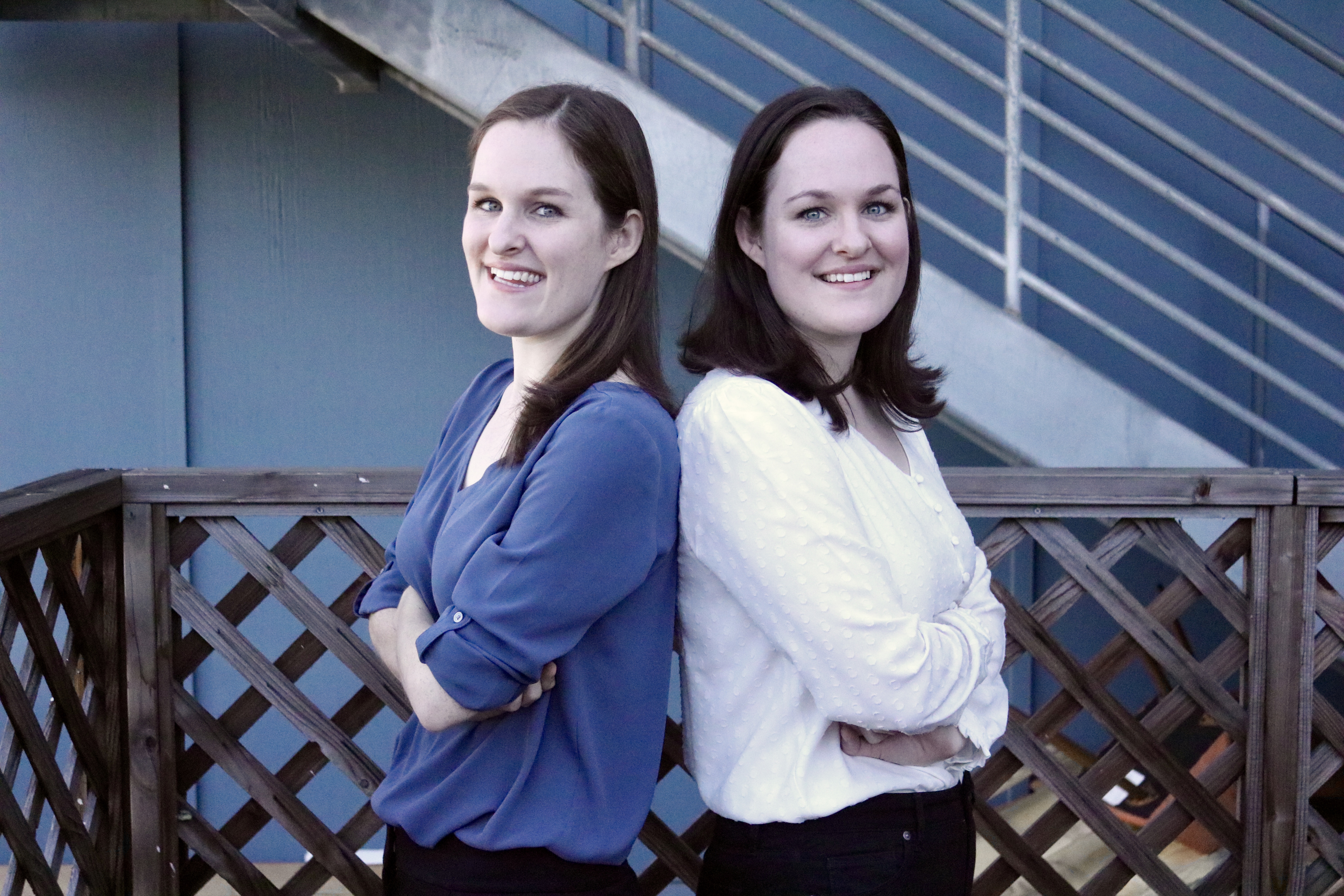
Justine (left) and her twin sister Olivia are venture investors at CRV.

By their senior year, they were fielding internship offers from those top-notch VCs. Olivia accepted an internship at First Round Capital, while Justine went to work at Cowboy Ventures. After graduation, they both went to work as analysts at Goldman.

After one year on the public equities team for Olivia and the private equities team for Justine, the twins were ready to transition into venture for good. They had met with CRV’s partners during their Cardinal Ventures days and felt the opportunity to work with Gur on consumer tech investing was something they couldn’t pass up. That, and the firm was willing to give them the freedom they needed to build their personal brand.

Building a brand

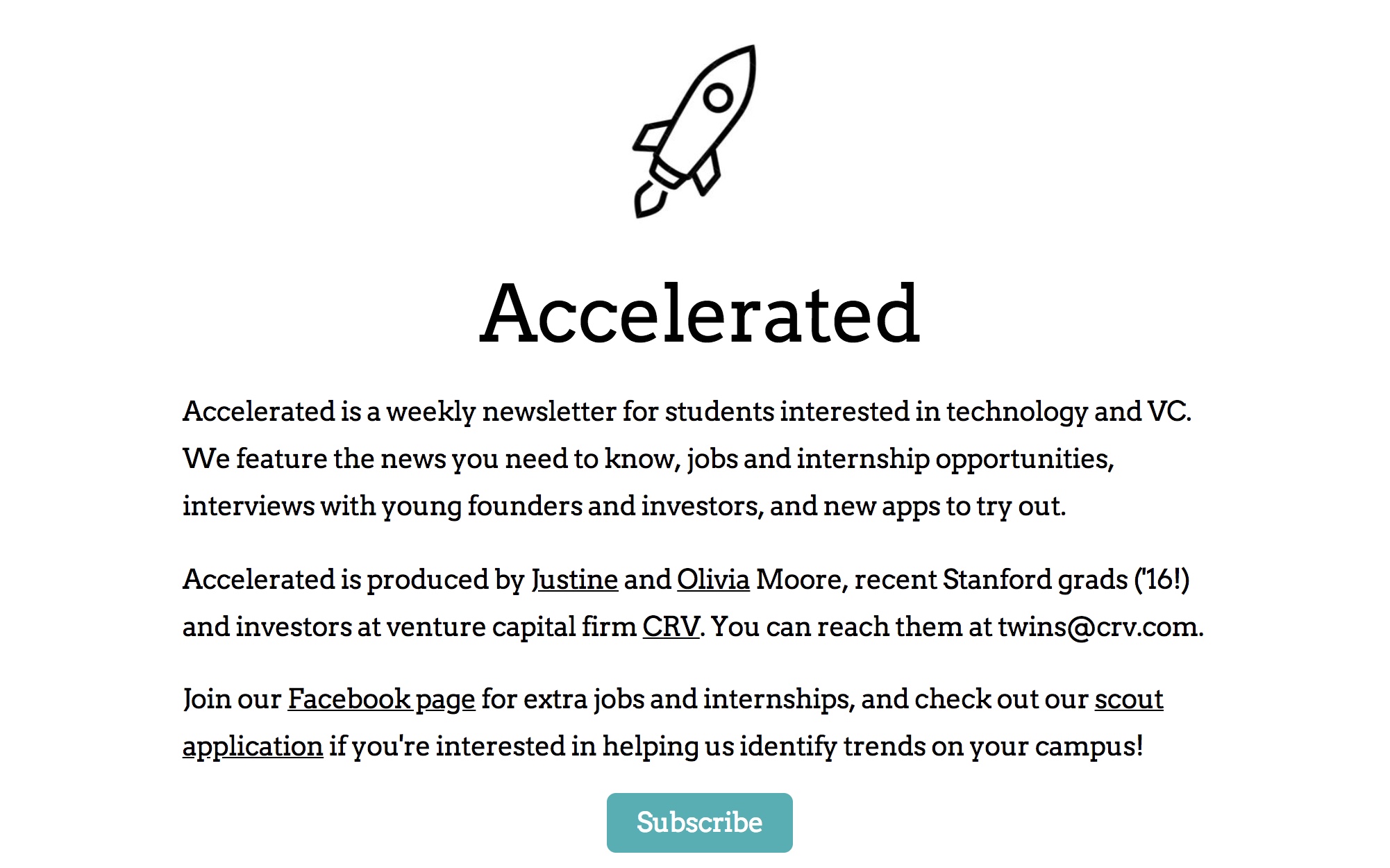
In addition to their Twitter account, @VentureTwins, and a very active Medium page, Justine and Olivia have a weekly newsletter called Accelerated that’s racked up some 5,200 subscribers since it launched one year ago.

The newsletter is written for college students. It provides the week’s biggest news in tech, notable internship and job openings, recommended reads and surveys on industry topics and trends for readers to complete.

We are from Oregon and we weren’t engineering majors, so I think the problem we had and part of the reason we went to Goldman was because it’s really hard if you aren’t from here to understand how it works,” Justine said. “Our full-time job is keeping up to date on Silicon Valley, what the hot trends are, who’s hiring, so we decided, why don’t we spend a couple of hours a week creating a newsletter that is the resource we wish we had when we were in college.”

Accelerated has a team of 120 campus ambassadors who Justine and Olivia can text at any time to ask about various topics. “Do you like this company?” “Have you ever heard of this product?” Things like that. So far, the Accelerated network has helped the twins source five potential deals, two of which became CRV portfolio companies. That’s Harper Wilde, a direct-to-consumer bra retailer, and Uppercase, which helps D2C companies open brick-and-mortar stores.

“I think we really underestimated what it would be,” Olivia said. “But being in someone’s inbox every week is this really fun and cool connection.”

CRV isn’t known for its D2C investments; in fact, Harper Wilde was its first ever. With their instincts, youth and network, the twins have quickly proved their value to the firm.

Better together

At this point, you’re probably wondering how two 24-year-old siblings can live and work together and not want to kill each other. And it may sound too cutesy and convenient, but they think they’re better together.

“Honestly, we’ve gotten closer over time,” Olivia said. “Going to Stanford together and as we’ve moved into the professional world, we’ve found we are able to communicate really effectively as a team and get things done because there is less worry about stepping on toes or hurting someone else’s feelings.”

The twins plan to stick together, though it’s not necessarily a requirement. For now, they’ll be keeping their residence in Menlo Park, where they have the space to dog-sit former 23andMe president Andy Page’s Bernedoodle.

In 20 years, who knows, maybe Justine and Olivia will be known as some of the greatest consumer VCs the industry has ever seen. They are smart, refreshingly modest and they seem to know their stuff.

“We’d love to be doing this in the long term if we’re good at it,” Justine said.

Olivia agreed.