Year: 2018

26 Oct 2018

Study: Latinx women-led startups have raised 0.4% of VC since 2009

In recent years, many have pushed to level the playing field for women in tech through new initiatives, funds, companies, support networks and more. White women, however, have emerged as the key beneficiaries.

Less has been done to bolster black and Latinx female founders specifically. Enter digitalundivided. The organization, which encourages black and Latinx women to pursue entrepreneurship, has been working to highlight just how extensive the disparity in funding is for black and Latinx female founders.

Today the company published its first-ever report on venture capital funding, or lack thereof, for Latinx female founders via its proprietary research arm, called ProjectDiane, in partnership with JPMorgan Chase.

The key takeaways: Latinx women make up 17.1 percent of the U.S. women’s population but less than 2 percent of women-led startups have Latinx women founders. Of the 107 Latinx women-led startups in digitalundivided’s database, 58 of them have raised more than $1 million in funding. Overall, Latinx women have raised only .4 percent of the more than $400 billion VC dollars invested in startups since 2009. 

“We are proud to be continuing the push toward a world where all women own their work through entrepreneurship, because that’s the path to real power and economic stability for black and Latinx communities,” said Kathryn Finney, digitalundivided’s chief executive officer, in a statement. “digitalundivided understands the impact of data on policy and startup ecosystems which is why we’re committed to using ProjectDiane to further develop data-driven programs for black and Latinx women founders and shape the narrative about women of color in startups.”

The company has released several reports on VC funding for black women founders. Their latest showed a slight increase in the number of black women to raise significant funding rounds. Still, black women have raised just .0006 percent of all VC since 2009.

In 2017, U.S. female-founded companies raised 2.2 percent of all VC, an abysmal and highly cited statistic. That number looks to be increasing ever-so-slightly in 2018, but the industry has a long way to go before capital is equally distributed.

26 Oct 2018

Microsoft has no problem taking the $10B JEDI cloud contract if it wins

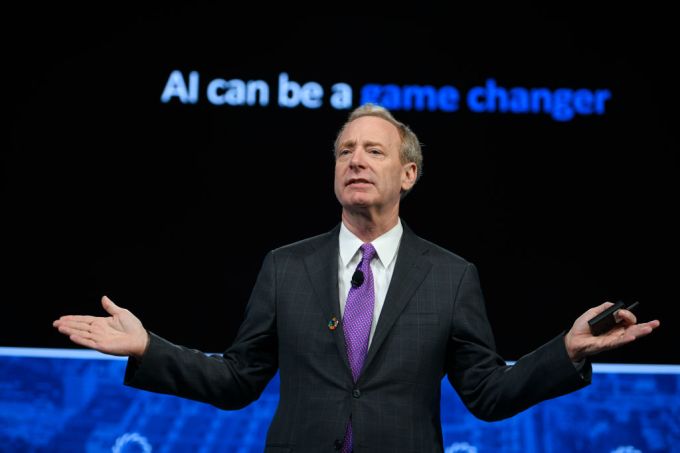
The Pentagon’s $10 billion JEDI cloud contract bidding process has drawn a lot of attention. Earlier this month, Google withdrew, claiming ethical considerations. Amazon’s Jeff Bezos responded in an interview at Wired25 that he thinks that it’s a mistake for big tech companies to turn their back on the US military. Microsoft president Brad Smith agrees.

In a blog post today, he made clear that Microsoft intends to be a bidder in government/military contracts, even if some Microsoft employees have a problem with it. While acknowledging the ethical considerations of today’s most advanced technologies like artificial intelligence, and the ways they could be abused, he explicitly stated that Microsoft will continue to work with the government and the military.

“First, we believe in the strong defense of the United States and we want the people who defend it to have access to the nation’s best technology, including from Microsoft,” Smith wrote in the blog post.

To that end, the company wants to win that JEDI cloud contract, something it has acknowledged from the start, even while criticizing the winner-take-all nature of the deal. In the blog post, Smith cited the JEDI contract as an example of the company’s desire to work closely with the U.S. government.

“Recently Microsoft bid on an important defense project. It’s the DOD’s Joint Enterprise Defense Infrastructure cloud project – or “JEDI” – which will re-engineer the Defense Department’s end-to-end IT infrastructure, from the Pentagon to field-level support of the country’s servicemen and women. The contract has not been awarded but it’s an example of the kind of work we are committed to doing,” he wrote.

He went on, much like Bezos, to wrap his company’s philosophy in patriotic rhetoric, rather than about winning lucrative contracts. “We want the people of this country and especially the people who serve this country to know that we at Microsoft have their backs. They will have access to the best technology that we create,” Smith wrote.

Microsoft president Brad Smith. Photo: Riccardo Savi/Getty Images

Throughout the piece, Smith continued to walk a fine line between patriotic duty to support the US military, while carefully conceding that there will be different opinions in a large and diverse company population (some of whom aren’t US citizens). Ultimately, he believes that it’s critical that tech companies be included in the conversation when the government uses advanced technologies.

“But we can’t expect these new developments to be addressed wisely if the people in the tech sector who know the most about technology withdraw from the conversation,” Smith wrote.

Like Bezos, he made it clear that the company leadership is going to continue to pursue contracts like JEDI, whether it’s out of a sense of duty or economic practicality or a little of both — whether employees agree or not.

26 Oct 2018

Google rolls out ‘.new’ links for instantly creating new Docs, Slides, Sheets and Forms

Google Docs just rolled out a time-saving trick that’s sure to be welcomed by heavy users of Docs, or any of Google’s other productivity tools like Sheets, Slides, Sites, or Forms. The company this week introduced its  “.new” domain, which can be used to instantly create a new file across any of these services, it says.

For example, instead of going to Google Drive, clicking the “new” button, then the service you want to use, you can just type “doc.new” to get started in a new Google Doc.

Google helpfully registered many variations on this domain, as well, so docs.new and documents.new also work.

And the same format applies across Google’s productivity apps, meaning you can also type in things like sheet.new, sheets.new, spreadsheet.new, site.new, sites.new, website.new, slide.new, slides.new, deck.new, presentation.new, form.new, or forms.new.

(Don’t type in the “www” – just the domain.)

If you tend to work with Google Docs on a regular basis, this little hack can end up saving a ton of time throughout your day. You can even bookmark the domains to use as shortcuts, so you can get to the same blank document with just a click.

This is all possible because Google owns the .new domain, which allows it to create whatever subdomains it wants on the site.

After Google tweeted the news on Thursday, users were so thrilled about the trick they started requesting other domains, too. “Do drawings pretty please,” asked one Twitter user. “Please also add email.new,” said another.

Google didn’t respond to those requests, but it wouldn’t be surprising if the domain was used in other ways across its apps in the future.


26 Oct 2018

Electric scooter startup Grin merges with Brazil-based Ride

Grin, the Mexico City-based electric scooter company backed by Y Combinator, is merging with Sao Paulo-based Ride to further the company’s expansion across Latin America. This comes shortly after Grin raised a ~$45 million Series A round.

Currently, Grin only operates in Mexico City, but it has plans to expand to other cities throughout Latin America. The merger with Ride, which already operates in Sao Paulo, will enable Grin to do this as early as next week, Grin co-founder Sergio Romo told TechCrunch.

As part of the merger, Ride will operate under the Grin brand in Brazil and the Ride team will be in charge of all of Grin’s operations in Brazil. Ride is currently the only shared electric scooter operator in all of Brazil, but that will soon change when Yellow deploys its scooters. Last month, Yellow raised a $63 million Series A round for its bike- and scooter-share company.

Grin has also partnered with Colombia-based Rappi, an on-demand delivery startup that raised $200 million back in August. This partnership, which will enable Rappi customers to unlock Grin scooters through the Rappi app, will help boost Grin’s expansion across Latin America, Romo said.

While LATAM is a huge market, Grin ultimately envisions operating its pick-up and drop-off scooter model worldwide.

“We definitely want to be global,” Romo said. “I don’t think you can become a ten-billion-dollar company if you don’t go global. I think LATAM might actually be the best market — there’s huge density and a huge market combined with Europe. And who knows, we might pop up in an American city soon if we do a good job. But this is definitely in our heads. This is engineered to be a global play.”

26 Oct 2018

California delays its net neutrality law while FCC’s new rules are challenged

California’s much-anticipated net neutrality rules, which were signed into law last month, are being put on ice until a challenge to the FCC’s own rules at the federal level is resolved. It’s unfortunate, but logical — if the FCC rules are undone or modified, the necessity and legality of California’s will also be affected.

As you likely remember, the FCC repealed 2015’s net neutrality rules at the end of 2017 and implemented a new, much weaker set that more or less puts broadband providers on the honor system when it comes to indiscriminate handling of your data in transit.

California responded by writing its own law establishing similar (and in some ways expanded) consumer protections. FCC Chairman Ajit Pai, who spearheaded the federal effort to overturn the old rules, was not amused; he called California’s rules “radical,” “anti-consumer,” “illegal” and “burdensome.”

So it was no surprise when, just hours after California governor Jerry Brown signed the bill into law, the FCC filed a lawsuit challenging it.

But the FCC is dealing with a challenge of its own: a lawsuit from a dozen or so internet advocacy companies including Mozilla, Vimeo, Public Knowledge, Etsy and others, alleging all manner of procedural and factual problems with the new federal rules.

If this suit succeeds and the FCC’s new net neutrality rules are rolled back or substantially altered (for instance, the court may find that some section or another is illegal or unenforceable), this could bear on the basis for the agency’s own lawsuit against California. Yes, it’s a bit confusing, and that’s why the state’s attorney general, Xavier Becerra, decided it might be best to wait and not litigate a suit that may be mooted a few months from now.

Senator Scott Wiener (D-CA) explained in a statement that he regrets but understands the necessity of this measure.

“Of course, I very much want to see California’s net neutrality law go into effect immediately, in order to protect access to the internet,” he said. “Yet, I also understand and support the Attorney General’s rationale for allowing the DC Circuit appeal to be resolved before we move forward to defend our net neutrality law in court. After the DC Circuit appeal is resolved, the litigation relating to California’s net neutrality law will then move forward.”

Ajit Pai also issued a statement on the matter, saying he was pleased California was staying implementation of “its onerous Internet regulations.”

“This substantial concession reflects the strength of the case made by the United States earlier this month,” he continued. “It also demonstrates, contrary to the claims of the law’s supporters, that there is no urgent problem that these regulations are needed to address.”

Although the rationale for this delay is understandable, it’s unfortunate that California residents will have to wait months or longer for the protections they supported while this case plays out. I’ve asked the AG’s office for more information and will update this post when I hear back.

26 Oct 2018

Snapchat’s new Camera desktop camera app brings AR masks to Twitch, Skype…

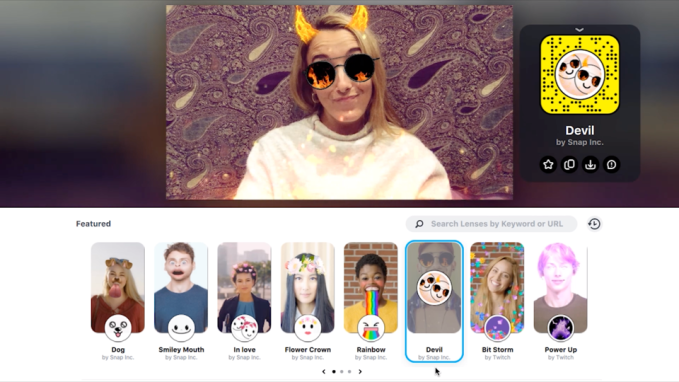
Snapchat is launching its first Mac and Windows software that takes over your webcam and brings its augmented reality effects to other video streaming and calling services. Snap Camera can be selected as a camera output in OBS Skype, YouTube, Google Hangouts, Skype, Zoom, and more plus browser-based apps like Facebook Live so you can browse through Snapchat’s Lens Explorer to try on AR face filters. And through its easily-equipped new Twitch extension, streamers can trigger different masks with hotkeys.

You can download the Mac and Windows versions of Snap Camera now. Users can us Lens Explorer to preview effects and see who made them, Star their favorites for easy access, and access a tab of your recently used Lenses.

Despite Snap Inc’s troubles following yesterday’s Q3 earnings announcement that revealed it’d lost 2 million users causing its share price to hit a new low, Snapchat Camera isn’t about stoking growth. You won’t even have to login to Snapchat to use it. Instead the goal is to drive more attention to its community AR Lens platform so more developers and creators will make their own effects. “We’re going down the path of providing more distribution channels [for Community Lens creators] and surfacing their work” Snap’s head of AR Eitan Pilipski tells me. The desktop camera could win Lens creators more attention, and Snapchat connects top the most talented ones to brands for sponsorship deals.

Snapchat first came to the desktop in January with its first embeddable content, designed for newsrooms that wanted to show off citizen journalism on their sites. But now Snapchat content creation is escaping the mobile medium.

Strangely, Snap Camera has no interface of its own. Really, it should have a Photo Booth-style app so you can record photos and videos of yourself with your webcam and share them wherever. “We don’t want to compete in that space. We just want to bring Community Lenses to whatever apps people are using” Pilipski explains. One major app that won’t support Snap Camera is Apple’s FaceTime. Why? “I don’t know. Apple didn’t comment on that. Believe me we tried” says Pilipski.

Since there’s “not even a facility to collect the impressions” and users don’t have to login, Snap won’t be able to add Camera users to its daily active user count. With that number falling from 191 million in Q1 to 188 million in Q2 to 186 million in Q3 as it announced yesterday, Snap really does need more ways to keep people straying to Instagram Stories. It will have to hope that when video chat users see their friends or family using Snap Camera’s lenses, it will remind them to fire up Snapchat more often. And Lenses could go viral if they show in a Twitch celebrity’s stream.

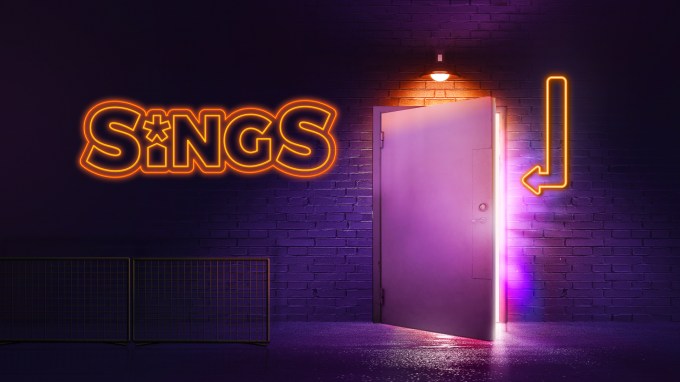
The Twitch extension comes amidst more announcements at today’s TwitchCon event including the reveal of Squad Streaming and a karaoke Twitch Sings game for the service’s average of 1 million concurrent viewers and half-million daily streamers.

The Snap camera equips Twitch broadcasters with extra features. They’ll have access to game-themed lenses for League of Legends, PlayerUnknown’s Battlegrounds, World of Warcraft, and Overwatch. Viewers will see the QR Snapcode for the Lens on the screen which they can scan with Snapchat to try the mask on themselves for virality. Streamers get a button that lets viewers subscribe to them, and can set up a “bonus” lens that shows up as a thank you when someone follows them. And with hotkeys, streamers can trigger different lenses, like an angry one for when they lose a game or victory lenses for if they manage to beat all the other Fortnite addicts.

Over 250,000 Community Lenses have been submitted through Snapchat’s Lens Studio since it launched in December, and they’ve been viewed over 1 billion times. Snapchat realized it couldn’t dream up every crazy way people could use AR just in-house. Out-Lensing Instagram is critical to Snapchat’s business strategy. The more people that use Snapchat’s AR features, the more the company can charge businesses to promote Sponsored Lenses. With the user count shrinking, Snap needs to show its business is growing to salvage its share price and pull in the outside investment or acquisition it will likely need to make it to profitability. A desktop presence could not only make Snapchat more ubiquitious, but get it in front of older users and advertisers who might be a little scared of its mobile app.

26 Oct 2018

Twitch announces group streaming and a karaoke game for its 1M concurrent viewers

The teens were out in force today in San Jose for the annual TwitchCon game streaming conference. There, Twitch announced that at any given time, 1 million people are watching it (up from 746,000 last year), and it seemed like that many game lovers were at TwitchCon in person to meet some of the nearly half-million web celebs that broadcast each day on the service. Considering Twitch said just 2 million were broadcasting per month in December, the service’s growth is still explosive under Amazon’s ownership.

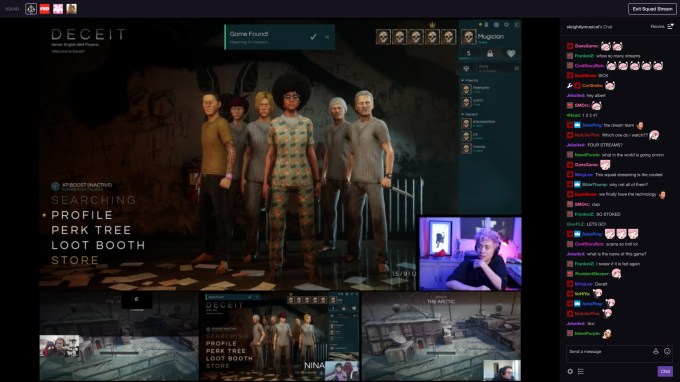
Amongst the major reveals at TwitchCon were a new Squad Streaming feature that lets up to four people broadcast at once in split-screen that will test with select streamers later this year.

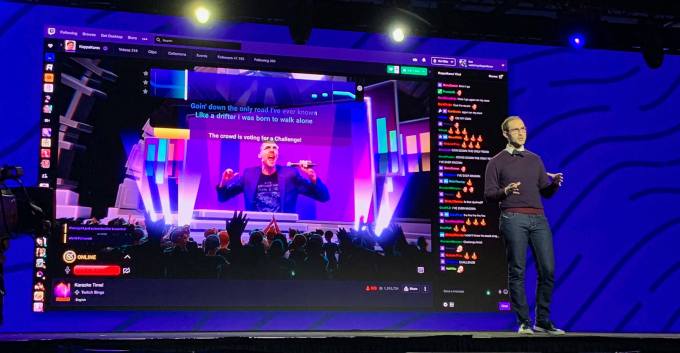
There’s also a new Twitch Sings game built in partnership with Rock Band-creator Harmonix. Broadcasters can play to perform karaoke (though only with fake versions of songs since Twitch lacks major label music licenses). Viewers can use the chat to request the next song, control the lights on the virtual karaoke stage,  Broadcasters can sign up here for the Twitch Sings closed beta that starts later in 2018.

Twitch Squad Streaming

And Twitch broadcasters can now use Snapchat’s augmented reality lenses thanks to the new Snap Camera desktop app and accompanying Twitch extension launching today. Streamers can use hotkeys to trigger different Snapchat Lenses, let viewers try those masks by scanning an onscreen Snapchat QR code, and reward subscribers with a bonus thank you effect. Read our full story on Snap Camera here:

There were plenty of other minor announcements during the conference’s keynote:

  • Over 235,00 streamers now have Affiliate status and are earning money on their channels while 6,800 have joined its Partnership program so they can earn even more through channel subscriptions and ads.
  • Twitch’s Highlight editor can now stitch together multiple clips from across a broadcasting session
  • New homepage sections will feature up-and-coming streamers, new Partners and Affiliates, or streamers local to viewers
  • VIP Badges will let creators recognize their favorite subscribers and moderators
  • Moderators can now see how long someone has been on Twitch, view chat messages that person has sent in the channel, and see how many timeouts or bans that account has received in that channel to better understand who to boot
  • 18 billion messages have been sent in Twitch chat and its Whispers feature in 2018, and fans have given creators 85 million Cheers and Subscriptions
  • 150 million Twitch Clips have been created in 2018 to bring the best game stream and other weird content to the rest of the web.
  • Twitch users have gifted $9 million worth of subscriptions to fellow users in just 9 weeks.
  • Twitch will open its Bounty Board of sponsorship opportunities to 30 more brands, and more Partners and Affiliates in the US and Canada in November
  • The Twitch Rivals in-person gaming tournaments will double to 128 events in 2019. Some will have million-dollar prizes, and it already gave out $5 million in winners’ jackpots last year


As CEO Emmett Shear made the announcements, audience members hooted and hollered with delight. They out-yelled even Apple’s keynote attendees. Shear shouted out early users who’ve been with it since Twitch was a Y Combinator lifevlogging startup called Justin.tv. “When people have your back and support you for a long time, we think they should be recognized for it” he said, revealing the new VIP badges and a counter that shows how many months a fan has been a channel’s paying subscriber.

“You spoke and we listened” Shear said. That truly seemed to be the message of this conference. Facebook’s F8 conferences held in the same San Jose Convention Center often seem to produce updates that are designed to help the company as much as the users. But Twitch has realized it can’t just be useful. It must remain beloved if people are going keep spending 760 million hours per month watching others game, joke, and express themselves. Shear concluded “I think we’re just scratching the surface when it comes to everyone playing together.”

Twitch Sings

26 Oct 2018

We’re addressing gender disparity in engineering way too late

STEM innovations, especially those in engineering, are an essential part of our modern-day lives. These innovations impact us all, and cut across social, economic and geographical boundaries. Yet, at a time when engineers must meet the needs of a vast population of users with diverse opinions and backgrounds, the engineering workforce continues to suffer from gender disparity.

The U.S. Department of Commerce reported that women accounted for 47 percent of all U.S. jobs in 2015. However, women only account for 24 percent of STEM jobs. And the percentage of women in STEM fields continues to be the lowest in engineering, with women representing just 15 percent of the workforce (NSF, 2018).

These are startling numbers — made even more striking given the range of STEM advocacy groups that making concerted efforts to increase female representation in engineering through programs that encourage women to enroll in engineering courses in high school, major in engineering in college and then go into the profession.

The problem, it seems, is that girls self-select out of engineering before these efforts even have a chance to be effective.

At a young age, girls internalize long-lasting stereotypes that tell them that boys are better at engineering and computer science, and that girls simply aren’t engineers. And during these formative years, they never have an opportunity to imagine themselves as engineers.

By the time we try to get young women involved in high school, their minds are already made up that engineering is not for them. Young women do not enroll in engineering-related secondary school courses at the same rates as young men, according to the 2018 National Science Foundation Science and Engineering Indicators Report: About two and a half times (21 percent) as many male students earned engineering and technology credits in high school as compared to female (eight percent). This gender disparity is also apparent in AP courses. In computer science, 77 percent of exam-takers are male.

Then, when women go on to college, they do not select STEM majors at the rate of men: 44 percent of men elect a STEM major compared to 24 percent of women, and only 19.3 percent of engineering degrees are awarded to women.

If we are going to bring more women into engineering, we must start to reach out to them when they’re still young girls.

We know from our work in creating the Museum of Science’s Engineering Is Elementary curriculum, which has been used by more than 15 million elementary students and 190,000 educators across the country, that when given the opportunity and when exposed to engineering concepts, girls are just as successful as boys at understanding the engineering design process. Additionally, a five-year of study of those curricula funded by the National Science Foundation found that girls perform just as well as boys on engineering outcome measures. (Exploring the Efficacy of Engineering is Elementary (E4) NSF No. 1220305)

This data is reinforced by what we see everyday within the halls of the Museum of Science: Girls like engineering if they get a chance to learn it.

More than one million kids have participated in Engineering Design Challenges at the Museum. Our research has shown that when girls immerse themselves in our exhibits, they demonstrate confidence and sustained interest in solving engineering problems and express an interest in future engineering activities (Auster & Lindgren-Streicher, 2013).

If young girls have the aptitude for and interest in engineering when they are able to experience it, and yet they are still not pursuing it as they get into high school and beyond, it means we are simply missing them.

It’s incumbent upon all of us to introduce girls to engineering, in both informal and formal educational settings, during the very earliest years of schooling. We can’t wait until high school and hope to sway them. Rather, it is time we expand engineering education to all children, starting as early as preschool — and then support educators in doing so — so we can build a learning environment in which engineering is part of girls’ daily conversations. When we start young, we never allow the stereotypes to take root in girls. They learn that all students are natural problem solvers and that all students are engineers — especially girls.


26 Oct 2018

Facebook takes down more disinformation activity linked to Iran

Facebook has removed 82 pages, groups and accounts for “coordinated inauthentic behavior” that originated out of Iran.

The social networking giant discovered the “inauthentic behavior” late last week, according to a blog post by the company’s cybersecurity policy chief Nathaniel Gleicher. He said the operation relied on posing as U.S. and U.K. citizens, and “posted about politically charged topics such as race relations, opposition to the President, and immigration.” The company said that although its investigation is in its early stages, it traced the activity back to Iran but does not yet know who is responsible.

Facebook said that a little over one million accounts followed at least one of the pages run by the Iranian actors. The takedown also included 16 accounts on Instagram.

The actors spent “less than $100” on two ads on Facebook and Instagram using both U.S. and Canadian currency, which helped the actors gain a greater reach to Facebook users.

The company shared its findings with the FBI prior to the takedowns, Gleicher added on a call.

It’s the latest batch of account and content takedowns in recent months. Facebook took down hundreds of accounts and pages in August with help from security firm FireEye, which found a widespread Iranian influencing operation on the social media platform. Although previous efforts by Facebook to take down accounts linked with spreading disinformation aimed at elections, the Iranian-backed campaign was targeting a scattering of issues. FireEye said in its analysis that the various narratives employed by the Iranians include “anti-Saudi, anti-Israeli, and pro-Palestinian themes, as well as support for specific U.S. policies favorable to Iran, such as the U.S.-Iran nuclear deal.”

Tech titans like Facebook have faced increasing pressure from lawmakers to better police their platforms from disinformation and the spread of false news from state-backed actors in the wake of the 2016 presidential election.

Although much of the focus has been on activity linked to trolls working for the Russian government, which used disinformation spreading tactics to try to influence the outcome of the election, Iran has emerged as a separate powerhouse in its use of spreading disinformation on the platform.

26 Oct 2018

R.I.P. FilmStruck, the best streaming service for classic films

Sad news for movie fans: FilmStruck, the streaming service developed by Turner Classic Movies, is shutting down.

A message on the FilmStruck website says it’s no longer accepting new subscribers, with plans to shut down on November 29. Meanwhile, The Hollywood Reporter suggests that this was an expected move — now that it’s part of AT&T, WarnerMedia (which owns Turner) is planning to a launch a comprehensive streaming service next year.

“While FilmStruck has a very loyal fanbase, it remains largely a niche service,” WarnerMedia said in a statement. “We plan to take key learnings from FilmStruck to help shape future business decisions in the direct-to-consumer space and redirect this investment back into our collective portfolios.”

In addition to classic Hollywood films, FilmStruck was also known for being the online home of the Criterion Collection, with its library of restored art-house and international films.

“Like many of you, we are disappointed by this decision,” Criterion says in a blog post. However, Criterion has worked with Hulu in the past, so it seems like could find another digital partner.

And indeed, the post says Criterion is “still committed to restoring and preserving the best of world cinema and bringing it to you in any medium we can,” and it continues, “We’ll be trying to find ways we can bring our library and original content back to the digital space as soon as possible.”

So it’s possible that much of this content will eventually find its way back online. Still, the transition from DVDs to digital, and now to subscription streaming, has made many classic film titles unavailable. FilmStruck was one of the few streaming services to fight that trend.

It will be missed.