
Year: 2018

26 Oct 2018

Reelgood acquires Guidebox to bring streaming TV data to more places

Reelgood, a startup aimed at helping cord cutters find shows and movies to watch on the services they subscribe to, has made an acquisition in the hopes of bringing Reelgood’s data to more places. The company has bought Guidebox, a streaming availability data provider which powers Roku, TVGuide, Metacritic and others.

Deal terms weren’t disclosed, but we understand the price was in the “multi millions.”

Guidebox began its life in 2012 as a consumer-facing website that brought together full show and episode data in one place, then pointed you where you could watch – very much like today’s Reelgood, in fact. But over the years, it shifted its focus to working with publishers and device manufacturers. For example, it’s been well known to be the service that powers Roku’s universal search feature.

It was most recently reported that Guidebox was sold to video data and recommendation startup ColorTV. However, Reelgood says that deal never actually happened – the announcement of the acquisition was premature. (ColorTV now appears to be shut down, as it turns out. We’ve attempted to reach them for confirmation.)

Reelgood says it decided to buy Guidebox because it aims to be more than just a guide for streaming TV.

“Imagine asking your Alexa, ‘Which of my shows has a new episode?’ or reading about a show online and, embedded within the article, seeing where you can watch it,” the company explains in its announcement about the deal. “For TV to ‘just work,’ we need to make it easier to get Reelgood’s data onto other products, too.”

The need for better organization of streaming services’ content is more critical than ever in today’s cord cutting era, as consumers increasingly ditch their cable and satellite TV subscriptions to build their own bundles of video services. The average U.S. household now uses four different streaming apps, says Reelgood, and this acquisition will allow it to expand its reach to over 50 million of those households.

The company says it will build on the existing Guidebox technology to make it even easier for companies to help their own users find streaming content. This data will be made available through an API.

That also means that Reelgood isn’t shutting down Guidebox or ending its existing business relationships – it aims to expand them, as well as pursue new business opportunities. It’s currently in the process of renegotiating some of Guidebox’s deals with larger TV and cable media-centric companies which provide service to some of the bigger networks, we understand.

Guidebox had been working with content providers like Lionsgate, the WWE and Fandor, Variety reported last year.

In terms of the Guidebox team, not all are joining long-term. The executive team is on an earn-out plan, and will help to integrate the technology with Reelgood and transition the client relationships. A few employees working on data  integrity and quality assurance have been hired by Reelgood to help as it expands the product and service.

“No one wants to spend time hunting through apps for the right show,” says David Sanderson, Reelgood founder and CEO, in a statement about the deal. “People expect their devices to help them decide what to watch and where to watch it. Whether it’s a search engine, website, streaming media player, or voice assistant, this is an opportunity for companies to get the experience right.”


26 Oct 2018

China’s ByteDance leapfrogs Uber to becomes world’s most valuable startup

Move aside Uber, China’s ByteDance is now the world’s highest-valued tech startup.

That’s according to reports from Forbes and Bloomberg both of which claim that the company has completed a $3 billion investment that values the company at $75 billion. A source with knowledge of the deal confirmed the round to TechCrunch and suggested that the value is pre-money, which, adding the round, would put ByteDance’s valuation at $78 billion. That’s ahead of Uber’s most recent $72 billion valuation, although the ride-hailing giant is being tipped to go public next year at a valuation of up to $120 billion.

ByteDance did not respond to a request for comment.

We previously reported that ByteDance was in talks with KKR and General Atlantic, and they were joined by SoftBank in the round — with Bloomberg reporting SoftBank plans to put in a total of around $1.8 billion which will include buying out some existing investors via secondary sales. On that note, the publication also claims that the round remains open to additional investors so the amount raised could increase.

ByteDance operates a range of digital media platforms, but it is best known for Toutiao, its AI-based news aggregator that has become one of China’s most-used apps with over 120 million users, and short video platform TikTok, which recently gobbled up Music.ly which ByteDance acquired via a $1 billion acquisition last year.

But it isn’t just popular in China. That TikTok-Music.ly merger is aimed at growing the platform globally, while ByteDance operates a number of Toutiao-like global services too. It has carefully fenced its Chinese and international versions, though. TikTok (500 million monthly users) and Chinese equivalent Douyin (300 million MAUs) are restricted to their respective markets, principally due to censorship concerns.

ByteDance has done the impossible and become an internet giant in China, breaking the dominance of Baidu, Alibaba and Tencent — the so-called BAT big three — but U.S. giants are also paying attention. Because imitation is the sincerest form of flattery, Google is said to be (controversially) developing a Toutiao-like news app for China, while TechCrunch reportedly this week that Facebook is hatching a TikTok clone.

It hasn’t been plain sailing, though. ByteDance has been reprimanded by the Chinese government which has seen its services given app store bans, and the company’s content moderation team grown from 6,000 to 10,000. That’s part of the growing pains and in many ways, interest from Beijing is definitely a compliment that shows just how influential the company has become.

26 Oct 2018

Chat fiction startup Hooked unveils ‘Dark Matter,’ its first feature-length thriller

Chat fiction startups have been exploring the types of stories that you can tell in the form text message conversations, and now Hooked is taking that exploration one step further with the launch of “Dark Matter.” The company describes this as its first feature-length story.

“Dark Matter” tells the story of Tasneem (Taz) Singh, a South Asian American student at Stanford who, after the mysterious death of her twin sister, discovers that she has the ability to interact with the paranormal.

The story debuts today on Snapchat, with a new chapter coming out every day until Tuesdsay, October 30. According to CEO Prerna Gupta, the full script totals 32,000 words — in other words, it’s the length of a feature film script or short novel: “I think it’s fair to say this is the longest chat fiction story. It’s certainly the longest on we’ve ever produced for Hooked .”

If you’re you’re not already a chat fiction fan, you may be skeptical about reading something that long in text message format. Gupta admitted that she and her husband Parag Chordia had similar doubts when they started the company together.

“I would be lying if I didn’t say if we also didn’t have that question ourselves,” she told me. “When a new kind of format or really new medium comes up, you start with the basics first. You tell the simplest stories, then as you become more adept at communicating with that format, you can start to go deeper.”

That’s meant going beyond text — “Dark Matter,” for example, will include a voice track and custom illustrations.

Dark Matter excerpt

“The length makes a big difference,” Gupta added. “You can take your time, slow it down and spend more time with world, developing deeper relationships between the characters.”

“Dark Matter” was written by Hooked staff writer Elyse Endick, but Gupta said the writing process was “almost more like a writers room — it was very collaborative, she did a show bible, then at each step she and I and our head of content would sit in a Google Hangout and just kind of flesh it out.”

Although the story is premiering on Snapchat, it will also make its way to the main Hooked app. Gupta said that she’s less focused on owning the distribution channel than on reaching big, global audiences — and distributing via Snapchat can help with that.

“I’m not trying to be the next Instagram,” she said. “It’s not about the app or any given app. For me, it’s really about our stories.”

And while Snapchat has recently lost some of its luster (daily active user count fell by another 1 percent in its most recent quarter), Gupta said, “I think people are underestimating their whole strategy around entertainment, around being TV for the next generation.”

She added that engagement around Hooked content on Snapchat has been “insane.”

“Why are we investing our resources with Snap? Because of what we’re seeing,” she said. “Our audience and how engaged they are, that’s real.”

26 Oct 2018

Tap, a new startup from Sam Rosen, wants to be the Google of drinking water

MakeSpace founder and former CEO Samuel Rosen is ready to launch his next venture, and it has little or nothing to do with the on-demand economy. This time, Rosen is setting his sights on the world of water.

Tap aims to be the world’s first public index and global search engine for drinking water.

Plastic water bottles are, in many ways, the scourge of the planet. More than 90 percent of the environmental impact of plastic water bottles happens during manufacture, and the Guardian reported that more than 1 million plastic water bottles were sold a minute across the globe in 2016.

Some people have switched over to reusable water bottles and canteens, but once they do, there is no way to search for water fountains or sources of drinking water. That’s where Tap comes in.
In its first iteration, Tap is a bit like the Waze for water. Using a combination of user-generated content and data from water fountain manufacturers, Tap aims to be a public search engine for where to find water. As it stands now, Tap has more than 34,000 Refill Stations across 30 countries indexed on the app.

But Tap also has ambitions to offer a backend system for water fountain companies. Normally, these companies sell a number of units to airports or other commercial or government properties. Those customers then install the fountains wherever they see fit, and the water fountain company is more or less uninvolved.

However, those companies then need to maintain the fountains, installing new filters and repairing broken parts, etc. But one fountain may be far more trafficked than another, and thus need higher frequency maintenance.

Tap wants to offer an SDK to these companies so that when users report bad filters or a broken water fountain, that information shows up on their dashboard.

Rosen sees an opportunity to generate revenue in a manner similar to Google, offering an advertising product for companies down the line.

26 Oct 2018

Epic Games, the creator of Fortnite, raises $1.25 billion

It pays to have the most popular game in the world.

Epic Games, the creators of the runaway gaming smash hit Fortnite, have raised $1.25 billion in a new round of financing.

via GIPHY

It’s been 20 years since Epic Games first released its Unreal game development engine in concert with its first person shooter, Unreal. Since then, the company has been releasing free-to-play games as a loss leader to show off what its powerful development toolkit can do.

Now, with the insane success of Fortnite, the company has flipped the script.

Since Fortnite became the thing that nearly every gamer in the world plays, the company has slashed prices on the Unreal game engine even as it keeps upgrading the technology.

And the company has been plowing that cash back into the community to support esports tournaments with a $100 million prize pool to support competitive Fortnite gamers.

The company’s game has become the kind of old-school cultural phenomenon that one rarely sees in the fractured age of internet silos. It’s inspired dance crazes, Halloween costumes, and even a Monopoly game and a Nerf gun.

And now it appears that the game has also inspired some of the biggest names in Silicon Valley’s venture capital investment scene to commit huge sums to continue its success.

Investors in the latest round include KKR, Iconiq Capital, Smash Ventures,Vulcan Capital, Kleiner Perkins and Lightspeed Venture Partners, as well as gaming companies like aXiomatic, which announced a significant investment from the NBA legend Michael Jordan earlier in October.

The new investors are joining Tencent, Disney, and Endeavor as minority shareholders in the company — which amazingly still is controlled by its chief executive and founder, Tim Sweeney.

Epic Games has fundamentally changed the model for interactive entertainment under the company’s visionary leadership,” said Ted Oberwager of KKR, in a statement.

26 Oct 2018

Blockchain partners with Ledger for its hardware wallet

Blockchain startup Blockchain shared its roadmap for the coming months. The company is launching a hardware wallet in partnership with Ledger. Blockchain is also launching a new trading platform called Swap — this platform will find the best trading prices across a variety of exchanges and liquidity pools so that you can exchange tokens at a fair price straight from your Blockchain account.

Blockchain is one of the most successful cryptocurrency wallets out there. The company has built a solid user base with a software wallet for Bitcoin, and now also Ethereum and Bitcoin Cash.

Compared to traditional exchanges, you remain in control of your private keys. Blockchain can’t access your tokens, hackers can’t empty your wallet if Blockchain gets hacked. Blockchain currently manages 30 million wallets, which represent over $200 billion in transaction volume in the last two years.

But a software wallet isn’t as secure as a hardware wallet. There have been countless of phishing attempts and scams to take over your private keys. That’s why Blockchain is going to release its own hardware wallet, sort of.

The company is partnering with French startup Ledger to release the Blockchain Lockbox. It looks exactly like the Ledger Nano S, but with a Blockchain logo. It’ll feature a customer Blockchain firmware and integrate with Blockchain’s wallets.

Just like Ledger’s own app, you’ll be able to check your balance without connecting your hardware wallet to a computer. But as soon as you want to process a transaction, you’ll need to plug your Ledger wallet to confirm the transaction on the device itself.

It’ll be interesting to see how your Blockchain wallet and the one tied to your Blockchain Lockbox work together. The Lockbox could act as a sort of longterm vault while you could keep some coins on your standard Blockchain wallet for frequent transactions.

As for Swap, Blockchain is building its own trading product. It’s not going to be a separate exchange as the company plans to integrate with multiple sources. Eventually, Blockchain hopes to add support for decentralized exchange protocols so that you can exchange tokens without going through an exchange.

The Blockchain Lockbox will cost $99 and start shipping in November. I hope there will be other versions that support Bluetooth and mobile phones in the future as Blockchain is quite popular on mobile.

26 Oct 2018

What to expect from Apple’s iPad event

Thrills? Chills? iPads? Definitely yes on that last one, at least. The invites are out and the rumors have been pouring in, fast and furious. On Tuesday October 30, the company will be wrapping up hardware season with one final event, hitting all of the points that didn’t quite make it into September’s big iPhone event.

As ever, the company’s attempting to keep a tight seal on the news, but we’ve got plenty of clues to work from here. For starters, there’s the fact that the “special event” is being held at the Brooklyn Academy of Music’s Howard Gilman Opera House. It’s a cool space. I saw Jeff Mangum do a bunch of shows there, NBD. 

Also, the company customized dozens (hundreds?) of designs for the event, sending out customized invites to everyone on its list. Thanks Apple! You really know how to make a tech blogger special. The through line, however, was the tag line, “There’s More in the Making.” All of which implies that the company is once again turning the camera back on creative pros.

That certainly comports with the rumors we’ve heard thus far, which largely focus on the iPad Pro and a slew of new MacBooks. So let’s start with the easy one.

A new iPad Pro is all but a given at this point. The device is expected to get a pretty thorough makeover, starting with some key design changes. The biggest news on that front borrows some cues from the last couple of iPhones, dramatically reducing the bezels on all sides (while keeping them present so there’s a place to put your hands).

That’s thanks, in part, to the elimination of the home bottom, a rumored change that would also anticipate the arrival of Face ID to unlock the handset. Inside, the device is expected to get the new A12 chip, which debuted on the iPhone XS. An update to the Pencil also appears to be in the works?

While the entry-level iPad was refreshed at an education event in Chicago this year, rumors of an iPad Mini 5 have been floated by human Apple crystal ball, Ming-Chi Kuo.

Kuo also predicts, get this, the long-awaited arrival of AirPower. Apple’s three-in-one iPhone/Watch/AirPod charging pad has been MIA since the company debuted it at WWDC of LAST YEAR. The mat is reported to finally be hitting later this year or early next, along with new AirPods. Among other things, the update to the popular Bluetooth earbuds will sport a new case with, naturally, wireless charging and a color indicator on the outside.

And then there are the Macs. Rumors have up to four new Apple computers hitting the stage on the 30th. The Mac Mini and iMac are the frontrunners here, along with the even longer-awaited MacBook Air refresh, sporting a Retina Display, priced at below the standard MacBook.

And for good measure, how about an update on the Mac Pro? Last we heard, it’s coming next year. So why not feature it as a “one more thing” at this creative pro-focused event? The event kicks off Tuesday October 30, at 10AM ET.

26 Oct 2018

More than half of crypto news sites are pay-for-play

In a clever bit of sleuthing by Corin Faife at Breaker, we find that over half of the most popular crypto blogs offer pay-for-play posts including “CEO interviews” that are not labelled as sponsored. Further, many sites offer premium services in which blog writers will repost PR content without a sponsored tag.

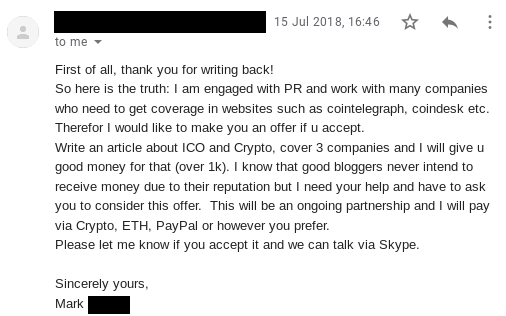
As I noted a few weeks ago, the crypto industry is awash with money and “journalists” are taking advantage of the naivety and dishonesty of the marketers tasked with pushing another me-too crypto product in front of an unreceptive audience. Faife received multiple emails like this one asking him to accept payment for placing articles at the places he worked, including Motherboard and Coindesk:

“I know that I would never take money for coverage, nor would any serious journalist. But covering the cryptocurrency industry, I read content on a daily basis that comes from a large number of outlets that I can’t vouch for. If these offers of pay-for-post are out there, can we rely on all of the journalists and editors to turn them down? Can we believe in the objectivity of the coverage we see every day, or has it simply been paid for by a company flush with cash?” he wrote. “The more I thought about it, the more it seemed like there was a simple way to find out. As a BREAKER investigation, we’d ask to pay for coverage of an ICO, and see who said yes.”

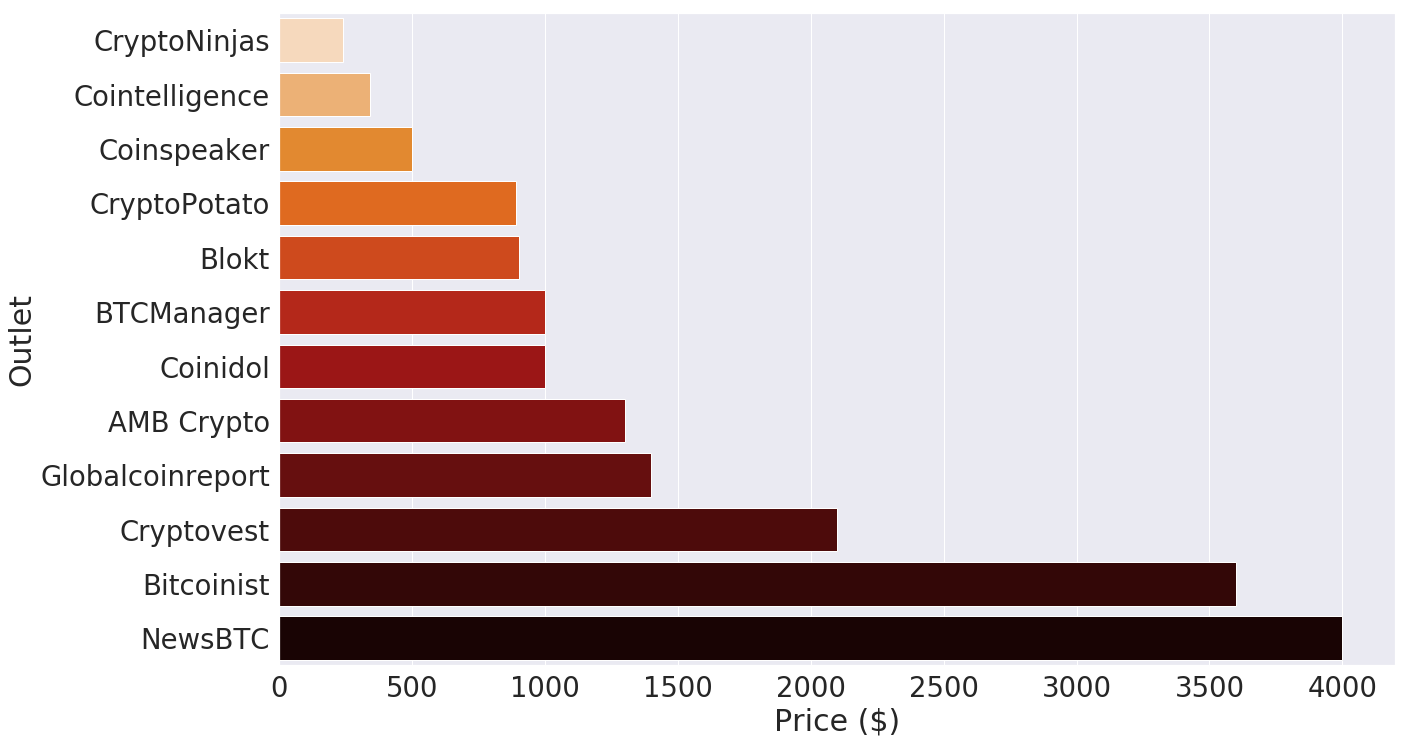
Faife reached out to 28 cryptocurrency news sites and received 22 definitive responses. Posing as a Russian PR professional, Faife first asked for rates for posting information on the site. When he received a response, he asked if the posts would have a “sponsored” tag, a traditional signal that a post wasn’t explicitly written by the news organization’s reporters.

Of the 22 replies, he received 14 agreeable responses including an offer to remove the sponsored tag for $4,500. This helpful graph shows how quickly sites will abandon journalistic ethics to grab a little cash:

One site, NewsBTC, responded to Faife when pressed about payola:

Contacted about the story, Samuel Rae, CEO of NewsBTC, responded:

“It’s come to my attention that one of our sales team has mistakenly suggested that we could publish content without disclosure that it has been paid for (i.e. a sponsored article) to one of your undercover reporters posing as a PR agent. This is not our policy. The sales executive offering this has been removed from our company active immediately and won’t be dealing with/offering our advertising (or otherwise) services again, be it to a PR company, a reseller or anyone else.”

Pressed to offer evidence that the staff member had been removed, and to explain a second source quoting NewsBTC’s willingness to publish sponsored content without disclosure, Rae declined to give further comment.

The important thing to note here are the sums of money that many of these crypto and ICO organizations will raise thanks to a small investment in media. A solid blog post can move untrained “investors” to buy or sell crypto and tokens in an instant, creating situations ripe for pump and dump schemes where the actual level of interest in a company is clouded by payola. Most sane, mature news organizations see this problem and address it by refusing to accept paid content. That said, times are changing and the lines are blurring between paid and unpaid content. Ultimately, however, the behavior Faife uncovered is implicitly wrong.

There’s an old saying: fools and their money are soon parted. Uneducated and uninformed crypto investors are fools, but they visit crypto sites for a proper education. When news organizations create so-called fake news in order to drum up a little advertising cash, everyone loses.

26 Oct 2018

Samsung reportedly debating foldable phone form factor and the S10’s headphone jack

Samsung’s foldable phone has been floating around the company under the codename “Winner” for some time now. That bit of info isn’t new. It’s understandably taken the company a while to get the thing just right.

After all, we’re talking a new paradigm here in terms of form factor. It’s an exciting process, indeed — and a code a LOT of companies have been trying to crack. According to a new report from Bloomberg, however, some of the heel dragging with regard to decision making on that front is really coming down to the wire here.

The Samsung Developer Conference, happening next month in San Francisco, could be the big debut for the long-awaited product. From the sound of the report, however, we’re going to see little more than a “conceptual image” of the product, rather than a retail device or even prototype.

That means, of course, that we can probably rule out any possibility that the company is going to attempt to jam this thing out for the holidays. The unveil would be more of a check in to let the world know that the product is, indeed, still in the works, and big innovation is just around the corner. Winners don’t just happen overnight, you know.

Screen orientation is reportedly a sticking point here, with the company ultimately opting for a design that opens like an old school flip phone. Samsung is said to be working with Google on a custom version of Android that can handle the new design language — similar to what LG did with Android wear on its new hybrid watch. There are also some concerns around mass production. The phrase “The screen, when it cracks, shatters like dried paper” doesn’t really instill a lot of confidence here.

As reported earlier, Samsung’s next flagship, the S10 will sport an in-screen fingerprint reader (a similar feature is also coming on the soon to launch OnePlus 6T). More surprisingly, the company is also “toying” with dropping the headphone jack on the device. While it’s true the decision feels like an inevitability, Samsung has roundly mocked Apple’s decision for years now.

26 Oct 2018

You can now use Alexa to move around inside apps like Netflix and Hulu on Fire TV Cube

Amazon is making it easier to use Alexa to do more than launch apps and streaming services on Fire TV devices, but to also navigate once inside them. The company confirmed it quietly launched an update specifically for Fire TV Cube devices that allows device owners to use Alexa instead of a remote control for doing things like making profile selections, moving up and down or left and right, as well as selecting items.

In other words, Fire TV Cube owners can now use Alexa to navigate their Fire TV, with no remote control required.

The feature began its rollout a few weeks ago, the company told TechCrunch, but reached all Fire TV Cube devices around a week ago. AFTVNews was the first spot the new navigation option in the wild. 

According to Amazon, the decision to enable Alexa to take place of a remote control was based on customer feedback.

“We got a deeper understanding that customers want the ability to use their voice to select, browse and navigate through their favorite apps, just like they can on the Fire TV home screen,” a spokesperson said.

To use the feature inside an app, you can say things like “Alexa, go up,” “Alexa, move right,” or “Alexa, scroll down,” then pick what you want to watch by saying “Alexa, select” (or “select this” or “select that.”)

“Think of it like a d-pad for you voice,” the spokesperson added.

The voice navigation is already supported across a range of apps, including Hulu, Netflix, ESPN, HBO Go, HBO Now, FOX Now, FXNow, ABC, FilmStruck, Boomerang, Tubi TV, Red Bull TV, Cartoon Network, Hallmark Movies Now, DramaFever, The CW, and CW Seed, with more being added regularly.

While it could be a bit awkward to use Alexa to browse through many screens of content – the way you do when in search of something to watch – if you’re just moving down a couple of rows to resume a show on Netflix, for example, it’s less of a bother.

The feature could also be useful from an accessibility standpoint, as it provides a way to navigate through the Fire TV interface without having to grip a remote and use your fingers and/or thumb to press buttons. And it could help users with low vision, who have trouble seeing the correct buttons on the remote.

Fire TV Cube hands-free navigation demo, courtesy AFTVnews on YouTube

Unfortunately, the new voice navigation is a Fire TV Cube-only feature for now. The feature was enabled on Fire TV devices over the past few weeks, but a software update began to roll out on October 19 which includes an explanation to end users, so they’re aware of the new functionality. Amazon didn’t say if or when it would arrive on other Fire TV platforms.