Year: 2018

26 Oct 2018

Microsoft closes its $7.5B purchase of code-sharing platform GitHub

After getting EU approval a week ago, today Microsoft’s acquisition of GitHub, the Git-based code sharing and collaboration service with 31 million developers, has officially closed. The Redmond, WA-based software behemoth first said it would acquire GitHub for $7.5 billion in stock in June of this year, and after the acquisition closed it would continue to run it as an independent platform and business.

The acquisition is yet another sign of how Microsoft has been doubling down on courting developers and presenting itself as a neutral partner to help them with their projects.

That is because, despite its own very profitable proprietary software business, Microsoft also has a number of other businesses — for example, Azure, which competes with AWS and Google Cloud — that rely heavily on it being unbiased towards one platform or another. And GitHub, Microsoft hopes, will be another signal to the community of that position.

In that regard, it will be an interesting credibility test for the companies.

As previously announced, Nat Friedman, who had been the CEO of Xamarin (another developer-focused startup acquired by Microsoft, in 2016), will be CEO of the company, while GitHub founder and former CEO Chris Wanstrath will become a Microsoft technical fellow to work on strategic software initiatives. (Wanstrath had come back to his CEO role after his co-founder Tom Preston-Werner resigned following a harassment investigation in 2014.)

Friedman, in a short note, said that he will be taking over on Monday, and he also repeated what Microsoft said at the time of the deal: GitHub will be run as an independent platform and business.

This is a key point because there has been a lot of developer backlash over the deal, with many asking if GitHub would become partial or focused more around Microsoft-based projects  or products.

“We will always support developers in their choice of any language, license, tool, platform, or cloud,” he writes, noting that there will be more tools to come. “We will continue to build tasteful, snappy, polished tools that developers love,” he added.

One of those, he noted, will be further development and investment in Paper Cuts, a project it launched in August that it hopes will help address some of the gripes that its developer-users might have with how GitHub works that the company itself hadn’t been planning to address in bigger product upgrades. The idea here is that GitHub can either help find workarounds, or this will become a feedback forum of its own to help figure out what it should be upgrading next on the site.

Of course, the need to remain neutral is not just to keep hold of its 31 million developers (up by 3 million since the deal was first announced), but to keep them from jumping to GitHub competitors, which include GitLab and Bitbucket.

26 Oct 2018

Market turmoil, billion dollar funds, and the Qualtrics IPO

Hello and welcome back to Equity, TechCrunch’s venture capital-focused podcast, where we unpack the numbers behind the headlines. This week the normal band was together, with Connie Loizos, Danny Crichton, and myself on hand along with IVP investor Jules Maltz.

We had yet another episode of market turmoil, that was again reversed to some extent before we could even talk about it. Our questions are somewhat simple: when does all this public market mayhem begin to impact private markets? Maltz isn’t worried yet, but we wondered not only about what level of upheaval is enough to change things, but also how we’d be able to tell when things were changing.

But, in keeping with recent news, the venture world is still blasting along. This week we talked about three different billion-dollar-plus rounds, including:

That’s a lot of new money charging into tech. If there’s going to be a downturn any time soon, it’s going to be a downturn that can afford a Bently. At least if the venture world keeps writing checks.

But not everything was doom, gloom and new cash. Yes, we had an IPO to go over. Qualtrics, one of the lesser-known but highest-quality companies out of the Utah scene is going public, and we like what we see.

How does solid revenue growth in the nine-figure range, effectively break-even GAAP profits, and strong cash flow sound? We’re guessing it’s going to sound pretty good to public market investors who have paid top dollar recently for tech IPOs that seem to be of, if we may, lesser quality.

Thanks for tuning in, we are back in a week!

Equity drops every Friday at 6:00 am PT, so subscribe to us on Apple PodcastsOvercast, Pocket Casts, Downcast and all the casts.

26 Oct 2018

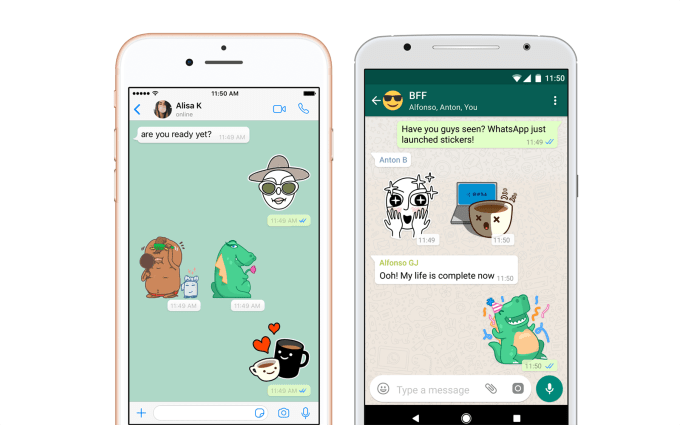
WhatsApp is finally adding stickers

WhatsApp is finally adding stickers to its hugely popular messaging app. The company said today that support for stickers will roll out to Android and iOS users over “the coming weeks.”

Initially, the app’s 1.5 billion users will have a seemingly limited selection with the first packs provided by WhatsApp’s own design team and some “other artists” chosen by the company.

However, that’s likely to change in the future since WhatsApp will allow anyone to add stickers that can be used inside the app.

It’s taking an interesting route to enabling that. Would-be sticker artists will need to publish their packs as an app on the Google Play or Apple App Store. From there, users can download the apps and then make use of the packs inside WhatsApp. The company has provided a template that it claims requires “minimal development or coding experience.”

A full guide on the sticker submission process can be found here.

Other messaging apps have taken a different approach.

Line — which pioneered the concept of stickers — takes a very curated approach, with sticker packs approved by the company itself. That walled garden approach has helped it curate the best selection of stickers, many of which are paid. That’s nothing to be scoffed as since Line makes hundreds of millions of dollars from sticker purchases every year.

Telegram has the most open sticker platform. Anyone can make and publish stickers in just minutes, but that leads to its own problems such as plagiarism and differing levels of quality.

Either way, WhatsApp’s move into stickers is very much a Facebook -led move.

The service’s founders — Jan Koum and Brian Acton — have both left the social network under controversial terms, at least according to Acton himself.

Prior to the acquisition deal, both men were very vocally opposed to advertising, games and other functions. They deemed them trivial and believed that they detracted from the core focus of WhatsApp: simple and fast messaging.

At this point, their ethical ship has long since sailed with Facebook introducing features like a business service and ad integrations with Facebook, while there are plans to roll out payments and other features that Koum and Acton would no doubt have railed against. It’s enough to make you vomit over the side of your yacht in the Mediterranean.

26 Oct 2018

Valentin Stalf to talk about scaling N26 at Disrupt Berlin

We couldn’t put together a conference in Berlin without inviting Valentin Stalf from N26, the co-founder and CEO of one of Europe's most promising startups.

A few years ago, few people would have bet on a startup creating a bank from scratch. N26 now has over 1.5 million clients and a ton of funding.

N26 originally launched at TechCrunch Disrupt London back in 2014. The company didn't win the Startup Battlefield. At the time, the company was called Number26 and they had 0 client. It was probably too early and too risky for our panel of judges. But we wanted to bet on them and give them some stage time.

I’ve covered N26 relentlessly over the years. They let me test the product back when everything was in German. They’re now available all around Europe (including the U.K.). And it always feels great when Startup Battlefield companies graduate and come back to Disrupt as regular speakers.

But N26 also faces a lot of scrutiny — all eyes are on that young company that wants to manage your money. N26 isn’t the only challenger bank either. It’s still fine for now as they’re all converting customers from traditional banks. But at some point, they’ll compete directly with each other.

Up next, N26 wants to expand to the U.S. It’s an interesting market as it’s highly fragmented with inconsistent regulation across all 50 states. And let’s be honest, American banks suck. They’re riddle with fees and a bad customer experience.

If you want to hear how Stalf plans to go to the next level, come to Disrupt Berlin. The conference will take place on November 29-30 and you can buy your ticket right now.

In addition to fireside chats and panels, like this one, new startups will participate in the Startup Battlefield Europe to win the highly coveted Battlefield cup.

Valentin Stalf

CEO & Co-founder, N26

Born in Vienna, Valentin studied Accounting & Finance (M.A. HSG) at the University of St. Gallen, Sophia University in Tokyo and the Vienna University of Economics and Business Administration. During his studies he worked in a number of fields including Strategy Consulting and Investment Banking/Mergers & Acquisition. Before he founded N26 together with Maximilian Tayenthal, he was with the Internet Incubator Rocket Internet as Entrepreneur in Residence and involved in building different companies

26 Oct 2018

China’s NIO invests in LiDAR startup Innovusion

Innovusion, a two-year-old startup developing LiDAR sensor technology for autonomous vehicles, has raised $30 million in a Series A funding round co-led by Chinese firms Nio Capital and Eight Roads Ventures along with U.S.-based F-Prime Capital.

Other seed round and strategic investors joined the round, the startup said.

Nio Capital is the venture arm of Nio, the Chinese electric automaker aiming to compete with Tesla. Nio, which raised $1 billion when it debuted on the New York Stock Exchange in September, has operations in the U.S., U.K. and Germany, although it only sells its ES8 vehicle in China.

Innovusion, which was founded in November 2016, says it will use the funding to scale up its operations, specifically to ramp up production of its light detection and ranging sensor system called Innovusion Cheetah. The company began shipping samples of the system in the second quarter of 2018 and is beginning to take customer orders.

The round of funding will allow the Los Altos, California-based company to expand its R&D team and manufacturing facilities to more quickly develop, market and deliver Innovusion Cheetah LiDAR to customers around the world, according to Junwei Bao, the company’s co-founder and CEO. The company primarily is targeting customers in China and the U.S.

LiDAR is used by companies developing autonomous vehicles to detect and measure objects on the road around them. Most of the companies testing AVs believe LiDAR is an essential sensor required to deploy self-driving vehicles safely on public roads. It’s what has propelled demand for LiDAR and, in turn, an array of startups to pop up and try capture market share away from Velodyne, the long-time dominant leader in the space.

26 Oct 2018

As Tether flails, cryptocurrency exchanges launch rival stablecoins

The promise of Tether, the digital currency pegged 1:1 to the US dollar, was that it could provide the benefits of a cryptocurrency while providing a fiat -backed peg against price fluctuations.

But the currency has fallen below the $1 in recent weeks, right as a range of competing currencies are becoming available to meet the growing interest in the so-called “stablecoin” sector. It’s certainly not a coincidence.

Stablecoins are digital currencies pegged to a stable asset, such as gold or fiat currencies, or backed by collateral (that could also be a cryptocurrency), or even an algorithm that governs the approach to expanding and contracting the money supply. The goal of every stablecoin project is to achieve the scale and adoption of modern monetary systems, as a store of value and also as a medium of exchange.

As we see Tether decline in adoption, opportunities arise for a number of new exchange stablecoins to become the go-to-coin. At the moment, we are seeing a commoditization of the space, and it won’t be until when trading volumes picks back up again when a new (or perhaps the same) Tether arises.

What’s been going on with Tether lately?

Tether (USDT), the largest stablecoin to date, seems to be in a terminal decline following intense scrutiny this year over dubious accounting practices. USDT is a widely tradable stablecoin created by Tether, a company run by the same executives behind the exchange BitFinex. Tether has been criticized for its failure to prove that the reserve has enough US dollar to back its digital currency on a one-to-one ratio, which it promises for its dollar-pegged cryptocurrency.

The pro-USDT narrative has been that despite its failure to provide transparency into its reserves and failing to acquire a proper audit, USDT is still the most widely traded stablecoin with significantly more volume than other stablecoin competitors. It previously compromised over 90% of market cap of all stablecoins and was listed on the most exchanges than any other stablecoin.

Nevertheless, that narrative seems to be breaking in the last 2 weeks. USDT has since seen its market cap go down by almost a third, from its peak of $2.8 billion to $2 billion in the course of 2 months.

In the past, users would purchase USDT via the Bitfinex platform for two major reasons, which is to buy bitcoin or transfer USD between countries. Given these two major applications, USDT has attracted users both outside and inside the cryptocurrency industry.

Recently, TechCrunch has gathered from investors that believe the price gap developed between Tether and USD is concerning. Because in the traditional markets, one would expect that big players and market makers would be capitalizing on that opportunity and closing the spread.

There have also been claims made by crypto researchers that Tether may be buying up USDT and planning to exit the stablecoin market. This can be driven by increasing scrutiny on the business and that having a stablecoin is no longer sensible and profitable for the company. There are increasingly signs pointing so on Tuesday this week when Tether announced that it has destroyed 500 million worth of USDT from the Tether treasury wallet.

Current stablecoin adoption and real world implementation are still in early stages. Despite more stablecoins getting introduced this year, there have not yet been any set of standards established for the space. If Tether really is winding down its market presence, that means there is room for other coin(s) to rise at least for the existing market demand. But really it’s about stablecoins potentially going mainstream one day

Below is a brief look at the other coins coming on to the market, and what they have done so far.

The rise of the exchange stablecoins

A number of stablecoins have been in existence since 2017 but exchange stablecoins pegged to the dollar have been a big trend in the last few months.

Among the latest movers, crypto exchange Gemini issued the Gemini Dollar and financial blockchain solution Paxos issued the Paxos Standard. Both coins were approved by the New York Department of Financial Services (NYDFS) last month, which set a precedence for the first regulated, digital representation of the U.S. dollar to be approved in the US. Similar to Tether, both exchanges assert that their stablecoins will be fully backed by a USD reserve. Gemini touts that the balance will be examined monthly by an independent registered public accounting firm to verify the 1:1 peg. Paxos was listed a couple weeks ago on top cryptocurrency exchange Binance.

Unlike non-exchange tied stablecoins, exchange- tied stablecoins enjoy certain benefits by being directly and immediately being put to use when launched. With Tether’s ongoing issue in the last few weeks, we are seeing exchanges either double downing on their own stablecoin, or diversifying to multiple different stablecoins to ensure they can capture majority of the market. Exchanges are incentivized to have their own in-house stablecoin because it allows their customers to turn any of their portfolio tokens trading on the market into stabilized tokens that they can keep as reserve — without having to rush to exchange it into fiat and worry about their portfolio change in value. Once more people hold a common stablecoin, they can transact with each other more easily and the coin could potentially grow adoption that way. This thereby indirectly raises the market cap of the exchange.

In mid-October, other top exchanges also started picking up their adoption and introduction of their own in-house stablecoins. OKEx, one of the top three cryptocurrency exchanges by volume, listed TrueUSD, along with Paxos Standard, Gemini Dollar and Circle’s stablecoin USD Coin. Huobi, another top ranked exchange by volume, followed with the same listings.

Huobi also listed its own stablecoin solution, called HUSD, which initially is launching by being the stablecoin replacement on its own exchange. And just on Tuesday this week, Coinbase backed Circle in forming the new CENTRE Consortium, and announced the support for USD Coin (USDC).

On the side, we also see numerous existing institutions that have announced and are making way into stablecoins. PWC has started getting into stablecoin advisory through partnerships, while IBM most recently announced its exploration into stablecoins through a collaboration with Stellar by building a stablecoin on the Stellar blockchain.

Which stablecoin could go mainstream?

For the launched tokens, the question now is: can they maintain their stability as their name alludes, and reach the adoption scale that Tether used to dominate?

Success to the public will be the 1) number of exchanges these coins get listed on and their float, 2) the number of transactions and size of transactions committed, and now hopefully 3) ongoing verified amount of reserve.

There are a few early indicators of who is moving ahead, even as many stablecoin projects are still building out their products or are in the process of launching.

Despite recognizing the importance of Tether, the Binance research team has said that they are evaluating almost all the other stablecoins on the market to add to its platform.

Additionally, as reported by Coindesk this last week, HBUS, the U.S. affiliate of the Singapore-based Huobi exchange, have seen both deposits and withdrawals of USDT “increased by over 10x over the last two days,”.

Per the spokesperson: “For deposits, users are transferring their USDT into HBUS from other exchanges to take advantage of our USDT/TUSD trading pair. There has been over a 30% increase in trading on the TUSD/USDT pair over the last two days.”

It is important to note that HBUS still only ranks 129th by adjusted total trading volume according to CoinMarketCap. However, these anecdotes explain how a number of these newer stablecoins broke their one-to-one fiat peg this week, and rose above $1 rather than falling below it. At least it gets some investors excited.

But once a token trades below or above the peg, it misses the whole purpose of stablecoin. It is evident that we are still in the early stage of the market, and over time, the token should stay stable regardless of market conditions, regardless location, and truly weather the most volatile of market times.

As stablecoin is still such a new arena in the cryptocurrency world, one can probably expect further insolvencies or regulatory shocks like what we saw with Tether, but in a lesser magnitude. After all, it certainly is a positive sign that many of these exchange stablecoins are now being regulated and recognized legally, as it is crucial for US-operating crypto companies’ adoption and scaling.

It will be most telling when trading volume returns to the scale of late 2017 to early 2018 time frame. As the market evolves, we may see true differentiation in the space, beyond yet another stablecoin maintaining reserves that are verified by a third party.


25 Oct 2018

Quizlet hits 50M monthly users

Most students in the U.S. have used or at least heard of Quizlet, the website for creating digital flashcards.

The company leverages machine learning to predict in which areas its users need the most help and provides 300 million user-generated study decks, maps, charts and other tools for learning.

Roughly eight months after closing a $20 million financing, Quizlet chief executive officer Matthew Glotzbach has disclosed some notable feats for the emerging edtech: it’s reached 50 million monthly active users, up from 30 million one year ago, and though it’s not profitable yet, its revenue is growing 100 percent YoY.

As a result of its recent growth, the company is opening its first office outside of Silicon Valley, in Denver.

“We by no means feel like our work is done; 50 million is a very small fraction of the 1.4 billion students on the planet,” Glotzbach told TechCrunch. “Our focus is growing the platform. If we continue to be successful in that mission, we will be the largest study and learning brand.”

The company has been around for a while. Founded in 2005 by then 15-year-old Andrew Sutherland, Quizlet was fully bootstrapped until 2015.

Its growth really began when Glotzbach, a seasoned executive most recently at YouTube, took the reigns in 2016. The $20 million round earlier this year, its largest yet, has allowed the company to blossom, too. Led by Icon Ventures, with participation from Union Square Ventures, Costanoa Ventures and others, it brought Quizlet’s total raised to just over $30 million.

Part of its growth, according to Glotzbach, has to do with its recent focus on its international users. The site has always been accessible around the world, but not until late 2016 did Quizlet begin offering the tool in other languages. Today, it’s available in more than 15 languages, a number the company is actively working to expand.

Newly added capabilities have also contributed to recent spikes in MAUs. Students can now access diagram-based content, which is helpful for STEM subjects, an area the company has historically been less helpful with.

Quizlet operates a freemium model but has three subscription products for power users. At $12 per year, Quizlet Go has no ads and provides an offline studying option on mobile. Quizlet Plus, at $20 per year, also provides an ad-free study experience, as well as image uploading and voice recording capabilities. Finally, Quizlet for Teachers offers educators a $35 per year option that lets them create their own decks for students and access to additional data, analytics and reporting.

25 Oct 2018

Two hackers behind 2016 Uber data breach have been indicted for another hack

Two hackers who stole millions of users’ data from ride-hailing firm Uber have been indicted on separate hacking charges related to a data breach at online learning portal Lynda, two people familiar with the case have told TechCrunch.

Vasile Mereacre, a Canadian citizen living in Toronto, and Brandon Glover, a Florida resident, were indicted earlier this month in Florida on federal hacking and extortion charges for stealing data on 55,000 Lynda users’ accounts.

According to the recently unsealed indictment, the FBI was considering extraditing Mereacre from Canada, but federal agents later learned that he was planning to fly to Miami on October 16. Mereacre was arrested by FBI agents once he landed, and made his initial appearance in court — at which the indictment was unsealed.

The indictment accuses the two alleged hackers of obtaining tens of thousands of Lynda user accounts from a company-owned Amazon web server. Prosecutors accused the two of “exerting control over the accounts as a means to obtain money from LinkedIn.” Using a burner Protonmail email account, the two emailed LinkedIn and HackerOne, a bug bounty program used by Lynda, to disclose the breach.

“I was able to access backups upon backups,” one of the defendants wrote in their email. They also claimed to have usernames, passwords, payment data and backend code.

When an unnamed LinkedIn executive emailed back inviting the alleged hackers to its HackerOne bug bounty program, they said to “keep in mind, we expect a big payment as this was hard work for us.”

The two were released on a bond, and on condition that they are not permitted to use the internet. The case is now being heard in a California court.

The accusations are nearly identical to the circumstances around Uber’s breach, just months earlier.

Uber disclosed the breach of 57 million worldwide users — including 4.1 million drivers — almost a year later. The company was accused of covering up the breach, after two former senior Uber executives — since fired — paid the two hackers $100,000 through its bug bounty to destroy the data that they obtained but without notifying customers or regulators.

Little was known about the hackers until Uber’s chief information security officer John Flynn told lawmakers at a Senate Commerce Committee hearing in February that the two hackers were from Florida and Canada.

Uber declined to comment.

The hackers gained access to an Amazon web server, owned by Uber, using credentials that were mistakenly left in a GitHub repository by an Uber engineer. According to an investigation by the Federal Trade Commission, the hackers downloaded more than a dozen files — including a backup file — containing Uber customer data. It’s not known what was said in the disclosure to Uber, but the FTC claimed the hackers were “demanding” a six-figure payout.

The breach was one of several scandals to plague the ridesharing company and the eventual departure of founder Travis Kalanick from the company.

Since the breach, Uber agreed to 20 years of privacy audits in a settlement with the FTC. The company was later ordered to pay $148 million in its breach settlement.

A spokesperson for the Justice Department did not respond to a request for comment, nor did Glover’s public defender Michael Ryan. Mereacre’s attorney, Christopher Lyons, declined to comment. HackerOne did not comment.

LinkedIn spokesperson Mary-Katharine Juric said: “We appreciate the ongoing work by the FBI to pursue those believed responsible for the 2016 breach of Lynda user information. We will continue to engage with law enforcement as this case develops.”

Parts of Glover’s docket appear to have been withheld. Mereacre will appear in court on November 8.

25 Oct 2018

Inspired by spiders and wasps, these tiny drones pull 40x their own weight

If we want drones to do our dirty work for us, they’re going to need to get pretty good at hauling stuff around. But due to the pesky yet unavoidable restraints of physics, it’s hard for them to muster the forces necessary to do so while airborne — so these drones brace themselves against the ground to get the requisite torque.

The drones, created by engineers at Stanford and Switzerland’s EPFL, were inspired by wasps and spiders that need to drag prey from place to place but can’t actually lift it, so they drag it instead. Grippy feet and strong threads or jaws let them pull objects many times their weight along the ground, just as you might slide a dresser along rather than pick it up and put it down again. So I guess it could have also just been inspired by that.

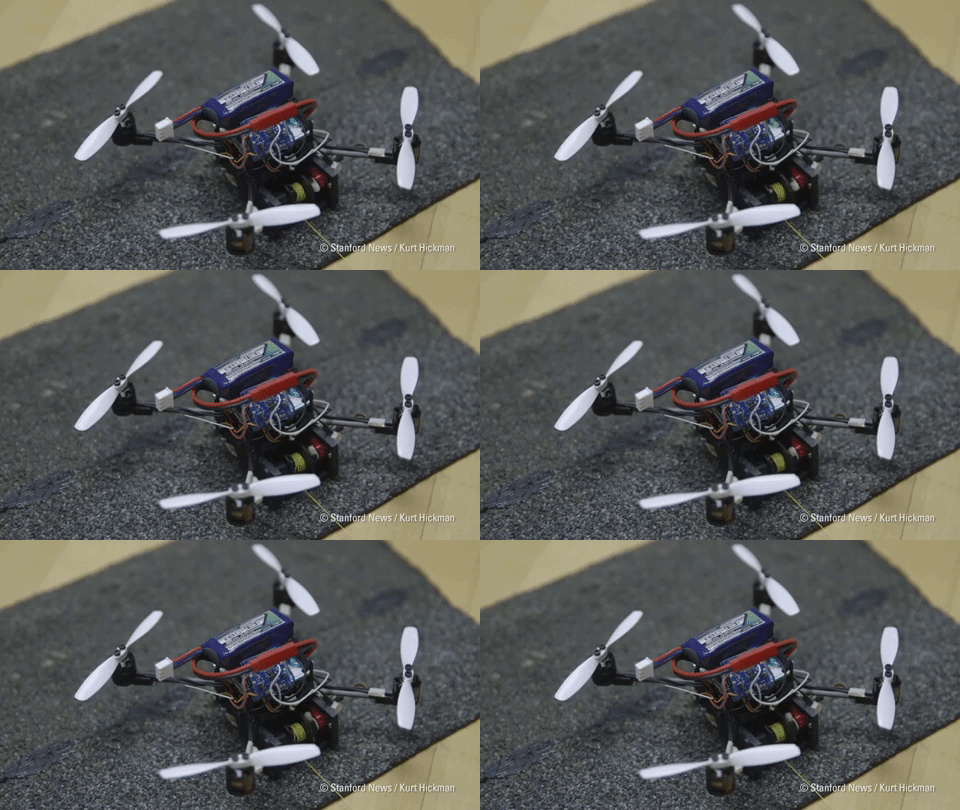
Whatever the inspiration, these “FlyCroTugs” (a combination of flying, micro and tug presumably) act like ordinary tiny drones while in the air, able to move freely about and land wherever they need to. But they’re equipped with three critical components: an anchor to attach to objects, a winch to pull on that anchor and sticky feet to provide sure grip while doing so.

“By combining the aerodynamic forces of our vehicle and the interactive forces generated by the attachment mechanisms, we were able to come up with something that is very mobile, very strong and very small,” said Stanford grad student Matthew Estrada, lead author of the paper published in Science Robotics.

The idea is that one or several of these ~100-gram drones could attach their anchors to something they need to move, be it a lever or a piece of trash. Then they take off and land nearby, spooling out thread as they do so. Once they’re back on terra firma they activate their winches, pulling the object along the ground — or up over obstacles that would have been impossible to navigate with tiny wheels or feet.

Using this technique — assuming they can get a solid grip on whatever surface they land on — the drones are capable of moving objects 40 times their weight — for a 100-gram drone like that shown, that would be about 4 kilograms, or nearly 9 pounds. Not quickly, but that may not always be a necessity. What if a handful of these things flew around the house when you were gone, picking up bits of trash or moving mail into piles? They would have hours to do it.

As you can see in the video below, they can even team up to do things like open doors.

“People tend to think of drones as machines that fly and observe the world,” said co-author of the paper, EPFL’s Dario Floreano, in a news release. “But flying insects do many other things, such as walking, climbing, grasping and building. Social insects can even work together and combine their strength. Through our research, we show that small drones are capable of anchoring themselves to surfaces around them and cooperating with fellow drones. This enables them to perform tasks typically assigned to humanoid robots or much larger machines.”

Unless you’re prepared to wait for humanoid robots to take on tasks like this (and it may be a decade or two), you may have to settle for drone swarms in the meantime.

25 Oct 2018

Vishal Makhijani steps down as chief executive of Udacity

Vishal Makhijani, the long time chief executive of online education company Udacity, is stepping down as its chief executive officer, TechCrunch has learned.

Makhijani first joined the company in 2013 as chief operating officer under Sebastian Thrun, the company’s founder and chief executive at the time.

In 2016, Thrun, the original architect of Alphabet’s self-driving car initiatives and a storied entrepreneur and engineer in Silicon Valley, handed the reins of his online education startup over to Makhijani, who assumed the mantle of CEO while Thrun became chairman and president of the company.

In an interview, Makhijani declined to disclose his next steps, but Thrun praised the executive for taking Udacity to new heights and hailed him as a key contributor to the company’s continuing growth.

As Thrun wrote in a blog post praising Makhijani for his tireless efforts.

Over the last five years, Vish worked with hundreds of tech companies to build curriculum focused on opening up new career opportunities for our students. Under Vish’s leadership, we launched more than thirty Nanodegree programs in areas such as Artificial Intelligence, Data Science, Self-Driving Cars, and Digital Marketing. We expanded our operations into China, India, Brazil, the Middle East, and Europe, and we started a fast-growing new enterprise division.

Udacity now employs a team of 500 across the globe and its enterprise division, offering continuing education to workers through partners like PriceWaterhouseCoopers and other Fortune 1000 customers has become a new engine of revenue and growth for the company.

It also has more than 10 million students across its paid and free classes, with over 50,000 enrolled in its nanodegree programs.

The financials are also looking better for Udacity. The company saw revenue rise 100% in 2017 to $70 million and is on track for continued revenue growth this year.

A spokesperson for the company said that there were no complaints brought against Makhijani that would have pushed him to step down.

With the executive’s departure, the Udacity board is instituting a new search for chief executive led by director and Andreessen Horowitz general partner, Peter Levine .

“In the interim, as Udacity’s founder and now executive chairman, I will work closely with Udacity’s leadership team to run the business and collaborate on a search for our new CEO,” Thrun wrote in a blog post.