Year: 2018

25 Oct 2018

New plans aim to deploy the first U.S. quantum network from Boston to Washington DC

About 800 kilometers of unused fiber optic cable running down the U.S. eastern seaboard is set to become the first stateside quantum network.

The aim is to get the quantum network up and running and accepting customers by the end of the year, making it the first time that quantum keys will be exchanged commercially on U.S. soil.

Quantum Xchange, a Bethesda, Maryland-based quantum communications provider, has inked a deal for Zayo, a fiber network giant, to provide the stretch of fiber from Boston to Washington DC. Its first aim is to help connect Wall Street financiers with their back operations in nearby New Jersey, but the hope is that other industries — from healthcare to critical infrastructure — will soon use the network for their own secure communications.

Quantum cryptography and networking aren’t new concepts but have risen to prominence in recent years as both a threat to some encryption and also the savior of future secure communications. Relying on photons and the laws of quantum physics to share encryption keys over a long distance from one place to another makes it significantly harder to intercept the keys without breaking the beam or perfectly cloning a copy. This technique, known as quantum key distribution (QKD), is seen as a likely contender for the future of end-to-end encryption.

Although quantum cryptography has been around for years, it’s only been in recently that scientists and computer engineers have harnessed the technology for practical uses. Soon, the technology could be used for protecting elections, transmitting payments, and securing communications between datacenters — even from satellites back to earth.

Europe has already seen some success in building a small-scale quantum network, but “shortcomings” made bringing the system to the U.S. more difficult, said Quantum Xchange chief executive John Prisco.

His company uses trusted node technology that passes quantum key data from point to point over a larger distance, making it easier to scale a quantum network over wider geographical spaces.

“Organizations with offices in Boston will be able to send secure communications to a partner in D.C., and eventually even further – as the goal is to keep buying up optical fiber that is already in the ground all over the country so that we can provide a secure quantum network that will serve the entire nation,” he said.

Prisco said it’s “critical” to establish a quantum key distribution network as a defensive measure “before the unprecedented power of quantum computers become an offensive weapon.”

25 Oct 2018

One-year-old Ribbon raises $225m to remove the biggest stress of home buying

Big problems require big war chests. Ribbon wants the biggest chest of them all.

The startup, which was founded just about a year ago by ex-LendingClub head of strategic development Shaival Shah and ex-Twitter/TellApart engineer Jian Wei Gan (who, full disclosure, is married to TechCrunch columnist Joyce Yang), wants to replace the incredible stress of securing a mortgage during the home buying process with a Ribbon Offer: if a buyer can’t secure a mortgage in time for close, Ribbon will pay for the house itself and give the buyer extra time to get financing.

It’s a simple premise, but potentially revolutionary in its effect on home buying in the United States, and Ribbon’s investors have taken notice. After raising a small seed earlier this year, the company announced today that it has raised $225 million in a combination of debt and Series A equity financing. (The company refused to go on-the-record about the breakdown of debt and equity). The equity portion was led by its existing seed investors Bain Capital Ventures, Greylock, NFX, and NYCA.

Understanding Ribbon requires understanding the immense difficulties of consumer home buying. Home ownership remains a dream for most Americans, but actually purchasing a home in the United States remains incredibly challenging. From finding a home to negotiating with a seller and handling hundreds of pages of paperwork — all of it together can create one of the most stressful periods of anyone’s life.

And it is getting even more intense. For consumers buying homes, their competitors are often not their fellow humans, but rather large investment firms who come with all-cash offers and guarantees to close. As the Wall Street Journal noted last year in a deep dive on the practice, “All told, big investors have spent some $40 billion buying about 200,000 houses, renovating them and building rental-management businesses, estimates real-estate research firm Green Street Advisors LLC.”

That has made mortgage financing — necessary for most buyers — an increasingly common no-go for home sellers. To solve for this, Ribbon wants to give every consumer the leverage of an all-cash offer while eliminating the mortgage contingency in home buying.
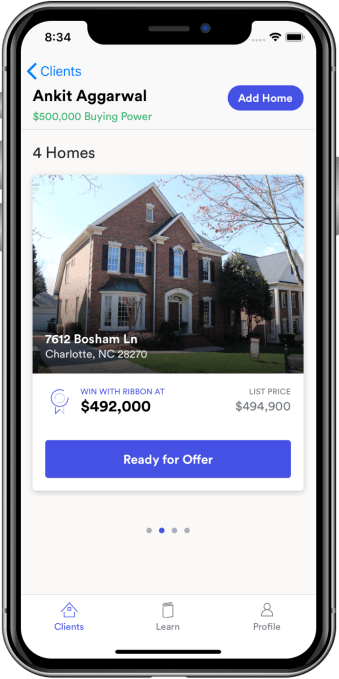
Ribbon’s app allows home buyers to find houses and determine Ribbon Offer prices (Photo from Ribbon)

When purchasing a home, buyers who need mortgage financing will include a clause in the home purchase contract stating that if they are unable to get a mortgage in time for closing, they are able to walk away from a deal, generally without financial penalty. This is known as a mortgage contingency.

That clause puts sellers in a bind: move forward with such a buyer, and their creditworthiness will determine whether a transaction is completed. Yet, sellers don’t really know their buyers, and they have very little visibility into a buyer’s ability to get a mortgage. Pre-approved mortgages help here, when they are available, but are a poor substitute for cash.

Ribbon takes on home buyers as clients and assesses their likelihood of securing a mortgage using data science. If convinced that a buyer will get a mortgage, it then offers a Ribbon guarantee to the seller that if financing falls through, it will offer the cash needed to close the transaction.

“We guarantee a close and we guarantee a move in,” explained Shah, who is CEO. He emphasized that “we are not just providing a cash offer, but a guarantee to close … which creates certainty in the real estate process.”

One of Ribbon’s early purchases was this home (Photo from Ribbon)

Ribbon is free for buyers, and the company charges a 1.95% fee at closing from sellers. It is not uncommon for home sellers to discount their home price for all-cash offers due to the greater certainty of close, and Ribbon believes the same pattern will hold true for its Ribbon Offer. “Our view is that if discounts are going to exist because of the cash guarantee … let that discount flow through to the consumer ecosystem,” Shah explained.

If a mortgage falls through at the last minute, Ribbon will buy the home and wait for the buyer to secure a different mortgage. That process can sometimes be just a few days, which means that Ribbon doesn’t need to hold substantial housing inventory or take on macroeconomic risk, and can turnover its debt quite rapidly.

The company launched in Charlotte, North Carolina and has been in the market for about six months. Shah said that the company “tripled” transaction volume from Q2 to Q3, although demurred on deeper details of the company’s revenues. Charlotte was chosen both because home prices are cheaper than in major global cities like New York City and San Francisco, and because the percentage of cash offers locally has hovered slightly above a third in recent years according to company data due to a surge in corporate buying.

Ribbon wants to be “Switzerland” according to Shah, which means working with existing realtors and existing mortgage lenders in a neutral and non-competitive way. He doesn’t see a world in which the company would offer its own mortgage products (at least, not yet), and instead wants to focus on perfecting the data models that underwrite its guarantee.

Home buying startups have been heavily financed by venture capitalists, including Opendoor, which has raised $1 billion, and others like Perch and Knock. Shah says that his competitors primarily focus on sellers rather than buyers, and Ribbon wants to do the opposite.

The company intends to expand to ten new markets in the coming year, and has already grown organically through realtor referrals to expand to Asheville and Cary, North Carolina.


25 Oct 2018

China to Trump: Dump the iPhone for a Huawei

A China foreign ministry spokeswoman Hua Chunying dismissed yesterday’s damning report about spying on Trump’s unsecured iPhone, calling it, “fake news,” according to The South China Morning Post. She had a few other choice words for the president, suggesting he switch to a Huawei handset, or, failing that, just stop communicating.

The shade amounts to a pretty solid bit of trolling from the spokesperson, who added, “Seeing this report, I feel there are those in America who are working all-out to win the Oscar for best screenplay.”

Yesterday’s New York Times report noted that, “American spy agencies, the officials said, had learned that China and Russia were eavesdropping on the president’s cellphone calls from human sources inside foreign governments and intercepting communications between foreign officials.”

Trump shot back on Twitter this morning, attempting to correct the record, while stating that he didn’t have time to do so, adding that it was “soooo wrong.” The president also insisted, contrary to the report, that he only uses “government phones.”

Hua’s statement takes things a few steps further, while wading into various on-going U.S. bans against Huawei handsets and networking equipment over government spying concerns.

25 Oct 2018

Google Lens comes to Google Images for searching – and shopping – inside photos

Google this morning announced it’s bringing its A.I.-powered Lens technology to Google Image Search. The idea, explains the company, is to allow web searchers to learn more about what’s in a photo – including, in particular, items they may want to shop for and buy. For example, a photo of a well-decorated living room might have a sofa you like, but the photo itself wouldn’t have necessarily informed you who made the sofa or where it was for sale.

Google Lens – yes, acting very much like Pinterest – will now be able to help with that.

You’ll be able to tap on “dots” that appear within the photo, which designate items Google Lens has identified, or you can use your finger to “draw” around an object in the photo to trigger Google Images to search for related information. Google then searches across the web, including for other images, web pages, and even videos where this object may appear.

This isn’t just for shopping, of course. Google Lens can also be used to learn more about landmarks, animals, places you want to travel and more.

But Google naturally sees a good fit for Lens when it comes to directing users to products and, therefore, the websites of potential Google advertisers. This is the area where Pinterest has been steadily advancing.

Pinterest last month reported a 25 percent increase in monthly active users, as it gears up for its IPO. That means more people are starting their shopping journeys on its site, looking for purchase inspiration around things like fashion, home décor, travel, and other ideas. It’s also been beefing up its advertising product to further capture users’ interests and connect them with brands, having earlier this year added promoted videos to its ad products. 

And just a week ago, Pinterest announced it had rebuilt the infrastructure around product pins to make its site and app more “shoppable,” while reporting that tests of the changes had shown a 40 percent increase in visits to retailers’ site, as a result.

For these reasons – not to mention the looming threat of Facebook and Instagram ads sending users directly to retailers’ websites, and Amazon’s not insignificant entry into the advertising business – it’s clear that it was time for Google to leverage its own technology to help improve shopping and click-through rates for retailers on its site, as well.

Google says Lens in Images is now live on the mobile web for people in the U.S. searching in English, and will soon be rolled out to other countries, languages and Google Images locations.

25 Oct 2018

Summersalt raises $6M for its direct-to-consumer line of eco-friendly swimsuits

Founders Fund has led the $6 million Series A for Summersalt, an early-stage e-commerce startup embracing the next-gen consumer’s penchant for inclusivity and affordability.

Headquartered in St. Louis, the 1-year old company sells swimsuits designed in-house with eco-friendly fabrics directly to consumers. Like other D2C brands, Summersalt cuts out the middlemen to give its customers access to its swimsuits for $95 or less. What sets it apart is its data-focused fit system. With a patent on recommending garments based on body type and consumer preference, it uses more than 10,000 scans of real women’s bodies and some 1.5 million measurements to create what it says are designer-quality garments.

Co-founder and chief executive officer Lori Coulter designs all the swimsuits herself and sources the fabrics directly with factories in the U.S. and Asia. With the latest investment, Coulter says the company will launch a line of travel wear and expand its inventory to offer more sizes.

“A core value of the brand really is inclusivity and we know from an economic perspective that by moving up to size 22, we really can acquire a broader set of consumers,” Coulter told TechCrunch.

Reshma Chattaram Chamberlin, co-founder and chief brand officer, said their strategy is to cater to women like them. Chamberlin herself is an immigrant, originally from Mumbai, while Coulter, a mother of two, was born and raised in Missouri.

“We were both tired of seeing the oversexualized approach to swimwear,” Chamberlain told TechCrunch. “We wanted a brand to appeal to women like us so we could feel sexy on our own terms. We wanted to appeal to women across the country, whether that’s a mom in Missouri or a stylish girl in Brooklyn.”

“Women like us are immigrants. Women like us are moms. Women like us are size 2 and women like us are size 22,” she added.

The pair said the move to incorporate a travel line is in keeping with their wanderlust-themed brand, which appeals to younger consumers.

“It’s a unique time in retail; women prefer experiences over things,” Coulter said. “We really see this as the next frontier in retail. We want to position Summersalt as the next-generation brand focused around travel.”

It’s the Peter Thiel -owned Founders Fund’s first investment in the startup, which previously raised a $2 million seed round in March 2018. Lewis and Clark Ventures, Revolution’s Rise of the Rest Seed Fund, Dundee Venture Capital, Breakout Capital, Cultivation Capital, Victress Capital, Amplifyher Ventures, M25 and Giuliana and Bill Rancic also participated in the funding.

25 Oct 2018

Europe’s parliament calls for full audit of Facebook in wake of breach scandal

The European Parliament has called for a full audit of Facebook following a string of data breach scandals —  including the Cambridge Analytica affair.

MEPs are urging the company to allow European Union bodies to carry out a full audit to assess data protection and security of users’ personal data, following the scandal in which the data of 87 million Facebook users was improperly obtained and misused.

In the resolution, adopted today, they have also recommended Facebook make additional changes to combat election interference — asserting the company has not just breached the trust of European users “but indeed EU law”.

We’ve reached out to the company for comment on the parliament’s resolution.

Earlier this month the EU parliament’s civil liberties committee adopted a similar resolution, calling for a full and independent audit of Facebook and for the company to make further changes to its platform.

The Libe committee also called for an update to EU competition rules to reflect what it dubs “the digital reality”, and investigation of what it called the “possible monopoly” of big tech social media platforms.

Commenting in a statement today, following the parliament’s vote, civil liberties committee chair Claude Moraes said: “This is a global issue, which has already affected our referenda and our elections. This resolution sets out the measures that are needed, including an independent audit of Facebook, an update to our competition rules, and additional measures to protect our elections. Action must be taken now, not just to restore trust in online platforms, but to protect citizens’ privacy and restore trust and confidence in our democratic systems.”

The resolution follows an appearance by Facebook’s founder Mark Zuckerberg in front of the EU parliament’s Conference of Presidents in May, and a series of parliament committee hearings including with Facebook staffers.

The EU’s tough new data protection framework, GDPR, only came into force this May — so the Cambridge Analytica breach is being handled under the bloc’s prior data protection framework, comprising a patchwork of Member State laws.

And earlier today a fine handed to Facebook for this breach by the UK data watchdog was upheld. The £500k penalty is the maximum possible fine under the country’s prior data protection regime.

In the new resolution, MEPs have suggested the data obtained by Cambridge Analytica may have been used for political purposes, by both sides in the UK referendum on membership of the EU and to target voters during the 2016 US presidential election — describing it as a matter of urgency that electoral laws be adapted to take account of digital campaigning. (Clearly with an eye on the upcoming EU elections, next May.)

To combat electoral meddling via social media, MEPs are proposing:

  • applying conventional “off-line” electoral safeguards online: rules on spending transparency and limits, respect for silence periods and equal treatment of candidates;
  • making it easy to recognise online political paid advertisements and the organisation behind them;
  • banning profiling for electoral purposes, including use of online behaviour that may reveal political preferences;
  • that social media platforms should label content shared by bots, speed up the process of removing fake accounts and work with independent fact-checkers and academia to tackle disinformation;
  • investigations should be carried out by member states with the support of Eurojust, into alleged misuse of the online political space by foreign forces.

In the UK a parliamentary committee also recently urged the government to prioritize updating electoral law to take account of digital risks to democratic processes. Although the government has so far only taken a cautious approach, saying it’s still gathering evidence via a series of reviews into different aspects of the issue.

Meanwhile Facebook has been rolling out its own system of checks on political advertisers in certain regions — including the UK.  Though MEPs evidently believe such systems need to go further.

25 Oct 2018

Xiaomi opts for sliding camera and no notch for new bezel-less Mi Mix phone

Xiaomi has announced the newest version of its bezel-less Mi Mix family, and it doesn’t sport a notch like its Mi 8 flagship. Indeed, unlike the Mi 8 — which I called one of Xiaomi’s most brazen Apple clones — there’s a lot more to get excited about.

The Mi Mix 3 was unveiled at an event in Beijing and, like its predecessor, Xiaomi boasts that it offers a full front screen. Rather than opting for the near-industry standard notch, Xiaomi has developed a slider that houses its front-facing camera. Vivo and Oppo have done similar using a motorized approach, but Xiaomi’s is magnetic while it can also be programmed for functions such as answering calls.

That array gives it a claimed 93.4 percent screen-to-body ratio and a full 6.4-inch 1080p AMOLED display. The slider, by the way, is good for 300,000 cycles, according to Xiaomi’s lab testing.

The device itself follows the much-lauded Mi Mix aesthetic with a Snapdragon 845 processor and up to 10GB in RAM (!) in the highest-end model. Xiaomi puts plenty of emphasis on cameras. The Mi Mix 3 includes four of them: a 24-megapixel front camera paired with a two-megapixel sensor and on the back, like the Mi 8, a dual camera array with two 12-megapixel cameras.

Xiaomi has also snuck an ‘AI button’ on the left side of the phone, a first for the company. That awakens its Xiao Ai voice assistant, but since it only supports Chinese don’t expect to see that on worldwide models.

The 10GB version — made in partnership with Palace Museum, located at the Forbidden City where the device was launched — also packs 256GB of onboard storage and is priced at RMB 4,999, or $720. That’s in addition to a ceramic design that Xiaomi says is inspired by the museum… better that than a fruity-sounding U.S. company.

That’s the special model, and the more affordable options include 6GB + 128GB for RMB 3,299 ($475), 8GB +128G for RMB 3,599 ($520) and 8GB + 256GB for RMB 3,999 ($575). The company also plans to introduce a 5G version in Europe sometime early next year.

Xiaomi said the phones will go on sale in China from 1 November, there’s no word on international availability or pricing right now.

25 Oct 2018

Real estate upstart Compass acquires part of shopping app Spring, including 20+ engineers and CTO

After raising $400 million in September in a round that valued it at $4.4 billion, the real estate startup Compass is making an acquisition to help it double down on growth: it is acquiring a portion of Spring, the mobile-first fashion shopping app that has raised more than $100 million since 2014, to work on parts of Compass’s AI-based real estate platform, which provides a marketplace to post properties for sale and rental across the US and soon other countries.

Compass and Spring are not disclosing the financial terms of this deal. When Spring last raised money in May 2017 — $65 million led by Fidelity — it was valued at nearly $152 million, according to PitchBook.

Compass is just one of Spring’s buyers: it is taking on an undisclosed element of the business (enough that Compass was clear to describe this a ‘strategic acquisition’), including Spring CTO Satwik Seshasai, director of engineering Jim Grandpre, and some 20 others from its engineering team. But at the same time, we have learned that the other part of Spring will be going to another buyer, Shoprunner, the Alibaba-backed shopping app that has ambitions to take on Amazon.

“Spring was founded on the belief that consumers were looking for a better online shopping experience, a single destination where they could find all their favorite brands,” said Seshasai in a statement. “In a similar way, Compass is embracing the digital future and revolutionizing a legacy industry with agent satisfaction at its focus. I am thrilled to help Compass grow its technology platform as it continues to be a leading disruptor in the real estate industry.”

Seshasai will become Compass’s senior director of growth infrastructure, and Compass said that the team it’s acquiring will be deployed alongside Compass’s existing team of engineers and other areas of the business “to help accelerate its technology roadmap and develop technologies that enhance the agent experience.” They will work under and with Compass’s VP of engineering, Priyendra Deshwal, and head of product, Eytan Seidman, and an existing team of 120+ technical staff.

Compass has built itself to become a very slick site focussing on high-end properties and customers, but under the surface it is a very well-oiled tech beast: it was co-founded by ex-banker Robert Reffkin and Ori Allon, and Allon is an engineering whiz who had built and sold search businesses to Google and then Twitter (respectively helping each of them build their earliest search algorithms). 

“The team at Spring built a service-oriented brand and technology platform that attracted 2,000 of today’s top retailers,” said Ori Allon, Compass Founder, and Executive Chairman, in a statement. “At Compass, we believe in investing in top talent which is why we welcome the opportunity to bring members of the Spring team on board. Our new Compass colleagues will execute against and innovate on ways to build the end-to-end real estate platform with real-time insights and technologies that will redefine the industry.”

When Spring first sprouted up in 2014, many thought its mobile-only approach — providing a marketplace for labels and shops that finally made buying and checking out from the virtual store as easy as swiping right — would help it steal a march on the world of online fashion. Indeed, we described it at the time as the “Instagram of shopping.”

However, over time it appeared to expand what it was doing in an effort to scale — adding a web site and working with retailers as well — which diluted its pitch to brands that had hoped for a more direct relationship with consumers. And on top of that, you could argue that Instagram itself has taken on the task of becoming the “Instagram of shopping.”

The Shoprunner part of the Spring deal has been rumored for the last month. A report in Recode that broke the news seemed to imply that Spring had failed to be able to scale its business, despite its funding and the expansion of its business.


25 Oct 2018

Twitter beats Wall St Q3 estimates with $758M in revenue

Twitter came in ahead of analysts’ financial estimates in its third quarter, reporting $758 million in revenue (a 29 percent year-over-year increase) and earnings per share of 21 cents.

Analysts had predicted revenue of $703 million and EPS of 14 cents per share. Ad revenue was also up 29 percent, to $650 million, and Twitter says total ad engagements increased 50 percent year over year.

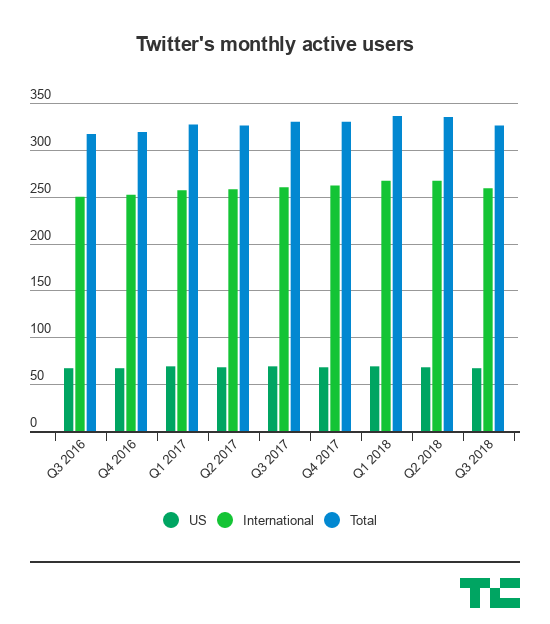
However, user growth didn’t quite match expectations, with 326 monthly active users, lower than predictions of 330 million, and also a decline from the same period last year, when Twitter had 335 million MAUs.

In the earnings release, the company says its user growth was “impacted by a number of factors including: GDPR, decisions we have made to prioritize the health of the platform and not move to paid SMS carrier relationships in certain markets, as well as a product change that reduced automated usage and a technical issue that temporarily reduced the number of notifications sent.”

Twitter MAU

In a statement, CEO Jack Dorsey similarly suggested that the company has been focusing on the “health” of the community, rather than pursuing growth at all costs.

“We’re achieving meaningful progress in our efforts to make Twitter a healthier and valuable everyday service,” Dorsey said. “We’re doing a better job detecting and removing spammy and suspicious accounts at sign-up. We’re also continuing to introduce improvements that make it easier for people to follow events, topics and interests on Twitter, like adding support for U.S. TV shows in our new event infrastructure. This quarter’s strong results prove we can prioritize the long-term health of Twitter while growing the number of people who participate in public conversation.”

While Twitter still attracts plenty of criticism for its approach to safety, harassment and misinformation (it was slower than the other major online platforms to ban Alex Jones and Infowars, for example), it has taken steps in the past few months to suspend accounts that were “engaging in coordinated manipulation,” as well as those who tried to get around previous suspensions.

The company says that the average number of daily active users actually increased 9 percent year-over-year, and the investor relations account tweeted that “DAU growth continues to be the best measure of our success in driving the use of Twitter as a daily utility.”

As of 7:55am Eastern, Twitter shares were up nearly 15 percent in pre-market trading.

25 Oct 2018

Apple picks Thailand for its second retail store in Southeast Asia

Apple continues to increase its efforts in Southeast Asia’s fast-growing market after it picked Thailand as the location for its second Apple Store in the region.

A post on Apple’s website reveals that it will operate a retail store at the soon-to-open Iconsiam which is set to become Bangkok’s largest mall when it opens next month. The Apple Store is set to open its doors on November 10. An Apple representative confirmed to TechCrunch that the details on the website are indeed accurate.

The new store follows the opening of an Apple Store in Singapore last year, which marked the U.S. firm’s first official brick and mortar presence in Southeast Asia, a region of 650 million consumers that has more internet users than the U.S. population.

Apple doesn’t break out sales figures for Southeast Asia. The region is part of the ‘rest of Asia Pacific’ bracket which excludes Japan and China and accounts for around six percent of Apple’s global revenue.

That is a drop in the proverbial ocean for Apple, but Southeast Asia is one of the few parts of the world where smartphone sales continue to grow at a double-digit percentage. With its devices accounting for a minor share of the region’s markets, primarily due to pricing and a lack of carrier subsidies, it makes sense that Apple is stepping up its retail focus.

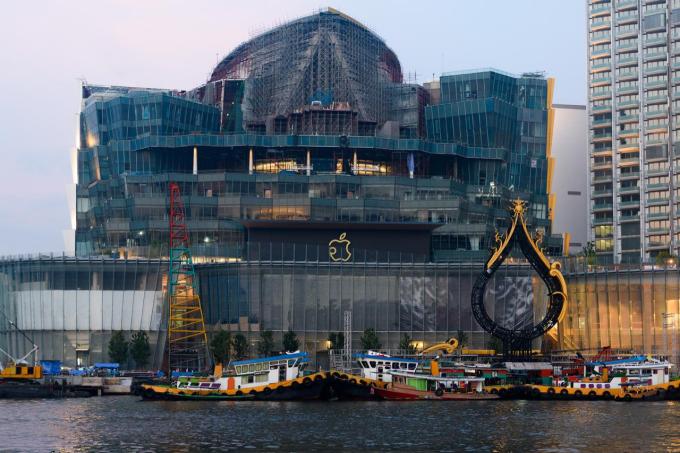
The Iconsiam mall which will house Bangkok’s first Apple Store is still under construction but scheduled to open next month

Apple’s official presence in Asia had been limited to China, Hong Kong and Japan until recent times when it opened stores in Korea, Taiwan and Singapore. TechCrunch understands from sources within the real estate industry that Apple is considering Indonesian capital Jakarta and Vietnam as its next store launch markets in Southeast Asia. It intended to open the Thai store as soon as last year but struggled to find a location that it deemed to be fitting for its store, we understand.

Right now, most countries in Southeast Asia are served by ‘licensed’ Apple stores from third-parties, unofficial retailers, Alibaba-owned e-commerce service Lazada and Apple’s own online store. Outside of the region, it has long tried to bring its iconic stores to India, but regulations on operating physical stores have hampered its progress.