Year: 2018

25 Oct 2018

Red Dead Redemption 2 sets the bar high for the next generation of open world games

It’s been nearly a decade since Rockstar Games introduced Red Dead Redemption, a massive open world game with a story about as reflective of American culture as the Grand Theft Auto franchise.

Tomorrow, Red Dead Redemption II goes live after months of breathless speculation. And yes, it’s as good as you dreamed it. That’s not to say that the layers of interactivity, which are a huge step forward for the next generation of open world games, are not without their faults. But the level of attention to detail, the way that the various components of the game work in conjunction, and the intricacy of even the most mundane activities makes playing Red Dead Redemption 2 feel as authentic as being Arthur Morgan yourself.

But before we dive into the review, it’s worth noting that Devin and I each spent less than a dozen hours playing this game before sitting down to write. In fact, according to the progress bar in my game, I’m less than 20 percent of the way through the story, with even less completed of the challenges and the Compendium (index of items discovered/found). This game is so massive, it would be impossible to bring you thoughtful analysis of the story. We haven’t finished it yet.

We do, however, have some early impressions of the game below. For those looking to avoid spoilers, don’t worry — everything we talk about takes place in the first couple hours of the game and we’ve shied away from naming places, characters, and missions.

A world of details

For a game this big, it kind of makes sense to start with the details. It’s evident that this is an environment not just crafted with care, but presented with directorial intent. That’s important to say right off the bat — this isn’t just a big chunk of land for you to wander, but the stage for a story, and a stage that has been dressed with more care than perhaps any game to date.

It’s easy to talk about square mileage, about how many buildings can be entered, about the hours of dialogue you may encounter. But those are quantitative measures when what matter are the qualitative ones.

The details are what set RDR2 apart. Everywhere you look there are details, from the seams and rips on the dozens of coats you’ll see and wear, to the fact that you have to clean and oil your gun regularly, to how the items you buy are actually on the walls of the general store you visit. The dialogue too is remarkably consistent and well acted, and largely free from anachronism while retaining personality and a sense of humor.

Look at that SNOW.

Although it’s difficult to forget that you’re playing a game, these details make it very easy to fool yourself that the world in which you’re playing is a real place. Nearly everything you do, and how you do it, retains the conceit of the Old West.

I can’t even begin to wonder how much work it took to put this together. I had similar thoughts when I was playing Assassin’s Creed: Odyssey, but while the scale and visual grandeur of that game impressed me, RDR2 hits those same notes while also hitting home in the much more difficult areas of authenticity, believability, and consistent direction.

From RDR to L2

One of the loveliest characteristics of RDR2 is how reminiscent it is of the original Red Dead. Riding my horse along a beaten path, normally near a railway, takes me back to 2010. All the things players have done before — shooting, riding, walking through the world — feel similar to the last game, albeit slightly smoother. The cinematic camera (a page out of the GTA playbook) is particularly delightful, especially in autopilot alongside NPCs leading the way.
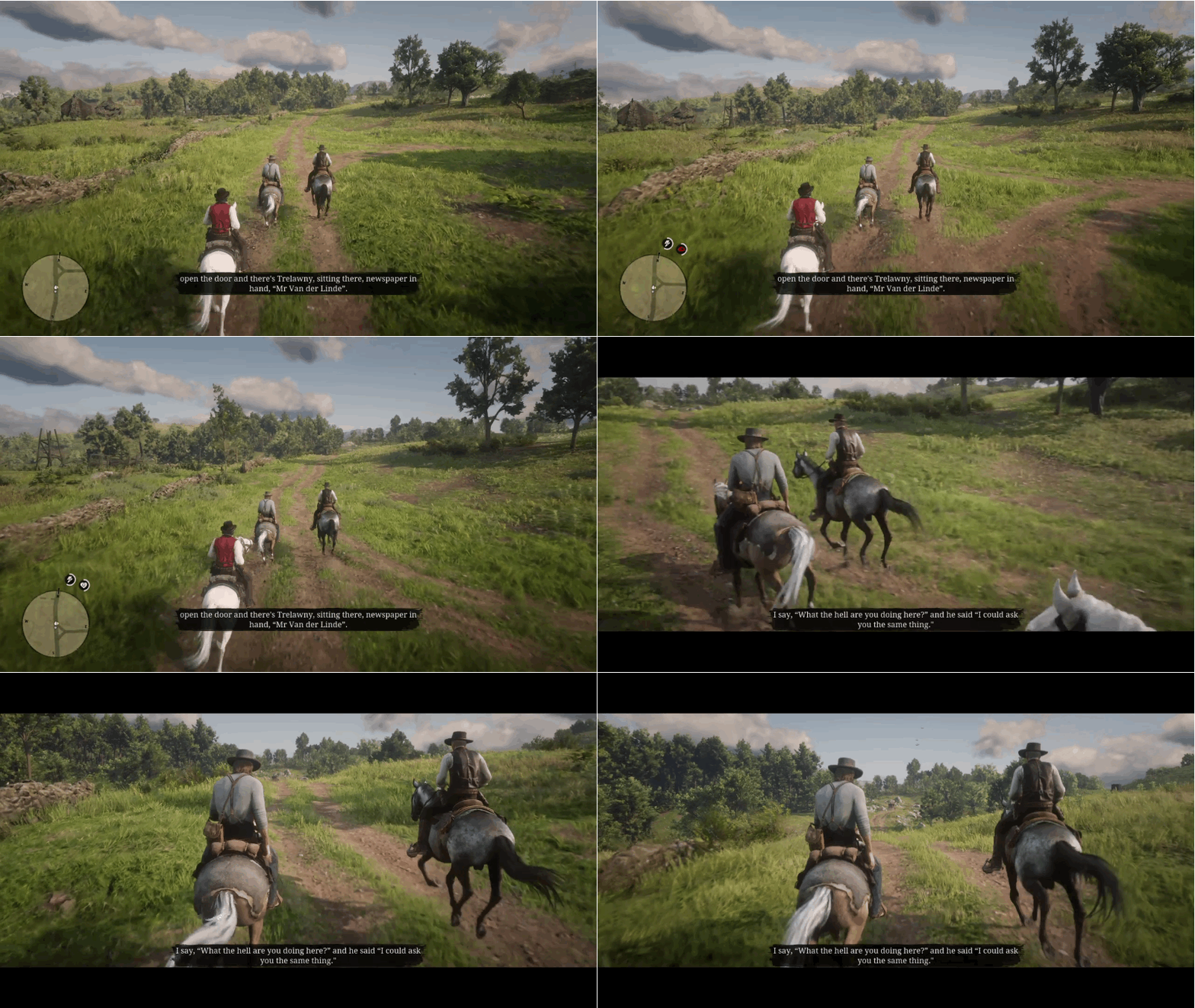
The world itself is far more alive and full of detail, and this time around, there is something deeper behind each item, NPC, and animal in the game. Red Dead Redemption taught us that our left trigger button was about aim, and aim only. In the next iteration of the game, L2 opens the door to everything else that this immersive world has to offer.

And it’s this untethering of every single object and character in the game that pushes RDR2 steps toward reality, and leaps forward for gaming.

During Story missions, Arthur can use L2 to make real-time decisions about how to ambush a camp. If he focuses on an item on a shelf in the store, the player can open up a menu through L2 to buy or inspect that item. Focus on an NPC walking around camp, and L2 opens up the options to greet or antagonize them. Approach Arthur’s horse, and L2 opens up a larger menu to feed the horse, brush the horse, or pat the horse. But these aren’t just empty actions. Feeding and cleaning the horse fill her health and stamina cores, and patting the horse increases her bond with Arthur, all of which affect the quality of the horse as a tool.

It’s important to note that, if Arthur gun is equipped, L2 defaults to aiming down sights, which sure can frighten a horse or an innocent NPC.

Like a crow bar, L2 cracked open the whole world of Red Dead Redemption. If you can inspect a letter on a nightstand, flip it over and read the back, and put it down again, what should stop you from inspecting a live animal to see if it’s worth hunting. L2 brings up information about the animal like its name, its quality, and what you can get from it.

Intuitive until it isn’t
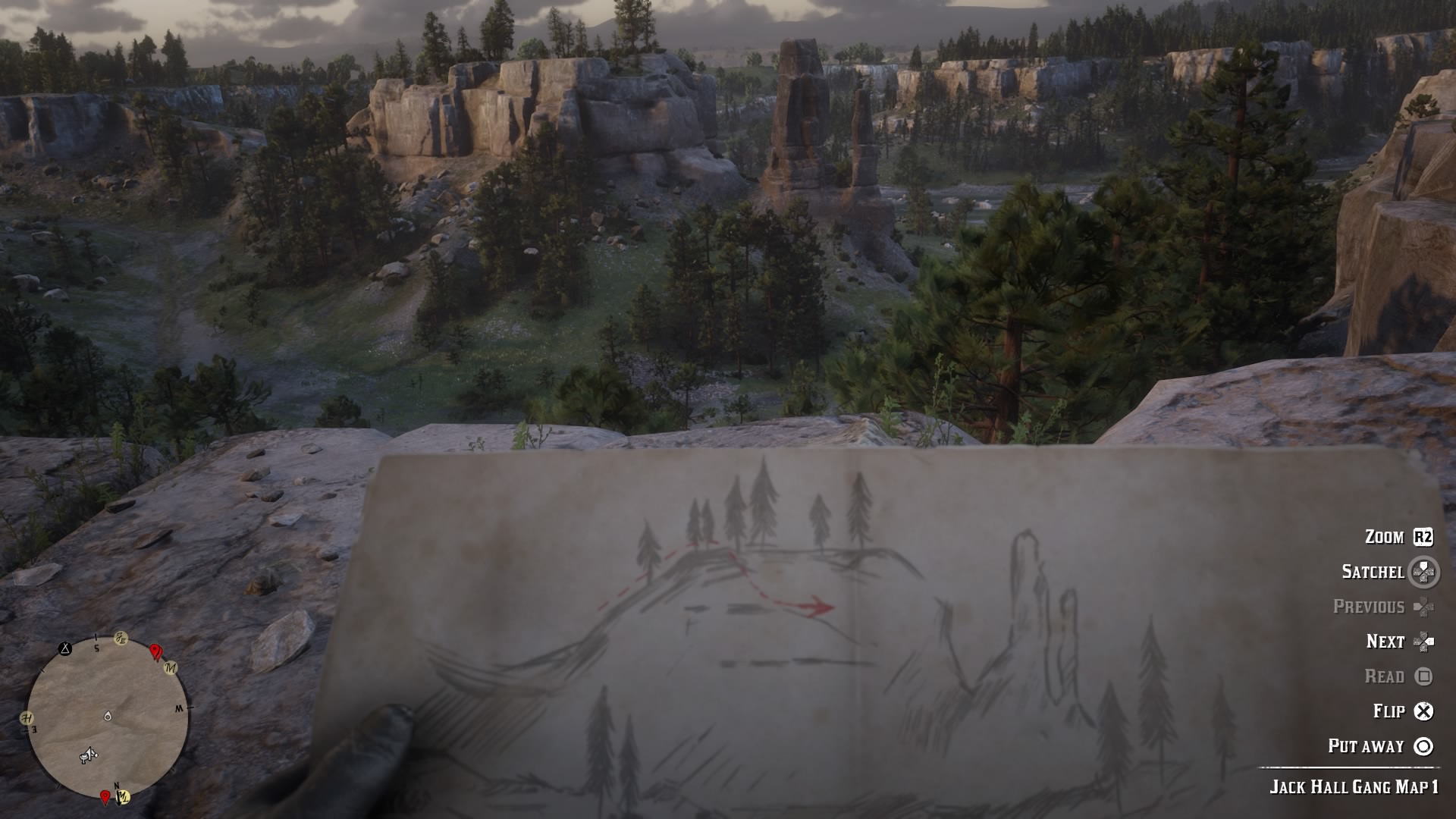
You can look up from a treasure map (handy) but have to dig through menus to pull it out in the first place.

Not all of the game’s interfaces are so fluid and convenient. Trotting along through town in my horse, I tap L2 to see if I can sketch a bird flying by, or study a farm dog, or hail a passerby (“hey, pardner!”). But then I see my horse is tired and I want to feed it an apple.

To do this I have to hold L1 to open the radial menu, then simultaneously hit R1 twice to get to the horse menu. Then I hold the right stick down in the direction of the item category I want to use, then (while holding L1 and the stick direction) pull the right and left triggers to find the item I want, and let go of L1 (but still hold the stick!) to use it (X and other normal “OK” buttons don’t do it). Are you kidding me?

Meanwhile time continues to pass in the background, albeit slowly, so you’re doing all this under pressure. Hell, someone might even be shooting at you and you’re trying to quaff a health tonic before returning to the weapon menu to pull out the rifle from your horse storage before you get gunned down.

It seems to me that although much of the world and your interactions with it are smoothed and interpreted from context, whenever that wasn’t possible the developers crammed it into this overworked radial menu system. I’ve gotten more used to it as I’ve played, but it still feels like something that started simple and quickly lost its elegance as it turned into a catch-all bucket for “video game stuff.”

There are also systems that are inadequately explained even when there’s opportunity for it. An early mission has you traveling with one of your bandit companions to hunt a big bear he saw a day’s ride away.

I happened to succeed in killing the bear, and loaded my ‘legendary bear pelt’ on the back of my horse. What was I supposed to do with it? Make a rug? I’d heard a little about pelts but precious little. Then I saw on my map that there was a trapper nearby — surely he would provide the tutorial I needed! But although the item’s description specifically said a trapper could turn it into a talisman, the trapper seemed to be able to do no such thing

Did I need to park my horse closer and hail him with it nearby? Did I “have” the pelt, or did it need to be there? Did I need to sell it to him first? Did I have to craft something on my own? Did I need to talk to my mission guy, or the cook who handles pelts in the camp? I had no clue and the game gave me no indication either. I couldn’t just keep it, since it took up valuable space on my horse — I had to turn down giving a lady a ride home because I’d have had to leave the pelt behind.

Ultimately I brought it back to camp, but couldn’t make anything out of it there either. Carts and boxes were everywhere but I couldn’t store the pelt in any of them. I dropped it on the ground and found myself and it teleported to the edge of camp; a message told me that “items dropped in camp will appear in a convenient place” or something. Oh, so the whole camp is a storage area! Nope. As soon as I rode away I was told I’d “abandoned” the pelt and some of its parts would go to the nearest trapper. What?

I don’t envy the developers and the info dumps they have to place like mines throughout this enormous world and story, but it felt like this was just one stumble after another, with relatively core gameplay elements that were almost completely unexplained. It’s an unexpected and forgivable failure given how much goes right, but the contrast is all the more jarring when it happens.

Nothing mundane about it
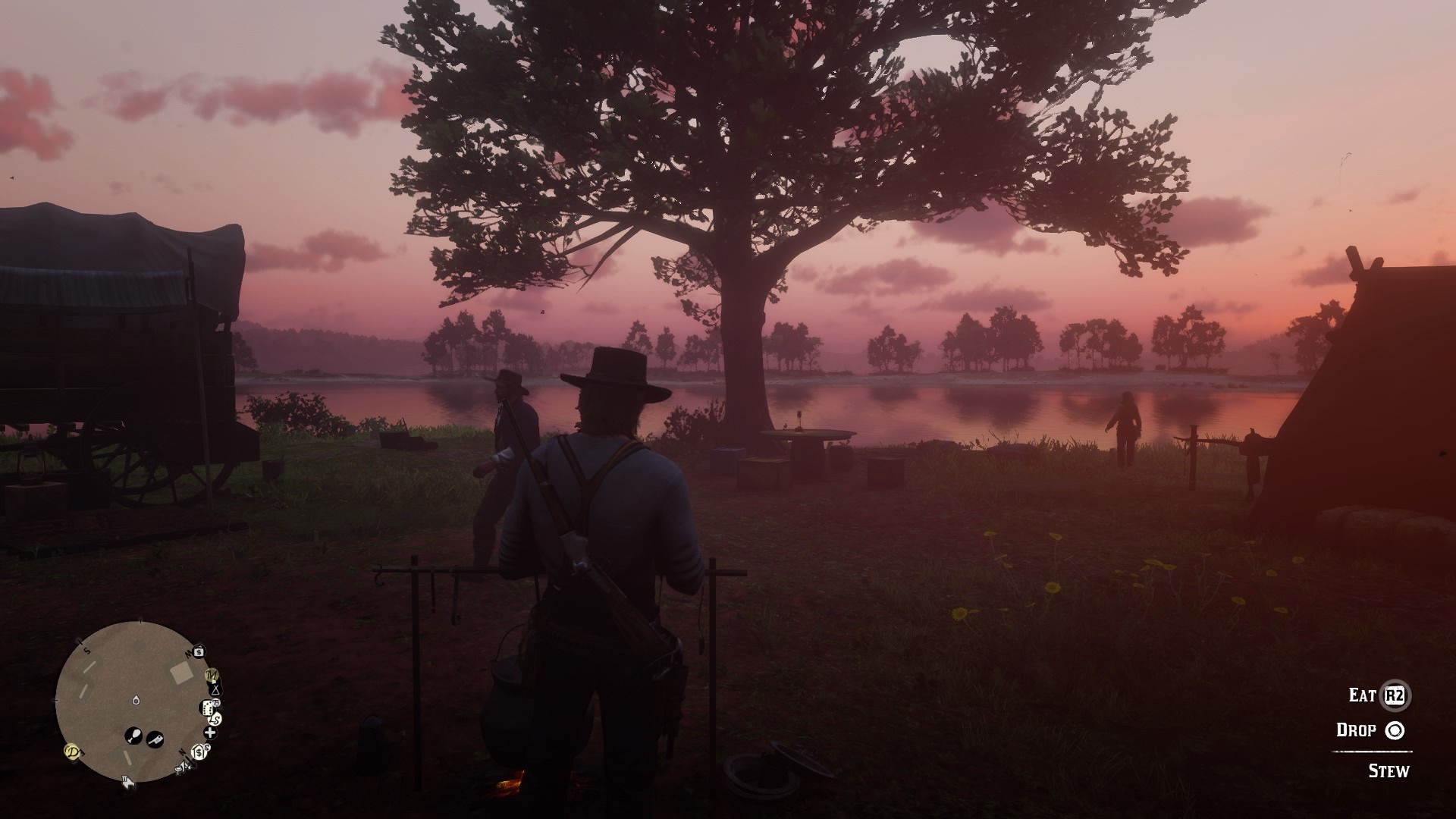
Eating stew with a beautiful view

RDR2 sets the bar high in a number of ways, but the overarching achievement is how closely this game tries to mimic reality. In some ways, this opens the world up, and in others, it limits you.

Arthur can’t carry around seven guns at once, so his horse stores the guns he can’t carry. If he forgets to equip his guns before running into a shootout on foot, he’s probably in trouble. Likewise, if Arthur goes hunting and loads a bear skin on the back of his horse, there isn’t any room to bring back a bounty target.

But Arthur isn’t just hunting for sport, or even for food. Whereas the last Red Dead focused on hunting as a way to make money, eat, or simply collect animals in the index, hunting now comes with its own system similar to Dead Eye and is paired together with crafting (which I’ll get to shortly).
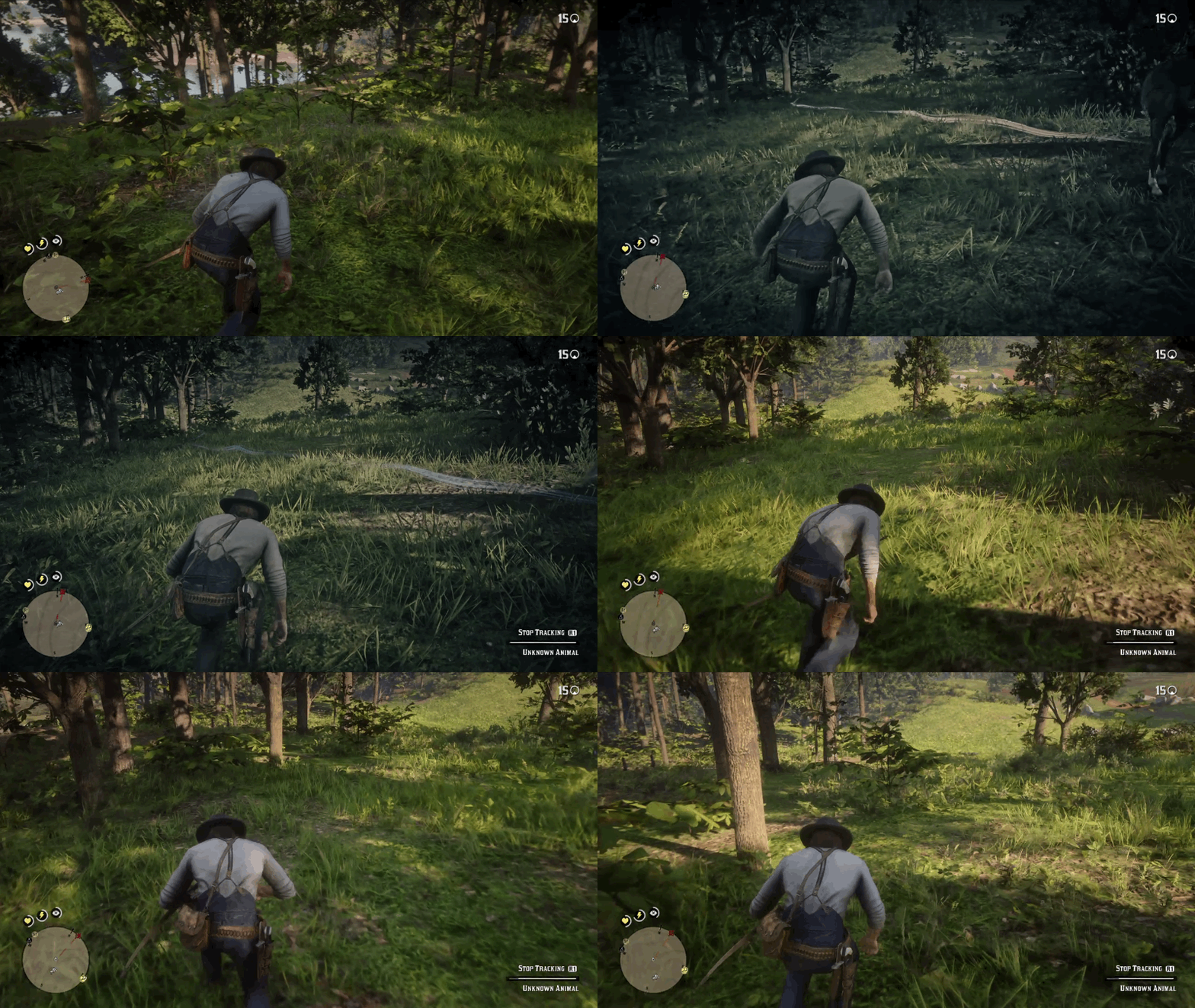
The hunting system is called Eagle Eye, and it’s slightly reminiscent of the Instinct mode in Hitman. This system lets Arthur track animal trails, paw prints, animal dung, etc. to find his desired prey. Clicking L3 and R3 simultaneously activates Eagle Eye, and then pressing R1 lets you follow the track without remaining in the slow-mo world of Eagle Eye.

Tracking doesn’t work so well for aquatic animals like fish and alligators, but fishing is an easy, laid-back way to gather food or turn a small profit.

Inspecting animals, via L2, ensures Arthur is targeting the right size and quality of animal, and the method by which Arthur hunts affects the quality of the skins. This seems unimportant, but in the exotic world of crafting, you might find yourself caring a lot.

Crafting allows Arthur or other NPCs (like the Trapper, or the camp cook Pearson) to create new items from stuff they’ve gathered in the wilderness. That could mean mixing up some meat with an herb to create a specific dish, which would have its own specific effect on health and stamina, or bringing back a few pelts to have more comfortable and colorful accommodations around camp.

Again, this method of hunting and crafting is more in line with how an outlaw might actually live off of the land in 1899. And in adding Eagle Eye and the ability to craft, the more mundane parts of Red Dead Redemption have come alive. In the last game, hunting was something you stumbled upon. The most interactive piece of it was buying and setting bait. In RDR2, hunting big game like bears and buffalo is nearly as enjoyable an activity as the story missions.

Stone cold or heart of gold?

The honor system from Red Dead Redemption is alive and well in RDR2, but with some added flare. Because the game tries to mimic real life, with all its opportunities and limitations, the honor system is even more consequential now.

Deeper interactivity through L2 allows you to interact with almost every NPC, even those that aren’t involved in challenges or side missions or story missions. What’s more, those NPCs remember you.

In one instance, a man had been bit by a snake and was screaming out nearby a road. I stopped to help him, sucked the poison out, and went on my way. Later, when I rode into town, he was sitting on a bench outside the gunsmith and he called out to me. He said thanks and offered to pay for any gun I’d like to buy inside the gunsmith. My decision to save him, instead of killing him and looting his body, not only gave me honor points but resulted in a reward.

In another instance, I accidentally pulled out my knife when I got in a bar fight. Instead of innocently beating a dude up, I killed him. The townspeople mentioned the murder the next time I came into town, and the only way to get rid of the bounty on my head was to pay it off at the Post Office.

These decisions and their respective results are pretty straight forward. More nuanced, however, is the effect that Arthur’s honor has on the atmosphere of the game. Honor level changes the way that the story plays out, affects the kill cams, alters the music in the game, and changes the way Arthur dreams and writes in his journal.

In the short time we’ve been able to play the game, it’s hard to tell how extremely this affects the game. I did notice, however, when my honor was at its highest level that one of the shootouts was accompanied by up-tempo (almost celebratory) banjo music, and that kill cams had a goldish tint to them. It’s unclear if that was directly related to my honor or not, but it felt like a subtle dynamic change.

This game offers no shortage of customization options, from your horse to your gun to your clothes to your camp. But there is perhaps no more influential factor that separates one player’s experience of the game from another than Honor.

Dear diary

I want to give an especial callout to the detail lavished on the catalogs and books in the game, as well as Arthur’s journal. The tongue-in-cheek period-style descriptions of equipment and clothing items sometimes run to multiple paragraphs, and as there’s no particular hurry for much of the game, why not take the time to read them?

Arthur’s journal is a treat as well. Although it is in some ways just a way to recap the story for you, it’s a pleasure to read the hand-written entries and the main character’s thoughts on events as they played out; missions will be described differently depending on how they ended or choices you made. And meanwhile every place you visit, and every critter you “study” will be sketched in the book in the order you see them.

[gallery ids="1737189,1737190,1737207,1737201"]

This isn’t explained or anything, and I was tickled when I figured it out. I had made a long trek back from a mission and stopped by a few places, scoped out a squirrel, some chickens, a deer and some other things in passing. When I went to my journal a few game days later, there they all were in order, as if (as is the intent) Arthur had in fact been jotting them down while I wasn’t looking.

It’s a shame the journal and books aren’t more prominently presented — the journal is in your horse’s pack, or that’s where it ended up for me. Take the time to read it and anything else you come across; as much effort was put into the writing here as it was everywhere else in the game.

Not-so-final word

Needless to say RDR2 gets a hearty recommendation from us despite some nitpicks and even a couple serious cracks in the carefully-constructed facade. It’s a landmark game in the open world genre and an artistic achievement in its own right. It’s worth your money.

That said, our limited time with the game, and choice to play it as though we were regular players and not blast through to the end, means we’re unable to evaluate the entirety of the game. I find it exceedingly unlikely that the game gets worse — if anything, it likely gets better as the story and gameplay concepts progress.

Still, there are a few specifics we should mention that we plan to look at over the next few weeks.

Online isn’t live yet and won’t be for a while. This isn’t core to the main game but will surely be a huge draw as the game ages and its quality will affect whether it’s worth picking up again or recommending to a friend a year or two from now.

The honor system, though we touched on it, is pretty hard to test thoroughly even with two people playing in parallel. We haven’t been able to experience how the game changes significantly to accommodate your choice of amorality or virtue.

The story is in many ways just beginning, not to mention the side stories of your camp members and other figures you encounter. Did Rockstar frontload all the good acting and setpieces? Does it fizzle out at the end? Doubtful but we can’t say one way or the other. Once we’ve both finished the game or gotten far enough to feel confident in our opinions we’ll issue a followup review and link it here.

25 Oct 2018

Xiaomi looks set to smash its 100M sales target for 2018

Despite share price struggles, Xiaomi has revealed that it is on track for a record sales year which will see it easily surpass its goal of selling 100 million smartphones in 2018.

Wang Xiang, the executive in charge of the Chinese firm’s international business, said on Twitter that he expects to hit its 2018 100 million sales target by the end of October. That would beat last year’s 90 million sales and give Xiaomi a further two months to raise the figure higher still. Given that phone sales are declining worldwide with many in the industry struggling, that’s no mean feat.

Wang didn’t provide further details on sales, but we already know that most of the company’s business happens in the Chinese market. Xiaomi’s most recent earnings report (its first as a public company) revealed that just 36 percent of its revenue comes from outside of its home market although that figure is steadily increasing. According to its IPO prospectus, China represented 72 percent of Xiaomi’s revenue in 2017 which is up from 87 percent and 94 percent in 2016 and 2015, respectively.

Building on that progress, Xiaomi is putting a major focus on expanding overseas post IPO — it said it would set aside 30 percent of the $4.7 billion that it raised from its Hong Kong listing for international growth.

To date, India has been its most successful market — it is consistently ranked as the top/near top vendor — but the Chinese phone maker has a presence across Southeast Asia and it has ventured into global markets that include the Middle East, Central and South America and — most recently — Europe.

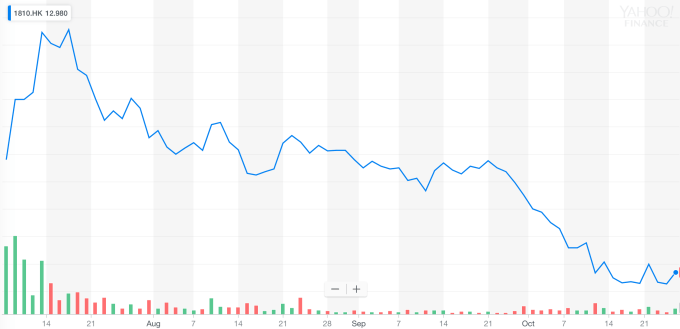
Despite hitting its lofty sales target ahead of time, Xiaomi has struggled to win over investors.

Its IPO valuation of $54 billion was well below its reported target of $100 billion, and the company’s shares have traded below their initial price for the past month. Xiaomi is set to report earnings next month so we should get more detail on its 100 million sales and overall progress then.

Xiaomi’s shares have traded below IPO price since September 21

Xiaomi previously had a well-documented struggle when it missed its sales goal of 100 million devices in 2015. One hallmark of the company’s rapid rise earlier in the decade was the crazy growth numbers it regularly boasted about but, after CEO Lei Jun admitted it had grown too fast, it stopped speaking so publicly about its targets.

As a public company, there is, of course, nowhere to hide in terms of numbers. But Wang’s decision to speak publicly shows that Xiaomi has got its swagger back, even if the market isn’t feeling the same way.

25 Oct 2018

UK watchdog hands Facebook maximum £500K fine over Cambridge Analytica data breach

The U.K. Information Commissioner’s Office (ICO) has confirmed that it has hit Facebook with a maximum £500,000 ($645,000) fine around the way it mishandled user data following the Cambridge Analytica scandal earlier this year.

The ICO announced its intention to hand Facebook the fine back in July and it said today that it had not changed its mind after hearing the social network’s responses to key questions raised. While £500,000 is a drop in the ocean for the U.S. company, it represents the maximum allowable punishment under UK law, which is the significant part to focus on here.

Facebook provided the following statement to TechCrunch:

“We are currently reviewing the ICO’s decision. While we respectfully disagree with some of their findings, we have said before that we should have done more to investigate claims about Cambridge Analytica and taken action in 2015. We are grateful that the ICO has acknowledged our full cooperation throughout their investigation, and have also confirmed they have found no evidence to suggest UK Facebook users’ data was in fact shared with Cambridge Analytica .”

The introduction of GDPR has given the ICO the power to issue fines of up to £17 million ($22 million) or four percent of a company’s global turnover — that’s potentially up to $1.6 billion in Facebook’s case. Luckily for the U.S. firm, though, that isn’t possible since this investigation began back in May 2017 following questions around digital influence on the Brexit vote.

In the case of Cambridge Analytica, the ICO found that at least one million UK users were among the 87 million Facebook users whose private data was harvested by Dr. Aleksandr Kogan and his company Global Science Research (GSR).

While the issue was identified in 2015, GSR and Kogan were not booted from Facebook’s platform until this year. That led the British organization to conclude that beyond failing to “make suitable checks on apps and developers using its platform,” Facebook “did not do enough to ensure those who continued to hold it had taken adequate and timely remedial action.” Indeed, CEO Mark Zuckerberg himself has admitted that the decision was a mistake.

“Facebook failed to sufficiently protect the privacy of its users before, during and after the unlawful processing of this data. A company of its size and expertise should have known better and it should have done better,” Information Commissioner Elizabeth Denham said in a statement.

“We considered these contraventions to be so serious we imposed the maximum penalty under the previous legislation. The fine would inevitably have been significantly higher under the GDPR. One of our main motivations for taking enforcement action is to drive meaningful change in how organizations handle people’s personal data,” she added.

Denham is slated to present an update on the investigation to the Department for Digital, Culture, Media and Sport (DCMS) Select Committee on November 6, but she said work on the topic of digital influence on politics will continue beyond that date.

“There are still bigger questions to be asked and broader conversations to be had about how technology and democracy interact and whether the legal, ethical and regulatory frameworks we have in place are adequate to protect the principles on which our society is based,” Denham added.

We’ve contacted Facebook for a response to today’s announcement.

Note: The original version of this story was updated to correct that the fine is £500,000 not $500,000.

25 Oct 2018

Adzuna acquires job board Work In Startups

Armed with new capital (following a recent £8 million Series C round) and now doing £1 million per month in revenue, job meta-search engine Adzuna has acquired the U.K. tech startup job board Work In Startups.

Terms of deal aren’t being disclosed. However, it will see Adzuna take over operation of the Work In Startups website but continue to run it as an independent brand and community. Notably, the site will remain free to post jobs.

Launched in 2011 by Diana Ilinca and Alex Borbely, Work In Startups set out to create a way for startups to more easily find tech and creative talent, without having to go through recruiters or use more generic job sites. It is said to have become an important tool in U.K. startup hiring over the past few years, and, I understand, has been used by Adzuna itself.

“As we continue to grow and learn more and more about the market, we’ve realised that ‘generalist’ search is not always the best solution for all jobseekers/employers, and sometimes a focussed, niche site can offer a more tailored experience and build a stronger community,” Adzuna co-founder Andrew Hunter tells me.

“Tech startup jobs and companies are cutting-edge, early adopters and have very particular needs… and this is truly a really strong but underdeveloped market-leading community asset with a freemium model like Adzuna. So it’s a great way for us to learn better how we can take what we’re good at — tech, traffic acquisition, data etc. — and apply it to create more value for a site like this and its users.”

Related to this, Adzuna’s data shows there are currently 1.1 million open job roles in the U.K. and that 90,000 (more than 8 percent) are in tech.

“On a personal note, I want to make hiring great people easier and less expensive for U.K. startups,” continues Hunter. “I’ve been through ‘the struggle’ and it’s f***ing hard to attract the best talent when your company is just getting going (let alone having to compete with big banks and established tech companies for talent!). We’d like to change that by taking on this community and growing it to new heights”.

With that said, he cautions me not to expect other imminent acquisitions. “Would we do other similar acquisitions in the future? For now, it’s a one off but maybe for right asset,” says the Adzuna co-founder.

25 Oct 2018

Amazon backs German smart heating and AC company Tado in new $50M funding round

Tado, the smart thermostat and AC control maker, has raised a further $50 million in funding from an array of noteworthy and strategic investors. Backing the Munich-headquartered company this time around is Amazon, E.ON, Total Energy Ventures, Energy Innovation Capital, Inven Capital, and the European Investment Bank.

It brings total funding to $102 million since being founded in 2011, while the new capital will be used to develop new products and to extend its service offerings. The latter already includes “proactive” boiler maintenance via data the app collects and analyses and Tado’s 40,000 strong network of heating engineer partners.

That Amazon has chosen to invest is probably the most interesting aspect of this new financing round. The e-retail and technology giant has made multiple moves into the smart home space over the last few years, including acquisitions such as Ring (smart doorbell and security), and Blink (more smart doorbell and security cameras). Prior to buying Ring it was an investor via its Amazon Alexa Fund, and has also backed U.S. focussed smart thermostat company Ecobee.

Zooming out further, Amazon’s Echo powered by Alexa has positioned itself as the device that can bring the disparate smart home ecosystem under a single voice interface, alongside competitors Apple (Siri) and Google (Google Home), of course. (Tado supports all three digital assistants and is sold by Amazon and in Apple retail stores). Amazon has also ventured into smart home device installation and other home services, and given that Tado has a strong services component, the strategic fit looks even stronger.

In a call with Tado co-founder Christian Deilmann, he reiterated the three pillars of the company’s offering. The first is helping you manage your home’s climate to make it more comfortable and convenient/cost-effective. This includes being able to connect your existing central heating or air conditioning to the internet for remote and smartphone control, but also geo-location and other “smart” features that detect when residents are leaving or approaching home, the weather is changing, or when windows are opened.

However, as we’ve noted before, Tado’s engineering play goes deeper than simply smart phone and location-based control of your home’s heating and cooling systems alone. The startup’s smart thermostat has been painstakingly engineered to be able to connect to the digital serial interface of thousands of different boilers/manufacturers typically found in heating systems in Europe and in newer systems in general. This enables the Tado cloud to do a number of interesting things, such as modulating heating, rather than simple switching the boiler on or off, and provide remote diagnostics — which is where Tado’s second pillar, its service model, comes into play.

Longer term, a third pillar will see Tado more directly benefit energy management overall, including at the national grid level. In practice this means partnerships with local utilities companies — a number of pilots are already underway — to enable Tado and its customers to opt into ‘demand response’ schemes so that a home’s heating and cooling systems are utilised where possible outside of known peak energy times.

This could be as simple as turning your heating down by a few points without it really being noticeable or heating your home up a little ahead of time. In aggregate, this can make a tangible difference to the national grid’s ability to stabilise energy consumption, something that becomes ever more crucial as more renewable energy that is sporadic in nature, such as wind and solar, is supplied to the grid.

Meanwhile, energy company E.ON joining this latest funding round builds on a number of partnerships that Tado has with utilities companies as a route to market other than its B2C sales in retail stores. Deilmann tells me Tado can be purchased from over 30 utility companies and that B2B makes up around 50 percent of sales. The company also counts Čez Group, a multinational energy conglomerate based in the Czech Republic, and Statkraft Venture Capital, the investment company of Europe’s largest producer of renewable energy, as previous backers.

25 Oct 2018

LG retains confidence in its mobile business despite continued losses

LG remains confident that it can turn the corner for its serially unprofitable mobile business despite the division racking up a loss of over $400 million this year so far.

The Korean company as a whole is having a good year. Following a record six months of profit and revenue in the first half of 2018, the group saw Q3 revenue jump 2.7 percent sequentially to reach 15.43 trillion KRW, or $13.76 billion. Operating profit rose by 45 percent year-on-year to reach 748.8 billion KRW, that’s $667.7 million.

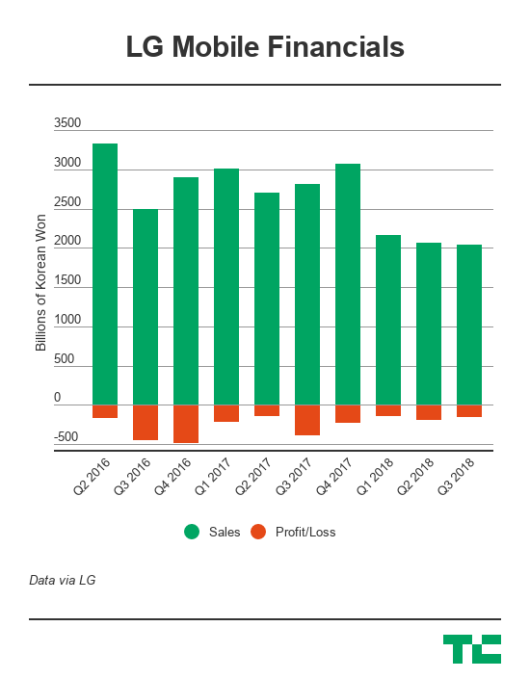
The company’s home entertainment business is the standout performer generating total sales of 3.71 trillion RKW ($3.31 billion) and a 325.1 billion KRW ($289.9 million) profit, with LG Mobile second in terms of revenue. But, the mobile division continues to bleed cash. This time around in Q3, its losses were 146.3 billion RKW, that’s $130.5 million.

That betters large losses for Q3 2016 and 2017 — 436.4 billion KRW and 436.4 billion KRW, respectively — but it means that LG’s mobile division has lost the company $410 million in 2018 so far. But, as the chart below shows, LG has a long way to go before its mobile business stops hurting the group’s overall bottom line and restricting its otherwise impressive growth as a company.

The company played up its performance with a claim that it had weathered challenging global markets — where Chinese brands are competing hard and mobile saturation is weakening consumer demand — by “significantly reduced its operating deficit as a direct result of its business plan and its stronger focus on mid-range products.”

LG recently outed its new V40 ThinQ, a flagship smartphone that packs no fewer than five cameras, and it is optimistic that its launch will boost sales in the final quarter of the year. More widely, it said that the cost-cutting strategy implemented with the appointment of new LG Mobile CEO Hwang Jeong-hwan last November will see it continue to “consolidate and implement a more profitable foundation.”

That strategy has focused around mid-range devices and emerging markets, where LG believes it can offer strong value for money that’ll appeal to consumers in the market for a deal. That explains why mobile division sales are down this year but, crucially, the division is bleeding less capital. Whilst that strategy has helped stem losses, it remains to be seen whether it is the right one to turn the unit profitable.

25 Oct 2018

Tesla to bring portion of Model 3 production to China next year

Tesla, which reported its first quarterly profits in two years Wednesday, is looking to extend its earnings streak by bringing its new Model 3 to customers beyond North America. And part of that plan involves accelerating its manufacturing plans in China.

Tesla saw its revenue skyrocket to $6.8 billion in the third quarter (and a $312 million profit) thanks to sales of its new Model 3 vehicle, despite production bottlenecks and more recent issues with delivery logistics. The company was able to achieve that profitability milestone just through sales in the U.S. and Canada. That leaves two other massive markets on the table. Cue Europe and China.

Tesla said Wednesday it will start to take orders for the Model 3 in Europe and China before the end of 2018. Tesla said it will begin deliveries of the Model 3 to Europe early next year.

“The mid-sized premium sedan market in Europe is more than twice as big as the same segment in the U.S.,” Tesla said in its shareholder letter released Wednesday. “This is why we are excited to bring Model 3 to Europe early next year.”

Notably, the company is further accelerating its timeline for China and said it will bring portions of Model 3 production to the country next year.

“We are aiming to bring portions of Model 3 production to China during 2019 and to progressively increase the level of localization through local sourcing and manufacturing,” Tesla said in its earnings report. “Production in China will be designated only for local customers.”

Tesla said earlier this month it plans for as rapid build out of a factory in China. But there’s something new here. The term “portions of Model 3 production” is the important phrase. This could be referring to a term used in the manufacturing world known as a complete knock down. CKD is basically a kit of non-assembled parts of a product, like say a Model 3. It’s a strategy used to avoid tariffs when shipping to foreign countries.

Tesla has plans to build a factory in Shanghai, but construction hasn’t even begun yet.

The company secured in October rights to about 210 acres of land in Lingang, Shanghai, the site of the electric automaker’s planned factory and its first outside of the U.S.

Tesla warned in its production and delivery report in early October that tariffs, combined with the cost of shipping its vehicles via ocean carrier and the lack of access to cash incentives available to locally produced electric vehicles, has put the company at a disadvantage in China. Tesla reiterated those cost constraints in its third-quarter earnings report.

Tesla reached a deal in July with the Shanghai government to build a factory that it says will be capable of producing 500,000 electric vehicles a year. Once construction begins, it will take about two years until Tesla can produce vehicles. It will be another “two to three years before the factory is fully ramped up to produce around 500,000 vehicles per year for Chinese customers,” a Tesla spokesman said at the time.

25 Oct 2018

Facebook says it removed 8.7M child exploitation posts with new machine learning tech

Facebook announced today that it has removed 8.7 million pieces of content last quarter that violated its rules against child exploitation, thanks to new technology. The new AI and machine learning tech, which was developed and implemented over the past year by the company, removed 99 percent of those posts before anyone reported them, said Antigone Davis, Facebook’s global head of safety, in a blog post.

The new technology examines posts for child nudity and other exploitative content when they are uploaded and, if necessary, photos and accounts are reported to the National Center for Missing and Exploited Children. Facebook had already been using photo-matching technology to compare newly uploaded photos with known images of child exploitation and revenge porn, but the new tools are meant to prevent previously unidentified content from being disseminated through its platform.

The technology isn’t perfect, with many parents complaining that innocuous photos of their kids have been removed. Davis addressed this in her post, writing that in order to “avoid even the potential for abuse, we take action on nonsexual content as well, like seemingly benign photos of children in the bath” and that this “comprehensive approach” is one reason Facebook removed as much content as it did last quarter.

But Facebook’s moderation technology is by no means perfect and many people believe it is not comprehensive or accurate enough. In addition to family snapshots, it’s also been criticized for removing content like the iconic 1972 photo of Phan Thi Kim Phuc, known as the “Napalm Girl,” fleeing naked after suffering third-degree burns in a South Vietnamese napalm attack on her village, a decision COO Sheryl Sandberg apologized for.

Last year, the company’s moderation policies were also criticized by the United Kingdom’s National Society for the Prevention of Cruelty to Children, which called for social media companies to be subject to independent moderation and fines for non-compliance. The launch of Facebook Live has also at times overwhelmed the platform and its moderators (software and human), with videos of sexual assaults, suicides, and murder—including that of an 11-month-old baby by her father—being broadcast.

Moderating social media content, however, is one noteworthy example of how AI-based automation can benefit human workers. Last month, Selena Scola, a former Facebook content moderator, sued the company claiming that screening thousands of violent images had caused her to develop post-traumatic stress disorder. Other moderators, many of whom are contractors, have also spoken of the job’s psychological toll and said Facebook does not offer enough training, support, or financial compensation.

25 Oct 2018

Facebook is building a video music app to steal TikTok’s teens

Facebook is working on a new app that it hopes could win back the attention of teens while capitalizing on its recently-attained major label music licenses. Facebook is building a standalone product where users can record and share videos of themselves lip syncing or dancing to popular songs, according to information from current and former Facebook employees.

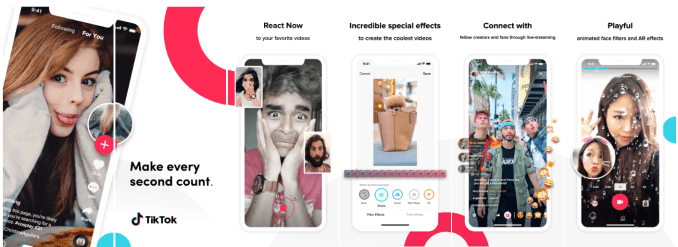
The app is designed to be a standalone competitor to Musically, which was a hit with teens and even pre-teens before the 60 million monthly user product was acquired by Chinese tech giant ByteDance for around $1 billion and rolled into the company’s TikTok app.

“It’s basically TikTok/Musical .ly. It’s full-screen, built for teens, fun and funny, and focused on creation” one source told me. “A lot of what they’re doing is just trying to be cool and trying to be something that Facebook isn’t.”

Two sources said the music app was codenamed Lasso. However it could be launched under a different name or scrapped, as Facebook does not always release the projects it builds. The app has been in development since at least the middle of the is year. As of August, the app was still in mock-up form. Facebook declined to comment for this report.

The product is being built by members of Facebook’s video and Watch team under leadership from Facebook’s principal lead product designer Brady Voss, a source says.

One of the leaders of the Facebook video music app team is Brady Voss, who built this feature Montage as part of a Facebook hackathon in 2016

Voss previously worked on Facebook’s TV app as well as the recently shut down Hello standalone app. For a 2016 hackathon project he presented to Mark Zuckerberg, Voss made a technology called Montage that would stitch together photos of say a snowboarder doing a trick into a single image like a still timelapse. Now he’s back at making creative expression simpler with Lasso. “Brady is great with fun new camera and video things” a source said.

Facebook has been investigating the teen music app space since 2016, when a source says the company spun up a research project to look into Musically. There were suspicions that Musically might not be as popular as it touted, and Facebook eased off.

Then earlier this year, Facebook’s music efforts were reinvigorated when it secured licensing deals with all the major record labels. At first, this just kept users’ videos, including Musically-style lip syncing clips, from being taken down for copyright infringement.

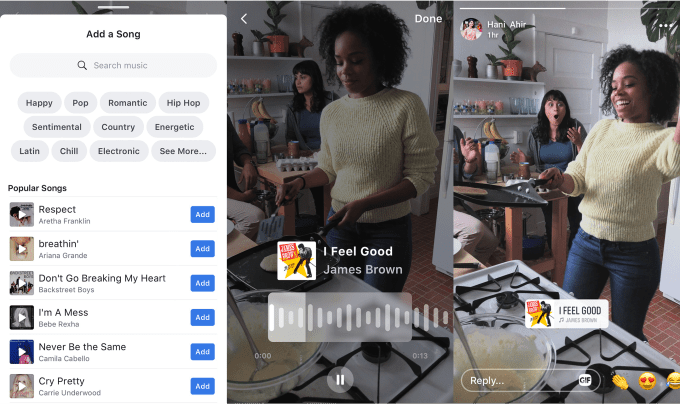
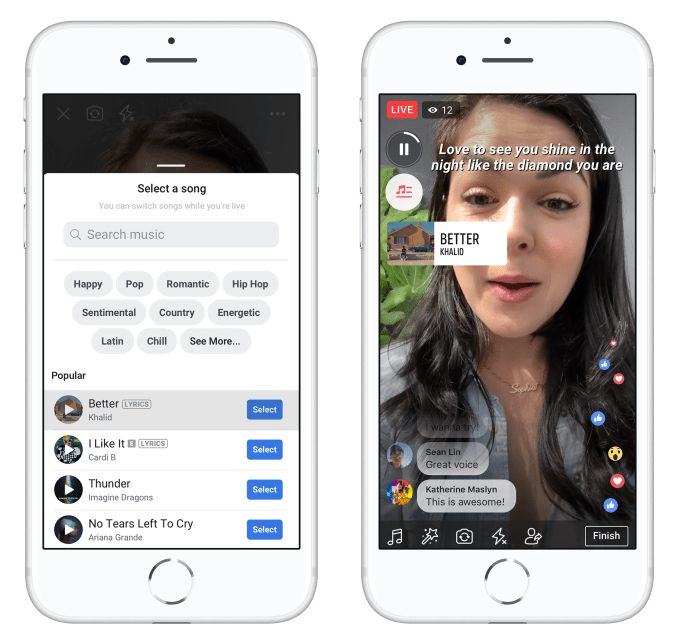
But soon it launched music stickers on Instagram that let you add soundtracks to your Stories, and that feature rolled out on Facebook today. The company also began experimenting with a Lip Sync Live feature for livestreaming karaoke, and today Facebook opened it for Pages and began showing some songs’ lyrics on screen. It plans to soon allow users to pin their favorite songs to their profile so friends can listen to a segment in what feels like a throwback to MySpace Music.

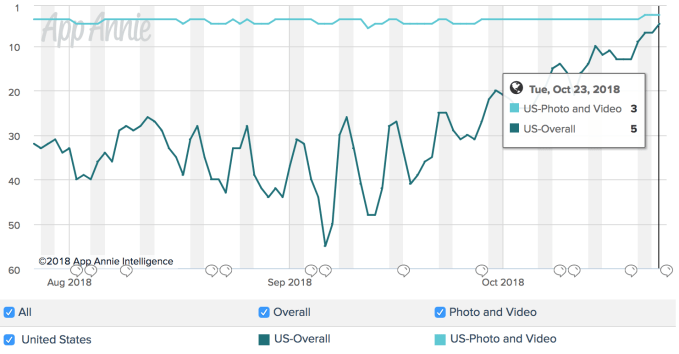
Meanwhile, TikTok is on the rise. The app has climbed from the #32 overall iPhone app in the US three months ago to reach #5 today, according to App Annie.

Now just 5 percent of US teens cite Facebook as their favorite social platform, according to a Piper Jaffray survey. The percentage who use it monthly has dropped from 60 percent to 36 percent since Spring 2016. Facebook needs new ways to engage teens beyond Instagram and WhatsApp, and a standalone music app potentially devoid of its own branding could be a better approach than cramming teen features like Lip Sync Live into its uncool main app.

Facebook already tried and failed to win back the youth with standalone apps like Poke, Slingshot, Bolt, Flash, and other variations on Snapchat. But with US giants like Snap and YouTube neglecting to build proper tools for video music creation, Facebook has a shot to challenge China’s ByteDance . Most people aren’t interesting on camera, especially awkward teens. But with the right soundtrack,  a stupid selfie video can become epic, or at least silly enough to watch.

25 Oct 2018

Facebook is building a video music app to steal TikTok’s teens

Facebook is working on a new app that it hopes could win back the attention of teens while capitalizing on its recently-attained major label music licenses. Facebook is building a standalone product where users can record and share videos of themselves lip syncing or dancing to popular songs, according to information from current and former Facebook employees.

The app is designed to be a standalone competitor to Musically, which was a hit with teens and even pre-teens before the 60 million monthly user product was acquired by Chinese tech giant ByteDance for around $1 billion and rolled into the company’s TikTok app.

“It’s basically TikTok/Musical .ly. It’s full-screen, built for teens, fun and funny, and focused on creation” one source told me. “A lot of what they’re doing is just trying to be cool and trying to be something that Facebook isn’t.”

Two sources said the music app was codenamed Lasso. However it could be launched under a different name or scrapped, as Facebook does not always release the projects it builds. The app has been in development since at least the middle of the is year. As of August, the app was still in mock-up form. Facebook declined to comment for this report.

The product is being built by members of Facebook’s video and Watch team under leadership from Facebook’s principal lead product designer Brady Voss, a source says.

One of the leaders of the Facebook video music app team is Brady Voss, who built this feature Montage as part of a Facebook hackathon in 2016

Voss previously worked on Facebook’s TV app as well as the recently shut down Hello standalone app. For a 2016 hackathon project he presented to Mark Zuckerberg, Voss made a technology called Montage that would stitch together photos of say a snowboarder doing a trick into a single image like a still timelapse. Now he’s back at making creative expression simpler with Lasso. “Brady is great with fun new camera and video things” a source said.

Facebook has been investigating the teen music app space since 2016, when a source says the company spun up a research project to look into Musically. There were suspicions that Musically might not be as popular as it touted, and Facebook eased off.

Then earlier this year, Facebook’s music efforts were reinvigorated when it secured licensing deals with all the major record labels. At first, this just kept users’ videos, including Musically-style lip syncing clips, from being taken down for copyright infringement.

But soon it launched music stickers on Instagram that let you add soundtracks to your Stories, and that feature rolled out on Facebook today. The company also began experimenting with a Lip Sync Live feature for livestreaming karaoke, and today Facebook opened it for Pages and began showing some songs’ lyrics on screen. It plans to soon allow users to pin their favorite songs to their profile so friends can listen to a segment in what feels like a throwback to MySpace Music.

Meanwhile, TikTok is on the rise. The app has climbed from the #32 overall iPhone app in the US three months ago to reach #5 today, according to App Annie.

Now just 5 percent of US teens cite Facebook as their favorite social platform, according to a Piper Jaffray survey. The percentage who use it monthly has dropped from 60 percent to 36 percent since Spring 2016. Facebook needs new ways to engage teens beyond Instagram and WhatsApp, and a standalone music app potentially devoid of its own branding could be a better approach than cramming teen features like Lip Sync Live into its uncool main app.

Facebook already tried and failed to win back the youth with standalone apps like Poke, Slingshot, Bolt, Flash, and other variations on Snapchat. But with US giants like Snap and YouTube neglecting to build proper tools for video music creation, Facebook has a shot to challenge China’s ByteDance . Most people aren’t interesting on camera, especially awkward teens. But with the right soundtrack,  a stupid selfie video can become epic, or at least silly enough to watch.