Year: 2018

24 Oct 2018

Tim Berners-Lee on the huge sociotechnical design challenge

In a speech discussing ethics and the Internet, the inventor of the World Wide Web, Sir Tim Berners-Lee, has tasked the technology industry and its coder army with paying continuous attention to the world their software is consuming as they go about connecting humanity through technology.

Coding must mean consciously grappling with ethical choices in addition to architecting systems that respect core human rights like privacy, he suggested.

“Ethics, like technology, is design,” he told delegates at the 40th International Conference of Data Protection and Privacy Commissioners (ICDPPC) which is taking place in Brussels this week.

“As we’re designing the system, we’re designing society. Ethical rules that we choose to put in that design [impact the society]… Nothing is self evident. Everything has to be put out there as something that we think we will be a good idea as a component of our society.”

If your tech philosophy is the equivalent of ‘move fast and break things’ it’s a failure of both imagination and innovation to not also keep rethinking policies and terms of service — “to a certain extent from scratch” — to account for fresh social impacts, he argued in the speech.

He pointed to how Wikipedia had to rapidly adapt its policies after putting online the power for anyone to edit its encyclopedia, noting: “They introduced a whole lot of bureaucracy around it but that actually makes it work, and it ended up be coming very functional.”

He described today’s digital platforms as “sociotechnical systems” — meaning “it’s not just about the technology when you click on the link it is about the motivation someone has to make such a great thing because then they are read and the excitement they get just knowing that other people are reading the things that they have written”.

“We must consciously decide on both of these, both the social side and the technical side,” he said. “[These platforms are] anthropogenic, made by people… Facebook and Twitter are anthropogenic. They’re made by people. They’ve coded by people. And the people who code them are constantly trying to figure out how to make them better.”

His keynote touched on the Cambridge Analytica data misuse scandal as an illustration of how sociotechnical systems are exploding simple notions of individual rights as people’s data is being cumulatively pooled and linked so that it can be repurposed and used to manipulate entire groups and even societies as a whole.

“You data is being taken and mixed with that of millions of other people, billions of other people in fact, and then used to manipulate everybody.

“Privacy is not just about not wanting your own data to be exposed — it’s not just not wanting the pictures you took of yourself to be distributed publicly. But that is important too.”

Given how the Internet’s ballooning connectivity has swept up and swept along personal data, enabling it to flow and pool far from the individuals who generated it in the first place, Berners-Lee also impressed the need for web users to have “the right to be able to share my data with whoever I want”.

And “the right to be able to get at all my data” — praising recent data download efforts from Apple, Twitter and others that let people take their information elsewhere, and lauding the companies for “recognizing that my data is mine to control”.

He also touched on his new startup: Solid, which is on a mission to push the envelope of interoperability, via decentralization, in order to transform how people control and share their own data.

“The principle of Solid is it’s a new platform in which you as a user have complete control of your data,” he explained. “It is revolutionary in the sense that it makes any app ask you where you want to put your data. So you can run your photo app or take pictures on your phone and say I want to store them on Dropbox, and I will store them on my own home computer. And it does this with a new technology which provides interoperability between any app and any store.”

Free speech and fighting censorship are other causes helped by putting people in control of their own data, he argued.

“We are not ready for people to use this at home,” he said of Solid. “We are ready for developers to join us in the quest to make new apps, and to make our service more powerful and more secure.

“The platform turns the privacy world upside down — or, I should say, it turns the privacy world right side up. You are in control of you data life… Wherever you store it you can control and get access to it.”

On the wider societal challenges, as regulators are paying increasing attention to powerful tech platforms, Berners-Lee added: “We have to get commitments from companies to make their platforms constructive and we have to get commitments from governments to look at whenever they see that a new technology allows people to be taken advantage of, allows a new form of crime to get onto it by producing new forms of the law. And to make sure that the policies that they do are thought about in respect to every new technology as they come out.

“We’ve got a lot of work to do, and a lot of discussion — across the boundaries of individuals, companies and governments. But very important work.”

24 Oct 2018

OnePlus commits to releasing a 5G phone in 2019

OnePlus has made its mark with a measured approach. The company has shied away from big, flashy features, in favor of offering well-rounded, budget devices. That’s changed a bit over the past year.

Take the upcoming 6T, which is rumored to be among the first to sport an in-screen fingerprint reader — one of the first times the technology is set to be available in the U.S. Or the fact that cofounder Carl Pei recently promised to deliver a 5G handset in 2019. Unlike other features, however, you can’t really accuse 5G of being a flash in the pan here. Though there’s plenty of ramp up time.

Sure, lots of companies have been talking around the technology, and Motorola kind of, sort of delivered something in the form of the Z3, which will offer the cellular technology in the future via Mod. But OnePlus promising to deliver a full-on 5G sporting handset puts the company ahead of the curve here.

There are still lots of questions — including how such technology will impact that the handset’s bottom line. After all, the OnePlus 6 came with a $529 starting price, which has long been a big part of the company’s growing appeal.

Meantime, it’s got a new, non-5G phone launching next week, just ahead of a big product launch for another tech company the following day.

24 Oct 2018

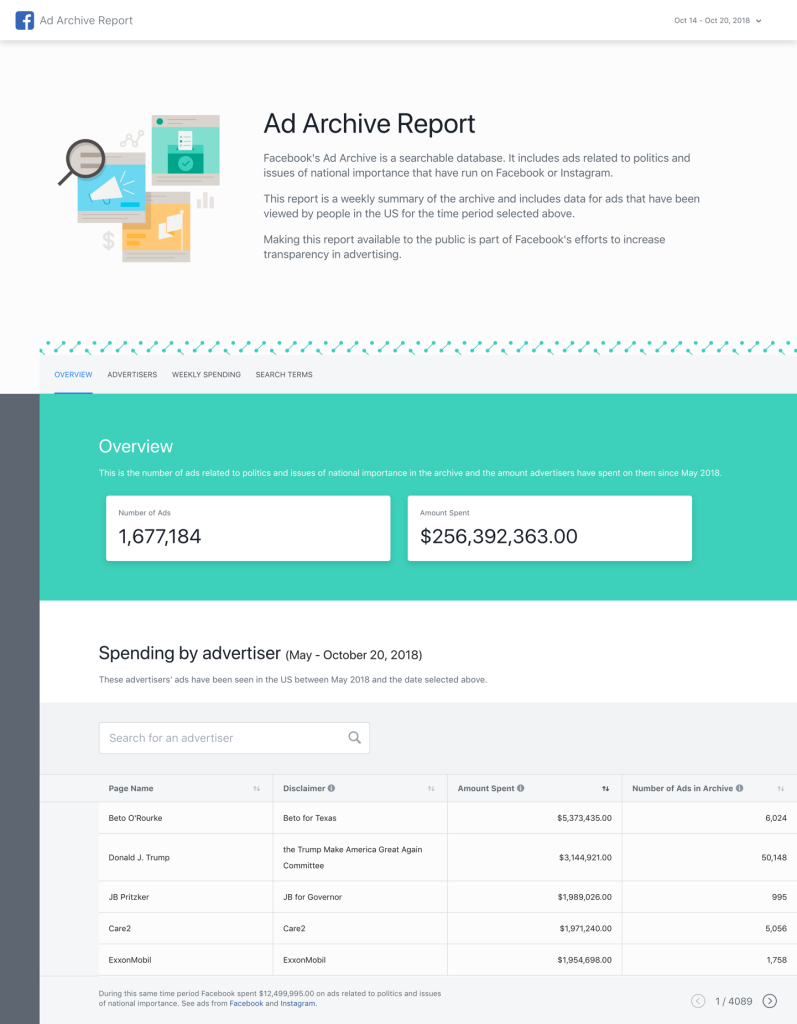
Facebook’s Ad Archive Report highlights top political spenders

For obvious reasons, Facebook’s looking to up political advertising transparency ahead of the midterms. Back in May, the social network introduced Ad Archive, a searchable database of political ads in the U.S. It’s following up the feature with a new Ad Archive Report, a weekly snapshot of political spending.

The survey offerings a breakdown of top spenders by campaign, including the amount spent and the number of ads run. The first report for ads on Facebook and Instagram from between May and October 20, shows a total of $256 million spent across 1.6 million ads.

The number includes $12 million related to Facebook’s own election integrity and getting out the vote ads. Other than that, it probably won’t come as a surprise that Beto O’Rourke’s tooth and nail Texas fight leads the way. The Beto for Texas campaign has spent $5.3 million across just over six thousand ads in that period.

Donald Trump’s “The Trump Make America Great Again Committee” is in second place at $1.9 million, while “Donald J. Trump for President, Inc.” is in eighth place at $1.6 million. That’s just behind the $1.7 million spent on Tom Steyer’s “Need to Impeach.” Those will no doubt see a boost as we head toward 2020.

The archive houses ads reaching back to seven years. The site is also offering up an API for researchers to tap into the data.

24 Oct 2018

Hear how Threads makes fashion social at Disrupt Berlin

TechCrunch Disrupt Berlin is right around the corner, and I’m excited to announce that we invited Threads founder Sophie Hill to talk about her innovative vision of luxury shopping.

Threads is like nothing out there. It isn’t an e-commerce website with warehouses and and suppliers. It isn’t a marketplace website for second-hand luxury goods. It isn’t a marketplace website for other brands. In fact, it’s not a website at all.

The startup combines a strong editorial strategy with a distribution method that is quite novel. You get recommendations through your favorite chat app on your phone. It works on services like WeChat, WhatsApp, Snapchat, Instagram and iMessage.

On the other end of the conversation, you interact with human shopping assistants. This is what makes the experience so great. You don’t receive a newsletter, you don’t have to download an app. It integrates directly with apps that you were already using.

This way, if you feel overwhelmed and think you’re falling behind on the fashion front, Threads is much more efficient. Chances are you often browse your conversation list anyway. Accessing Threads is just a tap away.

And it’s working. The company recently raised a $20 million round and people spend $3,000 on average per shopping session. Big fashion houses, such as Dior, Fendi and Chopard started working with the startup.

By adopting a WeChat-first approach, the company managed to attract quite a few Chinese customers in particular. But Threads currently has customers in over 100 countries.

If you think you knew everything about e-commerce, come to Disrupt Berlin to listen to Hill’s novel strategy.

The conference will take place on November 29-30 and you can buy your ticket right now.

In addition to fireside chats and panels, like this one, new startups will participate in the Startup Battlefield Europe to win the highly coveted Battlefield cup.

Sophie Hill

Founder, Threads

Sophie is founder and CEO of Threads, with a mission to pioneer the best luxury shopping experience in the world. By leveraging social media and messaging platforms, Sophie has built a £multi­million global fashion tech business, and is setting the rules for a new form of consumer buying, called chat commerce. Threads joined Future Fifty in 2017 and is now in Tech Track 100 as owner of one of the UK’s fastest growing tech growth companies. In between doubling the size of the company in 2018, Sophie is also figuring out how to sell the first $1m diamond through whatsapp.

24 Oct 2018

Subscription management startup RevenueCat raises $1.5M

RevenueCat, a startup that helps developers manage their in-app subscriptions, has raised $1.5 million in new funding.

The company was part of the most recent batch at Y Combinator, and CEO Jacob Eiting said growth has been “a rocket ship” for the past few months. As of this week, RevenueCat is working with 100 live apps, and it’s crossing $1 million in tracked revenue.

The startup offers an API to address what sounds like a straightforward task, supporting in-app subscriptions in iOS and Android. As Eiting put it when I first interviewed him a few months ago, it’s “boring work” solving a “boring problem” — but that’s one of the reasons why developers don’t want to deal with it. It also means they don’t have to spend time dealing with bugs and updates on the subscription side of either platform.

And RevenueCat continues to add new features, like allowing developers to bring their revenue data into analytics and attribution services. That, in turn, makes it easier for them to see which ads are driving real revenue.

The long-term goal is to build what Eiting (who’s pictured above with his co-founder Miguel Carranza) calls a “revenue management platform.”

“Our mission as a company is to help developers make more money,” he said. “I think we do become this one-stop shop, a service that you integrate with all the payment touch points in your app to help you track your revenue and help you understand how customers are spending.”

The new funding (which is on top of the $120,000 RevenueCat received from YC) was led by Jason Lemkin of SaaStr. Eiting said it’s “an obvious fit,” since the software-as-a-service entrepreneurs who read SaaStr articles, listen to its podcasts and attend its events form “this huge community of companies that are potential customers for us.”

FundersClub, Oakhouse Partners, Buckley Endeavours, Josh Buckley and OneSignal CEO George Deglin also invested.
24 Oct 2018

Target launches free, 2-day shipping with no minimum purchase requirement

Take that, Amazon and Walmart. Target has just come out swinging with news that it’s launching free, two-day shipping on hundreds of thousands of items across its site without requiring a minimum purchase or an annual membership fee. This challenge to Amazon Prime comes at a time when Prime membership is at highest – Prime subscribers passed the 100 million milestone this April. But it also arrives at a time when Prime subscription prices are climbing and there’s an undercurrent of dissatisfaction over Prime’s 2-day deliveries that often turn into three days, four or more.

Unfortunately, however, Target’s free shipping is only a holiday perk, not a new policy. (At least, not yet.)

Target says it’s launching the free, two-day shipping on November 1, and will extend the offer throughout the holiday season, wrapping on December 22.

Before, this free shipping option was only available to Target REDcard holders, who also get an extra 5% off purchases. The offering for REDcard holders was announced in March, and required a minimum purchase of $35.

That’s the same minimum Walmart requires for its own, free, two-day shipping option launched last year. Walmart this week expanded that to its marketplace sellers, as well.

Target announced its news on Tuesday, adding that its new, two-day option exists alongside a host of ways to shop its stores.

In addition to ship-to-home delivery, it also now operates same-day delivery service Shipt, for groceries, gifts, decorations, and other household goods; Target Restock, for next-day delivery; same-day delivery from store in urban markets like Boston, Chicago, New York City, San Francisco and Washington, D.C.; online order pickup; and Drive Up, for same-day order pick up.

The latter will be available at nearly 1,000 stores by the end of the month, it says, while Shipt is now available to millions of consumers across hundreds of markets in 46 U.S. states.

Target’s agenda to make a variety of easy and affordable ways to shop its stores and site have been paying off. During its most recent earnings, the retailer reported its web sales rose 41%, aided by slashing next-day delivery fees and the bump from Amazon’s Prime Day in July – a sales holiday that now helps all retailers running competing sales.

Target’s sales growth for the quarter was the best it had seen in 13 years, the company reported at the time.


24 Oct 2018

Dash Radio raises $8.8M as it reaches 10M monthly listeners

For Dash Radio founder Scott Keeney, streaming music and radio are two very different things. On the streaming side, Apple and Spotify dominate, and “there’s not going to be room for much else.” But when it comes to radio, he argued, “It’s the wild, wild west.”

Keeney, a.k.a. DJ Skee, was already one of the biggest radio DJs when he started Dash. For him, radio is a more curated, personality-driven, “lean back” experience — so Dash Radio focuses on live shows, with a lineup of more than 400 shows across 75 stations, with big names like Snoop Dogg, Lil Wayne and Ice Cube as hosts.

The startup is announcing that it’s now reaching 10 million monthly listeners, and that it’s raised an $8.8 million seed round.

Investors include Nimble Ventures, Slow Ventures, Lazerow Ventures, Muzik, Arab Angel, G Ventures, Lindzon Capital Partners, Jason Flom, Orin Snyder and Ian Schaefer. Warner Bros. chairman and CEO Kevin Tsujihara and Alibaba’s former chairman of U.S. investments Michael Zeisser also invested and are joining the company’s board, as is Passport Capital founder John Burbank.

“I’m honored to be joining the board at Dash, and excited about the real change they’re driving across radio,” said Tsujihara in the funding announcement. “With their great leadership team, terrific original curated content and an offering unmatched in the market, Dash is positioned to disrupt analog radio and convert listeners to Dash users.”

Dash studio

Speaking of analog radio, Keeney acknowledged that there are other services (like iHeartRadio) that bring live radio broadcasts online, but he suggested that they’re coming from “legacy players” who are “all burdened by legacy infrastructure.”

Dash is able to take a different approach. For one thing, it’s cut out the long stretches of advertising — as Keeney put it, “We figured a business model that goes around these traditional insertion-based advertising models.”

That doesn’t means it’s avoiding sponsorships. In fact, it recently opened a studio in the Empire State Building (it already has a studio in Los Angeles) in partnership with Build-A-Bear, which also operates a branded kids’ station on Dash. What Dash isn’t going to do is interrupt the music and shows with ads.

Keeney also suggested that Dash might eventually introduce a paid, premium plan with features like on-demand show archives.

He made it clear that if Dash really is going to be the future of radio, it needs to allow new talent to succeed as well. That includes surfacing new artists (Keeney said Post Malone’s first radio interview was on Dash), and also new DJs. After all, Snoop Dogg is “an incredible talent,” but he’s never going to be known primarily as a Dash Radio personality.

“Now we’re starting to see people emerging, they are going to be known as somebody from Dash Radio,” Keeney said.

24 Oct 2018

Product Hunt Radio: The baby boom and the future of work and education

In this episode of Product Hunt Radio, I’m visiting TechCrunch HQ to hang out with two journalists that see more startups in a month than most people in a lifetime.

Josh Constine is the Editor-At-Large at TechCrunch where he covers social products, including Facebook, Instagram and Snapchat. Sarah Buhr is a new mother and, as she announces on the show, is taking a break from reporting at TechCrunch to raise her child. I’ve known Sarah since she joined TechCrunch in 2014 and more recently she’s focused her writing on the wild world of biotechnology. We also have one more special guest: Sarah’s beautiful six-month-old baby boy, Hayes. If you hear crying and clapping in the background, it’s him.

In this episode we talk about:

  • The baby boom in Silicon Valley, including some of the coolest tech-enabled baby products helping tired moms and dads, as well as the ways that tech company cultures have changed since their founders and employees started having children.
  • Why it might be possible to beat unhealthiness with convenience. We talk about a number of startups that are trying to get you fit by making the healthy option the easier option, similar to how Spotify beat piracy by making streaming easier than pirating.
  • The future of work and education and how it will affect the world that baby Hayes grows up in. We talk about why Sarah and her husband have been debating whether they should be saving for Hayes to go to college, how AR and VR will transform education and how automation will affect the workplace.
  • All things Facebook – whether new startups can compete with the massive social network and some quick thoughts on their first hardware product, Portal.

We of course also talk about some of their favorite products including a robot that makes burgers, a time-sucking app for meme lovers and a virtual assistant that can do things for you when you run out of time (because you were browsing memes).

Subscribe on Apple Podcasts, Google Podcasts, Spotify, Breaker, Overcast, or wherever you listen to your favorite podcasts.

24 Oct 2018

Spotify launches its playlist submission feature out of beta

Spotify is taking its playlist submission feature for all artists out of beta, starting today. The feature, which was first introduced into beta this summer, offers musicians and labels a way to reach Spotify’s playlist editors – the increasingly important tastemakers who can make or break a new track or help an emerging artist reach an expanded audience.

For years, artists and labels had been playing a game of trying to get intros to the correct playlist editor – believing that if you could just reach the right person, you could sway them to get a new song selected for playlist inclusion.

The playlist submission tool aims to give artists a different means of reaching Spotify’s editors. Through the Spotify for Artists dashboard – the place where musicians can track their plays, view analytics, see fan base demographics, and now, upload music directly – they can now also send in songs for consideration.

Spotify says that over 75,000 artists are featured on editorial playlists every week, plus another 150,000 on its flagship playlist, Discover Weekly.

The company claims that it’s not quite as simple as throwing money around in exchange for being playlisted, of course. (But that insane Drake promotion led many to wonder if that’s true.)

All the new playlist submissions aren’t just going to a black hole, it seems. The company says that since the feature became available in July, more than 67,000 artists and labels have submitted music, and over 10,000 artists have been added to playlists for the first time.

The company didn’t say how many total submissions were included, however.

It offered a few examples of how being “playlisted” impacted streams, noting for example that when Gustavo Bertoni’s song “Be Here Now” was selected to appear on the Acoustic Morning and Fresh Folk playlists, his monthly listeners jumped from 7,000 to 617,000.

Alt-rock band Yonaka saw their numbers increase from 82,000 to 290,000 when they were added to New Music Friday, and the Dutch rapper Bryan Mg went from 4,600 to 33,000 monthly listeners after ending up on the La Vida Loca playlist.

The company also said that, even when songs aren’t immediately selected for playlists, having tracks submitted through the uploading feature with all their metadata included means they’re ready for inclusion on future playlists, if that comes to pass.

The robust set of features for artists through the Spotify for Artists platform – which will soon have a cross-platform music distribution tool as well, thanks to its recent DistroKid investment – is helping to differentiate Spotify from its competitors, including Apple Music, Amazon Music, Pandora, and others.

Alongside the public availability of the playlist feature, Spotify released a couple new episodes of its original series, The Game Plan, which discusses how playlists work.


24 Oct 2018

Spatial raises $8 million to bring augmented reality to your office life

Legitimate augmented reality use cases are hard to come by. Spatial, which dubs itself as a cross-reality platform, is launching today with $8 million in seed funding from iNovia Capital, Uber co-founder and Expa founder Garret Camp, Samsung Next, Joi Ito of MIT Media Lab, Mark Pincus and Andy Hertzfeld to bring augmented reality to enterprise customers. Spatial envisions its solution replacing tools like Google Hangouts, Zoom and the numerous other virtual workplace meeting apps.

While many companies are focused on games and entertainment, Spatial is looking at how everyday people can use AR for everyday work purposes.

“We think the future of work is going to be increasingly distributed,” Spatial co-founder and CEO Anand Agarawala told TechCrunch. “When you put on Spatial, they are in the room with you. It feels like they’re all sitting at the table, and they feel like they’ve been teleported into the space with you.”

Spatial is two things. One is a remote presence that enables people to feel like they’re face-to-face with their colleagues. The other is a suite of knowledge tools and an “infinite desktop” that uses the room as your monitor.

Spatial is purely a software platform that has partnerships with Microsoft HoloLens but is hardware agnostic. Spatial also offers both web and phone apps for people who may not have access to an AR headset.

To use Spatial, you would first pop on an AR headset and scan their current environment. From there, Spatial shares that environment with anyone you’d like and enables them to join the space. When you look around the room, you’re able to see and interact with the avatars of your co-workers. But more importantly, you’re all able to interact with a shared set of documents, websites, images and whatever else you or your teammates decide to put in the shared space.

Currently, there are a handful of companies using Spatial’s technology. One of those companies is Ford’s incubator, Ford X, which is piloting the software to enable its teams working on mobility to collaborate remotely. As it stands today, Spatial can handle about 15 to 20 people at a time, but the goal is to scale up to be able to manage hundreds of people at once.

Unlike other types of collaboration software, Spatial doesn’t have a presenter mode because the company wants “social etiquette to take over” and make the experience as realistic as possible, Agarawala said.

You can check it out in action below.