Year: 2018

23 Oct 2018

Hulu adds Starz to its premium add-ons

Following news of Hulu’s plans to move towards skinnier bundles, including those consisting of premium add-ons, the streaming service this morning announced the addition of Starz to its service. The Starz premium add-on will be available across all tiers of Hulu’s service, including its Limited Commercials and No Commercials plans, as well as its Live TV service.

It costs an extra $8.99 per month – the same price it sells for on rival services, like Amazon’s Prime Video Channels, for example.

This is the fourth premium add-on to come to Hulu, and the most affordable, following HBO, Showtime, and Cinemax, which cost $14.99/month, $10.99/month, and $9.99/month, respectively. Hulu, so far, has been surprisingly slow to roll out a customizable set of add-on subscriptions for those who want access to premium entertainment or sports programming.

Meanwhile, rival live TV service YouTube TV offers the NBA League Pass, Fox Soccer Plus, Curiosity Stream, Showtime, Starz, AMC Premiere, Shudder, and Sundance Now. Sling TV breaks up its extras into bundles customers can pick and choose from, and AT&T’s DirecTV Now offers programming tiers with optional add-ons, too.

But Hulu’s bundles and pricing may change in the future – CEO Randy Freer told The Information recently it’s eying a revamp of its service that will break up programming into smaller packages. Hulu wouldn’t comment today on whether it has plans for more add-ons in the future, however.

Hulu already had a deal with Starz to be the exclusive subscription streaming home to past seasons of Starz’ Original series “Power,” which arrived on Hulu last year, and has now been streamed for a total of 50 million hours by Hulu subscribers.

With the Starz add-on, subscribers can watch all seasons of the show, including Season 5 – and they can watch it live as it airs or on-demand.

Other Starz series of note include “Outlander,” Vida,” “Counterpart,” and “American Gods.” It’s also currently featuring movies like “Jumanji: Welcome to the Jungle,” “Spider-Man: Homecoming” and exclusive documentaries.


23 Oct 2018

Dating app Vibes aims to create a safe, authentic space for people to meet

Online dating is trash. Seriously, try to find anyone who disagrees with me.

Vibes, founded by an all-female team, aims to be different. Sure, the swipe mechanics are still there, but that’s about the only similarity you’ll find between Vibes and the likes of Tinder, Hinge, Bumble and others.

“Because of how crowded the space is, when people hear the words ‘dating app’ they’re like ‘ugh, why do I need another one? My dance card’s full,” Vibes co-founder Jenais Zarlin told TechCrunch. “But those same people are also the ones to say the ratio of good experiences to negative ones, or ones that feel transactional is way off.”

The basis for Vibes is that meaningful connections are rooted in respect and authenticity, Zarlin told me. That’s why she sees Vibes as an extension of physical safe spaces “we know and admire.”

“Text and semi-anonymity really embolden people to behave in ways they wouldn’t in person,” Zarlin said.

That’s why text-based messaging is not part of the experience at all. When you sign up (via Facebook)*, you first must agree to the app’s code of conduct. Vibes’ code of conduct centers around respecting difference (not being racist, sexist, misogynistic, homophobic, transphobic and body-shaming) and generally respecting others by not being sexually explicit or threatening harm.

Next, you select whether you’re down to vibe with people whose preferred pronouns are him, her or them.



“In other apps, the heteronormative agenda is pretty front and center and gender binaries are pretty core to them,” Zarlin said. “It feels like we’re at a time where we need to move past that.”

Next, you select some photos you want to feature and then choose a conversation starter. If you match with someone, you’ll record a short, pixelated video answering their question.

Vibes pixelates the video for those who may be shy. But even with the video pixelated, people can still hear your voice and pick up on mannerisms, just as they would be able to in person.

“It’s a much heavier lift sending a video message, but we expect that it will result in more quality interactions — but probably fewer overall interactions,” Zarlin said.

Its emphasis on moderation also sets Vibes apart from other dating apps. For every first message you receive, Vibes requires you to actively acknowledge if the message was or was not okay with you.

The present day also feels like the right time for Vibes to launch to the masses, Zarlin told me.

“2018 has been a very interesting year for a lot of reasons and there’s been dialogue around self-care, respect and equality,” Zarlin said. “We’ve never talked so much about those issues and yet I think we’re still not innovating around them, or not innovating enough. So Vibes really does to me feel like it has so much potential to be transformative and it was always designed with all of those ideals and values in mind.”

Vibes soft-launched back in July and currently has a few hundred people using the app. Vibes, which has $1.5 million in funding, is free to use but envisions developing a freemium model down the road.

*Zarlin said the decision to use Facebook was made before all of Facebook’s data scandals. Vibes does eventually plan to remove Facebook from the sign-up process.

23 Oct 2018

Y Combinator issues a request for geo-engineering startups because climate change is real and we’re all going to die

Y Combinator, the wildly successful San Francisco-based startup accelerator, is issuing a request for startups that will focus on different kinds of geo-engineering technologies in a bid to mitigate the effects of climate change.

With the acknowledgement earlier this month from the Intergovernmental Panel on Climate Change that drastic measures are going to be required to reverse climate change and protect the globe from catastrophic climatological events by 2050, the startup accelerator is hoping that its call to action might spur some new thinking.

“I’ve been thinking about this over the past year or so. [And I] keep meeting really smart people, and the situation keeps seeming to get more dire. This isn’t anyone’s plan A, but we seem to totally be failing at curbing emissions fast enough,” wrote Y Combinator partner Sam Altman, in an email. “If one talented group of people decided to take this seriously and work on one of these ideas, I’d be delighted.  We have good luck with RFS’s that sound extremely ambitious in the past. I believe you have to set out very ambitious goals, and think about what’s at the edge of possible, in order to get significant breakthroughs to happen.”

Limiting the damage caused by climate change, global net human-caused emissions of carbon dioxide (CO2) would need to fall by about 45% from 2010 levels by 2030, reaching ‘net zero’ around 2050 — meaning that any remaining emissions would need to be balanced by removing CO2 from the air. No government is anywhere near achieving this goal and certainly not the world’s most populous and most polluting nations — including the U.S., India, and China.

Indeed, the response from the current U.S. administration seems to be “smoke ’em if you got ’em.”

As the Y Combinator statement announcing the new initiative itself suggests, the world is well past reversing climate change by simply reducing emissions.

“Phase 1” of climate change is reversible by reducing emissions, but we are no longer in “Phase 1.” We’re now in “Phase 2” and stopping climate change requires both emission reduction and removing CO2 from the atmosphere. “Phase 2” is occurring faster and hotter than we thought. If we don’t act soon, we’ll end up in “Phase 3” and be too late for both of these strategies to work.

So the company has put out its call for what it’s dubbing “frontier technologies”. These include developing new strains of ocean phytoplankton, carbon fixing through electro-geochemical processes, genetically modified enzymatic carbon fixing using cell-free systems, and desert flooding to create micro-oases and carbon sinks of new (somewhat arable) land.

If all of these things sound insane and completely unfeasible without government support, that’s because they essentially are.

But as we’ve written ourselves, it’s time for the world to start thinking about geo-engineering as an option.

Some iterations of Y Combinator’s plan for carbon sequestration already exist or have been tried by previous startups. In its blog post, the accelerator pointed to bio-energy with carbon capture and storage, which would require growing new biomass to convert into energy and then capturing the emissions created when that biomass is burned for power and burying it in the ground. Other methods that have been floated include direct air capture; a technology used by companies like Carbon Engineering — a Bill Gates-backed company that takes carbon dioxide from the air and converts it into fuels and chemicals; LanzaTech, a New Zealand company that converts carbon into chemicals and fuels; and the Australian cement manufacturer Calix.

Further afield is solar radiation management, which would reflect inbound sunlight back into space. Researchers have proposed sending satellites into space that would reflect solar energy, injecting sulfate aerosols into the stratosphere, cloud-seeding to make them more reflective, or whitening roofs and developing reflective crops that would not absorb as much sun.

Those technologies are (to some degree) here already, what Y Combinator is asking for from startups and entrepreneurs are the next generation of geo-engineering technologies.

This new initiative from Y Combinator is both the ultimate expression of Silicon Valley hubris and a clear-eyed attempt to wrestle with what is quickly becoming accepted as the reality of climate change and its impact on the world.

And fortunately or unfortunately for everyone, without the support of the word’s governments, none of these solutions, however viable or compelling will ever see the light of day. What’s equally troubling is the thought that some government, recognizing how dire the situation is, might go rogue and unilaterally implement some of these technologies without regard to the consequences of the global ecosystem.

If the apocryphal butterfly flapping its wings could create monsoons halfway around the world, what might the potential implications be of creating new life in the ocean to absorb global emissions?

Altman acknowledges that the best solution is still emissions reduction — and he’s invested in nuclear power companies that could be a part of that solution — but the growing consensus is that emissions reduction may no longer be enough (unless a moonshot discovery is made).

That leaves building a world that’s better able to adapt to the consequences or changing the world to the solve the problem.

23 Oct 2018

Futrli raises a Series A to hone its decision-making platform for small businesses

Futrli, a cloud-based business decision-making platform aimed at small businesses, has raised a £4m Series A from e.ventures, Notion Capital and firstminute Capital.

Bootstrapped to date, Futrli claims to have over 40,000 businesses and 1,100 accountants in 130 countries using it.

The four-year-old business led by CEO and founder Hannah Dawson says it uses AI/ML techniques to produce actionable insights for small businesses.

Dawson said: “Futrli was born from my own typical experience as a small business owner. I needed a way to run my business that looked to the future, as making decisions is hard and full of risk when you haven’t got all of the information in one place.”

A spokesperson for Futrli said the way it works is that “static screens are removed, multiple sources of information have relationships drawn between them (sources well beyond just financial data from the likes of Xero, QBO etc.), are prioritized and then decisions and actions can be made and taken in one seamless smartspace.”

Giles Palmer, CEO of business intelligence company Brandwatch, joins as chairman.

Futrli competes with Manthan, among many, many others in the space.

23 Oct 2018

GoEuro raises $150 million for its travel aggregator

Berlin-based startup GoEuro just raised a new $150 million funding round from Kinnevik and Temasek, with Hillhouse Capital also participating. According to Crunchbase, the company has raised nearly $300 million to date.

Chances are you’ve used some sort of flight aggregator before to compare prices and find the best deal. But if you live in Europe, this isn’t enough. Sometimes, you want to compare flights with trains and buses.

GoEuro allows you to do just that. After entering two cities, you can compare all possible routes and book a ticket.

This is a tedious problem as there are countless of airlines, train and bus companies. But it is also a different offering compared to all the flight aggregators out there.

You can see why investors see some value in GoEuro. Transportation in Europe is fragmented. You can book tickets for 80 percent of transport providers on GoEuro. It creates an important barrier to entry for other aggregators. In other words, in addition to generating revenue from ticket sales, GoEuro’s technology platform is valuable by itself.

GoEuro operates in 36 European countries and works with all transportation providers in 15 markets. In fact, GoEuro recently acquired BusRadar to improve bus search results. 27 million people use GoEuro every month.

23 Oct 2018

Josh Kushner’s Thrive Capital brings in $1B

It’s a good week to be Josh Kushner, venture capitalist, founder of the health insurance unicorn Oscar, brother to President Donald Trump’s senior advisor Jared Kushner and son of real estate tycoon Charles Kushner.

Days after marrying supermodel Karlie Kloss, Kushner’s VC firm Thrive Capital has announced the close of $1 billion in new capital for its sixth flagship venture fund. The firm has raised $600 million for late-stage deals and an additional $400 million for earlier bets.

Thrive is stage and industry agnostic with investments in Oscar, Cadre, a real estate software company co-founded by the Kushner brothers, Glossier, Warby Parker, Slack, Robinhood and Stripe. Its exits include Spotify, Twitch and GitHub, of which it owned a 9 percent stake at the time of its $7.5 billion sale to Microsoft earlier this year.

Kushner, a close friend to Instagram’s former chief executive officer Kevin Systrom, famously doubled his money in 72 hours after investing in the photo-sharing app days before Facebook’s acquisition. He launched Thrive in 2009 and has quickly risen to prominence as both a founder and successful venture investor.

The New York-based firm’s funds have grown successively larger. Its fifth fund closed on $700 million in 2016. Before that, Thrive brought in $400 million in October 2014 for its fourth effort, $150 million in 2012 for its third, $40 million in 2011 for its second and $10 million for its 2009 debut fund.

The $1 billion vehicle is its largest to date.

Kushner, who at just 33 years old is one of the youngest billion-dollar fund managers, has been on a fundraising spree as of late. Oscar secured a $165 million investment in March at a reported valuation of $3.2 billion, bringing its total raised to date to some $1.2 billion.

Thrive’s latest infusion brings its total assets under management to date to $2.5 billion.

23 Oct 2018

Power Ledger launches token for retail investors to back renewable energy projects

Back in May Power Ledger, the Australian-born startup which allows consumers to buy and sell renewable energy directly between one another using a blockchain platform, launched its first commercial deployment in the US. It’s now extending its mission to allow individuals and communities to share in the profits of renewable energy assets by trading in a crypto token it will launch. To achieve this Power Ledger is literally acquiring energy assets to make the token asset-backed.

This Asset Germination Event (AGE) token has, says the company, the potential to disrupt the traditionally centralized energy market and thus grow the renewable energy industry, because of course, ownership of the token will incentivize people to invest in renewable energy.

This might be of some relief to observers who have seen some nation states lately captured by populist politicians withdraw or reduce funding for renewable energy, as has happened in the UK.

The token will be attached to energy from assets like solar and wind farms and community-owned batteries.

Dr. Jemma Green, co-founder and chairman of Power Ledger, said: “We’ve developed a model that we believe will define the world’s best practice when it comes to fully regulated blockchain token offerings, while allowing people to actively help the environment by supporting renewable energy all over the world.” She believes it will also empower more small-scale investment in renewable energy resources.

Power Ledger’s AGE token aims to increase the amount of capital flowing towards renewable energy by allowing an investor class previously denied the opportunity to participate in many projects of this nature as they were not ‘sophisticated investors’. Most of these products are currently only available to ‘sophisticated investors’ who are able to invest in large-scale energy projects, not retail investors. For example, in Australia, which has plenty of sun, you need at an annual income of at least AUD250,000.

Power Ledger says the asset-backed token will pay out distributions from renewable energy generation, unlike a utility token whose value corresponds to its future use.

To ensure their token is asset-backed, Power Ledger says it is acquiring its first assets; a grid-connected battery and a commercial solar system, and will then issue tokens that pay distributions from the energy generated by those assets as part of an investment fund structure.

As Green says: “When everyday people can invest in and co-own commercial renewable energy assets, we will be closer to our goal of a decentralized and democratized energy ecosystem.”

Power Ledger also provides several other blockchain-based energy trading platforms, including xGrid, which enables Peer-to-Peer electricity trading across the grid, and μGrid, designed for microgrid energy management, electricity metering and secure blockchain transactions.

Energy has increasingly become attractive to the Blockchain world which sees the ability to create a transparent, auditable and automated record of energy generation and consumption.

Last year UK startup DOVU launched to become “the global marketplace for transport data” powered by the “DOV” token, and received seed funding from InMotion Ventures, Jaguar Land Rover’s investment arm.

23 Oct 2018

iPharmacy Roman fights stigmas with premature ejaculation meds

There’s a war brewing to become the cloud pharmacy for men’s health. Roman, which launched last year offering erectile dysfunctional medication and recently added a ‘quit smoking’ kit, is taking on $97 million-funded Hims for the hair loss market. Today, Roman launched four new products it hopes to cross-sell to users through a unified telemedicine subscription and pill delivery app. It now sells meds for premature ejaculation, oral herpes, genital herpes, and hair loss at what’s often a deep discount versus your local drug store. And for those who are too far gone, it’s launching a “Bald Is Beautiful, Too” microsite for finding the best razors, lotions, and head shaving tips.

Roman CEO Zachariah Reitano

“It’s unlikely that you’ll buy razors from Bonobos or pants from Dollar Shave Club. But with a doctor, it’s actually the exact opposite” Roman CEO Zachariah Reitano tells me. “As a customer you’re frustrated if they send you somewhere else.” And so what started as a single product startup is blossoming into a powerful product mix that can keep users loyal.

Roman starts with a telemedicine doctor’s visit where patients can talk about their health troubles without the embarrassment of going to their general practitioner. When appropriate, the doc can then prescribe medications customers can then instantly buy through Roman.

“If you have something that’s truly consuming your day-to-day, it makes it really hard or nearly impossible to think about the long-term. If you’re 30 pounds overweight and experiencing erectile dysfunction, [it’s the latter symptom] that’s dominating your head space” Reitano explains. The doctor might focus on the underlying health issue, but most humans aren’t so logical, and want the urgent issue fixed first. Reitano’s theory is that if it can treat someone’s erectile dysfunction or hair loss first, they’ll have the resolve to tackle bigger lifelong health challenges. “We’re hoping to work on this so you can take a deep breath and get the monkey off your back” the CEO tells me.

But one thing Roman won’t do is prescribe homeopathic remedies or spurious remedies. “We will only ever offer products that are backed by science and proven to work” Reitano declares. Taking a shot at Roman’s competitor, he says “Hims sells gummies. Roman does not.  No doctor would say Biotin would help you regrow hair”, plus the vitamin can distort blood pressure readings that make it tough to tell if someone is having a heart attack.

“Roman will never slap sugar on vitamins, sell them on Snapchat, and say they’ll regrow your hair” Reitano jabs. Roman also benefits from the fact that Reitano’s father and one of the company’s advisors Dr. Michael Reitano was a lead author on a groundbreaking study about how Valacyclovir could be used to suppress transmission of genital herpes.

So what is Roman selling?

With Roman, Hims, Amazon acquisition PillPack, and more, there’s a powerful trend in direct-to-consumer medication emerging. Reitano sees it as the outcome of five intersecting facts.

  1. The evolution of telemedicine regulation allowing physicians to have a national presence by seeing patients online
  2. Physicians are being reimbursed less by Medicare, Medicaid, and private insurers for the same activity, pushing them towards telemedicine
  3. A patent cliff is making many medications suddenly affordable under generic names.
  4. Insurance deductibles are increasing, turning patients into consumers
  5. Technology is making it easier and cheaper to start medical startups

Roman’s $88 million Series A it announced last month is proof of this growing trend. Investors see the traditional pharmacy structure as highly vulnerable to disruption.

Roman will have to defeat not just security threats and competitors, but also the status quo of keeping a stiff upper lip. A lot of men silently suffer these conditions rather than speak up. By speaking candidly about his own erectile dysfunction as a side-effect of heart medication, Reitano is trying to break the stigma and get more patients seeking help wherever feels right to them.

23 Oct 2018

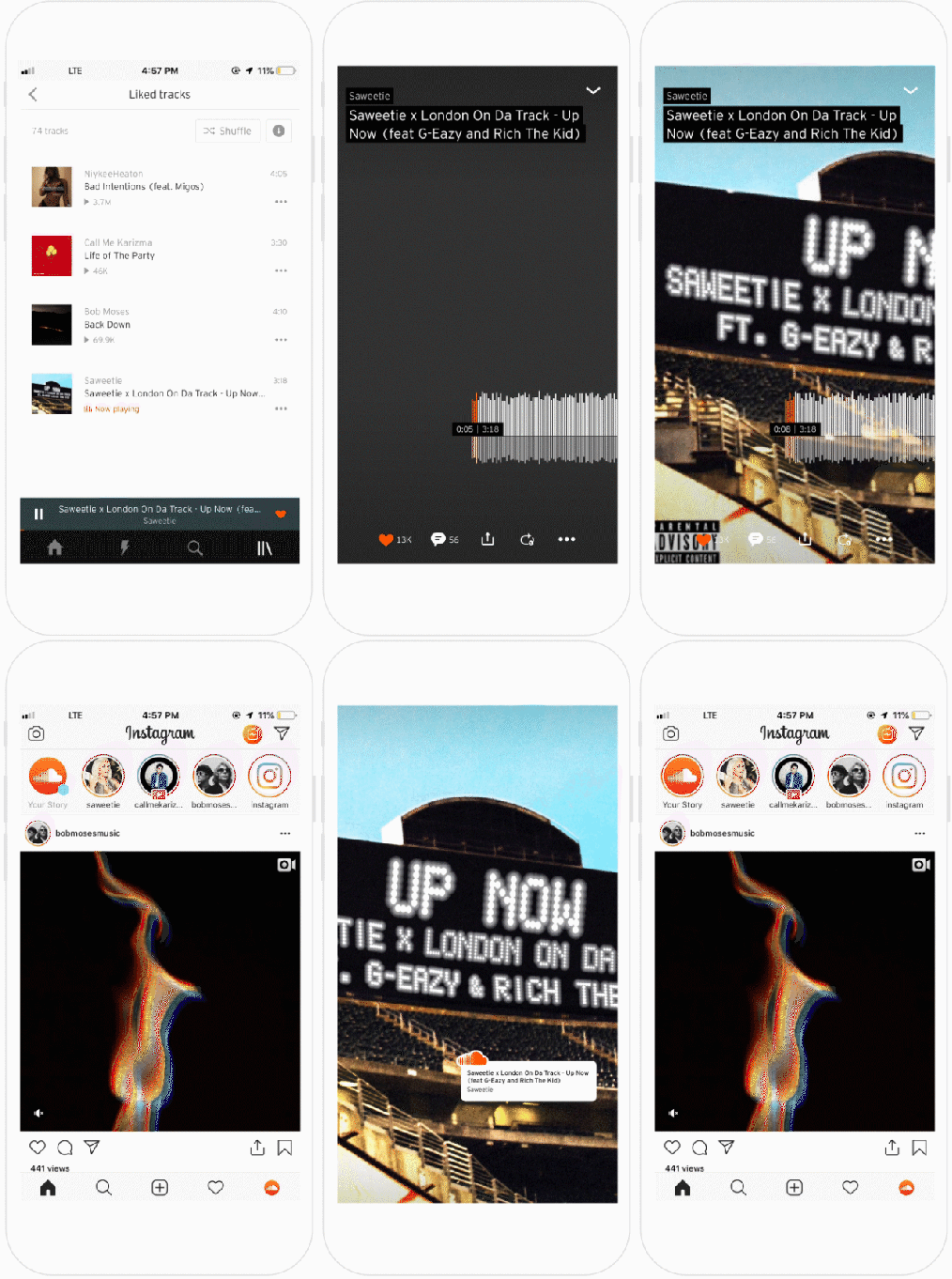
SoundCloud tracks can now be shared to Instagram Stories

Streaming service SoundCloud is making it easier for its users to share music from its service directly to Instagram . The company announced this morning a new feature that allows users to share tracks to Instagram Stories. However, there’s a big caveat here – the tracks are shared as a link that appears within Stories . To actually listen to the track, users have to click the “Play on SoundCloud” link, which then redirects them to the SoundCloud app to begin listening.

This offers a way for fans and artists to promote their music through Instagram’s hugely popular Stories platform, but it’s not quite the same as being able to actually share music via Instagram, as the listening takes place elsewhere.

Prior to this, people shared their SoundCloud discoveries via workarounds – like taking screenshots, for example.

To use the new feature, you first find the track you want to share, and tap the “Share” icon at the bottom of the screen. You then tap the Instagram icon or select “Share to Instagram Stories,” depending on whether you’re on an iOS or Android smartphone. The link to the track is then shared right in your Instagram Story. There’s a sticker label you can drag around to place on the screen. To listen, viewers click the “Play on SoundCloud” link at the top of the Instagram Story.

This sharing feature was actually first announced in May at Facebook’s F8 developer conference, alongside news of Instagram’s support for sharing from other third-party apps, like Spotify and GoPro, among others.

However, SoundCloud confirms that it simply hadn’t been implemented until now.

The sharing feature follows the recent launch of SoundCloud’s monetization program for artists, and serves as another means for musicians to reach their fans outside of the platform itself. However, because users have to click a link to listen, it’s not necessarily a way to expose friends to new music the way that Instagram’s own soundtracks feature can.

SoundCloud says sharing feature is live in the latest version of the SoundCloud iOS and Android app.

23 Oct 2018

Customer service ‘behavioral pairing’ startup Afiniti quietly raised $130M at a $1.6B valuation

Artificial intelligence touches just about every aspect of the tech world these days, aiming to provide new ways of making old processes work better. Now, a startup that has built an AI platform that tackles the ever-present, but never-perfect, business of customer service has quietly raised a large round of funding as it gears up for its next act, an IPO. Afiniti, which uses machine learning and behavioral science to better match customers with customer service agents — “behavioral pairing” is how it describes the process — has closed a $130 million round of funding ($75 million cash, $60 million debt) — a Series D that Afiniti CEO Zia Chishti says values his company at $1.6 billion.

If you are not familiar with the name Afiniti, you might not be alone. The company has been relatively under the radar, in part because it has never made much of an effort to publicise itself, and in part because the funding that it has raised up to now has largely been from outside the hive of VCs that swarm around many other startup deals that push those startups into the limelight.

At the same time, its backers make for a pretty illustrious list. This latest round includes former Verizon CEO Ivan SeidenbergFred Ryan, the CEO and publisher of the Washington Post; and investors Global Asset ManagementThe Resource Group (which Chishti helped found), Zeke Capitalas well as unnamed Australian investors.

The previous Series C round of $26.5 million, also has an interesting list of backers and also was not widely reported. They included McKinsey & Company, Elisabeth Murdoch, former Thomson Reuters CEO Tom Glocer, and former BP CEO John Browne, alongside Global Asset Management, The Resource Group, Seidenberg and Ryan.

That Series C was at a $100 million valuation, meaning that Afiniti’s valuation has increased more than 10 times in the last year on the back of 100 percent revenue growth each year over the last five.

That momentum led the company also to file confidentially for an IPO — although ultimately Chishti told TechCrunch that the company decided to raise privately at the potential IPO valuation since the money was easy to come by. (It’s also been one of the reasons he said he’s also rebuffed acquisitions, although at least one of the companies that’s approached him, McKinsey, now an investor.)

Now, Chishti — who is a repeat entrepreneur, with his previous company, Align Technology (which makes teeth alignment alternatives to braces), now at a $24 billion market cap — said that Afiniti has started to tip into profitability, so it seems the prospect of an IPO might be back on the table. That is possibly one reason that the company has started to speak to the press more and to make itself more visible.

Chishti and Afiniti are based out of the US, but it has roots into a range of local businesses globally in part by way of its well-connected team of advisors and local leaders. Among them, Princess Beatrice (or Beatrice York), currently 8th in line to the throne to succeed Queen Elizabeth, is the company’s vice president of partnerships. Alonso Aznar, the son of the former prime minister of Spain, runs Afiniti’s operations in Madrid.

The company itself sits in the general area of CRM, and specifically among that wave of startups that are trying to build tools using AI and other new technology to improve on the old ways of getting things done (it’s not alone: just today we noted that People.ai raised $30 million for its own AI-based CRM tools).

Afiniti on one hand calls itself a traditional AI company, but on the other, its CEO laments how overused and hackneyed the term has become. “AI is just a bubble,” he said in an interview. “The intensity of interest in AI is unwarranted because nothing has changed. It’s the same algorithms and software, and we just have faster hardware now.”

In actual fact, what Afiniti does is supply an AI layer to a process that is otherwise “ninety-nine percent human”, in the words of Chishti. The company uses AI to analyse sales people’s performance with specific types of calls and situations, and also to analyse customers in terms of their previous interactions with a company. It then matches up customer service reps who it believes will be most compatible with specific customers.

Afiniti’s pricing model has been an important lever for getting its foot in the door with companies. The company does not price its service per-seat or even per-month, but on a calculation between how well the company does when its call routing and running through Afiniti, versus how much is sold when it does not.

“We run systems on for 15 minutes, off for 5 minutes, and we do that perpetually,” Chishti said. It integrates with a company’s CRM, sales and telephony systems at the back end, in order both to route calls but also to track when those calls result in a sale. “We count the revenues, calculate the delta, and we get a share of that delta.”

If that sounds like a tricky measure, it doesn’t to customers, it seems. The zero-cost-to-try-it model is how it has surmounted the hurdle of getting used by a number of large, often slow-moving carriers and other large incumbents. “It means we have to continuously prove our value,” Chishti added.

As one example of how this works out, he used the example of Verizon (which is the owner of TechCrunch, by way of Oath). “Say Verizon makes $120 billion in revenues in a year,” he said, “and $30 billion of that is in phone-based sales. Afiniti would make $600 million on that.” Times that by dozens of customers in 22 countries, and that may point to how the company has quietly reached the valuation that it has.

Beyond its core product, the company has dozens of patents and more in the application phase in the US and other jurisdictions.