Year: 2018

22 Oct 2018

Ford expands self-driving vehicle program to Washington, D.C.

Ford is bringing its autonomous vehicles to Washington, D.C., the fourth city to join the automaker’s testing program as it prepares to launch a self-driving taxi and delivery service in 2021.

Ford will begin testing its self-driving vehicles in the district in the first quarter of 2019. The company is already is testing in Detroit, Pittsburgh and Miami. 

Ford is a bit different from other companies that have launched autonomous vehicle pilots in the U.S. Ford is pursuing two parallels tracks — testing the business model and autonomous technology — that will eventually combine ahead of its commercial launch in 2021.

Argo AI, the Pittsburgh-based company into which Ford invested $1 billion in 2017, is developing the virtual driver system and high-definition maps designed for Ford’s self-driving vehicles. Meanwhile, Ford is testing its go-to-market strategy through pilot programs with partners like Domino’s and Postmates, and even some local businesses.

The testing program in DC will follow that same thinking, with an emphasis on job creation and equitable deployment. Ford says its autonomous vehicles will be in all eight of the district’s wards. Eventually, it will operate business pilot programs in all eight wards, as well . Ford has already established an autonomous vehicle operations terminal in Ward 5, where it will house, manage and conduct routine maintenance on the fleet and continue developing its vehicle management process.

Argo AI already has vehicles on DC’s streets, mapping roads in the first step toward testing in autonomous mode, the company said.

“Both Ford and district officials are committed to exploring how self-driving vehicles can be deployed in an equitable way across the various neighborhoods that make up Washington, D.C., and in a way that promotes job creation,” Sherif Marakby, CEO, Ford Autonomous Vehicles LLC wrote in a Medium post Monday.

Marakby underscored a recent report by Securing America’s Future Energy that found autonomous technology could improve people’s access to jobs as well as retail markets.

Ford announced in July 2018 plans to spend $4 billion through 2023 in a newly created LLC dedicated to building out an autonomous vehicles business. The new entity, Ford Autonomous Vehicles LLC, houses the company’s self-driving systems integration, autonomous-vehicle research and advanced engineering, AV transportation-as-a-service network development, user experience, business strategy and business development teams. The spending plan includes a $1 billion investment in startup Argo AI.
22 Oct 2018

A look at the Android Market (aka Google Play) on its 10th Anniversary

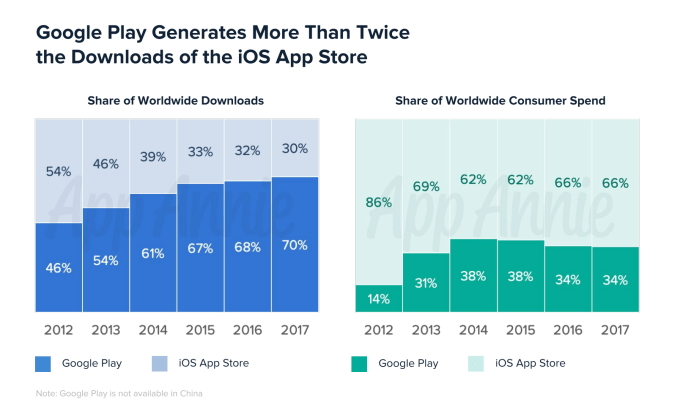
Google Play has generated more than twice the downloads of the iOS App Store, reaching a 70% share of worldwide downloads in 2017, according to a new report from App Annie, released in conjunction with the 10th anniversary of the Android Market, now called Google Play. The report also examined the state of Google Play’s marketplace and the habits of Android users.

It found that, despite the large share of downloads, Google Play only accounted for 34% of worldwide consumer spend on apps, compared with 66% on the iOS App Store in 2017 – a figure that’s stayed relatively consistent for years.

Those numbers are consistent with the narrative that’s been told about the two app marketplaces for some time as well. That is, Google has the sheer download numbers, thanks to the wide distribution of its devices – including its reach into emerging markets, thanks to low-cost smartphones. But Apple’s ecosystem is the one making more money from apps.

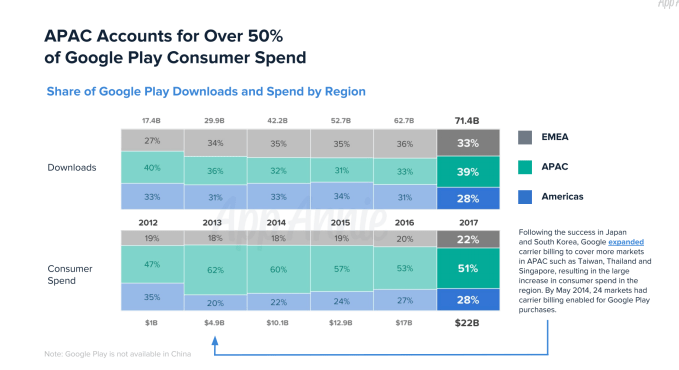
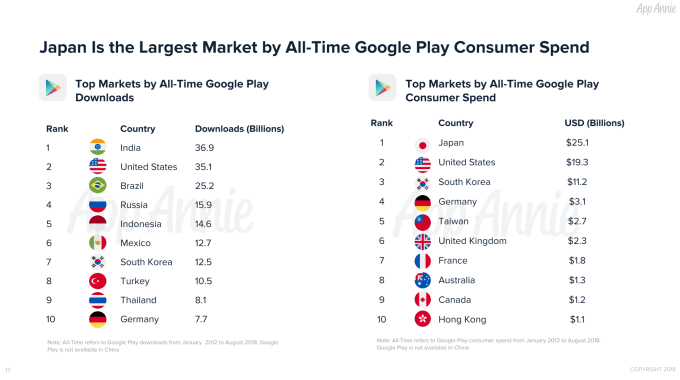
App Annie also found that the APAC (Asia-Pacific) region accounts for more than half of Google Play consumer spending. Japan was the largest market of all-time on this front, topping the charts with $25.1 billion dollars spend on apps and in-app purchases. It was followed by the U.S. ($19.3B) and South Korea ($11.2B).

The firm attributed some of Google Play’s success in Japan to carrier billing. This has allowed consumer spending to increase in markets like South Korea, Taiwan, Thailand and Singapore, as well, it said.

As to what consumers are spending their money on? Games, of course.

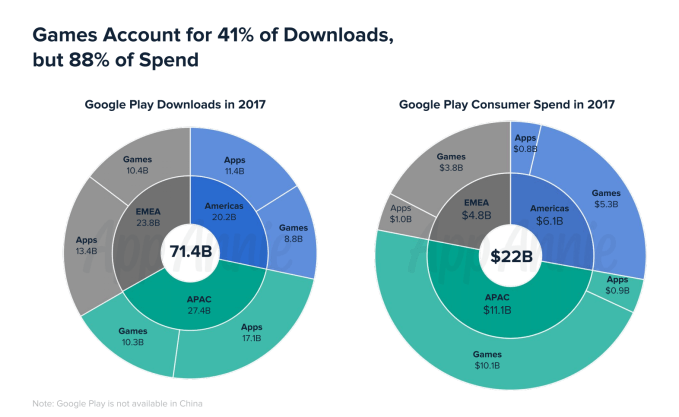
The report found that games accounted for 41% of downloads, but 88% of spend.

Outside of games, in-app subscriptions have contributed to revenue growth.

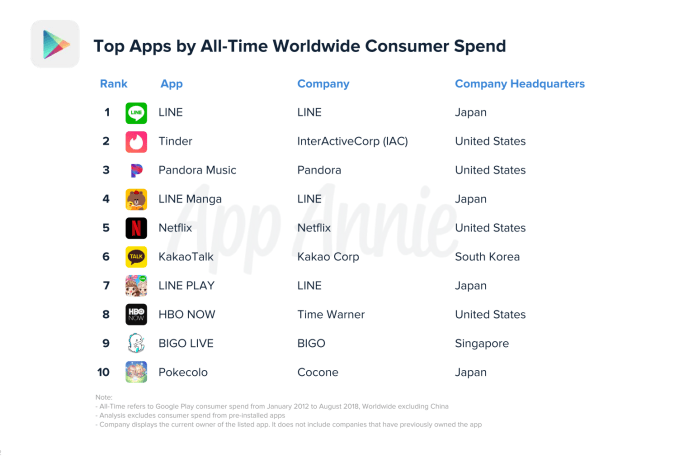
Non-game apps reached $2.7 billion in consumer spend last year, with 4 out of the top 5 apps offering a subscription model. The number one app, LINE, was the exception. It was followed by subscription apps Tinder, Pandora, Netflix, and HBO NOW.

In addition, App Annie examined the app usage patterns of Android users, and found they tend to have a lot of apps installed. In several markets, including the U.S. and Japan, Android users had over 60 apps installed on their phones and they used over 30 apps every month.

Australia, the U.S. and South Korea led the way here, with users’ phones holding 100 or more apps.

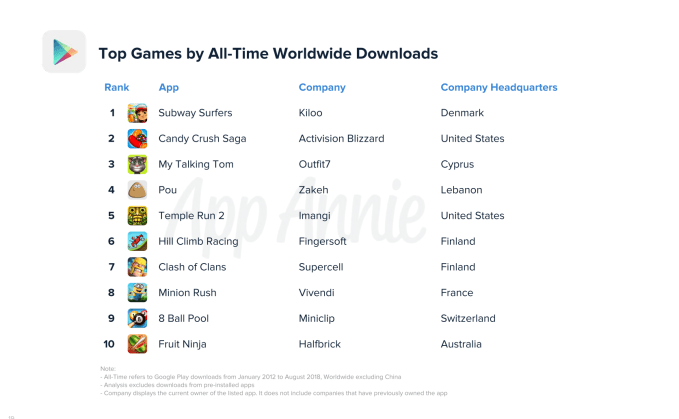
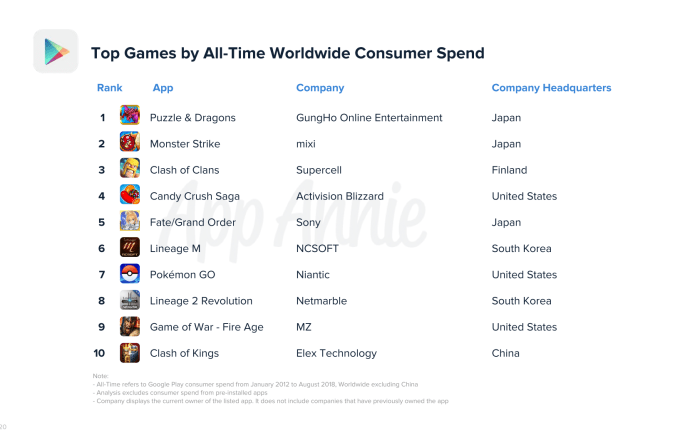
The report also looked at the most popular games and app of all time by both downloads and consumer spend. There weren’t many surprises on these lists, with apps like those made by Facebook dominating the top apps by downloads list, and subscription services dominating top apps by spend.

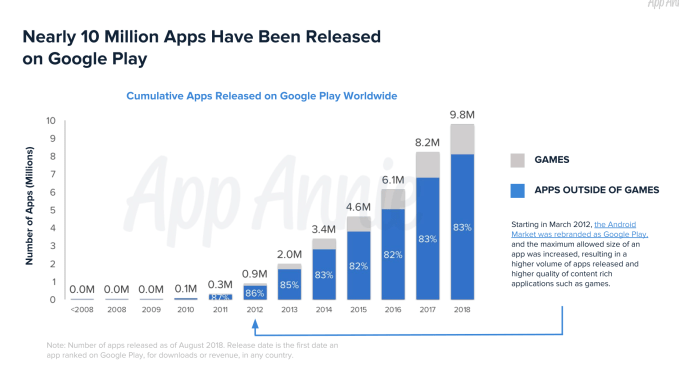
App Annie also noted Google Play has seen the release of nearly 10 million apps since its launch in 2008. Not all these remain, of course – by today’s count, there are just over 2.8 million apps live on Google Play.


22 Oct 2018

Cowboy, the Belgian e-bike startup, raises €10M Series A

Cowboy, the Belgium startup that’s designed and sells a smarter electronic bicycle, has raised €10 million in Series A funding.

Leading the round is Tiger Global Management, with participation from previous backers Index Ventures, and Hardware Club. The new capital will be used to scale operations, and expand beyond Belgum into Germany, U.K., Netherlands, and France.

Founded in January 2017 by Adrien Roose and Karim Slaoui, who both previously co-founded Take Eat Easy (an early Deliveroo competitor), and Tanguy Goretti, who was previously co-founded ridesharing startup Djump, Cowboy set out to build and sell direct a better designed and e-bike.

This included making the Cowboy lighter in weight and more stylish than models from incumbents, and adding automatic motor assistance. The latter utilises built-in sensor technology that measures speed and torque, and adjusts to pedaling style and force to deliver an added boost of motor-assisted speed at key moments e.g. when you start pedaling, accelerate or go uphill.

In addition, Cowboy’s “smart” features powered by the Cowboy app enables the device to be switched on and off, track location, provide “ride stats,” and support remote troubleshooting and software updates. A theft detection feature is also promised soon.

“We designed the Cowboy bike to appeal specifically to people who are yet to be convinced that electric bikes are a practical and mainstream mode of transport,” says Adrien Roose, Cowboy’s CEO, in a statement.

“We focused our attention on the three main reasons people are reluctant to purchase electric bikes: high cost, poor design and redundant technology – or a combination of the above – and we set about fixing them all”.

22 Oct 2018

Lime is building its first scooter “lifestyle brand store” in LA

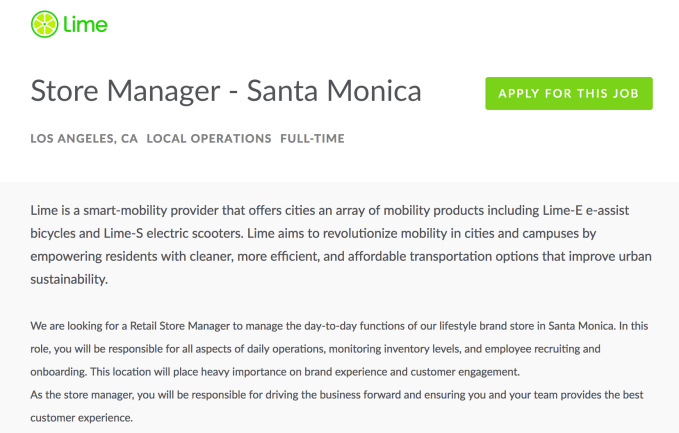
How can Lime differentiate its scooters and bikes from the piles of Birds and Spins filling Los Angeles sidewalks? Apparently with a physical storefront where it can convince customers of the wonders of on-demand mobility. According to a job listing from Lime seeking a “Retail Store Manager”, the startup plans to open a “lifestyle brand store in Santa Monica” that “will place heavy importance on brand experience and customer engagement.”

It seems Lime will rent vehicles directly from the store given the full-time manager’s role includes “monitoring inventory levels” as well as daily operations, and employee recruiting. They’ll also be throwing live events to build Lime’s hype. Given the company is calling this a lifestyle store, the focus will likely be on showing how Lime’s scooters and bikes can become part of people’s lives and enhance their happiness, rather than on maximizing rental volume.

A rendering of Lime’s new office it’s buidling in San Francisco. The design could hint at what Lime wants to do with its retail store branding.

The listing was first spotted by Nathan Pope, a transportation researcher for consultancy Steer, and later by Cheddar’s Alex Heath. We’ve reached out to Lime and will update if we hear back from the company. Glassdoor shows that the store manager job was posted over 30 days ago, and the site estimates the potential salary at $41,000 to $74,000.

The sheer number of Lime scooters in Santa Monica where the store will arise is already staggering. Supply doesn’t seem to be bottleneck as it is in some other cities. Instead, it’s the fierce competition from hometown startups like local favorite Bird that Lime wants to overcome through brick-and-mortar marketing. Often times you’ll see scooters from Lime and Bird lined up right next to each other. And with similarly cheap pricing, the decision of which to use comes down to brand affinity. According to Apptopia, Bird’s monthly U.S. downloads surpassed Lime’s in July for the first time ever, despite Lime offering bikes as well as scooters.
There are plenty of people who still have never tried an on-demand electric scooter, and going through the process of renting, unlocking, and riding them might be daunting to some. If employees at a physical store can teach people that it’s not too difficult to jump aboard, Lime could become their default scooter. This of course comes with risks too, as electric scooters can be dangerous to the novice or uncoordinated. More aggressive in-person marketing might pull in users who were apprehensive about scooting for the right reason — concerns about safety.

As cities figure out how to best regulate scooters, I hope we see a focus on uptime aka how often the scooters actually function properly. It’s common in LA to rent a scooter, then discover the handlebar is loose or the acceleration is sluggish, end the ride, and rent another scooter from the same brand or a competitor in hopes of getting one that works right. I ditched several Lime scooters like this while in LA last week.

Regulators should inquire about what percentage of scooter company fleets are broken and what percentage of rides end within 90 seconds of starting, which is typically due to a malfunctioning vehicle. Cities could then award permits to companies that keep their fleets running, rather than that litter the streets with massive paper weights, or worse, vehicles that could crash and hurt people. Scooters are fun, cheap and therefore accessible to more people than Ubers, and reduce traffic. But unless startups like Lime put a bigger focus on helments and safe riding behavior, we could trade congestion on the roads for congestion in the emergency room.

22 Oct 2018

Oculus co-founder is leaving Facebook after cancellation of ‘Rift 2’ headset

Brendan Iribe, the co-founder and former CEO of Oculus, announced today that he is leaving Facebook, TechCrunch has learned.

Iribe is leaving Facebook following some internal shake-ups at the company’s virtual reality arm last week that saw the cancellation of the company’s next generation “Rift 2” PC-powered virtual reality headset which he had been leading development of, a source close to the matter tell TechCrunch. Iribe and the Facebook executive team had “fundamentally different views on the future of Oculus that grew deeper over time” and Iribe wasn’t interested in a “race to the bottom” in terms of performance, we are told.

So much has happened since the day we founded Oculus in July 2012. I never could have imagined how much we would…

Posted by Brendan Trexler Iribe on Monday, October 22, 2018

The cancellation of the company’s next-gen PC-based “Rift 2” virtual reality product showcases how the interests of Facebook’s executive leadership have centered on all-in-one headsets that don’t require a connection to an external PC or phone. In May, Oculus released the $199 Oculus Go headset and plans to release the $399 Oculus Quest headset sometime next spring. A Facebook spokesperson tells TechCrunch that the PC VR is part of the company’s future product roadmap and that much of what Iribe’s team has been working on will be manifested in future products.

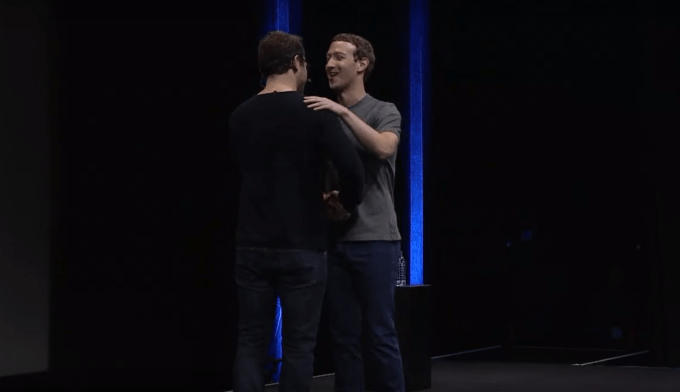
Facebook CEO Mark Zuckerberg and then-Oculus CEO Brendan Iribe at Oculus Connect 3 in late 2016

Iribe’s exit comes at a time when a number of the founders of Facebook’s high-profile startup acquisitions are leaving the company. Less than a month ago, Instagram co-founders Kevin Systrom and Mike Krieger announced their plans to leave the company in a decision that TechCrunch was told was partially the result of mounting tensions. WhatsApp co-founder Jan Koum left Facebook earlier this year. Iribe’s fellow co-founder Palmer Luckey left Facebook in early 2017, a decision he recently recounted was not a choice that he made.

Iribe came onto Facebook after the $2 billion acquisition of Oculus VR in 2014 where he had been the company’s founding CEO. After a substantial company reorganization in late 2016, Iribe was moved from the CEO position to the head of the company’s PC VR division.

Before co-founding Oculus VR, Iribe was the chief product officer of Gaikai, a cloud-gaming startup that Sony bought in 2012 for $380 million, before that, he co-founded and led Scaleform, a gaming user interface tools startup that Autodesk bought in 2011 for $36 million.

We’ve reached out to Iribe for comment.

22 Oct 2018

Saudi Arabia’s ‘Davos in the Desert’ website was hacked and defaced

The website of the Saudi government’s upcoming Future Investment Initiative conference was hacked and defaced with images of the murdered Saudi journalist Jamal Khashoggi.

Several reporters tweeted screenshots of the site after its defacement, purporting to show Saudi crown prince Mohammed bin Salman — the kingdom’s de facto ruler — brandishing a sword. A portion of text on the site was replaced with an accusation the kingdom of “barbaric and inhuman action,” referring not only to the death of Khashoggi but also the government’s involvement in the ongoing offensive in Yemen.

Names and phone numbers of several Saudi individuals were also uploaded to the site’s homepage, including government employees and senior staff in state-backed companies.

The site was pulled offline shortly after the defacement on Monday.

Nobody has yet publicly declared responsibility for the defacement. It comes days after the Saudi regime admitted that Khashoggi was “murdered” in its consulate in Istanbul, more than two weeks after The Washington Post columnist walked in to obtain marriage license papers. Saudi officials claimed he died following a “fist fight,” which Western nations decried as nonsensical. Leaked audio, believed to have been leaked by the Turkish government, claims the journalist was beaten, killed and dismembered.

Britain, France and Germany issued a statement demanding clarity and an explanation for his still missing body. Turkey is expected to reveal more about the killing Tuesday.

The Future Investment Initiative — also known as “Davos in the Desert” after the original Switzerland-based investment conference — is set for later this week.Saudi Arabia invests billions in U.S. tech companies, but the conference has seen dozens of well-known investors, tech companies and business leaders pull out of the conference after the journalist’s murder.

22 Oct 2018

YouTube CEO says EU’s new copyright legislation threatens jobs, smaller creators

YouTube CEO Susan Wojcicki published her quarterly letter to creators today, which included very strong language regarding the EU’s controversial copyright reform directive. Specifically, her letter focused on Article 13, the so-called “meme ban” that states that any site with a large amount of user-generated content – like Facebook or YouTube, for example – will be responsible for taking down content that infringes on copyright. Wojcicki says the way this legislation is written could “shut down the ability” of millions of people to upload to YouTube.

The legislation she’s referring to is Article 13 of the European Union Directive on Copyright in the Digital Single Market, which the EU Parliament just recently voted to back. The Directive contains several parts, including another concerning “link tax,” which gives publishers the right to ask for paid licenses when online platforms share their articles and stories.

But YouTube is most concerned with Article 13, which impacts sites with user-generated content. In order to comply with the law, sites like YouTube would have to automatically scan and filter user uploads to ensure they aren’t in violation of copyright.

But today, users often express themselves by sampling, remixing, and creating content using music, pictures and videos that would otherwise be considered copyrighted material. However, even though memes and parodies are protected by previous laws (in some countries), these upload filters wouldn’t be able to tell the difference between a copyright violation and a meme – and they’d block content that should be allowed. This is how Article 13 became to be known as the “meme ban.”

However, the language in legislation isn’t clear on how enforcement should take place – it doesn’t say, for example, that sites have to use upload filters. Others believe that YouTube’s existing Content ID system, which scans videos after upload, would be sufficient.

YouTube, for its part, seems to be believe that Article 13 will require more than the existing Content ID system to be compliant.

Writes Wojcicki, “Article 13 as written threatens to shut down the ability of millions of people — from creators like you to everyday users — to upload content to platforms like YouTube. It threatens to block users in the EU from viewing content that is already live on the channels of creators everywhere. This includes YouTube’s incredible video library of educational content, such as language classes, physics tutorials and other how-to’s,” she says.

The CEO also says Article 13 will threaten “thousands of jobs” – meaning those of EU-based content creators, businesses, and artists.

And she warns that YouTube may have to take down content from smaller, original video creators, as it would be liable for that content, saying:

The proposal could force platforms, like YouTube, to allow only content from a small number of large companies. It would be too risky for platforms to host content from smaller original content creators, because the platforms would now be directly liable for that content. We realize the importance of all rights holders being fairly compensated, which is why we built Content ID, and a platform to pay out all types of content owners. But the unintended consequences of article 13 will put this ecosystem at risk.

The company wants to weigh in on how the legislation is worded to protect its interests, and those of the larger creator community. Wojcicki said YouTube is committed to working with the industry to find a better way respect the rights of copyright holders, before the language in the EU legislation is finalized by year-end.


Other changes include expansion of memberships, premieres

While YouTube’s comments on Article 13 were the key part of today’s letter, Wojcicki also updated the community on its priorities for 2018.

This included an update on its plans to better communicate with creators, which it says it accomplished by increasing the number of product updates and “heads up” messages regarding changes to YouTube, including smaller tests or experiments, on its @TeamYouTube handle and the Creator Insider channel, in addition to its launch of YouTube Studio, where creators can read all the news and product updates.

The company also said that its new “self certification” video upload flow, where creators self-describe the content in their videos for advertisers, will roll out more broadly in 2019.

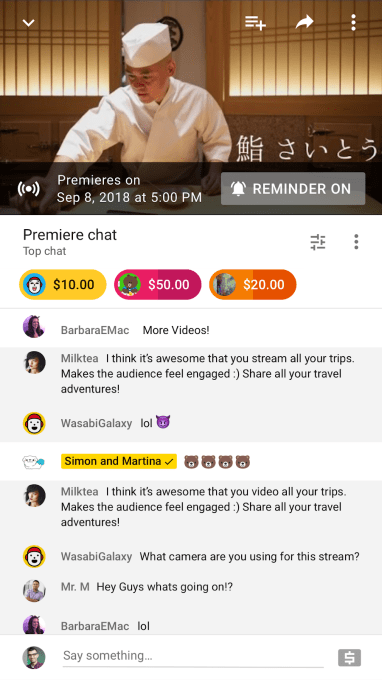
Newly launched channel memberships are also expanding their rollout, with the threshold now being lowered from 100,000 to 50,000 subscribers. Meanwhile, the new Premieres feature is now publicly available to all creators.

Other updates focused on what YouTube is doing across education, news and journalism, YouTube Giving charity work, gaming, and more. The full letter is on YouTube’s blog here.

22 Oct 2018

Square details compensation and promotion practices

When tech companies explore diversity and inclusion initiatives, there’s a risk that marginalized groups may feel “othered” and reduced to a number. That’s what Square has found, the company revealed in the first of a series of posts on Square’s diversity and inclusion efforts. So instead of emphasizing demographic data, Square is taking a new approach — one that entails deep dives into its inclusion efforts.

Regarding promotions and compensation — two key places where unconscious bias can often show up — Square has begun to implement three specific initiatives. One is pushing managers to consider promotion readiness for everyone on their team, explicitly highlighting the people who have been at their current job level longer than the median time for people in similar roles who were promoted in the past two promotion cycles.

“Although time in job level is just one metric in a multi-dimensional promotion consideration process, these primers help ensure that every team member is considered, not just those who are more vocal or in more visible roles,” Square describes on its blog.

And before someone gets a raise, Square’s people analytics team conducts a full audit of pay fairness by gender, race and age. The goal is to mitigate bias by checking for any statistical evidence of it before the decision becomes final.

“We check for potential disparities both overall and within specific jobs, and review any outliers we find,” Square says. “While this lengthens the overall promotion process, it gives us the opportunity to make any necessary adjustments before finalizing employees’ new compensation.”

Square is not at the point where diverse people are evenly distributed across high-paying roles, but says addressing that is part of the plan.

Square’s series on these topics comes almost 18 months after the company released its first diversity report. Last year, Square was 36.7 percent female globally, and 57.3 percent white, 6.4 percent black and 5.8 percent Latinx in the U.S.

“Reporting is important, but it doesn’t appear to be driving meaningful change or increasing our public accountability,” Square explains on its site. “Even worse, what these reports do seem to accomplish is the commoditization of the communities the practice was intended to support. Many employees tell us these reports make them feel like they’re reduced to numbers. And that sucks.”

While Square still has plans to share demographic data, the company is looking to be more transparent and communicative around all of its efforts. The purpose of these posts is to shed some light into Square’s approach to D&I, speaking candidly about what has worked and what hasn’t worked. The ideal outcome is that other companies will open up and share their best and inadvertently worst practices.

22 Oct 2018

Netflix to raise $2 billion in debt to fund more original content

Netflix’s commitment to growing its original content collection will see the company again returning to debt markets to raise more financing, the company announced today. According a release published to its investors site, Netflix says it plans to raise $2 billion to help fund new content, including “content acquisitions, production and development, capital expenditures, investments, working capital and potential acquisitions and strategic transactions.”

The funds will be raised in the form of senior unsecured notes, denominated in U.S. dollars and euros, it said.

This debt offering is the sixth time in under four years that Netflix is raising $1 billion or more through bonds, noted Variety, which was among the first to report the news. As of September 30, Netflix’s long-term debt had reached $8.34 billion, up 71% from $4.89 billion in the year ago quarter, it said during its last earnings, Variety’s report also noted.

Netflix recently explained during its Q3 2018 earnings that it needs to continue to invest in original programming in order to remain competitive.

“We recognize we are making huge cash investments in content, and we want to assure our investors
that we have the same high confidence in the underlying economics as our cash investments in the past.
These investments we see as very likely to help us to keep our revenue and operating profits growing for
a very long time ahead,” the letter to shareholders read.

Netflix also pointed to the increasing competition in the industry as one of the reasons why original content investment was so critical, adding that it didn’t only compete with linear TV, YouTube, gaming, social media, DVDs and pay-per-view, but with a number of new and upcoming streaming services, as well.

“Content companies such as WarnerMedia and Disney/Fox are moving to self-distribute their own content; tech firms like Apple, Amazon and others are investing in premium content to enhance their distribution platforms,” the letter also stated. “Amid these massive competitors on both sides, plus traditional media firms, our job is to make Netflix stand out so that when consumers have free time, they choose to spend it with our service,” it had said.


22 Oct 2018

The White House hopes tech employees will drive government innovation

The Trump administration has a major ask to make of big tech companies. In a meeting at the White House today, officials will ask Amazon, Microsoft, Google and IBM, among others, to make it easier for employees to do stints in the government.

It’s a heavy lift, of course, asking well-compensated workers to take time out from demanding gigs for the betterment of federal and state governments. A number of companies, including Facebook and Google, already allow employees to take time off for this exact reason. However, the particularly polarizing nature of politics in 2018 and all of the ill-will surrounding the current administration, have further complicated the ask.

The Washington Post quotes an anonymous official, who stressed the importance of “put[ting] politics aside” for the greater good. “This event on Monday is not just about our efforts, it’s about our successor, and their successor after that,” the person told the paper. “It’s good for the country in the long term for technology professionals to have civil service in their career at some point.”

The notoriously slow pace of government innovation was something the Obama administration looked to address during its eight years in power, and Trump’s White House appears to be interested in continuing that trend. Ahead of his inauguration, Trump met with tech leaders, including Tim Cook, Jeff Bezos and Satya Nadella, though the administration’s policies have been an on-going source of friction with Silicon Valley