Sony’s live TV streaming service, PlayStation Vue, announced this week it has become the first U.S. pay TV provider to integrate with Apple’s TV app. Until now, Apple’s TV app has featured content from both free and paid on-demand streaming apps like Hulu, Prime Video, HBO NOW, PBS Kids, The CW, and others, along with those that require you log in with your pay TV credentials, like ABC, AMC, USA, SYFY, Showtime Anytime, and many more.
With the new PlayStation Vue integration, subscribers to Sony’s pay TV service will be able to access all of Vue’s on-demand content across its nationally available channels in the Apple TV app. Live sports, including both national and regional sports networks, will be supported, too, the company says.
Explains Sony, users will be able to search and browse the PS Vue catalog in the TV app, while also taking advantage of TV app features like “Watch Now” and “Up Next” to organize their shows, movies and sports. When you find content you want to watch, it will open up the stream right in the PS Vue app.
This integration will matter more to those who already subscribe to at least a couple of other streaming services in addition to PS Vue, as the TV app is designed to aggregate content and recommendations from across services in a single place. It works on iOS devices, including iPhone and iPad, and on Apple TV.
PS Vue is one of now several pay TV streaming services, and a rival to YouTube TV, Hulu with Live TV, Sling TV, AT&T’s DirecTV Now and WatchTV. But it’s been lagging behind on subscribers.
Dish’s Sling TV and DirecTV Now lead the space, thanks to Sling’s early mover advantage and DirecTV Now’s distribution through AT&T’s wireless business. The former had 2.3 million subscribers as of June, while AT&T said DirecTV Now had 1.8 million, as of its earnings report in July. Hulu with Live TV cracked a million subscribers in September, ahead of YouTube TV.
Sony’s PlayStation Vue, meanwhile is just somewhereover half a million. It may have struggled to grow due to its branding, which seems to imply its only for PlayStation owners. (It’s not).
Perhaps the company is hoping the closer ties with Apple’s TV app will give its service more visibility.
The integration also arrives just ahead the launch of Apple’s own original content, which could bring more people back to the Apple TV app, further boosting PS Vue’s visibility.
While PS Vue is the first U.S.-based pay TV provider to offer this sort of integration with the TV app, it’s not the first worldwide. In France, for example, Canal+ “myCanal” and Molotov have offered this same sort of integration for some time.
Tesla is now offering a new, cheaper mid-range battery version of the Model 3 that starts at $45,000 before federal tax incentives.
CEO Elon Musk announced the new variant, which has an estimated battery range of 260 miles, via Twitter. The company’s website has already been updated. Customers in the U.S. can order the mid-range version as of today and it will soon be offered in Canada as well.
Musk tweeted that the mid-range Tesla Model 3 costs $35,000 after federal and state tax rebates in California.
However, for customers to realize the full $7,500 federal tax incentive, they must take delivery of the electric vehicle by December 31, 2018. The delivery estimate for the mid-range version is 6 to 10 weeks, which means customers who order the vehicle by late October or early November should still be able to get the full tax credit.
Earlier this year, Tesla delivered its 200,000th electric vehicle. The achievement activated a countdown for the $7,500 federal tax credit offered to consumers who buy new electric vehicles. The tax credit begins to phase out once a manufacturer has sold 200,000 qualifying vehicles in the U.S. Under these rules, Tesla customers must take delivery of their new Model S, Model X or Model 3 by December 31.
Costs $35k after federal & state tax rebates in California, but true cost of ownership is closer to $31k after gas savings
Musk explained in a subsequent tweet that the mid-range vehicle is outfitted with a long-range battery that has fewer cells. “Non-cell portion of the pack is disproportionately high, but we can get it done now instead of February,” he wrote.
It should be noted that while this mid-range battery model is cheaper than the long-range dual motor Model 3 and the performance versions, it’s still not the $35,000 base-spec Model 3 (before incentives) that was originally promised. That low-cost model, which will feature a standard battery with a different architecture, won’t be available for 4 to 6 months.
“As Model 3 production and sales continue to grow rapidly, we’ve achieved a steady volume in manufacturing capacity, allowing us to diversify our product offering to even more customers,” a Tesla spokesperson said in an emailed statement. “Our new Mid-Range Battery is being introduced this week in the U.S. and Canada to better meet the varying range needs of the many customers eager to own Model 3, and our delivery estimate for customers who have ordered the Standard Battery is 4-6 months.”
Facebook hopes detailing concrete examples of fake news it’s caught — or missed — could improve news literacy, or at least prove it’s attacking the misinformation problem. Today Facebook launched “The Hunt for False News,” in which it examines viral B.S., relays the decisions of its third-party fact-checkers and explains how the story was tracked down. The first edition reveals cases where false captions were put on old videos, people were wrongfully identified as perpetrators of crimes or real facts were massively exaggerated.
The blog’s launch comes after three recent studies showed the volume of misinformation on Facebook has dropped by half since the 2016 election, while Twitter’s volume hasn’t declined as drastically. Unfortunately, the remaining 50 percent still threatens elections, civil discourse, dissident safety and political unity across the globe.
In one of The Hunt’s first examples, it debunks that a man who posed for a photo with one of Brazil’s senators had stabbed the presidential candidate. Facebook explains that its machine learning models identified the photo, it was proven false by Brazilian fact-checker Aos Fatos, and Facebook now automatically detects and demotes uploads of the image. In a case where it missed the mark, a false story touting NASA would pay you $100,000 to study you staying in bed for 60 days “racked up millions of views on Facebook” before fact-checkers found NASA had paid out $10,000 to $17,000 in limited instances for studies in the past.
While the educational “Hunt” series is useful, it merely cherry-picks random false news stories from over a wide time period. What’s more urgent, and would be more useful, would be for Facebook to apply this method to currently circulating misinformation about the most important news stories. The New York Times’ Kevin Roose recently began using Facebook’s CrowdTangle tool to highlight the top 10 recent stories by engagement about topics like the Brett Kavanaugh hearings.
Top performing Kavanaugh-related posts on Facebook over the last 24 hours (per @crowdtangle) come from: 1. Trump 2. Fox News 3. Franklin Graham 4. Fox News 5. CNN 6. NRA Institute for Legislative Action 7. GOP 8. Ben Shapiro 9. The Sage Page 10. FreedomWorks 11. NRA 12. Breitbart
If Facebook wanted to be more transparent about its successes and failures around fake news, it’d publish lists of the false stories with the highest circulation each month and then apply the Hunt’s format explaining how they were debunked. This could help dispel myths in society’s understanding that may be propagated by the mere abundance of fake news headlines, even if users don’t click through to read them.
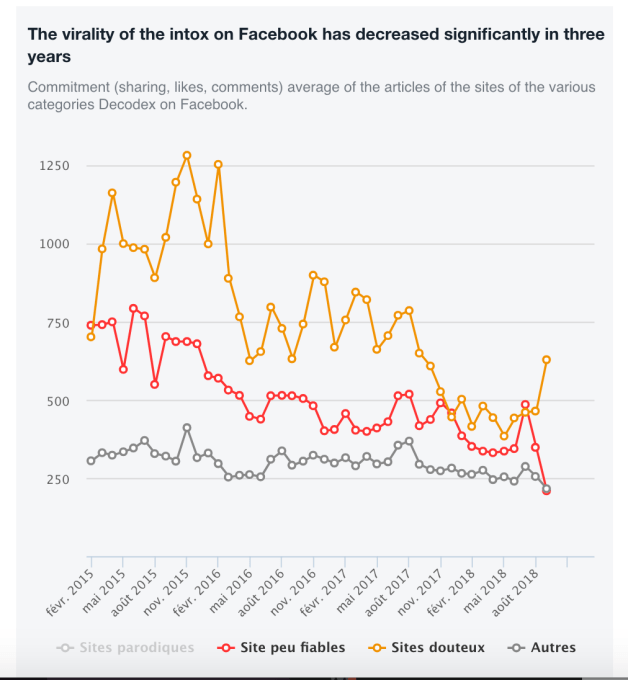
The red line represents the decline of Facebook engagement with “unreliable or dubious” sites
But at least all of Facebook’s efforts around information security — including doubling its security staff from 10,000 to 20,000 workers, fact checks and using News Feed algorithm changes to demote suspicious content — are paying off:
A Stanford and NYU study found that Facebook likes, comments, shares and reactions to links to 570 fake news sites dropped by more than half since the 2016 election, while engagements through Twitter continued to rise, “with the ratio of Facebook engagements to Twitter shares falling by approximately 60 percent.”
A University of Michigan study coined the metric “Iffy Quotient” to assess the how much content from certain fake news sites was distributed on Facebook and Twitter. When engagement was factored in, it found Facebook’s levels had dropped to nearly 2016 volume; that’s now 50 percent less than Twitter.
French newspaper Le Monde looked at engagement with 630 French websites across Facebook, Twitter, Pinterest and Reddit. Facebook engagement with sites dubbed “unreliable or dubious” has dropped by half since 2015.
Of course, given Twitter’s seeming paralysis on addressing misinformation and trolling, they’re not a great benchmark for Facebook to judge by. While it’s useful that Facebook is outlining ways to spot fake news, the public will have to internalize these strategies for society to make progress. That may be difficult when the truth has become incompatible with many peoples’ and politicians’ staunchly held beliefs.
In the past, Facebook has surfaced fake news-spotting tips atop the News Feed and bought full-page newspaper ads trying to disseminate them. The Hunt for Fake News would surely benefit from being embedded where the social network’s users look everyday instead of buried in its corporate blog.
Security researchers have found flaws in four popular connected storage drives that they say could let hackers access a user’s private and sensitive data.
The researchers Paulos Yibelo and Daniel Eshetu said the software running on three of the devices they tested — NetGear Stora, Seagate Home and Medion LifeCloud — can allow an attacker to remotely read, change and delete data without requiring a password.
Yibelo, who shared the research with TechCrunch this week and posted the findings Friday, said that many other devices may be at risk.
The software, Hipserv, built by tech company Axentra, was largely to blame for three of the four flaws they found. Hipserv is Linux-based, and uses several web technologies — including PHP — to power the web interface. But the researchers found that bugs could let them read files on the drive without any authentication. It also meant they could run any command they wanted as “root” — the built-in user account with the highest level of access — making the data on the device vulnerable to prying eyes or destruction.
We contacted Axentra for comment on Thursday but did not hear back by the time of writing.
Neither Netgear nor Seagate commented by our deadline, but we’ll update if that changes. Lenovo, which now owns Medion, did not respond to a request for comment.
The researchers also reported a separate bug affecting WD My Book Live drives, which can allow an attacker to remotely gain root access.
A spokesperson for WD said that the vulnerability report affects devices originally introduced in 2010 and discontinued in 2014, and “no longer covered under our device software support lifecycle.” WD added: “We encourage users who wish to continue operating these legacy products to configure their firewall to prevent remote access to these devices, and to take measures to ensure that only trusted devices on the local network have access to the device.”
In all four vulnerabilities, the researchers said that an attacker only needs to know the IP address of an affected drive. That isn’t so difficult in this day and age, thanks to sites like Shodan, a search engine for publicly available devices and databases, and similar search and indexing services.
Depending on where you look, the number of affected devices varies. Shodan puts the number at 311,705, but ZoomEye puts the figure at closer to 1.8 million devices.
Although the researchers described the bugs in moderate detail, they said they have no plans to release any exploit code to prevent attackers taking advantage of the flaws.
Their advice: If you’re running a cloud drive, “make sure to remove your device from the internet.”
Microsoft’s planned acquisition of Git-based code sharing and collaboration service, GitHub, has been given an unconditional greenlight from European Union regulators.
The software giant announced its intention to bag GitHub back in June, saying it would shell out $7.5 billion in stock to do so. At the time it also pledged: “GitHub will retain its developer-first ethos and will operate independently to provide an open platform for all developers in all industries.”
The European Commission approved the plan today, saying its assessment had concluded there would be no adverse impact on competition in the relevant markets, owing to the combined entity continuing to face “significant competition”.
In particular, it said it looked at whether Microsoft would have the ability and incentive to further integrate its own devops tools and cloud services with GitHub while limiting integration with third party tools and services.
The Commission decided Microsoft would have no incentive to undermine the GitHub’s openness — saying any attempt to do so would reduce its value for developers, who the Commission judged as willing and able to switch to other platforms.
The team behind mileage-tracking app MileIQ, a company Microsoft acquired a few years ago, is out with a new application. This time, the focus isn’t on tracking miles, but rather expenses. The new app, simply called “Spend,” arrived on the App Store on Thursday, offering automatic expense tracking for work reimbursement purposes or for taxes.
Spend doesn’t appear to be a part of some grand Microsoft plan to take on expense tracking industry giants, like Expensify or SAP-owned Concur, for example. At least, not at this time.
Instead, the app is a Microsoft Garage project, the App Store clarifies.
Microsoft Garage is the company’s internal incubator when employees can test out new ideas to see if they resonate with consumers and business users.
The new Spend app, at first glance, looks well-designed and easy to use.
Like most expense trackers, it offers features like the ability to take photos of receipts, expense categorization features, and reporting.
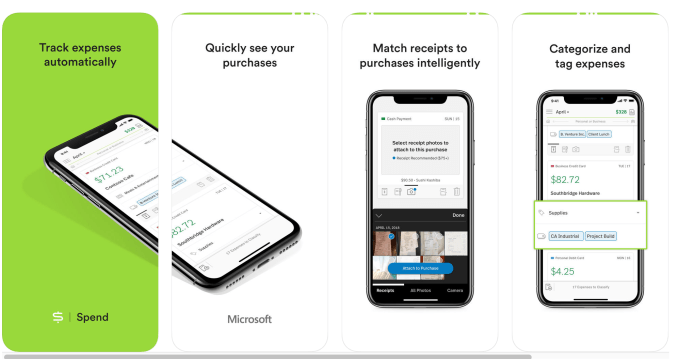
However, what makes Spend interesting is the app’s automated tracking and matching, and its user interface for working with your receipts.
The app begins by automatically tracking all your expenses from a linked credit card or bank account. You can then swipe on the expenses to mark them as personal or business. These expenses are automatically categorized, and you can add extra tags for added organization.
You can also add notes to purchases, split expenses, and customize expense categories, in addition to tags.
And the app can generate expense reports on a weekly, monthly or custom bases, which can be exported at spreadsheets or PDFs. There’s a web dashboard for when you’re using the app at your computer, but Spend doesn’t appear on the MileIQ main website at this time. It does, however, have a support site.
How well this all works, in practice, requires further testing.
MileIQ had been the top-grossing finance app in Apple’s App Store for the last 20 months at the time of its acquisition back in 2015. Microsoft had said then the team would work on other mobile productivity solutions going forward.
The company says the new app is an early version, and they plan to revise it going forward as they make improvements.
Microsoft has been asked for more details on its plans with Spend, and we’ll update if they have more to offer.
Meet Hiver, a service that lets you collaborate on generic email addresses, such as jobs@yourcompany.com, support@, sales@, etc. Hiver isn’t the only company working on shared inboxes. But compared to Front, everything happens in Gmail directly.
To be fair, Front has been doing a fantastic job when it comes to multiplayer email — and the company has been doing great. Front is a new email client that lets you work together on your inbound emails.
But many teams don’t necessarily want to use a brand new email client. Some people love the Gmail interface so much that they don’t even think about switching to something else.
Hiver is a Google Chrome extension that adds a bunch of feature to your Gmail inbox. In addition to your personal inbox, you can now access shared inboxes with other people in your team. You can then assign an email to one of your coworkers and see what everybody is working on.
If you need help in order to reply to a tedious email, you can write a note in the right column and notify your teammates using @-mentions. All your comments live in this separate column so that you don’t clutter your email thread with forwards and CCs.
Whenever someone starts replying, Hiver shows a collision alert so that customers don’t get two replies. You can also use templates for faster replies, send emails later and share drafts to get another pair of eyes.
More recently, Hiver added automation with simple if/then rules to assign conversations to the right person and categorize your emails automatically.
If you’ve used Front in the past, those features will sound familiar as you can do all of this in Front, and much more. But it turns out that some companies really wanted a “Front for Gmail”.
Hiver just raised a $4 million funding round from Kalaari Capital and Kae Capital. The company is based in India and has 50 employees already. A thousand companies are currently using Hiver, such as Hubspot, Vacasa, Pinterest and Lyft. Most of Hiver’s clients are based in the U.S.
Building a product on top of Gmail creates some limitations. For instance, you’ll have to remain a G Suite customer in order to keep using Hiver. Hiver also works better on desktop. The company has mobile apps, but they are still a bit basic so far.
Hiver uses a software-as-a-service approach. Plans start at $14 per user per month, and you need to pay more for automations, Salesforce integration and more.
Researchers at the University at Buffalo have found that 3D printers have fingerprints, essentially slight differences in design that can be used to identify prints. This means investigators can examine the layers of a 3D printed object and pinpoint exactly which machine produced the parts.
“3D printing has many wonderful uses, but it’s also a counterfeiter’s dream. Even more concerning, it has the potential to make firearms more readily available to people who are not allowed to possess them,” said Wenyao Xu, lead author of the study.
The researchers found that tiny wrinkles in each layer of plastic can be used to identify a “printer’s model type, filament, nozzle size and other factors cause slight imperfections in the patterns.” They call their technology PrinTracker.
“Like a fingerprint to a person, these patterns are unique and repeatable. As a result, they can be traced back to the 3D printer,” wrote the researchers.
This process works primarily with FDM printers like the Makerbot which use long spools of filament to deposit layers of plastic onto a build plate. Because the printers used in 3D printed guns are usually more complex and more expensive there could be less variation in the individual layers and, more importantly, the layers might be harder to discern. However, for some simpler plastic parts could exhibit variations.
“3D printers are built to be the same. But there are slight variations in their hardware created during the manufacturing process that lead to unique, inevitable and unchangeable patterns in every object they print,” said Xu.
PayPal this week announced an expanded relationship with American Express that will allow cardholders to use their Membership Rewards points when shopping from PayPal merchants, as well as more integrated experience within both PayPal and the Amex apps, among other things.
The deal is similar to those PayPal earlier struck with Visa and MasterCard., and follows a series of partnerships it has made across the industry, including others with Apple, Google, Samsung, and, most recently, Walmart, designed to increase its PayPal’s visibility and adoption.
In addition to using points for purchases at PayPal’s millions of online merchants, the new partnership will also allow Amex mobile app users to send money through PayPal or Venmo directly in the app. And they’ll be able to add their American Express cards to their PayPal wallet directly from the app, too.
On PayPal’s side, users will be able to pay their Amex bill with their PayPal or Venmo balance using the PayPal Instant Transfer feature, and it will more clearly identify users’ specific American Express cards in the PayPal wallet using card-specific branding.
These agreements have represented something of a change of course for PayPal over the past couple of years. Before, the company had been pursuing its own brick-and-mortar strategy to see its payment mechanism integrated at point-of-sale. But those ambitions have died down, and now PayPal is focused on expanding its relationships other payment providers, like Apple Pay or major credit cards, turning former rivals into partners.
“This partnership is the product of our companies’ strong commitment to create innovative payment experiences that utilize both organizations’ core assets, including the ability for customers to pay with American Express Membership Rewards points and the integration of peer-to-peer payments into the Amex app,” said Dan Schulman, President and CEO, PayPal, in a statement about the Amex agreement. “Our new partnership expands PayPal’s ubiquity, and enables us to offer consumers and merchants new and innovative product experiences,” he added.
PayPal says it will also integrate into the American Express Token Service, and continue its global card acceptance relationship, as part of this deal. The two companies will work together to implement the new features over the course of 2019.
These expanded agreements with stakeholders in the payments industry may be working.
The company also reported earnings this week, noting the addition of 9.1 million accounts during the quarter and a 25 percent increase in total payment volume. Payment volume in Venmo was also up 78% in Q3. PayPal’s total revenue grew 14% in the quarter to $3.68 billion, while earnings were up 26 percent.
Facebook has confirmed it has hired the former leader of the UK’s third largest political party — Nick Clegg of the political middle ground Liberal Democrats — to head up global policy and comms.
The news was reported earlier by the Financial Times.
Facebook confirmed to TechCrunch that Clegg’s title will be VP, global affairs and communications, and that he starts on Monday — and will be moving with his family to California in the New Year.
Former global policy and communications chief, Elliot Schrage, who has been in post for a decade is staying on as an advisor, according to Facebook, and in a post announcing Clegg’s hire COO Sheryl Sandberg thanked Schrage for his “leadership, tenacity, and wise counsel ‑- in good times and bad”.
Facebook told us that Sandberg and founder Mark Zuckerberg were both deeply involved in the hiring process, beginning discussions with Clegg over the summer — as fallout from the Cambridge Analytica data misuse scandal continued to rain down around it — and emphasizing they have already spent a lot of time with him.
Facebook also made a point of noting that Clegg is the most senior European politician to ever take up a senior executive leadership role in Silicon Valley.
The hire certainly looks like big tech waking up to the fact it needs a far better relationship with European lawmakers.
In a post on Facebook announcing his new job, Clegg says as much, writing: “Having spoken at length to Mark and Sheryl over the last few months, I have been struck by their recognition that the company is on a journey which brings new responsibilities not only to the users of Facebook’s apps but to society at large. I hope I will be able to play a role in helping to navigate that journey.”
“Facebook, WhatsApp, Messenger, Oculus and Instagram are at the heart of so many people’s everyday lives – but also at the heart of some of the most complex and difficult questions we face as a society: the privacy of the individual; the integrity of our democratic process; the tensions between local cultures and the global internet; the balance between free speech and prohibited content; the power and concerns around artificial intelligence; and the wellbeing of our children,” he adds.
“I believe that Facebook must continue to play a role in finding answers to those questions – not by acting alone in Silicon Valley, but by working with people, organizations, governments and regulators around the world to ensure that technology is a force for good.”
In her note about Clegg’s hire, Sandberg lauds Cleggs as “a thoughtful and gifted leader who… understands deeply the responsibilities we have to people who use our service around the world” — before also discussing the big challenges ahead.
“Our company is on a critical journey. The challenges we face are serious and clear and now more than ever we need new perspectives to help us though this time of change. The opportunities are clear too. Every day people use our apps to connect with family and friends and make a difference in their communities. If we can honor the trust they put in us and live up to our responsibilities, we can help more people use technology to do good,” she writes. “That’s what motivates our teams and from all my conversations with Nick, it’s clear that he believes in this as well. His experience and ability to work through complex issues will be invaluable in the years to come.”
One former Facebook policy staffer we spokes to for an insider perspective on Clegg’s hire, couched it as a sign Facebook is finally taking Europe seriously — i.e. as a regulatory force with the ability to bring big tech to rule.
“When I started at fb there were two people in a Regus office doing EU policy,” the person told us, speaking on condition of anonymity. “Now they have an army, and they’re still hiring.”
In Europe, the region’s new data protection framework, GDPR, which came into force at the end of May, has put privacy and security at the top of the tech agenda. And more regulations are coming — with the EU’s data protection supervisor warning today that GDPR is not enough.
“The Facebook/Cambridge Analytica revelations are still under investigation in Europe and America, but they are only the tip of the iceberg, a sign of a much wider problem and a symptom of many more problems still unnoticed,” writes Giovanni Buttarelli in a blog entitled: The urgent case for a new ePrivacy law.
“They didn’t take it seriously and they’re catching up now. I think it also just sends a strong signal that they’re not a U.S. centric company,” the former Facebooker added of the company’s attitude to EU policy, dating the dawning realization that a new approach was needed to around 2016.
Which was also the year that domestic election interference came home to roost for Zuckerberg, after Kremlin meddling in the US presidential elections.
So no more ‘pretty crazy ideas’ from Zuckerberg where politics is concerned — Nick Clegg instead.
For Brits, though, this is actually a pretty crazy idea, given Clegg is the awkwardly familiar face of middle ground, middler performance politics.
And, more importantly, the sacrificial lamb of political compromise, after his party got punished for its turn in coalition government with David Cameron’s Brexit triggering Conservatives.
Our ex-Facebooker source said they’d heard rumors linking the former Labour MP, David Miliband, and the Conservatives’ former chancellor, George Osborne, to the global policy position too.
Whatever the truth of those rumors, in the event Facebook went with Clegg’s third way — which of course meshes perfectly with the company’s desire to be a platform for all views; be that conservative, liberal and Holocaust denier too.
In Clegg it will have found a true believer that compromise can trump partisan tribalism.
Though Facebook’s business will probably test the limits of Clegg’s powers of accommodation.
The current state of the Lib Dem political animal — a party with now just a handful of MPs left in the UK parliament — does also hold a cautionary message for Facebook’s mission to be all things to all men.
A target some less machiavellian types might judge ‘mission impossible’.
Add to that, given Facebook’s now dire need to win back user trust — i.e. in the wake of a string of data scandals, such as the Cambridge Analytica affair (and indeed ongoing attempts by unknown forces to use its platform for voter manipulation) — Clegg is rather an odd choice of hire, given he’s the man who led a political party that fatally burnt the trust of its core supporters who punished it with near political oblivion at the ballet box.
Still, at least Clegg knows how to say sorry in a way that be turned into a hip and shareable meme …