Year: 2018

18 Oct 2018

Future Family raises $10M to make fertility treatments more affordable

Future Family, a startup that helps families more easily afford fertility services like IVF and egg freezing, has raised $10 million in a Series A round.

Just weeks back, Future Family switched up its offerings to feel less like a loan, and more like a monthly subscription. The end results might seem pretty similar — with both, customers get the services they need without having to cough up a big pile of cash up front — but the monthly subscription approach has a big advantage: flexibility. If a customer realizes a few months in that additional fertility services are needed, the cost can just be wrapped right into the monthly plan on the fly.

The company’s fertility offerings start at $195 a month (for 60 months) for a plan that pairs you with a clinic and concierge to help you start navigating, while $250 a month (for 60 months) covers the cost of lab work, medication, clinic visits and the IVF procedure.

Future Family CEO Claire Tomkins tells me that this Series A will largely go toward expanding their monthly subscription offerings, as well as expanding the number of fertility clinics they partner with. The company had previously raised around $4.2 million.

Future Family was born out of Claire Tomkins’ own experiences with the complexities and costs of fertility treatments. After spending hundreds of thousands of dollars on treatments involved with having her first child (with much of the cost coming as a surprise only revealed once the process had begun), Claire set out to build a better way. Future Family partners with clinics to work out all the pricing ahead of time and pays the bill upfront, ensuring there are no billing surprises down the road.

This round was led by Aspect Ventures, and backed by iNovia, BBG, Ulu Ventures, LaunchCapital and Portfolia. As part of the deal, Aspect Venture’s Lauren Kolodny will join Future Family’s board of directors.

18 Oct 2018

Future Family raises $10M to make fertility treatments more affordable

Future Family, a startup that helps families more easily afford fertility services like IVF and egg freezing, has raised $10 million in a Series A round.

Just weeks back, Future Family switched up its offerings to feel less like a loan, and more like a monthly subscription. The end results might seem pretty similar — with both, customers get the services they need without having to cough up a big pile of cash up front — but the monthly subscription approach has a big advantage: flexibility. If a customer realizes a few months in that additional fertility services are needed, the cost can just be wrapped right into the monthly plan on the fly.

The company’s fertility offerings start at $195 a month (for 60 months) for a plan that pairs you with a clinic and concierge to help you start navigating, while $250 a month (for 60 months) covers the cost of lab work, medication, clinic visits and the IVF procedure.

Future Family CEO Claire Tomkins tells me that this Series A will largely go toward expanding their monthly subscription offerings, as well as expanding the number of fertility clinics they partner with. The company had previously raised around $4.2 million.

Future Family was born out of Claire Tomkins’ own experiences with the complexities and costs of fertility treatments. After spending hundreds of thousands of dollars on treatments involved with having her first child (with much of the cost coming as a surprise only revealed once the process had begun), Claire set out to build a better way. Future Family partners with clinics to work out all the pricing ahead of time and pays the bill upfront, ensuring there are no billing surprises down the road.

This round was led by Aspect Ventures, and backed by iNovia, BBG, Ulu Ventures, LaunchCapital and Portfolia. As part of the deal, Aspect Venture’s Lauren Kolodny will join Future Family’s board of directors.

18 Oct 2018

Call for social media adtech to be probed by UK competition watchdog

A British Conservative politician, who has called repeatedly for Mark Zuckerberg to come to parliament to answer questions about how Facebook fences fake news — only to be repeatedly rebuffed — has made a public call for the UK’s competition regulator to look into social media giants’ adtech operations.

Damian Collins, the chair of the DCMS committee which has spent months this year asking questions about how disinformation spreads online — culminating in a report, this summer, recommending the government impose a levy on social media to defend democracy — made the suggestion in a tweet that references a news article reporting on a U.S. class action lawsuit against Facebook.

Advertisers in the US lawsuit allege Facebook knowingly inflated video viewing stats and thus mislead them into spending more money on its ad platform than they otherwise would have.

But Facebook disputes the allegations, saying the lawsuit is “without merit”. It has also filed a motion to dismiss the claims of ad fraud.

Although, two years ago, it did ‘fess up to a ‘miscalculation’ around average video viewing times, saying it had mistakenly discounted all the people who dropped out of watching a video in the first 3 seconds in calculating averages — thereby bumping viewing averages up.

At about the same time, it also said it had discovered some other ad-related bugs and errors in its system that had led to the wrong numbers being reported across four products, including Instant Articles, video and Page Insights.

The advertisers in the class action lawsuit — which was filed back in 2016 — had originally claimed Facebook engaged in unfair business practices. After receiving tens of thousands of documents in relation to the case they amended their complaint to accuse the company of fraud, CBS reports.

In its statement denying the suit’s claims, Facebook also said: “Suggestions that we in any way tried to hide this issue from our partners are false. We told our customers about the error when we discovered it — and updated our help center to explain the issue.” 

The company declined to comment on Collins’ remarks about adtech industry practices today.

A spokeswoman for the UK’s Competition and Markets Authority (CMA) also declined to comment when asked whether it has any concerns related to practices in the adtech sector.

Given market sensitivity to regulatory action it’s normal for the CMA to not want to stoke any speculation around a particular company.

For the same reason it would not normally discuss any complaints it’s received until the point of actually launching any investigation.

However this is not the first time the CMA has been urged by concerned politicians to investigate the adtech sector.

This fall another UK committee, the Lords Select Committee on Communications, directly asked the body to investigate digital advertising.

And earlier this month the CMA’s CEO, Andrea Coscelli, told the committee it is indeed considering doing so, if only it can carve out the resources to do so — saying he was worried about “potential gaps” in the regulatory framework around competition and consumer issues.

“A month ago, this Committee asked us to look at digital advertising. That is something we are actively considering, subject to Brexit in the next few weeks, because it has a big resource implication for us,” said Coscelli on October 9. “It is certainly something where we are interested in getting involved. If we did, we would work closely with Ofcom and give serious thought to the regulatory framework in that context.”

The CMA has also generally been ramping up its activity on the digital market front, recently spinning up a new data unit and appointing a chief data and digital insights officer, Stefan Hunt, hired in from the Financial Conduct Authority — to help it “develop and deliver an effective data and digital insight strategy… to better understand the impact that data, machine learning and other algorithms have on markets and people”.

So it sounds like a case of ‘watch this regulatory space’ for more action at the very least.

Elsewhere in Europe competition regulators have also been paying closer attention to the adtech industry in recent years — examining a variety of practices by adtech giants, Facebook and Google, and coming away with a range of antitrust-related concerns.

In preliminary findings at the end of last year, for example, Germany’s Federal Cartel Office accused Facebook of using its size to strong-arm users into handing over data.

While, earlier this year, the French Competition Authority suggested it was planning to investigate Facebook and Google‘s dominance of the adtech market, publishing a report in which it identified a raft of problematic behaviors — and pointed out that the two companies act as both publishers and technical intermediaries for advertisers, thereby gaining a competitive advantage.

Italian regulators have also been probing competition concerns related to big data for more than a year.

As we’ve reported before, the European Commission is also actively eyeing digital platforms’ market power — and looking to reshape competition policy to take account of how tech giants are able to draw on network effects and leverage their position from one market to another.

And when you’re talking about platform power, you are also — in the current era — talking about adtech.

There’s no doubt closer scrutiny of the digital advertising sector is coming. And with a brighter spotlight, tighter accountability screws applied to its practices.

Privacy reviews of adtech platforms have already raised plenty of ethical questions, in addition to flagging actual violations of the law.

This summer the UK’s data protection watchdog also called for an ethical pause of the use of social media ads for political purposes, writing that: “It is important that there is greater and genuine transparency about the use of such techniques to ensure that people have control over their own data and that the law is upheld.”

So while it remains to be seen what any competition investigations of the adtech sector will conclude, political momentum is building to increase transparency and ensure accountability — which makes regulation more likely.


18 Oct 2018

Call for social media adtech to be probed by UK competition watchdog

A British Conservative politician, who has called repeatedly for Mark Zuckerberg to come to parliament to answer questions about how Facebook fences fake news — only to be repeatedly rebuffed — has made a public call for the UK’s competition regulator to look into social media giants’ adtech operations.

Damian Collins, the chair of the DCMS committee which has spent months this year asking questions about how disinformation spreads online — culminating in a report, this summer, recommending the government impose a levy on social media to defend democracy — made the suggestion in a tweet that references a news article reporting on a U.S. class action lawsuit against Facebook.

Advertisers in the US lawsuit allege Facebook knowingly inflated video viewing stats and thus mislead them into spending more money on its ad platform than they otherwise would have.

But Facebook disputes the allegations, saying the lawsuit is “without merit”. It has also filed a motion to dismiss the claims of ad fraud.

Although, two years ago, it did ‘fess up to a ‘miscalculation’ around average video viewing times, saying it had mistakenly discounted all the people who dropped out of watching a video in the first 3 seconds in calculating averages — thereby bumping viewing averages up.

At about the same time, it also said it had discovered some other ad-related bugs and errors in its system that had led to the wrong numbers being reported across four products, including Instant Articles, video and Page Insights.

The advertisers in the class action lawsuit — which was filed back in 2016 — had originally claimed Facebook engaged in unfair business practices. After receiving tens of thousands of documents in relation to the case they amended their complaint to accuse the company of fraud, CBS reports.

In its statement denying the suit’s claims, Facebook also said: “Suggestions that we in any way tried to hide this issue from our partners are false. We told our customers about the error when we discovered it — and updated our help center to explain the issue.” 

The company declined to comment on Collins’ remarks about adtech industry practices today.

A spokeswoman for the UK’s Competition and Markets Authority (CMA) also declined to comment when asked whether it has any concerns related to practices in the adtech sector.

Given market sensitivity to regulatory action it’s normal for the CMA to not want to stoke any speculation around a particular company.

For the same reason it would not normally discuss any complaints it’s received until the point of actually launching any investigation.

However this is not the first time the CMA has been urged by concerned politicians to investigate the adtech sector.

This fall another UK committee, the Lords Select Committee on Communications, directly asked the body to investigate digital advertising.

And earlier this month the CMA’s CEO, Andrea Coscelli, told the committee it is indeed considering doing so, if only it can carve out the resources to do so — saying he was worried about “potential gaps” in the regulatory framework around competition and consumer issues.

“A month ago, this Committee asked us to look at digital advertising. That is something we are actively considering, subject to Brexit in the next few weeks, because it has a big resource implication for us,” said Coscelli on October 9. “It is certainly something where we are interested in getting involved. If we did, we would work closely with Ofcom and give serious thought to the regulatory framework in that context.”

The CMA has also generally been ramping up its activity on the digital market front, recently spinning up a new data unit and appointing a chief data and digital insights officer, Stefan Hunt, hired in from the Financial Conduct Authority — to help it “develop and deliver an effective data and digital insight strategy… to better understand the impact that data, machine learning and other algorithms have on markets and people”.

So it sounds like a case of ‘watch this regulatory space’ for more action at the very least.

Elsewhere in Europe competition regulators have also been paying closer attention to the adtech industry in recent years — examining a variety of practices by adtech giants, Facebook and Google, and coming away with a range of antitrust-related concerns.

In preliminary findings at the end of last year, for example, Germany’s Federal Cartel Office accused Facebook of using its size to strong-arm users into handing over data.

While, earlier this year, the French Competition Authority suggested it was planning to investigate Facebook and Google‘s dominance of the adtech market, publishing a report in which it identified a raft of problematic behaviors — and pointed out that the two companies act as both publishers and technical intermediaries for advertisers, thereby gaining a competitive advantage.

Italian regulators have also been probing competition concerns related to big data for more than a year.

As we’ve reported before, the European Commission is also actively eyeing digital platforms’ market power — and looking to reshape competition policy to take account of how tech giants are able to draw on network effects and leverage their position from one market to another.

And when you’re talking about platform power, you are also — in the current era — talking about adtech.

There’s no doubt closer scrutiny of the digital advertising sector is coming. And with a brighter spotlight, tighter accountability screws applied to its practices.

Privacy reviews of adtech platforms have already raised plenty of ethical questions, in addition to flagging actual violations of the law.

This summer the UK’s data protection watchdog also called for an ethical pause of the use of social media ads for political purposes, writing that: “It is important that there is greater and genuine transparency about the use of such techniques to ensure that people have control over their own data and that the law is upheld.”

So while it remains to be seen what any competition investigations of the adtech sector will conclude, political momentum is building to increase transparency and ensure accountability — which makes regulation more likely.

18 Oct 2018

Alexa’s new Whisper Mode goes live

At Amazon’s Alexa event last month in Seattle, the company teased a new feature soon coming to its voice assistant: the ability to whisper. The company demonstrated how whispering a request – like “play a lullaby” – to Alexa would trigger the voice assistant to respond in kind. Today, Amazon says Whisper Mode is officially going live.

The feature is now rolling out to users in the U.S., the company tells us, and works in U.S. English.

It’s particularly useful around bedtime or nighttime scenarios, where you’re trying to keep the room quiet. And, of course, it’s especially helpful for parents, who don’t want to wake a sleeping child to command Alexa, or who are trying to set a more peaceful “bedtime,” “nap time,” or just generally “quiet time” tone to their interactions.

Whisper Mode is one of several features Amazon has been working on to make Alexa more context aware.
For example, the assistant knows that a command to “play Hunger Games” likely means launch the movie, if asked on a device with a screen, while the same command to an Echo speaker would start the audiobook instead.

Also at Amazon’s September event, the company showed off a forthcoming smart-home feature for Echo devices called “Alexa Guard.” This sound-detection technology will allow Alexa to recognize smoke alarm, carbon monoxide alarms, and the sounds of glass breaking.

Both Alexa Guard and Whisper Mode use a machine-learning network known as a “long short-term memory,” explained Alexa head scientist Rohit Prasad.

The incoming audio signals are broken into ultrashort snippets, and the long short-term memory network processes them in order, the company explained in September. The system also factors in its judgments about preceding snippets when trying to make a judgement as to whether a new snippet is a whisper or alarm. In this way, it can learn systematic relationships between segments of an audio signal that are separated in time, Amazon says. 

The company also showed off last month how Alexa voice interactions were becoming more natural through “context carryover” – meaning you could ask follow-up questions, like “how about tomorrow?” after first asking “will it rain today?”, for example.

And recently, it patented tech that would allow Alexa to tell if you’re sick, then offer to sell you meds – like cough drops. The system could also detect emotion, like joy, anger or sorrow, according to reports.

To check to see if Whisper Mode has reached your Alexa device, you’ll just have to try it out. It’s not a setting you can manually turn on or off.

18 Oct 2018

Alexa’s new Whisper Mode goes live

At Amazon’s Alexa event last month in Seattle, the company teased a new feature soon coming to its voice assistant: the ability to whisper. The company demonstrated how whispering a request – like “play a lullaby” – to Alexa would trigger the voice assistant to respond in kind. Today, Amazon says Whisper Mode is officially going live.

The feature is now rolling out to users in the U.S., the company tells us, and works in U.S. English.

It’s particularly useful around bedtime or nighttime scenarios, where you’re trying to keep the room quiet. And, of course, it’s especially helpful for parents, who don’t want to wake a sleeping child to command Alexa, or who are trying to set a more peaceful “bedtime,” “nap time,” or just generally “quiet time” tone to their interactions.

Whisper Mode is one of several features Amazon has been working on to make Alexa more context aware.
For example, the assistant knows that a command to “play Hunger Games” likely means launch the movie, if asked on a device with a screen, while the same command to an Echo speaker would start the audiobook instead.

Also at Amazon’s September event, the company showed off a forthcoming smart-home feature for Echo devices called “Alexa Guard.” This sound-detection technology will allow Alexa to recognize smoke alarm, carbon monoxide alarms, and the sounds of glass breaking.

Both Alexa Guard and Whisper Mode use a machine-learning network known as a “long short-term memory,” explained Alexa head scientist Rohit Prasad.

The incoming audio signals are broken into ultrashort snippets, and the long short-term memory network processes them in order, the company explained in September. The system also factors in its judgments about preceding snippets when trying to make a judgement as to whether a new snippet is a whisper or alarm. In this way, it can learn systematic relationships between segments of an audio signal that are separated in time, Amazon says. 

The company also showed off last month how Alexa voice interactions were becoming more natural through “context carryover” – meaning you could ask follow-up questions, like “how about tomorrow?” after first asking “will it rain today?”, for example.

And recently, it patented tech that would allow Alexa to tell if you’re sick, then offer to sell you meds – like cough drops. The system could also detect emotion, like joy, anger or sorrow, according to reports.

To check to see if Whisper Mode has reached your Alexa device, you’ll just have to try it out. It’s not a setting you can manually turn on or off.

18 Oct 2018

YouTube partners with Eventbrite to sell concert tickets on music videos

YouTube is extending its ticketing initiative, already live with Ticketmaster, with the new addition of Eventbrite. The partnership, which was announced this morning, will see Eventbrite listings for live music performances across the U.S. when watching YouTube Official Artist Channels. Beneath these videos will be show listings and a “Tickets” button which users can click to make purchases, across both YouTube on the desktop and in the YouTube app.

The video streaming site had first entered into the ticketing business late last year with a dealt to sell concert tickets on YouTube video pages, powered by Ticketmaster listings.

The launch had arrived at a time when Spotify and Apple Music were running away with the streaming music business in the U.S., while YouTube was still getting its own music competitor, YouTube Music, off the ground. However, the video site on its own has a massive reach beyond those who pay for its streaming music subscription. It announced in May some 1.8 billion logged-in users monthly – many of whom are watching music videos, of course.

YouTube has also recently ventured into other ways to monetize its videos, including through merchandise sales in partnership with Teespring, for example, as well as through channel memberships and Super Chat for top fans.

With the Eventbrite deal, YouTube says the integration will apply to thousands of artists with YouTube Official Artist Channels around the world, with Eventbrite show listings. However, the listings will focus on concerts in the U.S.

The company declined to say how ticket sale revenue was shared, or discuss other aspects of the deal’s terms.

With the addition, YouTube now covers more than 70% of the U.S. ticketing market, it says. The company plans to expand the feature to include more artists and venues across North America next, then expand the feature globally.

18 Oct 2018

YouTube partners with Eventbrite to sell concert tickets on music videos

YouTube is extending its ticketing initiative, already live with Ticketmaster, with the new addition of Eventbrite. The partnership, which was announced this morning, will see Eventbrite listings for live music performances across the U.S. when watching YouTube Official Artist Channels. Beneath these videos will be show listings and a “Tickets” button which users can click to make purchases, across both YouTube on the desktop and in the YouTube app.

The video streaming site had first entered into the ticketing business late last year with a dealt to sell concert tickets on YouTube video pages, powered by Ticketmaster listings.

The launch had arrived at a time when Spotify and Apple Music were running away with the streaming music business in the U.S., while YouTube was still getting its own music competitor, YouTube Music, off the ground. However, the video site on its own has a massive reach beyond those who pay for its streaming music subscription. It announced in May some 1.8 billion logged-in users monthly – many of whom are watching music videos, of course.

YouTube has also recently ventured into other ways to monetize its videos, including through merchandise sales in partnership with Teespring, for example, as well as through channel memberships and Super Chat for top fans.

With the Eventbrite deal, YouTube says the integration will apply to thousands of artists with YouTube Official Artist Channels around the world, with Eventbrite show listings. However, the listings will focus on concerts in the U.S.

The company declined to say how ticket sale revenue was shared, or discuss other aspects of the deal’s terms.

With the addition, YouTube now covers more than 70% of the U.S. ticketing market, it says. The company plans to expand the feature to include more artists and venues across North America next, then expand the feature globally.

18 Oct 2018

Amplifyher Ventures launches to fund startups led by women

Amplifyher Ventures is a new firm looking to invest in female founders.

Amplifyher was created by Tricia Black, Facebook’s former vice president of advertising sales. Since her time at Facebook (where she was the seventh employee), Black has been angel investing, and she also co-founded Victress Capital.

Black told me that Amplifyher allows her to build on her work as an individual investor and at Victress: “I really wanted … to build a team, to formally build my own brand.”

At Amplifyher, the investment team consists of Black and Meghan Cross Breeden, the former managing partner at Red Bear Angels, who also worked at director of communications at StyleCaster.

“We’re a great match,” Black said. “Meghan has done a ton of work on the operational side, I’m really engaged on the networking side … I think we’re going to find a nice balance between the two of us.”

There are other firms with a similar focus on female founders, including Female Founders Fund and BBG Ventures (which is backed by TechCrunch’s parent company Oath) . However, Cross Breeden said she was “completely enthusiastic about Tricia’s whole thesis — not just about seeding the founders, but arming them with both resources and capital to get from founder to CEO.”

Amplifyher Ventures

Tricia Black, Meghan Cross Breeden

Black and Cross Breeden pointed to stats suggested that there’s plenty more work to be done on this front — the share of female CEOs in the Fortune 500 dropped by 25 percent this year, while in 2017, only 2 percent of VC dollars are going to startups founded solely by women.

“We look at female founders not as necessarily under funded … but just an untapped opportunity,” Black said.

To that end, Amplifyher has raised what Black said is an “evergreen fund” that’s fully-financed to make 10 to 15 investments of $100,000 to $300,000 for the next three years.

Again, these should be startups led by woman — ideally with at least one female founder, but “if there’s a woman in the C-suite, that works for us,” Black said.

And while the firm isn’t focused on any specific industry, she noted, “We are … both marketers by trade, and I’ve invested in many direct-to-consumer brands.” They also expect most of their investments to be on the East Coast, particularly those in Boston and New York City (where Amplifyher is based).

“We’re building an entire ecosystem of women leaders,” Black added. “Through our personal networks, we’re not just making introductions between them, but really encouraging the sharing of ideas and expertise.”

18 Oct 2018

Atlassian launches the new Jira Software Cloud

Atlassian previewed the next generation of its hosted Jira Software project tracking tool earlier this year. Today, it’s available to all Jira users. To build the new Jira, Atlassian redesigned both the back-end stack and rethought the user experience from the ground up. That’s not an easy change, given how important Jira has become for virtually every company that develops software — and given that it is Atlassian’s flagship product. And with this launch, Atlassian is now focusing on its hosted version of Jira (which is hosted on AWS) and prioritizing that over the self-hosted server version.

So the new version of Jira that’s launching to all users today doesn’t just have a new, cleaner look, but more importantly, new functionality that allows for a more flexible workflow that’s less dependent on admins and gives more autonomy to teams (assuming the admins don’t turn those features off).

Because changes to such a popular tool are always going to upset at least some users, it’s worth noting at the outset that the old classic view isn’t going away. “It’s important to note that the next-gen experience will not replace our classic experience, which millions of users are happily using,” Jake Brereton, head of marketing for Jira Software Cloud, told me. “The next-gen experience and the associated project type will be available in addition to the classic projects that users have always had access to. We have no plans to remove or sunset any of the classic functionality in Jira Cloud.”

The core tenet of the redesign is that software development in 2018 is very different from the way developers worked in 2002, when Jira first launched. Interestingly enough, the acquisition of Trello also helped guide the overall design of the new Jira.

“One of the key things that guided our strategy is really bringing the simplicity of Trello and the power of Jira together,” Sean Regan, Atlassian’s head of growth for Software Teams, told me. “One of the reasons for that is that modern software development teams aren’t just developers down the hall taking requirements. In the best companies, they’re embedded with the business, where you have analysts, marketing, designers, product developers, product managers — all working together as a squad or a triad. So JIRA, it has to be simple enough for those teams to function but it has to be powerful enough to run a complex software development process.”

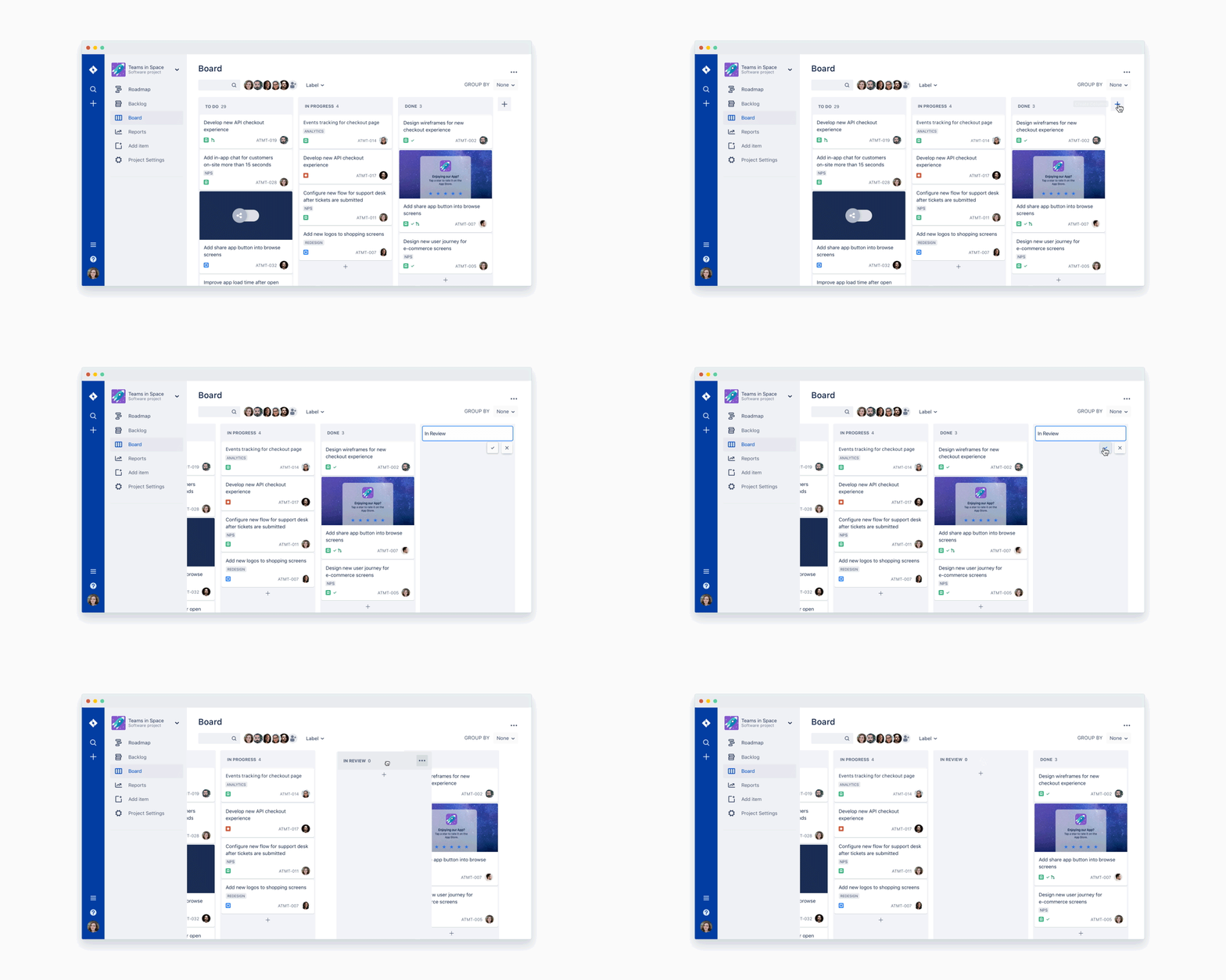
Unsurprisingly, the influence of Trello is most apparent in the Jira boards, where you can now drag and drop cards, add new columns with a few clicks and easily filter cards based on your current needs (without having to learn Jira’s powerful but arcane query language). Gone are the days where you had to dig into the configuration to make even the simplest of changes to a board.

As Regan noted, when Jira was first built, it was built with a single team in mind. Today, there’s a mix of teams from different departments that use it. So while a singular permissions model for all of Jira worked for one team, it doesn’t make sense anymore when the whole company uses the product. In the new Jira then, the permissions model is project-based. “So if we wanted to start a team right now and build a product, we could design our board, customize our own issues, build our own workflows — and we could do it without having to find the IT guy down the hall,” he noted.

One feature the team seems to be especially proud of is roadmaps. That’s a new feature in Jira that makes it easier for teams to see the big picture. Like with boards, it’s easy enough to change the roadmap by just dragging the different larger chunks of work (or “epics,” in Agile parlance) to a new date.

“It’s a really simple roadmap,” Brereton explained. “It’s that way by design. But the problem we’re really trying to solve here is, is to bring in any stakeholder in the business and give them one view where they can come in at any time and know that what they’re looking at is up to date. Because it’s tied to your real work, you know that what we’re looking at is up to date, which seems like a small thing, but it’s a huge thing in terms of changing the way these teams work for the positive.

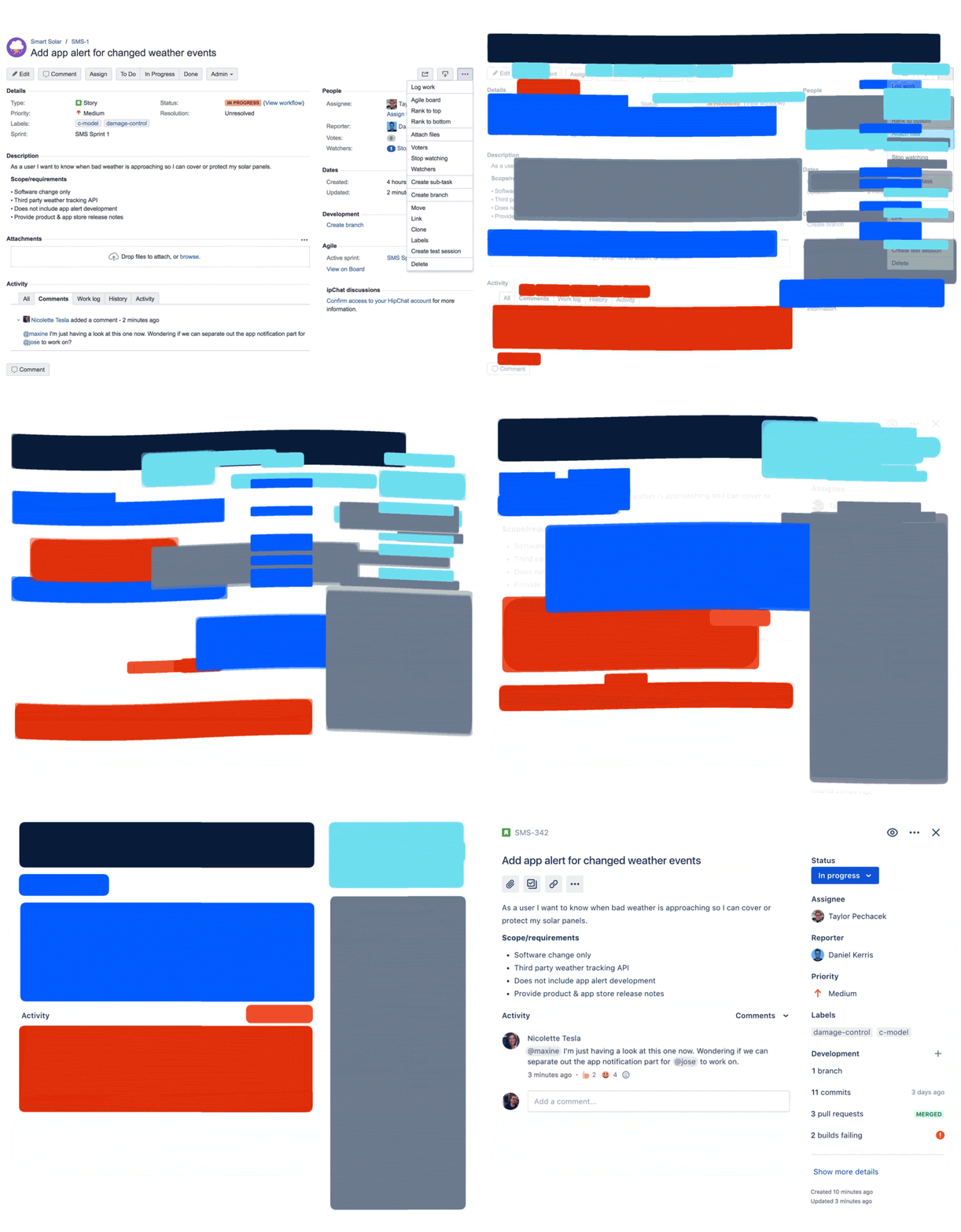
The Atlassian team also redesigned what’s maybe the most-viewed page of the service: the Jira issue. Now, issues can have attachments of any file type, for example, making it easier to work with screenshots or files from designers.

Jira now also features a number of new APIs for integrations with Bitbucket and GitHub (which launched earlier this month), as well as InVision, Slack, Gmail and Facebook for Work.

With this update, Atlassian is also increasing the user limit to 5,000 seats, and Jira now features compliance with three different ISO certifications and SOC 2 Type II.