Year: 2018

18 Oct 2018

Spotify’s Premium app gets a big makeover

Spotify has given its app a big makeover, with a focus on making the experience better for its paying subscribers. The company has simplified the app’s navigation by reducing the numbers of buttons and has revamped its Search page, which now incorporates elements previously found in “Browse,” like favorite genres or music to match a mood. And it’s given its Radio service a redesign as well, with the addition of new and easy-to-use Artist Radio Playlists.

The most immediately noticeable change is the app’s navigation.

Spotify has always felt a bit cluttered, with its five navigation buttons – Home, Browse, Search, Radio and My Library. The new app has chopped this down to just three buttons – Home, Search, and My Library.

Recommendations will appear on the Home page, following the update, while discovery is powered by Search.

The Search page lets you seek out artists, albums and podcasts by typing in queries, as before. But the page is also now personalized, showing your own “Top Genres” beneath the search bar – like R&B, Rock, Hip-Hop, Kids & Family – or whatever else you listen to. This is helpful because users’ tastes can change over time, or they may share their individual Spotify account with others (instead of opting for a Family plan), which can garble their recommendations.

The “Browse” section has moved to this Search page in the redesign, and points to things like top charts, Spotify’s programmed playlists, your own personalized playlists, plus music by mood, genre, activity and more.

The Radio section got an overhaul, too.

With the update, you can search for a favorite artist or song, then immediately start listing to one of the brand-new Artist Radio playlists. These are personalized, endless streams based on your own tastes – and they’re updated regularly to stay fresh, Spotify notes.

This latter feature appears to address a recent challenge from Pandora, which tapped into its Music Genome to create dozens of personalized playlists for its users. Spotify, effectively, is turning its radio stations into personalized playlists now, too. Instead of asking users to thumbs up/down its selections, it will just create stations it knows you’ll like, based on the data it already has. These radio playlists also work offline, the company says.

The updated app for Premium users follows a redesign of the app for its free customers, announced back in April. That redesign made it easier for free users to access over a dozen playlists with songs on demand, which also included the option to skip tracks. It also reduced the number of tabs in the bottom navigation.

This week, the company also rolled out a new Android Wear application. Plus, the third-party manufacturer Mighty launched a new version of its Spotify player, which is basically an iPod Shuffle-like device that works with Spotify instead of Apple Music or iTunes.

The changes to the Spotify app comes at a time when the company is losing ground in North America to Apple. Pandora was just snatched up by Sirius XM for $3.5 billion, which could make for increased competition in the U.S., as well.

Spotify’s Premium Subscribers grew to 83 million in Q2 2018, and it has 180 million monthly actives, including free customers, which still puts it ahead of the competition, in terms of user base size.

Spotify says the redesign for Spotify Premium is rolling out to all Premium subscribers on iOS and Android globally starting today.
18 Oct 2018

Document editor Coda adds third-party integrations with G Suite, Slack, Twilio and more

Coda, the smart collaborative document editor that breaks down the barriers between documents, spreadsheets, databases and presentations, is today launching one of its most important updates since its launch in 2017. With this update, users will be able to pull in data from third-party sources and send out messages to their teams on Slack or by SMS and email. With this, the company’s take on building living documents that are essentially small apps is now really taking shape.

“Coda is a new type of documents,” Coda co-founder and CEO Shishir Mehrotra told me. “It combines the best of documents, spreadsheets, presentations, applications into a new surface. The goal is to allow anybody to build a doc as powerful as an app.” That means you can use your inventory spreadsheet to build a small inventory management app, for example, that lives entirely in a tabbed Coda document. Mehrotra noted that many businesses essentially run on documents and spreadsheets, but they don’t have the ability to use that data to its full extent.

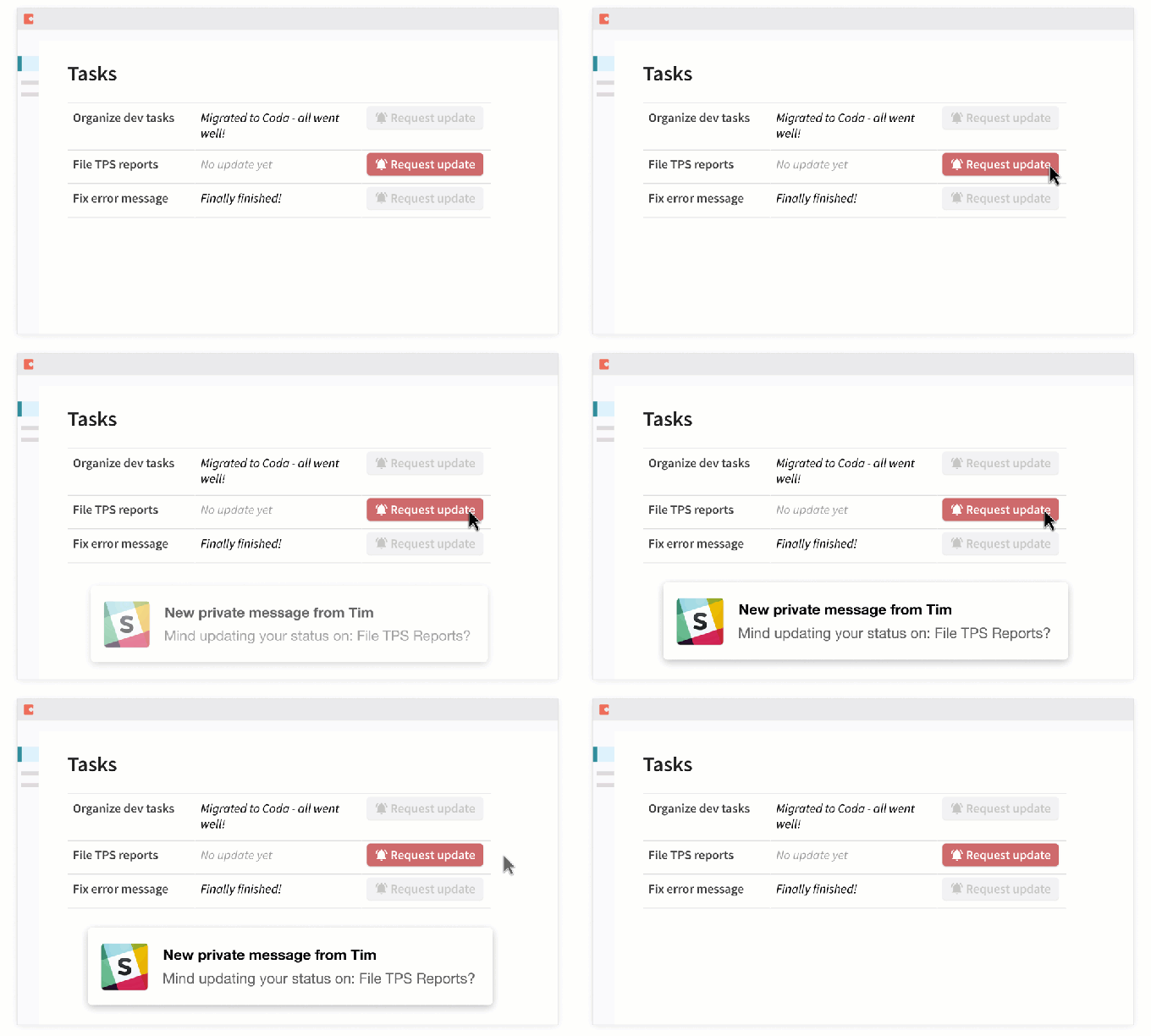
One part of these new integrations, which Coda calls “Coda Packs,” is that you now have the ability to extend your spreadsheets with data that you typically would have had to pull in by hand — something few people are likely to do. That may be stock, sports or weather data, but also open GitHub requests, Intercom tickets and data from your Google Calendar. But there also is a second set of integrations that now let you push out information to Slack and Twilio . In addition to these, Coda supports Figma, Greenhouse, Instagram, YouTube, Walmart Shopping and Wikipedia.

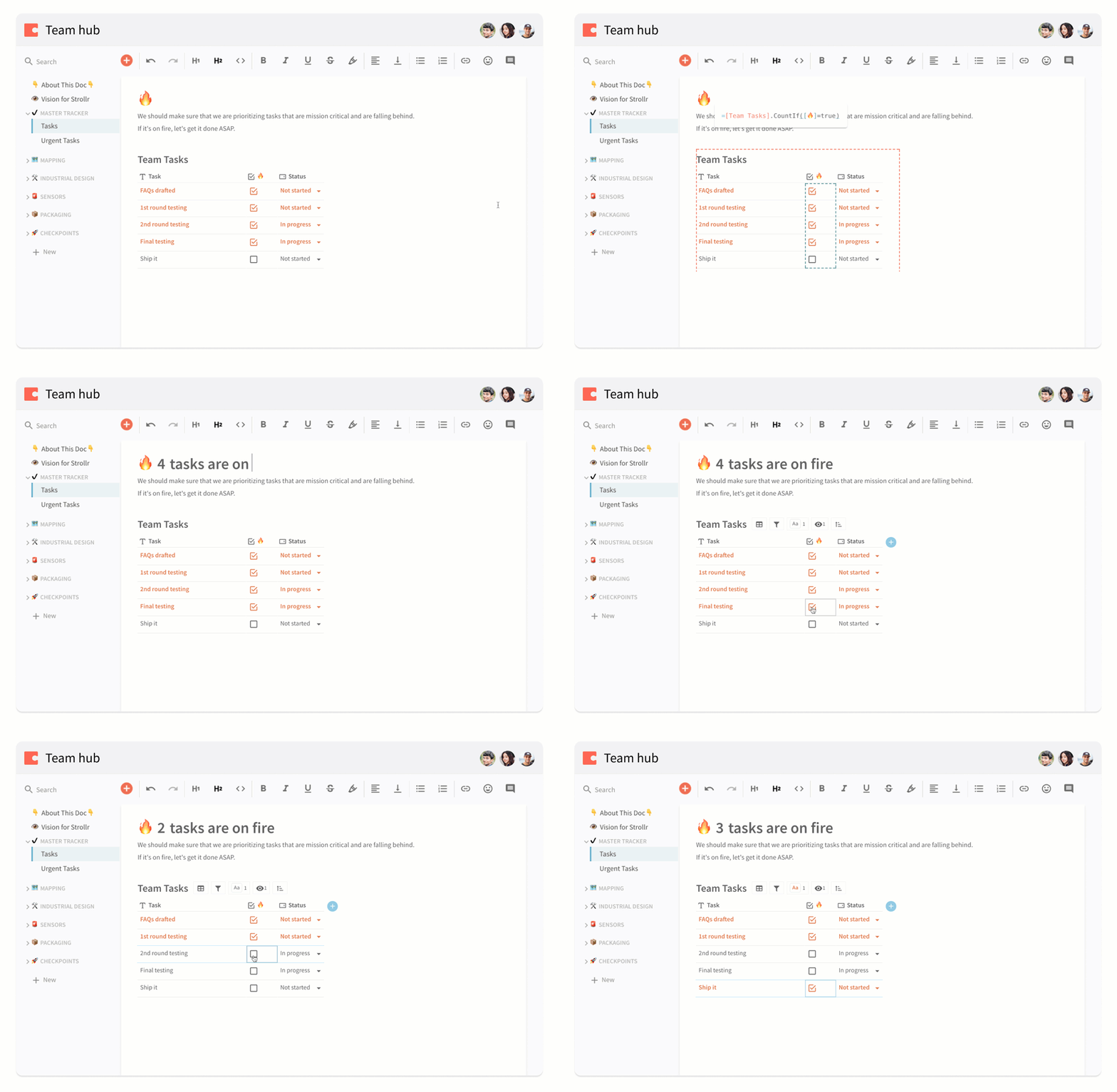
What’s cool here is that Coda lets you build buttons that can combine dozens of different actions. Maybe you have a spreadsheet about an upcoming event with the phone numbers of a dozen friends and want to text them all a reminder? You can now build a button that talks to Twilio and sends an SMS to all of those who haven’t RSVPed yet. And with the weather integrations, you can tell them what the temperature will be.

I’m typically rather skeptical when I see a company that tries to reimagine a well-established concept like a text editor or spreadsheet. And who knows if Coda will be a commercial success. But I can see how the overall concept makes sense (especially thanks to the ability to add a formula anywhere in a document). It’s worth noting, though, that Microsoft is also moving in this direction with the ability to pull third-party data into Excel (though mostly under the guise of artificial intelligence). What Microsoft doesn’t really do as smoothly as Coda is combine all the different document types in one.

18 Oct 2018

Daivergent connects people on the autism spectrum with jobs in data management

Great startups normally come from a personal place. Byran Dai’s new company, Daivergent, is no different.

Founded in December 2017, Daivergent looks to connect enterprise clients with folks on the autism spectrum who will help complete tasks in AI/ML data management.

Dai’s younger brother, Brandon, is on the autism spectrum. Dai realized that his brother and other folks on the spectrum are perfect candidates for certain high-complexity tasks that require extraordinary attention to detail, such as data entry and enrichment, quality assurance and data validation, and content moderation.

In a landscape where just about everyone is working on AI and machine learning algorithms, organizing data is a top priority. Daivergent believes that it can put together the perfect pool of data specialists to complete any task in this space.

Daivergent partners with various agencies including the AHRC and Autism Speaks to source talent. Those folks go through a screening process, which assesses their abilities to complete these sorts of tasks. They then become Daivergent contractors, where they get further training and then start working on projects.

The company says that there are 2.5 million adults with autism in the U.S., and Autism Speaks reports an 85 percent unemployment rate among college-educated adults with autism.

Daivergent not only provides a way for these people to get into the workforce, but it offers a way for corporations and companies to employ American workers for projects they would likely otherwise employ overseas contractors.

When a new task comes in to Daivergent, the company splits that project into smaller tasks and then assigns those tasks to its workers. The company also determines the complexity of the overall project, factoring in the urgency level of the request, to decide pricing.

Daivergent takes a small cut of the earnings and passes the rest on to the workers.

Right now, Daivergent has 25 active workers performing tasks for customers, with 150 workers registered and going through the qualification process and another 400 adults with autism in the candidate pool.

The company recently graduated from the ERA accelerator.

18 Oct 2018

Sam’s Club to offer same-day grocery delivery via Instacart at over half its stores by month end

Fresh off its $600 million round of new funding, grocery delivery service Instacart is expanding its relationship with Walmart, the companies announced this morning. The two first joined up in February to offer same-day grocery delivery at select Sam’s Clubs locations in the U.S. Today, Walmart says it plans to offer Instacart-powered grocery delivery in over half of Sam’s Clubs stores by the end of this month.

That expansion will make Sam’s Club grocery delivery via Instacart available to nearly 1,000 new ZIP codes and more than 100 new stores, including those in markets like New Jersey, Indianapolis, Houston and others, the company says.

In total, customers will be able to order from nearly 350 clubs by the end of October.

The partnership was first piloted in Dallas-Fort Worth, Austin and St. Louis, then reached San Diego and L.A. in more recent weeks.

The deal also allows consumers to shop Sam’s Clubs stores without a membership, including shopping its sales. However, Sam’s Club members will receive lower, membership-only pricing, Walmart says.

Deliveries are offered in as little as an hour, and may include non-grocery items, the retailer also notes.

“To help the holidays run smooth, we’re offering a wide product assortment available on Instacart so shoppers can now get household goods delivered,” said Sachin Padwal, Sam’s Club’s Vice President of Product Management, in a statement. “We’re excited that last-minute gifts, small appliances, extra pillows and towels – just to name a few things – are just a few clicks and minutes away,” he added.

The partnership between Sam’s Club and Instacart is significant in terms of Walmart’s larger battle with Amazon, which offers grocery pickup and delivery through its Whole Foods division, as well as grocery delivery through AmazonFresh and Prime Now.

Sam’s Club parent Walmart also offers an affordable curbside pickup program for groceries – which, unlike with third-party services, sells items at the same price as they are in stores. In select markets, Walmart offers grocery delivery, too.

In Walmart’s recent fiscal year 2020 guidance, it said that it expects to offer grocery pickup at 3,100 Walmart stores by 2020, and delivery at 1,600 locations. Currently, Walmart’s grocery delivery is on track to reach 100 U.S. metros by year-end.

Same-day delivery for Sam’s Club isn’t the only change Walmart’s warehouse membership club has made in recent months. Also in February, the club began to offer free shipping on orders, with no minimum purchase, and simplified memberships to two tiers, Savings ($45/year) and Plus ($100/year). Both of those options are cheaper than Amazon Prime, now $119/year.

Sam’s Club shoppers can visit samsclub.com/Instacart to see if their local store is supported.

18 Oct 2018

Proxxi saves workers from getting electrocuted

There are some gadgets that are nice to have – iPhones, sous vide wands – and some gadgets that you must have. Proxxi fits in the latter camp.

Proxxi is an always-on sensor that buzzes when it gets too close to high voltage electricity. Its worn by mechanics and electricians and warns them when they get too close to something dangerous. The Vancouver-based company just sold out of its initial commercial evaluation units and they’re building a huge business supplying these clever little bracelets to GE, Con Edison, Exelon, Baker Hughes, Schneider Electric and ABB.

The bracelet connects to an app that lets workers silence warnings if they’re working on something that is energized and it also tracks the number of potentially harmful interactions wirelessly. This lets management know exactly where the trouble spots are before they happen. If, for example, it senses many close brushes with highly charged gear it lets management investigate and take care of the problem.

Founded by Richard Sim and Campbell Macdonald, the company has orders for thousands of units, a testament to the must-have nature of their product. They raised $700,000 in angel funding.

“All of this is critical to enterprises looking to mitigate risk from catastrophic injuries: operational disruption, PR nightmare, stock analyst markdowns and insurance premiums,” said Macdonald. “This represents a whole new class of hardware protection for industrial workers who are used to protection being process driven or protective gear like gloves and masks.”

The company began when British Columbia Hydro tasked Sim to research a product that would protect workers from electricity. Macdonald, whose background is in hardware and programming, instead built a prototype and showed it around.

“We initially found that all utilities and electricians wanted this,” he said. “The most exciting thing we have discovered in the last year is that the opportunity is much larger covering manufacturing, oil and gas, and construction.”

“It’s a $40 billion problem,” he said.

The goal is to create something that can be used all day. Unlike other sensors that are used only in dangerous situations, Proxxi is designed to be put on in the morning and taken off at night, after work.

“There are other induction sensors out there, but they are focused on high risk scenarios, ie, people use them when they think they are at risk. The trouble is you can’t tell when you are at risk. You can’t sense that you have made a mistake in the safety process,” said Macdonald. The goal, he said, is to prevent human error and, ultimately, death. Not bad for a wearable.

18 Oct 2018

Seva snares $2.4M seed investment to find info across cloud services

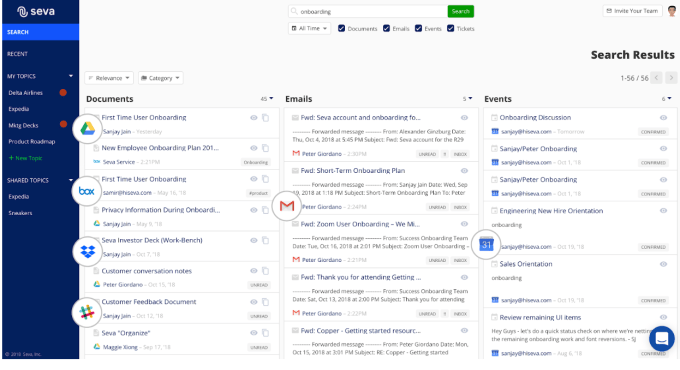
Seva, a New York City startup, that wants to help customers find content wherever it lives across SaaS products, announced a $2.4 million seed round today. Avalon Ventures led the round with participation from Studio VC and Datadog founder and CEO Olivier Pomel.

Company founder and CEO Sanjay Jain says that he started this company because he felt the frustration personally of having to hunt across different cloud services to find the information he was looking for. When he began researching the idea for the company, he found others who also complained about this fragmentation.

“Our fundamental vision is to change the way that knowledge workers acquire the information they need to do their jobs from one where they have to spend a ton of time actually seeking it out to one where the Seva platform can prescribe the right information at the right time when and where the knowledge worker actually needs it, regardless of where it lives.”

Seva, which is currently in Beta, certainly isn’t the first company to try and solve this issue. Jain believes that with a modern application of AI and machine learning and single sign-on, Seva can provide a much more user-centric approach than past solutions simply because the technology wasn’t there yet.

The way they do this is by looking across the different information types. Today they support a range of products including Gmail, Google Calendar, Google Drive,, Box, Dropbox, Slack and JIRA, Confluence. Jain says they will be adding additional services over time.

Screenshot: Seva

Customers can link Seva to these products by simply selecting one and entering the user credentials. Seva inherits all of the security and permissioning applied to each of the services, so when it begins pulling information from different sources, it doesn’t violate any internal permissioning in the process.

Jain says once connected to these services, Seva can then start making logical connections between information wherever it lives. A salesperson might have an appointment with a customer in his or her calendar, information about the customer in a CRM and a training video related to the customer visit. It can deliver all of this information as a package, which users can share with one another within the platform, giving it a collaborative element.

Seva currently has 6 employees, but with the new funding is looking to hire a couple of more engineers to add to the team. Jain hopes the money will be a bridge to a Series A round at the end of next year by which time the product will be generally available.

18 Oct 2018

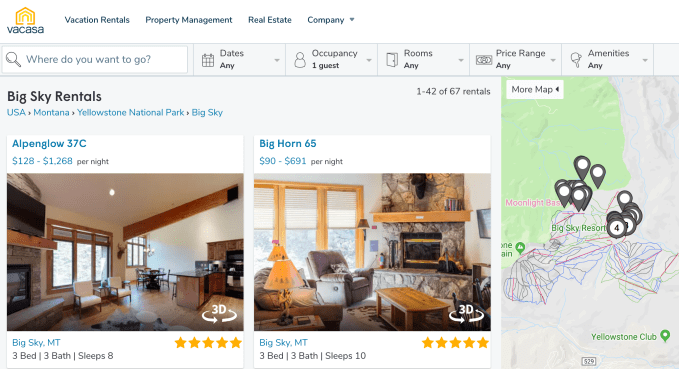
Sick of managing your Airbnb? Vacasa raises $64M to do it for you

Airbnbing can be a ton of work. Between key pickups, tidying, and maintenance emergencies, renting out your place isn’t such a passive revenue source. But Vacasa equips owners with full-service vacation home management, including listings on top rental platforms like Airbnb and HomeAway, as well as local cleaners who come between guests. It now manages 10,000 vacation rental properties in over 16 countries.

With the peer-to-peer housing market maturing and Airbnb looking to go public, private equity firms see an opportunity in who controls the end relationship with home owners like Vacasa does. So today the startup is announcing it’s raised $64 million in a Series B bridge round led by Riverwood, and joined by Level Equity, Assurant, and Newspring. The cash will fuel Vacasa’s expansion into real estate as it seeks to sell property to people who want to own and rent out a vacation home.

Vacasa was impressively bootstrapped from 2009 until 2015. “I’ve always been passionate about vacation rentals. When traveling with friends or family, I love having common spaces to come together in” says CEO Eric Breon. He founded the company after owning a vacation cabin on the Washington Coast. He’d go up in the Spring, spend a weekend fixing up the place, it’d sit idle all summer, and then he’d have to spend another weekend closing it up. He considered a local property manager, but they massively underestimated how much he could earn off renting it out. So Breon built Vacasa to make it easy for home owners to earn the most money without a hassle.

After years growing the business organically, Vacasa raised a $35 million series A from Level Equity in 2015, then $5 million more from Assurant. Then in fall of 2017, it raised an $103.5 million series B. Now it’s topping up that round with $64 million and a new valuation warranted by the startup’s growth this past year. That brings Vacasa to a total of $207.5 million in funding


While that’s just a fraction of the over $4.4 billion Airbnb has raised. But Vacasa caters to a more upscale market that don’t want to manage the properties themselves. With plenty of popular listings sites out there, Vacasa gets easy distribution. But eventually as the other giants in the space become public companies, they’ll be forced to chase bigger margins that could see them compete with Vacasa after years of partnership.

Breon remains confident, though. When I ask him the biggest existential threat to the business, he declares that “We’ve reached a point where failure isn’t a realistic outcome. We have great retention of our homeowners, and strong recurring revenue. The question is more about how quickly we can continue scaling into the huge $32 billion market we’re focused on.” Getting to an exit might not be quite so straightforward, but with life seeming to get more stressful by the year, there’ll be no shortage of people seeking a getaway.

18 Oct 2018

Arianna Huffington’s Thrive Global is teaming up with Zenefits

Many are familiar with Arianna Huffington’s personal journey from media mogul to outspoken sleep advocate.

In April 2007 she collapsed, broke her collarbone and woke up in a pool of blood, a well-publicized accident she attributes to sleep deprivation and exhaustion. In the years that followed, she shifted her focus to wellness, authoring two books on the topic: Thrive and The Sleep Revolutionand later founded a wellness media company called Thrive Global.

Thrive, which bills itself as a “behavior change” startup, helps businesses help their employees develop healthy relationships with technology and manage stress and burnout — issues with which Huffington is personally familiar. The company has raised nearly $43 million in venture capital funding to date, at a $121.5 million valuation as of May.

Today, Thrive is announcing a new partnership with Zenefits, the provider of software that helps small- and medium-sized business (SMBs) manage human resources, though is still often known for a series of regulatory and compliance issues that led to the exit of its founding chief executive, Parker Conrad.

The partnership will make available to employees of the 11,000 businesses that use Zenefits human resources software Thrive content, tips and tools within the Zenefits platform, and managers will be able to use the Thrive app to track and measure employee well-being.

“People are sleep deprived; people are eating the wrong food,” Huffington told TechCrunch. “It’s very basic things we can change through behavior that affect the bottom line of a company.”

“When you give employees science-based micro steps — that’s how change happens,” she added. “You need little nudges to help you change your behavior.”

Thrive educational content focuses on sleep, humans’ relationship with technology, goal setting and other issues that pertain to physical and mental health.

Huffington and Jay Fulcher, Zenefits CEO, told TechCrunch this arrangement was a year in the making.

Zenefits tapped Fulcher, the former CEO of Ooyala and Agile Software, as CEO last year. He was the third CEO in the span of 12 months after Conrad was ousted and Craft Ventures’ David Sacks stepped down after a brief stint as interim CEO. 

“{Stress] is the tipping point for things like retention, which obviously costs businesses billions and billions every year,” Fulcher said. “We have a very sophisticated and broad tech platform and to be able to put all of Thrive’s content on our platform, we think that is a really good proposition and one that customers are excited about.”

Thrive has historically worked with large enterprises, inking deals with Accenture, J.P. Morgan and others since Huffington launched the company in 2016. A partnership with Zenefits marks its first foray into SMBs. 

Thrive is backed by Salesforce CEO Marc Benioff, Sean Parker, Lerer Hippeau, Greycroft Partners and others. Zenefits, founded in 2013, is backed by Andreessen Horowitz, Fidelity, TPG and others. Both companies are backed by IVP.

18 Oct 2018

Take a video tour of Facebook’s election security war room

Beneath an American flag, 20 people packed tight into a beige conference room are Facebook’s, and so too the Internet’s, first line of defence for democracy. This is Facebook election security war room. Screens visualize influxes of foreign political content and voter suppression attempts as high-ranking team members from across divisions at Facebook, Instagram, and WhatsApp coordinate rapid responses. The hope is through face-to-face real-time collaboration in the war room, Facebook can speed up decision-making to minimize how misinformation influences how vote.

In this video, TechCrunch takes you inside the war room at Facebook’s Menlo Park headquarters. Bustling with action beneath the glow of the threat dashboards, you see what should have existed two years ago. During the U.S. presidential election, Russian government trolls and profit-driven fake news outlets polluted the social network with polarizing propaganda. Now Facebook hopes to avoid a repeat in the upcoming US midterms as well as elections across the globe. And to win the hearts, minds, and trust of the public, it’s being more transparent about its strategy.

“It’s not something you can scale to solve with just human.s And it’s not something you can solve with just technology either” says Facebook’s head of cybersecurity Nathaniel Gleicher. “I think artificial intelligence is a critical component of a solution and humans are critical component of a solution.” The two approaches combine in the war room.

Who’s In The War Room And How They Fight Back

Engineers – Facebook’s coders develop the dashboards that monitor political content, hate speech, user reports of potential false news, voter suppression content, and more. They build in alarms that warn the team of anomalies and spikes in the data, triggering investigation by…

  • Data Scientists – Once a threat is detected and visualized on the threat boards, these team members dig into who’s behind an attack, and the web of accounts executing the misinformation campaign.
  • Operations Specialists – They determine if and how the attacks violate Facebook’s community standards. If a violation is confirmed, they take down the appropriate accounts and content wherever they appear on the network.
  • Threat Intelligence Researchers and Investigators – These professional cybersecurity professionals have tons of experience in deciphering the sophisticated tactics used by Facebook’s most powerful adversaries including state actors. They also help Facebook run war games and drills to practice defense against last-minute election day attacks.
  • Instagram and WhatsApp Leaders – Facebook’s acquisitions must also be protected, so representatives from those teams join the war room to coordinate monitoring and takedowns across the company’s family of apps. Together with Facebook’s high-ups, they dispense info about election protection to Facebook’s 20,000 security staffers.
  • Local Experts – Facebook now starts working to defend an election 1.5 to 2 years ahead of time. To provide maximum context for decisions, local experts from countries with the next elections join to bring knowledge of cultural norms and idiosyncracies.
  • Policy Makers – To keep Facebook’s rules about what’s allowed up to date to bar the latest election interference tactics, legal and policy team members join to turn responses into process.

Beyond fellow Facebook employees, the team works external government, security, and tech industry partners. Facebook routinely cooperates with other social networks to pass each other information and synchronize take-downs. Facebook has to get used to this. Following the mid-terms it will evaluate whether it needs to constantly operate a war room. But after it was caught be surprise in 2016, Facebook accepts that it can never turn a blind eye again.

Facebook’s director of our global politics and government outreach team Katie Harbath concludes. “This is our new normal.”

18 Oct 2018

Banksy’s rigged art frame was supposed to shred the whole thing

In the connected future will anyone truly own any thing? Banksy’s artworld shocker performance piece, earlier this month, when a canvas of his went under the hammer at Sothebys in London, suggests not.

Immediately the Girl with Balloon canvas sold — for a cool ~$1.1M (£860,000) — it proceeded to self-destruct, via a shredder built into the frame, leaving a roomful of designer glasses paired with a lot of shock and awe, before facial muscles twisted afresh as new calculations kicked in.

As we reported at the time, the anonymous artist had spent years planning this particular prank. Yet the stunt immediately inflated the value of the canvas — some suggested by as much as 50% — despite the work itself being half shredded, with just a heart-shaped balloon left in clear view.

The damaged canvas even instantly got a new title: Love Is in the Bin.

Thereby undermining what might otherwise be interpreted as a grand Banksy gesture critiquing the acquisitive, money-loving bent of the art world. After all, street art is his big thing.

However it turns out that the shredder malfunctioned. And had in fact been intended to send the whole canvas into the bin the second after it sold.

Or, at least, so the prankster says — via a ‘director’s cut’ video posted to his YouTube channel yesterday (and given the title: ‘Shred the love’, which is presumably what he wanted the resulting frame-sans-canvas to be called).

“In rehearsals it worked every time…” runs a caption towards the end of the video, before footage of a complete shredding is shown…

The video also appears shows how the canvas was triggered to get to work cutting.

After the hammer goes down the video cuts to a close-up shot of a pair of man’s hands pressing a button on a box with a blinking red LED — presumably sending a wireless signal to shreddy to get to work…

The suggestion, also from the video (which appears to show close up shots of some of the reactions of people in the room watching the shredding taking place in real time), is that the man — possibly Banksy himself — attended the auction in person and waited for the exact moment to manually trigger the self-destruct mechanism.

There are certainly lots of low power, short range radio technologies that could have been used for such a trigger scenario. Although the artwork itself was apparently gifted to its previous owner by Banksy all the way back in 2006. So the built-in shredder, batteries and radio seemingly had to sit waiting for their one-time public use for 12 years. Unless, well, Banksy snuck into the friend’s house to swap out batteries periodically.

Whatever the exact workings of the mechanism underpinning the stunt, the act is of course the point.

It’s almost as if Banksy is trying to warn us that technology is eroding ownership, concentrating power and shifting agents of control.