Year: 2018

17 Oct 2018

Postmates launches food delivery in 134 additional US cities

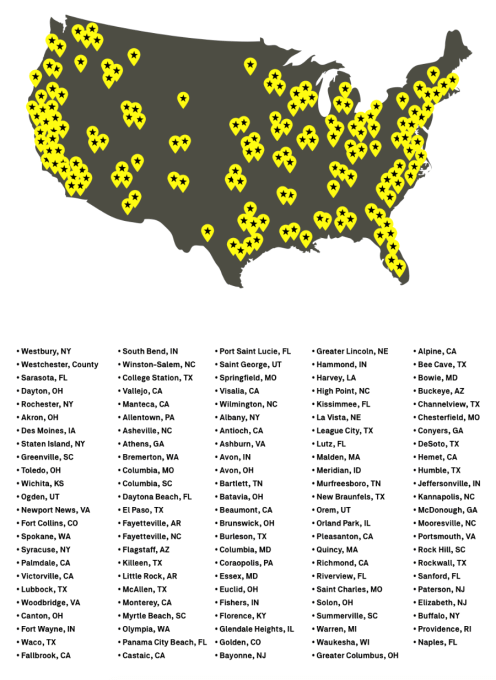
Homebodies across the U.S. have reason to celebrate. Postmates — the on-demand food delivery service so popular in major cities that it’s a verb now — just launched in 134 new markets. Those 134 additional cities mean that Postmates has a presence in 550 cities total across the U.S, including places like Lubbock, Texas; Athens, Georgia; Columbia, South Carolina and Albany, New York.

In April, the company announced that it would partner with Walmart on grocery delivery. The move was meant to offset Amazon’s potential dominance in the space given the online retail giant’s acquisition of Whole Foods last year. Postmates was most recently valued at $1.2 billion after a $300 million influx of funding last month.

In July, Postmates added a wave of more than 100 cities, bringing its count up to 385 at the time. Now, Postmates claims coverage of 60 percent of households in the U.S., showing that the company is serious about taking Bay Area-centric on-demand luxuries and its own delivery infrastructure far beyond Silicon Valley.

17 Oct 2018

Postmates launches food delivery in 134 additional US cities

Homebodies across the U.S. have reason to celebrate. Postmates — the on-demand food delivery service so popular in major cities that it’s a verb now — just launched in 134 new markets. Those 134 additional cities mean that Postmates has a presence in 550 cities total across the U.S, including places like Lubbock, Texas; Athens, Georgia; Columbia, South Carolina and Albany, New York.

In April, the company announced that it would partner with Walmart on grocery delivery. The move was meant to offset Amazon’s potential dominance in the space given the online retail giant’s acquisition of Whole Foods last year. Postmates was most recently valued at $1.2 billion after a $300 million influx of funding last month.

In July, Postmates added a wave of more than 100 cities, bringing its count up to 385 at the time. Now, Postmates claims coverage of 60 percent of households in the U.S., showing that the company is serious about taking Bay Area-centric on-demand luxuries and its own delivery infrastructure far beyond Silicon Valley.

17 Oct 2018

Investors see an opportunity framed in Lensabl’s prescription lens fulfillment business

Lensabl, the company that has built a business putting prescription lenses into any style of glasses frame, has raised $3.7 million in a new round of funding. 

Based in Los Angeles, Lensabl already has an agreement inked with the city’s latest tech wunderkind, partnering with the spectacles producing augmented reality luminaries at Snap.

“We are the preferred prescription provider of Snapchat Spectacles,” says Lensabl chief executive Andrew Bilinsky. “[And] we are already talking to and partnering with a variety of brands to start and scale their prescription operations [and] really scale our direct to consumer lens business.”

Powering that effort is the new $3.7 million in funding which came from a clutch of big name strategic partners, venture firms and individual angel investors. Rogue Venture Partners, the same lead investor behind SightBox, a contact lens subscription business acquired by Johnson & Johnson, led the round. And additional investors including Birchmere Ventures, Aspect Ventures, Cherry Tree Investments, Amplify, Luma Launch, Watertower Ventures, and Crowdsmart (a crowdfunding platform) also participated in the financing.

For Bilinsky, the opportunity in setting up a business exclusively focused on filling prescriptions means reduced prices and better options for the estimated 188.7 million people who wear corrective eyewear or contact lenses in the U.S.

“We’re offering every different type of prescription lens for every different frame brand,” says Biinsky. “[We’re] mimicking what a customer can do going into a Lens Crafters at up to 70% cheaper than a traditional provider.”

And given the changing ways in which glasses buyers are shopping for frames, launching a business that caters to providing the right lenses at a lower price makes sense, Bilinsky says.

“With Amazon becoming the largest individual reseller of eyewear in the U.S., every frame that people buy that needs to be re-lensed. It’s a secondary market in the same way that you would put new rims on the car,” says Billinsky.

Lensabl offers about 400 different permutations of lenses and 20 different tint colors. “It’s a customization platform for your frames,” says Bilinsky.

17 Oct 2018

Essential lays off nearly one-third of its staff

Layoffs are never an easy pill to swallow, but for Essential, it seems the writing was on the wall for a while with this one. After months of reports highlighting its struggles, the Andy Rubin-led smartphone startup has announced some major layoffs.

All told, the company will be losing around 30 percent of its staff.

We’ve since confirmed the news, which was initially noted by Bloomberg. “This has been a difficult decision to make,” a spokesperson for the company told TechCrunch. “We are very sorry for the impact on our colleagues who are leaving the company and are doing everything we can to help them with their future careers. We are confident that our sharpened product focus will help us deliver a truly game changing consumer product.”

The note strikes a similarly hopeful tone as past responses offered up in the wake of ongoing reports. Certainly the company went out of its way to acknowledge precisely how difficult it would be to launch a successful Android startup from the ground up in 2018. Ditto for the company’s plans to launch a smart speaker to compete with the Echo and Google Home — though that device has reportedly been placed on the back burner as the company looks for a way forward.

It’s been over a year since the company launched its first handset. That device got off to a rocky start, according to analysts, and in the meantime, the company has been fairly quiet on the hardware front, aside from a couple of accessories and a handful of deep discounts on the phone.

Hardware is hard — even when you’ve got the talent and experience to back it up.

17 Oct 2018

Tesla inks deal for Gigafactory 3 in China

Tesla has secured the rights to about 210 acres of land in Lingang, Shanghai, the site of the electric automaker’s planned factory and its first outside of the U.S.

Tesla executives and leaders of the Shanghai Economics and Information Committee, Shanghai Lingang Area Development Administration and Shanghai Lingang Group witnessed the agreement-signing ceremony in China on Wednesday.

“Tesla’s mission is to accelerate the world’s transition to sustainable energy not only through all-electric vehicles, but also scalable clean energy generation and storage products,” Robin Ren, Tesla’s vice president of Worldwide Sales said in a statement. “Securing this site in Shanghai, Tesla’s first Gigafactory outside of the United States, is an important milestone for what will be our next advanced, sustainably developed manufacturing site.”

The land transfer marks an important step for Tesla, which recently said rising costs had prompted the company to accelerate construction of its so-called Gigafactory 3. Tesla warned in its production and delivery report in early October that tariffs, combined with the cost of shipping its vehicles via ocean carrier and the lack of access to cash incentives available to locally produced electric vehicles, has put the company at a disadvantage in China.

Tesla reasserted those statements Wednesday, noting that it expects the project to be a “capital efficient and rapid buildout, using many lessons learned from the Model 3 ramp in North America.”

Tesla reached a deal in July with the Shanghai government to build a factory that it says will be capable of producing 500,000 electric vehicles a year. Once construction begins, it will take about two years until Tesla can produce vehicles. It will be another “two to three years before the factory is fully ramped up to produce around 500,000 vehicles per year for Chinese customers,” a Tesla spokesman said at the time.

The Shanghai factory deal marks a shift within the Chinese government to allow foreign companies to build and operate wholly owned facilities there. Foreign companies have historically had to form a 50-50 joint venture with a local partner to build a factory in China.

Chinese President Xi Jinping has said the country will phase out joint-venture rules for foreign automakers by 2022. Tesla is one of the first beneficiaries of this rule change.

The agreement allows Tesla to construct and operate a wholly owned factory in Lingang. The new factory will carry out research and development, manufacturing and sales operations.

The Chinese government will still be involved, however. Under a cooperation agreement, the Shanghai government and Tesla will jointly promote electric vehicle technology and industry development. The city of Shanghai said it will provide support for Gigafactory 3, although details are thin as to what that might mean.

17 Oct 2018

This 3D-printed prosthetic hand combines speed and strength with simplicity

Prosthetic limbs have come a long way from the heavy, solid hands and legs of yesteryear, but it’s still difficult to pack a range of motion into them without complex or bulky machinery. But new research out of Cornell uses a cleverly designed 3D-printed mechanism to achieve speed and strength with simple construction — and it costs a lot less, too.

“Developing prosthetic limbs requires designers to make difficult trade-offs among size, weight, force, speed, and cost of the actuation system,” the researchers say in their paper. For example, they point out, state of the art mechanical prosthetic hands can cost well over $10,000, with the high-end motors inside alone costing hundreds each. Cheaper hands use cheaper components, of course, which might mean that the hand can grip hard but not quickly, or vice versa.

This is partly because a mechanical hand needs to be able to adjust the force it’s applying very quickly on the fly, and this usually involves some kind of variable transmission or dynamic gear ratio. But Kevin O’Brien and his colleagues developed a new way to have the motor adjust its speed and force without using hundreds of finely machined components. In fact, it and the hand it actuates can be almost entirely 3D-printed.

It works like this: The fingers of the hand are controlled, like many other such hands and indeed our own, by flexible cords that run along their lengths. These cords can be tightened or slackened to make the fingers take different positions, and that’s often done by having a spool take up the slack or deal it out. It’s this spool that must move precisely and is the end point of the complex gearing mentioned above in other hands.
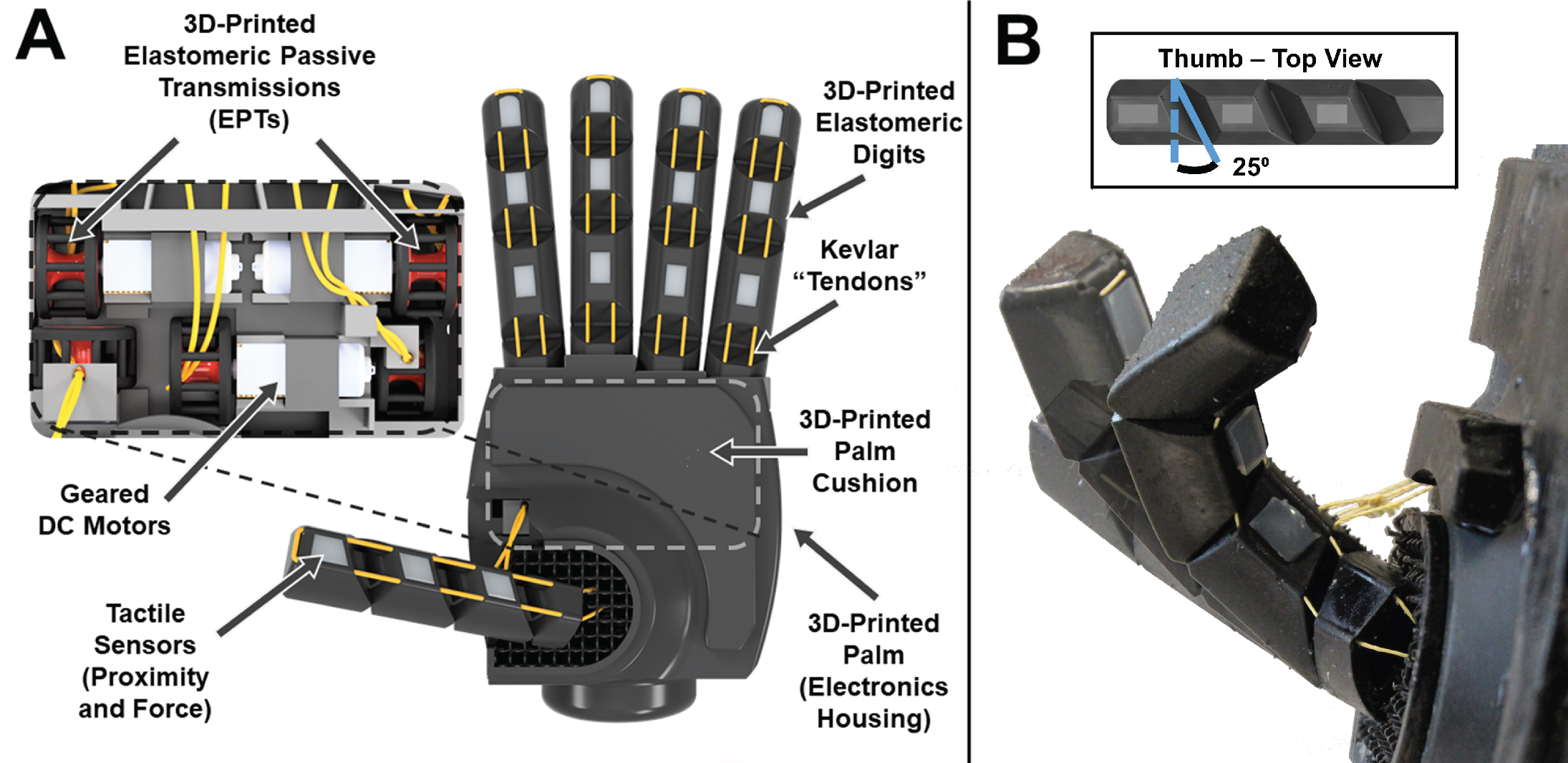
But in the ADEPT hand (adaptively driven via elastomeric passive transmissions — we’ll stick with the acronym) these spools have in their centers a flexible cylindrical core, the shape of which can be modified by tightening a separate “tendon” around it. When the tendon is loose, the core is wider and spins quickly, producing fast, responsive movement. When the tendon is tightened, the core is reduced in radius and correspondingly increases in torque while decreasing in speed.

There’s no switching of gears, no meshing of teeth — if the hand determines that it needs just a little bit more torque to hold something, it can get it by tightening the tendon just that little bit. And as soon as it needs to quickly release or catch something, the tendon can loosen up and the fingers move quickly and lightly.
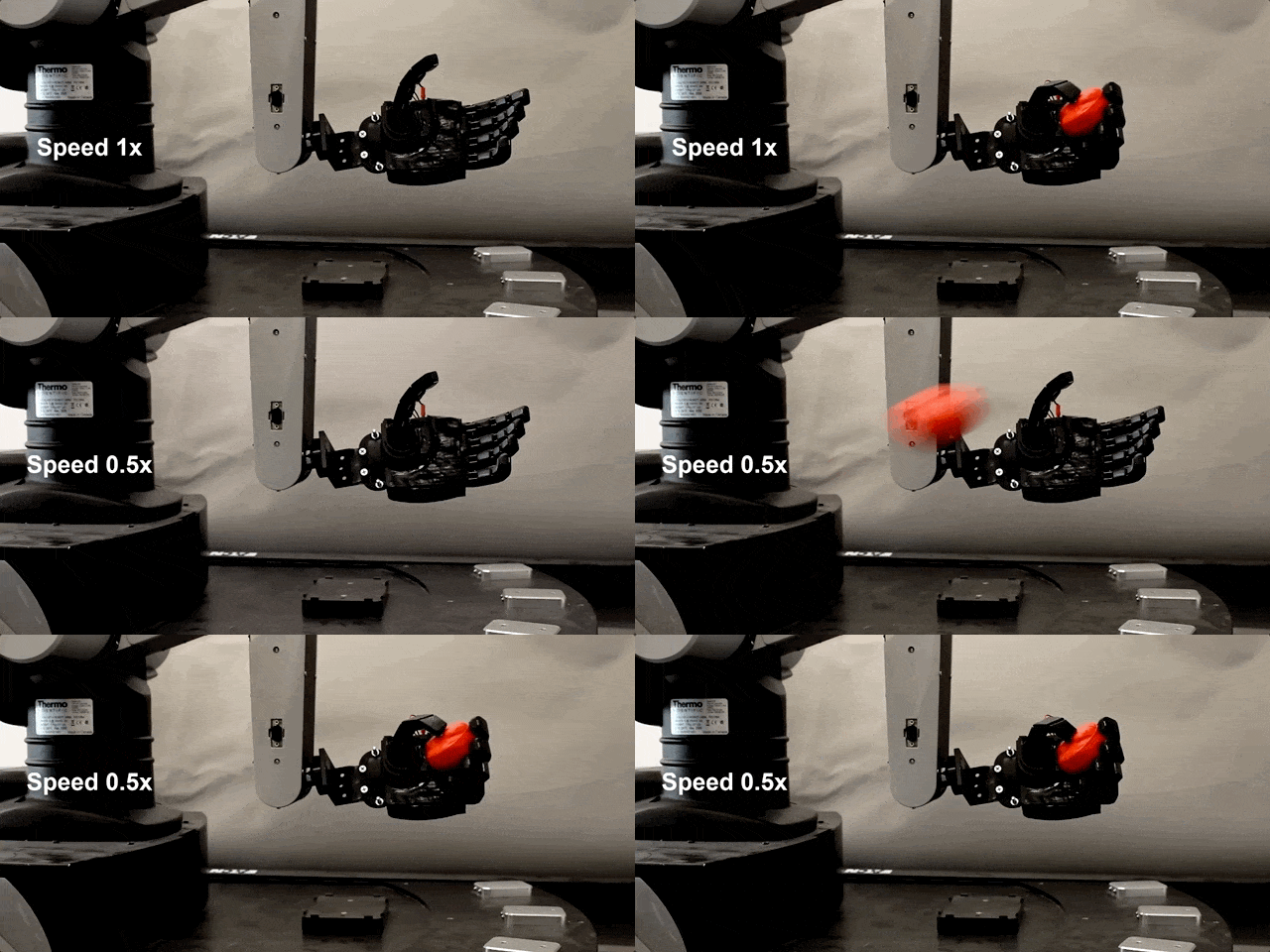
This simplicity and the ease of manufacturing make this much cheaper than other options, while it still provides a great deal of versatility and responsiveness.

“The benefits of elastomeric transmission systems are that they can be 3D printed quickly (50 per hour), cheaply (<$1 per part), and in many compact form factors,” the researchers wrote. A whole hand could be built for less than $500, they estimate.

Unfortunately the materials aren’t quite up to the task just yet — the part that’s constantly having its shape adjusted tends to degrade, though they managed to get it to the point where it could be adjusted about 25,000 times before failing (not catastrophically, just not doing its job well enough any more). That may sound like a lot, but your fingers move a lot. So there’s still work to do before this is a realistic replacement for other mechanical parts.

Still, it’s a promising approach and general enough that it also could be used in artificial legs, arms and exo-suits. You can read more at Science Robotics.


17 Oct 2018

Next 10 Ventures is launching an incubator for YouTube personalities

Los Angeles-based Next 10 Ventures, a $50 million fund focused on the creator economy, is launching an incubator program to support YouTubers.

The EduCreator Incubator will seed 25 to 40 “emerging video creators” with $25,000 to $75,000 in seed funding, depending on their location, and will enroll them in a 12-month mentorship program. The only requirement is that they focus on educational video content targeting children and young adults.

“The amazing thing about being able to provide more educational content to YouTube is that children, who may be first generation from an emerging or developing country, they now have a mobile phone and they have the ability to watch content,” said Cynthia So Schroeder, Next 10’s recently hired vice president of marketing, who’s leading the incubation efforts. “Through this content, they may discover a field or a topic they haven’t had access to. Maybe they’ll discover oceanography or physics and that glimpse will … inspire them to be a future astronaut or engineer.”

So Schroeder, eBay’s former head of global community development and engagement, joins the firm’s founders: Benjamin Grubbs, YouTube’s former global director of top creator partnerships, and Paul Condolora, the former co-head of the Harry Potter franchise at Warner Bros.

All participants in the program will jointly participate in a revenue share on revenue generated from their content. Next 10 says they intend to reinvest that into a growth fund for next year’s EduCreator participants and that any equity arrangements or follow-on investments will be discussed at the end of the program.

EduCreator will provide participants with a network of other like-minded creators, programming focused on content development and format and mentorship from digital storyteller Jay Shetty, WeCreateEdu founder Jacklyn Duff and others. The goal is to help the YouTubers build sustainable and scalable online businesses.

What’s in it for Next 10? The firm’s hypothesis is that digitally savvy, mobile-first content creators are big money makers, or will be 10 years down the line — hence the fund’s name. Nearly 60 percent of GenZers, after all, cite YouTube as their preferred learning method, and the quantity of streaming video has more than doubled in the past year.

“At YouTube, I saw over 5x growth in watch time, commercialization and really, globalization of the platform,” Grubbs told TechCrunch. “I have three kids ages 9, 7 and 4 and I’ve seen it there too in how they are consuming media. Looking ahead over the next 10 years, this is going to be the way consumers are [being entertained], accessing insights and knowledge, and connecting.”

Applications to the incubator opened today and close November 17, 2018.

17 Oct 2018

Open offices have driven Panasonic to make horse blinders for humans

At what point do we just give up and admit we’re living in exactly the dystopian nightmare speculative fiction warned us about? It probably ought to be these horse blinders for people, which look like something straight out of a Terry Gilliam movie.

Panasonic design studio Future Life Factory designed the things, but open space offices are basically the worst. The startup-driven push to eliminate the world from the tyranny of the cubicle has apparently driven us to create cubicles for our faces that have the added bonus of making workers look like their identity has been blurred out on Cops.

Along with obscuring the wearer’s peripheral vision, Wear Space (weirdly Office Face is still unclaimed), also sports noise-canceling headphones to really get the job done.

“As open offices and digital nomads are on the rise, workers are finding it ever more important to have personal space where they can focus,” the company told Dezeen. “Wear Space instantly creates this kind of personal space – it’s as simple as putting on an article of clothing.”

The device, which debuted as a prototype at SXSW earlier this year, is now the subject of a crowdfunding campaign. Early birds can snag one for around $260, but we’re going to say neigh on this one.

17 Oct 2018

Health insurance startup Alan covers meditation app subscription

French startup Alan wants to be a bit better than your good old health insurance. That’s why the company is trying something new and now covers part of your Petit Bambou subscription.

Petit Bambou is a popular meditation app. It’s a sort of Headspace, but with French content. You download an app, put your earphones, close your eyes and follow the instructions. Meditating ten or twenty minutes every day should help you feel better after a while.

The basic course is free and you need to pay a subscription to access more content. It costs €7 per month or €60 per year.

In France, health insurance companies usually cover your bills when the national healthcare system already pays for part of the bill.

For instance, if you get X-Rays for your arm, the national healthcare system will pay for part of the bill, and your health insurance will cover the rest. Usually, if something is not covered by the national healthcare system, your insurance company won’t cover it either.

But Alan wants to differentiate its offering and add more stuff. The Petit Bambou offering is just a test for now. You can get €25 back if you subscribe for six months or a year. It only works once. But Alan is thinking about turning it into a recurring offer if people like the feature.

17 Oct 2018

Stripe hires Niels Provos away from Google to be its new head of security

On the heels of raising new funding on a $20 billion valuation, payments and financial services startup Stripe is making a key hire to reinforce its message to the world that it’s taking security of its cloud-based services seriously. Today the company is announcing that it has hired Niels Provos as its new head of security. Provos was most recently a distinguished engineer at Google, where he has led some of the search giant’s biggest efforts to make its service secure, perhaps most famously Safe Browsing, but also more recently Google Cloud Platform and Google’s production infrastructure.

He’s also a well known cryptographer and researcher that has had a big impact on other projects aimed at improving internet security, such as bcrypt, honeyd, and OpenSSH. He’s also a blacksmith who makes swords and knives (another kind of security tool, I suppose).

From what I understand, Provos had been talking to Stripe about the job for a while before leaving Google.

“Over the last twenty years, I have applied myself to improving and advancing the security of the Internet not only for billions of users but also for businesses who are in critical need of a secure foundation,” he said in a statement. “I believe that what Google was to search, Stripe will be to commerce: global infrastructure that’s remaking what’s possible online. I am really excited to join Stripe’s excellent security team and to work with them helping businesses running on Stripe improve their security as well.”

Provos is the latest hire in a series of moves to beef up security talent at Stripe, at a time when security breaches are at an all-time high, with the financial services industry the largest target of that rise. Equifax is the breach we all know (some of us in a more painful way than others, unfortunately), but there have been many more. A study from Accenture estimates that the number of breaches go up by nearly 10 percent each year, with the cost to fix them rising about 40 percent each year, and are currently at around $18 million per organization.

In that context, it’s no surprise that Stripe is bringing in top talent to lead its efforts and also to shore up industry confidence in its services (because, despite the fact that Stripe has millions of customers, there remains a lot of competition in payments, Stripe’s core business). But it’s been a long-term process there, not just involving hiring talent but launching products like Radar for fraud prevention.

Interestingly, from what I understand Provos was hired by another security star, Mudge, who joined Stripe in May 2017, also to be its head of security. How does that square up? Mudge is apparently still staying on, but not in that role.

“We’re lucky to work with some of the foremost security experts in the world, especially Mudge, whose contributions to Stripe have been enormous,” said David Singleton, Stripe’s director of engineering. “Mudge joined us with the specific goal of building out a world class security team, and that’s exactly what he’s done — hiring dozens of security leaders and spinning up teams to focus on data privacy, security engineering, threat operations, application security, and more. He also helped us hire Niels, whom he’s known for over twenty years. While the bulk of his initial work is done, we’re grateful to have Mudge’s continued support at Stripe.”