Year: 2018

17 Oct 2018

Product Hunt Radio: Gen Z, what ‘the kids these days’ are using, and the future of social apps

In this episode of Product Hunt Radio, I’m recording from my home in San Francisco to talk to two young entrepreneurs.

Tiffany Zhong interned at Product Hunt while she was still in high school. After she finished school, she worked in venture capital before starting Zebra Intelligence, a startup helping brands and old people like myself better understand Gen Z. She’s also an investor with her fund, Pineapple Capital.

Drake Rehfeld is CEO of Splish, a Y Combinator-backed company that’s building social apps to make the internet more fun. He formerly worked at Snap, where he was one of the youngest hires, as well as at Team 10. Drake’s been a tech entrepreneur since high school, when he created a product for school events that made real money.

In this episode we talk about:

  • “What the kids are using these days” and all things Generation Z, including what they’re looking for in products and some of the common misconceptions about this younger demographic.
  • The projects that Tiffany, Drake and I started while still in high school, including the story of OperationLaugh.com, a site I created with the goal of earning $100,000 that netted $70 before I shut it down. (Tiffany and Drake had more success with their high school ventures.)
  • “Digital influencers” on Instagram, what Gen Z thinks of them, and why you would start your own. Also — why any of this has anything to do with fake plants.
  • The phenomenon of a “finsta,” the ways that “the kids these days” are reshaping how identity works on the web and some of the experimental social apps that don’t have any of the typical social features like comments, followers or likes.

We of course also talk about some of their favorite products, including the HQ Trivia of music, a tool for creating your very own “digital influencer” and an anonymous app that (surprisingly) brings positive vibes.

We’ll be back next week, so be sure to subscribe on Apple Podcasts, Google Podcasts, Spotify, Breaker, Overcast or wherever you listen to your favorite podcasts.

17 Oct 2018

Roku to resume sales in Mexico, following court ruling

Last year, Roku lost a legal battle in Mexico over piracy which resulted in a ban on sales of its devices in the country. Now, that ban has been lifted, the company says, following a favorable ruling from the 11th Collegiate Court in Mexico City. This will allow Roku to resume sales of its devices in Mexico in the coming weeks.

The issue first arose when Cablevision, the cable TV operator owned by Mexican media giant Televisa, took Roku to court alleging that Roku devices were being hacked to allow users to watch pirated channels.

The problem was that Roku’s platform – unlike, say, the more locked-down Apple TV – supports something called “private channels.” This feature was originally intended as a way for developers to test their channels before making them publicly available on Roku’s Channel Store. But many began to use private channels to stream illegal content, like cable TV programming, for example.

Roku was effectively benefiting from these channels and their popularity, while also able to turn a blind eye to the piracy problem. The channels, after all, were private – and what they did was seemingly not Roku’s concern or its business. Until, of course, it was.

The same issue also plagues Amazon Fire TV and Fire TV Stick devices today. Entire businesses have sprung up around selling “hacked” Fire Sticks, as consumers like to call them. These are devices that have been preloaded with software that allows users to stream illegal content, including TV shows and movies – even those still in theaters.

After its ban in Mexico, Roku began to take the piracy problem more seriously. It began cracking down on private channels, loading up warnings on screen that channels have to abide by Roku’s terms and distribute legal content. Some channels decided to exit Roku on their own, and others were booted by the device maker in the days that followed, including popular sources for pirated or illegally streamed content like XTV, USTVNOWChannel Pear, and others.

Roku had argued at the time of the original ruling that it was not enabling the distribution of pirated content on its platform, and was, in fact, taking channels down when found. It said it planned to fight the ruling.

With its victory now in hand, Roku says devices will soon return to stores in Mexico.

“Streaming is the future of TV. It offers a great opportunity for consumers in Mexico by providing more entertainment choices, the ability to watch TV on their schedules and more value for money,” said Roku CMO Matthew Anderson, in a statement. “We are grateful for our customers in Mexico who, despite the sales ban, continued to stream more and more hours; and for our retail partners and content providers who supported us throughout this past year. We look forward to launching the latest Roku devices in Mexico soon and giving customers an even richer streaming experience,” he added.

“Today’s decision is an important victory for Roku and its Mexican distributor, Latamel Distribuidora, S. de R.L. de C.V. and Mexican retailers in the legal battle against an improper ban on sales of its popular streaming players in Mexico,” Roku General Counsel Stephen Kay also noted. “We are pleased with the Collegiate Court’s decision and look forward to continuing to build Roku’s TV streaming business in Mexico,” he said.

Roku’s stock jumped several percentage points in late trading after its announcement Tuesday, and continued to climb in premarket trading as well.

17 Oct 2018

Epsagon emerges from stealth with serverless monitoring tool

Epsagon, an Israeli startup, launched today with a new serverless tool that helps customers monitor infrastructure, even when they don’t know where or what that is.

That’s the nature of serverless of course. It involves ephemeral resources. Developers build a series of event triggers and the cloud vendor spins up the necessary resources as needed. The beauty of that approach is programmers just codes without worrying about infrastructure, but the downside is that operations doesn’t have any way of controlling or understanding that infrastructure.

Epsagon is trying to solve that problem by giving visibility into serverless architecture. “What the company does, essentially is distributed tracing, observability and cost monitoring for serverless. We’ve been laying low for awhile, and now is actually the official launch of the company,” CEO and co-founder Nitzan Shapira told TechCrunch.

With serverless you can’t use an agent because you don’t know where to put it. There is no fixed server to attach it to. This makes using traditional logging tools inappropriate. Epsagon gets around this problem with an agentless approach using libraries. Shapria says the company will be open sourcing these libraries to make them more attractive to developers.

For starters, the company is supporting AWS Lambda, but plans to expand to other cloud platforms next year. First you sign up for Epsagon, enter your AWS credentials and it immediately begins providing some information about performance in the Epsagon dashboard. But Shapira says the real value comes from the libraries. “We have this library that is essentially the instrumentation, which acts in the same way an agent does,” he explained.

Screenshot: Epsagon

The product does more than simply provide traditional monitoring data though. It also allows customers to understand what they are spending. With serverless, the cloud company provides you resources as required, which is convenient, but could also spiral out of control quickly from a cost perspective. Epsagon lets you see exactly what you’re paying.

The company is still playing with pricing, but they are using a self-service approach for starters. You go and sign up on their website and there are a variety of pricing options starting with a free tier. All of the tiers have a free two-week trial.

Epsagon, which is based in Tel Aviv, currently has 11 employees. They are in the process of opening a US office where they will establish sales, marketing and support operations. They raised $4 million led by Lightspeed Venture Partners in January.

17 Oct 2018

Azimo launches business money transfer service

Hot on the heels of raising $20 million in Series C funding led by Japan’s Rakuten Capital, London-based money transfer service Azimo is launching a new service aimed at small and medium-sized businesses.

Dubbed “Azimo Business,” it lets SMEs across the U.K. and Europe send payments to an impressive 189 countries — including many emerging markets, which is Azimo’s traditional focus — and at a price the company claims undercuts banks by 50 percent or more.

The idea isn’t just to beat the banks on fees (which is often not hard to do) but also through better technology, delivering faster transfers and a smoother UX via the Azimo mobile apps and web versions.

In a brief call, Azimo co-founder and CEO Michael Kent told me that a fully fledged business version of Azimo was something that many of the company’s existing customers had been asking for as they wanted to expand their use of the money transfer service to the small businesses they operate, not just for sending money to family and friends in their original home country.

He also (rightly) noted that immigrants are much more likely to start their own business compared to native nationals, and that these micro and small businesses are often international in nature, such as importing or exporting specialist goods. This requires a significant amount of money transfer and exchange for things like paying suppliers and paying local salaries.

To that end, even though Azimo Business runs on the same rails as Azimo’s existing consumer service, Kent explained that there are additional regulatory requirements around anti-money laundering. This sees business users having to pass KYC and KYB checks, with Azimo ultimately needing to satisfy the regulator that it knows the beneficial owner of a business sending money.

However, the Azimo founder says that required building technology and processes to scale those checks but in a way that doesn’t expose Azimo to regulatory risk or creates too many false positives that would decline customers unnecessarily.

Meanwhile (and proof that there was pent-up demand), while running in beta, Azimo Business customers on average sent six times more money than Azimo’s consumer customers. The most popular sending countries were the U.K., Germany, the Netherlands, Spain and France. The most popular receiving countries were Poland, China, Singapore, Pakistan, Hong-Kong, and South Africa

17 Oct 2018

Skydio’s autonomous drone lands in Apple retail stores, now supports Watch controls

With a few taps, you can now direct Skydio‘s $1,999 autonomous drone from your Apple Watch allowing you to fulfill the geeky dream you never knew you had, directing an expensive autonomous drone with your little wrist computer.

The very cool R1 self-flying drone will also be going up for sale in US Apple Stores, a big win for the young drone startup which has only been taking orders via its own website. Apple doesn’t have a very robust selection of drones either, with most of their selection coming from drone giant DJI, putting Skydio in some pretty elite company.

Now, let’s get back to the real question here. Why on earth would you need to control a drone from your Apple Watch? Well, it’s certainly a valid question. The Apple Watch launched with a ton of third-party apps and one-by-one they kind of seemed to drop off as developers — and Apple — learned that the device is generally at its best when it’s part of a passive experience.

Skydio sort of bills the R1 as a drone built for the GoPro crowd, delivering a very unique type of footage but ultimately one that can be self-controlled. Navigating the Skydio app on your phone always takes you out of action for a bit and makes it so that you staring at your phone is always the first part of every cinematic shot. With Apple Watch support, some use cases make a lot more sense than others. People who use the drone to video themselves while biking will probably find this particularly useful, as the controls are all of a sudden in a much more accessible place on your wrist. Otherwise, the Watch support makes the very niche problem of controlling a drone in the most low-key way possible just a little bit easier.

The Watch app has a very straight-forward UI and really gives you a lot of control over the drone. You can cycle through the list of skills, tapping modes like Lead, Follow and Orbit and putting the drone to work, but you can also interestingly identify people in the R1’s feed for it to follow as well. It all works surprisingly well on the Watch, and feels like an unusually powerful set of features for the device.

For the Skydio user, the Watch is now in your control repertoire. It’s certainly not going to be the most logical piloting mechanism at all times, but if you’ve been looking for more effortless ways to direct the R1, you have some new options.

17 Oct 2018

WhiteSource nabs $35M to track open source code for security vulnerabilities

Open source software — a $14 billion market — has become a cornerstone for building apps and other IT services, with some 97 percent of developers today using using open source components of one form or another in their work. That popularity, however, belies a critical challenge: some of the most ubiquitous open source packages around are rife with vulnerabilities, so using them increases the risk of a security breach.

Rather than (unrealistically) expecting organizations to stop using open source components, there is a new wave of startups that are emerging to help them tackle this problem head on, by tracking open source components in their code, identifying when there are vulnerabilities, and providing routes to fix them. And today, one of the pioneers in the space, Israel-based WhiteSource, is announcing that it has raised $35 million to expand the scope of its work — by hiring more engineers, doubling down on its platform and coming to more geographies — it currently has offices in New York, Boston and Tel Aviv — to expand beyond the 500 large enterprises that use its tools today (including 23 percent of Fortune 100 companies).

Led by new investor Susquehanna Growth Equity, others in this round include 83North and M12 (formerly known as Microsoft Ventures), both previous backers.

WhiteSource is not disclosing its valuation, but a source close to the company tells me it’s in the region of $200 million. The company has raised $46 million to date.

WhiteSource has been around since 2011, founded by Rami Sass (CEO), Azi Cohen, Ron Rymon and Roni Einav — four alums from a previous startup, an identity management firm called Eurekify, which was acquired by CA about a decade ago. Sass said in an interview that even though WhiteSource had quietly bootstrapped itself initially and had only raised around $11 million before now, there had been a “big shift” in the marketplace in the last year or so.

“There is now an awareness to the potential risk of security vulnerabilities in open source code that’s being used, and that you want to use more,” he said. “So we decided to make a big jump, and focus on becoming a more substantial firm. That means a lot of plans to increase innovation and invest in the next phase of technology in this space.”

(Indeed, this funding comes on the heels of another startup in the same space, Synk, raising $22 million less than a month ago — a collective sign not just of the widespread use of open source, but the acceptance that there are a lot of vulnerabilities in the packages that need identifying and addressing.)

WhiteSource was one of the early companies to coin the term “software composition analysis” — “It wasn’t even in existence until we started the company,” Sass said — and while Sass didn’t specify what the next phase of tech at WhiteSource might entail, there are some critics of the “waterfall” model of SCA. Future work at WhiteSource might well entail more developer-centric versions of its detection software, on top of those it already offers.

While Black Duck (acquired by Synopsys last December), Snyk and others all offer a way to detect vulnerabilities in open source code, WhiteSource’s belief is that its solution is the most comprehensive on the market by comparison. “Monitoring is a limited description,” Sass said of what WhiteSource does. “We are able to govern security risk mitigation, able to look at every step, able to block out components based on corporate policy.”

These include tools to prevent vulnerabilities from creeping into code in the first place, as well as actions that an organization can take retroactively once a vulnerability has been identified; as well as scanning multiple sources for the newest information on open source code (building on what is considered the main resource, the National Vulnerability Database). On a positive note, nearly 98 percent of all vulnerabilities in open source packages have fixes built for them: the challenge is in identifying the holes and deploying the right code to the rescue.

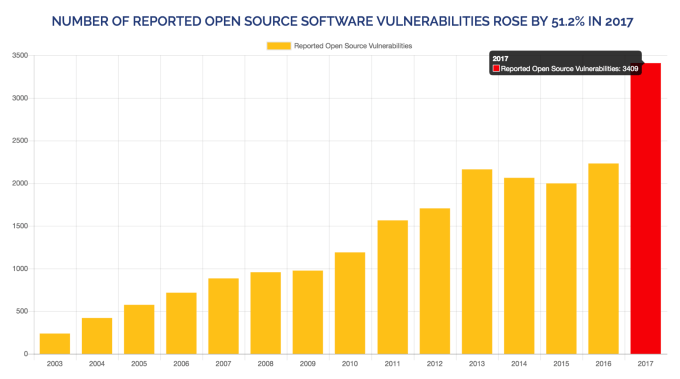
The issue of open source vulnerabilities is a persistent one. Research from WhiteSource found that the number of disclosed open source software vulnerabilities in 2017 rose by over 60 percent over 2016, with 2018 shaping up to be even bigger.

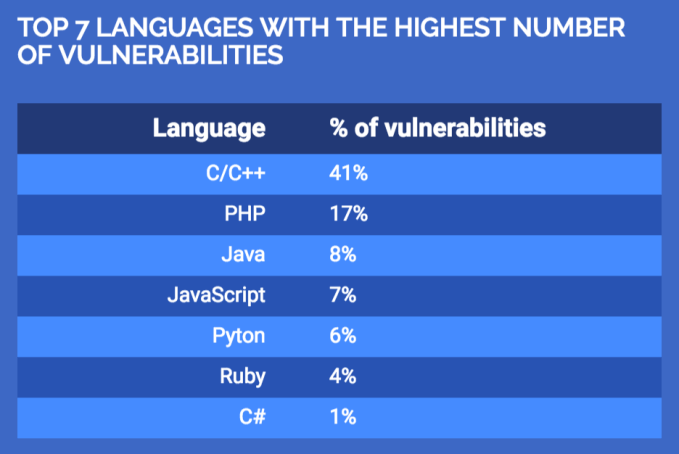
Moreover, the vulnerabilities seem to exist in direction variation to the popularity of the package or computing language being used.

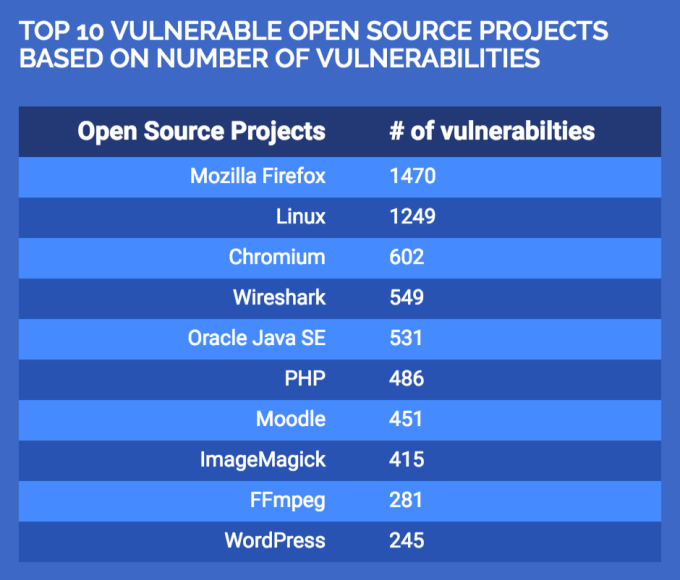
“The more popular an open source project is, the larger its community and the more ‘eyeballs’ it garners from security researchers,” the company noted in a recent report. “With more contributors looking at it, more security and quality issues are discovered and made public every month.” WhiteSource estimates that 7.5 percent of all open source projects are vulnerable because of this, but of the 100 most popular projects, 32% are vulnerable.


“WhiteSource has established the standard for open source security solutions with its strong leadership and breakthrough innovation,” said Martin Angert, Director at Susquehanna Growth Equity, in a statement. “We are excited for join WhiteSource on their journey to help businesses develop better software, faster.”


17 Oct 2018

Applied gets $2M to make hiring fairer — using algorithms, not AI

London-based startup Applied has bagged £1.5M (~$2M) in seed funding for a fresh, diversity-sensitive approach to recruitment that deconstructs and reworks the traditional CV-bound process, drawing on behavioural science to level the playing field and help employers fill vacancies with skilled candidates they might otherwise have overlooked.

Fairer hiring is the pitch. “If you’re hiring for a product lead, for example, it’s true that loads and loads of product leads are straight, white men with beards. How do we get people to see well what is it actually that this job entails?” founder and CEO Kate Glazebrook tells us. “It might actually be the case that if I don’t know any of the demographic background I discover somebody who I would have otherwise overlooked.”

Applied launched its software as a service recruitment platform in 2016, and Glazebrook says so far it’s been used by more than 55 employers to recruit candidates for more than 2,000 jobs. While more than 50,000 candidates have applied via Applied to date.

The employers themselves are also a diverse bunch, not just the usual suspects from the charitable sector, with both public and private sector organizations, small and large, and from a range of industries, from book publishing to construction, signed up to Applied’s approach. “We’ve been pleased to see it’s not just the sort of thing that the kind of employers you would expect to care about care about,” says Glazebrook.

Applied’s own investor Blackbird Ventures, which is leading the seed round, is another customer — and ended up turning one investment associate vacancy, advertised via the platform, into two roles — hiring both an ethnic minority woman and a man with a startup background as a result of “not focusing on did they have the traditional profile we were expecting”, says Glazebrook.

“They discovered these people were fantastic and had the skills — just a really different set of background characteristics than they were expecting,” she adds.

Other investors in the seed include Skip Capital, Angel Academe, Giant Leap and Impact Generation Partners, plus some unnamed angels. Prior investors include the entity Applied was originally spun out of (Behavioural Insights Team, a “social purpose company” jointly owned by the UK government, innovation charity Nesta, and its own employees), as well as gender advocate and businesswoman Carol Schwartz, and Wharton Professor Adam Grant.

Applied’s approach to recruitment employs plenty of algorithms — including for scoring candidates (its process involves chunking up applications and also getting candidates to answer questions that reflect “what a day in the job actually looks like”), and also anonymizing applications to further strip away bias risks, presenting the numbered candidates in a random order too.

But it does not involve any AI-based matching. If you want to make hiring fairer, AI doesn’t look like a great fit. Last week, for example, Reuters reported how in 2014 ecommerce giant Amazon built and then later scrapped a machine learning based recruitment tool, after it failed to rate candidates in a gender-neutral way — apparently reflecting wider industry biases.

“We’re really clear that we don’t do AI,” says Glazebrook. “We don’t fall into the traps that [companies like] Amazon did. Because it’s not that we’re parsing existing data-sets and saying ‘this is what you hired for last time so we’ll match candidates to that’. That’s exactly where you get this problem of replication of bias. So what we’ve done instead is say ‘actually what we should do is change what you see and how you see it so that you’re only focusing on the things that really matter’.

“So that levels the playing field for all candidates. All candidates are assessed on the basis of their skill, not whether or not they fit the historic profile of people you’ve previously hired. We avoid a lot of those pitfalls because we’re not doing AI-based or algorithmic hiring — we’re doing algorithms that reshape the information you see, not the prediction that you have to arrive at.”

In practice this means Applied must and does take over the entire recruitment process, including writing the job spec itself — to remove things like gendered language which could introduce bias into the process — and slicing and dicing the application process to be able to score and compare candidates and fill in any missing bits of data via role-specific skills tests.

Its approach can be thought of as entirely deconstructing the CV — to not just remove extraneous details and bits of information which can bias the process (such as names, education institutions attended, hobbies etc) but also to actively harvest data on the skills being sought, with employers using the platform to set tests to measure capacities and capabilities they’re after.

“We manage the hiring process right from the design of an inclusive job description, right through to the point of making a hiring decision and all of the selection that happens beneath that,” says Glazebrook. “So we use over 30 behavioural science nudges throughout the process to try and improve conversion and inclusivity — so that includes everything from removal of gendered language in jobs descriptions to anonymization of applications to testing candidates on job preview based assessments, rather than based on their CVs.”

“We also help people to run more evidence-based structured interviews and then make the hiring decision,” she adds. “From a behavioral science standpoint I guess our USP is we’ve redesigned the shortlisting process.”

The platform also provides jobseekers with greater visibility into the assessment process by providing them with feedback — “so candidates get to see where their strengths and weaknesses were” — so it’s not simply creating a new recruitment blackbox process that keeps people in the dark about the assessments being made about them. Which is important from an algorithmic accountability point of view, even without any AI involved. Because vanilla algorithms can still sum up to dumb decisions.

From the outside looking in, Applied’s approach might sound highly manual and high maintenance, given how necessarily involved the platform is in each and every hire, but Glazebrook says in fact it’s “all been baked into the tech” — so the platform takes the strain of the restructuring by automating the hand-holding involved in debiasing job ads and judgements, letting employers self-serve to step them through a reconstructed recruitment process.

“From the job description design, for example, there are eight different characteristics that are automatically picked out, so it’s all self-serve stuff,” explains Glazebrook, noting that the platform will do things like automatically flag words to watch out for in job descriptions or the length of the job ad itself.

“All with that totally automated. And client self-serve as well, so they use a library of questions — saying I’m looking for this particular skill-set and we can say well if you look through the library we’ll find you some questions which have worked well for testing that skill set before.”

“They do all of the assessment themselves, through the platform, so it’s basically like saying rather than having your recruiting team sifting through paper forms of CVs, we have them online scoring candidates through this redesigned process,” she adds.

Employers themselves need to commit to a new way of doing things, of course. Though Applied’s claim is that ultimately a fairer approach also saves time, as well as delivering great hires.

“In many ways, one of the things that we’ve discovered through many customers is that it’s actually saved them loads of time because the shortlisting process is devised in a way that it previously hasn’t been and more importantly they have data and reporting that they’ve never previously had,” she says. “So they now know, through the platform, which of the seven places that they placed the job actually found them the highest quality candidates and also found people who were from more diverse backgrounds because we could automatically pull the data.”

Applied ran its own comparative study of its reshaped process vs a traditional sifting of CVs and Glazebrook says it discovered “statistically significant differences” in the resulting candidate choices — claiming that over half of the pool of 700+ candidates “wouldn’t have got the job if we’d been looking at their CVs”.

They also looked at the differences between the choices made in the study and also found statistically significant differences “particularly in educational and economic background” — “so we were diversifying the people we were hiring by those metrics”.

“We also saw directional evidence around improvements in diversity on disability status and ethnicity,” she adds. “And some interesting stuff around gender as well.”

Applied wants to go further on the proof front, and Glazebrook says it is now automatically collecting performance data while candidates are on the job — “so that we can do an even better job of proving here is a person that you hired and you did a really good job of identifying the skill-sets that they are proving they have when they’re on the job”.

She says it will be feeding this intel back into the platform — “to build a better feedback loop the next time you’re looking to hire that particular role”.

“At the moment, what is astonishing, is that most HR departments 1) have terrible data anyway to answer these important questions, and 2) to the extent they have them they don’t pair those data sets in a way that allows them to prove — so they don’t know ‘did we hire them because of X or Y’ and ‘did that help us to actually replicate what was working well and jettison what wasn’t’,” she adds.

The seed funding will go on further developing these sorts of data science predictions, and also on updates to Applied’s gendered language tool and inclusive job description tool — as well as on sales and marketing to generally grow the business.

Commenting on the funding in a statement, Nick Crocker, general partner at Blackbird Ventures said: “Our mission is to find the most ambitious founders, and support them through every stage of their company journey. Kate and the team blew us away with the depth of their insight, the thoughtfulness of their product, and a mission that we’re obsessed with.”

In another supporting statement, Owain Service, CEO of BI Ventures, added: “Applied uses the latest behavioural science research to help companies find the best talent. We ourselves have recruited over 130 people through the platform. This investment represents an exciting next step to supporting more organisations to remove bias from their recruitment processes, in exactly the same way that we do.”


17 Oct 2018

Unifonic, dubbed the Twilio of emerging markets, closes $21M Series A round

Those of you familiar with the incredible rise of Twilio, which came along to utterly disrupt the communications world, will be interested to hear that another player plans to do the same, but this time in the staid and tricky area of emerging markets.

Unifonic, which has been dubbed “the Twilio of emerging markets” has today closed a $21M Series A funding round led by Saudi Technology Ventures (STV), and the emerging market specialist fund Endeavor Catalyst, which is backed by LinkedIn co-founder Reid Hoffman, among others. Other participants include RTF ELM, and Raed Ventures.

At $500M, STV is the largest VC fund in the region, and anchored by the Saudi Telecom Company (STC), the largest telecom company in the Middle East. Former Googler turned VC Abdulrahman Tarabzouni lead this round.

As far as we can tell, the is the largest Series A funding in the history of the Middle East technology sector. Appropriately, it shows the sheer growth in the region and comes on the heels of our recent and highly successful TechCrunch Startup Battlefield MENA in Beirut, as well as the Series C round announced by the “Uber for Doctors” in MENA Vezeeta’s Series C.

The capital will be used by Unifonic to scale the company across the MENA region and globally, and invest in the platform.

Unifonic is similar to Twilio in that it is a B2B cloud communications platform, a space that is sometimes called Communications Platform as a Service (CPaaS).
With 100+ employees spread across nine regional offices, and over 5,000 B2B clients, many of whom are giants in the MENA region, such as Souq.com, Aramex, Al Jazeera, HSBC, Uber, FedEx, Carrefour and others, they are the MENA region’s clear No.1 in this arena.

Started by two brothers – Hassan and Ahmed Hamdan, they were funded 5 years ago by Endeavor since July 2013. They now regularly compete against their European counterpart, MessageBird, which recently raised $60M (led by Accel and Atomico), and their US benchmark, Twilio.

Hassan told me: “Unifonic’s competition in emerging markets are small players that operate in a single country not cross the region like Unifonic. The product suite is designed for both the non-tech-savvy with last-mile tools already built to plug and play, localized to telecom infrastructure, hosted on multiple clouds, geographically in the region, to increase reliability and minimize latency so transactions are processed in milliseconds.”

In a joint statement Reid Hoffman, Linkedin co-founder and chairman of Endeavor Catalyst and Linda Rottenberg, Endeavor’s Co-founder and CEO said: “Endeavor selects and connects the most promising global companies and entrepreneurs with experienced business advisors to help drive growth and economic development around the world. The founders of Unifonic were selected as high-impact Endeavor Entrepreneurs in 2013, and we are thrilled to announce the Endeavor Catalyst fund is now investing in Unifonic alongside STV as the company continues scaling up.”

Why should you care?

Well, this comes on the heels of the first tech wave in the MENA region (culminating in Amazon’s acquisition of e-commerce player Souq.com last year, and large funding rounds for ride-hailing leader, Careem), this funding represents that Middle East investors are now starting to bet on B2B. It’s also STV’s 3rd publicly announced investment, as they previously invested co-led Careem’s Series D in December 2016 and last month led Vezeeta’s Series B.

As I wrote last year, Middle East startups are growing fast, and that’s even before the flying taxis arrive.

17 Oct 2018

Cognata raises $18.5M as race to deploy autonomous vehicles quickens

Cognata has raised $18.5 million in a funding round led by Scale Venture Partners, fresh capital that the Israeli autonomous simulation startup will use to meet demand for technology that will help companies speed up the deployment of self-driving vehicles.

Cognata founder and CEO Danny Atsmon told TechCrunch the company, which has 28 employees, will use the funds to double its staff and expand commercial operations. Cognata wants to increase its international presence, specifically into the U.S., Germany, China and Japan, he added.

Existing investors Emerge, Maniv Mobility, and Airbus Ventures as well as newcomer Global IoT Technology Ventures also participated in the round.

“All of the companies that are working on autonomous vehicles in the world identify simulation as a key technology to bring autonomous vehicles to market,” Atson told TechCrunch.

Cognata recreates cities in its 3D simulation platform using a combination of AI, deep learning and computer vision to give customers a variety of testing scenarios that simulates real-world test driving. Many autonomous vehicle companies use simulation because it allows them to test edge cases — those unlikely and unexpected scenarios that pop up while driving —without the risk of an accident. 

The automotive simulation platform pulls in layers of data to help build these virtual environments. It starts with recreating real cities, then adds AI-based traffic models to simulate real-world conditions, as well as data from the vehicle’s sensors.

Audi’s self-driving unit Autonomous Intelligent Driving signed a multi-year partnership earlier this year to use Cognata’s simulation platform to help it bring its self-driving vehicles to market faster. That partnership validates a product Cognata spent 2.5 years to bring to market, Atson said, adding with the additional capital “there will be more of these kinds of announcements” in the future.

As part of this funding round, Rory O’Driscoll, a partner at Scale Venture Partners will join Cognata’s board.

“As autonomous vehicles get closer to market, automakers must have a comprehensive simulation solution in place to meet the stringent training demands,”  O’Driscoll said in a statement.  “Cognata’s simulation platform is a critical component for the development of self-driving vehicles and the future of the industry.”

Cognata raised $5 million in 2017 from Airbus Ventures, Emerge and Maniv Mobility.

17 Oct 2018

Smule raises $20M, with plans to expand India operations

App maker turned music social network Smule has raised another $20 million. The latest round follows a $54 million raise in May of last year, led by Tencent, intent on helping the company expand Asia operations. This time out, funding is arriving via Times Bridge, the VC wing of India media conglomerate The Times Group.

The “strategic investment” comes as Smule pushes to expand its footprint in India, currently the second largest of the app maker’s international markets. Engaging there requires building a platform for an utterly massive and multi-lingual market.

“Building the Smule brand in India is a long term process, but a critical facet of realizing our vision to connect the world through music,” CEO and co-founder Jeffrey Smith told TechCrunch. “We are therefore thrilled to expand our reach in India through this significant partnership with Times Bridge.”

The round marks the first full social media partnership for Times Bridge, which finds the organization leveraging connections with local artists and helping to provide targeted marketing for Smule.

“Times Bridge’s mission is to bring the world’s best ideas to India and share India’s best insights with the world,” Times Bridge CEO Rishi Jaitly says in a statement. “Smule is a deeply original, bold idea with a mission of changing the way the world experiences music. Our investment will advance Smule’s music mission across the Indian subcontinent and unlock the creativity of many millions along the way. We are delighted to be working with a partner who approaches India with the empathy, conviction and optimism that the Indian market warrants.”