Year: 2018

17 Oct 2018

Memory raises $5M to bring AI to time tracking

Memory, a startup out of Norway and maker of time tracking app Timely, has raised $5 million in further funding. Leading the round is Concentric, and Investinor, with participation from existing investor SNÖ Ventures. The company had previously raised $1 million in 2016 from 500 Startups, and SNÖ.

Founded by Mathias Mikkelsen, a designer by background and who I understand turned down a job offer at Facebook to try his hand at startup life, Memory is applying what it describes as AI and digital technology to create various tools to help solve “the abuses of time” that workers typically face in the modern workplace. The first of those abuses being tackled is the monotonous and time-consuming task of time tracking and filing time sheets — a meta problem if there ever was one.

“The problem we’re trying to solve is with time tracking, the most common currency of work that exists,” Mikkelsen tells me. “The problem is that people find it extremely painful to do and thus do it incorrectly. For example, what did you do last Friday? How long did it take? Humans are not built to remember that kind of detail and we shouldn’t be doing it. Harvard Business Review estimates that U.S. companies loose billions of dollars per day because of incorrect time tracking, so we think the potential is massive”.

The resulting product, dubbed Timely, is billed as a fully automatic time tracking tool. Powered by “AI”, it automatically records everything employees work on and then claims to create accurate time sheets on their behalf.

“We solve it with tons of data and machine learning,” says Mikkelsen. “We have built an ML model (recurring neural net) that literally tracks, completely privately and securely, everything you do in life. Files you work on, locations, websites, calendar, email, etc. Then we analyse all of that, make sense of it and automatically create a timesheet for you. We round up the time, choose projects, tags, all of it. It matches your individual pattern and the only thing our customers have to do is to hit an Accept button and you’re done with your timesheet”.

Mikkelsen says that Timely is currently used by more than 4,000 paying businesses across 160 countries, and that having created a complete “virtual memory” of time data, the Oslo startup is developing new tools to improve the “quality of time” and help businesses use time more effectively. As part of this effort, Memory will use the new funding to double its current 30-person team. It also plans on refining Timely’s AI model and to accelerate international growth.

17 Oct 2018

European late-stage FinTech startups get a boost with new Corviglia fund

In a boost to late-stage funding for FinTech startups looking to scale-up without having to leave Europe, what claims to be the largest growth equity fund for Fintech in Europe launches today.

The Corviglia Capital Fund will be deployed from Luxembourg and has secured $250M as a first closing for its first three years of operations, with the aim being to raise a total of $500M.

The fund has been started by two former fund managers Petr Šmída and Cezary Smorszczewski, and is a geographically agnostic, long-term investor in late-stage fintech companies. It will make minority investments with tickets ranging from $10M to $50M.

Šmída said banking and financial services are being disrupted by FinTech startups, so they “decided to set up Corviglia Capital Fund to find those very entrepreneurs and invest in their growth.”

Šmída previously co-founded ENERN, an Eastern European/DACH venture capital firm which has invested in 20 tech companies via three different funds since its founding. Prior to that, he worked in banking. Smorszczewski has previously held senior positions at a number of major Polish banks.

17 Oct 2018

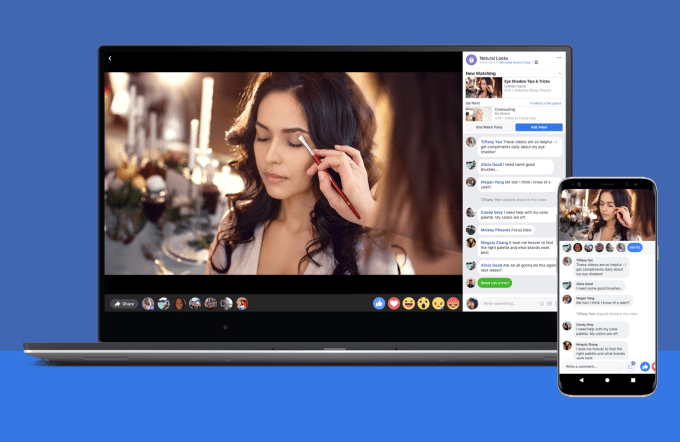
An interactive MTV Real World is coming to Facebook Watch

The world’s first hit reality show “The Real World” is being reimagined for Facebook Watch 26 years after it debuted on cable. Come Spring 2019, fans will get a chance to vote on who’ll join as the final cast member and connect with the housemates through Facebook Watch Party’s synchronized viewing chat rooms as they “stop being polite and start getting real”.

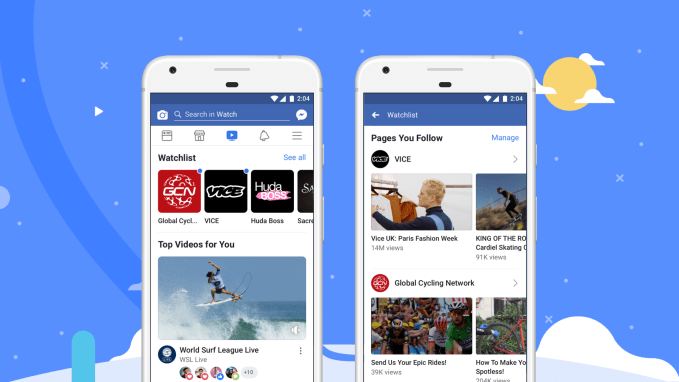
Facebook’s first truly tent-pole show for its Watch video hub could lure in viewers after a lackluster slate of mostly no-name shows launched alongside the feature in August 2017. But it’s starting to gain momentum, as 50 million people now spend at least 1 minute per month on Watch, and total Watch view time is up 14X since the start of 2018. For comparison, over 18 Snapchat Shows have over 10 million viewers per month. Users who do come to Facebook Watch spend 5X longer watching than on spontaneously discovered News Feed videos, which seems to have emboldened it to invest more in Watch content.

Facebook is hoping to outcompete YouTube Originals and Snapchat Discover’s Shows to win the mid-length social video market and the landslide of ad dollars shifting away from TV commercials.

As I wrote recently, there’s already plenty of user generated content to consume on these platforms, so the real opportunity is in super-premium shows that stand firmly apart from what litters feeds and Stories. While it’s unclear how much Facebook paid for the Real World, it likely didn’t come cheap,  but now it has arguably the highest profile show of any of the platforms.

Facebook’s partnership with MTV and Real World-creator Bunim/Murray Productions comes as part of a slew of original video content announcements revealed today at the MIPCOM TV industry trade show.

The [Business] INSIDER original game show on Facebook Watch called Confetti will expand internationally — curiously without INSIDER’s help. Facebook tells TechCrunch it will work with local partners in international markets to create versions of the HQ Trivia-style live video game show where players compete through their phones to win cash prizes. EMEA, APAC and LATAM editions of Confetti will launch by the end of this year.

Facebook Watch will also launch The World’s Most Amazing Dog, an interactive global competition show. In partnership with The Dodo, the show will spotlight top dogs and their owners from around the world.

Now that Facebook’s ad breaks are running in 25 countries, it’s able to get serious about monetizing Watch and recouping its content investments. Facebook has been paying up front for these shows but hopes that ad breaks could wean creators off its cash and create sustainable businesses based on Watch. But with today’s Wall Street Journal report that Facebook underreported the scale of video ad view time metrics bug that inflated measurements years ago, it may face additional skepticism that Watch is worth studios’ investment.

But again, it’s the name brand of The Real World that could change Watch’s trajectory. Facebook has signed on for three different one season runs of 12 episodes of the show localized for the US, Mexico, and Thailand.

“The Real World made history as the world’s first original reality show and trailblazing social experiment — and we’re thrilled to reboot the show for today’s audiences — representing and amplifying the real life, real people, real places and real social tensions of each country” says Matthew Henick, Facebook’s Head of Content Planning & Strategy. It poached Henick from BuzzFeed earlier this year to bring some experienced leadership to its intersection of traditional studio content and the smallest screen.

Last week Snapchat announced 12 original shows including two produced by Bunim/Murray. Yet with the ephemeral social apps losing users as well as over $300 million per quarter, it was only able to secure new and unknown docuseries like Endless Summer and Growing Up Is A Drag.

Despite Facebook jamming the Watch tab into its main app’s navigation bar, many users have ignored it. They already get short-form clips in the News Feed, longer web shows on YouTube, and full-length series on Netflix and Amazon Prime Video. It will require more big bets like The Real World to convince users that Watch is where they want to relax.

17 Oct 2018

Roborace to replace F1 racing drivers with robots at Disrupt

Formula E is so 2017. This year, it's all about Roborace, an upcoming F1-style competition. And the big new thing is that it's all about self-driving cars. I'm excited to announce that Roborace CEO Lucas DiGrassi will come to TechCrunch Disrupt Berlin to talk about this crazy idea.

DiGrassi may sound like a familiar name already as he's also a racing driver. He has competed in Formula One, Formula E and the World Endurance Championship. He’s also the current Formula E Champion. Clearly, DiGrassi is much better at parallel parking than I’ll ever be.

Racing has always been a great way to break new grounds for car manufacturers. Many of the technologies that you can find in your current car were first developed for endurance and Formula One competitions.

And it seems logical that the next radical step involves removing the driver altogether. Roborace will be a competition with self-driving cars that run using electric motors. Cars will compete on the Formula E tracks.

Teams will share the same chassis, powertrain, sensors and Nvidia Drive PX 2 system on a chip. You can find radars, lidars and other sensors on each car. But, of course, each team will be able to customize their AI-powered algorithm to beat competitors.

Right now, Roborace is testing the racing format alongside Formula E events. Sometimes, it involves putting an actual human being in a development car called a “DevBot”.

I’m incredibly excited about meeting DiGrassi and talking about this new competition. And if you want to meet him too, you should buy your ticket to Disrupt Berlin to listen to this discussion and many others. The conference will take place on November 29-30.

In addition to fireside chats and panels, like this one, new startups will participate in the Startup Battlefield Europe to win the highly coveted Battlefield cup.

Lucas DiGrassi

CEO, Roborace

Lucas DiGrassi is the CEO of Roborace, the world's first competition for human and artificial intelligent racing, making autonomous technology exciting and inspirational for a new generation of spectators.

Lucas is also a racing driver who has competed in Formula One, Formula E and the World Endurance Championship and is the current Formula E Champion.

He has been instrumental in building and growing the Formula E series over the past six years having joined as Special Advisor for the FE CEO Alejandro Agag back in 2012.

He is now bringing his business experience and extensive knowledge of racing, to Roborace, helping grow it into an established competition and cooperation of human and AI intelligence.

17 Oct 2018

Samsung acquires network analytics startup Zhilabs to help its transition to 5G

Samsung Electronics is betting that acquiring Zhilabs, a real-time networks analytics startup based in Barcelona, will ease its transition from 4G to 5G technologies. Financial details of the deal, which was announced today, have not been disclosed. Zhilabs will be fully owned by Samsung, but it will continue to operate independently under its own management.

The acquisition of Zhilabs is part of Samsung’s initiative, announced in August, to invest 25 trillion won (about $22 billion) in businesses working on AI, 5G, components for self-driving vehicles, and biopharmaceutical technologies.

In a statement, Youngky Kim, Samsung Electronic’s president and head of networks business, said “5G will enable unprecedented services attributed to the generation of exponential data traffic, for which automated and intelligent network analytics tools are vital. The acquisition of Zhilabs will help Samsung meet these demands to assure each subscriber receives the best possible service.”

Founded in 2008, Zhilabs’ products are used by customers including Hewlett Packard Enterprise, Vodafone, and Telefonica to analyze and test network performance in real-time. Because its solutions allow service issues to be automatically detected and fixed, Zhilabs’ AI-based automation will help Samsung launch new services related to the industrial Internet of Things and smart cars.

17 Oct 2018

Scribd and The New York Times announce a joint $12.99 subscription

If you want to subscribe to both Scribd and The New York Times, you can now do it for a combined price of $12.99 per month — particularly impressive when you consider that a standard NYT digital subscription costs $15.99 on its own.

You sign up and pay through Scribd, but once you do, you’ll get separate logins. Those will give you full access to The Times’ website and apps, as well Scribd’s library of ebooks, audiobooks and more. (One caveat: You’ll need to be a new subscriber to both services.)

The two companies have worked together in the past, both on a student subscription and by incorporating selected Times articles into the Scribd service. This, however, looks like their biggest partnership yet.

When asked about the price, The Times’ vice president of customer experience and retention Dork Alahydoian said simply, “We felt the need to be competitive with other major services.”

He added that The Times is hoping use these kinds of bundles to find and retain new subscribers. However, it hasn’t done many of these partnerships in the past — basically, a promotion with Spotify is the only one in the United States.

“We definitely needed to make sure it was the right partner, the right audience, the right model,” Alahydoian said. In his view, Scribd was a good fit because it attracts a similar audience as The Times, namely educated readers who are “willing to pay for content.”

As for whether The Times might do more deals like this in the future, he said, “We’re always looking for the right partnership. It’s about making sure it’s an impactful relationship.”

Scribd, meanwhile, has been experimenting with subscription bundles of its own. In this case, CEO Trip Adler said he’s hoping to provide “everything you could want to read in one subscription.”

“By having such a great offering, we think we can really expand the number of people who pay for news and for books and for written content,” he added.

17 Oct 2018

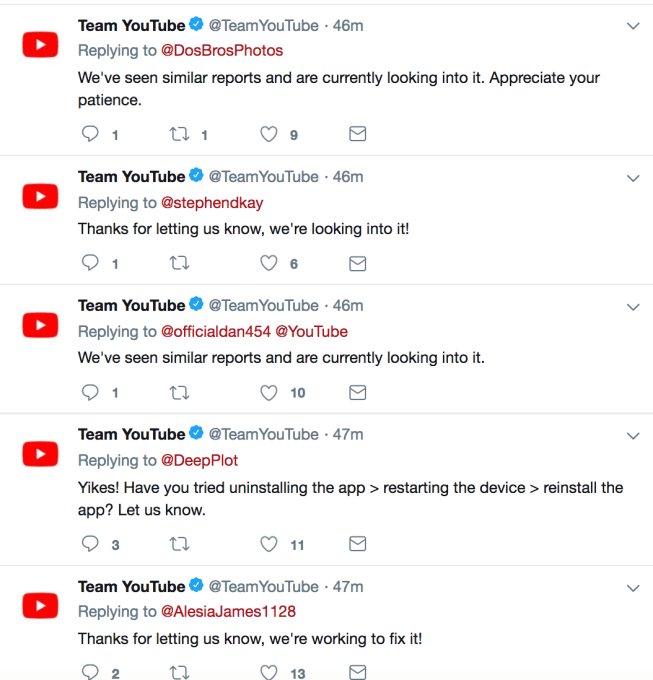
YouTube has been down for more than an hour

No, it’s not just you. As of Tuesday evening Pacific Time, YouTube was down for many users. The outage appears to have begun some time around 6:15 p.m., making this a pretty long outage for such a major site.

The company is well aware of the issue and tweeting its updates. The account began responding to tweets reporting the outage about an hour ago and has painstakingly replied to many, many reports from users since.

YouTube doesn’t experience downtime very often, making Tuesday’s outage pretty notable. We’ve reached out to YouTube about the cause of the outage and will update this story when we learn more.

16 Oct 2018

Blockchain media startup Civil is issuing full refunds to all buyers of its cryptocurrency

Many doubted The Civil Media Company‘s ambitious plan to sell $8 million worth of its cryptocurrency, called CVL. 

The skeptics, as it turns out, were right. Civil’s initial coin offering, meant to fund the company’s effort to create a new economy for journalism using the blockchain, failed to attract sufficient interest. The company announced today that it would provide refunds to all CVL token buyers by October 29.

Civil’s goal was to sell 34 million CVL tokens for between $8 million and $24 million. The sale began on September 18 and concluded yesterday. Ultimately, 1,012 buyers purchased $1,435,491 worth of CVL tokens. A spokesperson for Civil told TechCrunch an additional 1,738 buyers successfully registered for the sale, but never completed their transaction.

Civil isn’t giving up. The company says “a new, much simpler token sale is in the works,” details of which will be shared soon. Once those new tokens are distributed, Civil will launch three new features: a blockchain-publishing plugin for WordPress, a community governance application called The Civil Registry and a developer tool for non-blockchain developers to build apps on Civil.

ConsenSys, a blockchain venture studio that invested $5 million in Civil last fall, has agreed to purchase $3.5 million worth of those new tokens. The purchase is not an equity; all capital from the token sale is committed to the Civil Foundation, an independent nonprofit initially funded by Civil that funds grants to the newsrooms in Civil’s network.

In a blog post today, Civil chief executive officer Matthew Iles wrote that the token sale failure was a disappointment but not a shock. Days prior, he’d authored a separate post where he admitted things weren’t looking good.

“This isn’t how we saw this going,” Iles wrote. “The numbers will show clearly enough that we are not where we wanted to be at this point in the sale when we started out. But one thing we want to say at the top is that until the clock strikes midnight on Monday, we are still working nonstop on the goal of making our soft cap of $8 million.”

A recent Wall Street Journal report claimed Civil had reached out to The New York Times, The Washington Post, Dow Jones and Axios, among others, but failed to incite interest in its token.

Separate from its token sale, Civil has inked strategic partnerships with media companies like the Associated Press and Forbes, both of which confirmed to TechCrunch today that the failed token sale doesn’t impact their partnerships with Civil. 

Forbes became the first major media brand to test Civil’s technology when it announced earlier this month that it would experiment with publishing content to the Civil platform. As for the AP, it granted the newsrooms in Civil’s network licenses to its content. 

Civil, of course, isn’t the only blockchain startup targeting journalism. Nwzer, Userfeeds, Factmata and Po.et, which was founded by Jarrod Dicker, a former vice president at The Washington Post, are all trying their hand at bringing the new technology to the content industry.

Which, if any, will actually find success in the complicated space, is the question.

16 Oct 2018

Google tweaks Android licensing terms in Europe to allow Google app unbundling — for a fee

Google has announced changes to the licensing model for its Android mobile operating system in Europe,  including introducing a fee for licensing some of its own brand apps, saying it’s doing so to comply with a major European antitrust ruling this summer.

In July the region’s antitrust regulators hit Google with a recordbreaking $5BN fine for violations pertaining to Android, finding the company had abused the dominance of the platform by requiring manufacturers pre-install other Google apps in order to license its popular Play app store. 

Regulators also found Google had made payments to manufacturers and mobile network operators in exchange for exclusively pre-installing Google Search on their devices, and used Play store licensing to prevent manufacturers from selling devices based on Android forks.

Google disputes the Commission’s findings, and last week filed its appeal — a legal process that could take years. But in the meanwhile it’s making changes to how it licenses Android in Europe to avoid the risk of additional penalties heaped on top of the antitrust fine.

Hiroshi Lockheimer, Google’s senior vice president of platforms & ecosystems, revealed the new licensing options in a blog post published today.

Under updated “compatibility agreements”, he writes that mobile device makers will be able to build and sell Android devices intended for the European Economic Area (EEA) both with and without Google mobile apps preloaded — something Google’s same ‘compatibility’ contracts restricted them from doing before, when it was strictly either/or (either you made Android forks, or you made Android devices with Google apps — not both).

“Going forward, Android partners wishing to distribute Google apps may also build non-compatible, or forked, smartphones and tablets for the European Economic Area (EEA),” confirms Lockheimer.

However the company is also changing how it licenses the full Android bundle — which previously required OEMs to load devices with the Google mobile application suite, Google Search and the Chrome browser in order to be able to offer the popular Play Store — by introducing fees for OEMs wanting to pre-load a subset of those same apps under “a new paid licensing agreement for smartphones and tablets shipped into the EEA”.

Though Google stresses there will be no charge for using the Android platform itself. (So a pure fork without any Google services preloaded still wouldn’t require a fee.)

Google also appears to be splitting out Google Search and Chrome from the rest of the Google apps in its mobile suite (which traditionally means stuff like YouTube, the Play Store, Gmail, Google Maps, although Lockheimer’s blog post does not make it clear which exact apps he’s talking about) — letting OEMs selectively unbundle some Google apps, albeit potentially for a fee, depending on the apps in question.

“[D]evice manufacturers will be able to license the Google mobile application suite separately from the Google Search App or the Chrome browser,” is what Lockheimer unilluminatingly writes.

Perhaps Google wants future unbundled Android forks to still be able to have Google Search or Chrome, even if they don’t have the Play store, but it’s really not at all clear which configurations of Google apps will be permitted under the new licensing terms, and which won’t.

“Since the pre-installation of Google Search and Chrome together with our other apps helped us fund the development and free distribution of Android, we will introduce a new paid licensing agreement for smartphones and tablets shipped into the EEA. Android will remain free and open source,” Lockheimer adds, without specifying what the fees will be either. 

“We’ll also offer new commercial agreements to partners for the non-exclusive pre-installation and placement of Google Search and Chrome. As before, competing apps may be pre-installed alongside ours,” he continues to complete his trio of poorly explained licensing changes.

We’ve asked Google to clarify the various permitted and not permitted app configurations, as well as which apps will require a fee (and which won’t), and how much the fees will be, and will update this post with any response.

The devil in all those details should become clear soon though, as Google says the new licensing options will come into effect on October 29 for all new (Android based) smartphones and tablets launched in the EEA.

16 Oct 2018

10 lessons from Marketo’s growth to a multi-billion-dollar exit

With Adobe’s acquisition of Marketo, I have been reflecting on what an amazing and pioneering company Marketo has been since it was founded in 2006. There are very few tech companies that have defined a new category, executed a successful IPO, been acquired by a private equity firm for more than four times the company’s initial IPO market value and now, at a price of $4.75 billion, become the largest acquisition of a world-class company like Adobe.

The credit for this dream-come-true Silicon Valley company goes to the co-founding team of Phil Fernandez, Jon Miller and David Morandi, who together built an amazing customer-first product, defined a breakthrough category and launched a marketing automation company that continues to delight and amaze partners and customers alike.

I had the unique pleasure of meeting the founding team in 2006 when they shared their vision and passion for marketing automation. At the time, all they had was a PowerPoint deck. But it was clear then that they had a special idea and the unique capability to build a breakthrough product to deliver on their vision.

In all honesty, I couldn’t know how truly extraordinary the company would become. Thankfully, I was lucky enough that the team chose me and my former partner Bruce Cleveland as their first investor and also was fortunate to serve on the board for 10 years. Most recently, I was thrilled that Phil joined me at Shasta. One of the qualities I admire most about Phil — which was apparent all those years ago and continues to this day — is that he never stops iterating to do things better or faster or more efficiently or more thoughtfully. Phil always carried a notebook that said “THINK” on the cover, which epitomizes how he approaches his work.

Phil recently shared his “10 Things I’d Do Even Better If I Did It Again” presentation with our team and our founder/CEO community. We believe his insights are “10 Must-Dos” for today’s software entrepreneurs. It’s hard for entrepreneurs to know the trade-offs required when making the tough decisions — especially early on ­– but what follows is what I learned from Phil, and the key takeaways from his talk that I believe can help more founders create iconic companies with lasting value. (Note: Click here to view excerpts of Phil’s talk.)

Have one person own revenue

If your company is like every other company, there are two executives — vice president of Sales and the chief marketing officer — who are regularly locking horns because they are each tasked with taking different approaches to the same goal of increasing revenue. How do you solve this?

Hire a chief revenue officer (CRO) who can see both perspectives, plus give the context that sales and marketing are missing. This seat understands the big picture and doesn’t belong in marketing or sales. The CRO needs to talk strategically about life cycle revenue — across the customer journey. She or he should be a storyteller who can look at the numbers and the models and explain it all in plain English to the executive team so that everyone understands. Like a chief people officer, you’re going to have to spend on a CRO — but it’s worth it in the long run.

Hire a chief people officer (CPO) ASAP

Your company needs a leader of “all things people” who can make sure your workplace is welcoming, diverse and responsive to employee needs. For the staff to have trust, this person needs to be in a role that is empowered by the organization and not just by the CEO. Hire the most senior, overqualified HR executive into your business as early as possible — Series A level — and have him or her report directly to the CEO. By constantly listening to people — which is really hard when you’re working really hard — the CPO will help build your culture and be the eyes and ears for the CEO. Investing early in HR will come back to you tenfold through employee retention, team morale and an enviable culture.

Give back when it makes no sense

The day you think you’ve got to get a product release out the door and there’s no time to do anything else is the day you get out and give back in whatever way makes sense for your company and your community. Give employees time off to volunteer. Pick a cause for your company to support. Or, consider starting a charitable foundation with pre-public stock. It will create a spirit and energy that will give back to your team five or 10 times whatever it is costing you.

Charge your first customer

Phil personally wrote a stupid thing on their website that said, “At Marketo, your success doesn’t have a price.” That copy stayed up for years as a testament to how customer-centric they were. They were proud that they weren’t charging for services. But as Phil said, that was a big mistake; they should have been charging from day one.

When you’re a startup, short-range thinking is seductive, but long-range thinking is powerful.

There really isn’t any friction about asking customers to pay for services. If you say, “Look, this product is great. It’s going to transform your business but it’s not easy and it will cost money,” they will spend it. Feature-level sales is a great way to justify why you are charging what you are charging, and it keeps customers renewing services and adding more features as their business grows and changes. To make this strategy work, gear your sales metrics toward incremental increases over time­ instead of pushing sales reps to sell as much as they can all at once. Customers will pay for quality products that meet their needs.

Build a world-class Rev Ops/Sales Enablement team

You need a VP-level Rev Ops/Sales Enablement executive by the time your company reaches $2-3 million in revenue. That individual must think holistically about how revenue is happening, from the early lead in the door and the sale to renewal and the up-sale; understanding full lifetime value and thinking about it in a modeling sense. She or he needs to be a storyteller — one who can look at the numbers, look at the models and then explain it in plain English to the executive team. That’s gold.

Focus on continuous ARPU expansion

Today, to increase ARPU (average revenue per user), you need to design feature-level packaging every bit as much as how you design product functionally. The same people on product management ought to be thinking together with Rev Ops and Sales about how you dish out the product, how you launch the pieces, how you turn on pieces and how you enable pieces. It becomes a part of the art of product design as much as the art of revenue design — and that’s where these two rules of thought really come together. Basically, you need to design an expansion pass.

Incubate new product initiatives

Marketo failed in defining a multi-product company, from when it was $30 million a year to when it was $300 million a year. If you’re going to bring a second product line into the company — whether it’s organic or inorganic — it needs to be incubated. It needs to have its own dedicated sales team and its own separate quotas. If you’re thinking about becoming a multi-product company, do not pass Go, do not collect $200; go read Geoffrey Moores’ Zone to Win, the only business book Phil has ever recommended.

Pursue constant technology renewal

The pace at which tech is moving and the competitive advantage that new tech is providing over old tech has never been like this during the past 35 years. Today, you need someone that’s charged with thinking not about product but about the future. You need to value technical currency. If you’re three years old on your technology and a new company enters your market — the degree of agility, pace and performance the new entrant has in running circles around your company will win over a five-year cycle. Every time.

Always be seeking more TAM

No matter how good your initial tenure is, no matter how good it feels, no matter how amazing you see your company, as the CEO, as a leader, have a Plan B. Know what’s next, know where you’re going next and make sure you’re always talking about it. Be absolutely zealous about ensuring you know the next piece of TAM you’re going to go after. Think about what’s going to happen if you have more money; what would you do next? Give yourself that opportunity to dream, but make it real, make it defensible.

Watch the clock during scale up

When you’re a startup, short-range thinking is seductive, but long-range thinking is powerful. Always be watching the time. The tension between operating leverage and scale-up investment is really dangerous. At Marketo, they got to it late and their growth slowed a little too much. Live in the real world and focus on cash and on making the investments so you have the capacity when you need it. Have a long-range planning process and understand the day when you’ll need $2 million of ramp capacity. Don’t let the tyranny of a seductive short-range model triumph over what the real world is telling you about the dynamics of growing the business. Understand what it takes to really scale.