Year: 2018

16 Oct 2018

Netflix shares are up after the streaming service adds nearly 7M new subscribers in Q3

After a disappointing second quarter, Netflix is back in Wall Street’s good graces. The company just released its third quarter earnings report, and as of 5:30pm East Coast time, the stock is up 12 percent in after hours trading.

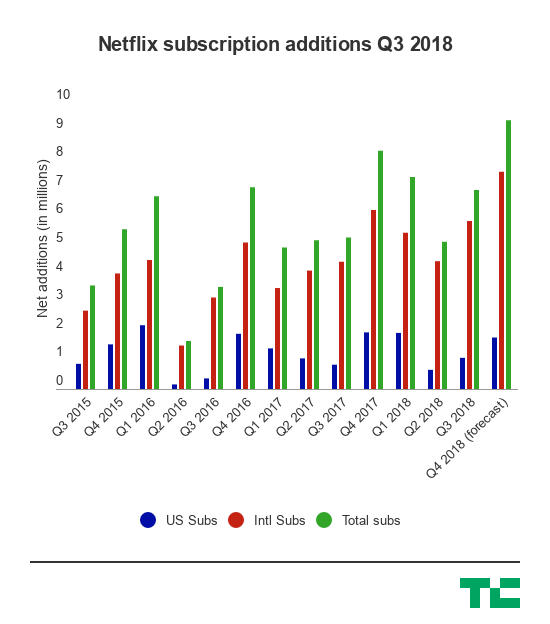
The most important number here is subscriber growth, and that’s where Netflix came in way ahead of expectations, with 6.96 net additions, compared to the 5.07 million that analysts predicted. The service now has a total of 137 million members, and 130 million paying members.

The company also reported earnings of 89 cents per share on revenue of $4 billion — analysts had predicted EPS of 68 cents.

In addition to reporting on the latest financials, Netflix’s letter to shareholders also offers an update on its original content strategy. It distinguishes between two different types of Netflix Originals — the ones like “Orange Is The New Black,” where Netflix gets the first window for distribution, and others like “Stranger Things,” where it actually owns the content.

The company says:

Today, we employ hundreds of people in physical production, working on a wide variety of owned titles spread across scripted and unscripted series, kids, international content, standup, docs and feature films from all over the world. To support our efforts, we’ll need more production capacity; we recently announced the selection of ​Albuquerque, New Mexico​ as the site of a new US production hub, where we anticipate bringing $1 billion dollars in production over the next 10 years and creating up to 1,000 production jobs per year. Our internal studio is already the single largest supplier of content to Netflix (on a cash basis).

Netflix subscription adds Q3

Netflix also says romance has been big recently, thanks to its “Summer of Love” slate of original films, which have been watched by more than 80 million accounts. Apparently “To All The Boys I’ve Loved Before” did particularly well, becoming one of Netflix’s most-watched original films, “with strong repeat viewing.”

The service plans to release “Gravity” director Alfonso Cuarón’s new film “Roma” in December, which has already been getting rave reviews at film festivals. While Netflix’s original movies generally have a minimal presence in theaters, the company says “Roma” (like Paul Greengrass’ “22 July”) will be released in more than 100 screens worldwide — not a blockbuster rollout, but not a perfunctory release, either.

The company is forecasting the addition of 9.4 new members in the fourth quarter.

16 Oct 2018

Passport, a customer service company focused on shipping, has raised $3 million in seed funding from some notable names

Founders building a brand today are largely relying on new infrastructure to do it, though they’re still heavily reliant on legacy carriers like FedEx and DHL when it comes to international shipping. In fact, prohibitively high prices, along with not a lot of support or tools, are a few reasons why more American products aren’t shipped abroad. Many startups especially decide it’s simply not worth it.

Enter Passport, a 1.5-year-old, San Francisco-based startup that sees an opportunity to make it easier for brands to reach far-flung customers and that has raised $3 million in seed funding toward that end. Among its backers is Resolute Ventures; Precursor Ventures; Product Hunt cofounder Ryan Hoover; Girlboss founder Sophia Amoruso; and April Underwood, the chief product officer of Slack.

What piqued investors’ interest? The team, for starters, including cofounder and COO Aaron Schwartz, who previously founded his own e-commerce company (Modify Watches) and CEO Alex Yancher, who, among other things, cofounded a smart fridge kiosk company called Pantry that was acquired. The two have some experience in moving packages from one point to another; they also know the pain of dealing with lost and delayed packages.

The company is also “asset light,” which investors typically like. Indeed, the company is largely a customer service business focused on shipping globally. How it works: one of its customers — let’s take Native Deodorants — will hold its inventory in a third party logistics warehouse. In Native’s case, it’s a Connecticut company called Fulfillment Works, and Fulfillment Works slaps a label on Native’s packages that have been created by Passport, then gets the packages ready for pickup.

After that, Passport arranges for a daily pickup of all of Native’s internationally bound parcels, working through a third-party freight company like Old Dominion or FedEx Freight. That company brings the parcels to a consolidation point, where the parcels are sorted by country and final mile. After that, the Canada parcels, say, are sent on a truck to the border and perhaps injected into the Canadian Postal system, or they’re flown to Australia on a Qantas flight and shipped out to the recipient via the Australian Post. Passport then acts as a reference point so that if a customer has any questions about his or her package, they are fielded by Passport.

It doesn’t sound like rocket science. All the same, in an age where consumer expectations are higher than ever when it comes to at-home delivery, an aggregator that connects all the pieces to provide a better customer experience may well prove worth it to some brands. Indeed, in addition to Native, others of Passport’s early customers include the men’s outfitter Shinesty, the backpack maker ISM, the socks manufacturer Bombas, and the clothing company Betabrand.

We were in touch yesterday with Yancher and Schwartz to learn more.

TC: How did you identify this particular sliver of industry as a problem worth tackling?

AY: I ran a personal shopping service — Lynks.com — that helped people abroad buy products from the U.S., and I saw that demand for American goods is booming abroad. In fact, half of a brand’s Instagram followers are from abroad, but only 10 percent of its sales are. Despite the boom in cross-border, current international shipping options are lacking a lot of what a merchant needs to successfully sell and ship abroad.

This pain doesn’t just exist for individual brands alone but also for third party logistics facilities — the operations companies that partner with brands and that receive, warehouse and fulfill customer orders.  They have incredible buying power for shipping customers, and yet they’re also unsatisfied.

TC: It sounds like your differentiator is customer service, but couldn’t another startup come in and strike relationships with international carriers and do precisely the same thing?

AY: Shipping a package internationally is complicated. Building a consistent experience across hundreds of partners with different transit times expectations, technical backends and terms and conditions requires technological as well as logistical expertise. I’ve spent years stringing together custom shipping routes. This isn’t something you just jump into, there’s a ton of nuance into how you work with global posts and private carriers.

What we do differently is embed customer support via Intercom on the tracking page, which is where consumer anxiety happens. Anyone can offer customer experience, but for international shipping, it’s pretty darn hard. You have to get detailed data from a bunch of carriers. You also have to know what the “exceptions” are. We automate a lot of the support behind the scenes, which has taken a year to get going.

We also offer proactive notifications when door tags are left, so a customer can follow-up directly with their local carrier and packages aren’t set back to the U.S.; we set up direct Slack channels with brands in order to help their own customer experience teams deal with any other questions about international shipping; and we do in-shopping-cart integrations, like a fully landed cost calculator, so consumers know exactly what they are paying for an item and won’t get hit with a “your item is held at customs.”

TC: Which international carriers are you working with, and do you have any kind of exclusive deals with them?

AS: We ship to 195 countries around the world and use a different last mile provider in each country and use a variety of trucks (to Canada and Mexico) and air transport partners to get parcels all over the world. In total we work with over 300 carriers and posts. We don’t have exclusive deals on the carrier side of the business.

TC: How do you price packages? How much more do you mark them up in exchange for the hand-holding you provide?

AS: Our price depends on multiple factors from the origin point to the quantity of shipments. Our markup range is between 5 percent to 50 percent depending on the client, but our pricing is 100 percent transparent. If you ship with DHL, FedEx, etc. you’ll get a rate sheet. But then you’ll also have a bunch of hidden fees like fuel surcharges, or “remote area surcharges” of up to 30 percent that will be sent 30 days later, after you’ve charged your customer.  They’ll charge you extra for certain deliveries. They’ll charge you extra for the fully-landed cost calculator — or tell you to partner with a different party. And if your package is lost, they’ll say, “Fill out this form. We’ll be in touch in 90 days after an investigation.”

Our point of view is that great logistics is necessary but insufficient when it comes to international shipping. You also need to deliver a great digital experience for brands. Everything that goes into delivering that gets bundled into our postage price.


16 Oct 2018

Facebook News Feed now downranks sites with stolen content

Facebook is demoting trashy news publishers and other websites that illicitly scrape and republish content from other sources with little or no modification. Today it exclusively told TechCrunch that it will show links less prominently in the News Feed if they have a combination of this new signal about content authenticity along with either clickbait headlines orlanding pages overflowing with low-quality ads. The move comes after Facebook’s surveys and in-person interviews with discovered that users hate scraped content.

If illgotten intellectual property gets less News Feed distribution, it will receive less referral traffic, earn less ad revenue, and the there’ll be less incentive for crooks to steal articles, photos, and videos in the first place. That could create an umbrella effect that improves content authenticity across the web.

And just in case the scraped profile data stolen from 29 million users in Facebook’s recent massive security breach ended up published online, Facebook would already have a policy in place to make links to it effectively disappear from the feed.

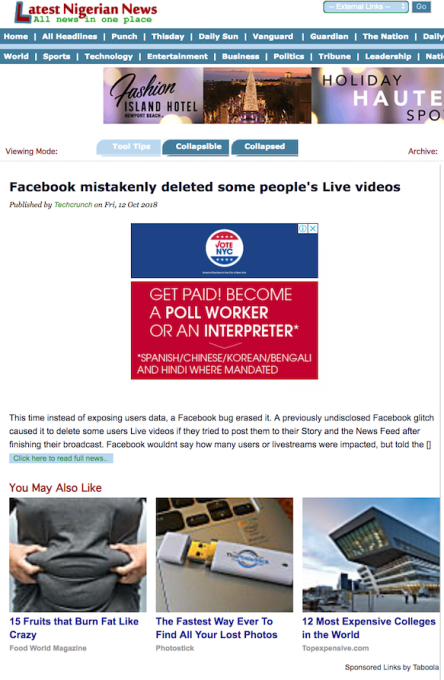
Here’s an example of the type of site that might be demoted by Facebook’s latest News Feed change. “Latet Nigerian News” scraped one of my recent TechCrunch articles, and surrounded it by tons of ads.

An ad-filled site that scraped my recent TechCrunch article. This site might be hit by a News Feed demotion

“Starting today, we’re rolling out an update so people see fewer posts that ink out to low quality sites that predominantly copy and republish content from other sites without providing unique value. We are adjusting our Publish Guidelines accordingly” Facebook wrote in an addendum to its May 2017 post about demoting sites stuffed with crappy ads. Facebook tells me the new publisher guidelines will warn news outlets to add original content or value to reposted content or invoke the social network’s wrath.

Personally, I think the importance of transparency around these topics warrants a new blog post from Facebook as well as an update to the original post linking forward to it.

So how does Facebook determine if content is stolen? It’s systems compare the main text content of a page with all other text content to find potential matches. The degree of matching is used to predict that a site stole its content. It then uses a combined classifier merging this prediction with how clickbaity a site’s headlines are plus the quality and quantity of ads on the site.

16 Oct 2018

Google Maps amplifies its app for electric vehicle owners

Google Maps is beefing up its app to help electric vehicle owners find the most suitable and closest place to charge up.

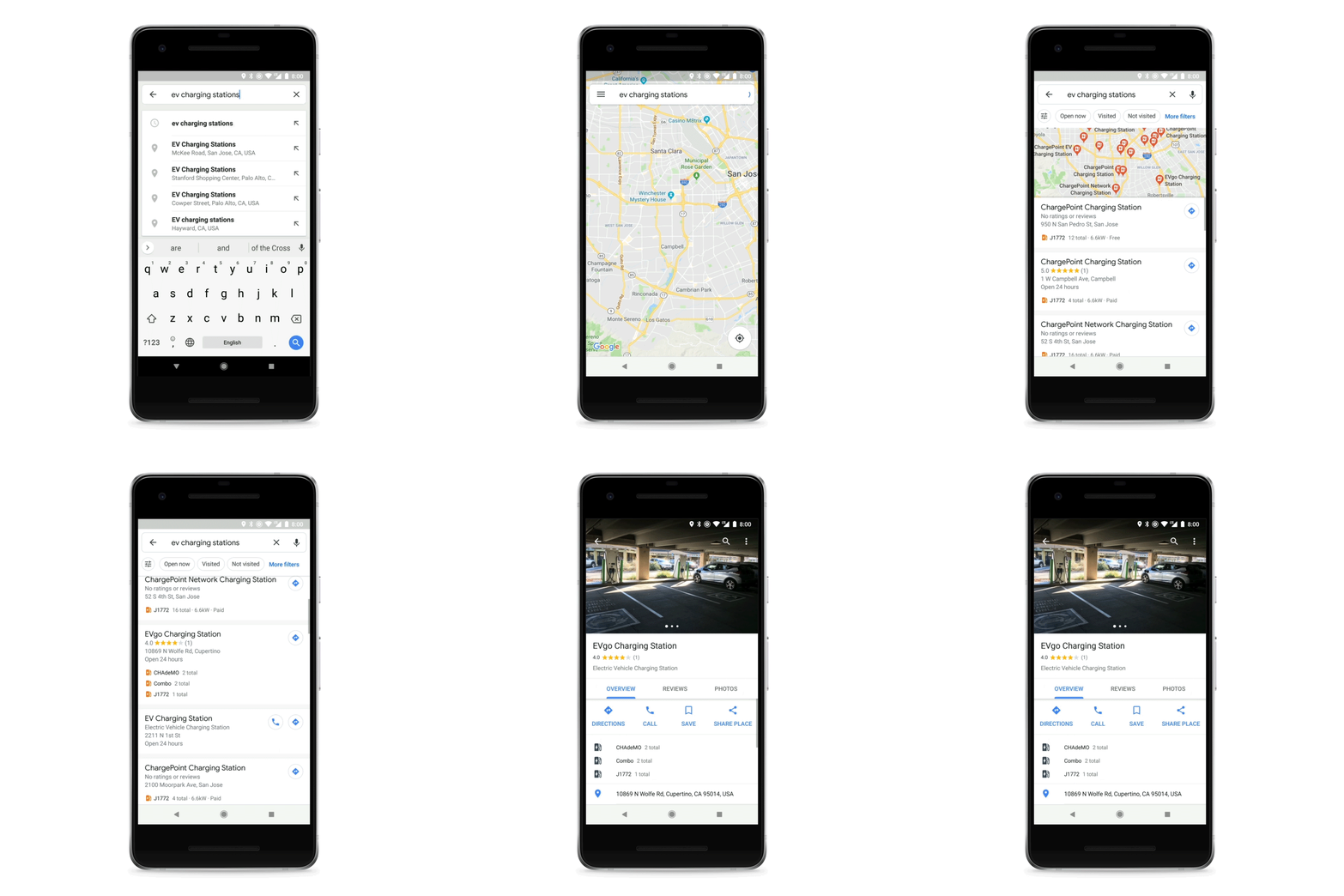
Google Maps said Tuesday it’s adding an EV charging feature to the app that will give users information about charging stations. Google has featured charging stations for a number of years now. But now, Google Maps is displaying more stations from supported networks and providing information about the stations themselves, including how many charging ports are available and how quickly they’ll be able to charge.

Users can type in keywords like “ev charging” or “EV charging stations” to see the nearest supported stations.

The EV charging search feature starts rolling out Tuesday on Android and iOS, with desktop launching in the coming weeks.

Google Maps now supports charging stations around the world, including Tesla and ChargePoint globally. In the U.S., the feature also includes SemaConnect, EVgo and Blink. ChargeMaster and Pod Point are included in Google Maps in the UK and ChargeFox stations will be shown in Australia and New Zealand.

Google Maps will show information about the business where the station is located, the types of ports available, charging speeds, and how many ports there are. Users will also see information about the station from drivers, including photos, ratings, reviews and questions.

There are other third-party apps out there with this kind of information, notably PlugShare, which has been a go-to source for many electric vehicles owners in the past. Innogy recently acquired PlugShare’s parent company Recargo.

16 Oct 2018

Coinbase now lets you buy and sell ZRX

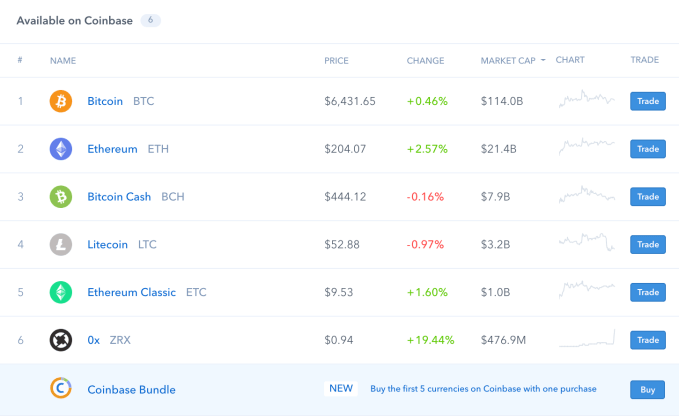
Coinbase’s newest asset is live. On Tuesday the popular U.S.-based cryptocurrency platform added support for ZRX, the token representing the 0x Project. On Coinbase, ZRX joins the rarified ranks of Bitcoin, Bitcoin Cash, Ethereum, Ethereum Classic and Litecoin.

Coinbase ZRX

The addition doesn’t come as a surprise. Last week, Coinbase added ZRX to Coinbase Pro, the so-called “evolution of GDAX,” Coinbase’s more feature-rich trading platform. Coinbase also previously signaled its intentions to “explore” the addition of a number of new cryptocurrencies including 0x (ZRX), Cardano (ADA), Basic Attention Token (BAT), Stellar Lumens (XLM) and Zcash (ZEC).

By showing its hand well in advance and being more transparent about its regulatory hurdles, the platform will hopefully avoid another debacle like the volatile launch of Bitcoin Cash last December, which prompted an insider trading investigation.

“One of the most common requests we hear from customers is to be able to trade more assets on Coinbase,” Coinbase said in a blog post.

ZRX should show up soon for most users across the desktop, iOS and Android versions of Coinbase. At launch time, ZRX won’t be available in the state of New York or the United Kingdom due to unresolved regulatory issues.

16 Oct 2018

Periscope broadcasters can now assign their own chat moderators

It’s going to be harder for trolls to disrupt Periscope broadcasts. The Twitter-owned live streaming app has offered chat moderation capabilities for years, but it has so far relied on group moderation. That means when users flagged a comment as abuse, spam or harassment, Periscope would randomly select a few other viewers to take a look and decide if that’s true. Violators would be banned if the users agreed. That worked well in some cases, but it still put control in the hands of the crowd, not the live streamer. Now, Periscope is changing that.

Instead of relying solely on group moderation, the company says broadcasters will instead be allowed to assign chat moderators before they start streaming.

These moderators can then watch the chat during the live broadcast and actively mute commenters in the audience who are disruptive.

After being muted, the person will not be allowed to chat for the remainder of the broadcast. This muting activity will be visible to anyone joining the broadcast from either Periscope or Twitter, but assigning chat moderators can only be done from Periscope, the company says.

When the live stream wraps, the broadcaster can then view a list of all the muted accounts and can choose to block those users from joining in future broadcasts.

The addition, which arrived alongside new replay editing tools, is another step towards improving the health of conversations on Periscope, the company claims. It follows another change announced this past summer, which focused on stricter enforcement of its rules around abuse and harassment.

Before, trolls whose comments were flagged during a broadcast were only temporarily blocked from chatting. They wouldn’t be able to comment on that live broadcast, but they could still join others in the future and continue to disrupt, threaten or abuse the video creator or the community.

The change that rolled out this summer made it so that those people who repeatedly got suspended for violating the guidelines would have their Periscope accounts reviewed and suspended.

Online harassment is not a new problem, to be sure, but the major social platforms have been struggling to get a handle on the issues.

In Twitter’s case, in particular, it’s been called out for being too tolerant of online harassment and hate speech, under the guise of protecting free speech. But Twitter has been trying to better handle abuse complaints, in more recent months, including through the acquisition of anti-abuse technology provider Smyte, which is helping to automate some of the processes here, as well as with the rollout of more stringent policies and anti-abuse features. Periscope hasn’t received as much attention, but is focusing on reducing the abuse that occurs during the real time conversations on live broadcasts.

More info on how the new chat moderation feature works is here.


16 Oct 2018

Google-incubated AdLingo uses chatbot integration to create conversational ads

“Conversational marketing” is a phrase that I hear a lot, but when the team at AdLingo uses it, they mean something specific — namely, bringing chatbots and other conversational assistants into online advertising.

The startup is part of Google’s Area 120, and co-founder and general manager Vic Fatnani said he’s worked on advertising at Google for more than a decade.

“One of the things we saw happening was this paradigm shift with users and consumers going towards more of a conversational medium,” he said. “Everything is becoming more conversational, whether it’s through devices such as your phone, your speaker and eventually your car … We asked ourselves, ‘Hey if this shift is happening, why can’t marketing be more conversational?'”

You may be wondering whether consumers are really clamoring to interact with ads, but Fatnani said he and his co-founder Dario Rapisardi were determined not to build “a solution that needs a problem,” so they spent months talking to marketers and chatbot developers.

Apparently, when they asked about what challenges everyone was facing, the big answer was “discovery.” As Fatnani put it, “Hey, I have this amazing conversational assistant, but it’s really hard for me to bring this in front of audience.”

General Manager Vic Fatnani, Head of Partnerships Stephanie Lyras, Head of Engineering Dario Rapisardi

In his view, advertising provides the perfect medium to solve this problem. Instead of building a chatbot and just letting consumers find it on their own website or app, brands can integrate it into their advertising, allowing people who see the ad to ask questions and provide feedback.

“Imagine you want to launch a new soda drink in Brazil, a market that you’ve never entered before,” he added. “Imagine you can now run a conversational display ad and actually have people vote to say what kind of flavor would you like to drink.”

Or for a real example, there’s the Allstar Kia experience that you can see at the top of this post. Che company’s director of internet marketing Chris Ferrall said in a statement that “AdLingo lets our customers browse inventory, determine car trade-in value and make an appointment with a salesperson — all within an engaging, interactive experience that meets them right where they are.”

To be clear, Adlingo isn’t building the chatbots. Instead, Fatnani said, “The brands and developers bring the conversational experience to us, and we distribute that experience all over the web.”

To do this, the platform integrates with chatbot tools like Dialogue Flow, Microsoftbot Framework, LiveEngage and Blip. It’s also partnered with Valassis Digital and LivePerson (the Kia campaign happened through Valassis).

How does this all fit into Google’s larger plans for advertising? Fatnani said it doesn’t, at least not yet.

“We are completely separate efforts in terms of our product roadmap and what we execute,” he said, later adding, “At this point, we just want to make sure we’re really, really focused on our customer.”

16 Oct 2018

No, your Twitter was not hacked

Twitter users on iOS were hit with a strange bug today. Instead of receiving notifications that included the tweet itself, they received a string of alphanumeric characters. The issue only affected iOS users, we confirmed with the company, and has since been resolved.

Twitter was quick to address the problem, following complaints from Twitter users about the weird notifications.

Twitter CEO Jack Dorsey posted at 12:42 PM ET today that Twitter was aware of the issue and was working on a fix.

Minutes later, he tweeted again that the issue was resolved.

We asked Twitter for more details on what went wrong, as a lot of people were wondering why their phones’ notification screen looked like this.

Some were also concerned it was a security issue of some kind, and didn’t know if a password reset was in order.

Twitter now says the issue was only a bug – nothing to be concerned about.

The company pointed us to a tweet from its Support channel (see below), which explains the issue in layman’s terms. It says the bug was related to the code used for iOS notifications – specifically the “red bubbles” (meaning the app icon’s badges).

Normally, you would not see this in “numbers and code,” Twitter explains.

Or, as @Jack put it in more technical terms: “We send an invisible background notification to the app with badge counts (mainly unread notifications, DMs, etc.). The issue caused these notifications to become visible for a short period of time. We don’t know exactly why, but quickly reverted.”

In any event, the issue is fixed, it’s not a hack, and we can all rest easy.

Whew. 

16 Oct 2018

Report: Lyft picks JPMorgan to lead IPO in 2019

Lyft and Uber’s race to an IPO is heating up.

Lyft has selected JPMorgan Chase & Co. as the lead underwriter of its initial public offering along with Credit Suisse Group and Jefferies Group, the WSJ reported, citing “people familiar with the company’s plans.”

Lyft declined to comment.

Lyft is expected to file an IPO in the first half of 2019. Choosing an underwriter marks the next official step in the process. Meanwhile, Uber is making it’s own preparations.

Uber, which has received proposals from banks that placed its value as much as $120 billion, is also considering an early 2019 listing.

Some people familiar with the plan said Lyft’s valuation will exceed the $15.1 billion it was valued earlier this year. While Lyft’s value is still considerably lower than Uber’s, it’s on the upswing.

Lyft said in June 2018 that it raised an additional $600 million in a Series I financing round led by Fidelity Management & Research Company, pushing its post-money valuation to $15.1 billion. The valuation had more than doubled in a 14-month span.

Lyft has spent the past 18 months aggressively expanding into new U.S. cities, as well as into Canada and pursuing its autonomous vehicle ambitions. Lyft has increased its market share in the U.S. to 35 percent. In January 2017, Lyft had just 22 percent market share in the United States.

Lyft has raised $2.9 billion in primary capital since April 2017. In total, Lyft has raised $5.1 billion since its inception.

16 Oct 2018

Macaw will curate Twitter for you, help expand your network

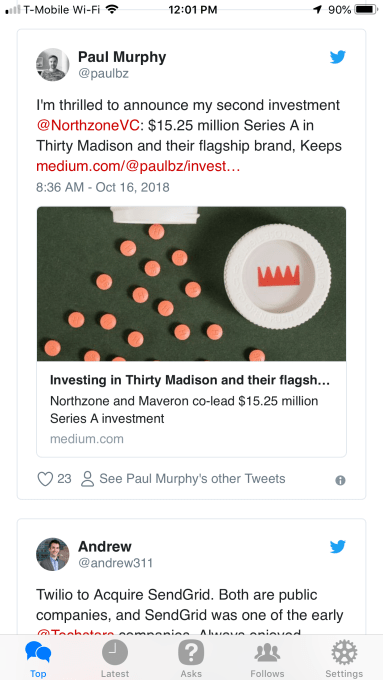
Twitter today inserts activity-based tweets into your timeline, alerting you to things like the popular tweets liked by people you follow, or those Twitter accounts that a lot of people in your network have just started to follow. These alerts can be useful, but their timing is sporadic and they can be easily missed. Plus, if you turn off Twitter’s algorithmic timeline (as may be possible for some), you’ll lose access to this sort of info. A new Twitter app called Macaw aims to help.

Macaw, which recently launched on Product Hunt, offers a set of similar information as Twitter does, with a few changes.

Macaw works by first pulling in a list of people you follow. It then tracks what tweets they like throughout the day and turns that into a feed of tweets that were most popular. Macaw does the same thing for users, too – that is, it shows you if a number of people have suddenly started following someone, for example.

Beyond this, Macaw will also show you the “Latest” tweets receiving likes from your network in a separate tab, as well as tweets where someone has asked a question.

This “Asks” section will highlight tweets where someone on Twitter has asked something like “Does anyone know…?” or “what are the best…?”, for example. This can help you find new conversations to participate in and help you expand your network.

The end result is a curated version of Twitter, where you can catch up with what’s important, without so much endless scrolling through your timeline.

Even if you’re on Twitter itself a lot, Macaw can still be useful.

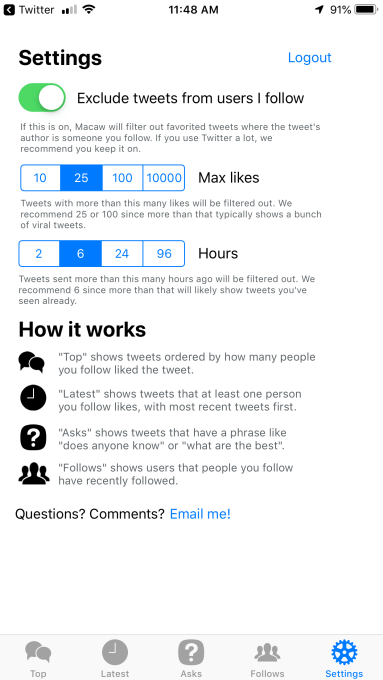
Its default setting will hide top tweets posted by someone in your network – because, chances are, you’ve already read them. With this setting turned on, you’ll only be shown top tweets by users you don’t yet follow.

You can also configure how many likes are required for something to be considered a “top” tweet. By default, this is set to 25, but you can change it to 10, 100, or even 1,000. You can adjust the default setting for the age of the tweet, too, from 6 hours to 2 hours, 24 hours, or 96 hours, based on how often you check in.

The app, however, is not a Twitter client.

That is, it doesn’t take the place of Twitter or other apps like Twitterific or Tweetbot, as you can’t use it to post tweets, access direct messages, update your profile, or follow users. You’ll need a different app, like the main Twitter client, for that. But a tap in Macaw will launch Twitter for you, making the transition feel seamless.

The app was built by Zachary Hamed, who had previously built Daily 140 for tracking a similar set of data, shared via email. He says he started building Macaw as a side project and launched it into private beta in August. It doesn’t currently have a business model, beyond a plan to maybe charge for additional features later on.

In some ways, Macaw is similar to Nuzzel, another Twitter summarization app that provides a list of top links that your network is sharing and discussing. But many of the best things on Twitter aren’t links, they’re individual tweets or tweetstorms. (Like that recent Google+ rant, for example).

Hamed admits Nuzzel was a source of inspiration for Macaw (a bird that screams constantly, by the way. Ha!)

“I was actually inspired by those notifications in the main Twitter app since I’ve always found them fascinating and by Nuzzel, which is one of my most used apps – and whose founder Jonathan I really respect,” Hamed says. “I think there is a lot of hidden insight to be found in posts people have liked and who they start following, especially if there is momentum around certain names or topics. As of now, Twitter only shares one to two of those recommendations, not all of it,” he adds.

*While we do like Macaw, the app, one thing we’re not a fan of are the fake reviews on the Macaw website, which pretend to be from @Jack, Mary Meeker, and Chamath Palihapitiya. It’s obviously meant to be a joke, but it falls flat – Macaw doesn’t need this sort of false promotion, and it’s wrong because it could confuse less savvy users.

Macaw is a free download on the App Store.