Year: 2018

16 Oct 2018

Substack celebrates its first birthday with 25K paying newsletter subscribers

It’s been a year since the launch of Substack, a platform that allows newsletter writers to build a subscription business. Today, on its first birthday, the startup has a simple message: Yes, people really are willing to pay for newsletters.

In fact, the company says there are more than 25,000 paying subscribers for Substack -powered newsletters (up from 11,000 in July). And newsletters published on the platform reach a total of 150,000 paying active readers.

Co-founder and CEO Chris Best described the pitch as, “We’ll do everything for you except the hard part,” namely writing the newsletter. It offers way to publish newsletters, charge a subscription fee and then decide which content only goes to paying subscribers.

“It’s a really simple idea,” Best said — and in his view, that’s part of what makes it powerful.

At the same time, the startup has been adding more features like gift subscriptions, podcast support and subscriber-only comments, which have the bonus of reducing troll-ish commentary from random visitors.

“We can be like, ‘Comments are for people that are paying,'” Best said. “That actually fixes a lot of the problem.”

Substack launched with Sinocism, a China-focused newsletter written by MarketWatch co-founder Bill Bishop, and apparently the paid subscription sign-ups on Bishop’s first day added up to six figures in annual revenue. Since then, writers like Judd Legum (who quit his job as editor in chief of ThinkProgress to launch his newsletter Popular Information), Toast founders Nicole Cliffe and Daniel Mallory Ortberg and Slate political correspondent Jamelle Bouie have also used Substack to create paid newsletters (though again, it’s not all behind a paywall — the platform allows them to publish a mix of free and paid content).

“One of the things striking to us is the kinds of writers,” Best added. “It’s not a particular genre or type of writer, it’s not the subject matter that determines [success]. The kinds of writers who make it work are people who have a dedicated following, that have a particular point of view that makes them indispensable.”

Best also said this is “the kind of thing you want to do whole hog.” In other words, the successful writers are passionate about their subjects and committed to the newsletter format and subscription business model, rather than asking, “How can I diversify my revenue?”

At the same time, co-founder Hamish McKenzie (a journalist himself) noted that Substack isn’t just a platform for well-known writers to start charging their existence audience for their work. For example, there’s Petition, which was launched on Substack as an anonymously-written newsletter about corporate restructuring and bankruptcy.

The Substack team didn’t get specific about plans for the year two, but Best and McKenzie made it clear that they think this reflects a broader shift away from a news and commentary model driven by social distribution and monetized by ads.

“The core thing is really simple,” Best said. “The core thing is: Publish some stuff, get people to love it and then charge them for it.”

16 Oct 2018

With Watch GT, Huawei ditches Google for its own OS

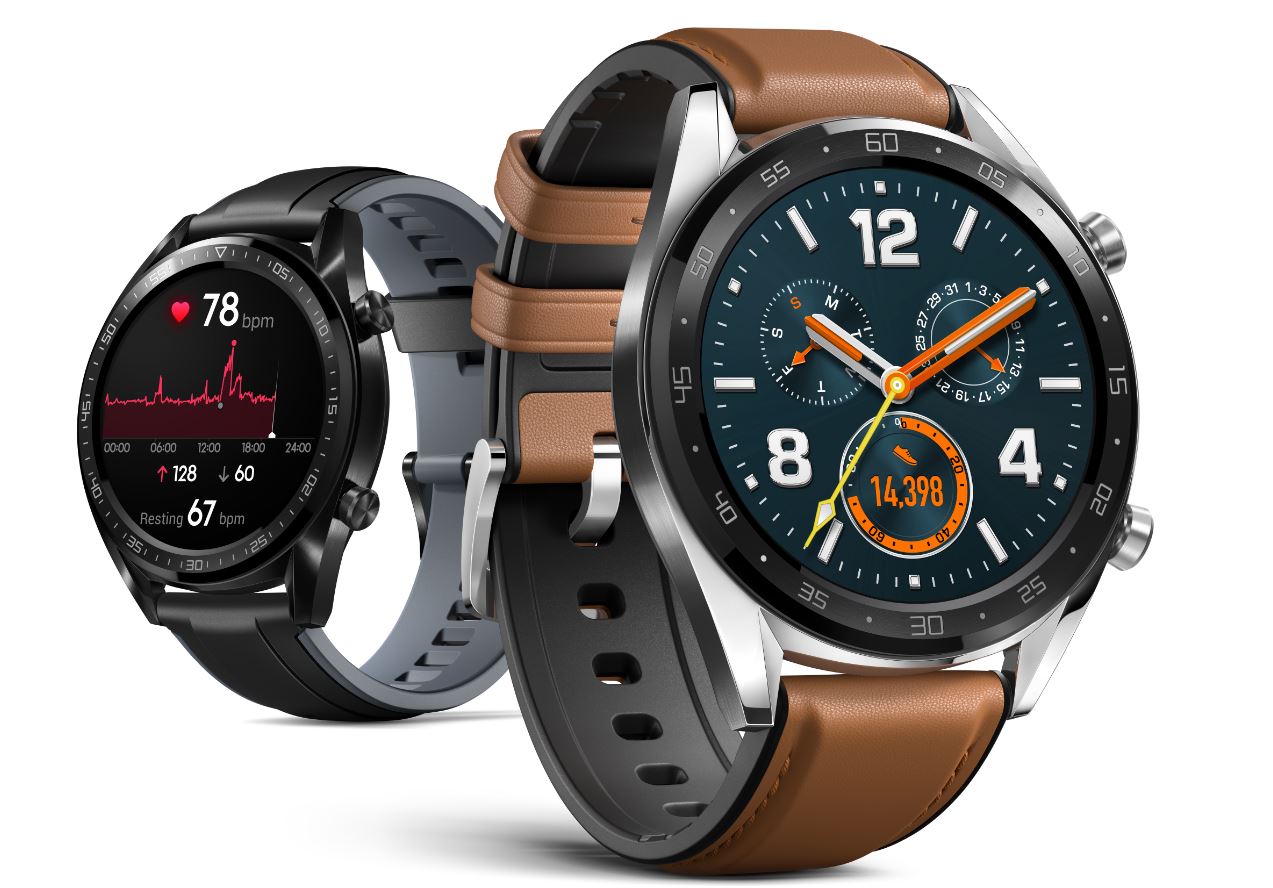
LG’s strange new hybrid Watch W7 marked a small but important victory for Wear OS. But this morning in London, Google lost a key ally in the smartwatch wars — for this model, at least. Huawei’s latest wearable, the Watch GT ditches the Google operating system for its own in-house brew, LiteOS.

The move marks a blow for Google’s struggling wearable operating system. The company has made a point of avoiding fragmentation for Wear OS, a decision that may ultimately haunt the company as manufacturers like Samsung, Fitbit and now Huawei go it on their own.

Each manufacturer has their own reasons, of course, but Huawei, the decision is pretty straightforward. Namely, the company wants to squeeze as much battery out of this as possible. That’s in keeping with a day’s announcements that also included a phone that can charge other phones, mind.

Here, that means some pretty outrageous claims. Huawei says the thing gets two weeks on a charge with standard use, which seems downright silly compared to the competition. If you turn off all of the distractions, meanwhile, you can apparently get up to 30 days, which is essentially Kindle territory we’re talking about here.

The watch is a bit beefy, as you no doubt expected. That’s going to be a bit of a drawback, given the watch’s focus on fitness. As is the fact that, well, most of the competition has also made fitness the centerpiece of their products — Apple and Fitbit are going to be tough to topple.

There’s continuous heart rate monitoring on-board, along with a built-in tri-GPS system for more accurate run tracking. As with its new phone, the Huawei looks firmly aimed at Samsung’s marketshare in the watch category, and that’s apparently meant leaving Wear OS in the dust. 

16 Oct 2018

Timex builds its first automatic watch in decades

Leave your smartwatch on the counter because Timex is back with its first automatic watch in decades. Called the Marlin, this 21-jewel timepiece that hearkens back to the days of “Takes a licking, keeps on ticking.”

The Marlins cost $249 and come in multiple styles. This particular model, in a rich burgundy, looks like something that you’d wear to a Madison Avenue cocktail party after work. Timex has also released manual wind watches for $199 featuring a truly retro design and numerals.

Timex has long been a drug store brand – a brand sold in those cases at big drug stores and aimed at impulse shoppers who needed a watch… any kind of watch. While their Indiglo line of bright, light-up quartz watches was a long-time hit, they really didn’t do much beyond making a few very basic pieces for a non-discerning audience.

Now, however, the company clearly looked at its history and liked what it saw. Timex was one of the first American watch brands to expand on a mass scale and they suffered greatly during the 1980 quartz crisis, a moment when the watch industry went from mechanical movements to electronic. Many watchmakers never recovered or are now a husk of their former glory – Hamilton, for example – but Timex kept at it.

Now that they’ve given automatics and manual winds a try I’m excited to see where they go next. Many watchmakers have noticed that men and women are buying more and more retro watches to offset the creeping smartwatch flood. I’m glad to see the team at Timex is ready to take on this fascinating new world.

16 Oct 2018

Discord’s new game store rolls out to the rest of the world today

When Discord first launched its new built-in game store just a few weeks back, there was one big caveat: it was available to only a tiny, tiny slice of its 150M users. 50,000 of them, to be exact — all of them in Canada.

Today it’s going global.

Discord says that access to its store should be rolling out to the rest of the world throughout the day.

Discord’s move to become a store comes just weeks after Valve overhauled the chat system in Steam. While perhaps a coincidence, the timing certainly felt very “two-can-play-at-that-game”.

When you first start poking around Discord’s store, you might notice that… well, there’s not a ton there. Around 20 games, at first. That, says the company, is deliberate; whereas the competition might offer ten thousand different games, Discord is trying to frame its store as something closer to “a local bookstore” — if it’s on their shelves, it’s essentially their digital stamp of approval.

At launch, it’ll sell:

  • Moonlighter
  • Frostpunk
  • Starbound
  • Masters of Anima
  • Celeste
  • Dead Cells
  • CrossCode
  • Omensight
  • Into the Breach
  • Battle Chasers: Nightwar
  • Red Faction Guerrilla
  • Spellforce 3
  • This is the Police 2
  • Hollowknight
  • Subnautica
  • The Banner Saga 3
  • Pillars of Eternity II: Deadfire

Plus five “First on Discord” games: King of the Hat, Sinner: Sacrifice for Redemption, Minion Masters, Bad North, and At Sundown. These are titles that Discord will have exclusive runs on for ~90 days.

Meanwhile, Discord is also globally overhauling its Nitro service. Previously available for $4.99, Nitro was mostly a way to lets the power users and hardcore fans support Discord — it got you a few aesthetic perks like animated avatars, but that’s about it. Now $9.99, Nitro will include a rotating library of around 60 games. With titles like Brutal Legend, Guacamelee, FTL, de Blob, and Super Meat Boy in the mix, they’re not the newest titles, but there’s a lot of great stuff in here.

And just in case Valve/Steam wasn’t annoyed enough: Discord is also rolling out its new launcher, which it says should be able to list and launch pretty much all of your games “regardless of where [they] were purchased”. Even if a game requires another company’s launcher to load.

The goal, it seems, is clear: if you’re not actively playing a game, Discord doesn’t want you having to poke around anywhere else.

Here’s what it looks like:

[gallery ids="1733409,1733416,1733420"]
16 Oct 2018

Walmart’s Vudu may add subscription video channels to its streaming service

Walmart appears to have big plans for its video streaming service, Vudu . On the heels of a partnership with MGM for original content, new reports claim the retailer is now in discussions with various video services, in the hopes of making them accessible through Vudu itself. That move would make Vudu more like Amazon’s Prime Video Channels, an offering that allows customers to pick and choose which streaming service subscriptions they want to access through Prime Video.

The news was first reported by AdAge and Bloomberg, with both reporting that the types of services that could arrive on Vudu as add-on subscriptions include HBO NOW, Showtime and Starz.

The talks are still in the very early stages, the reports claim.

If Walmart chooses to go this route with Vudu, it shouldn’t be too difficult to get these deals done.

As more consumers cut the cord with traditional pay TV, premium cable TV networks need new ways to achieve distribution. Even the broadcaster CBS has ventured into over-the-top subscriptions, with CBS All Access, a service that offers live TV, on-demand series, and original programming like the new “Star Trek” series, which is only accessible to its cord cutting audience.

It would not be an unusual step for Vudu to include add-on subscriptions – most live TV streaming services do today, as well as marketplaces like Prime Video Channels, and even on-demand streamers like Hulu.

What is interesting, however, is that Walmart is now paying attention to Vudu, whose potential it has overlooked for years. Vudu hasn’t received a major new feature since the launch of “Movies on Us” two years ago. That brought a free streaming movie channel to the service, similar to the new Roku Channel. But for the most part, Vudu’s audience are viewers looking for movie rentals and purchases, not streaming content.

That could ultimately prove a challenge for Vudu, as consumers associate the brand with purchases, not subscriptions. They may not think to ever check Vudu for signing up to something like HBO or Showtime.

Walmart has also been rumored to be considering its own Netflix competitor, which could help fill out a new streaming offering in the future.


16 Oct 2018

Huawei’s new phone can wirelessly charge the competition

Make no mistake, Huawei’s going after the big dogs here. The company’s taken a Samsung-esque approach to the world of flagship smartphones with a beast of a handset that delivers everything and the kitchen sink.

The Mate 20 Pro is a 6.4 inch powerhouse with features and specs to spare. It’s a combination of the genuinely useful and the just sort of novel, but the hardware maker has clearly spared no expense getting itself on the global map with this thing. 

There’s a lot to unpack here, but the most compelling feature of the set may well be the device’s wireless charging. While that’s not particularly exciting on the face of it, get this, the company is confident enough about the on-board battery that you can use it to wirelessly charge the competition.

I’m not sure how practical that will be for a majority of users, but as someone who has multiple phones on his person most days, I’ve  found myself in a handful of scenarios where pulling a little extra juice from the phone’s massive 4,200mAh battery. The phone itself, naturally, has quick charging capabilities, hitting 70 percent battery after 30 minutes.

You’ve also got three cameras on the back, because Huawei. They’re all smushed together a square design, which the company says was inspired by sports cars. Sure, why not? There’s a 20-megapixel lens for super wide shots, a 40 megapixel standard shooter and an eight megapixel telephoto.

Oh, and those in-screen fingerprint readers everyone’s talking about? There’s one here, too, along with a depth-sensing face unlock for added security. The depth detecting front-facing cameras are also being put to use for things like image scanning and, yes, 3D selfies.

Inside is the proprietary Kirin 980 processor the company’s been talking up since way back at IFA. Huawei says its chip is able to eke out better performance than Qualcomm’s premium Snapdragon, but we’ll wait for the benchmarks for that one. And Huawei, like Apple, has been investing a lot in on-board AI processing, which is certainly on display here.

16 Oct 2018

Paperspace scores $13M investment for AI-fueled application development platform

Paperspace wants to help developers build artificial intelligence and machine learning applications with a software/hardware development platform powered by GPUs and other powerful chips. Today, the Winter 2015 Y Combinator grads announced a $13 million Series A.

Battery Ventures led the round with participation from SineWave Ventures, Intel Capital and Sorenson Ventures. Existing investor Initialized Capital also participated. Today’s investment brings the total amount to $19 million raised.

Dharmesh Thakker, a general partner with Battery Ventures sees Paperspace as being in the right place at the time. As AI and machine learning take off, developers need a set of tools and GPU-fueled hardware to process it all. “Major silicon, systems and Web-scale computing providers need a cloud-based solution and software ‘glue’ to make deep learning truly consumable by data-driven organizations, and Paperspace is helping to provide that,” Thakker said in a statement.

Paperspace provides its own GPU-powered servers to help in this regard, but co-founder and CEO Dillon Erb says they aren’t trying to compete with the big cloud vendors. They offer more than a hardware solution to customers. Last spring, the company released Gradient, a serverless tool to make it easier to deploy and manage AI and machine learning workloads.

By making Gradient a serverless management tool, customers don’t have to think about the underlying infrastructure. Instead, Paperspace handles all of that for them providing the resources as needed. “We do a lot of GPU compute, but the big focus right now and really where the investors are buying into with this fundraise, is the idea that we are in a really unique position to build out a software layer and abstract a lot of that infrastructure away [for our customers],” Erb told TechCrunch.

He says that building some of the infrastructure was an important early step, but they aren’t trying to compete with the cloud vendors. They are trying to provide a set of tools to help developers build complex AI and machine learning/deep learning applications, whether it’s on their own infrastructure or on the mainstream cloud providers like Amazon, Google and Microsoft.

What’s more, they have moved beyond GPUs to support a range of powerful chips being developed to support AI and machine learning workloads. It’s probably one of the reasons that Intel joined as an investor in this round.

He says the funding is definitely a validation of something they set out to work on when they first started this in 2014 and launched out of Y Combinator in 2015. Back then he had to explain what a GPU was in his pitch decks. He doesn’t have to do that anymore, but there is still plenty of room to grow in this space.

“It’s really a greenfield opportunity, and we want to be the go-to platform that you can start building out into intelligent applications without thinking about infrastructure.” With $13 million in hand, it’s safe to say that they are on their way.

16 Oct 2018

MongoDB switches up its open source license

MongoDB is a bit miffed that some cloud providers — especially in Asia — are taking its open source code and are offering a hosted commercial version of its database to their users without playing by the open source rules. To combat this, MongoDB today announced that it has issued a new software license, the Server Side Public License (SSPL), that will apply to all new releases of its MongoDB Community Server, as well as all patch fixes for prior versions.

Previously, MongoDB used the GNU APGLv3 license, but it has now submitted the SSPL for approval from the Open Source Initiative.

For virtually all regular users who are currently using the community server, nothing changes because the changes to the license don’t apply to them. Instead, this is about what MongoDB sees as the misuse of the APGLv3 license. “MongoDB was previously licensed under the GNU AGPLv3, which meant companies who wanted to run MongoDB as a publicly available service had to open source their software or obtain a commercial license from MongoDB,” the company explains. “However, MongoDB’s popularity has led some organizations to test the boundaries of the GNU AGPLv3.”

So while the SSPL isn’t all that different from the GNU GPLv3, with all the usual freedoms to use, modify and redistribute the code (and virtually the same language), the SSPL explicitly states that anybody who wants to offer MongoDB as a service — or really any other software that uses this license — needs to either get a commercial license or open source the service to give back the community.

“The market is increasingly consuming software as a service, creating an incredible opportunity to foster a new wave of great open source server-side software. Unfortunately, once an open source project becomes interesting, it is too easy for cloud vendors who have not developed the software to capture all of the value but contribute nothing back to the community,” said Eliot Horowitz, the CTO and co-founder of MongoDB, in a statement. “We have greatly contributed to — and benefited from — open source and we are in a unique position to lead on an issue impacting many organizations. We hope this will help inspire more projects and protect open source innovation.”

I’m sure this move will ruffle some feathers. It’s hard to discuss open source licenses without getting religious about what this movement is all about. And since MongoDB is the commercial entity behind the software and manages outside contributions to the code, it does have a stronger grip on the actual code than other projects that are managed by a large open source foundation, for example. For some, that alone is anathema to everything they think open source should stand for. For others, it’s simply a pragmatic way to develop software. Either way, though, this will kick off a discussion about how companies like MongoDB manage their open source projects and how much control they can exert over how their code is used. I, for one, can’t wait to read the discussions on Hacker News today.

16 Oct 2018

Hinge is first dating app to actually measure real world success

Dating app Hinge is today launching a new feature aimed at improving its recommendations, based on whether or not matches had successful real-world dates. The feature may also help to address one of the major problems with today’s dating apps: that no one knows how well they actually work. After all, it’s one thing to get matches and have conversations, but it’s quite another to turn those into dates, much less a long-term relationship.

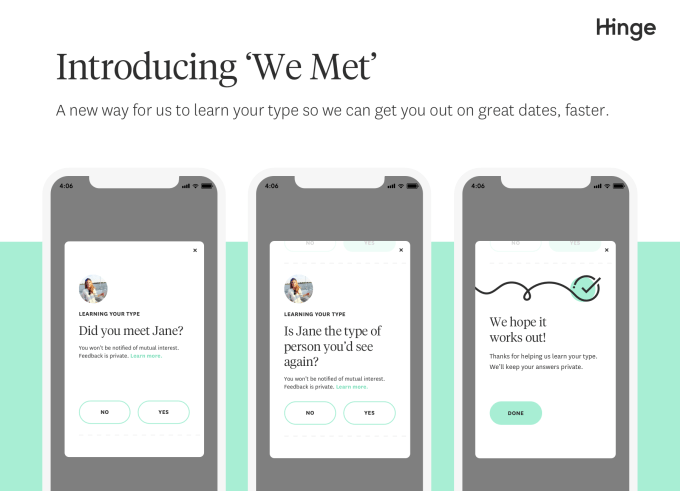
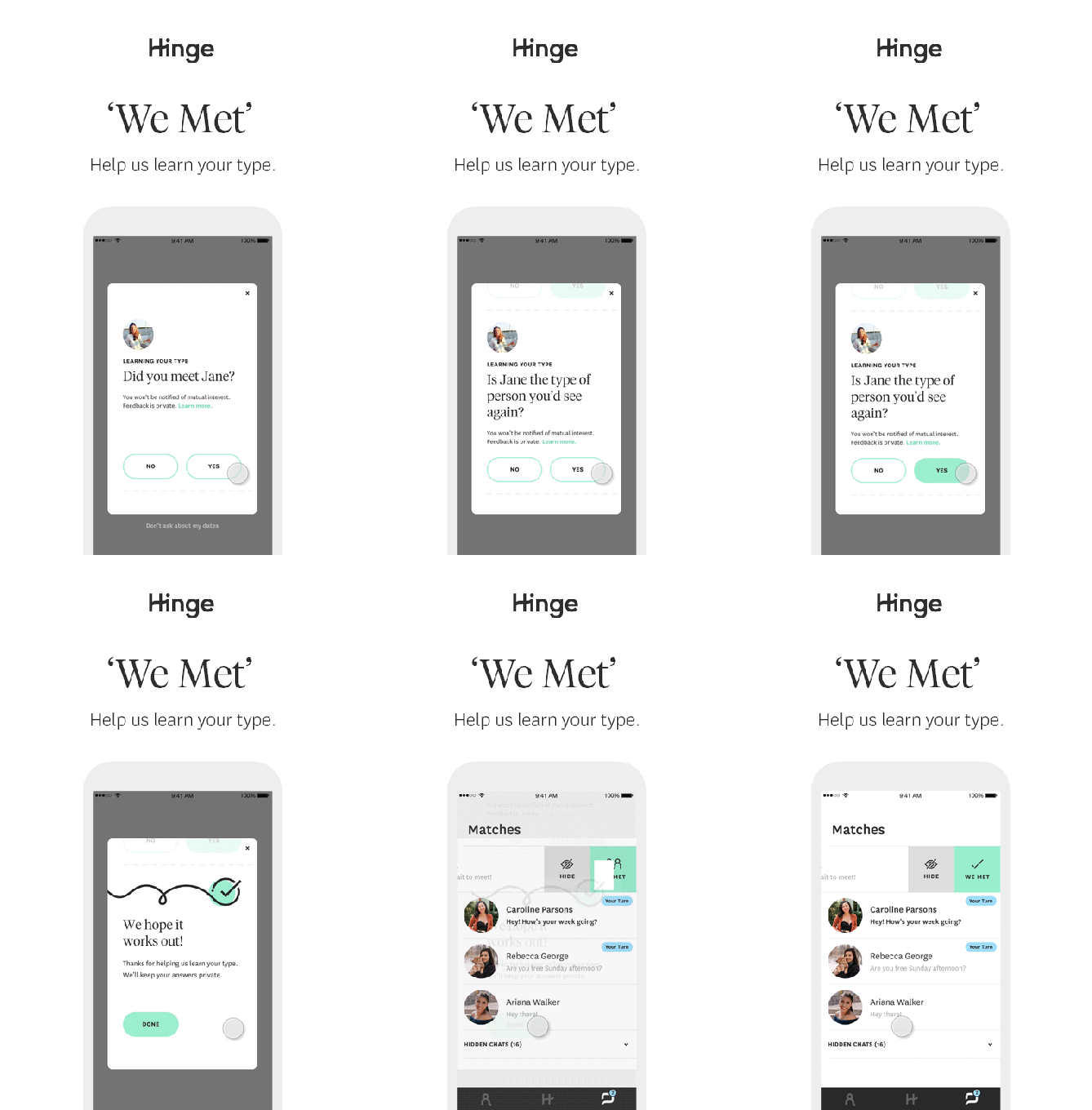
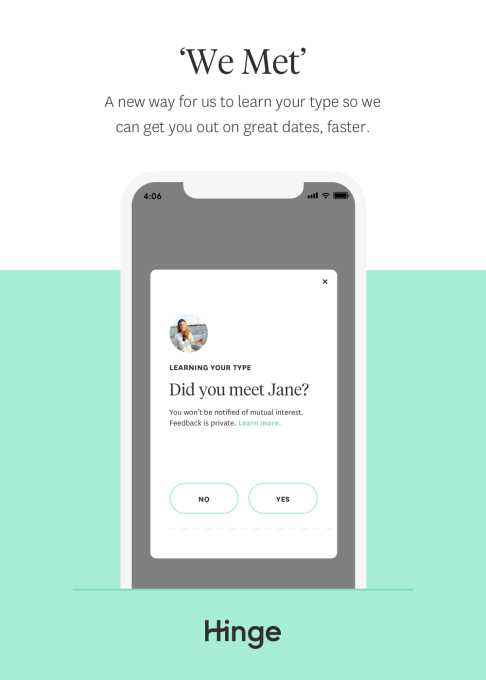
With a new feature called “We Met,” Hinge will ask users a few days after they shared their phone numbers if they went on a date, and, if so, if they’d want to see that person again. This data will be used as a signal to inform Hinge’s algorithms and improve matches, if the user later returns to the app.

During beta trials, Hinge says that 90% of members said their first dates were great, and 72% said they wanted to go on a second.

“Ultimately, if you went on a date with someone and you thought they were great, that’s the strongest signal that we’ve gotten very close to your type of person. So if there are more people like that person, we can show them to you,” says Hinge CEO Justin McLeod.

By “like that person” it’s not a matter of physical appearance or some sort of profile categorization, to be clear.

“You can’t really aggregate people into their component pieces and try to crack what’s someone’s ideal person,” McLeod explains.

Instead, Hinge uses collaborative filtering – people who like X also like Y – to help inform its matches on that front.

With the launch of We Met, Hinge will now know when dates succeed or fail, and eventually, perhaps, why. It also plans to combine the We Met data with other signals – such as, whether users become inactive in the app or delete their accounts, as well as email survey data – to figure out which dates may have turned into relationships.

This is something of a first for the dating app industry, which is today incentivized to keep users “playing” their matching games, and spending money on in-app subscriptions – not leave them. It’s not in dating apps’ financial interest, at least, to create relationships (i.e., heavy user churn).

This influences the dating apps’ design – they don’t tend to include features designed to connect people in real life.

For example, they don’t make suggestions of events, concerts, and other things to do; they don’t offer maps of nearby restaurants, bars, coffee shops, or other public spaces for first dates; they don’t offer built-in calling (or gamify unlocking a calling feature by continuing to chat in app); they don’t use in-app prompts to suggest users exchange numbers and leave the app. Instead, apps tend to push users to chat more – with things like buttons for adding photos and GIFs, or even tabs for browsing Facebook-style News Feeds.

The problem of wasting time chatting in dating apps has now become so prevalent that many users’ profiles today explicitly state that they’re “not looking for pen pals.”

Of course dating apps – just like any other way of meeting new people – will have their share of success stories. Everyone knows someone who met online.

But claims that, for example, Tinder is somehow responsible for a whole generation of “Tinder babies” are hugely suspect, because the company doesn’t have any way of tracking if matches are actually dating, and certainly not if they end up getting married and having kids. It even said so in a recent documentary.

All Tinder has – or any of these companies, really – are anecdotes and emails from happy couples. (And this, of course, should be expected, with user bases in the tens of millions, like Tinder.)

We Met, meanwhile, is actually focused on quantifying real world dating successes in Hinge, not in-app engagement. Longer term, it could help to establish Hinge as place that’s for people who want relationships, not just serial dates or hookups.

The feature is also another example of how Hinge is leveraging A.I. combined with user insights to improve matches. Recently, it rolled out a machine learning-powered feature, Most Compatible, to help provide users with daily recommendations based on their in-app activity.

Hinge says We Met will launch today, October 16, on iOS first. Android will soon follow.

16 Oct 2018

Instacart raises another $600M at a $7.6B valuation

Instacart chief executive officer Apoorva Mehta wants every household in the U.S. to use Instacart, a grocery delivery service that allows shoppers to order from more than 300 retailers, including Kroger, Costco, Walmart and Sam’s Club, using its mobile app.

Today, the company is taking a big leap toward that goal.

San Francisco-based Instacart has raised $600 million at a $7.6 billion valuation, just six months after it brought in a $150 million round and roughly eight months after a $200 million financing that valued the business at $4.2 billion.

D1 Capital Partners, a relatively new fund led by Daniel Sundheim, the former chief investment officer of Viking Global Investors, has led the round.

Instacart is raking in cash aggressively but spending it cautiously. The company still has all of its Series E, which ultimately totaled $350 million, and the majority of its $413 million Series D in the bank, a source close to the company told TechCrunch. That means, in total, Instacart has $1.2 billion at its fingertips. Currently, according to the same source, the company is only profitable on a contribution margin basis, meaning it’s earning a profit on each individual Instacart order.

In a conversation with TechCrunch, Mehta said the company didn’t need the capital and that it was an “opportunistic” round, i.e. the capital was readily available and Instacart has ambitious plans to scale, so why not fundraise. Instacart plans to use the enormous pool of capital to double its engineering team by 2019, which will include filling 300 open engineering roles in its recently announced Toronto office, he said.

As far as an initial public offering, it will happen — eventually.

“It will be on the horizon,” Mehta told TechCrunch.

“2018 has been a really big year for us,” he added. “The reason why we are so excited is because the opportunity ahead of us is enormous. The U.S. is a $1 trillion grocery market and less than 5 percent of that is bought online. It’s an enormous category that’s highly under-penetrated.”

In the last six months, Instacart has announced a few notable accomplishments.

As of August, the service has been available to 70 percent of U.S. households. That’s due to the expansion of existing partnerships and new deals entirely, like a recently announced pilot program between Instacart and Walmart Canada that gives Canadian Instacart users access to 17 different Walmart locations across Winnipeg and Toronto, Ontario.

The company has also completed several executive hires. Most recently, it tapped former Thumbtack chief technology officer Mark Schaaf as CTO. Before that, Instacart brought on David Hahn as chief product officer and Dani Dudeck as its first chief communications officer.

In early September, the company confirmed its chief growth officer Elliot Shmukler would be leaving the company.

The 6-year-old Y Combinator graduate has raised more than $1.6 billion in venture capital funding from Coatue Management, Thrive Capital, Canaan Partners, Andreessen Horowitz and several others.