
Year: 2018

16 Oct 2018

CIA, NSA and the Pentagon still aren’t using a basic email security feature

Some of the most sensitive U.S. government departments and agencies still aren’t using a basic email security feature that would significantly cut down on incoming spam or phishing emails.

Fifteen percent of all U.S. government domains still aren’t employing DMARC, or domain-based message authentication, reporting, and conformance policy on their domains, which email systems use to verify the identity that the sender of an email is not an impersonator.

New data from security firm Agari shows that out of over a thousand federal domains, 75 percent have a DMARC policy that either monitors, quarantines to your spam folder or entirely rejects all spoofed emails.

But the CIA, the NSA, and the Department of Defense are among the outliers still haven’t rolled out DMARC across their web domains.

That’s despite Tuesday’s deadline for BOD 18-01, a directive issued by Homeland Security that ordered the rollout of DMARC a year ago, following complaints by a leading Democratic senator.

BOD 18-01 aimed to improve email and cybersecurity across the federal government by introducing email encryption (STARTTLS) and doubling down on use of HTTPS certificates across the government. By cranking up the DMARC settings to its safest by outright rejecting unverified email, government departments would comply with the directive by bouncing any unauthenticated email from user inboxes.

That may not sound too important, but it means that now that a sizable portion of the federal government — and intelligence agencies — aren’t protected against an easy class of impersonated emails.

According to Agari’s breakdown:

  • CIA has 9 out of 10 domains without a DMARC record;
  • Neither of the NSA’s two domains have DMARC records;
  • The White House’s Executive Office of the President has half of its domains lacking a DMARC record’
  • The Director of National Intelligence, which co-ordinates the entire U.S. intelligence apparatus, also has all 17 domains without a DMARC record;
  • Defense Dept. has 32 out of 35 domains without a DMARC record;
  • And even Homeland Security, which instituted the policy, has 3 out of 33 domains without a DMARC record.

And those are the worst contenders. Only a handful of departments are fully compliant.

Proofpoint, which issued similar research Monday with approximately the same data — said that it estimates about 60 percent of the federal government are fully compliant with the directive.

The government isn’t the only outlier. Only one-third of the Fortune 500 are said to use DMARC on their domains.

16 Oct 2018

CIA, NSA and the Pentagon still aren’t using a basic email security feature

Some of the most sensitive U.S. government departments and agencies still aren’t using a basic email security feature that would significantly cut down on incoming spam or phishing emails.

Fifteen percent of all U.S. government domains still aren’t employing DMARC, or domain-based message authentication, reporting, and conformance policy on their domains, which email systems use to verify the identity that the sender of an email is not an impersonator.

New data from security firm Agari shows that out of over a thousand federal domains, 75 percent have a DMARC policy that either monitors, quarantines to your spam folder or entirely rejects all spoofed emails.

But the CIA, the NSA, and the Department of Defense are among the outliers still haven’t rolled out DMARC across their web domains.

That’s despite Tuesday’s deadline for BOD 18-01, a directive issued by Homeland Security that ordered the rollout of DMARC a year ago, following complaints by a leading Democratic senator.

BOD 18-01 aimed to improve email and cybersecurity across the federal government by introducing email encryption (STARTTLS) and doubling down on use of HTTPS certificates across the government. By cranking up the DMARC settings to its safest by outright rejecting unverified email, government departments would comply with the directive by bouncing any unauthenticated email from user inboxes.

That may not sound too important, but it means that now that a sizable portion of the federal government — and intelligence agencies — aren’t protected against an easy class of impersonated emails.

According to Agari’s breakdown:

  • CIA has 9 out of 10 domains without a DMARC record;
  • Neither of the NSA’s two domains have DMARC records;
  • The White House’s Executive Office of the President has half of its domains lacking a DMARC record’
  • The Director of National Intelligence, which co-ordinates the entire U.S. intelligence apparatus, also has all 17 domains without a DMARC record;
  • Defense Dept. has 32 out of 35 domains without a DMARC record;
  • And even Homeland Security, which instituted the policy, has 3 out of 33 domains without a DMARC record.

And those are the worst contenders. Only a handful of departments are fully compliant.

Proofpoint, which issued similar research Monday with approximately the same data — said that it estimates about 60 percent of the federal government are fully compliant with the directive.

The government isn’t the only outlier. Only one-third of the Fortune 500 are said to use DMARC on their domains.

16 Oct 2018

Amazon puts $10M in Closed Loop Fund to make recycling easier in more American cities

Amazon announced today that it has invested $10 million in Closed Loop Fund, which finances the creation of recycling infrastructure and services in U.S. cities. In a statement, the e-commerce behemoth claimed that its investment will keep one million tons of recyclable material out of landfills and “eliminate the equivalent of two million metric tons of CO2 by 2028, equivalent to shutting down a coal-fired power plant for six months.”

Founded in 2014, Closed Loop Fund invests in companies and organizations working on services, infrastructure, or technology that will make recycling accessible to more communities in the U.S. Only a few cities have made recycling mandatory and in many municipalities, trucking trash to the landfill is still much cheaper than offering curbside recycling. According to Amazon’s announcement, about half of Americans “lack access to convenient, sufficient curbside recycling at their homes.” Over the next 10 years, Closed Loop Fund wants to save more than 8 million tons of waste from landfills by making recycling easier for 18 million households.

In a statement, Closed Loop Fund CEO Ron Gonen said “Amazon’s investment in Closed Loop Fund is another example of how recycling is good business in America. Companies are seeing that they can meet consumer demand and reduce costs while supporting a more sustainable future and growing good jobs across the country. We applaud Amazon’s commitment to cut waste, and we hope their leadership drives other brands and retailers to follow suit.”

As the largest online retailer in the U.S. by far, Amazon packages produce a massive amount of cardboard and packaging waste every year. More than 5 billion items were shipped through Amazon Prime last year, while the company’s fulfillment and shipping network increased by more than 30% in square footage.

The burden placed on overwhelmed municipalities and waste collection services that need to dispose of packaging from Amazon and other e-commerce stores has been dubbed the “Amazon Effect” and blamed for contributing to the decline in the cardboard recycling rate. According to the American Forestry and Packaging Association, the recycling rate for cardboard fell to 88.8% in 2017 from 92.9% in 1999.

Amazon claims its Frustration-Free Packaging program, which offers brands incentives to use less wasteful packaging, has eliminated more than 244,000 tons of packaging materials and made it possible to avoid more than 500 million shipping boxes since launching 10 years ago. But with its rapid pace of growth—Amazon is expected to reach $258.22 billion in U.S. retail sales this year, accounting for 49.1 percent of all online retail spending in the country and 5 percent of all retail sales—there is still a lot of work to do if it really wants to stop contributing to packaging waste.

16 Oct 2018

Announcing the Disrupt Berlin Agenda

TechCrunch Disrupt is the world’s biggest and most impactful tech startup conference, and we can’t wait to bring the hype to Berlin.

We’re very proud of the show we’ve put together and are thrilled to give you a look at what’s in store.

Editor’s Note: Not all of our speakers are included on this agenda as we like to keep a couple tricks up our sleeves. ;)

THURSDAY, NOVEMBER 29

Morning


Racing to the Future with Lucas Di Grassi (Roborace)

Hear from Roborace’s new CEO and former F1 driver Lucas Di Grassi on how Roborace is merging human driving and artificial intelligence to build a better racing series. Including a sneak peak at their latest vehicle! Main Stage @ 9:05AM

A New Start with Anne Kjaer-Riechert (ReDI School of Digital Integration), Aline Sara (NaTakallam)

The world has been shocked by the plight of refugees from both war zones and natural disasters in the last few years. But the tech world has stepped up to the plate to assist refugees and NGOs, in this case with ReDI School’s hugely successful code school for refugees and NaTakallam’s global platform for refugees to teach languages. Main Stage @ 9:25AM

In The Money with Pieter van der Does (Adyen)

Payments company Adyen has achieved that rare thing all startups hope for but many do not achieve: it went public as a profitable company with a huge IPO pop. Hear how a startup quietly built up a payments empire under the radar, out of Amsterdam. Main Stage @ 9:45AM

Regaining Momentum in Europe with Saul Klein (LocalGlobe)

Saul Klein has long had an outsized imprint on Europe’s tech scene, as an operator, founder and investor, as well as the mastermind behind the global meet up concept OpenCoffee and the “YC of Europe,” Seedcamp. We’ll talk with Klein about creating a sustainable ecosystem, as well as how Europe now competes against faster-growing markets, including in China. Main Stage @ 10:05AM

STARTUP BATTLEFIELD

The hottest startups compete for the Disrupt Cup, $50,000 USD, and eternal glory. Main Stage @ 10:50AM

Bootstrapping Your Way To The Top with Denys Zhadanov (Readdle)

Readdle, a strartup out of Ukraine, has racked up 100 million downloads of its popular PDF app, and is now making a bold move into other productivity tools, all without a single dime of funding. It can be done! Hear Denys Zhadanov tell his startup’s story. Main Stage @ 11:55AM

STARTUP BATTLEFIELD

The hottest startups compete for the Disrupt Cup, $50,000 USD, and eternal glory. Main Stage @ 1:15PM

Afternoon


Sharing the Ride-Sharing Industry with Daniel Ramot (Via), and other speakers to be announced

It’s time to say it: there won’t be a single global leader in the ride-sharing industry. Many companies will survive and compete in dozens of countries with different offerings. But how do you beat Uber at its own game? Main Stage @ 2:40PM

Pioneering Crypto with Jamie Burke (Outlier Ventures), Vinay Gupta (Mattereum), and other speakers to be announced

Investing in Crypto and Blockchain startups has never been hotter. We’ll hear from these key pioneers in the field who are feeling their way in this brand new arena. Main Stage @ 3:45PM

Making Everyone A Secondary VC with Kaidi Ruusalepp (Funderbeam)

As startups stay private longer and more people want to gamble on them, CEO Kaidi Ruusalepp will discuss the risks and rewards of would-be investors turning to Funderbeam’s secondary market. Main Stage @ 4:10PM

STARTUP BATTLEFIELD

The hottest startups compete for the Disrupt Cup, $50,000 USD, and eternal glory. Main Stage @ 4:30PM


FRIDAY, NOVEMBER 30TH

Morning


Going Global with Brynne Kennedy (Topia)

Topia’s Brynne Kennedy will discuss building the tools that enable companies to manage the 21st century mobile workforce. Main Stage @ 9:25AM

The European Fintech Fever with Ricky Knox (Tandem) and other speakers to be announced

Thanks to a unified market, fintech startups have boomed in Europe. And yet, with so many megarounds and startups doing the same thing, are we experiencing a fintech fever? Main Stage @ 9:45AM

Learning Languages and Building a Startup with Julie Hansen and Markus Witte (Babbel)

Babbel is now managing the top-grossing language learning app in the world. It’s a European success story. The company is now facing a new challenge: conquering the U.S. Main Stage @ 10:10AM

Building Your Next Car, Today with Laurin Hahn (Sono Motors), Ole Harms (MOIA)

The car industry has never been so exciting. Everybody is working on the car of the future, which will represent the perfect combination of automation, connectivity, electric motors and mobility services. But who will do it better: Startups or car giants trying to reinvent themselves? Including a sneak peak of Sono’s new vehicle. Main Stage @ 11:05AM

Becoming a “Unicorn Factory” with Philipe Botteri, Sonali De Rycker, Luciana Lixandru, and Harry Nelis (Accel)

Accel London has built a very strong brand in Europe over the past 18 years, with bets that include Deliveroo and Supercell. Yet staying relevant means continuing to bet on winners. How does Accel think about its heritage and its future, and what does that mean for the startups looking to work with the firm? Main Stage @ 11:30AM

Afternoon


European Space Tech Comes of Age with Mike Collett (Promus Ventures), Rafal Modrzewski (ICEYE)

Mike Collett has built a reputation as a savvy investor in deep-technology software and is now an investor in one of Europe’s hottest space-tech startups, ICEYE, which ICEYE recently became the first company to launch a Synthetic-Aperture Radar satellite under 100 kilograms which can scan the globe in 3D. Where does space technology go from here? Main Stage @ 1:00PM

STARTUP BATTLEFIELD FINALS

The hottest startups compete for the Disrupt Cup, $50,000 USD, and eternal glory. Main Stage @ 1:45PM

Emerging Market Tech is About to Explode with Lizzie Chapman (Zestmoney) and Alan Mamedi (Truecaller)

With a $100M warchest, Truecaller has gone from a simple anti-spam service to a payments and chat service for huge new markets like India. Meanwhile, Zest is India’s first completely automated consumer digital lending platform which is giving consumers there new options in financing. We’ll get into how these two pioneers are expanding. Main Stage @ 3:30PM

Selling Fashion in a Post-Web World with Sophie Hill (Threads)

Threads, a startup out of London, has found the perfect way to sell to its target millennial customer: forget the web and focus on messaging apps instead. That bold choice has helped the company land tons of clients and millions in backing from VCs who want in on the action. Hear from founder Sophie Hills about how she got here, and what will come next. Main Stage @ 4:20PM

Can Starling Become the Next HSBC with Anne Boden (Starling Bank)

Starling has now convinced hundreds of thousands of people, but it is still far behind the biggest consumer banks. Anne Boden has worked in the banking industry for decades, so she knows what’s missing to jump from a small competitor to a dominant player. Main Stage @ 4:40PM
16 Oct 2018

Video-based recruitment startup JobUFO scores €2M seed

JobUFO, the Berlin-based startup that has built a video focussed app to help facilitate better job applications, has raised €2 million in seed funding. Leading the round is IBB and Hevella Capital, with the investment to be used for growth.

Claiming to re-invent the way companies handle the application process, JobUFO has developed an online/mobile application form that focuses on the personality of the candidate. This includes being asked to created a CV in a specific format and the ability to record or upload a personal application video. The JobUFO application form can be embedded anywhere online, such as a company’s career page or job ad, so that it becomes the preferred way to receive applications.

“The HR market is overloaded with too many information and recruiting tools,” JobUFO co-founder and CEO Thomas Paucker tells me when asked to describe the problem being tackled. “This makes it very hard to find the best process of applying to a job. That’s why everybody is writing the same motivational letters. You still need a laptop and there is no real first impression of yourself when you apply. Recruiters do not read motivational letters because someone else could have written it. The longer a recruiting process is, the higher the average dropout rate of an applicant”.

To remedy this, the JobUFO mobile app or web-version enables applicants to quickly create a “DIN-correct” CV in combination with a guided video of up to thirty seconds. Paucker says the idea is to be able to give a good first impression at the very moment the application is received. JobUFO powered applications are pushed directly into a company’s application tracking system via the JobUFO API.
“Recruiters get more and reliable applications without changing their daily routine,” he says. “Applicants get recommendations based on big data and are guided nearly fully automatically during their whole work life. Additionally we automate the communication between those two groups to focus on the main goal: filling the vacancy with someone who fits and likes the job”.

To that end, in two years since being founded, JobUFO has grown its customer base to over 30 well-known companies operating in Germany. They include Deutsche Bahn, Edeka, Evonik, Hertz, and Ikea. In 2018 alone, over 60,000 applications have been generated.

“Digitalisation is changing the recruiting sector,” adds Paucker, noting that younger applicants have no prior knowledge of a more traditional application process and are much more akin to using consumer apps such as Instagram and YouTube. “Since we guide the applicants directly through the application process, JobUFO is particularly popular with this younger target group,” he says.

In addition, the “talking application photos” concept is resonating with recruiters and HR managers since the last mile to the applicant is often the most time-consuming and least scalable. “The company sees the video as well as the checked data of the applicant directly in its own applicant management system. For both sides, this is an uncomplicated process that continues to spur us on to expand,” says the JobUFO CEO.

16 Oct 2018

Google CEO Sundar Pichai speaks publicly for the first time about its censored China search engine

Commenting publicly for the first time about Google’s censored search engine for China, CEO Sundar Pichai said onstage at the WIRED 25 summit in San Francisco that the company is taking “a longer-term view” about the country. Codenamed Project Dragonfly, the controversial development has been public knowledge since a report in August by the Intercept, generating significant backlash, with several employees resigning in protest.

Google did not confirm Project Dragonfly’s existence until its chief privacy officer, Keith Enright, spoke at a Senate hearing last month. Even then, Enright did not provide much information about the project, so this means Pichai’s comments at WIRED 25 are the most detailed ones made officially by Google’s leadership so far.

Even before Project Dragonfly was revealed by The Intercept, Google had already been quietly working on a strategy to re-enter China, including launching (or re-launching) apps through third-party Android stores (Google Play is not available in China) and working with partners like Xiaomi and Huawei to introduce its ARCore technology for augmented and virtual reality there. Pichai said Google has not decided if it will actually launch Project Dragonfly in China, but if it does, the search engine’s biggest competition would be Baidu.

Pichai said that Chinese tech innovations means it’s time for Google to get an understanding of the market from the inside out. “It’s a wonderful, innovative market. We wanted to learn what it would look like if we were in China, so that’s what we built internally,” adding that “given how important the market is and how many users there are, we feel obliged to think hard about this problem and take a longer-term view.”

Even though it follows China’s strict censorship laws, Pichai claimed that Project Dragonfly will still be able to answer “well over 99% of the queries” put to it and that “there are many, many areas where we would provide information better than what’s available.”

Google once operated a censored search engine in China at Google.cn, but pulled out of the country in 2010. At the time, Google said its decision was prompted by a “sophisticated cyber attack originating from China” that targeted human rights activists, and the country’s efforts to “further limit free speech on the web in China” by blocking websites like Googe Docs, Blogger, Facebook, Twitter and YouTube.

For its critics, Project Dragonfly’s existence means Google has reneged on the values it avowed nine years ago. While onstage at WIRED 25, however, Pichai said working on a search engine is in line with the company’s mission to “provide information to everyone,” noting that China contains about 20% of the world’s population.

Google only embarked on Project Dragonfly after much deliberation, he said. “People don’t understand fully, but you’re always balancing a set of values” when entering new countries,” adding “but we also follow the rule of law in every country.”

16 Oct 2018

Uber and Lyft are responsible for about half of SF’s rise in traffic since 2010, SFCTA says

Uber and Lyft are often times the ones to blame for the rise in traffic and congestion in cities. In San Francisco, the two ride-hailing services are undoubtedly partially to blame, but not entirely to blame, according to a new study from the San Francisco County Transportation Authority. The gist is that while ride-hailing companies have contributed to the increase in traffic congestion in San Francisco, jobs and population growth also play a major role.

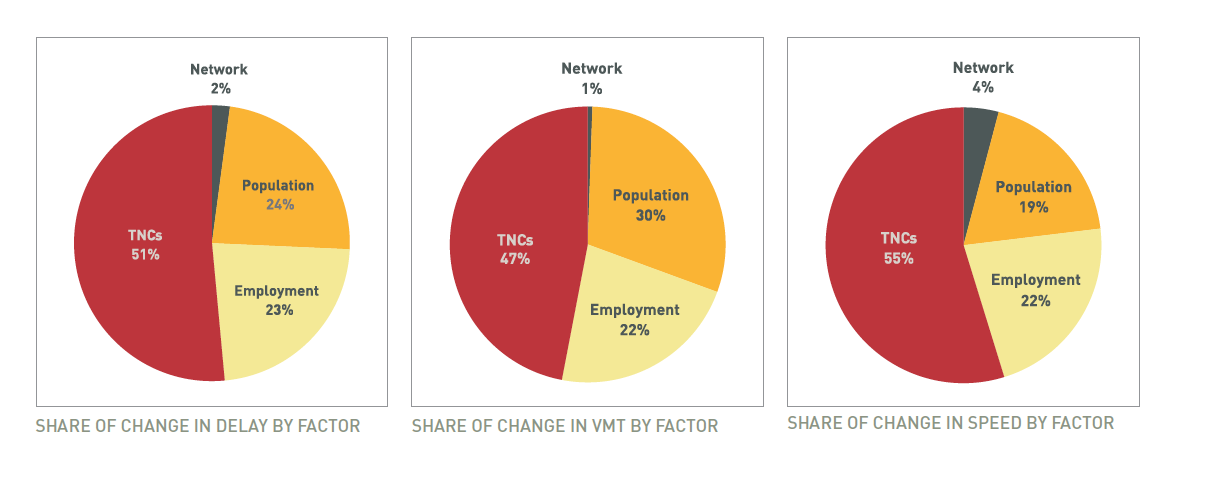
Between 2010 and 2016, according to the SFCTA, ride-hailing services accounted for:

  • 51 percent of the increase in daily vehicle hours of delay
  • 47 percent of the increase in vehicle miles traveled
  • 55 percent of the average speed decline
  • 25 percent of total vehicle congestion citywide

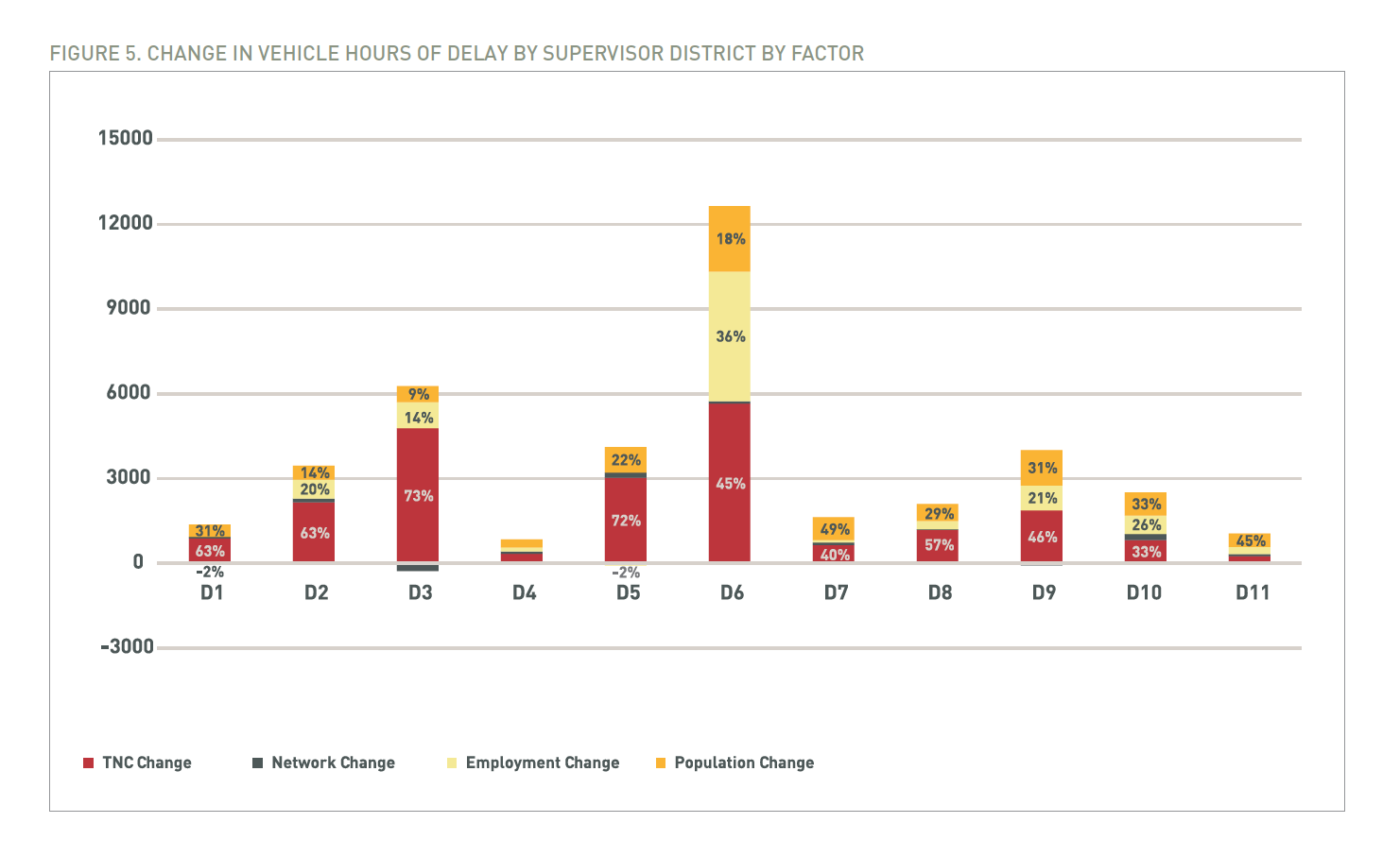
While ride-hailing services increase congestion throughout the entire city, there are concentrated effects in certain districts. Take District 6, which includes the tech company-heavy SOMA neighborhood, where ride-hailing services account for 45 percent of the increased delay while employment change accounts for 36 percent of the increased delay. But in District 3, which includes tourist-heavy areas like The Embarcadero and North Beach, Uber and Lyft account for 73 percent of increased delays.

“One thing that has really been sorely absent is that we have remained largely in the realm of the hypothesis” in terms of why there’s been such an increase in traffic in the city, said Joe Castiglione, the study’s co-author and SFCTA Deputy Director for Technology, Data and Analysis. “We’re seeking to ground this in a real data-driven and rigorous analytic approach to answering this question.”

The SFCTA utilized data from INRIX, a commercial dataset that combines numerous real-time GPS monitoring sources with data from highway performance monitoring systems. It also tapped Northeastern University for its transportation network services trip data set. There are, however, some limitations to this data, Castiglione pointed out. There’s no data set available on delivery services — think FedEx, UPS, and even Postmates, Caviar and UberEats.

Now that there’s all this data-driven information, it begs the question of what the city will do with it. The SFCTA is not a policy-making agency, but its bosses (the San Francisco Board of Supervisors) are.

“We’re silent on policy prescriptions,” Castiglione said. “We’re trying to peel the onion a bit more but we’re not going to lay on policy recommendations. We’re trying to give people some insight into what happens. Ultimately, our board, they’re the policymakers.”

This report comes at a time when the city is actively grappling with how to manage and regulate emerging modes of transportation, like bike-share and scooter-share.

“To the extent we believe all of these things will shape our future, then we want to wrestle with them,” Castiglione said. “We’re working with the SFMTA to determine how to look at all these on-demand delivery services.”

16 Oct 2018

Syncron, a SaaS to help manufacturers move to a service model, raises $67M

Syncron, a Stockholm-headquartered company that offers a SaaS to help equipment and other product manufacturers move to a service model, has raised $67 million, its first ever funding round despite being over 15 years old. Leading the round is growth equity firm Summit Partners, while a source close to Syncron pegs the post-money valuation at $175 million.

Tapping into the growing “servitization” trend — that is, offering a product as a service or a subscription — Syncron’s SaaS grew out of the company’s original consultancy offering and is designed to solve issues around post-sales support offered by equipment manufacturers targeting various heavy industry.

For example, when heavy equipment breaks down –- think tractors, bulldozers and dump trucks -– it can stall a multimillion-dollar project. To help mitigate this, Syncron uses AI to enable equipment manufacturers to predict when machine parts will fail and need to be replaced — a shift from the traditional “when it breaks, then I’ll fix it” model.

“There is currently a gap between customers’ increasing demand for maximized product uptime and manufacturers’ ability to deliver it,” explains Syncron CEO Anders Gruden in an email. “For decades, manufacturers have been focused on repair execution (repairing a product after it has already broken down), but today’s customers want products that work all the time.

“As consumers, we are all familiar with subscription-based businesses like Netflix, Spotify and more. This shift -– where customers pay for access and output as opposed for a product itself -– is known as servitization. This mindset has carried over into manufacturing and means products need to be up and running and accessible at all times”.

Specifically, Syncron’s tech reads IoT sensor data on equipment and parts to analyse their lifetime and suggest replacement, inventory restocking, and price for replacement parts. In other words, Syncron makes IoT data actionable.

“Manufacturers are turning to Syncron to help in the shift to servitization, which requires maximized product uptime,” explains Gruden. “As more products are equipped with smart sensors, it is more important than ever to shift from a reactive, break-fix service model to one focused on maximizing product uptime, or preemptively repairing equipment before it ever fails. The best way to achieve this is to leverage sensor-based IoT data to ensure parts are pre-emptively replaced before they fail – and this is where Syncron and our solutions come in”.

The strategy appears to be working, too, given today’s growth funding and the list of companies as customers Syncron boasts, which span various manufacturers that make heavy machines and equipment, everything from industrial and agricultural equipment to mining and construction, automotive, aerospace, energy and utilities, and more. They include ABB, Atlas Copco, BAE, Brother, CLAAS, Electrolux, Hitachi, JCB, Manitowoc, Mazda, Motor Coach Industries, Perkins, Renault, Siemens, and Terex.

16 Oct 2018

IoT company Smartfrog takes controlling interest in Canary

Things have been pretty quiet on the Canary front. In January at CES, the New York-based smart security startup released a stripped-down version of it its flagship camera. Beyond the odd software updates here and there, however, we haven’t heard much. This morning, however, the company announced some pretty big changes coming from the top, down.

Smartfrog, a European IoT company, has invested $25 million in the startup, bringing its total funding up to $66 million.  With its investment, Smartfrog will also take a controlling interest.

That means some shakeups, up top. Smartfrog CEO Charles Fraenkl will retain the top spot at the combined companies, while Bob Stohrer, Canary’s CMO, will be put in charge of its New York-based operations. Former Canary CEO Adam Sager, meanwhile, will stay around in an advisory role, according to the company. 

“We are very excited about the opportunities that derive from joining forces. Our businesses are extremely complementary and will enable us to scale the business faster globally,“ Stohrer told TechCrunch.

From a strategic standpoint, the move gives Smartfrog a foothold in the States, while potentially affording Canary the ability to spread into the EU. The camera maker offered a pretty impressive product out of the gate, putting it at the forefront of smart home security.

A spokesperson for the companies told TechCrunch,

Globally, the smart home security market is at an inflection point, and as the industry becomes increasingly competitive with some of the world’s largest technology companies, Smartfrog and Canary joining forces enables both companies to better compete globally. Together the group will immediately become a formidable global provider of IoT services and SaaS solutions leveraging combined strengths. With artificial intelligence, machine learning initiatives, easy-to-use products and affordable prices, the group ensures continued consumer benefits and accelerated global growth.

Increased competition from the likes of Nest, Amazon-owned Ring and, most notably, Netgear’s Arlo, have, however, made for a far more competitive space.

“Canary´s achievements — in creating an award-winning smart home security solution and becoming one of the fastest-growing category leaders in US — is nothing short of impressive,” Fraenkl said in a statement. “By joining forces, the group will be well positioned in an increasingly competitive market.”

Canary will continue to function as an independent brand, moving forward.

16 Oct 2018

Jeff Bezos is just fine taking the Pentagon’s $10B JEDI cloud contract

Some tech companies might have a problem taking money from the Department of Defense, but Amazon isn’t one of them, as CEO Jeff Bezos made clear today at the Wired25 conference. Just last week, Google pulled out of the running for the Pentagon’s $10 billion, 10-year JEDI cloud contract, but Bezos suggested that he was happy to take the government’s money.

Bezos has been surprisingly quiet about the contract up until now, but his company has certainly attracted plenty of attention from the companies competing for the JEDI deal. Just last week IBM filed a formal protest with the Government Accountability Office claiming that the contract was stacked in favor one vendor. And while it didn’t name it directly, the clear implication was that company was the one owned by Bezos.

Last summer Oracle also filed a protest and also complained that they believed the government had set up the contract to favor Amazon, a charge spokesperson Heather Babb denied. “The JEDI Cloud final RFP reflects the unique and critical needs of DOD, employing the best practices of competitive pricing and security. No vendors have been pre-selected,” she said last month.

While competitors are clearly worried about Amazon, which has a substantial lead in the cloud infrastructure market, the company itself has kept quiet on the deal until now. Bezos set his company’s support in patriotic terms and one of leadership.

“Sometimes one of the jobs of the senior leadership team is to make the right decision, even when it’s unpopular. And if if big tech companies are going to turn their back on the US Department of Defense, this country is going to be in trouble,” he said.

“I know everyone is conflicted about the current politics in this country, but this country is a gem,” he added.

While Google tried to frame its decision as taking a principled stand against misuse of technology by the government, Bezos chose another tack, stating that all technology can be used for good or ill. “Technologies are always two-sided. You know there are ways they can be misused as well as used, and this isn’t new,” Bezos told Wired25.

He’s not wrong of course, but it’s hard not to look at the size of the contract and see it as purely a business decision on his part. Amazon is as hot for that $10 billion contract as any of its competitors. What’s different in this talk is that Bezos made it sound like a purely patriotic decision, rather than economic one.

The Pentagon’s JEDI contract could have a value of up to $10 billion with a maximum length of 10 years. The contract is framed as a two year deal with two three-year options and a final one for two years. The DOD can opt out before exercising any of the options.

Bidding for the contract closed last Friday. The DOD is expected to choose the winning vendor next April.