Year: 2018

16 Oct 2018

Disney‘s John Snoddy will talk imagineering augmented worlds at TC Sessions: AR/VR in LA this week

At our one-day TC Sessions: AR/VR event in LA on October 18, we’ll be joined by Walt Disney Imagineering’s R&D Studio Executive Jon Snoddy.

We’re going to talk about how Disney is using augmented and virtual reality in their parks and other projects and how they’re coupling those technologies with physical spaces and robotics in ways that no other company is attempting. Disney has shipped a bunch of ambitious projects lately like their robotic acrobats, a series of autonomous robots to add life to queues and attractions and a variety of different applications of AR.


Here’s some more info on Snoddy via Disney:

Jon Snoddy has lived on the leading edge of entertainment technology his entire career. Prior to leading Research & Development for Walt Disney Imagineering, Jon worked at NPR, Lucasfilm, started his own companies, and pulled a previous stint at Imagineering developing ride concepts such as Indiana Jones as well as founding the original Disney VR Studio. 

Jon’s work spans industries as well as continents. Starting off as a recording engineer for NPR, he went on to help launch the THX system at Lucasfilm, install Captain EO at Disneyland, and spearheaded GameWorks LLC with DreamWorks, Sega, and Universal Studios. Additionally, he’s led redevelopment projects like Centum City in Pusan, Kr.; created movie theater games with TimePlay Entertainment; and enabled personalized video sharing with Big Stage Entertainment. 

Jon Snoddy is currently the SVP of Disney Research and Walt Disney Imagineering Research & Development Studio Executive. He oversees a cross-disciplinary group of scientists, artists, and engineers inventing the future of entertainment. His teams work across robotics, AI, displays, visual computing, materials, and interactive storytelling to create the next generation of Disney characters, rides, experiences, and more.


Final tickets are now on sale — book yours here and you’ll save 35 percent on general admission tickets. Student tickets are $45.


15 Oct 2018

TravelPerk grabs $44M to take its pain-free SaaS for business travel global

Only six months ago Barcelona-based TravelPerk bagged a $21M Series B, off the back of strong momentum for a software as a service platform designed to take a Slack-like chunk out of the administrative tedium of arranging and expensing work trips.

Today the founders’ smiles are firmly back in place: TravelPerk has announced a $44M Series C to keep stoking growth that’s seen it grow from around 20 customers two years ago to approaching 1,500 now. The business itself was only founded at the start of 2015.

Investors in the new round include Sweden’s Kinnevik; Russian billionaire and DST Global founder Yuri Milner, and Tom Stafford, also of DST. Prior investors include the likes of Target Global, Felix Capital, Spark Capital, Sunstone, LocalGlobe and Amplo.

Commenting on the Series C in a statement, Kinnevik’s Chris Bischoff, said: “We are excited to invest in TravelPerk, a company that fits perfectly into our investment thesis of using technology to offer customers more and much better choice. Booking corporate travel is unnecessarily time-consuming, expensive and burdensome compared to leisure travel. Avi and team have capitalised on this opportunity to build the leading European challenger by focusing on a product-led solution, and we look forward to supporting their future growth.”

TravelPerk’s total funding to date now stands at almost $75M. It’s not disclosing the valuation that its latest clutch of investors are stamping on its business but, with a bit of a chuckle, co-founder and CEO Avi Meir dubs it “very high”.

Gunning for growth — to West and East

TravelPerk contends that a $1.3tr market is ripe for disruption because legacy business travel booking platforms are both lacking in options and roundly hated for being slow and horrible to use. (Hi Concur!)

Helping business save time and money using a slick, consumer-style trip booking platform that both packs in options and makes business travellers feel good about the booking process (i.e. rather than valueless cogs in a soul-destroying corporate ROI machine) is the general idea — an idea that’s seemingly catching on fast.

And not just with the usual suspect, early adopter, startup dog food gobblers but pushing into the smaller end of the enterprise market too.

“We kind of stumbled on the realization that our platform works for bigger companies than we thought initially,” says Meir. “So the users used to be small, fast-growing tech companies, like GetYourGuide, Outfittery, TypeForm etc… They’re early adopters, they’re tech companies, they have no fear of trying out tech — even for such a mission critical aspect of their business… But then we got pulled into bigger companies. We recently signed FarFetch for example.”

Other smaller sized enterprises that have signed up include the likes of Adyen, B&W, Uber and Aesop.

Companies small and big are, seemingly, united in their hatred of legacy travel booking platforms. And feeling encouraged to check out TravelPerk’s alternative thanks to the SaaS being free to use and free from the usual contract lock ins.

TravelPerk’s freemium business model is based on taking affiliate commissions on bookings. While, down the road, it also has its eye on generating a data-based revenue stream via paid-tier trip analytics.

Currently it reports booking revenues growing at 700% year on year. And Meir previously told us it’s on course to do $100M GMV this year — which he confirms continues to be the case.

It also says it’s on track to complete bookings for one million travellers by next year. And claims to be the fastest growing software as a service company in Europe, a region which remains its core market focus — though the new funding will be put towards market expansion.

And there is at least the possibility, according to Meir, that TravelPerk could actively expand outside Europe within the next 12 months.

“We definitely are looking at expansion outside of Europe as well. I don’t know yet if it’s going to be first US — West or East — because there are opportunities in both directions,” he tells TechCrunch. “And we have customers; one of our largest customers is in Singapore. And we do have a growing amount of customers out of the US.”

Doubling down on growth within Europe is certainly on the slate, though, with a chunk of the Series C going to establish a number of new offices across the region.

Having more local bases to better serve customers is the idea. Meir notes that, perhaps unusually for a startup, TravelPerk has not outsourced customer support — but kept customer service in house to try to maintain quality. (Which, in Europe, means having staff who can speak the local language.)

He also quips about the need for a travel business to serve up “human intelligence” — i.e. by using tech tools to slickly connect on-the-road customers with actual people who can quickly and smartly grapple with and solve problems; vs an automated AI response which is — let’s face it — probably the last thing any time-strapped business traveller wants when trying to get orientated fast and/or solve a snafu away from home.

“I wouldn’t use [human intelligence] for everything but definitely if people are on the road, and they need assistance, and they need to make changes, and you need to understand what they said…” argues Meir, going on to say ‘HI’ has been his response when investors asked why TravelPerk’s pitch deck doesn’t include the almost-impossible-to-avoid tech buzzword: “AI”.

“I think we are probably the only startup in the world right now that doesn’t have AI in the pitch deck somewhere,” he adds. “One of the investors asked about it and I said ‘well we have HI; it’s better’… We have human intelligence. Just people, and they’re smart.”

Also on the cards (it therefore follows): More hiring (the team is at ~150 now and Meir says he expects it to push close to 300 within 18 months); as well as continued investment on the product front, including in the mobile app which was a late addition, only arriving this year.

The TravelPerk mobile app offers handy stuff like a one-stop travel itinerary, flight updates and a chat channel for support. But the desktop web app and core platform were the team’s first focus, with Meir arguing the desktop platform is the natural place for businesses to book trips.

This makes its mobile app more a companion piece — to “how you travel” — housing helpful additions for business travellers, as nice-to-have extras. “That’s what our app does really well,” he adds. “So we’re unusually contrarian and didn’t have a mobile app until this year… It was a pretty crazy bet but we really wanted to have a great web app experience.”

Much of TravelPerk’s early energy has clearly gone into delivering on the core product via nailing down the necessary partnerships and integrations to be able to offer such a large inventory — and thus deliver expanded utility vs legacy rivals.

As well as offering a clean-looking, consumer-style interface intended to do for business travel booking feels what Slack has done for work chat, the platform boasts a larger inventory than traditional players in the space, according to Meir — by plugging into major consumer providers such as Booking.com and Expedia.

The inventory also includes Airbnb accommodation (not just traditional hotels). While other partners on the flight side include include Kayak and Skyscanner.

“We have not the largest bookable inventory in the world,” he claims. “We’re way larger than old school competitors… We went through this licensing process which is almost as difficult as getting a banking license… which give us the right to sell you the same product as travel agencies… Nobody in the world can sell you Kayak’s flights directly from their platform — so we have a way to do that.”

TravelPerk also recently plugged trains into its directly bookable options. This mode of transport is an important component of the European business travel market where rail infrastructure is dense, highly developed and often very high speed. (Which means it can be both the most convenient and environmentally friendly travel option to use.)

“Trains are pretty complex technically so we found a great partner,” notes Meir on that, listing major train companies including in Germany, Spain and Italy as among those it’s now able to offer direct bookings for via its platform.

On the product side, the team is also working on integrating travel and expenses management into the platform — to serve its growing numbers of (small) enterprise customers who need more than just a slick trip booking tool.

Meir says getting pulled to these bigger accounts is steering its European expansion — with part of the Series C going to fund a clutch of new offices around the region near where some of its bigger customers are based. Beginning in London, with Berlin, Amsterdam and Paris slated to follow soon.

Picking investors for the long haul

What does the team attribute TravelPerk’s momentum to generally? It comes back to the pain, says Meir. Business travellers are being forced to “tolerate” horrible legacy systems. “So I think the pain-point is so visible and so clear [it sells itself],” he argues, also pointing out this is true for investors (which can’t have hurt TravelPerk’s funding pitch).

“In general we just built a great product and a great service, and we focused on this consumer angle — which is something that really connects well with what people want in this day and age,” he adds. “People want to use something that feels like Slack.”

For the Series C, Meir says TravelPerk was looking for investors who would be comfortable supporting the business for the long haul, rather than pushing for a quick sale. So they are now articulating the possibility of a future IPO.

And while he says TravelPerk hadn’t known much about Swedish investment firm Kinnevik prior to the Series C, Meir says he came away impressed with its focus on “global growth and ambition”, and the “deep pockets and the patience that comes with it”.

“We really aligned on this should be a global play, rather than a European play,” he adds. “We really connected on this should be a very, big independent business that goes to the path of IPO rather than a quick exit to one of the big players.

“So with them we buy patience, and also the condition, when offers do come onto the table, to say no to them.”

Given it’s been just a short six months between the Series B and C, is TravelPerk planning to raise again in the next 12 months?

“We’re never fundraising and we’re always fundraising I guess,” Meir responds on that. “We don’t need to fundraise for the next three years or so, so it will not come out of need, hopefully, unless something really unusual is happening, but it will come more out of opportunity and if it presented a way to grow even faster.

“I think the key here is how fast we grow. And how good a product we certify — and if we have an opportunity to make it even faster or better then we’ll go for it. But it’s not something that we’re actively doing it… So to all investors reading this piece don’t call me!” he adds, most likely inviting a tsunami of fresh investor pitches.

Discussing the challenges of building a business that’s so fast growing it’s also changing incredibly rapidly, Meir says nothing is how he imagined it would be — including fondly thinking it would be easier the bigger and better resourced the business got. But he says there’s an upside too.

“The challenges are just much, much bigger on this scale,” he says. “Numbers are bigger, you have more people around the table… I would say it’s very, very difficult and challenging but also extremely fun.

“So now when we release a feature it goes immediately into the hands of hundreds of thousands of travellers that use it every month. And when you fundraise… it’s much more fun because you have more leverage.

“It’s also fun because — and I don’t want to position myself as the cynical guy — the reality is that most startups don’t cure cancer, right. So we’re not saving the world… but in our little niche of business travel, which is still like $1.3tr per year, we are definitely making a dent.

“So, yes, it’s more challenging and difficult as your grow, and the problems become much bigger, but you can also deliver the feedback to more people.”


15 Oct 2018

Microsoft cofounder Paul Allen has died at age 65

Microsoft Co-Founder Paul Allen passed away this afternoon in Seattle at age 65, owing to complications relating to non-Hodgkin’s lymphoma.

Vulcan, the privately held company that Allen founded in 1986, three years after leaving Microsoft, released a statement that says it is “with deep sadness that we announce the death of our founder Paul G. Allen, co-founder of Microsoft and noted technologist, philanthropist, community builder, conservationist, musician and supporter of the arts.”

His sister, Jody Allen, a businesswoman and long the CEO of Vulcan, released a separate statement, writing that her brother “was a remarkable individual on every level. While most knew Paul Allen as a technologist and philanthropist, for us he was a much loved brother and uncle, and an exceptional friend. Paul’s family and friends were blessed to experience his wit, warmth, his generosity and deep concern. For all the demands on his schedule, there was always time for family and friends. At this time of loss and grief for us – and so many others – we are profoundly grateful for the care and concern he demonstrated every day.” 

Allen had been battling for the second time non-Hodgkin’s lymphoma, a cancer that originates in the body’s lymphatic system and that causes tumors to develop from lymphocytes, a type of white blood cell.

Just two weeks ago, Allen disclosed that that the cancer, for which he was successfully treated nine years ago, had returned, writing on Twitter that his doctors were “optimistic that I will see a good result.”

This story is breaking. More soon.

15 Oct 2018

Twilio acquires email API platform SendGrid for $2 billion in stock

Twilio, the ubiquitous communications platform, today announced its plan to acquire the API-centric email platform SendGrid for about $2 billion in an all-stock transaction. That’s Twilio’s largest acquisition to date, but also one that makes a lot of sense given that both companies aim to make building communications platforms easier for developers.

“The two companies share the same vision, the same model, and the same values,” said Twilio co-founder and CEO Jeff Lawson in today’s announcement. “We believe this is a once-in-a-lifetime opportunity to bring together the two leading developer-focused communications platforms to create the unquestioned platform of choice for all companies looking to transform their customer engagement.”

SendGrid will become a wholly owned subsidiary of Twilio and its common stock will be converted into Twilio stock. The companies expect the acquisition to close in the first half of 2019, after it has been cleared by the authorities.

Twilio’s current focus is on omnichannel communication, and email is obviously a major part of that. And while it offers plenty of services around voice, video and chat, email hasn’t been on its radar in the same way. This acquisition now allows it to quickly build up expertise in this area and expand its services there.

SendGrid went public in 2017. At the time, it priced its stock at $16. Today, before the announcement, the company was trading at just under $31, though that price obviously spiked after the announcement went public. That’s still down from a high of more than $36.5 last month, but that’s in line with the overall movement of the market in recent weeks.

Today’s announcement comes shortly before Twilio’s annual developer conference, so I expect we’ll hear a lot more about its plans for SendGrid later this week.

We asked Twilio for more details about its plans for SendGrid after the acquisition closes. We’ll update this post once we hear more.

15 Oct 2018

Disney-backed Jaunt lays off ‘significant’ number of employees as it moves away from VR

One of the top-funded VR content startups, with backers including Disney and GV (Google Ventures), is laying off a “significant portion” of its employees as it pivots away from virtual reality.

In a blog post titled “The Future of Jaunt is AR,” the formerly VR-focused company announced it was leaving much of its VR business behind and shifting toward AR tech, laying off many of its employees in the process:

We will be winding down a number of VR products and content services in the coming weeks. We will work with our current clients to deliver our existing commitments and manage this transition smoothly and professionally. In addition, this unfortunately means that some of our valued and highly talented colleagues will be moving on.

“Today we had to make some difficult decisions in an effort to realign Jaunt for continued success. We are restructuring the company, resulting in letting go of a significant portion of our staff,” a company spokesperson told TechCrunch in a statement.

Jaunt’s VR effort was a victim of their going full throttle on an emerging business model before enough details were clear. Months before Oculus and HTC had even released their flagship headsets, Jaunt had already raised $100 million from investors with the promise that it was going to capture and gobble up the new VR medium before people event knew what it was.

The endless potential open to Jaunt ultimately led to them losing out to other startups as they sought more areas for growth.

Startups like NextVR were able to whittle away at their ambitions of becoming a hub for live VR entertainment by steadily building up partnerships with sports leagues and entertainment companies. Meanwhile, the live-action VR space has failed to grow as much as many expected, while work in computer-generated cinematic VR content remains slow, steady and unsure as creative strides are made but the business model of the industry remains a big honking question mark. Creation tools have remained an area of focus for Jaunt, especially volumetric capture, on which they seem to have doubled down as of late.

The entire industry has progressed more slowly than fervent investors had hoped, with sluggish headset sales being particularly damaging to content companies that needed those extra eyeballs. The pivot to AR means future potential for content on AR headsets like those from Magic Leap and Microsoft, but the focus is likely structured largely on the wide reach of smartphone-based platforms like Apple’s ARKit and Google’s ARCore.

While the early 2010s were marked by a number of media companies “pivoting to video,” Jaunt is in the unique position of “pivoting to AR,” strangely leaving the much more entertainment-friendly VR platform in the dust in favor of a medium than can run on hundreds of millions of smartphones instead.

15 Oct 2018

Donald Daters, a dating app for Trump supporters, leaked its users’ data

A new dating app for Trump supporters that wants to “make America date again” has leaked its entire database of users — on the day of its launch.

The app, called “Donald Daters,” is aimed at “American-based singles community connecting lovers, friends, and Trump supporters alike” and has already received rave reviews and coverage in Fox News, Daily Mail and The Hill.

On its launch day alone, the app had a little over 1,600 users and counting.

We know because a security researcher found issues with the app that made it possible to download the entire user database.

Elliot Alderson, a French security researcher, shared the database with TechCrunch, which included users’ names, profile pictures, device type, their private messages — and access tokens, which can be used to take over accounts.

The data was accessible from a public and exposed Firebase data repository, which was hardcoded in the app. Shortly after TechCrunch contacted the app maker, the data was pulled offline.

We reached out to Emily Moreno, the app’s founder and a former aide to Sen. Marco Rubio; she did not comment.

According to the app’s website, “all your personal information is kept private.” Except, as it happens, when it’s not.

15 Oct 2018

New tech lets robots feel their environment

A new technology from researchers at Carnegie Mellon University will add sound and vibration awareness to create truly context-aware computing. The system, called Ubicoustics, adds additional bits of context to smart device interaction, allowing a smart speaker to know its in a kitchen or a smart sensor to know you’re in a tunnel versus on the open road.

“A smart speaker sitting on a kitchen countertop cannot figure out if it is in a kitchen, let alone know what a person is doing in a kitchen,” said Chris Harrison a researcher at CMU’s Human-Computer Interaction Institute. “But if these devices understood what was happening around them, they could be much more helpful.”

The first implementation of the system uses built-in speakers to create “a sound-based activity recognition.” How they are doing this is quite fascinating.

“The main idea here is to leverage the professional sound-effect libraries typically used in the entertainment industry,” said Gierad Laput, a Ph.D. student. “They are clean, properly labeled, well-segmented and diverse. Plus, we can transform and project them into hundreds of different variations, creating volumes of data perfect for training deep-learning models.”

From the release:

Laput said recognizing sounds and placing them in the correct context is challenging, in part because multiple sounds are often present and can interfere with each other. In their tests, Ubicoustics had an accuracy of about 80 percent — competitive with human accuracy, but not yet good enough to support user applications. Better microphones, higher sampling rates and different model architectures all might increase accuracy with further research.

In a separate paper, HCII Ph.D. student Yang Zhang, along with Laput and Harrison, describe what they call Vibrosight, which can detect vibrations in specific locations in a room using laser vibrometry. It is similar to the light-based devices the KGB once used to detect vibrations on reflective surfaces such as windows, allowing them to listen in on the conversations that generated the vibrations.

This system uses a low-power laser and reflectors to sense whether an object is on or off or whether a chair or table has moved. The sensor can monitor multiple objects at once and the tags attached to the objects use no electricity. This would let a single laser monitor multiple objects around a room or even in different rooms, assuming there is line of sight.

The research is still in its early stages but expect to see robots that can hear when you’re doing the dishes and, depending on their skills, hide or offer to help.

15 Oct 2018

Ahead of midterm elections, Facebook expands ban on posts aimed at voter suppression

Facebook is expanding its ban on false and misleading posts that aim to deter citizens from voting in the upcoming midterm elections.

The social media giant is adding two more categories of false information to its existing policy, which it introduced in 2016, in an effort to counter new types of abuse.

Facebook already removes verifiably false posts about the dates, times and locations of polling stations — but will now exclude false posts that wrongly describe methods of voting — such as by phone or text message — as well as posts that aim to exclude portions of the population, such as based on a voter’s age, for example.

But other posts that can’t be immediately verified will be sent to the company’s fact checkers for review.

Facebook’s public policy manager Jessica Leinwand said in a blog post announcing the changes that users will also be given a new reporting option to flag false posts.

The expanded policy is part of the company’s ongoing work to counter misleading or maliciously incorrect posts that try to suppress voters from casting their ballot, which could alter the outcome of a political race.

The ban comes into effect with less than a month before the U.S. midterm elections, after facing heavy criticism from lawmakers that Facebook has not done enough to prevent election meddling and misinformation campaigns on its site. Facebook has largely shied away from banning the spread of deliberately false news and information, including about candidates and other political issues, amid concerns that the platform would be accused of stifling free speech and expression.

But the company didn’t have much room to maneuver after a prominent Democratic senator challenged Facebook’s chief operating officer Sheryl Sandberg during a congressional hearing about how the company planned on preventing content that suppresses votes.

During that hearing, Sandberg admitted that the company could have done more to prevent the spread of false news on its platform, but argued that U.S. intelligence could have helped.

15 Oct 2018

Major browsers simultaneously drop support for old security standards

Firefox, Chrome, Edge, Internet Explorer and Safari are all dropping support for older versions of the online security protocol TLS, used in practically any encrypted exchange online. While few people or machines are using the long-unsafe TLS 1.0 and 1.1, they’re still permitted in many connections — but not for long.

Transport Layer Security is a community-developed standard that got its 1.0 release nearly 20 years ago. It and its close relative, 1.1, have known flaws that make them unsafe to use for any secure communications. 1.2 addressed these major flaws in 2008 and is currently used by the vast majority of clients. 1.3, released earlier this year, both improves and streamlines the standard, but as yet has only a limited presence online as many servers and services haven’t been updated to support it.

Mozilla, Google, Microsoft and WebKit all made separate but similar announcements on their blogs, essentially that the old versions, 1.0 and 1.1, will be phased out by early 2020 — March specifically for some, which we can take as a general indicator for the others.

“Two decades is a long time for a security technology to stand unmodified,” wrote Microsoft’s Kyle Pflug. “While we aren’t aware of significant vulnerabilities with our up-to-date implementations of TLS 1.0 and TLS 1.1, vulnerable third-party implementations do exist. Moving to newer versions helps ensure a more secure Web for everyone.”

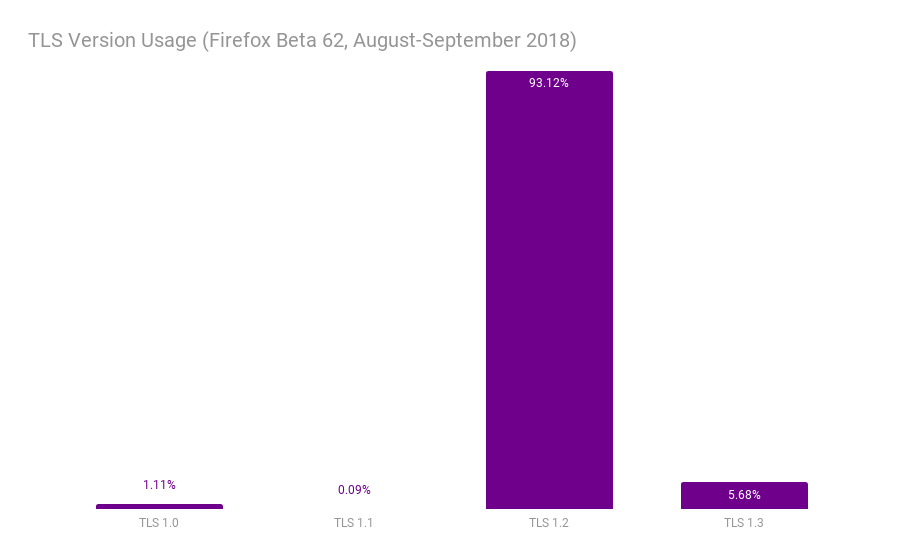
As a user you don’t need to do a thing. The browsers and apps you use will work just as they have before — chances are they’re all using 1.2 already. Mozilla shared a chart showing that only a smattering of connections it sees use the earlier versions:

These connections, low by proportion but still numerous, could be lots of things. Legacy machines embedded here are there; old apps for which the security stack hasn’t been updated in years; hacked devices. It’s almost certainly not you or even your parents.

The long lead time is given because of the possibility (nay, inevitability) that there are some critical systems (for example in aging municipal infrastructure) that will cease to work because of this change. People need time to do a real audit, although they probably should have done it years ago.

This move should make everyone a little safer online, though everything will continue to act exactly as it did before. That’s by design.

15 Oct 2018

Docker has raised $92 million in new funding

Docker, the company that did more to create today’s modern containerized computing environment than any other independent company, has raised $92 million of a targeted $192 million funding round, according to a filing with the Securities and Exchange Commission.

The new funding is a signal that while Docker may have lost its race with Google’s Kubernetes over whose toolkit would be the most widely adopted, the San Francisco-based company has become the champion for businesses that want to move to the modern hybrid application development and information technology operations model of programming.

To understand the importance of containers in modern programming it may help to explain what they are. Put simply, they’re virtual application environments that don’t require an operating system to work. In the past, this type of functionality would have been created using virtual machines, which included software and an operating system.

Containers, by contrast, are more efficient.

Because they only contain the application and the libraries, frameworks, etc. they depend on, you can put lots of them on a single host operating system. The only operating system on the server is that one host operating system and the containers talk directly to it. That keeps the containers small and the overhead extremely low.

Enterprises are quickly moving to containers as they are looking to improve how they develop and manage software — and do so faster. But they can’t do that alone and need partners like Docker to help them make that transition.

What many people miss is that Docker is far more than the container orchestration layer — Kubernetes won that war — but a full toolchain for building and managing those containers.

With every open source project, technology companies are quick to adopt (and adapt) the open source project and be well-versed with how to use it. More mainstream big businesses that aren’t quite as tech-savvy will turn to a company like Docker to help them manage projects developed with the toolkits.

It’s the natural evolution of a technology startup that serves big business customers to become uninteresting while they become more profitable. Enterprises use them. They make money. The hype is gone. Because once a company sells to a big enterprise customer, they stick with that vendor forever.

When Docker’s founder and former chief executive, Solomon Hykes, left the company earlier this year, he acknowledged as much.

… Docker has quietly transformed into an enterprise business with explosive revenue growth and a developer community in the millions, under the leadership of our CEO, the legendary Steve Singh. Our strategy is simple: every large enterprise in the world is preparing to migrate their applications and infrastructure to the cloud, en masse. They need a solution to do so reliably and securely, without expensive code or process changes, and without locking themselves to a single operating system or cloud. Today the only solution meeting these requirements is Docker Enterprise Edition. This puts Docker at the center of a massive growth opportunity. To take advantage of this opportunity, we need a CTO by Steve’s side with decades of experience shipping and supporting software for the largest corporations in the world. So I now have a new role: to help find that ideal CTO, provide the occasional bit of advice, and get out of the team’s way as they continue to build a juggernaut of a business. As a shareholder, I couldn’t be happier to accept this role.

With the money, it’s likely that Docker will ramp up its sales and marketing staff to start generating the kind of revenue numbers it needs to go out for a public offering in 2019. The company has built up a slate of independent directors (in another clear sign that it’s trying to open a window for its exit into the public markets).

Docker is already a “unicorn” worth well over $1 billion. The last time Docker reportedly raised capital was back in late 2017, when The Wall Street Journal  href="https://www.wsj.com/articles/docker-raising-75-million-1507332173">uncovered a filing document from the Securities and Exchange Commission indicating that the company had raised $60 million of a targeted $75 million round. Investors at the time included AME Cloud Ventures, Benchmark, Coatue Management, Goldman Sachs and Greylock Partners. At the time, that investment valued the company at $1.3 billion.

We’ve reached out to the company for comment and will update this post when we hear back.