Year: 2018

15 Oct 2018

Sneaky subscriptions are plaguing the App Store

Subscriptions have turned into a booming business for app developers, accounting for $10.6 billion in consumer spend on the App Store in 2017, and poised to grow to $75.7 billion by 2022. But alongside this healthy growth, a number of scammers are now taking advantage of subscriptions in order to trick users into signing up for expensive and recurring plans. They do this by intentionally confusing users with their app’s design and flow, by making promises of “free trials” that convert after only a matter of days, and other misleading tactics.

Apple will soon have an influx of consumer complaints on its hands if it doesn’t reign in these scammers more quickly.

However, the company’s focus as of late has been more so on getting developers to give subscriptions a try — even holding “secret” meetings where it evangelizes the business model that’s earning developers (and therefore Apple itself) a lot of money. In the meantime, a good handful of apps from bad actors have been allowed to flourish.

Utilities Top Grossing Apps are worst offenders 

Today, the majority of the Top Grossing apps on Apple’s App Store are streaming services, dating sites, entertainment apps or games. But when you get past the market leaders — apps like Fortnite, Netflix, Pandora, Tinder, Hulu, etc. — and down into the top hundreds on the Top Grossing chart, another type of app appears: Utilities.

How are apps like QR code readers, document scanners, translators and weather apps raking in so much money? Especially when some of their utilitarian functions can be found elsewhere for much less, or even for free?

This raises the question as to whether some app developers are trying to scam App Store users by way of subscriptions.

We’ve found that does appear to be true, in many cases.

After reading through the critical reviews across the top money-making utilities, you’ll find customers complaining that the apps are too aggressive in pushing subscriptions (e.g. via constant prompts), offer little functionality without upgrading, provide no transparency around how free trials work and make it difficult to stop subscription payments, among other things.

Here are a few examples. This is by no means a comprehensive list, but rather a representative one, just to illustrate the problem. A recent Forbes article listed many more, if you’re curious.

Scanner AppThis No. 69 Top Grossing app is raking in a whopping $14.3 million per year for its document scanning utility, according to Sensor Tower data. It has an unbelievable number of customer reviews, as well — nearly 340,000 as of today, and a rating of 4.7 stars out of 5. That will lead most customers to believe this is a good and trustworthy app. But when you parse through the critical reviews, you’ll see some valid complaints.
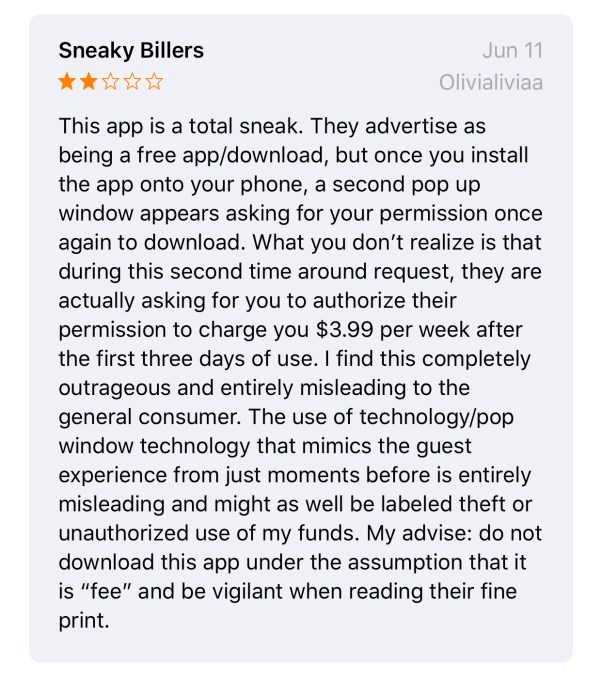
Tap around in the app and you’ll be constantly prompted to subscribe to a subscription ranging from $3.99 a week to $4.99 per month, or start a free trial. But the subscription following the free trial kicks in after only 3 days — something that’s detailed in the fine print, but often missed. Consumers clearly don’t understand what they’re agreeing to, based on their complaints. And many of the negative reviews indicate customers feel they got duped into paying.
QR Code Reader — Forbes recently found that TinyLab’s QR Code Reader was tricking users into a ridiculously priced $156 per year subscription. This has now earned the app the rank of No. 220 Top Grossing across the App Store, and annual revenue of $5.3 million.

QR Code Scanner, via Forbes 

Again, this “free” app immediately starts pushing you to upgrade by starting a “free trial.” And again, this trial converts to a subscription after only 3 days. Can you imagine paying $156 per year for QR code scanning — something the iPhone camera app now does natively?

Weather Alarms – With a 4-star rating after hundreds of reviews, this weather alerting app seems to be handy. But in reality, it’s been using a “dark pattern” to trick users into pushing a button that will start a free trial or sign them up for subscription. And it’s working — to the tune of over a million in annual revenue.

A full screen ad appears in the app, offering two buttons — try for free or pay. The small “X” to close the ad doesn’t even immediately appear! Users then end up paying some $20/month for weather alerts. That seems… excessive.

Legitimate developers have complained about this app for months, but Apple even featured it on its big screen at WWDC. (Watch the video embedded below. It’s incredible.)

*After speaking to Apple about this app, Weather Alarms was removed from the App Store over the weekend. 

Translate Assistant – The same developer behind Weather Alarms offers this real-time translation app promising instant translations across more than 100 languages and has 4.7 stars after nearly 4,000 ratings.

But the app is also super aggressive about pushing its subscriptions. With every app launch, a splash screen appears with three different boxes — 1 month ($12.99/mo), 12 months ($44.99/year) or the “free trial,” which converts users to a pricey $7.99/week plan after only 3 days.

Meanwhile, the option to “continue with a limited version” is in small, gray text that’s intentionally been designed to be hard to see.

The app is making $1.3 million a year, per Sensor Tower data.

As you can tell, the issue with many of these scammy apps is that they capitalize on people not reading the fine print, or they allow an app’s design to guide them to the right button to tap. Trickery like this isn’t anything new — it’s been around on the web as long as software has been sold. It’s just that, now, subscriptions are the hip way to scam.

These developers also know that most people — especially if they’ve just downloaded a new app — aren’t going to immediately subscribe. So they push people to their “free trial” instead. But that “free trial” is actually just an agreement to buy a subscription unless you visit the iTunes Settings and cancel it right away.

Many of these “free trials” convert almost immediately, too, which is another way developers are cashing in. They don’t give you time to think about it before they start charging.

“It’s incredibly frustrating how little has been done to thwart these scams,” says Contrast founder and longtime developer David Barnard, whose apps include Weather Atlas and Launch Center Pro. “It erodes trust in the App Store, which ultimately hurts Apple and conscientious developers who use subscriptions,” he says.

Apple also buries Subscription management 

The issue of scam apps may not always be the failure of App Store review. It’s possible that the scammy apps sneak in their tricks after Apple’s App Review team approves them, making them harder to catch.

But for the time being, users have to take it upon themselves to cancel these sneaky subscriptions.

Unfortunately, Apple isn’t making it as easy for users to get to their subscriptions as it could be.

Compare Apple’s design with Google Play, where the option to manage Subscriptions is in the top-level navigation:
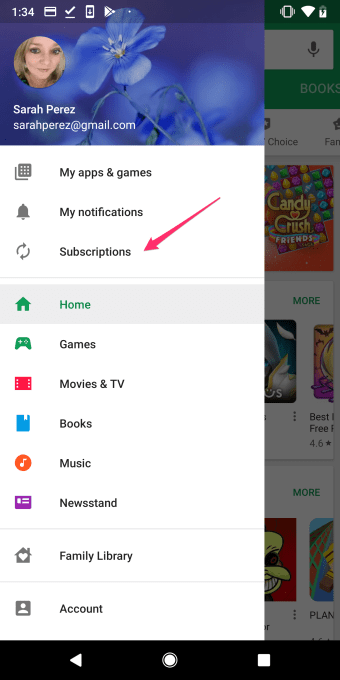
On the iPhone, it takes several more taps and a bit of scrolling to get to the same area in iOS Settings:
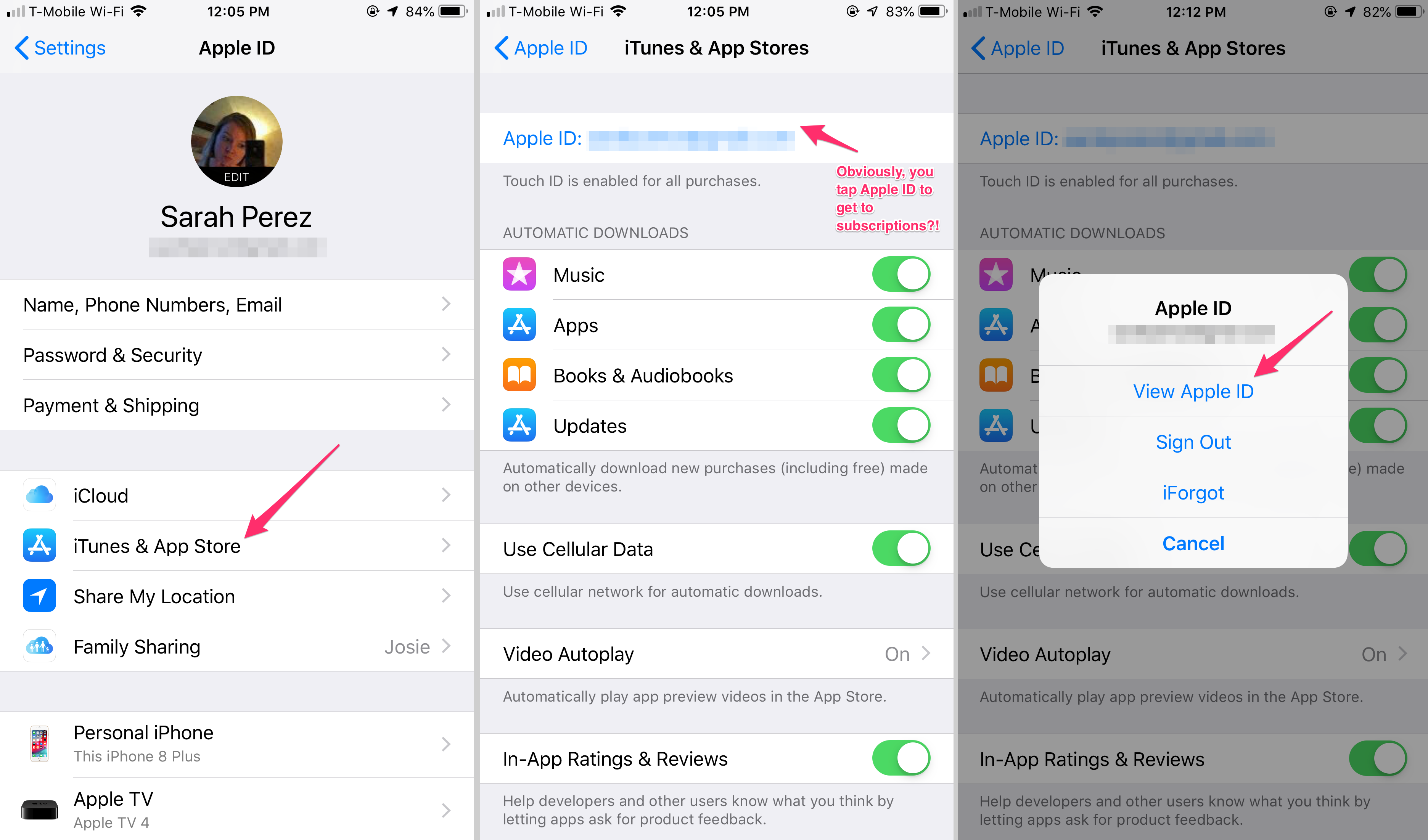
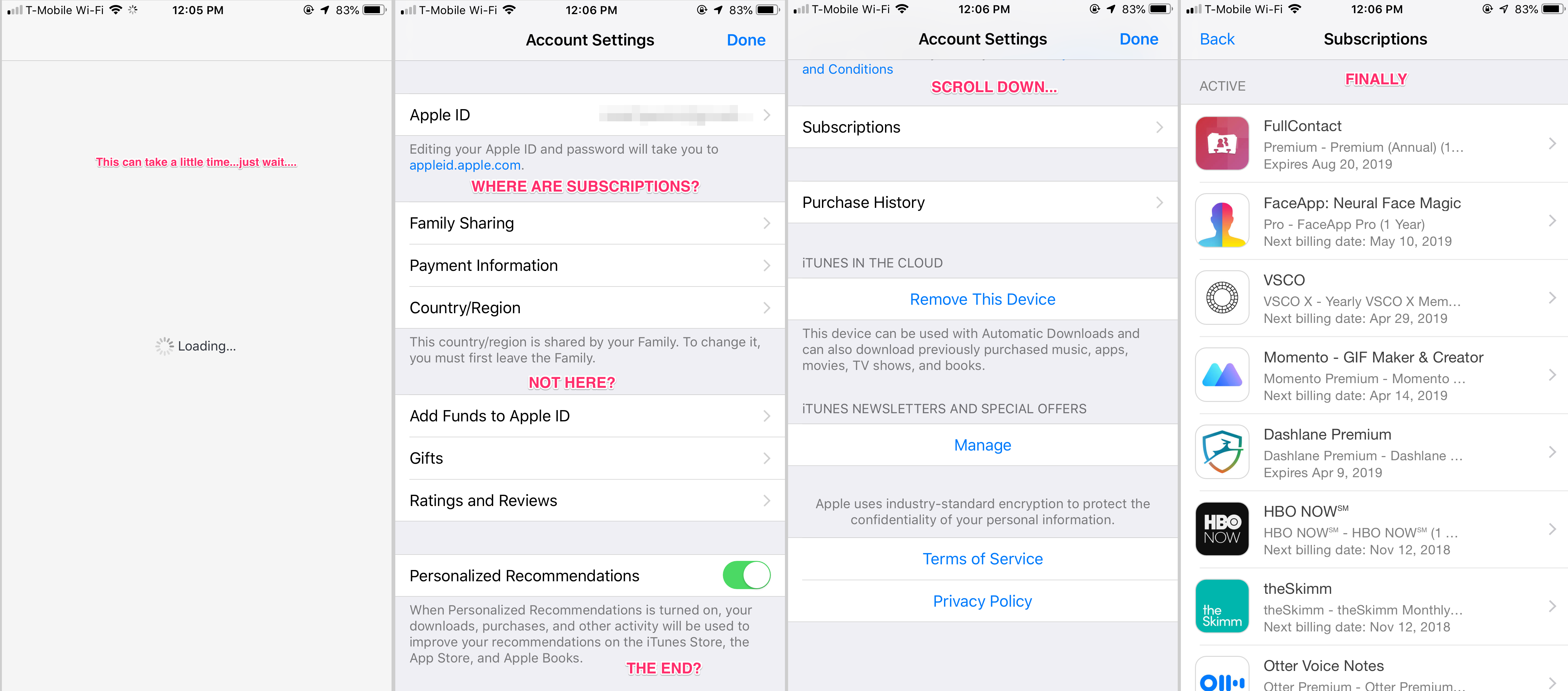
 

Above: Getting to subscriptions in the iPhone Settings (click images to view larger)

In the App Store itself, you can navigate to subscriptions in fewer taps, but it’s not obvious how. You first tap on your profile icon on the top right of the Home page, then your Apple ID, then scroll down to the bottom of the page. It’s still buried further than need be, considering how critical it is to manage these auto-payments.

“I firmly believe this is not the future we should be aspiring for in terms of user experience,” says Denys Zhadanov, VP at Readdle, makers of Scanner Pro, Spark, PDF Expert and other productivity apps, speaking about these scam apps. “Apple as a platform, as an ecosystem, has always been a symbol of trust. That means people can rely on it for personal life and work needs,” he continues.

“The App Store has always been a great place, overseen and curated by highly intelligent and ethical people. I believe the App Store can stay as it always has been, if the right measures are taken to deal with those developers who trick the system,” Zhadanov adds.

Today, most subscription-based businesses thriving on the App Store come from legitimate developers. But they know how scammers could easily ruin the market for everyone involved. If allowed to continue, these scams could lead to consumer distrust in subscriptions in general.

In a worst-case scenario, consumers may even go so far as to avoid downloading apps where subscriptions are offered as in-app purchases in order to protect themselves from scams.

For now, Apple is largely relying on user and developer reports via reportaproblem.apple.com — a site most probably don’t know exists — to help them fight scammers. It needs to do more.

In addition to making access to your subscriptions easier, it also needs to better police “Top Grossing” utilities and productivity apps — especially if the service’s value is questionable, and the 1-star reviews are specifically calling out concerns like “sneaky billing” or mentions other subscription tricks.

Apple declined to comment on the matter, but its Developer Guidelines clearly prohibit fraudulent behavior related to subscriptions, and insist that apps are clear about pricing. In other words, Apple has grounds to clear out these scammy subscription apps, if it chose to focus on this problem more closely in the future.

 

15 Oct 2018

Y Combinator survey confirms what we already know — female founders are too often victims of sexual harassment

Y Combinator has released the results of a survey, completed in partnership with its portfolio company Callisto, highlighting the pervasive role of sexual harassment in venture capital and technology startups.

Callisto, a sexual misconduct reporting software built for victims, is a graduate of YC’s winter 2018 class. The company sent a survey to 125 of YC’s 384 female founders, asking if they had been “assaulted or coerced by an angel or VC investor in their startup career.”

Eighty-eight female founders completed the survey; 19 in total claimed to have experienced some form of harassment.

More specifically, 18 said that inappropriate experience consisted of “unwanted sexual overtures;” 15 said it was “sexual coercion;” four said it was “unwanted sexual contact.”

As part of the release of the survey findings, YC announced they’ve established a formal process for their founders to report harassment and assault within Bookface, the startup accelerator’s private digital portal for its founders.

“You can report at any time, even years after the incident took place,” YC wrote in the blog post. “The report will remain confidential. We encourage other investors to set up similar reporting systems.”

First Round Capital is another investor to recently poll its founders on issues of sexual misconduct. Similarly, the early-stage investor found that half of the 869 founders polled were harassed or knew a victim of workplace harassment.

As for Callisto, the 7-year-old non-profit said it will launch Callisto for founders, a new tool that will support victims. Using Callisto, founders can record the identities of perpetrators in the tech and VC industry. The company will collect the information and refer victims to a lawyer who will provide free advice and the option to share their information with other victims of the same perpetrator. From there, victims can decide if they want to go public together with their accusations.

Tech’s widespread sexual harassment problem is not new, but more women and victims of harassment have come forward in recent years as the #MeToo movement encourages them to name their harassers. Justin Caldbeck, formerly of Binary Capital, and former SoFi chief executive officer Mike Cagney are among the Silicon Valley elite to be ousted amid allegations of sexual misconduct in the #MeToo era.

15 Oct 2018

A former Google+ UI designer suggests inept management played a role in the network’s demise (beyond Facebook’s impact)

A lot of people leave their jobs because of bosses they can’t stand. Yet it’s seldom the case that a former employee publicly badmouths management after the fact. The obvious risk in doing so: future employers might not want to gamble on this person badmouthing them at a later date.

That isn’t stopping Morgan Knutson, a UI designer who seven years ago, spent eight months at Google working on its recently shuttered social networking product Google+ and who, in light of the shutdown, decided to share on Twitter his personal experience with how “awful the project and exec team was.”

It’s a fairly long read, but among his most notable complaints is that former Google SVP Vic Gundotra, who oversaw Google+, ruled by fear and never bothered to talk with Knutson, whose desk was “directly next to Vic’s glass-walled office. He would walk by my desk dozens of times during the day. He could see my screen from his desk. During the 8 months I was there, culminating in me leading the redesign of his product, Vic didn’t say a word to me. No hello. No goodbye, or thanks for staying late. No handshake. No eye contact.”

He also says Gundotra essentially bribed other teams within Google to incorporate Google+’s features into their products by promising them handsome financial rewards for doing so atop their yearly bonuses. “You read that correctly, “tweeted Knutson. “A f*ck ton of money to ruin the product you were building with bloated garbage that no one wanted.”

Gundotra is today the cofounder and CEO of AliveCor, maker of a device that captures a “medical grade” E.K.G. within 30 seconds; AliveCor has gone on to raise $30 million from investors, including the Mayo Clinic.

Asked about Knutson’s characterization of him, Gundotra suggested the rant was “absurd” but otherwise declined to comment.

Knutson disparages even more strongly a former manager that he calls “Greg” and he portrays a fellow designer, Jim, as paranoid and vindictive. Indeed, in describing how his unit was organized, Knutson paints a picture of a political, haphazard, wasteful and ultimately disappointing division where it was never quite clear who should be working on what or why. In fact, though he says he thought he was “joining the big leagues” when recruited by Google, Knutson wound up taking a job with Dropbox shortly afterward in order to escape from the corporate leviathan.

It also sounds from his own telling like Knutson might have been canned eventually.

No matter what you think of the tweets, it’s an interesting narrative and it’s instructive as one insider’s view onto what — other than Facebook’s stranglehold on users — may have ultimately doomed Google+, which was shut down last week due to lack of user and developer adoption (even while a business version of the network lives on for the foreseeable future).

The biggest takeaway: like many other gigantic companies, Google has its fair share of flaws.

You can check out the full tweetstorm here.

Thread Reader has also published them in a more palatable format here.

15 Oct 2018

Chinese electric automakers Nio exceeds Q3 delivery target for its ES8 SUV

Nio, the Chinese electric automaker aiming to compete with Tesla, reported that it delivered 3,268 of its new ES8 vehicles in the third quarter, beating its own target by 9%.

The company planned to deliver between 2,900 and 3,000 ES8s in the third quarter, according to Nio CFO Louis T. Hsieh.

Nio began deliveries of the ES8, a 7-seater high performance electric SUV in China on June 28. The company reported that its year-to-date ES8 deliveries, as of September 30, 2018, totaled 3,368 vehicles. The first 100 vehicles were delivered in the last days of the second quarter.

“Growing our monthly deliveries from 381 in July to 1,766 in September demonstrates our steady production ramp, strong demand from users and the initial acceptance of NIO as a premium brand,” William Li, founder, Chairman and CEO of Nio, said in a statement.

The company, which shut down its ES8 production line for 10 days for routine maintenance and to install equipment for its second production line, warned that deliveries in October will be lower.

However, the company said it remains on track to hit its delivery target of 10,000 ES8 vehicles for the second half of 2018.

The company is planning to release the ES6, a 5-seater premium SUV,  in June/July 2019.

Nio, which raised $1 billion when it debuted on the New York Stock Exchange in September, has operations in the U.S., U.K. and Germany, although it only sells its ES8 vehicle in China. The 7-seater ES8 SUV is priced at 448,000 RMB, or around $65,000.

Baillie Gifford  & Co., the second-biggest shareholder of Tesla stock, owns an 11.44 percent stake in Nio, according to a regulatory filing posted October 9.

15 Oct 2018

Pokémon Go maker Niantic is coming to TechCrunch Sessions AR/VR

Niantic is one of the few companies in the augmented reality world making some actual goddamn revenue.

As such, It didn’t feel right not to have the company that built Pokemon Go represented at our one-day Sessions AR/VR event this Thursday in LA. I’ll be sitting down with the company’s AR research lead Ross Finman at the event to talk about why augmented reality is so important to Niantic’s future and why AR tech can actually make tomorrow’s games and apps more engaging.

The game maker struck gold with Pokemon Go, but as it looks for lighting to strike twice with its upcoming Harry Potter title that’s being released later this year, the company has become a lot more vocal about the potential of AR tech to make users feel like the game world and the physical world are aligned.

Finman joined Niantic after the startup he co-founded, Escher Reality, was acquired by the company earlier this year. Prior to founding Escher, Finman spent 7 years at MIT researching 3D perception and mapping. There isn’t much in the augmented reality space he hasn’t directly interacted with.

We’ll chat with Finman about the challenges of scaling some of these more experimental technologies to a global user base and what learnings Niantic has garnered from all of the success of Pokemon Go.

Final tickets are now on sale – book yours here and you’ll save 35% on general admission tickets. Student tickets are $45.


15 Oct 2018

Winamp returns in 2019 to whip the llama’s ass harder than ever

The charmingly outdated media player Winamp is being reinvented as a platform-agnostic audio mobile app that brings together all your music, podcasts, and streaming services to a single location. It’s an ambitious relaunch, but the company behind it says it’s still all about the millions-strong global Winamp community — and as proof, the original desktop app is getting an official update as well.

For those who don’t remember: Winamp was the MP3 player of choice around the turn of the century, but went through a rocky period during Aol ownership (our former parent company) and failed to counter the likes of iTunes and the onslaught of streaming services, and more or less crumbled over the years. The original app, last updated in 2013, still works, but to say it’s long in the tooth would be something of an understatement (the community has worked hard to keep it updated, however). So it’s with pleasure that I can confirm rumors that substantial updates are on the way.

“There will be a completely new version next year, with the legacy of Winamp but a more complete listening experience,” said Alexandre Saboundjan, CEO of Radionomy, the company that bought Winamp (or what remained of it) in 2014. “You can listen to the MP3s you may have at home, but also to the cloud, to podcasts, to streaming radio stations, to a playlist you perhaps have built.”

“People want one single experience,” he concluded. “I think Winamp is the perfect player to bring that to everybody. And we want people to have it on every device.”

Laugh if you want but I laugh back

Now, I’m a Winamp user myself. And while I’ve been saddened by the drama through which the iconic MP3 player and the team that created it have gone (at the hands of TechCrunch’s former parent company, Aol), I can’t say I’ve been affected by it in any real way. Winamp 2 and 5 have taken me all the way from Windows 98 SE to 10 with nary a hiccup, and the player is docked just to the right of this browser window as I type this. (I use the nucleo_nlog skin.)

And although I bear the burden of my colleagues’ derisive comments for my choice of player, I’m far from alone. Winamp has as many as a hundred million monthly users, most of whom are outside the US. This real, engaged user base could be a powerful foot in the door for a new platform — mobile-first, but with plenty of love for the desktop too.

“Winamp users really are everywhere. It’s a huge number,” said Saboundjan. “We have a really strong and important community. But everybody ‘knows’ that Winamp is dead, that we don’t work on it any more. This is not the case.”

This may not come as a shock Winamp users still plugged into the scene: following years of rumors, an update to the desktop player leaked last month, bringing it from version 5.666 to 5.8. It was a pleasant surprise to users who had encountered compatibility problems with Windows 10 but had taken the “more coming soon” notice on the website with a massive grain of salt.

This kind of thing happens a lot, after all: an old property or app gets bought, promises are made, and after a few years it just sort of fades away. So a free update — in fact, 5.8 eliminates all paid options originally offered in the Pro version — bringing a bucketful of fixes is like Christmas coming early. Or late. At any rate it’s appreciated.

The official non-leaked 5.8 release should come out this week (the 18th, to be precise), and won’t be substantially different from the one we’ve been using for years or the one that leaked. Just bug and compatibility fixes that should keep this relic trucking along for a few years longer.

The update to the desktop app is basically a good faith advance payment to the community: Radionomy showing they aren’t just running away with the property and slapping the brand on some random venture. But the real news is Winamp 6, which Saboundjan says should come out in 2019.

“What I see today is you have to jump from one player to another player or aggregator if you want to listen to a radio station, to a podcast player if you want to listen to a podcast — this, to me, is not the final experience,” he explained. It’s all audio, and it’s all searchable in one fashion or another. So why isn’t it all in one place?

The planned version of Winamp for iOS and Android will be that place, Saboundjan claims. On desktop, “the war is over,” he said, and between the likes of iTunes and web apps, there’s not much room to squeeze in. But mobile audio is fractured and inconvenient.

While Saboundjan declined to get into the specifics of which services would be part of the new Winamp or how the app would plug into, say, your Spotify playlists, your Google Music library, your Podcasts app, Audible, and so on, he seemed confident that it would meet the needs he outlined. There are many conversations underway, he said, but licensing and agreements aren’t the main difficulty, and of course release is still quite a ways out. The team has focused on creating a consistent app across every platform you might want encounter mobile audio. A highly improved search will also play a role — as it ought to, when your media is all lumped into one place.

No word on whether it will retain its trademark intro upon installation — “WINAMP. It really whips the llama’s ass.” I certainly hope so.

This lack of specifics is a bit frustrating, of course, but I’m not worried about vaporware. I’m worried that other services will insist on the fragmented experience they’ve created that serves their interests better than ours. But if Radionomy can navigate these tricky waters and deliver a product even a little like what they’ve described, I’ll be thrilled (and my guess is tens of millions more will be as well). And if not, well, we’ll always have the original.

15 Oct 2018

Worries linger as Facebook withholds stolen searches & checkins

Hacked Facebook users still don’t know which 15 recent searches and 10 latest checkins were exposed in the company’s massive breach it detailed last week. The company merely noted that those were amongst the data sets stolen by the attackers. That creates uncertainty about how sensitive or embarrassing the scraped data is, and whether it could possibly be used to blackmail and stalk them.

Much of the scraped data from the 14 million most-impacted users out of 30 million total people hit by the breach was biographical and therefore relatively static, such as their birth date, religion or hometown. While still problematic because it could be used for unconsented ad targeting, scams, hacking attempts or social engineering attacks, at least users likely know what was illicitly grabbed.

Thankfully, some of the most sensitive data fields, such as sexual orientation, were not accessed, Facebook confirms to me. But the exposure of recent searches and checkins could threaten users in different ways.

Given the attack was so broad and impacted a wide variety of users, unlike say a targeted attack on the Democratic National Convention, there’s no evidence that blackmailing or stalking individual users was the purpose of the hack. For the average user hit by the breach, the likelihood of this kind of follow-up attack may be low.

But given that public figures, including Facebook CEO Mark Zuckerberg and COO Sheryl Sandberg, were victims of the attack, as well as many reporters (myself included), there remains a risk that the perpetrators paw through the data seeking high-profile people to exploit.

Stolen data on “the 15 most recent searches you’ve entered into the Facebook search bar” could contain embarrassing or controversial topics, competitive business research or potential infidelity. Many users might be mortified if their searches for racy content, niche political viewpoints or their ex-lovers were published in association with their real name. Hackers could potentially target victims with blackmail scams threatening to reveal this info to the world, especially since the hack included user contact info, including phone numbers and email addresses.

Scraped checkins could power real-world stalking or attacks. Users’ exact GPS coordinates were not accessible to the hackers, but they did grab 14 million people’s “10 most recent locations you’ve checked in to or been tagged in. These locations are determined by the places named in the posts, such as a landmark or restaurant, not location data from a device,” Facebook writes. If users checked in to nearby coffee shops, their place of work or even their home if they’ve given it a cheeky name as some urban millennials do, their history of visiting those locations is now in dangerous hands.

If users at least knew what searches or checkins of theirs were stolen, they could choose if or how they should modify their behavior or better protect themselves. That’s why amongst Facebook’s warnings to users about whether they were hacked and what types of data were accessed, it should also consider giving those users the option to see the specific searches or checkins that were snatched.

When asked by TechCrunch, a Facebook spokesperson declined to comment on its plans here. It is understandable that the company might be concerned that disclosing the particular searches and checkins could unnecessarily increase fear and doubt. But if it’s just trying to limit the backlash, it forfeited that right when it prioritized growth and speed over security.

As Facebook tries to recover from the breach and regain the trust of its audience of 2.2 billion, it should err on the side of transparency. If hackers know this information, shouldn’t the hacked users too?

15 Oct 2018

No, Apple didn’t acquire music analytics startup Asaii, it hired the founders to work on Apple Music

On the heels of news of not one but two acquisitions from Apple last week, a report surfaced yesterday that Apple had picked up yet another company, the music analytics startup Asaii, for under $100 million; the report led to a “confirmation” from a shareholder in a separate report. But as it turns out, neither appear to be correct.

But we asked and Apple has declined to confirm the deal, and it gave no green light to use its usual statement — the one it often issues when smaller startups are acquired. (You can see a sample of it in this story about Apple buying computer vision startup Spektral last week, which we did get Apple to confirm.) That is, the company has not acquired the assets of the startup.

What it has done is hire a few employees of the company — specifically the three founders, Sony TheakanathAustin Chen and Chris Zhang — who are all now working at Apple at Apple Music. (Apple has done this before: for example, it hired a team from the mapping app PinDrop in the UK; at the time it was also misreported as an acquisition.)

It’s not clear if the three will be working on similar technology, or other kinds of tools to affect how music is discovered on Apple Music. Apple has already launched a beta of its own analytics service called Apple Music for Artists.

Asaii announced in September that it would shut down its service October 14 (yesterday). It also provided music analytics, but it focused on a wider picture across multiple platforms (not just a single silo like Apple Music or Spotify).

Spotify — the music streaming business that is currently Apple’s biggest rival — has added a number of features over the years (some built in-house, some by way of acquisition) to improve the services that it offers to artists to have more transparency on how well their music, and their “brands,” are performing on Spotify. For Spotify, it’s part of a suite of services to help them leverage Spotify as a distribution platform to improve their overall business as artists.

Some believe that Spotify will continue to ramp up these services over time to take on more of the functions of a traditional label in a bid to improve its margins, and also provide more utility to artists. It’s making those moves at a time when many musicians and songwriters have grown disillusioned with the music industry and how they can (or can’t, as the case may be) make money in it.

So it stands to reason that Apple, too, might be considering how it can build similar features into Apple Music — although the company has not confirmed that it will, nor will it be using Asaii’s existing tools to do so.

To be clear, Apple already has some features in place to help promote and understand how music performs on its platform. The beta of Apple Music for Artists, which launched in June of this year, currently provides details on plays, radio spins, song purchases and album purchases.

It also lets you look into trends around your music, control how your artist profile looks, and get insights into how and where your music gets discovered. Separately, it also provides various widgets you can use to promote your Apple Music tracks elsewhere, as well a guidelines on best practices.

But there is still a lot of ground to cover for Apple when it comes to music, both in terms of what it can provide artists as tools to improve their experience on there; and also in terms of how consumers discover and use music on the service. Both of these are potential areas that you might see getting developed over time.

Theakanath and Chen had both worked at Apple previously. PitchBook lists SkyDeck, an accelerator based at UC Berkeley, as its only investor. Meanwhile, Crunchbase lists The House Fund as its only investor, with no details on the amount raised.

15 Oct 2018

Electric scooter startup Grin raises ~$45 million

Grin, an electric scooter startup backed by Y Combinator, has raised a $45.7 million Series A to operate shared, electric scooters in Latin America.

Grin, which is based in Mexico City, had previously raised funding from Sinai Ventures, Liquid2 Ventures, 500 Startups, Monashees, Base10 Partners and others.

Currently, Grin only operates in Mexico City but it has plans to expand to other cities throughout Latin America.

Electric scooters are clearly a hot space. U.S.-based companies like Bird and Lime have raised millions of dollars. Bird is currently valued at over $2 billion while Lime is valued at over $1 billion. Meanwhile, transportation behemoths Lyft and Uber have both staked their claim in the electric scooter space, both deploying them in Santa Monica, Calif. in the last month.

I’m getting in touch with Grin co-founder Sergio Romo shortly. More to come.

15 Oct 2018

Nurse-1-1 lets you text a nurse for health info, learn if a doctor is needed

A new startup wants to help you figure out if your medical issue requires a visit to a doctor’s office, the ER, or can be handled over a telemedicine service, while also providing you with some basic information about the problem and its severity. Nurse-1-1, the latest company from former RunKeeper co-founder Michael Sheeley, is launching today to offer a quick, affordable way to get answers from physician assistants, nurse practitioners, and registered nurses via chat.

Sheeley, a serial entrepreneur, sold his shopping app Kickscout to Mobee in 2014, and later worked on a food ordering service before starting Nurse-1-1 around two years ago.

The idea for the startup emerged from an experience he had after the birth of his daughter.

“My daughter was born with a congenital heart defect,” Sheeley explains – a health crisis that involved her having open heart surgery, he tells us. “I was sitting next to her for a week while she was recovering in the hospital….and I was Google searching everything and anything I could to learn about her condition,” he says.
But the more he read, the more confused he became, as it can be hard to parse health information found online.

He ended up connecting with his wife’s friend, a nurse practitioner, over SMS text messaging, in order to ask some of the questions that he hadn’t asked the doctors at the hospital.

“I was having these conversations with my friend, Kim, and I didn’t have to worry about it being a treatment; I didn’t have to worry about it being a prescription; and I didn’t have to worry about interrupting her busy day,” Sheeley says.

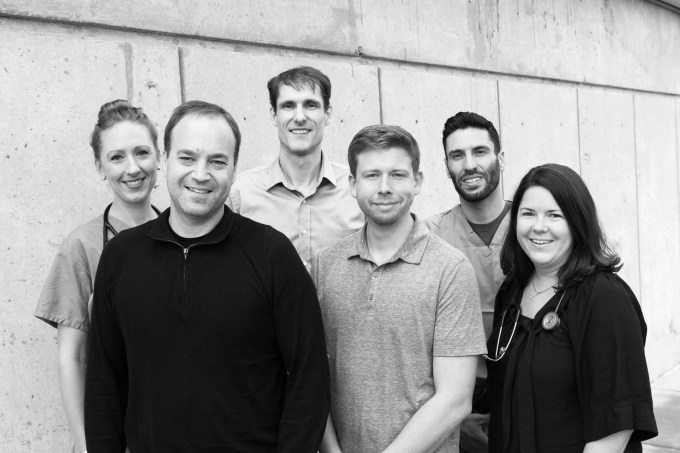
That nurse practitioner, Kim Liner, now works at Nurse-1-1 along with Meri Clare, RN; an ER doctor from Boston Children’s Hospital, Igor Shumskiy, MD; and a former marketing exec for TripAdvisor, Steve McAveeney, among others. The team is currently based out of Harvard University’s Innovation Lab.

The team opted for texting instead of calls, after doing some customer research. They found that most people preferred to communicate asynchronously – like through text messages. When offered the choice between phone calls, video chat or texting via the Nurse-1-1 website, patients choose texting at a much higher rate.

The startup also found that, often, what people first want to know when they have a health concern is what level of care they should get.

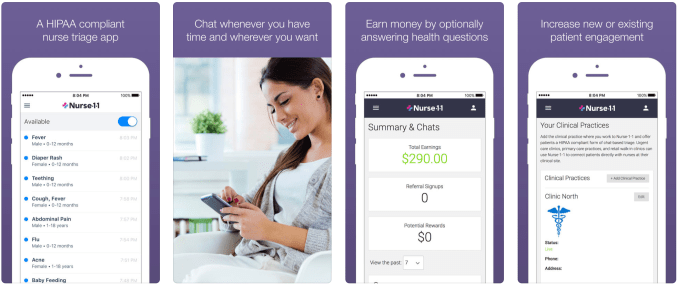
Ahead of today’s launch, the texting service was tested with over 1,200 patients and received interest from 190 nurses, who have since joined its platform. It’s free to end users if the patient’s provider is signed up on Nurse-1-1. (None have yet – but discussions are underway, Sheeley says.) Otherwise it’s $12.50 per chat.

This is much less than video visits with doctors, which typically go for around $49 or have co-pays of around $30 per visit.


“The triage industry is a multi-billion dollar industry. When you call your doctor late at night and get that phone call back, it’s usually a third-party service calling you. They charge $15 per call to these clinics and it’s very low quality,” Sheeley explains. “Our business model is to charge clinics only $12.50 per call…if your provider is on the platform, that money is charged to them, not to [patients.],” he notes.

When your provider is not available, the money customers pay, minus a $2.50 processing fee, will go directly to nurses instead.

In the future, Nurse-1-1 may generate referrals to telemedicine providers, allowing it to earn referral fees, too.

Already, the company found that many of its customers are moms or moms-to-be, asking questions about pregnancy, kid’s ailments, colds, flus, and the like. They’re trying to figure out if they should visit an urgent care now, or see a doctor in the morning, for example.

The service works both via the web and through an iOS app. It’s HIPAA-compliant, and data is encrypted end-to-end.

Nurse-1-1 is immediately available across the U.S. because it’s not actually prescribing or diagnosing. The company hasn’t raised outside funding, but may look to do a seed round in the near future.