Year: 2018

15 Oct 2018

Vinli launches mobility data platform, signs partnership with ALD Automotive

Connected car startup Vinli aims to connect vehicles to the cloud and is today announcing a change in its business model as it partners with the largest fleet operator in Europe, ALD Automotive.

Vinli launched in 2014 as a direct consumer company that allowed owners to add cloud services to automobiles. It was a clever concept, and when it launched four years ago, it was ahead of the curve. The company went on to raise to $6.5M through four rounds of funding, slowly evolving the product to meet the changing needs of the market.

Today, the company is announcing a change in focus and will no longer sell products directly to consumers. The company founder and CEO Mark Haider tells TechCrunch this is in response to the product’s evolution, which can now offer enterprises a platform for them to launch their own mobility applications directly to their users.

Vinli is discontinuing the production of its hardware and will work with partners to offer the same services to consumers.

To go along with this new business strategy, Vinli is launching a data platform that Haider tells me can ingest data from any source and correlate it with machine learning and AI, allowing customers to develop predictive services for their products. Called Era, Vinli believes this will enable its customers to mine trends from data without the need of data scientists.

Vinli signed a deal with ALD Automotive to add its connected services to its fleets of 1.6 million vehicles. In a press release, ALD Automotive says Vinli will enrich ALD’s “overall service offering and develop new value-added solutions to improve both driver experience and optimize overall Total Cost of Ownership for efficient fleet management.”

“We believe that the automotive industry is evolving to become a service-based and subscription-driven industry,” said Mark Haidar, CEO of Vinli. “Connected cars and data are at the epicenter of this change. Collecting, analyzing, and discovering trends from ALD’s 1.6 million vehicles will not only be transformative to the driver but to the industry as a whole”

Terms of the partnership were not released.

Connecting vehicles to the cloud has significant implications as car makers, insurers and consumers alike can gain deep insights into the habits of the driver and mechanics of the car throughout its life. Vinli seems well positioned to offer a platform to provide this data and today’s moves should help the company into the future.

15 Oct 2018

Adobe XD now lets you prototype voice apps 

Adobe XD, the company’s platform for designing and prototyping user interfaces and experiences, is adding support for a different kind of application to its lineup: voice apps. Those could be applications that are purely voice-based — maybe for Alexa or Google Home — or mobile apps that also take voice input.

The voice experience is powered by Sayspring, which Adobe acquired earlier this year. As Sayspring’s founder and former CEO Mark Webster told me, the team has been working on integrating these features into XD since he joined the company.

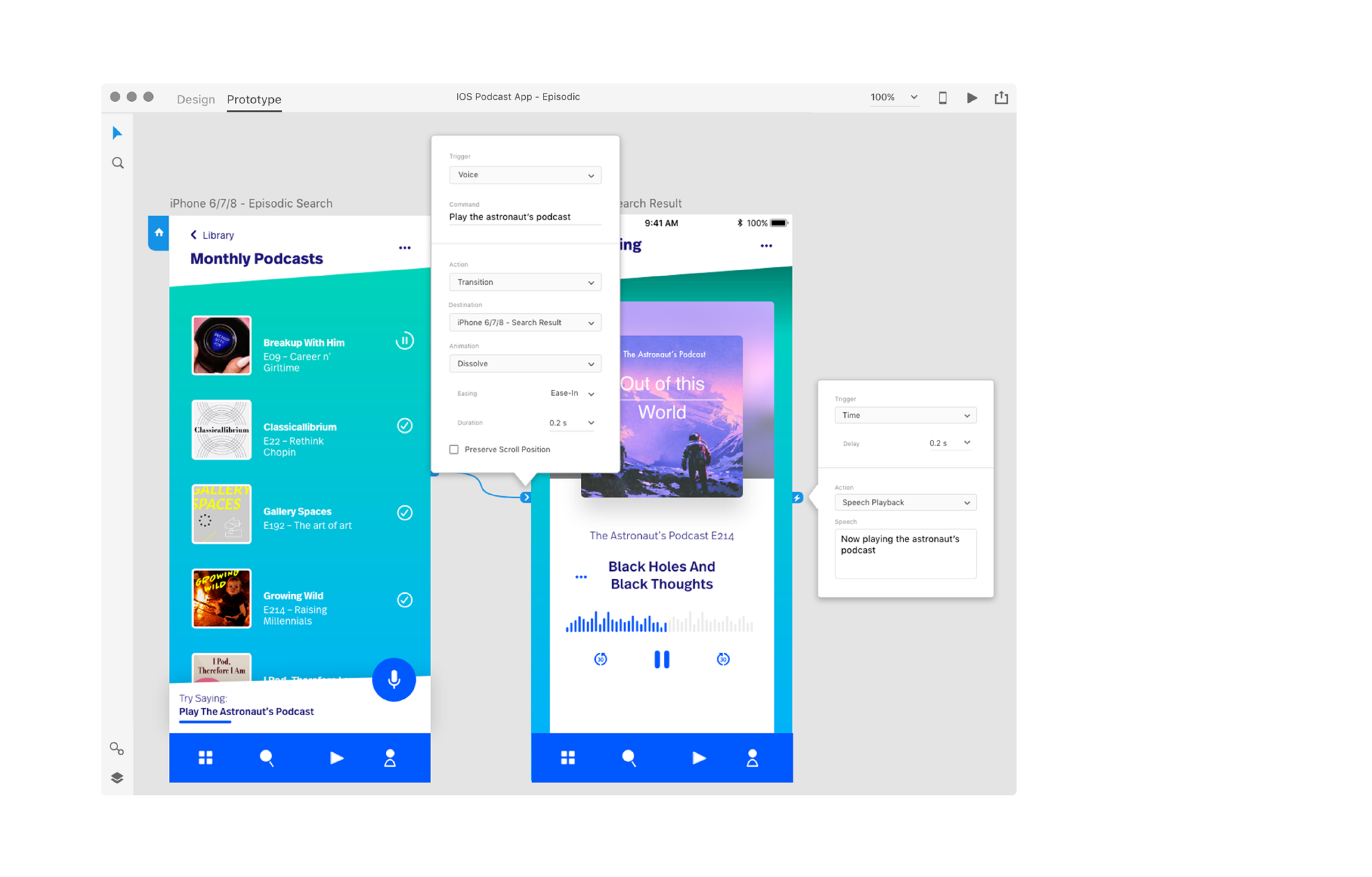
To support designers who are building these apps, XD now includes voice triggers and speech playback. That user experience is tightly integrated with the rest of XD and in a demo I saw ahead of today’s reveal, building voice apps didn’t look all that different from prototyping any other kind of app in XD.

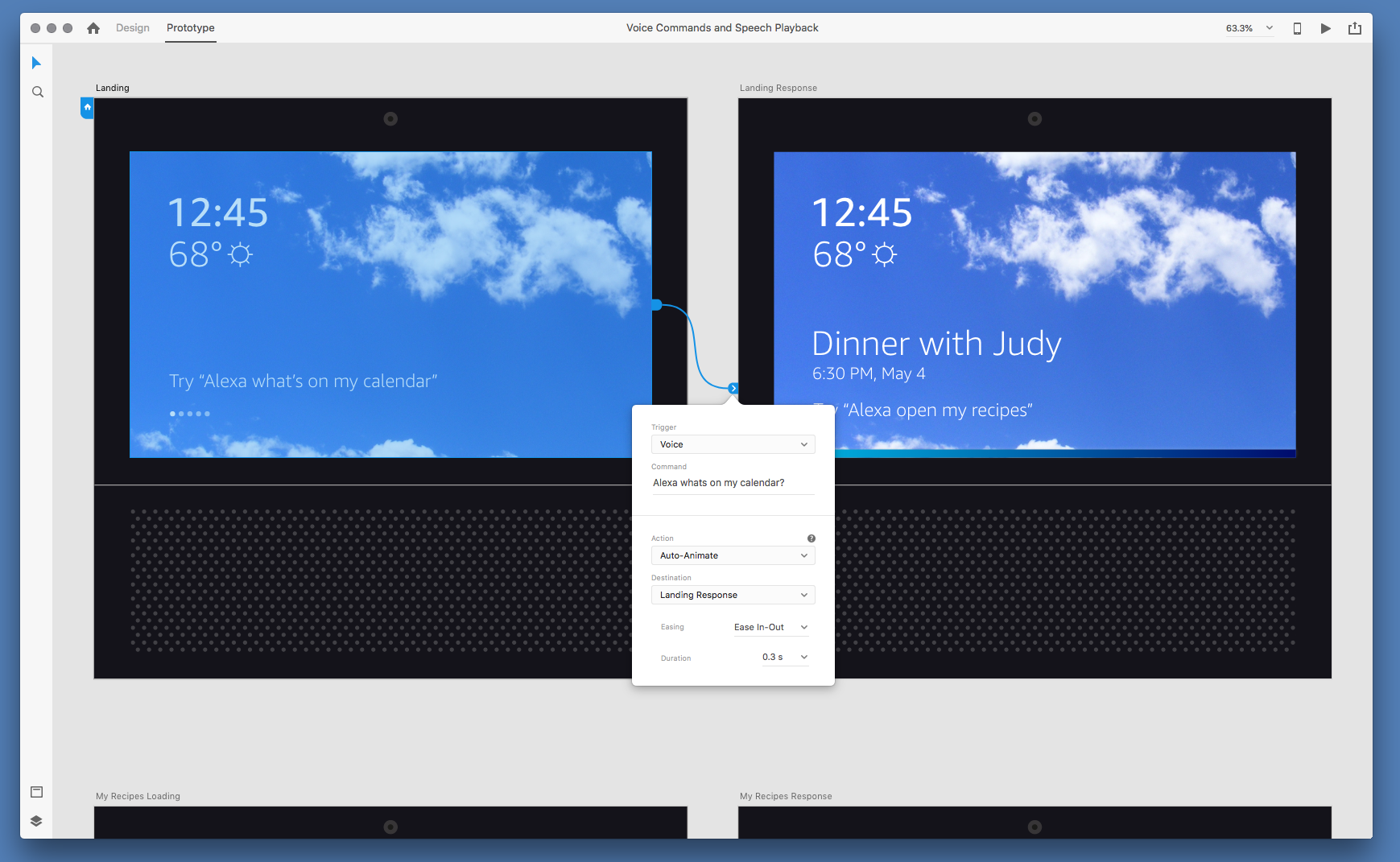
To make the user experience realistic, XD can now trigger speech playback when it hears a specific word or phrase. This isn’t a fully featured natural language understanding system, of course, since the idea here is only to mock-up what the user experience would look like.

“Voice is weird,” Webster told me. “It’s both a platform like Amazon Alexa and the Google Assistant, but also a form of interaction […] Our starting point has been to treat it as a form of interaction — and how do we give designers access to the medium of voice and speech in order to create all kinds of experiences. A huge use case for that would be designing for platforms like Amazon Alexa, Google Assistant and Microsoft Cortana.”

And these days, with the advent of smart displays from Google and its partners, as well as the Amazon Echo Show, these platforms are also becoming increasingly visual. As Webster noted, the combination of screen design and voice is being more and more important now and so adding voice technology into XD seemed like a no-brainer.

Adobe’s product management lead for XD Andrew Shorten stressed that before acquiring Sayspring and integrating it into XD, its users had a hard time building voice experiences. “We started to have interactions with customers who were beginning to experiment with creating experiences for voice,” he said. “And then they were describing the pain and the frustration — and all the tools that they’d use to be able to prototype didn’t help them in this regard. And so they had to pull back to working with developers and bringing people in to help with making prototypes.”

XD is getting a few other new features, too. It now features a full range of plugins, for example, that are meant to automate some tasks and integrate it with third-party tools.

Also new is auto-animate, which brings relatively complex animation to XD that appear when you are transitioning between screens in your prototype app. The interesting part here, of course, is that this is automated. To see it in action, all you have to do is duplicate an existing artboard, modify some of the elements on the pages and tell XD to handle the animations for you.

The release also features a number of other new tools. Drag Gestures now allows you to re-create the standard drag gestures in mobile apps, maybe for building an image carousel, for example, while linked symbols make it easier to apply changes across artboards. There is also now a deeper integration with Adobe Illustrator and you can export XD designs to After Effects, Adobe’s animation tool for those cases where you need full control over animations inside your applications.

15 Oct 2018

Adobe is bringing Photoshop CC to the iPad 

It’s no secret that Adobe is currently in the process of modernizing its Creative Cloud apps and bringing them to every major platform. Today, the company is using its Max conference in Los Angeles today to officially announce Photoshop CC for the iPad.

Sadly, you won’t be able to try it today, but come 2019, you’ll be able to retouch all of your images right on the iPad. And while it won’t feature ever feature of the desktop from the get-go, the company promises that it’ll add them over time.

As with all of Adobe’s releases, Photoshop for iPad will play nicely with all other versions of Photoshop and sync all the changes you make to PSD files across devices. Unsurprisingly, the user experience has been rethought from the ground up and redesigned for touch. It’ll feature most of the standard Photoshop image editing tools and the layers panel. Of course, it’ll also support your digital stylus.

Adobe says the iPad version shares the same code base as Photoshop for the desktop, “so there’s no compromises on power and performance or editing results.”

For now, though, that’s pretty much all we know about Photoshop CC on the iPad. For more, we’ll have to wait until 2019. In a way though, that’s probably all you need to know. Adobe has long said that it wants to enable its users to do their work wherever they are. Early on, that meant lots of smaller specialized apps that synced with the larger Creative Cloud ecosystem, but now it looks as if the company is moving toward bringing full versions of its larger monoliths like Photoshop to mobile, too.

15 Oct 2018

Celonis brings intelligent process automation software to cloud

Celonis has been helping companies analyze and improve their internal processes using machine learning. Today the company announced it was providing that same solution as a cloud service with a few nifty improvements you won’t find on prem.

The new approach, called Celonis Intelligent Business Cloud, allows customers to analyze a workflow, find inefficiencies and offer improvements very quickly. Companies typically follow a workflow that has developed over time and very rarely think about why it developed the way it did, or how to fix it. If they do, it usually involves bringing in consultants to help. Celonis puts software and machine learning to bear on the problem.

Co-founder and CEO Alexander Rinke says that his company deals with massive volumes of data and moving all of that to the cloud makes sense. “With Intelligent Business Cloud, we will unlock that [on prem data], bring it to the cloud in a very efficient infrastructure and provide much more value on top of it,” he told TechCrunch.

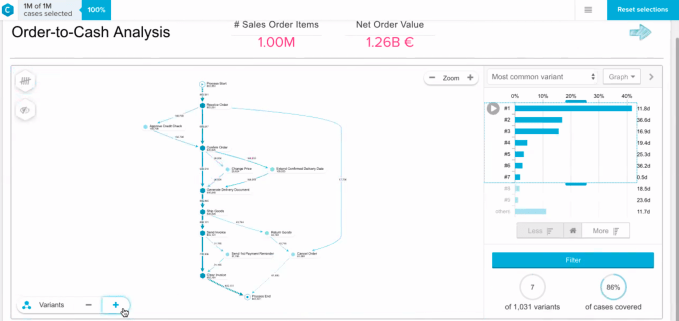
The idea is to speed up the whole ingestion process, allowing a company to see the inefficiencies in their business processes very quickly. Rinke says it starts with ingesting data from sources such as Salesforce or SAP and then creating a visual view of the process flow. There may be hundreds of variants from the main process workflow, but you can see which ones would give you the most value to change, based on the number of times the variation occurs.

Screenshot: Celonis

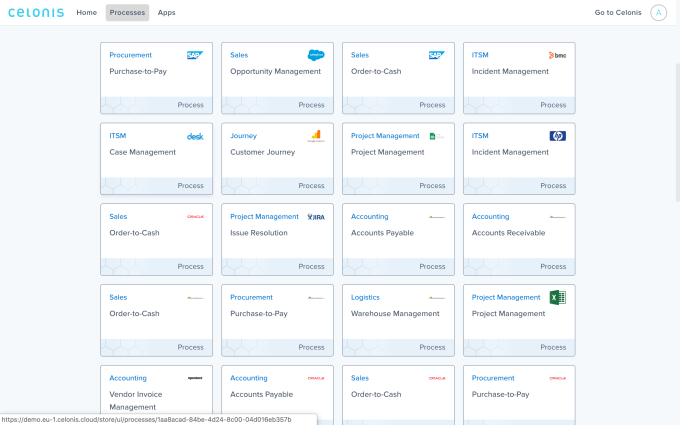
By packaging the Celonis tools as a cloud service, they are reducing the complexity of running and managing it. They are also introducing an app store with over 300 pre-packaged options for popular products like Salesforce and ServiceNow and popular process like order to cash. This should also help get customers up and running much more quickly.

New Celonis App Store. Screenshot: Celonis

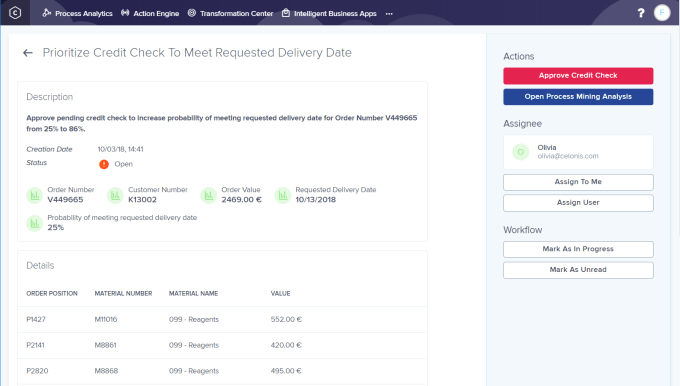
The cloud service also includes an Action Engine, which Rinke describes as a big step toward moving Celonis from being purely analytical to operational. “Action Engine focuses on changing and improving processes. It gives workers concrete info on what to do next. For example in process analysis, it would notice on time delivery isn’t great because order to cash is to slow. It helps accelerate changes in system configuration,” he explained.

Celonis Action Engine. Screenshot: Celonis

The new cloud service is available today. Celonis was founded in 2011. It has raised over $77 million. The most recent round was a $50 million Series B on a valuation over $1 billion.

15 Oct 2018

Saudi ally calls for Uber boycott over response to Khashoggi’s vanishing

Uber is facing calls for a boycott of its app in the Persian Gulf, a region that has poured billions of dollars of investment into the company’s ride-hailing business in recent years: Directly via Saudi Arabia’s Public Investment Fund (PIF) and indirectly because the Saudis are major investors in Softbank’s Vision Fund vehicle, which is another big Uber investor.

The regional calls to boycott Uber were stoked yesterday by Saudi ally, Bahrain, whose foreign minister retweeted hashtags calling for a boycott of the company, according to reports by Bloomberg and Reuters.

An Uber spokesperson declined to comment when reached for a response.

A few boycott calls circulating on Twitter urge app users to switch to Uber ride-hailing rival, Careem, though it’s unclear whether Uber alternatives are seeing any local uplift as yet.

Anger at Uber has been sparked by the reaction of CEO Dara Khosrowshahi to the disappearance of Saudi journalist, Jamal Khashoggi, a U.S. resident, who has not been seen since entering the Saudi consulate in Istanbul on October 2 for a pre-arranged appointment to obtain documentation for his forthcoming marriage to a Turkish citizen.

Newspaper reports have suggested Khashoggi was killed inside the embassy by a Saudi hit squad that traveled to Turkey for the purpose of carrying out the murder. As a Saudi ex-pat the journalist had written critically of the crown prince’s regime.

And while independent CCTV footage shows Khashoggi entering the embassy but there is no proof to show he ever left. Although the Saudis have denied any wrongdoing, and claimed their citizens were just visiting Turkey as tourists.

Following growing alarm over Khashoggi’s disappearance, Uber’s CEO was among several business leaders to announce they were pulling out of an investment conference due to take place in the Saudi capital later this month.

“I’m very troubled by the reports to date about Jamal Khashoggi. We are following the situation closely, and unless a substantially different set of facts emerges, I won’t be attending the FII conference in Riyadh,” said Khosrowshahi in a statement last week.

Uber confirmed to TechCrunch today that Khosrowshahi will not be attending the Future Investment Initiative conference — a conference’s hosted by Saudi’s crown prince, Mohammad bin Salman bin Abdulaziz Al-Saud, aka MBS, who is also chairman of the PIF; a key Uber investor, which has a member sitting on Uber’s board

Those links underline quite how complicated managing this particular piece of legacy baggage is for Khosrowshahi — who, as Uber’s new broom, has made it his stated mission to chart a new course by ‘doing the right thing. Period‘. 

Yet when Uber accepted $3.5BN from the Saudi PIF two years ago ‘doing the right thing’ meant just one thing: Growing Uber, with few if any other considerations on the table for then CEO and founder Travis Kalanick .

At the time he took the Saudi billions, Kalanick said: “We appreciate the vote of confidence in our business as we continue to expand our global presence. Our experience in Saudi Arabia is a great example of how Uber can benefit riders, drivers, and cities and we look forward to partnering to support their economic and social reforms.”

It’s unclear whether he weighed up the ethical and political risks of accepting investment from a conservative regime seeking to project a reforming image at the same time as carrying out violent repression in Yemen, and with its own long history of persecuting domestic critics.

But Uber’s decision to take Saudi money in 2016 and again, via SoftBank at the end of last year, is very much Khosrowshahi’s problem now. 

In a public remark on Twitter, tech investor, Mark Tluszcz, co-founder and CEO of Mangrove Capital Partners, suggested Uber’s CEO should have kept his concerns about Khashoggi’s fate to himself — saying there’s “no upside” for Uber or its investor SoftBank…

Responding to a follow up question about human rights, Tluszcz also told us: “Personally [a CEO] can do what they want, but should NOT use their position to express personal opinions. I doubt personal opinions are in the best interest of all stakeholders.”

Bloomberg also notes that SoftBank’s shares have continued to have a bumpy ride as outcry has grown over Khashoggi’s disappearance, as well as investors responding to wider uncertainties attached to its approach with the Vision Fund.

In the case of Uber, you could argue that had Khosrowshahi said nothing about the extraterritorial vanishing of a journalist critical to the Saudi regime that might have been a pretty tricky position for the CEO to square with a loud PR message about ‘doing the right thing’.

‘Uber: We do the right thing, sometimes’, wouldn’t have the same purifying ring as: ‘We do the right thing. Period.’ And detoxifying the Uber brand is clearly a key intent of Khosrowshahi’s tenure at Uber. 

Yet, at the same time, Uber remains awash with billions of dollars of Saudi investment. And a PR message alone can’t purge problematic legacy decisions which are also baked into the investment structure of the company.

That would take more than fine words.

So Uber is now facing regional blowback for something Khosrowshahi said, and setting itself against a major investor — risking another messy investor spat — while still potentially looking a like a hypocrite.

Safe to say, there are no shortcuts when the legacy issues attached to a business run so deep.

Not that Uber is alone in having Saudi money on its books, of course. As we wrote last week, a number of other Silicon Valley firms have welcomed recent overtures from MBS, and plenty will also have accepted Saudi PIF money, mostly via SoftBank’s vision fund.

Talking generally about MBS, longtime VC Jeff Bussgang of Flybridge Capital Partners in Boston told us last week that venture and private equity firms have been raising money from Middle East capital sources for many years — adding that “typically, entrepreneurs don’t like to focus on politics and historically have not cared very much where the money came from” (unless it’s “from the PLO or Iran”).

Whether future entrepreneurs will have the luxury of not being able to care so much about where investment comes from remains to be seen. Political and geopolitical risk must surely be looming larger on every entrepreneur’s radar.

15 Oct 2018

Palm returns as an ‘ultra-mobile’ smartphone

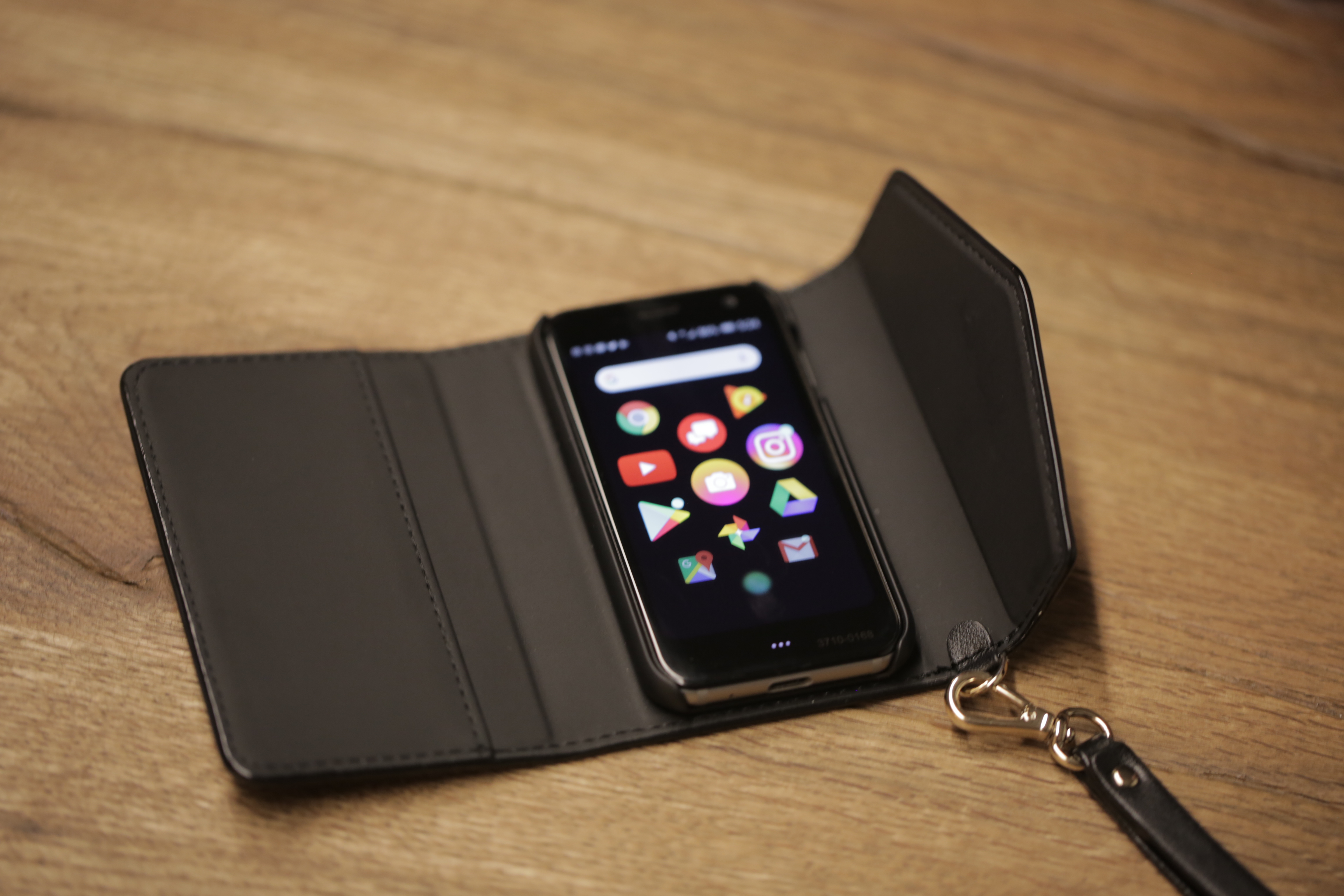
I shared images I shot of the Palm device with a few co-workers ahead of this morning’s unveiling, and they were downright giddy. The new “ultra-mobile” device (a term us old people used to use to refer to something closer to a netbook) is a hard thing to contextualize without a picture, so I took a bunch, and many of my oft-jaded co-workers fell for the thing immediately.

The device, which is designed to split the difference between a smartphone and a smartwatch, is admittedly adorable. The startup behind the product employs designs with some impressive credentials, from Samsung to Frog Design.

Really, the device most obviously resembles an iPhone, shrunk down to a 3.3-inch display. The first iPhone, incidentally, had a 3.5-inch screen — though a lot has been done in the intervening 11 years to jam that kind of real estate into a far smaller footprint. And this device, fittingly, fits comfortably in the Palm of your hand.

But adorableness is hardly enough to convince a large swath of the public to shell out $349 for a product category they didn’t know they needed in their life until this morning. There are a number of issues. For one thing, this is a Verizon exclusive. Sure, our parent company’s parent company has a lot of subscribers, but you’re already writing off a number of potential buyers with the fact that you need an existing VZW plan to tack the Palm onto. Oh, and that will run you an additional $10 a month.

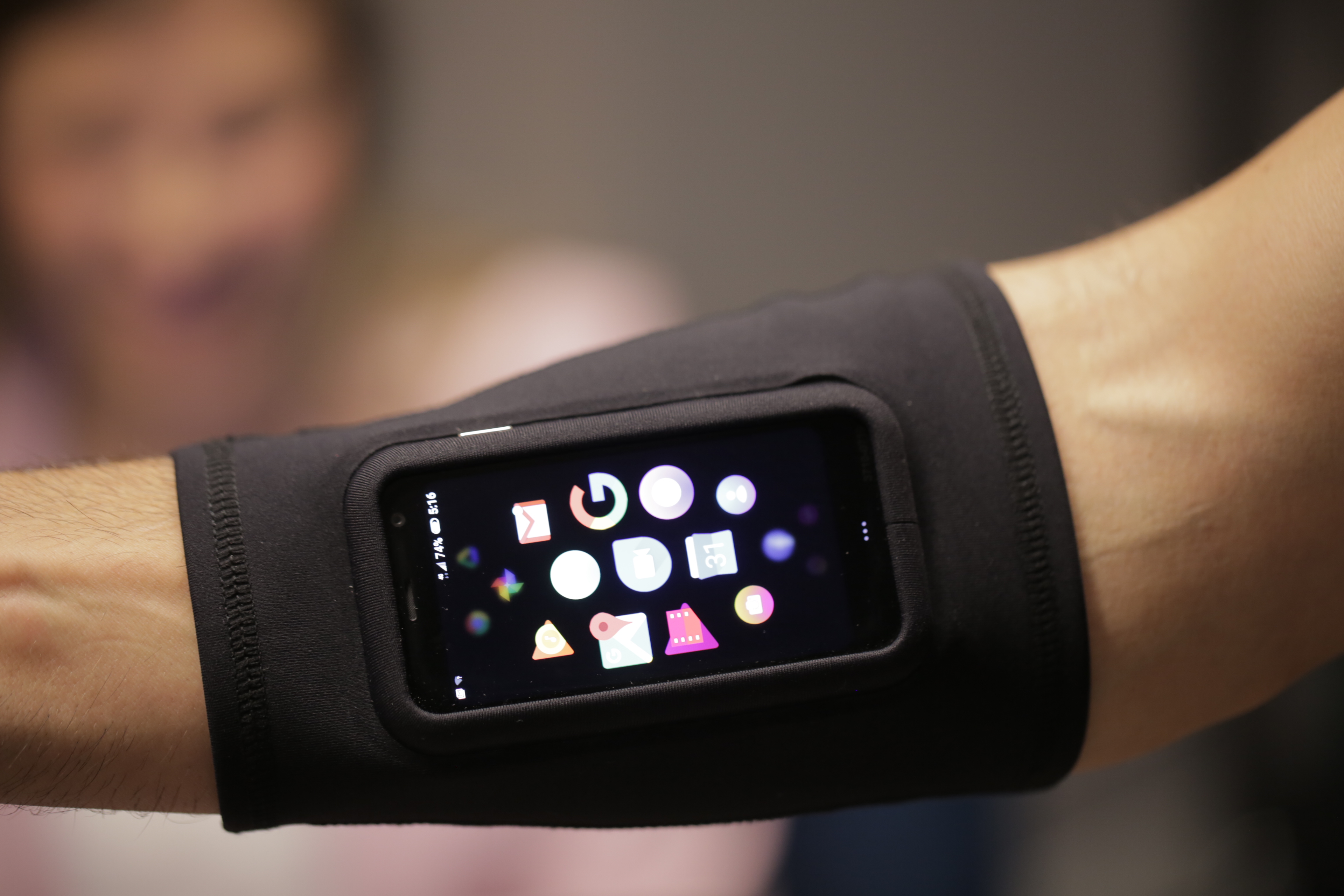
[Note: I did not take this photo of Steph.]

I’m sure you’re already imagining the ways this thing will fit into your life. If not, Palm investor, accessory designer and Splash Brother Stephen Curry is happy to help you. The Warrior all-star has been incorporating the product into his off-season workouts, and certainly there’s something to be said for the much smaller form factor when it comes to strapping it to your arm for NBA workouts.

For the rest of us, perhaps the reborn Palm represents freedom from being tethered to our six-inch smartphones. Granted, it’s still a smartphone of sorts, but it’s a start. And the device can help you get a lot more done than your average smartwatch — though I speak from experience when I say it’s going to take a lot of practice to get used to typing on that tiny screen again.

The Palm runs Android (8.1), naturally. Though the company has created a custom skin that forgoes the desktop and takes you right into the app tray. From there, you can reorder your apps based on preference. And yes, unlike Wear OS, they run as their full versions here.

The device is IP68 water-resistant and sports an 800mAh battery — not big, but then, neither is the screen, so they ought to even each other out. Palm rates it as “All Day.” Inside, you also get 3GB of RAM, 32GB of storage and a Snapdragon 435. Those are bad smartphone specs, but perhaps good specs as far as “ultra-mobiles” go? Hard to say. The category didn’t really exist until right now.

The newly reborn Palm created the device with help from supplier TCL. Unlike TCL’s BlackBerry deal, however, the startup owns the exclusive rights to the once-mighty Palm name and operates independently of the massive Chinese phone maker.

Cute? Check. Interesting? Double check. Ready to disrupt the industry? The jury is definitely still out on that one.

[gallery ids="1732277,1732278,1732279,1732281,1732282,1732283,1732284,1732285,1732287,1732288,1732289"]
15 Oct 2018

Truphone, an eSIM mobile carrier that works with Apple, raises another $71M, now valued at $507M

Truphone — a UK startup that provides global mobile voice and data services by way of an eSIM model for phones, tablets and IoT devices — said that it has raised another £18 million ($23.7 million) in funding; additionally securing £36 million ($47 million) more “on a conditional basis” to expand its business after signing “a number of high-value deals.”

It doesn’t specify which deals these are, but Truphone was an early partner of Apple’s to provide eSIM-based connectivity to the iPad; and it will also be offering a service for new iPhone XS and XR models, taking advantage of the dual SIM capability. Truphone says that strategic partners of the company include Apple (“which chose Truphone as the only carrier to offer global data, voice and text plans on the iPad and iPhone digital eSIM”); Synopsys, which has integrated Truphone’s eSIM technology into its chipset designs; and Workz Group, a SIM manufacturer, which has a license from Truphone for its GSMA-accredited remote SIM provisioning platform and SIM operating system.

The company said that this funding, which was made by way of a rights issue, values Truphone at £386 million ($507 million at today’s rates) post-money. Truphone told TechCrunch that the funding came from Vollin Holdings and Minden Worldwide — two investment firms with ties to Roman Abramovich, the Russian oligarch who also owns the Chelsea football club, among other things — along with unspecified minority shareholders. Collectively, Abramovich-connected entities control more than 80 percent of the company.

We have asked the company for more detail on what the conditions are for the additional £36 million in funding to be released and all it is willing to say is that “it’s KPI-driven and related to the speed of growth in the business.”

For some context, Truphone most recently raised money almost exactly a year ago, when it picked up £255 million also by way of a rights issue, and also from the same two big investors. The large amount that time was partly being raised to retire debt. That deal was done at a valuation of £370 million ($491 million at the time of the deal). Going just on sterling values, this is a slight down-round.

Truphone, however, says that business is strong right now:

“The appetite for our technology has been enormous and we are thrilled that our investors have given us the opportunity to accelerate and scale these groundbreaking products to market,” said Ralph Steffens, CEO, Truphone, in a statement. “We recognised early on that the more integrated the supply chain, the smoother the customer experience. That recognition paid off—not just for our customers, but for our business. Because we have this capability, we can move at a speed and proficiency that has never before seen in our industry. This investment is particularly important because it is testament not just to our investors’ confidence in our ambitions, but pride in our accomplishments and enthusiasm to see more of what we can do.”

Truphone is one of a handful of providers that is working with Apple to provide plans for the digital eSIM by way of the MyTruphone app. Essentially this will give users an option for international data plans while travelling — Truphone’s network covers 80 countries — without having to swap out the SIMs for their home networks.

The eSIM technology is bigger than the iPhone itself, of course: some believe it could be the future of how we connect on mobile networks. On phones and tablets, it does away with users ordering, and inserting or swapping small, fiddly chips into their devices (that ironically is also one reason that carriers have been resistant to eSIMs traditionally: it makes it much easier for their customers to churn away). And in IoT networks where you might have thousands of connected, unmanned devices, this becomes one way of scaling those networks.

“eSIM technology is the next big thing in telecommunications and the impact will be felt by everyone involved, from consumers to chipset manufacturers and all those in-between,” said Steve Alder, chief business development officer at Truphone. “We’re one of only a handful of network operators that work with the iPhone digital eSIM. Choosing Truphone means that your new iPhone works across the world—just as it was intended.” Of note, Alder was the person who brokered the first iPhone carrier deal in the UK, when he was with O2.

Truphone has not released numbers detailing how many devices are using its eSIM services at the moment — either among enterprises or consumers — but it has said that customers include more than 3,500 multinational enterprises in 196 countries. We’ll update this post as we learn more.

15 Oct 2018

Did you score tickets to Startup Battlefield Africa 2018?

In just about two months, the TechCrunch crew will head to Lagos, Nigeria to host the day-long, action-packed Startup Battlefield Africa 2018. Come join us and watch the founders of Africa’s best early-stage tech startups compete for the glory, cash and investor love that only Startup Battlefield provides.

We have a limited number of spectator tickets available for the December 11 event, so don’t waste time — buy your ticket here today.

We’re not kidding when we call this an action-packed day. While the Battlefield pitch competition is the crown jewel, we’re also creating a slate of outstanding speakers who will hold forth on vital topics affecting the region.

Topics like venture capital investing, something that Kola Aina, CEO and founder of Lagos-based Ventures Platform, will be on hand to discuss. And if blockchain is your bag, you won’t want to miss hearing IIyinoluwa Aboyeji’s take on that subject. He’s the founder and CEO of Flutterwave, a Lagos-based payment solution startup designed to transfer funds between Africa and abroad.

If you haven’t heard, we recently announced that Omobola Johnson, a senior partner at TLcom Capital, and Lexi Novitske, the principal investment officer for Singularity Investments, will take part in a panel discussion. Keep an eye on TechCrunch, because we’ll be announcing even more speakers in the coming weeks.

Okay, let’s talk about the main event. Startup Battlefield consists of three preliminary rounds with up to five startups in each round. Each startup team gets six minutes to pitch and present a live demo to a panel of judges consisting of top tech founders and VCs. Those judges then have six minutes to question each team thoroughly.

No more than five teams move to the finals for another round of pitches and more probing inquisition. Only one startup will emerge victoriously and claim the title: Startup Battlefield Africa 2018 champion.

The winning founders receive US$25,000 in no-equity cash, plus a trip for two to compete in Startup Battlefield in San Francisco at TechCrunch Disrupt 2019 (assuming the company still qualifies to compete at the time).

Startup Battlefield Africa 2018 takes place on December 11 in Lagos, Nigeria. Don’t miss your chance to watch Africa’s most talented startup founders launch their dream on a global stage, learn about the exciting tech trends emerging across the continent and enjoy world-class networking while you’re at it. Buy your spectator tickets here.

15 Oct 2018

It’s official: London-based Stride.VC raises £50M seed fund

Stride.VC, the new VC fund from Fred Destin, formerly a partner at Accel, and Harry Stebbings, producer of the “The Twenty Minute VC” podcast and ex-Entrepreneur-in-Residence at Atomico, is being officially unveiled today, confirming most of the details of my earlier report.

The fund has closed at just over its £50 million target and will be used to do seed investments exclusively in U.K. startups (at least for now). The team has been bolstered, too, with Arj Soysa, ex-Atomico and most recently head of finance for LGT Impact, joining as operating partner. The firm also disclosed its first investment earlier this month, backing healthcare messaging app Forward Health.

In a call with Destin last week and followed up over subsequent emails with the pair, I got further details on Stride.VC’s LPs and how Destin and Stebbings plan to approach seed investing. Kicking off, I asked if perhaps there was already enough money in the U.K. (and elsewhere in Europe) chasing seed-stage startups.

“We don’t think there is too much seed money at work in Europe,” says Destin. “We think tech startups are impacting more and more industries and sectors so the importance and impact of great founders is growing. It’s logical that the VC market grows alongside the startup ecosystem. Just look at the amazing diversity of projects coming out of London and the spread of industries people are going after.

“Stride is fundamentally trying to answer the question of ‘if all the stars are aligned, what could this look like’ and constantly strives for greatness. Founders often tell us that ‘real’ risk appetite is still missing in the venture capital community”.

The pair say they plan to write “meaningful seed checks,” typically in the region of £1.5 million, but will consider anything pre-Series A that enables founders to make the next jump convincingly. “We exclusively do seed and we get diluted with our founders over time,” they tell me.

“We are happy to write those larger checks when it matters most, when the data is ambiguous, the startups are still raw and constant change is the name of the game. “We embrace the chaos that can surround a business at that stage. We don’t make assumptions and ensure we can all question and challenge each other to maker the best decisions. Our intention is to weaponise both the expertise and the ignorance of everybody around the table”.

The point of differentiation — if I’ve read correctly — is that Stride.VC wants to do less but larger seed investments than perhaps some other small seed firms in Europe. This, the pair say, is partly what they mean by conviction investing and the absolute opposite end of the spray ‘n’ pray spectrum.

“We undertake fewer projects that many of our peers. This is a factor of both the size of cheque we write and the profile of founder we’re looking for. We are not claiming our strategy is better — it’s just different. We undertake fewer projects with absolute conviction,’ they both write.

Currently, the firm is 100 percent focused on the U.K., but Destin and Stebbings say they will relax that rule once Stride.VC’s operations are well honed. With that said, there are no plans to become a pan-European venture capital firm as “proximity matters,” so any entry into another market will only be done after careful consideration.

In terms of investment thesis or specific sectors or technology the pair are looking to invest in, they say that entrepreneurs are “fundamentally better at finding white spaces than VCs are,” and so the aim is to be as “mentally plastic” as possible.

“Having said that, we only invest in what we understand well, so right now we are primarily focused on the upper echelons of the stack, which means exceptional product experiences that wow the user or customer. Our themes will evolve as we grow the team and continuously learn about new markets. We don’t view machine learning or blockchain as standalone themes but rather as key long-term enablers of innovation”.

Meanwhile, a raft of new LPs are being disclosed. Mostly notably they include publicly-listed U.K. venture capital firm Draper Esprit, who I’m told was one of the first batch of investors to commit to the new fund as part of its fund-of-funds initiative.

In addition, the other LPs are Delin Capital, Compagnie Nationale a Portefeuille (Groupe Frere), Korelya Capital, Entree Capital, Merifin as well as the newly de-merged marketplaces division of Schibsted (codenamed MPI).

A number of notable founders and industry execs have also invested including Alex Chesterman of Zoopla, Henri Moissinac from Uber, Garrett Curran, Riccardo Zacconi and Stephane Kurgan of King.com, Ahmed Husain, and others.

15 Oct 2018

Penta, the German challenger bank account for SMEs, raises €7M Series A

Penta, the German fintech startup that offers a digital bank account targeting SMEs, has raised €7 million in Series A funding. Backing the company once again is Inception Capital, with total funding now at €10 million since Penta was founded in May 2016.

Launched in Germany in December, and powered by Banking-as-a-Platform solarisBank (rather than holding a banking license of its own), Penta is designed to meet the banking needs of small to medium-sized businesses, including startups.

The premise is that SMEs are currently underserved by incumbent banks, including account opening being cumbersome and much more difficult than it should be and exorbitant fees charged for making payments or international money exchange.

Penta is also bringing some much-need innovation and features to the German business banking market.

One of those is multi-card support to make it easier to manage company expenses. Dubbed ‘Team Access,’ the recently launched feature lets business owners issue multiple MasterCards to employees who need to make purchases on a company’s behalf.

Each card is linked to a business’ Penta account but can have custom rules and permissions per card/employee, in terms of how much money can be spent and where. More broadly, the feature is designed to cut down the time and cost of expense management for SMEs.

Notably, I’m told that the Berlin-based challenger bank, which has already grown to a team of 40 and plans to get to 100 over the next year, is seeing 68 percent of new customers switching from their existing business bank account, with the remaining 40 percent newly incorporated businesses.

That suggest many German businesses aren’t satisfied with the banking status quo, even if they’ve already crossed the account opening hurdle. Specifically, I understand that multi-card support has been one of the main draw, the kind of feature that older banks with legacy software often struggle to deliver.