Year: 2018

12 Oct 2018

At 10 trillion frames per second, this camera captures light in slow motion

Light is the fastest thing in the universe, so trying to catch it on the move is necessarily something of a challenge. We’ve had some success, but a new rig built by Caltech scientists pulls down a mind-boggling 10 trillion frames per second, meaning it can capture light as it travels along — and they have plans to make it a hundred times faster.

Understanding how light moves is fundamental to many fields, so it isn’t just idle curiosity driving the efforts of Jinyang Liang and his colleagues — not that there’d be anything wrong with that either. But there are potential applications in physics, engineering, and medicine that depend heavily on the behavior of light at scales so small, and so short, that they are at the very limit of what can be measured.

You may have heard about billion- and trillion-FPS cameras in the past, but those were likely “streak cameras” that do a bit of cheating to achieve those numbers.

A light pulse as captured by the T-CUP system.

If a pulse of light can be replicated perfectly, then you could send one every millisecond but offset the camera’s capture time by an even smaller fraction, like a handful of femtoseconds (a billion times shorter). You’d capture one pulse when it was here, the next one when it was a little further, the next one when it was even further, and so on. The end result is a movie that’s indistinguishable in many ways from if you’d captured that first pulse at high speed.

This is highly effective — but you can’t always count on being able to produce a pulse of light a million times the exact same way. Perhaps you need to see what happens when it passes through a carefully engineered laser-etched lens that will be altered by the first pulse that strikes it. In cases like that, you need to capture that first pulse in real time — which means recording images not just with femtosecond precision, but only femtoseconds apart.
Simple, right?

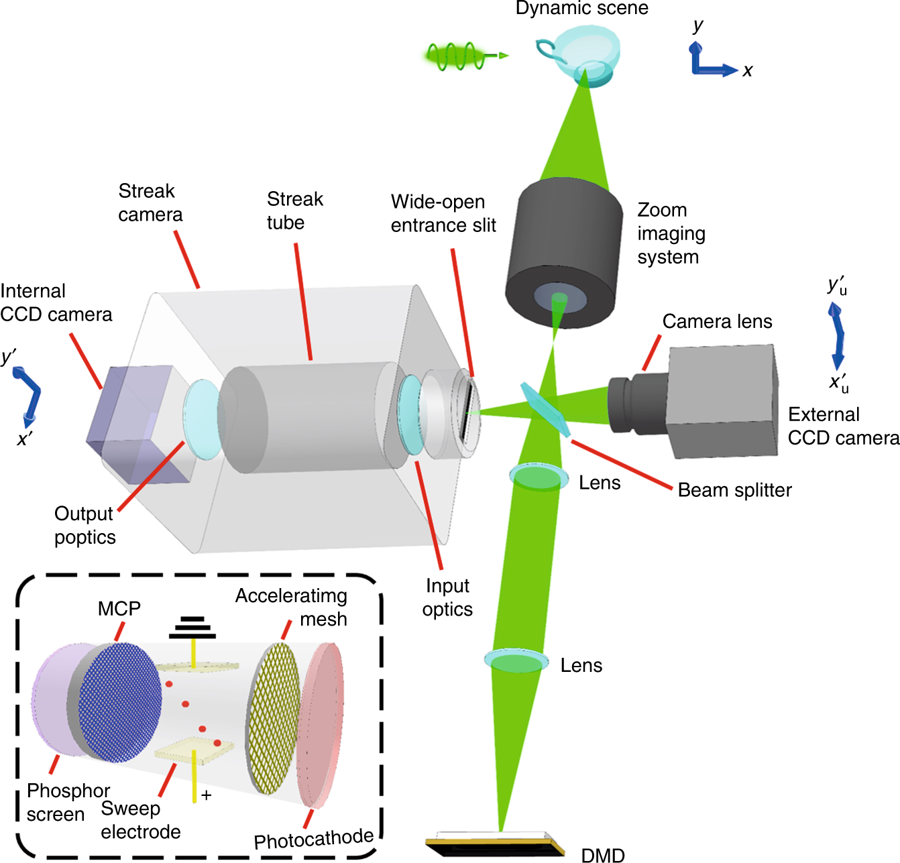
That’s what the T-CUP method does. It combines a streak camera with a second static camera and a data collection method used in tomography.

“We knew that by using only a femtosecond streak camera, the image quality would be limited. So to improve this, we added another camera that acquires a static image. Combined with the image acquired by the femtosecond streak camera, we can use what is called a Radon transformation to obtain high-quality images while recording ten trillion frames per second,” explained co-author of the study Lihong Wang. That clears things right up!

At any rate the method allows for images — well, technically spatiotemporal datacubes —  to be captured just 100 femtoseconds apart. That’s ten trillion per second, or it would be if they wanted to run it for that long, but there’s no storage array fast enough to write ten trillion datacubes per second to. So they can only keep it running for a handful of frames in a row for now — 25 during the experiment you see visualized here.
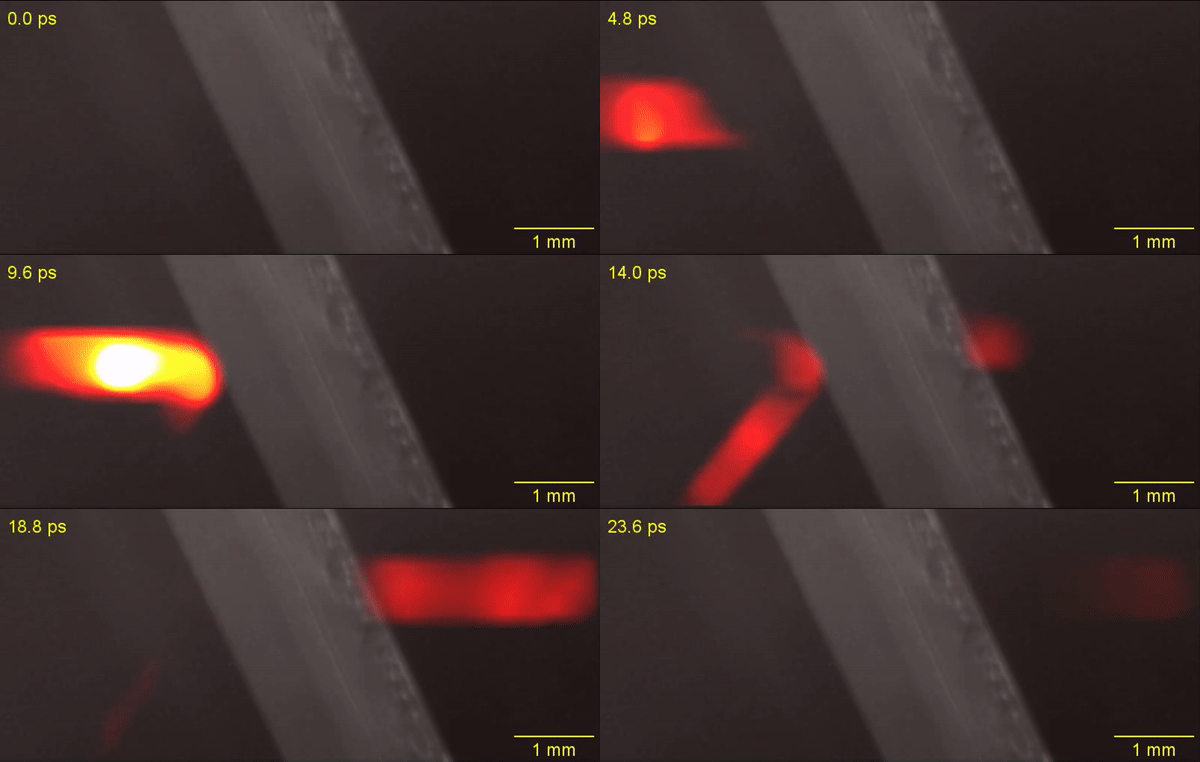
Those 25 frames show a femtosecond-long laser pulse passing through a beam splitter — note how at this scale the time it takes for the light to pass through the lens itself is nontrivial. You have to take this stuff into account!

This level of precision in real time is unprecedented, but the team isn’t done yet.

“We already see possibilities for increasing the speed to up to one quadrillion (1015) frames per second!” enthused Liang in the press release. Capturing the behavior of light at that scale and with this level of fidelity is leagues beyond what we were capable of just a few years ago and may open up entire new fields or lines of inquiry in physics and exotic materials.

Liang et al.’s paper appeared today in the journal Light.

12 Oct 2018

New wave founders are headed to Startup Battlefield Latin America

TechCrunch is thrilled to announce that Rappi co-founder Sebastian Mejia, Enjoie founder Ana McLaren and Konfío founder and CEO David Arana will be joining us on stage at Startup Battlefield Latin America for a panel about new wave startups coming out of the region.

What does scaling a delivery startup out of Latin America look like? Where do you find the top engineering talent to build a marketplace app? What are the big opportunities for ecommerce and fintech companies? These are some of the ideas these three founders will speak to.

Sebastián Mejia is a co-founder of Rappi, the on-demand delivery startup worth over $1 billion.

Rappi initially began as a beverage delivery service, but has since expanded into groceries, meals, medicine and tech products to become a solution for last-mile delivery on demand. The company also has a popular cash withdrawl feature, and charges $1 per delivery. The Colombian startup has been backed by some of the world’s most prominent investors like Sequoia and Andreessen Horowitz. In fact, Rappi marked A16z’s first investment into Latin America in 2016. Now, thanks to a huge $200M round that closed in September 2018, Rappi is now worth over $1 billion. Mejia built his career working in the financial and tech sectors in New York before starting his path as an entrepreneur. He currently serves as the CSO and co-founder of Rappi.

Ana McLaren is the Executive Director in enjoei,  a fashion focused online marketplace in Brazil.

After graduating from Superior School of Advertising and Marketing (ESPM) McLaren started her career in the ecommerce industry working for Americanas.com as a sales executive. After five years working in retail she switched to the media industry, where she worked for Abril, iG and Google. She started enjoei as a blog while at iG, but eventually left Google to take enjoei to the next level. The company now has 160 employees and $250M in gross merchandise volume in 2018.

David Arana is the Founder & CEO of Konfío, an online lending platform for small businesses in Mexico.

Konfío uses data for rapid credit assessment, allowing owners to focus on business growth. Prior to Konfío, Arana spent over six years at Deutsche Bank, based in New York, NY as Vice President of the Credit Derivatives Structuring division for Latin America. He received his Bachelor of Science degree in Mathematics from Massachusetts Institute of Technology (MIT). He was recognized as a National Society of Collegiate Scholar in 2005, a Hispanic Recognition Scholar in 2003, and won the Rensselaer Math & Science Medal and Scholarship in 2003.

With growing funds and an influx of capital available for early stage companies, the potential for Latin America-based startups to shake up big industries has never been higher. The latest generation of tech founders has the potential to be more disruptive than their predecessors. But these new companies face rapidly rising expectations at home and abroad.

The three founders will take the stage in what will surely be a fascinating talk, and you can find the full agenda for the event here. This interview, more panel discussions and the Startup Battlefield competition will take place at Startup Battlefield Latin America on November 8 at the Tomie Ohtake Institute in São Paulo, Brazil. Apply for your free spectator tickets here.

12 Oct 2018

Anaplan hits the ground running with strong stock market debut up over 42 percent

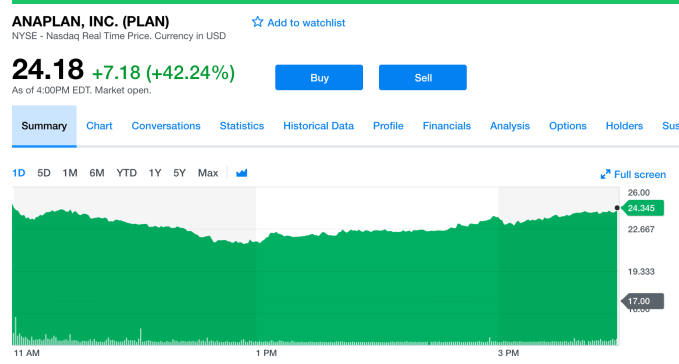
You might think that Anaplan CEO, Frank Calderoni would have had a few sleepless nights this week. His company picked a bad week to go public as market instability rocked tech stocks. Still he wasn’t worried, and today the company had by any measure a successful debut with the stock soaring up over 42 percent. As of 4 pm ET, it hit $24.18, up from the IPO price of $17. Not a bad way to launch your company.

Stock Chart: Yahoo Finance

“I feel good because it really shows the quality of the company, the business model that we have and how we’ve been able to build a growing successful business, and I think it provides us with a tremendous amount of opportunity going forward,” Calderoni told TechCrunch.

Calderoni joined the company a couple of years ago, and seemed to emerge from Silicon Valley central casting as former CFO at Red Hat and Cisco along with stints at IBM and SanDisk. He said he has often wished that there were a tool around like Anaplan when he was in charge of a several thousand person planning operation at Cisco. He indicated that while they were successful, it could have been even more so with a tool like Anaplan.

“The planning phase has not had much change in in several decades. I’ve been part of it and I’ve dealt with a lot of the pain. And so having something like Anaplan, I see it’s really being a disrupter in the planning space because of the breadth of the platform that we have. And then it goes across organizations to sales, supply chain, HR and finance, and as we say, really connects the data, the people and the plan to make for better decision making as a result of all that,” he said.

Calderoni describes Anaplan as a planning and data analysis tool. In his previous jobs he says that he spent a ton of time just gathering data and making sure they had the right data, but precious little time on analysis. In his view Anaplan, lets companies concentrate more on the crucial analysis phase.

“Anaplan allows customers to really spend their time on what I call forward planning where they can start to run different scenarios and be much more predictive, and hopefully be able to, as we’ve seen a lot of our customers do, forecast more accurately,” he said.

Anaplan was founded in 2006 and raised almost $300 million along the way. It achieved a lofty valuation of $1.5 billion in its last round, which was $60 million in 2017. The company has just under 1000 customers including Del Monte, VMware, Box and United.

Calderoni says although the company has 40 percent of its business outside the US, there are plenty of markets left to conquer and they hope to use today’s cash infusion in part to continue to expand into a worldwide company.

12 Oct 2018

Watch this quadrotor turn into a trirotor and keep flying

In a video that similar to those videos where humans push around ATLAS, researchers at Delft University of Technology have created a system that will let a quadrotor drone keep flying even if one of the propellers is broken.

The video above – which is, arguably, pretty boring – shows the drone fighting against both structural damage and wind and most definitely winning. The fact that it is able to stay airborne under such wild conditions is the real draw here and it’s a fascinating experiment in robust robotics. In other words, this drone routed around damage that would destroy a normal quadcopter.

According to IEEE the system works by adding a multiple subsystems to the drone in order to manage the position and altitude. The system uses the built-in gyro and accelerometer readings to keep itself in the air and lots of processing power to keep it moving forward even as it seems to careen into the wild blue yonder. Further, the system manages motor power to ensure that the propellers aren’t “saturated.”

The researchers, Sihao Sun, Leon Sijbers, Xuerui Wang, and Coen de Visser, presented their paper in Spain last week at IROS 2018.

12 Oct 2018

Take ten seconds now to make sure you’re registered to vote

Fellow citizens! An important election is approaching, and you should vote in it. But are you registered? Are you sure? Why don’t you take ten seconds now to check?

Maybe you moved recently and the notices are going to your old place. Maybe your county had a records snafu. Maybe you’re one of thousands of voters being purged from the rolls in order to tip a close race. Who knows?

It’s very simple to do this online. You don’t need any documents and you don’t need to send anything in or call anyone. The nonpartisan Vote.org will query your state’s registration database for you, or you can scroll down a bit at that page and go directly to the state site to do it yourself.

If you’re not registered, don’t worry. Many states allow you to register right up until election day, and if you haven’t registered before or it’s been a while, all you really need is to be a citizen with a valid ID. Special welcome to all new citizens!

Some states have already closed registration: Alaska, Arizona, Arkansas, Georgia, Indiana, Kentucky, Michigan, Mississippi, Missouri, New Mexico, Ohio, Pennsylvania, Rhode Island, Tennessee and Texas. Some states have deadlines that have already passed for mail-in registration, in-person registration, and so on. But as of today it is still possible to register to vote in every state not listed above.

For instance here in Washington, online registration closed on October 8, but I could still register in person for the next couple weeks. In Delaware you only have until the 13th — but you can register online, by mail, or in person until then. South Carolina and Florida would normally have closed registration but have extended it because of the hurricane.

The New York Times has put together a comprehensive list of deadlines for each state, with links for each registration method. And if you’ll be gone for election day, November 6, you should be able to check your state’s site for an absentee or early voting ballot.

Every vote counts. Your candidates and issues need yours! Check if you’re registered at Vote.org or your state site, and if you’re not, there’s still time to register.

12 Oct 2018

Apple rebukes Australia’s “dangerously ambiguous” anti-encryption bill

Apple has strongly criticized Australia’s anti-encryption bill, calling it “dangerously ambiguous” and “alarming to every Australian.”

The Australian government’s draft law — known as the Access and Assistance Bill — would compel tech companies operating in the country, like Apple, to provide “assistance” to law enforcement and intelligence agencies in accessing electronic data. The government claims that encrypted communications are “increasingly being used by terrorist groups and organized criminals to avoid detection and disruption,” without citing evidence.

But critics say that the bill’s “broad authorities that would undermine cybersecurity and human rights, including the right to privacy” by forcing companies to build backdoors and hand over user data — even when it’s encrypted.

Now, Apple is the latest company after Google and Facebook joined civil and digital rights groups — including Amnesty International — to oppose the bill, amid fears that the government will rush through the bill before the end of the year.

In a seven-page letter to the Australian parliament, Apple said that it “would be wrong to weaken security for millions of law-abiding customers in order to investigate the very few who pose a threat.”

“We appreciate the government’s outreach to Apple and other companies during the drafting of this bill,” the letter read. “While we are pleased that some of the suggestions incorporated improve the legislation, the unfortunate fact is that the draft legislation remains dangerously ambiguous with respect to encryption and security.”

“This is no time to weaken encryption,” it read. “Rather than serving the interests of Australian law enforcement, it will just weaken the security and privacy of regular customers while pushing criminals further off the grid.”

Apple laid out six focus points — which you can read in full here — each arguing that the bill would violate international agreements, weaken cybersecurity and harm user trust by compelling tech companies to build weaknesses or backdoors in its products. Security experts have for years said that there’s no way to build a “secure backdoor” that gives law enforcement authorities access to data but can’t be exploited by hackers.

Although Australian lawmakers have claimed that the bill’s intentions are not to weaken encryption or compel backdoors, Apple’s letter said the “the breadth and vagueness of the bill’s authorities, coupled with ill-defined restrictions” leaves the bill’s meaning open to interpretation.

“For instance, the bill could allow the government to order the makers of smart home speakers to install persistent eavesdropping capabilities into a person’s home, require a provider to monitor the health data of its customers for indications of drug use, or require the development of a tool that can unlock a particular user’s device regardless of whether such tool could be used to unlock every other user’s device as well,” the letter said.

Apple’s comments are some of the strongest pro-encryption statements it’s given to date.

Two years ago, the FBI sued Apple to force the technology giant to build a tool to bypass the encryption in an iPhone used by one fo the the San Bernardino shooters, who killed 14 people in a terrorist attack in December 2015. Apple challenged the FBI’s demand — and chief executive Tim Cook penned an open letter called the move a “dangerous precedent.” The FBI later dropped its case after it paid hackers to access the device’s contents.

Australia’s anti-encryption bill is the latest in a string of legislative efforts by governments to seek greater surveillance powers.

The U.K. passed its Investigatory Powers Act in 2016, and earlier this year the U.S. reauthorized its foreign surveillance laws with few changes, despite efforts to close warrantless domestic spying loopholes discovered in the wake of the Edward Snowden disclosures.

The Five Eyes group of governments — made up of the U.K., U.S., Canada, Australia and New Zealand — further doubled down on its anti-encryption aggression in recent remarks, demanding that tech companies provide access or face legislation that would compel their assistance.

12 Oct 2018

Facebook prototypes Unsend 6 months after Zuckerberg retracted messages

In April, TechCrunch broke the news that some of Mark Zuckerberg’s Facebook messages were deleted from recipients’ inboxes in what some saw as a violation of user trust. Then, Facebook suddenly announced that it would actually build this Unsend functionality for everyone. Then six months went by without a peep about the feature, furthering suspicions that the announcement that it would release an Unsend button was merely a PR driven response to the scandal.

Late last week, TechCrunch asked Facebook about its progress on Unsend, and the company told us “Though we have nothing to announce today, we have previously confirmed that we intend to ship a feature like this and are still planning to do so.”

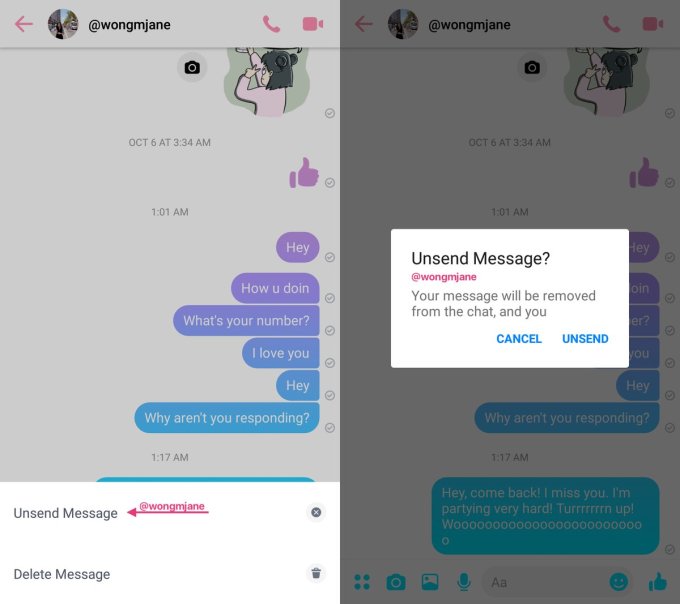
Now we have our first look at the feature thanks to TechCrunch’s favorite tipster Jane Manchun Wong. She’s managed to generate screenshots of a prototype Unsend button from Facebook Messenger’s Android code. Currently, you can only delete messages from your own inbox — they still remain in the recipients’ inbox. But with this Unsend feature, you’ll be able to remove a message from both sides of a conversation. However, the code indicates that in the current prototype, users may only have a certain amount of time after they send a message to unsend it.

In response, a spokesperson confirmed that “Facebook internally tests products and features before they ship to the public so we can ensure the quality of the experience.”

The Unsend feature could be useful to people who say something stupid or inappropriate, disclose a secret they shouldn’t have, or want to erase evidence of their misdeeds. That could make users more comfortable speaking freely on the app, since they know they can retract their texts. But it could also open vectors for abuse, as users could harass people over Messenger and then delete the evidence. Facebook will need to ensure that Unsend doesn’t acceidentally become a weapon for bullies.

12 Oct 2018

Elon Musk: Teslaquila tequila is ‘coming soon’

Tesla CEO Elon Musk confirmed Friday in a tweet that the Tesla-branded tequila called “Teslaquilla”—the bottle of liquor that co-starred in his April Fool’s Day joke about the automaker filing for bankruptcy — is “coming soon.”

Musk’s tweet was a response to a CNBC article that reported Tesla had filed an application with the U.S. Patent and Trademark Office to trademark “Teslaquila.”

Musk later tweeted a photo of a Teslaquila label.

The Teslaquila story began on April Fool’s Day after Musk posted a photo of himself passed out against a Tesla Model 3 “surrounded by “Teslaquilla” bottles, the tracks of dried tears still visible on his cheeks.” In the photo, Musk is holding a cardboard sign that reads “bankwupt.”

It’s important to note that the filing Monday is an “intent to use” trademark, which, just like it sounds, means Tesla has a “bona fide intention, and is entitled, to use the mark in commerce on or in connection with the identified goods/services.”

12 Oct 2018

Facebook bans hundreds of clickbait farms for ‘coordinated inauthentic behavior’

Facebook has announced a relatively small but significant purge of bad actors from the platform: 810 pages and accounts that have “consistently broken our rules against spam and coordinated inauthentic behavior.” It may not seem like a lot, but it sounds like the company is erring on the side of disclosure even if the news isn’t particularly hard-hitting.

These were not, as far as Facebook could tell, part of an organized nation-state effort or political interference campaign, like the Iranian and Russian groups previously highlighted in these ban alert posts. These are pages that use networks of fake accounts and pages to drive traffic to clickbait articles strictly for the purpose of ad revenue.

810 can’t be much more than a drop out of the bucket of fake accounts on Facebook — of which there are millions — but the company’s focus right now isn’t individual bad actors but coordinated ones.

A few hundred accounts working together to do a bit of ad fraud produces a sort of digital footprint that might look similar to a a few hundred accounts working together to push a political narrative or sow discontent.  And one can turn into the other quite easily.

There are patterns of logins, likes, visits, account creation, and so on that Facebook has been working hard to identify — recently, at least. Although they’ve designed their net to catch the nation-state actors and large-scale operations that have previously been uncovered, small fry like these spammers are getting tangled up as well. Not a bad thing.

“Given the activity we’ve seen — and its timing ahead of the US midterm elections — we wanted to give some details about the types of behavior that led to this action,” the company wrote on its blog.

No doubt they also want to give the impression that there is indeed a cop on the beat. Expect more announcements like this through the midterms as Facebook strives to make it clear that it is working round the clock to keep you, its valuable product users, safe.

12 Oct 2018

Here’s how to find out if your Facebook was hacked in the breach

Are you one of the 30 million users hit by Facebook’s access token breach announced two weeks ago? Here’s how to find out.

  1. Visit this Facebook Help center link while logged in: https://www.facebook.com/help/securitynotice?ref=sec.
  2. Scroll down to the the section “Is my Facebook account impacted by this security issue?”
  3. Here you’ll see a Yes or No answer to whether your account was one of the 30 million users impacted
  4. If Yes, you’ll be in one of three categories:
    A. You’re in the 15 million users’ whose name plus email and/or phone number was accessed.
    B. You’re in the 14 million users’ who had that data plus account bio data accessed including “username, gender, locale/language, relationship status, religion, hometown, self-reported current city, birthdate, device types used to access Facebook, education, work, the last 10 places they checked into or were tagged in, website, people or Pages they follow, and the 15 most recent searches”.
    C. You’re in the 1 million users whose access token was stolen but your account was never actually accessed with it.


So what should you do if you were hacked?

  1. You don’t necessarily have to change your Facebook password or credit card info as there’s no evidence that data was accessed in the attack
  2. Watch out for spam or scam calls, emails, or messages as your contact info could have been sold to unscrupulous businesses
  3. Be on alert for phishing attempts that may try to email you and get you to sign in to one of your online accounts on a fake page that will steal your data. If you get a suspicious email that looks like it’s from Facebook, you can check here to see if it’s legitimate
  4. If you’re in group B who had their bio info accessed, you may want to contact your bank or cell phone provider and add additional security layers such as a pincode since hackers may have enough biographical info to perform social engineering attacks where they pretend to be you and use stolen data to answer security questions and gain access.