Year: 2018

11 Oct 2018

How this Kazakhstan internet giant built success on ideas from Russia and China

The advantage of entering an emerging market is that the market still has a lot of empty space to fill, and as a startup you can be the first player. Kazakhstan might not be the first country that comes to mind when you think of overseas expansion. However, it is the world’s largest landlocked country, and shares borders with Russia and China, which are important consumer markets as well as technology hubs.

In fact, companies in Russia and China provided good benchmarks for Chocofamily, now the biggest e-commerce holding in Kazakhstan. The 2011-founded startup’s current capitalization is $50 million, and they’ve hired 350 employees in their office in Almaty, the country’s largest city and previous capital.

The company claims it has 2 million registered users on its platform, and expects $170 million gross billings in 2018 with 7,000 purchases per day. Chocofamily launched their payment app, Rakmet, in 2017, following in the steps of WeChat Pay.

2011: Copying from Russia 

Looking at how Groupon was exploding in Russia, and how Delivery Club, a Russia-based food delivery service, was growing at a fast pace, the founder of Chocofamily, Ramil Mukhoryapov, decided the success could be replicated in Kazakhstan. So he quit his studies in Russia and went to Kazakhstan.

“Russia is three years above Kazakhstan. Check out what is happening in Russia and do the same in Kazakhstan, it is going to work in three years. That’s what we did, how we started the Chocofamily itself,” Nikolay Shcherbak, CEO at Chocofood says. “We just copied. If this works in Russia, it will work in Kazakhstan as well, because the markets are really close to each other.”

Ramil started with a daily deal service, Chocodaily, in Kazakhstan. After his first attempt was successful, he later started Chocofood, a food delivery service; Chocotravel, an online travel service; Lensmark, an online shop for contact lenses; and iDoctor, a platform with all the doctors in Kazakhstan where patients can find the doctor that they need and check doctor and hospital information and reviews. Now all these services are affiliates of Chocofamily Holding. 

How this company consolidated the market

In Kazakhstan, Chocofamily had competitors, but they either defeated them, purchased them or merged with them.

Chocofamily’s food delivery service, Chocofood, faced stiff competition in the market. Its rival was Foodpanda, which also started in Kazakhstan in 2013. After a four-year war of attrition, Foodpanda remained as No. 2 and wanted to get out of the market — so Chocofood acquired Foodpanda and took over their customer base and the legal entity. The company got additional growth uplift after integrating with Foodpanda.

“The best we got from the deal was the team, the people. They joined the company and just doubled our orders,” Nikolay says. 

Now Chocofood has an 80 percent market share in the food delivery market with 34,000 orders per month, working with 350 restaurants.

Online travel services Chocotravel merged with its rival Aviata in 2017. Now the two companies take a 67 percent combined market share. They’ve been profitable since the second half of 2018, with 80,000 air tickets and 50,000 railway tickets sold per month. 

In the future, Chocotravel plans to enter the South-Eastern and CIS (Commonwealth of Independent States, namely northwest Russia, Eastern Europe and the Baltic states) travel markets, and they are looking for additional funds for expansion.

2017: Copying from China

In 2017, the company launched a payment app, Rakmet, which means “thank you” in Kazakhstan. It allows users to pay for purchases by simply scanning QR codes. For users, the advantage is that every merchant gives them cash back.

The idea for the app came about in early 2017, as they were looking at other companies in different countries. 

“We were looking at WeChat, and it had a good system of using QR codes for payments. We thought it was a good idea. QR code technology is really old, but it only comes to our everyday life now,” Nikolay said.

Like other payment apps, users can use the Rakmet app by connecting their bank card to the app as a payment option. With a population of 18 million in Kazakhstan, bank card penetration is quite good; 19 million bank cards have been issued in total, and there are 10 million active bank cards.

For businesses to join the Rakmet app, they must give a certain percentage of cash back to customers. The approach has been especially popular with cafes and restaurants that have been using loyalty cards to attract consumers. Nikolay says it is a marketing strategy for merchants, because they’re paying the commission to Rakmet only for those transactions. To date, 300+ predominantly small businesses in Almaty have posted their stores via the Rakmet app. 

“Rakmet app will be on top of the ecosystem of all Chocofamily affiliates. We also plan to add different services to Rakmet app, such as allowing users to pay traffic fines to the government on the app and pay the parking fee using the app,” Nikolay says. 

Women are typically responsible for the household in Central Asia. Thus, women make up 60 percent of their users, making transactions on mobile such as booking flight tickets, ordering food, and making doctor appointments. The biggest growth is among their users in the age group between 25 to 35.

They also are working on big data. The team is now building the infrastructure for big data analysis, such as data warehousing and the support. Then they plan to build the mechanism for data processing. In September, they signed a contract with one of the universities in Kazakhstan so they can attract students who are experts on big data analysis.

In 2011, Chocofamily started with their own money. In 2013, they received $50,000 from two angel investors, then another $150,000. Then they attained Series A funding of $1 million from Murat Abdrakhmanov, an experienced entrepreneur in Kazakhstan, and later received $2 million in Series B.
11 Oct 2018

Facebook mistakenly deleted some people’s Live videos

This time instead of exposing users’ data, a Facebook bug erased it. A previously undisclosed Facebook glitch caused it to delete some users’ Live videos if they tried to post them to their Story and the News Feed after finishing their broadcast. Facebook wouldn’t say how many users or livestreams were impacted, but told the bug was intermittent and affected a minority of all Live videos. It’s since patched the bug and restored some of the videos, but is notifying some users with an apology that their Live videos have been deleted permanently.

The bug raises the question of whether Facebook is a reliable place to share and store our memories and important moments. In March, Facebook COO Sheryl Sandberg told congress regarding the Cambridge Analytica scandal that “We have a responsibility to protect your data – and if we can’t, then we don’t deserve to serve you.” Between that misappropriation of user biographical data, the recent breach that let hackers steal the access tokens that would let them take over 50 million Facebook accounts, wrongful changes to users’ default sharing privacy settings, and now this, some users may conclude Facebook in fact no longer deserves to serve them.

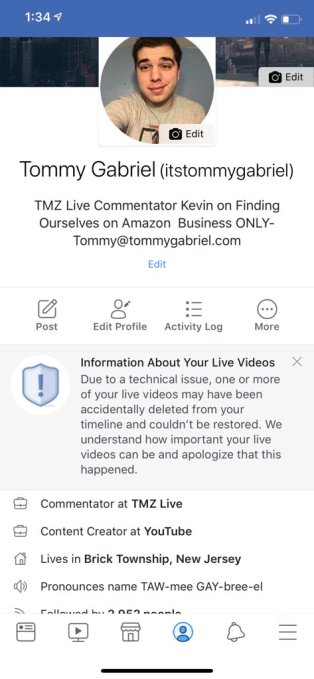
Facebook user Tommy Gabriel Sparandera provided TechCrunch with this screenshot showing the apology note from Facebook on his profile. It reads “Information About Your Live Videos: Due to a technical issue, one or more of your live videos may have been deleted from your timeline and couldn’t be restored. We understand how important your live videos can be and apologize that this happened.”

When TechCrunch asked Facebook about the issue, it confirmed the problem and provided this statement: ““We recently discovered a technical issue that removed live videos from some people’s Facebook Timelines. We have resolved this issue and restored many of these videos to people’s Timelines. People whose videos we were unable to restore will get a notification on Facebook. We know saving memories on Facebook is important to people, and we apologize for this error.”

Facebook made a huge push to own the concept of “going Live” in 2016 with TV commercials, billboards and more designed to overshadow competitors like Twitter’s Periscope. It eventually succeeded, with Periscope’s popularity fading while one in five Facebook videos became Live broadcasts. But in its blitz to win this market, it didn’t build adequate safety and moderation tools. That led to suicides and violence being livestreamed to audiences before Facebook’s content police could take down the videos.

Nowadays, most users don’t go live frequently unless they’re some kind of influencer, public figure, or journalist. When they do see something important transpiring, Facebook has positioned itself as the way to broadcast it. But if users can’t be sure Facebook will properly save those videos, it could persuade them it’s not worth becoming a camera man instead of a participant in life’s most interesting moments.

11 Oct 2018

YC-grad Papa raises $2.4M for its ‘grandkids-on-demand’ service

One of the latest additions to the on-demand economy is Papa, a mobile app that connects college students with adults over 60 in need of support and companionship.

The recent graduate of Y Combinator’s accelerator program has raised a $2.4 million round of funding to expand its service throughout Florida and to five additional states next year, beginning with Pennsylvania. Initialized Capital led the round, with participation from Sound Ventures.

Headquartered in Miami, the startup was founded last year by chief executive officer Andrew Parker. The idea came to him while he was juggling a full-time job at a startup and caring for his grandfather, who had early onset dementia.

“I’ve always been a connector of humans,” Parker, the former vice president of health systems at telehealth company MDLIVE, told TechCrunch. “I’ve always naturally felt comfortable with all walks of life and all age groups and have just felt human connection is really critical.”

Seniors can request a “Papa Pal” using the company’s mobile app, desktop site or by phone. The pals can pick them up and take them out for an activity or have them over to play a game, complete household chores, teach them how to use social media and other technology or simply to chat. A senior is matched with a student, who must complete a “rigorous” background check, in as little as 30 seconds.

Parker says there are 600 students working with Papa an average of 25 hours per month.

“We’ve been fortunate that this is something the students really want to be part of,” he said. “They aren’t doing this for a couple extra dollars. They are doing this to help the community.”

The service costs seniors $20 per hour, $12 of which is paid to the students and $8 is returned to Papa. It’s not a subscription-based service, but seniors can pay for a premium option that lets them choose between three Papa Pals instead of being randomly paired with one of the several hundred options. The students do not provide any personal care, like bathing or grooming. And they are not a pick-up and drop-off service, like Uber or Lyft.

“We believe the Papa team has found a unique way to combat loneliness and depression in older adults,” said Alexis Ohanian, co-founder and managing partner of Initialized Capital, in a statement. “The experience that Papa Pals bring their members make it seem like they are part of a family.”

In addition to expanding to new markets, Papa is in the process of partnering with insurance companies with a goal of allowing seniors to pay for some of its services through their Medicare plans.

“Loneliness is a crisis. It’s a disease. It’s killing people prematurely,” Parker said. “We are providing a really massive impact to these people’s lives.”

11 Oct 2018

Grado takes the wraps off their first pair of wireless headphones

Legacy open-backed headphone maker Grado is taking their classic design into the future with the small Brooklyn company’s first pair of wireless headphones.

The GW100s have a familiar look, but integrate Bluetooth tech and volume controls. They go for $249.

Grado headphones are a favorite of mine; they have a very unique open sound that really resonates and are perfect for home listening. Previous iterations haven’t really thrived as much on the road or in noisy offices because they tend to let in a lot of outside noise and leak a lot of your tunes. The company says that they’ve redesigned the housings and internals of the GW100s to reduce noise leakage by 60 percent — no famed wooden enclosures on this design either.

Part of what’s great about Grado headphones is their history; we toured the company’s tiny Brooklyn HQ a few years back and took a look at their operations… really cool stuff.

It’s tough for a company to make do on just brand legacy alone, and even though audio tech generally has a much longer shelf life than other products, there’s always a time to adapt, especially now as more hardware makers purge headphone jacks from their devices.

In the past few years, the company branched out into some more mobile-friendly products, but the magic wasn’t all there. The wireless GW100s keep the company’s same drivers, though it’ll be interesting to hear what they sound like as the company tunes them to be more amenable to “on-the-go” listening. Speaking of which, they also look like they have a sturdier design than some of the company’s more spartan headbands, which were strangely kind of part of the appeal, but are definitely welcome for something more likely to be chucked in a backpack.

The headphones charge via micro-USB and offer a 15-hour battery life, the company says. They also pack an included 3.5mm cable if you want to use them with your old gear. More details on precise audio tuning are listed on its product page.

11 Oct 2018

Copyright compromise: Music Modernization Act signed into law

Musicians are celebrating as the Music Modernization Act, an attempt to drag copyright and royalty rules into the 21st century, is signed into law after unanimous passage through Congress. The act aims to centralize and simplify the process by which artists are tracked and paid on digital services like Spotify and Pandora, and also extends the royalty treatment to songs recorded before 1972.

The problems in this space have affected pretty much every party. Copyright law and music industry practices were, as you might remember, totally unprepared for the music piracy wave at the turn of the century, and also for the shift to streaming over the last few years. Predictably, it isn’t the labels, distributors, or new services that got hosed — it’s artists, who often saw comically small royalty payments from streams if they saw anything at all.

Even so the MMA has enjoyed rather across-the-board support from all parties, because existing law is so obscure and inadequate. And it will remain that way to a certain extent — this isn’t layman territory and things will remain obscure. But the act will address some of the glaring issues current in the media landscape.

The biggest change is probably the creation of the Mechanical Licensing Collective. This new organization centralizes the bookkeeping and royalty payment process, replacing a patchwork of agreements that required lots of paperwork from all sides (and as usual, artists were often the ones left out on the cold as a result). The MLC will be funded by companies like Pandora or Google that want to enter into digital licensing agreements, meaning there will be no additional commission or fee for the MLC, but the entity will actually be run by music creators and publishers.

Previously digital services and music publishers would enter into separately negotiated agreements, a complex and costly process if you want to offer a comprehensive library of music — one that stifled new entrants to the market. Nothing in the new law prevents companies from making these agreements now, as some companies will surely prefer to do, but the MLC offers a simple, straightforward solution and also a blanket license option where you can just pay for all the music in its registry. This could in theory nurture new services that can’t spare the cash for the hundred lawyers required for other methods.

There’s one other benefit to using the MLC: you’re shielded from liability for statutory damages. Assuming a company uses it correctly and pays their dues, they’re no longer vulnerable to lawsuits that allege underpayment or other shenanigans — the kind of thing streaming providers have been weathering in the courts for years, with potentially massive settlements.

The law also improves payouts for producers and engineers, who have historically been under-recognized and certainly under-compensated for their roles in music creation. Writers and performers are critical, of course, but they’re not the only components to a great song or album and it’s important to recognize this formally.

The last component of the MMA, the CLASSICS Act, is its most controversial, though even its critics seem to admit that it’s better than what we had before. CLASSICS essentially extends standard copyright rules to works created before 1972, during which year copyright law changed considerably and left pre-1972 works largely out of the bargain.

What’s the problem? Well, it turns out that many works that would otherwise enter the public domain would be copyright-protected (or something like it — there are some technical differences) until 2067, giving them an abnormally long term of protection. And what’s more, these works would be put under this new protection automatically, with no need for the artists to register them. That may sound convenient, but it also means that thousands of old works would be essentially copyrighted even though their creators, if they’re even alive, have asserted no intention of seeking that status.

A simple registry for those works was proposed by a group of data freedom advocates, but their cries were not heard by those crafting and re-crafting the law. Admittedly it’s something of an idealistic objection, and the harm to users is largely theoretical. The bill proceeded more or less as written.

At all events the Music Modernization Act is now law; its unanimous passage is something of an achievement these days, though god knows both sides need as many wins as they can get.

11 Oct 2018

G2 crowd, a business software marketplace, raises another $55M at just under a $500M valuation

G2 Crowd, a platform that lets businesses search for, compare reviews and pricing for, and then buy software and other IT services — it likes to refer to itself as the “Amazon of business software” — has raised $55 million in growth funding to continue expanding its business. This round was led by IVP, with participation from enterprise VC Emergence Capital and Accel (which led its previous round, which also included LinkedIn as an investor), and brings the company “close to half a billion dollar valuation,” according to a source close to the company.

This is a big leap: in May 2017, when it last raised money, G2 Crowd was valued at $130 million post-money, according to PitchBook.

The rise of that valuation underscores just how fragmented and competitive the market is for business software today, and how a company that provides a useful way to navigate through that has a very good shot at building a lucrative business. More generally, a vertical search engine filling a gap in the market and that actually works remains a killer app, despite the dominance of Google in so many areas of search, and of Amazon in so many areas of online commerce.

G2 Crowd has seen a big leap in its growth in the last 16 months. Software reviews is a core part of what it offers to people who come to the site looking for software — the company likes to compare itself to Amazon, but I’ve previously described it as the Glassdoor of software reviews — and today it has 500,000 verified-user reviews free to browse on its site. That’s up from 225,000 in May 2017. It has traffic of 2 million “business professionals” monthly, who go to G2 Crowd to browse 58,500 products across 1,200 categories. G2 Crowd also happens to have a very strong SEO game at the moment, with a top slot when you input searches like “LinkedIn competitor.”

While SEO and software comparisons are what might bring in users, what makes money for G2 is that many of them stay to shop for software, and that is what the company will continue building out with this funding.

“We started as a way to help companies make better buying decisions. Now, the focus is on helping them reach their potential through digital transformation, more quickly than ever.” said Godard Abel, CEO and co-founder of G2 Crowd.

It plans to use it to ramp up hiring, expand internationally in Europe and Asia, and make some acquisitions. “We have our eyes on a few companies that are complementary to our vision and mission,” CMO Ryan Bonnici tells me.

“When it comes to marketplaces, in today’s business climate it’s winner takes all. What Amazon is for consumers, G2 Crowd is becoming for businesses: the place to discover and buy the best business solutions,” said IVP General Partner Jules Maltz, in a statement. “G2 Crowd is disrupting the $3.7 trillion enterprise technology market for buying and selling business solutions, one of the fastest-growing sectors of the global economy. Small businesses to large enterprises like Nike and Facebook trust G2 Crowd to discover and buy the best solutions for their business.” Maltz is also joining the board with this round.

There are, of course, others that offer similar services to G2, with companies like IDC, Forrester and Gartner being strong contenders for enterprises, and others like Owler also hanging in the wings. Investors say G2 Crowd is king at the moment, though.

“G2 Crowd has the highest traffic and engagement, largest selection of products and services, and highest quality data of any B2B marketplace,” Jason Green at Emergence, said in a statement. “G2 Crowd is already growing at an incredible rate, and this latest funding round will only help them build the next Amazon for business even faster.”

11 Oct 2018

Instagram tests tapping instead of scrolling through posts, first in Explore

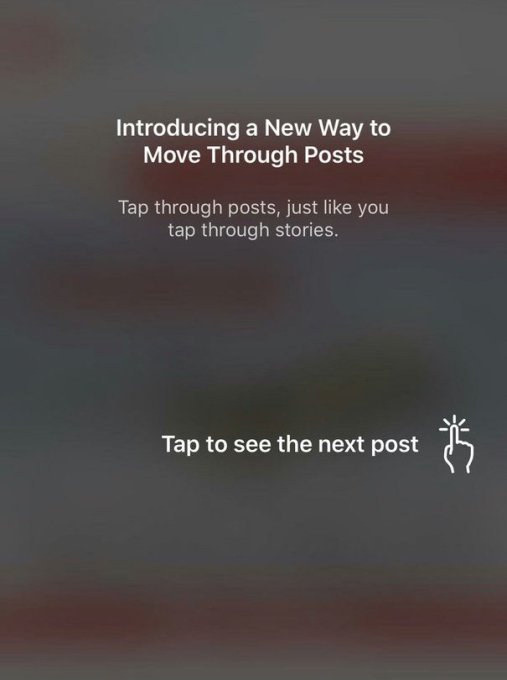
The effortless way you fast forward through Stories could be coming to more of Instagram . A screenshot from user Suprateek Bose shows Instagram “Introducing a new way to move through posts — Tap through posts, just like you tap through stories.”

Now Instagram confirms to TechCrunch that it’s testing tap to advance within Explore, and a spokesperson provided this statement: “We’re always testing ways to improve the experience on Instagram and bring you closer to the people and things you love.” As for whether this could come to the main feed, an Instagram spokesperson tells me that not something it’s actively thinking about right now.

Instagram already uses an auto-advance feature in its Videos You Might Like section of Explore, jumping down to the next video when the last one finishes. It previously offered themed video collections around Halloween and top creators too. But for photos where it’s not clear when you’re done viewing, a quick tap is the closest thing to Instagram propelling you through posts automatically.

Tap to advance, pioneered by Snapchat, eliminates the need for big thumbstrokes on your touch screen that can get tiring after awhile. It also means users always see media full-screen rather than having to fiddle with scrolling the perfect amount to see an entire post. Together, these create a more relaxing browsing experience that can devour hours of a user’s time. Instagram doesn’t show ads in Explore, but tap-to-advance could save your thumb stamina for more feed and Stories viewing where it does earn money. While Snapchat remains the teen favorite, Instagram could cater to seniors with arthritis with this new method of navigation (no, seriously, swiping can be tough on the joints for some people).

The fact that tap-to-advance is now testing but Instagram still hasn’t actually rolled out the Your Activity screentime digital well-being dashboard it says was launching two months ago begs the question of whether it really wants us to be more purposeful with our social media usage.

11 Oct 2018

Improbable brings its massive multiplayer platform to Unity game engine

As battle royale games like Fortnite pit more players against each other, studios are starting to realize the potential of bringing a massive online audience together at one time. This ambition has always existed, but Improbable, a well-funded startup aiming to enable these vast online worlds, is looking to bring these experiences to more game developers.

Improbable has announced that it is bringing a game development kit for its SpatialOS multiplayer platform to Unity, a popular game development platform used to create about half of new video games.

Improbable has some pretty grand ambitions for multi-player gaming and they’ve raised some grand venture capital to make that happen. The London startup has raised just over $600 million for their vision to enable digital worlds with vast expanses of concurrent users. The company’s SpatialOS platform allows single instances of an online game to run across multiple servers, essentially stitching a world together with each server keeping an eye on the other, allowing for hundreds of users to see each other and their in-game actions translated in a persistent way on systems across the globe.

The company’s tech opens the door for a lot of game developers to become more ambitious. There are several developers who have released titles on the platform.

Today’s news is a major step for the company, leveraging the popularity of Unity with a lot of younger studios to enable easier MMO development on an engine that is very popular with a wide range of developers. SpatialOS was previously available in a more limited, experimental scope on Unity. It also supports some development on Unreal Engine and CryEngine.

With today’s release, developers building with SpatialOS can craft games that allow for up to 200 players. The game development kit gives developers multiplayer networking and some other related features to expand the playing field, or at least further populate it. Improbable’s involvement goes far beyond just facilitating a download; a game built for SpatialOS will be hosted on Improbable’s servers, where it can be maintained via its host of web tools.

11 Oct 2018

Why missing Saudi journalist’s Apple Watch is an interesting, but unlikely, lead

Police investigating the missing Saudi journalist Jamal Khashoggi are searching for his Apple Watch to obtain his health and location data before his disappearance. But that may prove impossible, according to new details learned by TechCrunch.

The Saudi-born U.S. resident and Washington Post columnist went missing last week after he entered the Saudi consulate in Istanbul, reportedly to obtain marriage papers. His soon-to-be wife was waiting outside the consulate with Khashoggi’s iPhone.

Khashoggi never emerged from the consulate, sparking a manhunt. It has been reported but not confirmed that he was killed inside the consulate. The Washington Post reports that U.S. intercepts showed efforts by the Saudi crown prince Mohammad bin Salman to lure the reporter back to the kingdom and detain him.

Khashoggi was a vocal critic of the Saudi government. The Saudi kingdom has denied any involvement with his disappearance.

On Wednesday, Reuters reported, citing Turkish officials, that investigators were looking to Khashoggi’s black Apple Watch that he was wearing as he entered the consulate. The inference was that any data collected by the Apple Watch could glean answers into health data, such as his heart rate, location or other clues.

Turkey does not have the watch, Reuters said, suggesting it may have been lost, destroyed or remains in the custody of Saudi authorities.

TechCrunch staff have scoured several photo libraries and social media and found one image of Khashoggi wearing a third-generation Apple Watch — based on the red dot on the watch’s crown. The 2017 model comes come with an LTE connection.

Jamal Khashoggi in Istanbul, Turkey in May 2018 wearing a third-generation Apple Watch. (Image: Al Sharq Forum/Twitter)

But even if Khashoggi entered the Saudi consulate wearing that model, a third-generation Apple Watch does not support cellular connections in Turkey, effectively ruling out any chance that his health data synced either with his iPhone outside or Apple’s servers.

It’s also unlikely that the watch connected to a known Wi-Fi network inside the consulate, or that the watch was within close enough range to sync with his iPhone outside using Bluetooth.

In any case, if health data from Khashoggi’s watch was transmitted over the air to Apple’s iCloud where it could be synced with his iPhone, the data is end-to-end encrypted with his passcode.

Not even Apple — and therefore law enforcement — can access this data, meaning any evidence of his whereabouts will be on his iPhone.

There have been several cases of watches and fitness trackers helping authorities find missing persons, as well as help secure prosecutions. As much as wearables help track a person’s fitness and activity, they store and transmit data that’s often stored in the cloud. That data is often obtainable by law enforcement, which critics say is a privacy risk.

11 Oct 2018

Facebook rolls out 3D photos that use AI to simulate depth

What if you could peek behind what’s in your photos, like you’re moving your head to see what’s inside a window? That’s the futuristic promise of Facebook 3D photos. After announcing the feature at F8 in May, Facebook is now rolling out 3D photos to add make-believe depth to your iPhone portrait mode shots. Shoot one, tap the new 3D photos option in the status update composer, select a portrait mode photo, and users on the desktop or mobile News Feed as well as in VR through Oculus Go’s browser or Firefox on Oculus Rift. Everyone can now view 3D photos and the ability to create them will open to everyone in the coming weeks.

Facebook is constantly in search of ways to keep the News Feed interesting. What started with text and photos eventually expanded into videos and live broadcasts, and now to 360 photos and 3D photos. Facebook hopes if it’s the exclusive social media home for these new kinds of content, you’ll come back to explore and rack up some ad views in the mean time. Sometimes that means embracing mind-bending new formats like VR memories that recreate a scene in digital pointalism based on a photo.

So how exactly do 3D photos work? Our writer Devin Coldeway did a deep-dive earlier this year into how Facebook uses AI to stitch together real layers of the photo with what it infers should be there if you tilted your perspective. Since portrait mode fires off both of a phone’s cameras simultaneously, parralax differences can be used to recreate what’s behind the subject.

To create the best 3D photos with your iPhone 7+, 8+, X or XS, Facebook recommends you keep your subject three to four feet away, and have things in the foreground and background. Distinct colors will make the layers separate better, and transparent or shiny objects like glass or plastic can throw off the AI.

Originally, the idea was to democrative the creation of VR content. But with headset penetration still relatively low, it’s the ability to display depth in the News Feed that will have the greatest impact for Facebook. In an era where Facebook’s cool is waning, hosting next-generation art forms could make it a must-visit property even as more of our socializing moves to Instagram.