Year: 2018

11 Oct 2018

With Cred partnership, PwC wants to help make stablecoins legit

Audit giant PwC is the latest mainstream firm to show new interest in digital currencies. This week it announced a partnership with decentralized lending platform Cred to advise on better standards for stablecoins.

While details of the partnership are light, Cred is working on its own stablecoin tied to the U.S. dollar, and is hoping to avoid the mistakes of certain competitors by ensuring confidence in its operations from the ground up.

PwC’s overall interest here is to build broader trust so it can help millions of new users gain digital assets — and presumably create new revenue streams for its global professional services business in the process.

Like IBM and other companies large and small that are looking at stablecoins today, PwC is attracted to the blend of traditional and new monetary systems. Stablecoins are digital currencies pegged to a stable asset, such as gold or fiat currencies, or backed by collateral (that could also be a cryptocurrency); the arrangement is analogous to how some countries peg their national currencies to the dollar.

“Many investors are looking for crypto assets that can be pegged to a stable fiat currency such as the US dollar,” PwC and Cred said in the announcement. “But these assets require a reserve ledger built for decentralized assets, that can provide 100% transparency and value substantiation. PwC’s experience will provide valuable perspective on how standards can be enhanced to facilitate a more transparent set of reserve functions, stablecoins and deposit and yield products.”

PwC did not comment when we asked whether it has explored partnerships with other stablecoins, nor did it comment on the profile of customers that are looking to adopt these consulting solutions.

Today, stablecoin adoption and real-world implementation are still in the early stages. Despite more stablecoins getting introduced this year, there has not yet been any set of standards established for the space. Some stablecoins that have tried to go through traditional procedures, such as reserve auditing processes, have gone awry thus far, most famously Tether.

Still, optimism seems to be growing. Stablecoins have been in development for some time in the U.S., with multiple companies raising large sums of money to create a price-stable coin since early this year, including Carbon, MakerDAO and TrustToken. The company Basis appears to have raised the most to date, in a whopping $133 million round from top venture firms and financiers announced six months ago.

So far, stablecoin project teams have generally been heads-down developing detailed mechanics of their own coins, and they have been independently working with regulators to ascertain the future of stablecoins and their role in it.

Hence the lack of standardization. In most of the stablecoin teams’ mind, there should be only one or just a few stablecoin winners that could capture most of the mind share, and create products and an ecosystem that uses its cryptocurrency. This creates an invisible divide in the ecosystem, with the coins and tokens all trying to outcompete each other.

One outlier in the market has been USDT, a widely tradable stablecoin created by Tether, a company run by the same executives behind the exchange BitFinex’ed. Tether has been criticized for its failure to prove that the reserve has enough USD to back its digital currency on a one-to-one ratio, which it promises for its dollar-pegged cryptocurrency.

Among other issues this year, Tether “dissolved” its relationship with its first auditors, Friedman LLP, without an audit ever being completed. It then commissioned a law firm, not an auditor, to review its reserve balances. The result was its proof of funds’ “transparency update” highlighting that it should not be construed as the results of an audit. For more details, check out TechCrunch’s writeup back in August.

Meanwhile, PwC is just one of the traditional parties hoping to clean up stablecoins for mass adoption.

IBM most recently announced its exploration into stablecoins through a collaboration with Stellar by building a stablecoin on the Stellar blockchain. Additionally, a number of stablecoins have come out in the last few months, from the crypto exchange Gemini issuing the Gemini Dollar and financial blockchain solution Paxos issuing the Paxos Standard. There are also other stablecoins such as Terra, which is looking to implement a stablecoin through e-commerce.

Cred, for its part, has already been busy laying a strong foundation. It is founded by former PayPal financial technology veterans, with the mission to harness the power of blockchain to allow everyone to benefit from low-cost credit products. The team at Cred did not comment on whether they have worked with a consulting partner before, but they are currently in conversation with other consulting firms.

Cred is also the founding member of the UP Alliance, consisting of Uphold, Cred, Blockchain at Berkeley and Brave. Earlier this year, the Alliance announced a universal transparent reserve and custody standard that introduces what it calls “proxy” digital assets to the world, via the Universal Protocol Platform.

Given that cryptocurrency price volatility continues to be an obstacle for institutions looking to adopt the technology, it is likely that other financial and consulting institutions will turn to stablecoins as a way to support their existing customers and bring in interested new customers.
11 Oct 2018

App Store generated 93% more revenue than Google Play in Q3

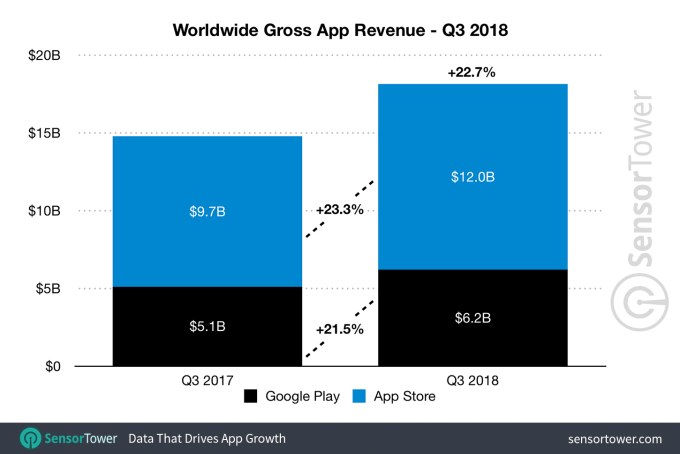
There’s always been a gap between how much money Apple’s App Store makes when compared with Google Play. But in the third quarter of 2018, that gap widened considerably – possibly to the widest point yet. According to a new report from Sensor Tower, the App Store earned nearly 93% more than Google Play in the quarter, the largest gap since at least 2014 – or, when Sensor Tower began tracking Google Play data.

The firm says that approximately 66% of the $18.2 billion in mobile app revenue generated in Q3 2018 came from Apple’s App Store. The store made $12 billion in the quarter, up 23.3% from the $9.7 billion it made during the same period last year.

Meanwhile, Google Play earned $6.2 billion in the quarter, up 21.5% from the year-ago quarter’s $5.1 billion.

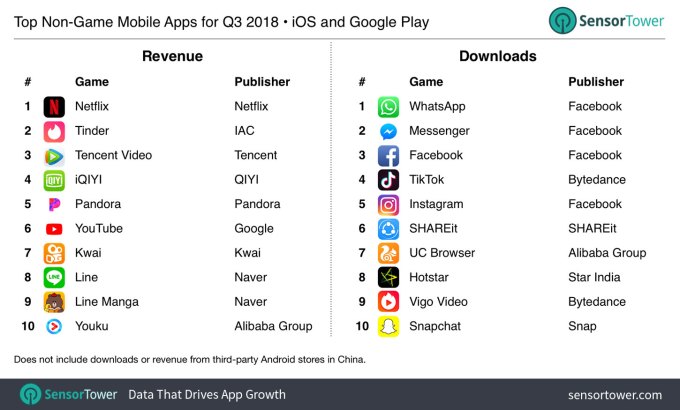
Based on Sensor Tower’s chart of top-grossing apps across both stores, subscriptions are continuing to aid in this revenue growth. Netflix remained the top-grossing non-game app for the third quarter in a row, bringing in an estimated $243.7 million across both platforms. Tinder and Tencent Video remained in the second and third spots, respectively.

Mobile game spending also helped fuel the revenue growth, with spending up 14.9% year-over-year during the quarter to reach $13.8 billion. In fact, it accounted for 76% of all app revenue across both platforms in the quarter, with $8.5 billion coming from the App Store and $5.3 billion from Google Play.

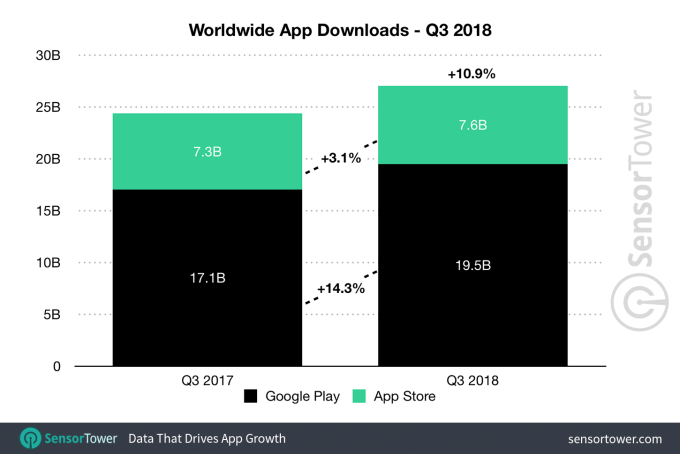
In terms of app downloads, however, Google Play still has the edge thanks to rapid adoption of lower-cost Android devices in emerging markets, the report said. App installs grew 10.9% across both stores, reaching 27.1 billion, up 24.4% from Q3 2017.

The rankings of the most downloaded apps also got a big shakeup in Q3, thanks to Bytedance’s short-video app TikTok absorbing Musical.ly during the quarter. As a result of the merger, it’s now the No. 4 ranked app worldwide, having grown 15% quarter-over-quarter and 440% year-over-year.

That puts it ahead of both Instagram (No. 5) and Snapchat (No. 10), in terms of Q3 app downloads, and sets the stage for Bytedance becoming a more serious player in the social app market.

Sensor Tower’s full report is available here.

11 Oct 2018

CommonSense Robotics’ first automated fulfillment center is now live

Israeli startup CommonSense Robotics is launching its first automated micro-fulfillment center in Tel Aviv. It’s a tiny 6,000 square feet warehouse that is packed from ground to ceiling with products. Robots do the heavy lifting when it comes to getting items ready to dispatch.

TechCrunch shot a video os CommonSense Robotics’ test fulfillment center. Today’s new warehouse is much bigger than that, but still much smaller than an Amazon warehouse. The company’s first client is Superpharm, Isarel’s largest drug store chain.

The startup wants to convince grocery retailers in urban areas that they can deliver orders in less than an hour. Currently, grocery retailers either leverage their stores (which is a waste of time) or have a giant warehouse outside of the big city.

With CommonSense Robotics, you could imagine a city with multiple micro-fulfillment centers so that you’re never too far. When you order something, robots instantly navigate around the warehouse and the shelves to pick up your stuff. A central server coordinates all the robots in real time to optimize the routes. This way, humans can stay at a scanning station and put together an order without having to move.

CommonSense Robotics remains in charge of the fulfillment centers. E-commerce retailers pay the startup to create and manage those fulfillment centers. This way, you can focus on your product inventory and last mile deliveries.

The company already signed a deal with Israeli grocery retailer Rami Levy for 12 centers. And CommonSense also plans to launch multiple sites in the U.S. in 2019.

11 Oct 2018

SpankChain spanked

SpankChain, a cryptocurrency aimed at decentralized sex cams, has announced that a hacker stole about $38,000 from their payment channel thanks to a broken smart contract. They wrote:

At 6pm PST Saturday, an unknown attacker drained 165.38 ETH (~$38,000) from our payment channel smart contract which also resulted in $4,000 worth of BOOTY on the contract becoming immobilized. Of the stolen/immobilized ETH/BOOTY, 34.99 ETH (~$8,000) and 1271.88 BOOTY belongs to users (~$9,300 total), and the rest belonged to SpankChain.

Our immediate priority has been to provide complete reimbursements to all users who lost funds. We are preparing an ETH airdrop to cover all $9,300 worth of ETH and BOOTY that belonged to users. Funds will be sent directly to users’ SpankPay accounts, and will be available as soon as we reboot Spank.Live.

The hacker used a ‘reentrancy’ bug in which the user calls the same transfer multiple times, draining a little Ethereum each time. The bug is the same one that previously affected the DAO.

The company pointed out that a security audit on their smart contract would have cost $50,000, a bit more than the amount lost. “As we move forward and grow, we will be stepping up our security practices, and making sure to get multiple internal audits for any smart contract code we publish, as well as at least one professional external audit,” they wrote.

I’ve reached out to the company for clarification but in short it seems the spanker has become the spankee.

11 Oct 2018

Coord, a Sidewalk Labs spin-out, raises $5 million to help mobility services better integrate into cities

Coord, the mobility data startup that spun out of Alphabet-owned Sidewalk Labs, has raised a $5 million Series A round led by Alliance Ventures, with participation from Trucks, Urban.Us and DB Digital Ventures.

The plan with the funding is to continue to enhance Coord’s APIs and geographic coverage, as well as “build a bridge between the private and public sectors,” Coord co-founder and CEO Stephen Smyth wrote on Medium.

Coord offers a few products for its customers, which includes companies like Zipcar, Mozio and Google’s Maps product. There’s the Tolls API, which keeps tabs on toll roads, bridges and tunnels to determine the costs of trips, the Curbs API that is designed to help drivers easily figure out the parking and passenger loading rules (think ride-hailing drivers) in the area, meter prices and so forth, as well as a Routing API that uses real-time information to surface the best multi-modal routes.

And as bike-sharing and scooter-sharing continue to expand across the world, Curbs also offers a Shared Vehicle API to enable its customers to integrate the real-time availability, prices and locations of both bikes and scooters.

“Our goal is to help the public and private sectors speak the same language when it comes to urban transportation,” Smyth wrote. “While many private companies are not well integrated into existing transportation systems of today, we believe that end users will ultimately demand interoperability across all of the systems in a city. To that end, we are driving standardization of transportation-related data across cities.”

11 Oct 2018

Fortnite for Android no longer requires an invite

Fortnite’s journey to Android has been an adventure unto itself. It first launched as a Samsung exclusive, alongside the Note 9, before circumventing the Play Store to arrive on Google’s Mobile operating system.

Until now, however, actually getting the game required going to the site, signing up and waiting for an invite. Epic announced today via Twitter that it’s finally cutting that red tape. While the company is still sidestepping Play in order to keep its earnings to itself, downloading the game is a simple as scanning a QR code from its site.

Not that any of those extra steps were hurting the game. The wildly popular hit 15 million installs a mere three weeks after launching on the OS.

11 Oct 2018

Uber Freight’s app for truck drivers is getting an upgrade

Uber Freight, the newly spun out Uber business unit, will push out an upgraded app in the coming weeks with better, more intuitive tools to help truck drivers connect with shipping companies.

The redesigned and updated app comes just two months after Uber announced it would make Uber Freight a separate unit and more than double its investment into the business.

“This is an industry that is just fraught with a lot of manual processes,” Adam Schwabe, senior product designer at Uber Freight told TechCrunch. “A lot of work that has to go into running the business is the overhead. The way we approached this is to design an app in a very user-centered way around the truck drivers.”

That meant going to a lot of truck shows and getting the app into drivers’ hands, Schwabe added.

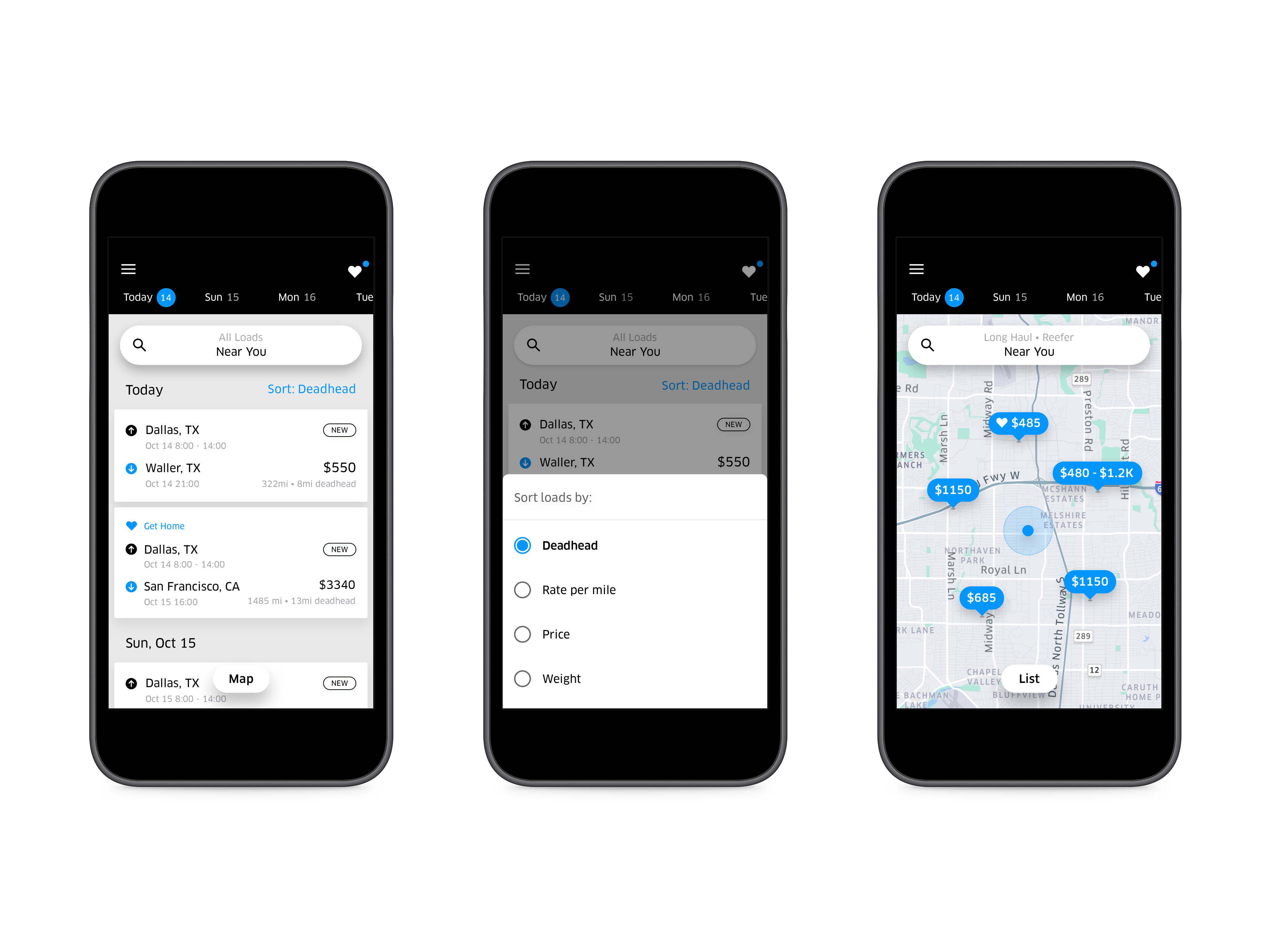
The result is an upgraded app with new navigation features that make searching for and filtering loads easier to customize and more intuitive. The new redesign has a search bar across the top of the screen, an easy place where all of the driver’s preferences can be found. If drivers change their selections — say putting a preference on maximizing the rate per mile — the  search bar will update in real time about how many load matches are found.

Uber Freight also added a date picker to the app that lets carriers and their drivers jump to a pick-up date of their choosing with just a tap, so they can plan their weeks more efficiently.

Drivers also can sort for the factors that are the most important to them, according to Uber Freight product manager Xinfeng Le.

The search and sort upgrades will be available on iOS and Android in the coming weeks.

The app is also getting an updated map view, which will roll out to all users in 2019. The map view provides a brand new way for truck drivers to look for loads around their location. The app is already equipped with a list view, which shows them many loads at once. The map view is handy because users can drag the map to areas where they’ll be traveling.

Uber Freight has been scaling up its business since launching in May 2017, growing from limited regional operations in Texas to the rest of the continental U.S. The company, which is led by Lior Ron, has offices in San Francisco and Chicago.

The company has launched a series of programs and features since March, including “fleet mode” and Uber Freight Plus, which gives app users access to discounts on services such as fuel, tires and phone plans.

Uber Freight also started an advisory board of truck drivers and introduced a platform that lets shippers into the company’s network and lets them manage shipments directly from their desktop.

11 Oct 2018

Roblox makes first acquisition with purchase of app performance startup PacketZoom

Fresh off a $150 million round of funding, kids’ gaming platform Roblox is making its first acquisition. The company says it’s acquiring the small startup PacketZoom, bringing its team and technology in-house to help it improve mobile application performance as its platform expands further into worldwide markets.

Founded in 2013, and based in San Mateo, California, PacketZoom had raised a $5 million Series A late last year. The company combines a content delivery network (CDN) to speed up performance with an application performance management tool to identify issues in a single package, TechCrunch had explained at the time.

The company’s products allow developers access to analytics about the app and network-performance related issues, as well as optimize app delivery and content downloads – up to 2 to 3 times faster.

The system in particular is designed to overcome the limitations of slow and unreliable networks, like those found in emerging markets. It also helps to ensure faster and lower latency data transfers worldwide.

It’s clear how this acquisition makes sense for Roblox, which offers a platform where kids create and play in 3D worlds and games and has global expansion in mind. With PacketZoom integrated into its gaming platform, users will be able to join games faster and have a better experience when playing on mobile devices.

Roblox had said earlier this year it was cash-flow positive and continues to be profitable. It raised funds in order to stock its war chest and have a buffer, while focused on its international expansion efforts. It also said it would use the funds to make acquisitions and open offices outside the U.S. in some regions, like China.

PacketZoom had raised $11.2 million to date from investors including Founder Collective, Tandem Capital, First Round Capital, Baseline Ventures, Arafura Ventures, and others.

According to PacketZoom’s website, it was working with customers like Glu Mobile, Sephora, Photofy, Inshorts, Upwork, News Republic, Wave, Belcorp, GOTA, Netmeds, Houzify, Wooplr, Fluik Entertainment, Wondermall, and others. These relationships will be wound down, as Roblox plans to only use the IP internally, not to support other customers.

Roblox declined to speak to the acquisition price, but notes it was an all-cash deal. It includes all of PacketZoom’s IP and code. PacketZoom’s founder and CTO, Chetan Ahuja, along with the PacketZoom’s four-person engineering team will join Roblox.

11 Oct 2018

Google updates its Assistant on smart displays and phones

Earlier this week at its annual hardware event, Google announced a number of new features for its Assistant coming to the new Pixel 3 phones and Google’s own Home Hub smart display. As it turns out, though, Google didn’t pull back the curtain on everything new with the Assistant, so today, it’s announcing a number of new features and clarifying which of those that it showed off on the Pixel 3 are coming to other phones as well.

If you currently have the Lenovo Smart Display or the JBL Link View at home, then you’ll be happy to hear that you’ll get Live Albums, support for the Nest Hello doorbell and Home View for controlling all of your smart home devices soon. This update will also remedy one of my biggest gripes with smart displays so far because you’ll finally be able to add them to your speaker groups — something that was oddly missing when Lenovo and JBL announced their gadgets.

As Google already announced before, Call Screen, which lets you use the Assistant to answer a call to make sure it’s not yet another annoying telemarketing scam, and Duplex for making restaurant reservations is coming to Pixel phones later this year.

What’s new is that Google also today announced that its new visual snapshot of your day — so that you can see reminders, recent notes and event notifications — is coming to all Android smartphones with the Assistant soon. To see this, you simply swipe up after activating the assistant.

The Assistant is also coming to the lockscreen and now lets you pose personal queries like “What’s on my calendar?” without unlocking the phone. Instead, Google relies on its ability to recognize your voice to provide you this information, similar to what it already does on its Google Home devices.

On phones, Google is also introducing its new “Filters” setting that allows you to manage your kids’ access to the apps on your phone and a new ‘downtime’ feature that lets you set a schedule for when you can’t use your device. Soon, you’ll also be able to access many of the Pixel phones’ Digital Wellbeing features from the Assistant (“Hey Google, set wind down for 10am”).

11 Oct 2018

Facebook Groups can now launch up to 250-person chat rooms

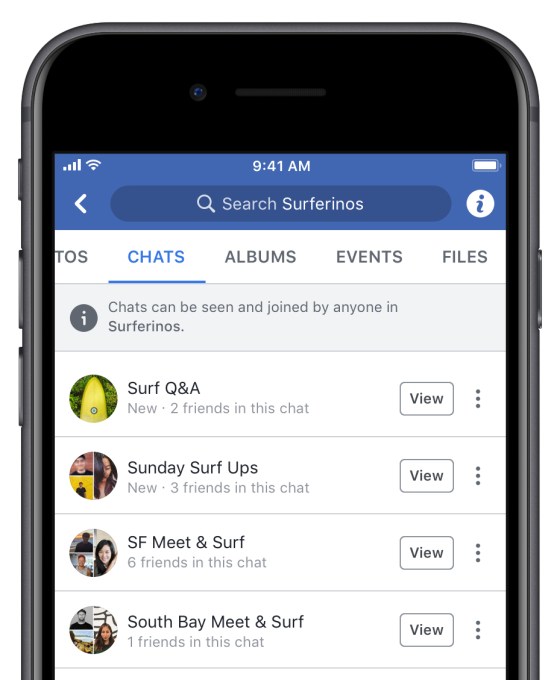
If you miss the old AOL chat rooms, you’ll love Facebook’s plan to combine Groups and with Messenger without spamming you to death. Starting today, Facebook will gradually roll out the ability for members of Facebook Groups to launch group chats about specific sub-topics that up to 250 members can join. They can also start audio or video calls with up to 50 members. A dog owners’ Group could spawn threads for discussing spontaneous park meetups, grooming tips, or sharing photos as they’re puppies grow up. Chat for Groups could make Facebook’s discussion forums more real-time and engaging, strengthening loyalty to one of the social network’s most differentiated features.

But instead of immediately alerting you of every message in every thread, you’ll first get a Facebook Groups notification inviting you to each new group chat you have to voluntarily join to receive further notifications. If you miss that initial alert, you can always go to the new Chat tab on Facebook Groups to browse the active threads or launch a new one. And if a Group chat gets overwhelming, you can turn off notifications about message reactions and Messenger games, or opt to only be notified if you’re @ mentioned in the thread. As a last resort against spam, Group admins can always shut down a group chat or limit their creation to only other admins.

Facebook has been poking around how it could integrate Messenger and Groups for a while. It already offers group chat for up to 250 members of a Facebook Event, and in 2016 Messenger tested public discussion “Rooms”. Now Facebook has settled on building chat as an extension of its existing Groups instead.

As the News Feed gets more politically combative and the algorithm preferences generalist content that’s appealing to everyone, there’s less room for niche interest content on Facebook. That’s contributed to an explosion of group chat activity on competitors like Telegram. WhatsApp revamped its own group chats with more admin tools in May to fight off this threat.

With 1.4 billion people active in Facebook Groups each month as part of tens of millions of active Groups, the feature generates a ton of activity and return visits for Facebook. With Groups Chats, Facebook expects users could “plan events, arrange in-person meetings, or have deeper discussions”. Messaging could also help Facebook build towards its goal of getting 1 billion people into what it calls “meaningful Groups” after it announce 200 million people already were as of May. With all the scandals plaguing its reputation and concerns that it polarizes the populace, Facebook is eager to find more ways to show it actually brings people together