Year: 2018

10 Oct 2018

AT&T will launch another streaming service in 2019, with HBO and other WarnerMedia content

AT&T will launch a new direct-to-consumer streaming service next year, the company announced today. Yes, another one. AT&T currently already operates cord cutter-friendly streaming services DirecTV Now and the low-cost WatchTV, but its new service will be focused on WarnerMedia properties, including HBO.

The move follows AT&T’s acquisition of Time Warner, which completed this past June. That means AT&T also now operates Time Warner’s streaming services HBO GO, for pay TV viewers, and HBO NOW, for cord cutters.

The upcoming, subscription-based service will include all of WarnerMedia’s properties, like HBO plus WarnerMedia’s other TV and movie franchises, as well as third-party licensed content.

And unlike DirecTV Now and Watch TV, the focus is not on streaming live TV, but on-demand content.

In that way, it’s being positioned more as a Netflix competitor, or even a rival to Disney’s upcoming streaming service, also due in 2019.

WarnerMedia CEO John Stankey discussed the service on stage at Vanity Fair’s New Establishment Summit on Wednesday, but didn’t confirm its pricing or even what titles, specifically, would be included.

However, as CNBC noted, the company owns many major media brands like “Harry Potter,” “Batman,” and shows from cable TV networks like CNN, TNT, and TBS.

The service will cost more than HBO NOW, Variety also reports, and will be competitive in terms of content spend with Netflix. Currently, Warner Media spends $2.5 million to Netflix’s $8 billion on content, its report said.

In a statement, Stankey confirmed the new service would arrive in the fourth quarter of 2019.

“This is another benefit of the AT&T/Time Warner merger, and we are committed to launching a compelling and competitive product that will serve as a complement to our existing businesses and help us to expand our reach by offering a new choice for entertainment with the WarnerMedia collection of films, television series, libraries, documentaries and animation loved by consumers around the world,” Stankey said.

“We expect to create such a compelling product that it will help distributors increase consumer penetration of their current packages and help us successfully reach more customers,” he added.

10 Oct 2018

Jeffrey Katzenberg and Meg Whitman announce the name of their stealthy mobile video startup

On stage at Vanity Fair’s New Establishment Summit in Los Angeles, Jeffrey Katzenberg and Meg Whitman unveiled the name of their highly-anticipated mobile video company known until now as NewTV.

The name is Quibi, short for “quick bites,” per a note on its new website: “Something cool is coming from Hollywood and Silicon Valley — quick bites of captivating entertainment, created for mobile by the best talent, designed to fit perfectly into any moment of your day.”

The short-form video service, launching next year, will operate on a two-tiered subscription model similar to Hulu, per Deadline. Quibi is cooking up original content with Oscar-winning filmmaker Guillermo del Toro, Southpaw director Antoine Fuqua and Spiderman director Sami Raimi, as well as Get Out producer Jason Blum and Van Toffler, the CEO of digital media production company Gunpowder & Sky.

The Hollywood Reporter says the del Toro project “is a modern zombie story,” the Fuqua project is “a modern version of Dog Day Afternoon” and the Blum project, titled Wolves and Villagers, could be compared to Fatal Attraction.

Katzenberg, the former chairman of Walt Disney Studios and founder of WndrCo, a consumer tech investment and holding company, has raised $1 billion for Quibi from Disney, 21st Century Fox, Entertainment One, NBCUniversal, Sony Pictures Entertainment, Alibaba Goldman Sachs, JPMorgan Chase, Madrone Capital and several others. He hired Meg Whitman as Quibi’s CEO in January.

Quibi, given Katzenberg and Whitman’s entertainment and business acumen, is expected to compete with the biggest players in the space, including Instagram, Netflix and Snap, which today announced Snap Originals. The new effort will have the ephemeral messaging service rolling out 12 new scripted shows on its app from Keeping Up With The Kardashians creator Bunim/Murray, Friday Night Lights writer Carter Harris and more.

Quibi is hiring aggressively, recently bringing on former Viacom executive Doug Herzog, former Instagram product manager Blake Barnes and former Hulu chief technology officer Rob Post, also per THR.

Quibi did not immediately respond to a request for comment.

10 Oct 2018

Shasta Ventures is doubling down on security startups with 3 new hires

Early-stage venture capital firm Shasta Ventures has brought on three new faces to beef up its enterprise software and security portfolio amid a big push to “go deeper” into cybersecurity, per Shasta’s managing director Doug Pepper.

Balaji Yelamanchili (above left), the former general manager and executive vice president of Symantec’s enterprise security business unit, joins as a venture partner on the firm’s enterprise software team. He was previously a senior vice president at Oracle and Dell EMC. Pepper says Yelamanchili will be sourcing investments and may take board seats in “certain cases.”

The firm has also tapped Salesforce’s former chief information security officer Izak Mutlu (above center) as an executive-in-residence, a role in which he’ll advise Shasta portfolio companies. Mutlu spent 11 years at the cloud computing company managing IT security and compliance.

InterWest board partner Drew Harman, the final new hire, has joined as a board partner and will work closely with the chief executive officers of Shasta’s startups. Harman has worked in enterprise software for 25 years across a number of roles. He is currently on the boards of the cloud-based monetization platform Aria, enterprise content marketing startup NewsCred, customer retention software provider Totango and others.

There’s no area today that’s more important than cybersecurity,” Pepper told TechCrunch. “The business of venture has gotten increasingly competitive and it demands more focus than ever before. We aren’t looking for generalists, we are looking for domain experts.”

Shasta’s security investments include email authentication service Valimail, which raised a $25 million Series B in May. Airspace Systems, a startup that built “kinetic capture” technologies that can identify offending unmanned aircrafts and take them down, raised a $20 million round with participation from Shasta in March. And four-year-old Stealth Security, a startup that defends companies from automated bot attacks, secured an $8 million investment from Shasta in February.

The Menlo Park-based firm filed to raise $300 million for its fifth flagship VC fund in 2016. A year later, it announced a specialty vehicle geared toward augmented and virtual reality app development. With more than $1 billion under management, the firm also backs consumer, IoT, robotics and space-tech companies across the U.S.

In the last year, Shasta has promoted Nikhil Basu Trivedi, Nitin Chopra and Jacob Mullins from associate to partner, as well as added two new associates, Natalie Sandman and Rachel Star.

10 Oct 2018

Target’s newest incubator is looking for ‘save the world’ kind of stuff

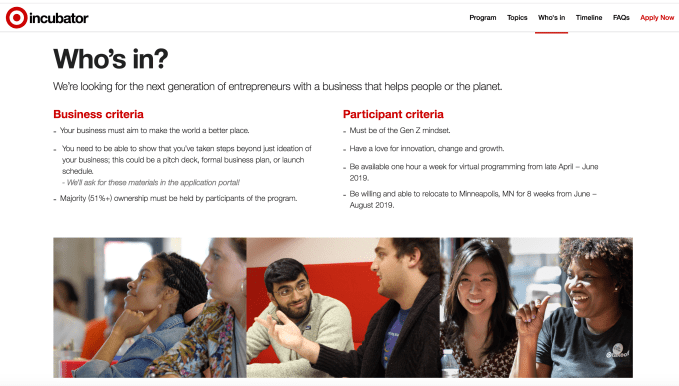
Target is no stranger to running startup accelerators. The company today operates its Target + Techstars program, the beauty-focused Target Takeoff, and the India-based Target Accelerator Program. Now it’s adding a fourth business accelerator to the mix with the launch of Target Incubator. The new program is aimed at Gen Z entrepreneurs and its only real require is that the businesses involved are doing some sort of good.

As Target puts it, the businesses simply need to be making things “better for people or the planet.”

That broad requirement could cover a range of businesses, including those with new product ideas, new technology, or new services. Target says these could be things that impact everything from how you get your groceries to greenhouse emissions.

The businesses themselves don’t have to be too far along, either. All Target is asking is the company has taken some steps to try to get traction, but the business itself doesn’t have to have already publicly launched. It just needs to be more than “an idea” and it needs to be established as a legal entity. The founders must also still retain majority ownership (51%+) to be considered.

The retailer says it will select eight businesses for the program, with up to two members per business directly participating in the new incubator.

These “Gen Z”-focused entrepreneurs will then participate in virtual programming one hour per week from late April through June 2019, followed by a two-month in-person incubator program at Target’s HQ in Minneapolis from mid July through early August 2019.

While there, they’ll receive mentorship from Target leaders and other businesses; participate in workshops, learning sessions and team-building events; be able to access subject matter experts across industries; and participate in other founder growth and development opportunities, Target says.

Applications opened up Monday and will close on October 29, with offers doled out on December 5, following a round of finalist interviews.

The businesses selected will also receive a $10,000 stipend from Target.

And the retailer will cover travel and accommodations for the interviews, plus travel and housing for those attending the eight-week program, which wraps with a demo day.

For Target, being involved with startups gives it the chance to invest in businesses at an early stage, which can ultimately benefit Target’s own bottom line, help it keep up with trends – especially those that draw in younger shoppers – and aid in its battle with Amazon.

The company has already established itself as a company that wants to work with emerging brands, through moves like its investment in online mattress company Casper, as well as through partnerships with digital-first brands like Bevel, Harry’s, Bark, Who What Wear, Native, Quip, Rocketbook, GIR, NatureBox, Hello, and others. It also last year acquired same-day delivery service Shipt, a still-emerging company that allowed it to get into the hot grocery delivery market.

Beyond working with new and digital-first brands, Target wants to reach businesses doing “good.” Today, many younger shoppers – those Target dubs as “Gen Z” – are driven to stores by more than just price. They often want to feel happy about their purchases because they believe in the company’s mission, or because it supports sustainable businesses, for example. Target Incubator will give the retailer a first look into those kinds of businesses now, too.

10 Oct 2018

Nintendo’s ‘souped-up’ NES Zelda loads you with gear for an easier adventure

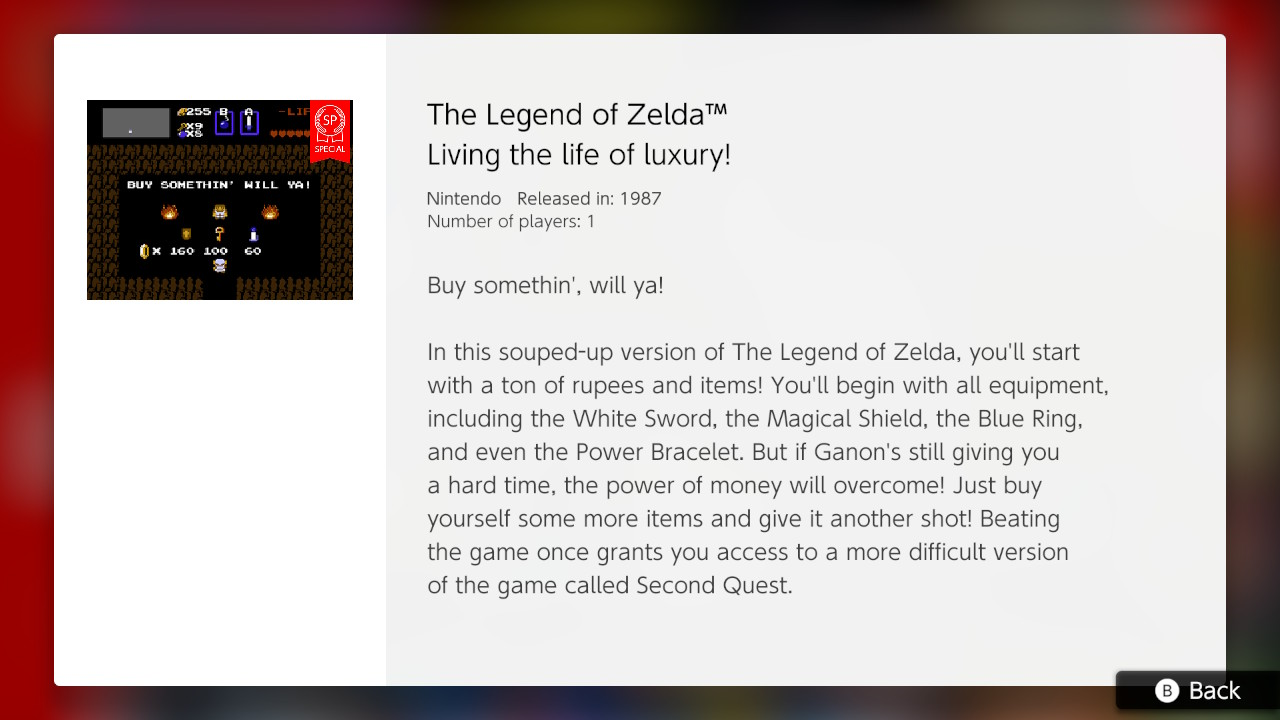
Nintendo has set a strange new precedent with the release of Legend of Zelda SP on the Switch: it’s essentially the original NES game but with Link starts loaded up with good gear and cash. In a way it’s no different from a cheat code, but the way it’s executed feels like a missed opportunity.

The game itself (SP stands for “special”) is described by Nintendo in the menu as a “souped up version” of the original: “Living the life of luxury!” It’s a separate entry in the menu with all the other NES games you get as part of the company’s subscription service.

You’re given the white sword, big shield, blue ring and power bracelet, plus 255 rupees to replace that shield when a Like-like eats it. Basically they’ve given you all the stuff you can find on the overworld (including max bombs and keys), but no items you’d get from inside a dungeon. You also have six hearts, and traveling around a little bit I determined these were awarded by raiding nearby hidden areas, not simply assigned. Secret passages are already revealed, and so on.

Because it skips the title screen and save game selection it seems like someone must have essentially played through the game to this point (or more likely edited the values in game RAM) and then walked to the classic starting point and made a save state that automatically loads when you start or reset the game. This means the only way to save is to use the Switch’s built-in save states, not the rather inconvenient save method the game used.

It’s plain enough that this will be a less frustrating way to explore this famously difficult game, but it seems untrue to Zelda’s roots. I understand perhaps gifting the player some of the impossible to find things like a heart hidden inside a random block here or there. Getting some bombs to start is great too, and maybe even the rings (warping is helpful, and the game is pretty punishing, so damage reduction is nice). But the white sword?

For one thing, a player experiencing the game this way misses out on one of the most iconic moments in all gaming — “It’s dangerous to go alone. Take this!” Then the ritual lifting of the wooden sword. And then setting out into the world to die again and again.

And for me, the white sword was always sort of a rite of passage in the game — your first big step toward becoming powerful. You earned it by finding those extra heart containers, perhaps after asking in vain after it before you were ready. Once you have it, you’re cutting through enemies like butter.

To make it the default sword and to skip these steps seems like it causes the player to miss out on what makes Zelda Zelda.

To be fair, it’s not the only version of the game you can play — the original is available, too. But it seems like a missed opportunity. Why not just have a save game you can load with this stuff, so you can continue playing as normal? Why not have the option baked into the launch of the original Zelda — have a couple secret save states ready with differing levels of items?

Nintendo has the opportunity to introduce a new generation to classic NES games here, having provided a rather bare-bones experience with the NES Classic Edition. Why not enhance them? Include the manual, god mode, developer commentary? This is the legacy the company has been stewarding for decades, and what better than to give it the respect it deserves?

I’m probably overthinking it. But this Zelda SP just seems like a rushed job when players would appreciate something like it, just not so heavy-handed. It’s not that these games are inviolable, but that if they’re going to be fiddled with, we’d like to see it done properly.

10 Oct 2018

Skello raises $6.9 million for its staff management service

French startup Skello just raised a $6.9 million funding round (€6 million) from Aglaé Ventures, XAnge, Jean-Baptiste Rudelle and existing investors Thomas Landais, Guillaume le Dieu de Ville and Gilles Blanchard.

The startup is helping bar, restaurant and hotel managers keep track of all the shifts and staffing issues. Skello uses a software-as-a-service approach to help you save time on pesky admin tasks.

After setting up your rules, you can easily generate shifts. Waiters, receptionists and other staff members receive their schedule via email and SMS. Employees can also request shift changes, say when they’re unavailable and make sure everything is taken into account.

At the end of the month, Skello can generate detailed reports with bonuses, leaves, etc. Everything is then exported to payroll solutions. And of course, Skello helps you visualize how much you’re spending on staff, if you’re keeping costs under control and more.

There are many companies trying to do the same thing. But in reality many bars and restaurants still rely on Excel. Chances are it works quite well if you’re running a small business. But it doesn’t scale well. 30,000 employees are now using Skello every day. Alain Ducasse, Planet Sushi and AccorHotels’ Ibis are using Skello.

With today’s funding round, the company first wants to expand to new categories, such as retail and healthcare. Skello then plans to expand to other European countries.

10 Oct 2018

Waymo’s self-driving cars hit 10 million miles

Alphabet’s self-driving car company Waymo has spent years testing its autonomous vehicles on public roads. What started as a trickle of miles driven each day has exploded in the past few years.

And now, the company has hit a new milestone as it prepares to launch a commercial ride-hailing service with fleets of self-driving vehicles.

Waymo announced Wednesday that its autonomous vehicles have driven 10 million miles on public roads in the United States. Keep in mind that the company hit 8 million miles in July and had logged just 4 million miles in November 2017. In other words, Waymo’s pace is quickening.

These autonomous vehicle miles were logged in 25 cities, notably in Google’s hometown of Mountain View, California and in the greater Phoenix area, where the company launched an early rider program to shuttle passengers around the city. More than 400 early riders use the Waymo app and ride in their autonomous Chrysler Pacifica Hybrid minivans.

The company’s progress on public roads is made possible by its investment in simulation, Waymo CEO John Krafcik noted in a post on Medium. The company will hit 7 billion miles driven in its virtual world by the end of the month.

“In simulation, we can recreate any encounter we have on the road and make situations even more challenging through ‘fuzzing,’ ” Krafcik wrote. “We can test new skills, refine existing ones, and practice extremely rare encounters, constantly challenging, verifying, and validating our software. We can learn exponentially through this combination of driving on public roads and simulation.”

Of course, it’s not just about racking up miles.

Companies like Cruise and Waymo with large numbers of autonomous vehicles have been challenged to develop self-driving cars that can safely navigate complex urban environments and fit in with the millions of human drivers on the road. It’s not always smooth, and traffic can stack up behind these cautious autonomous vehicles, sometimes requiring the human test driver to take manual control of the car.

“Today, our cars are programmed to be cautious and courteous above all, because that’s the safest thing to do,” Krafcik wrote. “We’re working on striking the balance between this and being assertive as we master maneuvers that are tough for everyone on the road. For example, merging lanes in fast-moving traffic requires a driver to be both assertive enough to complete the maneuver without causing others to brake and smooth enough to feel pleasant to our passengers.”

For now, Waymo vehicles are more circumspect and are designed to take the safest route, even if that means adding a few minutes to the trip, according to Krafcik.

The next 10 million miles, Krafcik said, will focus on building out the ride-hailing service to make it more convenient and efficient. For instance, the company is working to improve its routes, pick-ups and drop-offs.

Waymo engineers are also applying advanced artificial intelligence and new in-house-designed sensing systems to navigate complex weather conditions like heavy rain and snow, Krafcik said.

10 Oct 2018

Kahoot, the educational gaming startup, has raised another $15M, now at a $300M valuation

School’s back in session and a startup that’s building games to help students learn has moved to the top of the class. Kahoot — the educational gaming startup out of Norway that has been a quick hit with schools in the US and elsewhere — today announced that it has raised 126.5 million Norwegian krone (around $15.4 million), its second round this year, at a valuation of about 2.55 billion krone ($300 million), tripling its valuation in 7 months.

For some context, the company raised $17 million in March at a $100 million valuation.

Kahoot has been around since 2006 — originally as a gamefied education app called Lecture Quiz — although its rise in popularity and usage has been a more recent shift, dovetailing with how teachers are increasingly using more learning aids that are in tune with two of the more popular pastimes among kids these days: playing around on devices with screens, and playing games.

Kahoot is a notable standout at a time when gaming among kids is dominated by Fortnite, a top-grossing app, but a controversial one because of how addictive it is. (Even Prince Harry — yes, Prince Harry — has weighed in on this one.)

Åsmund Furuseth, Kahoot’s CEO and co-founder, said in an interview that the money will be used to continue investing in building the platform, and also to make acquisitions — likely to be announced in the next couple of months.

“It’s about strengthening our position in learning and the platform,” he said in an interview. This latest round comes from Nordic investors in the company led by existing investor Datum AS, and Furuseth said that there is likely to be another round in the company that brings in international investors and strategic backers.

“Disney is an investor already and they have an option to become a larger shareholder,” he noted. Others that have already backed Kahoot include Microsoft and Northzone. “This round was specifically around the Nordic region and Nordic investment bankers, who were interested in acquiring shares because of our growth and what we are doing in the learning space.”

As we have written before, Kahoot in January this year passed the 70 million user mark with about a 50 percent penetration among K-12 students in the US, with about 51 million games created on the platform.

Furuseth today said that the company is on track to pass 100 million users by the end of this year, with rises in its other metrics. Alongside its push into the K-12 education sector, it’s also been growing its enterprise line, building “games” for businesses to use in helping onboard employees and other services. 

“Our largest amount of users come from the education sector, but when it comes to revenue and growth, it’s the business segment that is larger,” he said. The plan is to continue building products for audiences, he added.

He did not say whether the company is closer to being cash-flow positive. Notably, he took over as CEO earlier this year on a platform of aiming for just that, after a period in which the company appeared to be bulking up quickly with an ambitious plan to ink content partnerships and build out more products.

10 Oct 2018

Will MBS’s money ever become radioactive?

Yesterday, a Saudi news outlet broke the news that such Silicon Valley big wheels as Marc Andreessen, Sam Altman, and Travis Kalanick are advisors to a $500 billion megacity project being built by the country, which has pitched it as a model of what future cities will look like.

The announcement’s timing was not ideal for members of this 19-member list, who signed on to the project months ago in some cases. At the moment, there’s growing outrage over the weeklong disappearance of dissident Saudi journalist Jamal Khashoggi, who Turkish officials say was murdered last week in the Saudi Consulate in Istanbul on orders from the Saudi Royal family, then chopped into pieces with a bone saw and removed from the building. It’s graphic and upsetting to contemplate and, importantly, it has not been proven. But the widespread and growing assumption that Saudi intelligence agents did something to Khashoggi (there is no evidence to support that he left the building) has put Saudi Arabia’s Crown Prince Mohammed bin Salman Al Saud under the world’s glare. Indeed, the advisory board announcement seemed very much a way for the prince, known as MBS, to brandish his powerful American friends just as many in the U.S. are beginning to wonder exactly what he is capable of.

We might have wondered sooner, given that MBS has been fairly consistent about his lack of tolerance for either criticism or rivals since his rise to prominence was sealed by his appointment as crown prince in June of last year. Though MBS has been widely lauded for his reformist tendencies — he has “stood up to the religious elite to impose breathtaking social changes, including letting women drive and allowing concerts and cinemas,” as noted this summer in a WSJ opinion piece — he has also led air raids in Yemen that have killed many thousands of civilians (with White House support, to the dismay of lawmakers from both political parties).

Saudi Arabia also detained more than a dozen women’s rights activists over the summer. When Canada’s foreign ministry rebuked Riyadh for jailing them, saying it was “seriously concerned” with the arrests, Saudi Arabia expelled the country’s ambassador, suspended flights to and from Toronto, barred its citizens from receiving medical care in Canada, and froze new trade and investment with Canada worth billions of dollars. It also announced plans to move thousands of Saudi scholarship students out of Canadian schools.

Meanwhile, last year, MBS directed Saudi officials to lock up for several months more than 300 businessmen and royal family members in what was billed an anti-corruption campaign, one that led to MBS’s control of more than $100 billion in seized assets. As later reported by the New York Times, at least 17 of those detainees were “hospitalized for physical abuse and one later died in custody with a neck that appeared twisted, a badly swollen body and other signs of abuse, according to a person who saw the body.”

The maneuver was widely reported by U.S. outlets, yet MBS came to the U.S. just months after this high-profile sweep and he was welcome with open arms. Donald Trump invited him to the White House and has only worked to solidify that attachment, one characterized as “abnormal and unseemly” by international relations scholars.

Silicon Valley CEOs also embraced MBS on that spring tour. MBS visited with Google co-founder Sergey Brin and CEO Sundar Pichai; Magic Leap CEO Rony Abovitz; and Virgin Group founder Sir Richard Branson, among others who praised his social progressiveness. What they apparently liked even more: his ambitious plans to reduce Saudi Arabia’s dependence on oil, including by plugging more of the kingdom’s money into American companies.

In fact, looking the other way at MBS’s other goings-on hasn’t been all that hard, given the money at stake. Certainly, SoftBank doesn’t have qualms with it. In fact, SoftBank CEO Masayoshi Son has bragged the he convinced MBS to provide $45 billion for SoftBank’s massive $100 billion fund in just 45 minutes’ time. And just last week, MBS said he is committing $45 billion to a second Vision Fund.

If the alarming disappearance of Khashoggi, who was most recently working as a Washington Post columnist, changes the calculation in any way, no one is willing to say. Neither representatives from SoftBank’s Vision Fund nor roughly ten SoftBank-backed founders responded to requests for comment yesterday.

A number of venture capitalists whose companies have received funding from SoftBank were also either unresponsive when asked their opinion yesterday about SoftBank and whether Khashoggi’s disappearance might impact how startups think about their fundraising. In fact, just one, Pejman Nozad of Pear Ventures, who has seen two portfolio companies — DoorDash and newly public Guardant Health — raise later-stage funding from the Vision Fund, responded at all. “There is an overflow of capital in tech, from seed to pre IPO. Companies that need $500,000 in seed funding are ending up raising $3 million, and those who need $50 million raise $500 million. Only history will tell us if this is healthy or not,” said Nozad in an email.

Longtime VC Jeff Bussgang of Flybridge Capital Partners in Boston offered a slightly more nuanced view, noting that venture and private equity firms have been raising money from Middle East capital sources for many years and that “typically, entrepreneurs don’t like to focus on politics and historically have not cared very much where the money came from.”

Added Bussgang, “Yes, it would be great if all VC money came from poor widows and orphans, but that’s obviously not the case. And it is obviously a subjective process to determine whether the money is from a righteous source. Is Starbucks a righteous source?”

Bussgang was referring to a recent incident at Starbucks involving two black men who were wrongly arrested in a Philadelphia Starbucks after an employee called the police. Which isn’t really comparable with killing innocent civilians in Yemen, jailing human rights activists, or others of MBS’s alleged pastimes, even while terrible.

In fairness, many in the U.S. and elsewhere are waiting to see if Khashoggi materializes. While it seems less likely by the day that he will, never knowing what happened is undoubtedly the best possible outcome for those in tech and the White House, who would rather be affiliated with a reformer than a murderous despot. Let’s face it, a missing Washington Post columnist may look today like a miscalculation, but as these cycles go, Khashoggi may be yesterday’s news by tomorrow, if you’ll forgive the pun. Then everyone can get back to business.

It’s almost comical when one considers that many of these same people — especially Silicon Valley leaders — can muster outrage over a memo about gender diversity.

Mostly, it’s just hugely depressing.

10 Oct 2018

Announcing the agenda for TechCrunch Startup Battlefield Latin America 2018

We’re excited to head to São Paulo, Brazil on November 8 for TechCrunch Startup Battlefield Latin America. Yes, we’re bringing our premier startup pitch competition to Latin America and launching 15 of the hottest startups in the region onstage for the first time. We’ll also be joined by some leading lights of the scene.

Tickets to this event — our first in this part of the world — are free, and you can apply for your tickets right here.

Startup Battlefield consists of three preliminary rounds with 15 teams — five startups per round — which have six minutes to pitch and present a live demo to a panel of expert technologists and VC investors. After each pitch, the judges have six minutes to grill the team with tough questions. This is all after the free pitch-coaching the teams receive from TechCrunch editors.

One startup will emerge as the winner of TechCrunch Startup Battlefield LATAM 2018 — and receive a USD$25,000 cash prize and win a trip for two to compete in the Startup Battlefield at TechCrunch Disrupt in 2019 (assuming the company still qualifies to compete at the time).

We still have a few tricks up our sleeves and will be adding some new names to the agenda over the next few weeks, so keep your eyes open. In the meantime, check out these agenda highlights:

9:35 AM – 10:00 AM

A China Twist to Brazil’s Mobility Revolution with Ariel Lambrecht (Yellow), Eduardo Musa (Yellow), Tony Qiu (Didi Chuxing), Hans Tung (GGV Capital)

With Didi Chuxing’s acquisition of car-sharing service 99 and GGV’s investment in scooter / bike mobility startup Yellow, what lessons from China’s mobility revolution will unfold in Brazil?

10:00 AM – 11:05 AM

Startup Battlefield Session 1

TechCrunch’s iconic startup competition is here for the first time in Latin America, as entrepreneurs from around the region pitch expert judges and vie for the Battlefield Cup.

The first preliminary round of five contestants.

11:20 AM – 11:40 AM

Keynote by Konstantinos Papamiltiadis (Facebook)

Facebook’s Director of Platform Partnerships discusses the Facebook developer ecosystem. Sponsored by Facebook.

11:40 AM – 12:40 PM

Startup Battlefield Session 2

The second preliminary round of five contestants.

1:40 PM – 2:40 PM

Startup Battlefield Session 3

The third preliminary round of five contestants.

2:40 PM – 3:00 PM

20 Years Ahead of the Curve with Fabricio Bloisi (Movile)

Movile started with SMS and ringtones in 1998 and evolved into a powerful conglomerate of digital businesses on mobile platforms. Founder Fabricio Bloisi discusses the journey and what’s next.

3:00 PM – 3:20 PM

Keynote by Rodrigo Schmidt (Instagram)

The director of engineering at Instagram discusses the rapid growth and development of the popular photo-sharing app. Sponsored by Facebook.

3:20 PM – 3:45 PM

Venture Investing In Latin America Today with Eric Acher (Monashees),Veronica Allende Serra (Innova Capital ), Hernan Kazah (Kaszek), Fernando Lelo de Larrea (ALLVP)

The pace and scale of venture investing in Latin America is accelerating fast. How will the ecosystem adapt?

4:00 PM – 5:15 PM

Startup Battlefield Final

The final round. One of these five finalists will be the winner of Startup Battlefield.

5:15 PM – 5:35 PM

Nubank Unleashed with Cristina Junqueira (Nubank) and David Velez (Nubank)

With $180 million in fresh capital and a $4 billion valuation, where will Nubank go from here?

5:35 PM – 6:00 PM

New Wave Latin Founders with David Arana (Konfio), Sebastian Mejia (Rappi), Ana McLaren (Enjoie)

The latest generation of tech founders in Latin America may be more disruptive than their predecessors but also face rapidly rising expectations at home and abroad.

6:00 PM

Startup Battlefield Closing Awards Ceremony
Watch the announcement of the Startup Battlefield winner.