Year: 2018

10 Oct 2018

Nvidia launches Rapids to help bring GPU acceleration to data analytics

Nvidia, together with partners like IBM, HPE, Oracle, Databricks and others, is launching a new open-source platform for data science and machine learning today. Rapids, as the company is calling it, is all about making it easier for large businesses to use the power of GPUs to quickly analyze massive amounts of data and then use that to build machine learning models.

“Businesses are increasingly data-driven,” Nvidia’s VP of Accelerated Computing Ian Buck told me. “They sense the market and the environment and the behavior and operations of their business through the data they’ve collected. We’ve just come through a decade of big data and the output of that data is using analytics and AI. But most it is still using traditional machine learning to recognize complex patterns, detect changes and make predictions that directly impact their bottom line.”

The idea behind Rapids then is to work with the existing popular open-source libraries and platforms that data scientists use today and accelerate them using GPUs. Rapids integrates with these libraries to provide accelerated analytics, machine learning and — in the future — visualization.

Rapids is based on Python, Buck noted; it has interfaces that are similar to Pandas and Scikit, two very popular machine learning and data analysis libraries, and it’s based on Apache Arrow for in-memory database processing. It can scale from a single GPU to multiple notes and IBM notes that the platform can achieve improvements of up to 50x for some specific use cases when compared to running the same algorithms on CPUs (though that’s not all that surprising, given what we’ve seen from other GPU-accelerated workloads in the past).

Buck noted that Rapids is the result of a multi-year effort to develop a rich enough set of libraries and algorithms, get them running well on GPUs and build the relationships with the open-source projects involved.

“It’s designed to accelerate data science end-to-end,” Buck explained. “From the data prep to machine learning and for those who want to take the next step, deep learning. Through Arrow, Spark users can easily move data into the Rapids platform for acceleration.”

Indeed, Spark is surely going to be one of the major use cases here, so it’s no wonder that Databricks, the company founded by the team behind Spark, is one of the early partners.

“We have multiple ongoing projects to integrate Spark better with native accelerators, including Apache Arrow support and GPU scheduling with Project Hydrogen,” said Spark founder Matei Zaharia in today’s announcement. “We believe that RAPIDS is an exciting new opportunity to scale our customers’ data science and AI workloads.”

Nvidia is also working with Anaconda, BlazingDB, PyData, Quansight and scikit-learn, as well as Wes McKinney, the head of Ursa Labs and the creator of Apache Arrow and Pandas.

Another partner is IBM, which plans to bring Rapids support to many of its services and platforms, including its PowerAI tools for running data science and AI workloads on GPU-accelerated Power9 servers, IBM Watson Studio and Watson Machine Learning and the IBM Cloud with its GPU-enabled machines. “At IBM, we’re very interested in anything that enables higher performance, better business outcomes for data science and machine learning — and we think Nvidia has something very unique here,” Rob Thomas, the GM of IBM Analytics told me.

“The main benefit to the community is that through an entirely free and open-source set of libraries that are directly compatible with the existing algorithms and subroutines that their used to — they now get access to GPU-accelerated versions of them,” Buck said. He also stressed that Rapids isn’t trying to compete with existing machine learning solutions. “Part of the reason why Rapids is open source is so that you can easily incorporate those machine learning subroutines into their software and get the benefits of it.”


10 Oct 2018

Snapchat becomes the mobile HBO with 12 daily scripted Original shows

Snapchat needs reasons for teens to come back every day as it struggles to grow amidst competition from Instagram, so it’s capitalizing on its Los Angeles roots. Today Snapchat unveiled its fall slate of a dozen “Original” video shows including its first scripted programs from top producers like Bunim/Murray and Makeready.

The Snapchat Originals will appear in Discover, which will soon have a dedicated section for Shows, as well as new permanent Show Profile pages available through Snapchat search. And with new Show Portal lenses, users can stick an augmented reality doorway in their Snaps that they can walk through to explore a scene from the Show and then tap to watch that Show, allowing them to spread virally.

“Time spent watching shows on Snapchat has tripled this year alone” a Snapchat executive tells me. The stats on Snap’s previous shows made it clear there was an opportunity to double down, especially as original mobile programming efforts like Facebook Watch and Instagram’s IGTV have stumbled. NBC News’ twice daily show Stay Tuned has doubled viewership in the past year to 5 million unique viewers per day, over half of which watch at least 3 days per week, while SporsCenter’s show reaches 17 million monthly viewers.


10 Oct 2018

Indonesian co-working startup GoWork lands $10 million

Co-working today is a global game that’s played by many more than just WeWork, despite the company’s valuation surging to $20 billion. But, as WeWork increasingly globalizes its focus, the U.S. firm is coming into contact with smaller players who are highly localized in markets with the potential to grow significantly.

One such market is Indonesia, the largest economy in the growing region of Southeast Asia. Indonesia’s capital alone has a population of 10 million and it is tipped to overtake Tokyo as the world’s most populous city by 2020. WeWork is prioritizing Indonesia as one of the keys markets in Asia but already there are strong local competitors. EV Hive, now known as Cocowork, raised $20 million earlier this year, and now Gowork, a startup formed from a merger between Rework and GoWork, has pulled in $10 million for expansion.

The new capital is led by VC firm Gobi Partners and The Paradise Group, a firm that operates shopping malls, residential developments and more. 

GoWork currently operates 16 ‘hubs’ which are its main locations for 8,000 members and operate at over 90 percent occupancy. In addition, that reach is extended by a series of over 30 ‘spokes.’ Those are essentially smaller spaces that are designed to be accessible while members are traveling or wanting to work outside of normal business hours. They are developed in conjunction with F&B group Ismaya, so are located within their coffee shops or restaurants.

That might concept might sound cute but trivial in the West, but in Asia’s megacities, the option can help with productivity. In particular, Jakarta’s roads are so traffic logged that a day of meetings could require spendings hours queuing in traffic.

“We want to bring productivity to all people, we think that [issues like traffic jams] are costing us all money,” GoWork CEO Vanessa Hendriadi told TechCrunch in an interview.

Adding The Paradise Group to the team could help expand that spoke reach, as well as finding new real estate for GoWork spaces.

“Co-working is not a category anymore, it’s just how people work,” Hendriadi added. “WeWork has 57 spaces in Manhattan alone, it’s just a matter of time for when every office building or mall in Jakarta will need to have a space as this is a permanent shift in how people work.”

She added that, as in the West, Indonesia is beginning to see a shift in working for larger companies not just small startups or independent workers.

That’s why, Hendriadi explained, that GoWork is doubling down on its focus on Jakarta and look to second-tier cities, but there’s no immediate plan to venture overseas. The goal is to grow to reach over 100,000 sqm by 2020.

The GoWork CEO said that her company isn’t phased by WeWork and others like Cocowork — the latter which she said is aimed more at the mass market. Instead, Hendriadi believes that there is plenty of space in the market for a few major players.

“Obviously we watch what [WeWork] are doing and we speak to building owners to know where they are going, the fact we have a two-year head start — we’re talking to major property developers with great location — means we are not too worried. The pie is big and local players get a huge benefit that is not easily replicable by non-local players in this business as it is relationship based,” she said.

“We’re all here to educate the market and fulfill their needs,” she added. “Indonesia is the market we are familiar with, the opportunity is still massive so we’ll focus here, but we talk to big players in the region so when the opportunity comes with the right partner we won’t close any doors.”

10 Oct 2018

Google files appeal against Europe’s $5BN antitrust fine for Android

Google has lodged its legal appeal against the European Commission’s €4.34 billion (~$5BN) antitrust ruling against its Android mobile OS, according to Reuters — the first step in a process that could keep its lawyers busy for years to come.

“We have now filed our appeal of the EC’s Android decision at the General Court of the EU,” it told the news agency, via email.

We’ve reached out to Google for comment on the appeals process.

Rulings made by the EU’s General Court in Luxembourg can be appealed to the top court, the Court of Justice of the European Union, but only on points of law.

Europe’s competition commissioner, Margrethe Vestager, announced the record-breaking antitrust penalty for Android in July, following more than two years of investigation of the company’s practices around its smartphone operating system.

Vestager said Google had abused the regional dominance of its smartphone platform by requiring that manufacturers pre-install other Google apps as a condition for being able to license the Play Store.

She also found the company had made payments to some manufacturers and mobile network operators in exchange for them exclusively pre-installing Google Search on their devices, and used Google Play licensing to prevent manufacturers from selling devices based on Android forks — which would not have to include Google services and, in Vestager’s view, “could have provided a platform for rival search engines as well as other app developers to thrive”.

Google rejected the Commission’s findings and said it would appeal.

In a blog post at the time, Google CEO Sundar Pichai argued the contrary — claiming the Android ecosystem has “created more choice, not less” for consumers, and saying the Commission ruling “ignores the new breadth of choice and clear evidence about how people use their phones today”.

According to Reuters the company reiterated its earlier arguments in reference to the appeal.

A spokesperson for the EC told us simply: “The Commission will defend its decision in Court.”

10 Oct 2018

Let’s talk about space at Disrupt Berlin with Mike Collett

You thought TechCrunch Disrupt Berlin was all about SaaS, fintech, social, blockchain and all the traditional tech topics? Of course not! I’m excited to announce that Mike Collett from Promus Ventures is going to tell you why you should care about space beyond SpaceX.

Arguably, SpaceX is the reason why many people are interested in space topics. But there’s a vibrant ecosystem of startups that are working on small and big challenges to create new use cases, launch bigger objects, travel further and open up new possibilities.

Collett in particular has been studying this (ahem) space for many years. He’s the founder and managing partner of Promus Ventures, a VC firm focused on deep tech investments.

He invests in many things, such as AI, robotics, computer vision, blockchain, healthcare, agriculture and… space. Before that, he focused on nanotechnology more specifically, with investments in quantum cascade lasers, quantum dots, photonic integrated optoelectronic devices, nano-engineered fabrics and more.

It’s clear that Collett will have plenty of interesting things to say about the current landscape of space startups. That’s why you should buy your ticket to Disrupt Berlin to listen to this discussion and many others. The conference will take place on November 29-30.

In addition to fireside chats and panels, like this one, new startups will participate in the Startup Battlefield Europe to win the highly coveted Battlefield cup.

Mike Collett

Founder & Managing Partner, Promus Ventures

Mike Collett is Founder and Managing Partner of Promus Ventures, a venture capital firm based in Chicago and San Francisco investing in deep-technology software and hardware companies in the U.S., Europe and New Zealand. Mike has been a venture capital investor in software and hardware for over 15 years. He has invested in more than 65 private technology companies, including areas such as artificial intelligence/machine learning, space, fintech, robotics, syn bio, computer vision, connected car, blockchain, healthcare, insurance, agriculture, nanotechnology and others. Mike currently serves on numerous Boards of Directors of private technology companies, including Spire, Gauss Surgical, Dispatch, ICEYE, CrossLend, Rhombus and others.

Mike previously was Founder and Managing Partner of Masters Capital Nanotechnology Fund, a venture capital firm. Investments included companies in quantum cascade lasers, quantum dots, photonic integrated optoelectronic devices, nano-engineered fabrics and others. While at Masters Capital, a hedge fund, Mike invested in private technology software and hardware companies. Prior to venture capital, Mike was a Vice President at Merrill Lynch in their Mergers & Acquisitions group as well as an Associate at Duff & Phelps.

Mike holds a Bachelor’s of Science in Math and Bachelor’s of Arts in English from Vanderbilt University. He also holds a Masters of Business Administration in Finance from Washington University in St. Louis. Mike and his wife Paige have four children and live in Chicago.

10 Oct 2018

Cloud Foundry expands its support for Kubernetes

Not too long ago, the Cloud Foundry Foundation was all about Cloud Foundry, the open source platform as a service (PaaS) project that’s now in use by most of the Fortune 500 enterprises. This project is the Cloud Foundry Application Runtime. A year ago, the Foundation also announced the Cloud Foundry Container Runtime that helps businesses run the Application Platform and their container-based applications in parallel. In addition, Cloud Foundry has also long been the force behind BOSH, a tool for building, deploying and managing cloud applications.

The addition of the Container Runtime a year go seemed to muddle the organization’s mission a bit, but now that the dust has settled, the intent here is starting to become clearer. As Cloud Foundry CTO Chip Childers told me, what enterprises are mostly using the Container Runtime for is for running the pre-packaged applications they get from their vendors. “The Container Runtime — or really any deployment of Kubernetes — when used next to or in conjunction with the App Runtime, that’s where people are largely landing packaged software being delivered by an independent software vendor,” he told me. “Containers are the new CD-ROM. You just want to land it in a good orchestration platform.”

Because the Application Runtime launched well before Kubernetes was a thing, the Cloud Foundry project built its own container service, called Diego.

Today, the Cloud Foundry foundation is launching two new Kubernetes-related projects that take the integration between the two to a new level. The first is Project Eirini, which was launched by IBM and is now being worked on by Suse and SAP as well. This project has been a long time in the making and it’s something that the community has expected for a while. It basically allows developers to choose between using the existing Diego orchestrator and Kubernetes when it comes to deploying applications written for the Application Runtime. That’s a big deal for Cloud Foundry.
“What Eirini does, is it takes that Cloud Foundry Application Runtime — that core PaaS experience that the [Cloud Foundry] brand is so tied to and it allows the underlying Diego scheduler to be replaced with Kubernetes as an option for those use cases that it can cover,” Childers explained. He added that there are still some use cases the Diego container management system is better suited for than Kubernetes. One of those is better Windows support — something that matters quite a bit to the enterprise companies that use Cloud Foundry. Childers also noted that the multi-tenancy guarantees of Kubernetes are a bit less stringent than Diego’s.

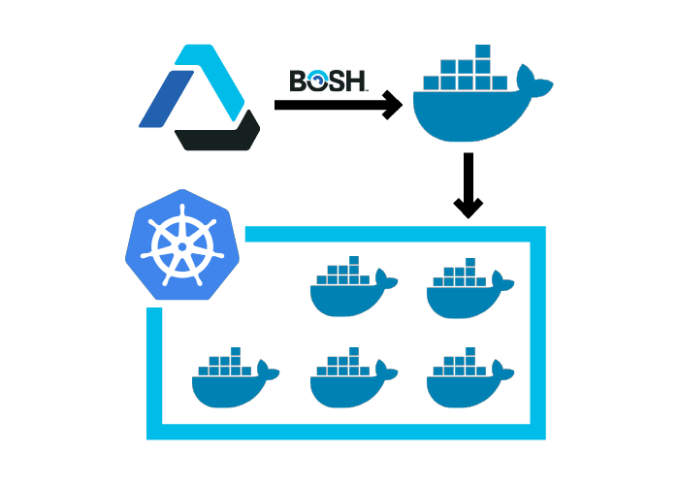
The second new project is ContainerizedCF, which was initially developed by Suse. Like the name implies, ContainerizedCF basically allows you to package the core Cloud Foundry Application Runtime and deploy it in Kubernetes clusters with the help of the BOSH deployment tool. This is pretty much what Suse is already using to ship its Cloud Foundry distribution.

Clearly then, Kubernetes is becoming part and parcel of what the Cloud Foundry PaaS service will sit on top of and what developers will use to deploy the applications they write for it in the near future. At first glance, this focus on Kubernetes may look like it’s going to make Cloud Foundry superfluous, but it’s worth remembering that, at its core, the Cloud Foundry Application Runtime isn’t about infrastructure but about a developer experience and methodology that aims to manage the whole lifecycle of the application development. If Kubernetes can be used to help manage that infrastructure, then the Cloud Foundry project can focus on what it does best, too.

10 Oct 2018

Cloud Foundry expands its support for Kubernetes

Not too long ago, the Cloud Foundry Foundation was all about Cloud Foundry, the open source platform as a service (PaaS) project that’s now in use by most of the Fortune 500 enterprises. This project is the Cloud Foundry Application Runtime. A year ago, the Foundation also announced the Cloud Foundry Container Runtime that helps businesses run the Application Platform and their container-based applications in parallel. In addition, Cloud Foundry has also long been the force behind BOSH, a tool for building, deploying and managing cloud applications.

The addition of the Container Runtime a year go seemed to muddle the organization’s mission a bit, but now that the dust has settled, the intent here is starting to become clearer. As Cloud Foundry CTO Chip Childers told me, what enterprises are mostly using the Container Runtime for is for running the pre-packaged applications they get from their vendors. “The Container Runtime — or really any deployment of Kubernetes — when used next to or in conjunction with the App Runtime, that’s where people are largely landing packaged software being delivered by an independent software vendor,” he told me. “Containers are the new CD-ROM. You just want to land it in a good orchestration platform.”

Because the Application Runtime launched well before Kubernetes was a thing, the Cloud Foundry project built its own container service, called Diego.

Today, the Cloud Foundry foundation is launching two new Kubernetes-related projects that take the integration between the two to a new level. The first is Project Eirini, which was launched by IBM and is now being worked on by Suse and SAP as well. This project has been a long time in the making and it’s something that the community has expected for a while. It basically allows developers to choose between using the existing Diego orchestrator and Kubernetes when it comes to deploying applications written for the Application Runtime. That’s a big deal for Cloud Foundry.

“What Eirini does, is it takes that Cloud Foundry Application Runtime — that core PaaS experience that the [Cloud Foundry] brand is so tied to and it allows the underlying Diego scheduler to be replaced with Kubernetes as an option for those use cases that it can cover,” Childers explained. He added that there are still some use cases the Diego container management system is better suited for than Kubernetes. One of those is better Windows support — something that matters quite a bit to the enterprise companies that use Cloud Foundry. Childers also noted that the multi-tenancy guarantees of Kubernetes are a bit less stringent than Diego’s.

The second new project is ContainerizedCF, which was initially developed by Suse. Like the name implies, ContainerizedCF basically allows you to package the core Cloud Foundry Application Runtime and deploy it in Kubernetes clusters with the help of the BOSH deployment tool. This is pretty much what Suse is already using to ship its Cloud Foundry distribution.

Clearly then, Kubernetes is becoming part and parcel of what the Cloud Foundry PaaS service will sit on top of and what developers will use to deploy the applications they write for it in the near future. At first glance, this focus on Kubernetes may look like it’s going to make Cloud Foundry superfluous, but it’s worth remembering that, at its core, the Cloud Foundry Application Runtime isn’t about infrastructure but about a developer experience and methodology that aims to manage the whole lifecycle of the application development. If Kubernetes can be used to help manage that infrastructure, then the Cloud Foundry project can focus on what it does best, too.

10 Oct 2018

Cloud Foundry expands its support for Kubernetes

Not too long ago, the Cloud Foundry Foundation was all about Cloud Foundry, the open source platform as a service (PaaS) project that’s now in use by most of the Fortune 500 enterprises. This project is the Cloud Foundry Application Runtime. A year ago, the Foundation also announced the Cloud Foundry Container Runtime that helps businesses run the Application Platform and their container-based applications in parallel. In addition, Cloud Foundry has also long been the force behind BOSH, a tool for building, deploying and managing cloud applications.

The addition of the Container Runtime a year go seemed to muddle the organization’s mission a bit, but now that the dust has settled, the intent here is starting to become clearer. As Cloud Foundry CTO Chip Childers told me, what enterprises are mostly using the Container Runtime for is for running the pre-packaged applications they get from their vendors. “The Container Runtime — or really any deployment of Kubernetes — when used next to or in conjunction with the App Runtime, that’s where people are largely landing packaged software being delivered by an independent software vendor,” he told me. “Containers are the new CD-ROM. You just want to land it in a good orchestration platform.”

Because the Application Runtime launched well before Kubernetes was a thing, the Cloud Foundry project built its own container service, called Diego.

Today, the Cloud Foundry foundation is launching two new Kubernetes-related projects that take the integration between the two to a new level. The first is Project Eirini, which was launched by IBM and is now being worked on by Suse and SAP as well. This project has been a long time in the making and it’s something that the community has expected for a while. It basically allows developers to choose between using the existing Diego orchestrator and Kubernetes when it comes to deploying applications written for the Application Runtime. That’s a big deal for Cloud Foundry.

“What Eirini does, is it takes that Cloud Foundry Application Runtime — that core PaaS experience that the [Cloud Foundry] brand is so tied to and it allows the underlying Diego scheduler to be replaced with Kubernetes as an option for those use cases that it can cover,” Childers explained. He added that there are still some use cases the Diego container management system is better suited for than Kubernetes. One of those is better Windows support — something that matters quite a bit to the enterprise companies that use Cloud Foundry. Childers also noted that the multi-tenancy guarantees of Kubernetes are a bit less stringent than Diego’s.

The second new project is ContainerizedCF, which was initially developed by Suse. Like the name implies, ContainerizedCF basically allows you to package the core Cloud Foundry Application Runtime and deploy it in Kubernetes clusters with the help of the BOSH deployment tool. This is pretty much what Suse is already using to ship its Cloud Foundry distribution.

Clearly then, Kubernetes is becoming part and parcel of what the Cloud Foundry PaaS service will sit on top of and what developers will use to deploy the applications they write for it in the near future. At first glance, this focus on Kubernetes may look like it’s going to make Cloud Foundry superfluous, but it’s worth remembering that, at its core, the Cloud Foundry Application Runtime isn’t about infrastructure but about a developer experience and methodology that aims to manage the whole lifecycle of the application development. If Kubernetes can be used to help manage that infrastructure, then the Cloud Foundry project can focus on what it does best, too.

10 Oct 2018

GDPR has cut ad trackers in Europe but helped Google, study suggests

An analysis of the impact of Europe’s new data protection framework, GDPR, on the adtech industry suggests the regulation has reduced the numbers of ad trackers that websites are hooking into EU visitors.

But it also implies that Google may have slightly increased its marketshare in the region — indicating the adtech giant could be winning at the compliance game at the expense of smaller advertising entities which the study also shows losing reach.

The research was carried out by the joint data privacy team of the anti-tracking browser Cliqz and the tracker blocker tool Ghostery (which merged via acquisition two years ago), using data from a service they jointly run, called WhoTracks.me — which they say is intended to provide greater transparency on the tracker market. (And therefore to encourage people to make use of their tracker blocker tools.)

A tale of two differently regulated regions

For the GDPR analysis, the team compared the prevalence of trackers one month before and one month after the introduction of the regulation, looking at the top 2,000 domains visited by EU or US residents.

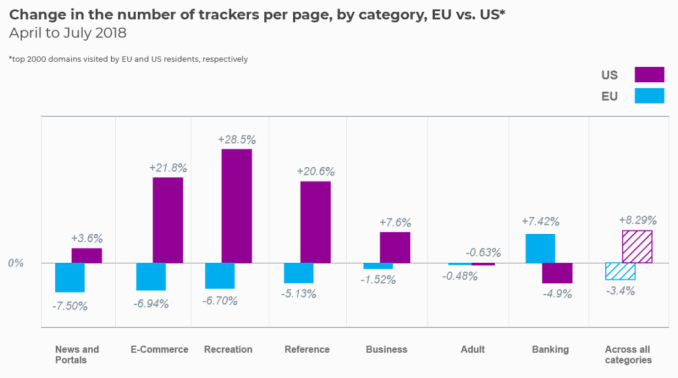
On the tracker numbers front, they found that the average number of trackers per page dropped by almost 4% for EU web users from April to July.

Whereas the opposite was true in the US, with the average number of trackers per page rose by more than 8 percent over the same period.

In Europe, they found that the reduction in trackers was nearly universal across website types, with adult sites showing almost no change and only banking sites actually increasing their use of trackers.

In the US, the reverse was again true — with banking sites the only category to reduce tracker numbers over the analyzed period.

“The effects of the GDPR on the tracker landscape in Europe can be observed across all website categories. The reduction seems more prevalent among categories of sites with a lot of trackers,” they write, discussing the findings in a blog post. “Most trackers per page are still located on news websites: On average, they embed 12.4 trackers. Compared to April, however, this represents a decline of 7.5%.

“On ecommerce sites, the average number of trackers decreased by 6.9% to 9.5 per page. For recreation websites, the decrease is 6.7%, which corresponds to 10.7 trackers per page. A similar trend is observed for almost all other website categories. The only exception are banking sites, on which 7.4% more trackers were active in July than in April. However, the average number of trackers per page is only 2.6.”

Shifting marketshare

In the blog post they also argue that their snapshot comparison of tracker prevalence of April 2018 against July 2018 reveals “a clear picture” of GDPR’s impact on adtech marketshare — with “especially” smaller advertising trackers having “significantly” lost reach (which they are using as a proxy for marketshare).

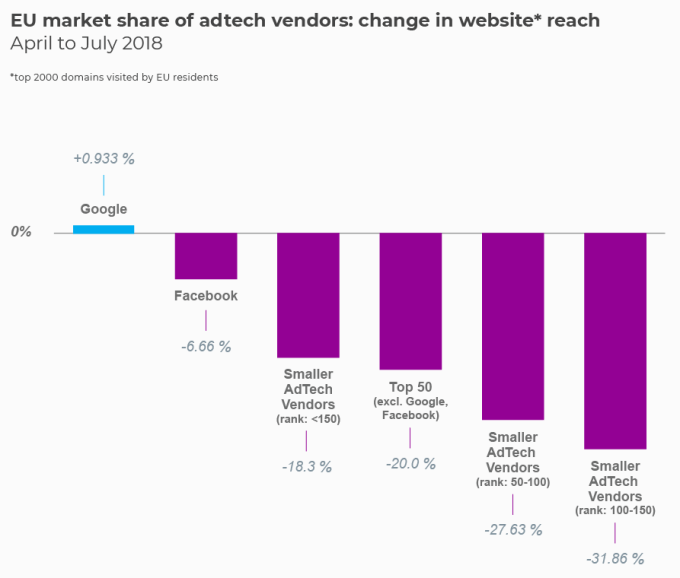
In their analysis they found smaller tracker players lost between 18% and 31% reach/marketshare when comparing April (pre-GDPR) and July (post-GDPR).

They also found that Facebook suffered a decline of just under 7%.

Whereas adtech market leader Google was able to slightly increase its reach — by almost 1%.

Summing up their findings, Cliqz and Ghostery write: “For users this means that while the number of trackers asking for access to their data is decreasing, a tiny few (including Google) are getting even more of their data.”

The latter finding lends some weight to the argument that regulation can reinforce dominant players at the expense of smaller entities by further concentrating power — because big companies have greater resources to tackle compliance.

Although the data here is just a one-month snapshot. And the additional bump in marketshare being suggested for Google is not a huge one — whereas a nearly 7% drop in marketshare for Facebook is a more substantial impact.

Cliqz shared their findings with TechCrunch ahead of publication and we put several questions to them about the analysis, including whether or not the subsequent months (August, September) indicated this snapshot is a trend, i.e. whether or not Google sustained the additional marketshare.

However the company had not responded to our questions ahead of publication.

In the blog post Cliqz and Ghostery speculate that the larger adtech players might be winning (relatively speaking) the compliance game at the expense of smaller players because website owners are preferring to ‘play it safe’ and drop smaller entities vs big known platforms.

In the case of Google, they also flag up reports that suggest it has used its dominance of the adtech market to “encourage publishers to reduce the number of ad tech vendors and thus the number of trackers on their sites” — via a consent gathering tool that restricts the number of supply chain partners a publisher can share consent with to 12 vendors. 

And we’ve certainly heard complaints of draconian Google GDPR compliance terms before.

They also point to the use of manipulative UX design (aka dark patterns) that are used to “nudge users towards particular choices and actions that may be against their own interests”, suggesting these essentially deliberately confusing consent flows have been successfully tricking users into clicking and accepting “any kind of data collection” just to get rid of cryptic choices they’re being asked to understand. 

Given Google’s dominance of digital ad spending in Europe it stands to gain the most from websites’ use of manipulative consent flows.

However GDPR requires consent to be informed and freely given, not baffling and manipulative. So regulators should (hopefully) be getting a handle on any such transgressions and transgressors soon.

The continued existence of nightmarishly confused and convoluted consent flows is another complaint we’ve also heard before — much and often. (And one we have ourselves, frankly.)

Overall, according to the European Data Protection Board, a total of more than 42,000 complaints have been lodged so far with regulators, just four months into GDPR.

And just last week Europe’s data protection supervisor, Giovanni Buttarelli, told us to expect the first GDPR enforcement actions before the end of the year. So lots of EU consumers will already be warming up the popcorn.

But Cliqz and Ghostery argue that disingenuous attempts to manipulate consent might need additional regulatory tweaks to be beaten back — calling in their blog post for regulations to enforce machine-readable standards to help iron away flakey flows.

“The next opportunity for that would be the ePrivacy regulation,” they suggest, referencing the second big privacy rules update Europe is (still) working on. “It would be desirable, for example, if ePrivacy required that the privacy policies of websites, information on the type and scope of data collection by third parties, details of the Data Protection Officer and reports on data incidents must be machine-readable.

“This would increase transparency and create a market for privacy and compliance where industry players keep each other in check.”

It would also, of course, provide another opportunity for pro-privacy tools to make themselves even more useful to consumers.

10 Oct 2018

GDPR has cut ad trackers in Europe but helped Google, study suggests

An analysis of the impact of Europe’s new data protection framework, GDPR, on the adtech industry suggests the regulation has reduced the numbers of ad trackers that websites are hooking into EU visitors.

But it also implies that Google may have slightly increased its marketshare in the region — indicating the adtech giant could be winning at the compliance game at the expense of smaller advertising entities which the study also shows losing reach.

The research was carried out by the joint data privacy team of the anti-tracking browser Cliqz and the tracker blocker tool Ghostery (which merged via acquisition two years ago), using data from a service they jointly run, called WhoTracks.me — which they say is intended to provide greater transparency on the tracker market. (And therefore to encourage people to make use of their tracker blocker tools.)

A tale of two differently regulated regions

For the GDPR analysis, the team compared the prevalence of trackers one month before and one month after the introduction of the regulation, looking at the top 2,000 domains visited by EU or US residents.

On the tracker numbers front, they found that the average number of trackers per page dropped by almost 4% for EU web users from April to July.

Whereas the opposite was true in the US, with the average number of trackers per page rose by more than 8 percent over the same period.

In Europe, they found that the reduction in trackers was nearly universal across website types, with adult sites showing almost no change and only banking sites actually increasing their use of trackers.

In the US, the reverse was again true — with banking sites the only category to reduce tracker numbers over the analyzed period.

“The effects of the GDPR on the tracker landscape in Europe can be observed across all website categories. The reduction seems more prevalent among categories of sites with a lot of trackers,” they write, discussing the findings in a blog post. “Most trackers per page are still located on news websites: On average, they embed 12.4 trackers. Compared to April, however, this represents a decline of 7.5%.

“On ecommerce sites, the average number of trackers decreased by 6.9% to 9.5 per page. For recreation websites, the decrease is 6.7%, which corresponds to 10.7 trackers per page. A similar trend is observed for almost all other website categories. The only exception are banking sites, on which 7.4% more trackers were active in July than in April. However, the average number of trackers per page is only 2.6.”

Shifting marketshare

In the blog post they also argue that their snapshot comparison of tracker prevalence of April 2018 against July 2018 reveals “a clear picture” of GDPR’s impact on adtech marketshare — with “especially” smaller advertising trackers having “significantly” lost reach (which they are using as a proxy for marketshare).

In their analysis they found smaller tracker players lost between 18% and 31% reach/marketshare when comparing April (pre-GDPR) and July (post-GDPR).

They also found that Facebook suffered a decline of just under 7%.

Whereas adtech market leader Google was able to slightly increase its reach — by almost 1%.

Summing up their findings, Cliqz and Ghostery write: “For users this means that while the number of trackers asking for access to their data is decreasing, a tiny few (including Google) are getting even more of their data.”

The latter finding lends some weight to the argument that regulation can reinforce dominant players at the expense of smaller entities by further concentrating power — because big companies have greater resources to tackle compliance.

Although the data here is just a one-month snapshot. And the additional bump in marketshare being suggested for Google is not a huge one — whereas a nearly 7% drop in marketshare for Facebook is a more substantial impact.

Cliqz shared their findings with TechCrunch ahead of publication and we put several questions to them about the analysis, including whether or not the subsequent months (August, September) indicated this snapshot is a trend, i.e. whether or not Google sustained the additional marketshare.

However the company had not responded to our questions ahead of publication.

In the blog post Cliqz and Ghostery speculate that the larger adtech players might be winning (relatively speaking) the compliance game at the expense of smaller players because website owners are preferring to ‘play it safe’ and drop smaller entities vs big known platforms.

In the case of Google, they also flag up reports that suggest it has used its dominance of the adtech market to “encourage publishers to reduce the number of ad tech vendors and thus the number of trackers on their sites” — via a consent gathering tool that restricts the number of supply chain partners a publisher can share consent with to 12 vendors. 

And we’ve certainly heard complaints of draconian Google GDPR compliance terms before.

They also point to the use of manipulative UX design (aka dark patterns) that are used to “nudge users towards particular choices and actions that may be against their own interests”, suggesting these essentially deliberately confusing consent flows have been successfully tricking users into clicking and accepting “any kind of data collection” just to get rid of cryptic choices they’re being asked to understand. 

Given Google’s dominance of digital ad spending in Europe it stands to gain the most from websites’ use of manipulative consent flows.

However GDPR requires consent to be informed and freely given, not baffling and manipulative. So regulators should (hopefully) be getting a handle on any such transgressions and transgressors soon.

The continued existence of nightmarishly confused and convoluted consent flows is another complaint we’ve also heard before — much and often. (And one we have ourselves, frankly.)

Overall, according to the European Data Protection Board, a total of more than 42,000 complaints have been lodged so far with regulators, just four months into GDPR.

And just last week Europe’s data protection supervisor, Giovanni Buttarelli, told us to expect the first GDPR enforcement actions before the end of the year. So lots of EU consumers will already be warming up the popcorn.

But Cliqz and Ghostery argue that disingenuous attempts to manipulate consent might need additional regulatory tweaks to be beaten back — calling in their blog post for regulations to enforce machine-readable standards to help iron away flakey flows.

“The next opportunity for that would be the ePrivacy regulation,” they suggest, referencing the second big privacy rules update Europe is (still) working on. “It would be desirable, for example, if ePrivacy required that the privacy policies of websites, information on the type and scope of data collection by third parties, details of the Data Protection Officer and reports on data incidents must be machine-readable.

“This would increase transparency and create a market for privacy and compliance where industry players keep each other in check.”

It would also, of course, provide another opportunity for pro-privacy tools to make themselves even more useful to consumers.