Year: 2018

09 Oct 2018

Princeton Identity debuts a new walkthrough biometric scanner — in a shipping container

Soon, you might be walking across the border through a shipping container.

Yes, you read that right.

You’re off the flight, seven hours later, exhausted and hungry, and cranky from being hurtled at your destination at more than half the speed of sound. You grab your bag from overhead, stumble through the bright lights of the airport towards customs and then — suddenly — you’re funneled through a 20-foot shipping container that’s packed to the rafters with biometric gadgetry.

That’s the latest vision from Princeton Identity, a New Jersey-based startup, which will this week lift the lid on its latest offering.

The container — dubbed the Biometric Conex — can work almost anywhere — from government buildings and border control to large events that require personnel checks to prevent improper access or perimeter breaches.

The Conex takes several of the company’s existing biometric technologies and integrates it into a self-contained air-conditioned unit that can process as many as 20 people per minute. You enter the container at one end and, in a normal walking pace, pass through the container as you have your biometrics scanned — your fingerprints, then your face and irises — and out of the other side. By fusing together the three sets of data, the system claims a near-perfect level of accuracy to prevent identity spoofing.

No stopping, no standing, and no waiting around.

Princeton Identity’s specializes in biometrics in motion, authenticating people while they move. “That helps speed up the process by cutting down on queueing,” said Mark Clifton, the company’s chief executive, told TechCrunch.

Assuming you’re not flagged as on a watchlist and tackled to the ground by security guards, the process is quick and non-invasive to the average person.

Clifton said the container is operational in less than a day. As it’s smaller than the average shipping container, it can fit on the back of a heavy duty truck. It can be deployed almost anywhere — power can be drawn from a generator and a connection drawn from the cell networks. And, the company’s technologies are compatible with government databases, making it easy to integrate the technology wherever it’s needed. In other cases, anyone who requires authentication can be enrolled in less than a minute.

Each unit costs about $280,000, he said.

To some, biometric authentication makes life easy — replacing passwords that can be shared, lost or stolen. To others, it sparks worry. Governments and airports are increasingly relying on biometrics to speed up immigration, border and pre-flight security. But what happens when the data is lost or stolen? You can’t just get new fingerprints — or eyeballs for that matter.

“Credentials get copied,” Clifton said. “There’s a lot of fraud.” Passwords can be written down, and driving licenses and passports can be cloned. “Biometrics will rise as the way you become authenticated.” Not wanting to see anyone’s data get exposed, the company took an approach of storing each set of biometrics as a scrambled record that’s readable by its technology but not to anybody else.

“We don’t store the images — we store the template, the digital representation,” he said. “It may mean you re-enroll, but you haven’t lost your data.” Though, Clifton said that its customers who buy its technology can choose to store data as a raw image, like governments. And, in most cases, he said, data is encrypted and stored locally on the devices — and not by the company.

“We’re just devices that sit inside their firewall,” he said. “We don’t control the data — they do.”

So far the company has deployed its technologies at Dubai International Airport to help passengers process through the terminal — with more partnerships set to be announced in the near future.

As convenient as biometrics are, the more they’re used, the greater the data collection — and the risk that data could get lost or stolen. But Princeton Identity’s effort to minimize the data it collects is a mature take, but whether others heed that approach remains to be seen.

09 Oct 2018

Review: The Marshall Woburn II packs modern sound, retro look

Marshall speakers stand out. That’s why I dig them. From the company’s headphones to its speakers, the audio is warm and full just like the classic design suggests.

The company today is announcing revisions across its lines. The new versions of the Action ($249), Stanmore ($349) and Woburn Bluetooth ($499) speakers now feature Bluetooth 5.0, an upgraded digital signal processor and a slightly re-worked look.

Marshall also announced a new version of the Minor wireless in-ear headphones. The wireless headphones were among the company’s first products and the updated version now features Bluetooth 5.0 aptX connectivity, new 14.2 mm drivers and 12 hours of battery life. Marshall also says the redesigned model will stay in place better than the original model.

It’s important to note that the company behind these Marshall speakers and headphones is different from the company that makes the iconic guitar amp though there is collaboration. The Marshall brand is used by Zound Industries, which also operates Ubanears.

The models produced by Zound Industries stay true to the Marshall brand. I’ve used several of the products since the company launched and I’m pleased to report that this new generation packs the magic of previous models.

The company sent me the new Woburn II speaker (pictured above) and it’s a lovely speaker. This is the largest speaker in the company’s line. It’s imposing and, in Reddit-speak, an absolute unit. It’s over a foot tall and weighs just under 20 lbs.

The speaker easily fills a room. The sound is warm and inviting.

The Woburn II features a ported design which helps create the rich sound. Bass is deep though doesn’t pound. Mid-tones are lovely and the highs are perfectly balanced. If they’re not, there are nobs mounted on the top to adjust the tones.

I find the Woburn a great speaker at any volume. Turn it down and the sound still feels as complex as it does at normal listen volumes. Crank the speaker to 10, drop the treble a bit, and the speaker will shake walls.

Don’t be scared by the imposing size. The Woburn II can party, but it is seemingly just as happy to spend the evening in, playing some Iron and Wine.

Sadly, the Woburn II lacks some of the magic of the original Woburn. The new version does not have an optical input and the power switch is a soft switch. It’s just for looks. The first Woburn had a two position switch. Click one way to turn on and click the other to turn off. It was an analog experience. This time around the speakers retain the switch, but the switch is different. It’s artificial and might as well be a power button. When pressed forward, the switch turns on the speaker and then snaps back to its original position. The clicking it gone. I know that seems like a silly thing to complain about but that switch was part of the Marshall experience. It felt authentic and now it feels artificial.

Like past models, the speaker is covered in a vinyl-like material and the front of the speaker is covered in fabric. Don’t touch this fabric. It stains. The review sample sent to me came with stains already on the fabric.

The Woburn II is a fantastic speaker with a timeless look. At $499 it’s pricy but produces sound above its price-point rivals. I expect the same performance out of updated Action II and Stanmore II speakers. These speakers are worthy of the Marshall name.

09 Oct 2018

Google Photos adds ‘Live Albums’ an automated way of sharing people, pet photos with anyone

Just ahead of today’s Google’s hardware event, the company has quietly rolled out an update to its Google Photos application which introduces a new, automated way of organizing and sharing photos: Live Albums. According to the app’s “What’s New” description, Live Albums appear to be a spin-off from partner sharing, introduced last year. But instead of automating sharing of a set of photos – like those of a child – between just two people, Live Albums allow you to automate the sharing of people and pet photos with anyone you choose.

For example, the feature could be used to share photos of your children with your extended family, instead of just a spouse. You could also specify certain, close friends who would always receive the photos you took together.

Easy, collaborative photo sharing has been something of a holy grail for photo apps for years. It’s been the basis of numerous startups including Bump, whose founder David Lieb now leads Google Photos, Fabric, Batch, Color, Cluster, and many more. Facebook Moments also tries to make collaborative photo sharing easier.

But automation using A.I. technologies and facial recognition is a next step, and one that makes Google Photos an even more compelling app.

In practice, it means that you wouldn’t have to manually share photos with certain people ever again – you can just set up a Live Album once, and then allow the automation to take over.

The feature was previously spotted in testing, in an APK breakdown done by Android Police last month. However, today’s iOS app update text indicates it’s now rolling out to a broader set of users.

That may be a staged rollout, though, as not everyone has access to the feature at this time. It’s also not currently mentioned in the update text of the Android version, but Google keeps its cross-platform apps in parity, with few delays.

Here’s the full text of the change, per the App Store description:

Introducing Live Albums, an easier way to share with loved ones. Select the people and pets you want to see and Google Photos will automatically add photos of them as you take them. Now your family and friends will always see the latest photos, no manual updates needed.

It seems we’ll hear more at today’s Google event about the news, given Google Photos has been teasing updates on its Twitter account. Hopefully, there’s even more to come, as well.

In the meantime, we’ve reached out to Google for further comment. We aren’t expecting a response as this news is likely being held until the event later this morning.


09 Oct 2018

Netlify just got $30 million to change the way developers build websites

Netlify wants to revolutionize the way developers build websites, abstracting away the web server and breaking web sites into microservices, making the process more like building a mobile application than a traditional website. Today, the company announced a $30M Series B investment to help continue to build on that vision.

Kleiner Perkins led the round. Andreessen Horowitz and the founders of Slack (Stewart Butterfield), Yelp (Jeremy Stoppelman) and Figma (Dylan Field) all participated. Today’s investment brings the total raised to over $44 million, according to Crunchbase data.

Chris Bach, co-founder and president and Matt Biilmann, co-founder and CEO see the change they are trying to make as part of the larger shift to an API economy. They want to take the same ease of development APIs have given programmers in a mobile context and bring that to web development.

As I wrote earlier this year when they announced support for AWS Lambda, they want to reduce the complexity around web development:

“Netlify has abstracted away the concept of a web server, which it says is slow to deploy and hard to secure and scale. By shifting from a monolithic website to a static front end with back-end microservices, it believes it can solve security and scaling issues and deliver the site much faster.”

The founders have a grand vision, “We are basically out to replace all web servers with a with a global application delivery network,” Bach explained.

Mamoon Hamid, general partner at investor Kleiner Perkins says that while the website backend has evolved over recent years, the front end has remained static, and that’s what Netlify is addressing with their microservices-based approach to web development. “Netlify smack dab hits our view of where we need to go for the web to flourish,” Hamid told TechCrunch.

He believes the last shift of this magnitude in web development at the presentation layer was the advent of the CMS 15 years ago, and we are starting to see developers attracted to the Netlify approach in a big way. “We really believe that with this 300,000 strong developer force that’s already behind Netlify that they’re showing early signs of tapping into what could be  the platform from which a significant portion of the web content is served from [in the future],” Hamid said.

Netlify is working to increase the number of websites running on their approach in the coming years and see this as a mission to change the web. “For us, it’s very important to keep being a place where developers want to go and very easily can get something up and running. And then you can scale from there,” Bach said.

The company wants to build out a more organized sales and marketing team to sell the Netlify approach to larger organizations, while continuing to build out the product and developer outreach. All of this takes money and that’s why they went for such a large round today.

09 Oct 2018

Tim Berners-Lee is on a mission to decentralize the web

“I’ve always believed the web is for everyone,” wrote Tim Berners-Lee, the well-known (and knighted) creator of the World Wide Web.

“The web has evolved into an engine of inequity and division; swayed by powerful forces who use it for their own agendas,” he added. “Today, I believe we’ve reached a critical tipping point, and that powerful change for the better is possible — and necessary.”

Late last month, he published the above in a blog post announcing inrupt, a startup that would finally execute on his vision for the information superhighway he built nearly 30 years ago. Backed with an undisclosed amount of funding from Glasswing Ventures, the startup is emerging from stealth today with a plan to decentralize the web and restore power to the people rather than the companies that have exploited user trust for their own financial gains.

The timing couldn’t be better. The last year has been plagued with scandals, from Cambridge Analytica, a data analysis firm that used Facebook data to target voters for President Donald Trump’s presidential campaign, to most recently a data-exposing hack on Google+ that relinquished the private information of hundreds of thousands of unsuspecting users.

Internet privacy and security are hot-button issues, to say the least. Users are rapidly losing trust in the companies that became institutions in the digital age — and they’re demanding solutions.

The race to restore control of data and the web at large has begun; inrupt is looking to the finish line.

The father of the World Wide Web

Berners-Lee is a British engineer and professor of computer science who famously gave away the web, which allows anyone with a computer to access the internet, for free.

For the past few years, he’s been quietly working on a project called Solid with a small team at the Massachusetts Institute of Technology. Solid is an open-source project built on the existing web meant to give people control over their own data. Using Solid, users can keep their data wherever they choose, rather than being forced to store it on centralized servers.

The world we’ve created on the web [is] not the right one. — John Bruce, co-founder of inrupt.

Despite its populist ambitions, Solid has failed to garner the momentum necessary to truly disrupt the web.

Berners-Lee realized Solid needed commercial backing, a real business behind it to earn the interests of open-source developers who have to build decentralized apps on the Solid platform for it to be useful.

Thus, inrupt was born. Berners-Lee tapped John Bruce, a fellow British engineer and serial entrepreneur, to lead the company as its chief executive officer. Most recently, Bruce co-founded Resilient, an incident response platform later acquired by IBM. Before that, he was the chairman and CEO of Quickcomm and the vice president of Symantec.

Bruce resigned from IBM in April to focus on inrupt full time.

“The world we’ve created on the web [is] not the right one,” Bruce told TechCrunch. “Maybe, just maybe, we can put it in the place it was originally intended to be.”

“Inrupt’s mission, at this point, is to bring resources, process and skills to galvanize the open-source effort that Tim was leading out of MIT to help [Solid] become, truly, a force to be reckoned with,” he added. “We are at the stage of the new web that Tim was at when he first started the World Wide Web.”

Bruce says that since Berners-Lee announced inrupt in late September, open-source developers have poured into the Solid platform in droves.

Now, the pair are gearing up to raise another round of funding, hire, expand the Solid platform and work on a digital assistant tool called Charlie, which the company describes as a “decentralized version of Alexa.”

For Berners-Lee, inrupt is Act II of a much larger story. For Bruce, it’s the opportunity to work with a legend.

“This is a man that understands the web truly better than anyone else on the planet,” Bruce said. “And the wheels of innovation have really just started to turn.”

09 Oct 2018

Pitch, from the founders of Wunderlist, raises $19M to take on Powerpoint in presentations

Microsoft’s Powerpoint today has over 1 billion installs, 500 million users, and some 95 percent market share, making it the most ubiquitous presentation software in the world. But that doesn’t make it the most loved. Now, a new startup out of Berlin called Pitch is emerging from stealth with plans to challenge it, by making what CEO and co-founder Christian Reber describes as “a presentation tool for the Slack generation.” And to do so, the company is announcing $19 million in Series A funding, ahead of a projected launch date by Summer 2019 (Reber is talking, but without any previews of the actual product).

The Slack reference is intentional, not just because of how the product will be built (more on that below). Part of the funding is coming from the Slack Fund, the arm of the work-chat unicorn that makes strategic investments into like-minded startups. Others in the round include Index Ventures and BlueYard as leads, along with Zoom CEO Eric Yuan, Framer CEO Koen Bok, Elastic Co-Founder Simon Willnauer, Datadog CEO Olivier Pomel, Wunderlist-backer Frank Thelen, and Metalab Founder Andrew Wilkinson. Blue Yard led Pitch’s seed funding as well: the company has raised $22 million to date.

“Pitch is one of Europe’s few true product-centric companies breaking new ground in software for businesses,” said Neil Rimer, partner at Index Ventures, in a statement. “From messaging to file sharing, software companies like Slack and Dropbox have transformed how teams work together and unlocked greater productivity as a result. We believe Pitch has the potential to redefine the presentation space and become a central hub for content collaboration, knowledge-sharing, and ultimately a platform for better decision-making.” Rimer’s also joining the board.

If $22 million sounds like a lot of money for a product that hasn’t launched, in a field that already has a very dominant player, Pitch is not your average contender. it’s being built by the same founders who created Wunderlist, a popular to-do app that — coincidentally — Microsoft acquired to supercharge its existing list-making and to-do software. You could say that Pitch knows just what it is pitching, when it goes after a problem that already appears to be “solved.”

In an interview, Reber said that he and the team — which includes founders Vanessa Stock; Marvin Labod; Adam Renklint; Charlette Prevot; Jan Martin; Eric Labod; and Misha Karpenko and 12 others — have been at work on the app for about nine months already and that it is in some private betas with a few businesses.

As for the app itself, Reber would not show it off to me, but he did provide some detail about what it’s setting out to do.

The premise behind Pitch is to make “a presentation tool for the Slack generation,” he said, in reference to the workplace communications tool that became a runaway hit with organizations because of its ease of use, its speed, and the fact that it positions itself as a platform, integrating with just about any app that a person might use in the normal course of a working day, turning itself into a communication layer underpinning all those apps, too.

The same will go for Pitch. “Pitch integrates with everything you already use,” Reber said, describing Pitch presentations as “living documents” that will essentially update with information as data in other documents gets modified.

There will also be a social element, a la SlideShare (a cloud-based presentation app that was acquired by LinkedIn many years ago but has seen few updates since, and of course now is part of Microsoft too, like PowerPoint). In the case of Pitch, users will be able to create documents for their own ends, but they can also use Pitch as a distribution platform, either to a selected group of users (for example, if you are pitching your startup to investors), or to a wider audience who are also Pitch users.

It’s ironic that Reber, who joined Microsoft along with the rest of the Wunderlist team when the startup was acquired, left the mothership rather than potentially trying to either build another presentation tool within Microsoft, or moving to PowerPoint to work on updating that product. The reasons, I suspect, are the same ones that keep large tech giants from being able to move quickly on ideas, and to often live with bad ones for too long: they are too big and too entrenched, and the halls are rife with politics.

Reber — who jokes that he seems to have a knack at trying to build things “that others have already built” — said that another reason is that he also has a little regret for selling Wunderlist when they did. “I didn’t feel like I’d accomplished my goal,” he said reflecting on the sale. (For the reasons why he sold anyway, you might speak to a lot of other founders who have exited, and I’d guess that the multiple reasons are often the same.) “So, a year after the exit I thought I would like a chance to start from scratch and be more strategic in how I built my startup.”

The choice to tackle presentations came, as many startup ideas often do, out of his own frustrations — and possibly yours, too, if you have been PowerPointed at some moment in your life.

The most popular presentation tools that exist today are just outdated, he said, with different versions out in the wild, across different platforms, making for a challenge in sharing presentations with others. Reber describes the Pitch-nee-Wunderlist team as “design driven,” you can imagine how that kind of lack of aesthetic consistency might grate.

He noted that Pitch is built on Electron — the application framework that’s used for WhatsApp, WordPress and many other apps — to smooth out some of those bumps across platforms.

Pitch is most certainly going into business with its eyes open, knowing that even if you put Microsoft’s PowerPoint and SlideShare to the side, there are yet others, such as Keynote from Apple, the web-based Prezi, and Slides from Google. But there are plenty of precedents that nevertheless indicate opportunity.

“It’s really fascinating for me why new products win,” Reber said. “Just look at the business communications space. The market was saturated, and Hipchat dominated the startup world, but then all of the sudden Slack came and everything change. It just took over. There will be a similar shift, I think.”

Besides, he added, having multiple competitors is a good thing. “It just means that the best product will come out the winner.” Let’s hope so.

09 Oct 2018

Instagram now uses machine learning to detect bullying within photos

Instagram and its users do benefit from the app’s ownership by Facebook, which invests tons in new artificial intelligence technologies. Now that AI could help keep Instagram more tolerable for humans. Today Instagram announced a new set of antii-cyberbullying features. Most importantly, it can now use machine learning to optically scan photos posted to the app to detect bullying and send the post to Instagram’s community moderators for review. That means harassers won’t be able to just scrawl out threatening or defamatory notes and then post a photo of them to bypass Instagram’s text filters for bullying.

In his first blog post directly addressing Instagram users, the division’s newly appointed leader Adam Mosseri writes “There is no place for bullying on Instagram . . . As the new Head of Instagram, I’m proud to build on our commitment to making Instagram a kind and safe community for everyone.” The filter for photos and captions rolls out over the next few weeks.

Instagram launched text filtering for bullying in May, but that could have just pushed trolls to attack people through images. Now, its bullying classifier can identify harassment in photos including insults to a person’s character, appearance, well-being, or health. Instagram confirms the image filter will work in feed and Stories. “Although this update only focuses on photos, we will be working to add protections for video, including IGTV, very soon” a spokesperson tells me.

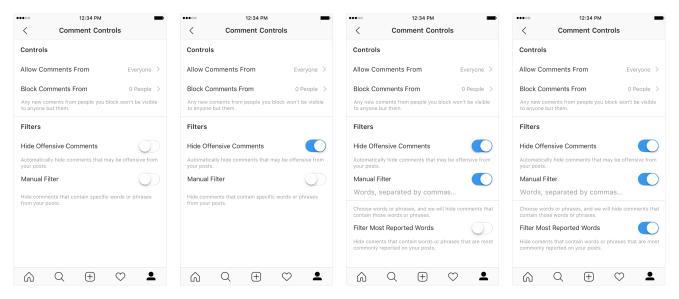
Instagram users will see the “Hide Offensive Comments” setting defaulted on in their settings. They can also opt to manually list out words they want to filter out of their comments, and can choose to auto-filter the most commonly reported words. With text, it’s black and white so Instagram can just block keywords. With images, it won’t let the AI play executioner, and instead uses the filter to direct posts to human moderators who make the final call.

Meanwhile, Instagram is expanding its proactive filter for bullying in comment from the feed, Explore, and profile to also protect Live broadcasts. It’s launching a “Kindness” camera effect in partnership with Maddie Ziegler, best known as the child dancer version of Sia from her music video “Chandelier”. The effect showers your image with hearts and positive comments in different languages while prompting you to tag a friend you care about. It’ll be visible to in users’ camera effects tray if they follow Ziegler, or if they see a friend use it, they can try it themselves.

For Instagram to remain the favorite app of teens, it can’t let this vulnerable community be victimized. There’s been a lot of talk about Facebook interfering with Instagram after the photo app’s co-founders resigned. But the parent company’s massive engineering organization affords Instagram economies of scale that unlock tech like this bullying filter that an independent startup might not be able to develop.

09 Oct 2018

SoundCloud finally lets more musicians monetize four years later

SoundCloud moves painfully slow for a tech company, and no one feels that pain more than musicians who are popular on the site but don’t get paid. 10 years since SoundCloud first launched, and four years since it opened an invite-only program allowing just the very biggest artists to earn a cut of the ad and premium subscription revenue generated by their listeners, SoundCloud is rolling out monetization.

Now, musicians 18 and up who pay SoundCloud $8 to $16 per month for hosting, get over 5000 streams per month, and only publish original music with no copyright strikes against them can join the SoundCloud Premier program. They’ll get paid a revenue share directly each month that SoundCloud claims “meets or beats any other streaming service”. However, the company failed to respond to TechCrunch’s inquiries about how much artists would earn per 1000 ad-supported or premium subscription listener streams, or how many streams would earn them a dollar.

Beyond payouts, Premier members can post new tracks instantly without having to wait to be discoverable or monetizable, they’ll get real-time feedback from fans, and extra discovery opportunities from SoundCloud. The company hopes monetization will lure more creators to join the 20 million on the platform, get them to promote their presence to drive listens, and imbue the site with exclusive artist-uploaded content that attracts listeners.

It’s been a year since SoundCloud raised an $170 million emergency funding round to save itself from going under after it was forced to lay off 40 percent of its staff. That deal arranged by Kerry Trainor saw him become CEO and the previous co-founder and CEO Alex Ljung step aside. With underground rap that had percolated on SoundCloud for years suddenly reaching the mainstream, the startup seemed to have momentum.

The problem is the slow speed of progress at SoundCloud has allowed competitors with monetization baked in to catch up to its formerly unique offering. YouTube Music’s launch in June 2018 combined premium major label catalogues with user uploaded tracks in a cohesive streaming service. And last month, Spotify began allowing indie artists to upload their music directly to the platform. Meanwhile, licensing distribution services like Dubset are making it legal for big streaming apps to host remixes and DJ sets. Together, these make more of the rarities, live versions, and hour-long club gigs that used to only be on SoundCloud available elsewhere.

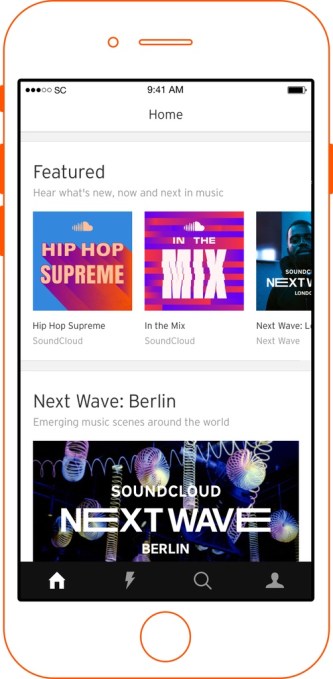
The delays seem in part related to the fact that SoundCloud wants to be Spotify as well as SoundCloud. It’s refused to back down from its late entry into the premium streaming market with its $9.99 per month SoundCloud Go+ subscription. As I previously recommended, “to fix SoundCloud, it must become the anti-Spotify” by ruthlessly focusing on its differentiated offering in artist-uploaded music. Instead, another year has passed with only a light revamping of SoundCloud’s homescreen and some more personalized playlists to show for it.

SoundCloud proudly announced it had reached $100 million in revenue in 2017, and exceeded its financial and user growth targets. But filings reveal it lost over $90 million in 2016 and it was previously projected to not become profitable until 2020. That begs the question of whether SoundCloud will have to raise again, or might once again open itself to acquisitions. With Apple, Google, Amazon, and Spotify all in fierce competition for the future of streaming, any of them might be willing to pay up for music that fans can’t easily find elsewhere.

09 Oct 2018

Upskill launches support for Microsoft HoloLens

Upskill has been working on a platform to support augmented and mixed reality for almost as long as most people have been aware of the concept. It began developing an agnostic AR/MR platform way back in 2010. Google Glass didn’t even appear until two years later. Today, the company announced the early release of Skylight for Microsoft HoloLens.

Upskill has been developing Skylight as an operating platform to work across all devices, regardless of the manufacturer, but company co-founder and CEO Brian Ballard sees something special with HoloLens. “What HoloLens does for certain types of experiences, is it actually opens up a lot more real estate to display information in a way that users can take advantage of,” Ballard explained.

He believes the Microsoft device fits well within the broader approach his company has been taking over the last several years to support the range of hardware on the market while developing solutions for hands-free and connected workforce concepts.

“This is about extending Skylight into the spatial computing environment making sure that the workflows, the collaboration, the connectivity is seamless across all of these different devices,” he told TechCrunch.

Microsoft itself just announced some new HoloLens use cases for its Dynamics 365 platform around remote assistance and 3D layout, use cases which play to the HoloLens strengths, but Ballard says his company is a partner with Microsoft, offering an enhanced, full-stack solution on top of what Microsoft is giving customers out of the box.

That is certainly something Microsoft’s Terry Farrell, director of product marketing for mixed reality at Microsoft recognizes and acknowledges. “As adoption of Microsoft HoloLens continues to rapidly increase in industrial settings, Skylight offers a software platform that is flexible and can scale to meet any number of applications well suited for mixed reality experiences,” he said in a statement.

That involves features like spatial content placement, which allows employees to work with digital content in HoloLens, while keeping their hands free to work in the real world. They enhance this with the ability to see multiple reference materials across multiple windows at the same time, something we are used to doing with a desktop computer, but not with a device on our faces like HoloLens. Finally, workers can use hand gestures and simple gazes to navigate in virtual space, directing applications or moving windows, as we are used to doing with keyboard or mouse.

Upskill also builds on the Windows 10 capabilities in HoloLens with its broad experience securely connecting to back-end systems to pull the information into the mixed reality setting wherever it lives in the enterprise.

The company is based outside of Washington, D.C. in Herndon, Virginia. It has raised over $45 million, according to Crunchbase. Ballard says the company currently has 70 employees. Customers using Skylight include Boeing, GE, Coca-Cola, Telestra and Accenture.

09 Oct 2018

The Guild launches tech-driven hotel experience

Falling somewhere between a boutique hotel experience and an Airbnb, The Guild is launching today with $9 million in funding led by Maveron with participation from Convivialite Ventures and Corigin Ventures to provide travelers with tech-driven hospitality. The startup is also officially expanding into Miami, Cincinnati and Denver. Based in Austin, The Guild has a handful of properties in Austin and Dallas.

The Guild works by partnering with building owners to operate hotel accommodations in commercially-zoned or mixed-use buildings. The Guild’s room offerings range from a mix of traditional hotel rooms to more apartment-style accommodations (think studio, 1 BR and 2 BR apartments).

Right now, The Guild leases the 290 units across its five markets, but the company is open to revenue-share and other types of financing structures down the road.  Before launching in a market, The Guild looks at the area’s walkability and the prevalence of businesses and conferences. In general, it’s paying attention to the potential for marketability. By the end of next year, The Guild expects to operate in 1,000 units across up to 10 markets.

The Guild aims to differentiate itself from traditional hotels with its technology. Guests, for example, can quickly get food delivered from services like UberEats and DoorDash, rather than pay highway robbery for room service.

The Guild also offers digital check-in and keyless entry. But the idea isn’t to replace humans with technology. While The Guild uses technology as a means of communication, there is still a front desk person on hand to help around the clock.

“We use tech as a way to connect people,” The Guild co-founder Brian Carrico told TechCrunch. “We’ve found people like human interaction and connection. Humans are fed a lot of information about why guests are there and then use that information to surprise and delight guests.”

On average, The Guild exchanges 40 text messages with every guest.

“It’s cool to see how tech can connect people and not be a substitute for people,” Carrico said.

The Guild functions as both the brand and the operator, which Carrico says makes it possible to run a viable business while ensuring workers are taken care of. For example, every single employee — which covers the front desk, reservations and maintenance, gets health insurance and equity in the company. While The Guild does not employ housekeeping workers, Carrico says the vendor it works with pays above market rate.