Year: 2018

08 Oct 2018

UK High Court blocks compensation suit against Google’s ‘Safari workaround’

An attempt to bring a class-action style litigation in the UK to claim up to £3BN in compensation from Google for ignoring iPhone user privacy settings has been blocked after the High Court judge ruled the case cannot proceed.

The case pertains to actions by Google between 2011 and 2012 when it allegedly harvested personal data from Safari users without their permission, via the use of tracking cookies.

In the US, Google settled with the FTC over the same cookie tracking issuing — agreeing in 2012 to pay $22.5M to settle the charge that it bypassed Safari’s privacy settings to serve targeted ads to consumers.

In the UK a civil legal action was filed last year by one named iPhone user, Richard Lloyd — the former director of consumer group, Which? — who was seeking to represent millions of UK users, whose Safari settings the complaint alleged were similarly ignored by Google’s tracking technologies, via a representative legal action.

Lawyers for the claimants argued that sensitive personal data such as iPhone users’ political affiliation, sexual orientation, financial situation and more had been gathered by Google via a ‘Safari Workaround’ that operated between August 2011 and February 2012, and used for targeted advertising without their consent.

The suit sought compensation for Google’s improper use of people’s data — with a proposed amount of £750 per claimant, which could have resulted in a bill of up to £3BN for the company (based on representing ~4.4 million UK iPhone users).

While the judge did not disagree “it is arguable that Google’s alleged role in the collection, collation, and use of data obtained via the Safari Workaround was wrongful, and a breach of duty”, the ruling was based on legal questions related to the merit of the case’s compensation claims, and whether the court should allow a representative action in this case.

In a judgement issued today Mr Justice Warby ruled that the claimants had not been able to demonstrate a basis for bringing a compensation claim.

UK law in this area requires claimants to be able to demonstrate they suffered damage as a result of violation of the relevant data protection rules. And in this instance the claimants had not been able to show damage, the judge ruled.

“I do not believe that the authorities show that a person whose information has been acquired or used without consent invariably suffers compensatable harm, either by virtue of the wrong itself, or the interference with autonomy that it involves. Not everything that happens to a person without their prior consent causes significant or any distress. Not all such events are even objectionable, or unwelcome. Some people enjoy a surprise party,” wrote Warby in the judgement, going on to state that “the question of whether or not damage has been sustained by an individual as a result of the non-consensual use of personal data about them must depend on the facts of the case”.

“The bare facts pleaded in this case, which are in no way individualised, do not in my judgment assert any case of harm to the value of any claimant’s right of autonomy that amounts to “damage” within the meaning of DPA s 13,” he concluded.

On a second legal point, the judge also ruled that the case would not have been allowed to proceed as a class-action style suit, asserting that “the essential requirements for a representative action are absent” — owing to individuals in the group not all having the “same interest” in the claim, and the difficulty of reliably defining a class for the purposes of this case.

In a statement after the ruling was announced, Google said: “The privacy and security of our users is extremely important to us. This claim is without merit, and we’re pleased the Court has dismissed it.”

08 Oct 2018

RankScience closes $1.8M seed — and now only wants to replace human SEO staff if you don’t have any

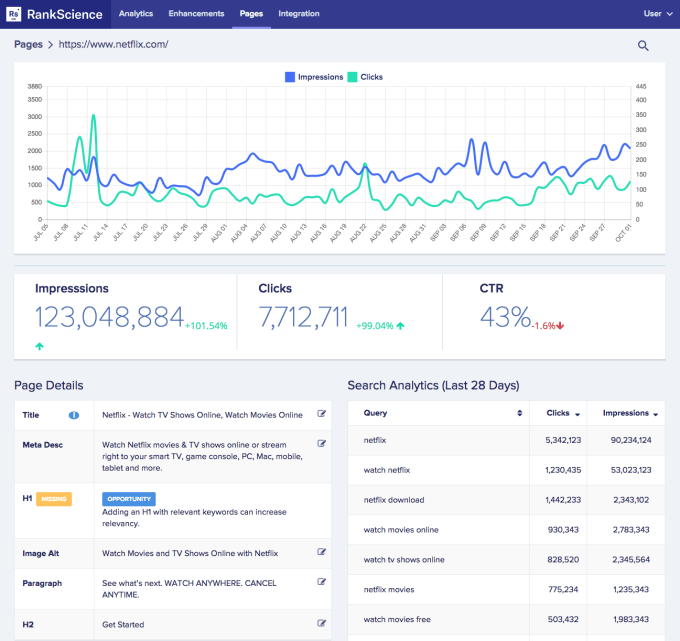
A couple of years ago YC-backed RankScience, which offers AI-enhanced SEO split-testing, put a few SEO experts’ noses out of joint when the fledgling startup brashly talked about replacing human expertise with automation.

Two years on its pitch has mellowed, with the team saying their self-service platform is “augmenting human SEO ability rather than replacing them”.

The startup has also — finally — closed a seed round, announcing $1.8M led by Initialized Capital, along with Adam D’Angelo, Michael Seibel, BoxGroup, Liquid2 Ventures, FundersClub, and Jenny 8 Lee participating.

The new roster of investors join a list of prior backers that includes Y Combinator, 500 Startups, Christina Cacioppo, and Jack Groetzinger.

So what took them so long? Founder Ryan Bednar tells TechCrunch they wanted to take their time with the seed, rather than raise more money than they needed — a position that was possible thanks to already being profitable at YC Demo Day.

“I admit that this is unusual,” he says of the slow seed, though he also says they did raise a “small amount” after demo day, before filling out the rest this month.

“I saw many YC batchmates raising massive rounds pre product-market-fit, which can end up being a mistake,” he adds. “We probably could have raised a few million at Demo Day but ultimately didn’t feel we were ready for it. I didn’t know what I would spend the money on, and we were growing without it, so we chose not to. I wanted to raise capital when I felt we were ready to use it for growth, and now’s that time.”

Bednar also says he is “selective” when it comes to investors — and “specifically” wanted to work with Initialized, saying he’s “known Garry and Alexis personally for years, and trust that they would support us in building a long-term scalable business”.

Commenting on the funding to TechCrunch, Initialized Capital’s Alexis Ohanian tells us: “Even though so many businesses depend on traffic from search, it’s a challenge for them to be data-driven about SEO. RankScience makes it easy to test changes to your website that can lift search traffic. They also automate a growing number of technical SEO tasks, which otherwise would take engineers away from building product and infrastructure, which is really exciting.”

RankScience plans to use the fresh funding to hire more AI and machine learning engineers, with headcount growth targeted at its SF office.

While the founders have stepped back from pronouncing ‘the death of the SEO expert’, they are still touting the power of automation AI for SEO — noting how, after crawling a customer’s site/s, the software automatically proposes “SEO enhancements and experiments” to customers — for “one-click [human] approval”.

It also includes what Bendar bills as a “self-driving car mode” — where the tech will deploy the touted “enhancements and experiments” without customer approval. But he concedes it’s not for all RankScience users.

“For about half of our customers, we’re their only SEO vendor so we automate SEO services 100% for them, and for the other half, our software augments human SEO ability, either from in-house marketers or agencies,” he says, explaining how the team has evolved their thinking on automation vs human agency and expertise.

“When we launched we didn’t think hard enough about what sorts of controls SEO managers at larger websites would want, and we tried to automate everything without giving marketers enough control. This was a mistake and we’ve worked hard on correcting it.

“This should have been obvious but it turns out that SEO managers are highly selective about what sorts of HTML changes our software might make to their webpages. So we’ve spent the past year building tools to give SEO marketers complete control over everything our software does, and also advanced editors and tools so they can create their own SEO enhancements and run SEO split tests through the platform.”

For those who make use of RankScience’s ‘Self-Driving Car Mode’ the software is replacing SEO staff “completely”, but he adds: “This works especially well for startups and medium size businesses. But SEO is such a multifaceted problem, we want to give larger companies with marketing teams complete control over our platform, and so we work with both types of customers.”

As well as (finally) closing out its seed round now, RankScience is also launching a new self-service platform for startups and SMEs — touting greater controls.

On the customer front, Bednar says they have “hundreds” of sites on the platform now — and are serving “hundreds of millions of page views per month”. Cumulatively he says they’ve deployed “millions” of SEO split tests at this point.

“Our customers run the gamut from startups just getting started with SEO to publicly-traded companies,” he continues. “Our best industries are SaaS, ecommerce, marketplaces, healthcare, publishing, and location-based sites.

“We’ve recently been working with more consumer goods brands, and we’ve also launched a partnership program so that we can work with SEO and Digital Marketing Agencies and independent consultants.”

He says the vast majority of RankScience users are based in the US at this stage but adds that Europe is a “growing market”.

In terms of competition, Bednar name-checks the likes of Moz, Conductor (acquired this year by WeWork), BloomReach and BrightEdge — so it is swimming in a pool with some very big fish.

“Most of these products are more akin to advanced SEO analytics suites, and we differ in that RankScience is 100% focused on data-driven SEO automation,” he says, fleshing out the differences and RankScience’s edge, as he sees it. “Our software doesn’t just tell you what changes to make to your site to increase search traffic, it actually makes the changes for you. (Now with more controls!)”

08 Oct 2018

WeWork taps Lemonade to offer insurance to WeLive members

WeWork has partnered with Lemonade to provide renters insurance to WeLive members.

WeLive is the residential offering from WeWork, offering members a fully-furnished apartment, complete with amenities like housekeeping, mailroom, and on-site laundry, on a flexible rental schedule. In other words, bicoastal workers or generally nomadic individuals can rent a short-term living space without worrying about all the extras.

As part of that package, WeLive is now offering Lemonade renters insurance to new and existing members.

WeLive currently has two locations — one in New York and one in D.C. — collectively representing more than 400 units. WeWork says that both units are nearly at capacity. The company has plans to open a third location in Seattle Washington by Spring 2020.

Lemonade, meanwhile, is an up-and-coming insurance startup that is rethinking the centuries-old industry. The company’s first big innovation was the digitization of getting insurance. The company uses a chatbot to lead prospective customers through the process in under a minute.

The second piece of Lemoande’s strategy is rooted in the business model. Unlike incumbent insurance providers, Lemonade takes its profit up-front, raking away a percentage of customers’ monthly payments. The rest, however, is set aside to fulfill claims. Whatever goes unclaimed at the end of the year is donated to the charity of each customer’s choice.

To date, Lemonade has raised a total of $180 million. WeWork, on the other hand, has raised just over $9 billion, with a reported valuation as high as $35 billion.

Of course, part of the reason for that lofty valuation is the fact that WeWork is a real estate behemoth, with Re/Code reporting that the company is Manhattan’s second biggest private office tenant. But beyond sheer square footage, WeWork has spent the past few years filling its arsenal with various service providers for its services store.

With 175,000 members (as of end of 2017, so that number is likely much higher now), WeWork has a considerable userbase with which it can negotiate deals with service providers, from enterprise software makers to… well, insurance providers.

Lemonade is likely just the beginning of WeWork’s stretch into developing a suite of services and partnerships for its residential members.

08 Oct 2018

This is not fine

A UN report compiled by a coalition of international climate experts has warned that “rapid, far-reaching and unprecedented changes in all aspects of society” are required if global warming is to be limited to just 1.5°C.

The report also sets out some of the dire consequences for both humanity and life on Earth if that threshold is exceeded, and points out that, conversely, limiting global warming would give people and ecosystems “more room to adapt and remain below relevant risk thresholds”.

Decisions made by world leaders today are critical in ensuring a safe and sustainable world for everyone, the authors warn.

“One of the key messages that comes out very strongly from this report is that we are already seeing the consequences of 1°C of global warming through more extreme weather, rising sea levels and diminishing Arctic sea ice, among other changes,” said Panmao Zhai, co-chair of one of the report’s scientific working groups.

“The good news is that some of the kinds of actions that would be needed to limit global warming to 1.5°C are already underway around the world, but they would need to accelerate,” added Valerie Masson-Delmotte, co-chair of the same group.

To limit the damage caused by climate change, global net human-caused emissions of carbon dioxide (CO2) would need to fall by about 45% from 2010 levels by 2030, reaching ‘net zero’ around 2050 — which means that any remaining emissions would need to be balanced by removing CO2 from the air.

If world leaders do not succeeding in keeping warming to 1.5°C humanity will face a range of far more severe impacts, with a 2°C rise meaning an extra 10cm rise in sea levels by 2100 — which would inundate scores more coastal cities and low lying areas, increasing the amount of people who would be displaced in future.

Climate-related risks to health, livelihoods, food security, water supply, human security, and economic growth are also projected to be more severe at the higher temperature rise.

While the report says that limiting global warming to 1.5°C would reduce risks to marine biodiversity, fisheries, and ecosystems, and their functions and services to humans.

Even with a 1.5°C rise coral reefs would still be severely impacted, declining by 70-90% — but virtually all (>99%) reefs would be lost with a 2°C rise.

While the likelihood of an Arctic Ocean free of sea ice in summer would be once per century with global warming of 1.5°C, compared with at least once per decade with 2°C, according to the report.

Likewise, on land, impacts on biodiversity and ecosystems, including species loss and extinction, are projected to be lower at 1.5°C of global warming vs 2°C.

Impacts associated with other biodiversity-related risks — such as forest fires, and the spread of invasive species — would also be less severe if climate change can be contained to a smaller rise.

The Intergovernmental Panel on Climate Change (IPCC) compiled the Special Report on Global Warming in response to an invitation from the UN’s Framework Convention on Climate Change when 195 global leaders adopted the 2015 Paris Agreement to tackle climate change — an accord which President Trump turned his back on last year when he withdrew the US from the agreement.

The report will be a key scientific input for the Katowice Climate Change Conference, which takes place in Poland in December, when other heads of state will meet to review the Paris Agreement.

The group of 91 authors and review editors from 40 countries who prepared the report argue that keeping global temperature rise to 1.5°C would also support a more sustainable and equitable society.

“Limiting global warming to 1.5°C compared with 2°C would reduce challenging impacts on ecosystems, human health and well-being, making it easier to achieve the United Nations Sustainable Development Goals,” said Priyardarshi Shukla, co-chair of IPCC Working Group III, in a statement.

“Every extra bit of warming matters, especially since warming of 1.5°C or higher increases the risk associated with long-lasting or irreversible changes, such as the loss of some ecosystems,” added Hans-Otto Pörtner, Co-Chair of IPCC Working Group II.

Any ‘overshoot’ of 1.5°C would mean a greater reliance on techniques that remove CO2 from the air to return global temperature to below 1.5°C by 2100.

But policymakers are warned that the effectiveness of such techniques are unproven at large scale and some may carry significant risks for sustainable development.

Meme via GIPHY

08 Oct 2018

Payments startup Klarna raises $20M from H&M, its second backer from the fashion world

Klarna, the payments startup out of Sweden that helps online shoppers arrange for financing at the point of sale, has picked up another strategic investor: fashion retailer H&M is taking a $20 million stake in the business, and with it, the two plan to build an “omni-channel” payments service across H&M’s physical stores — which span 4,800 stores in 70 markets — as well as its online storefronts.

Klarna says the deal will cover “frictionless” in-store, mobile and online payments across the company’s whole footprint, a better delivery and return process, and more flexible payment options, including “try before you buy” pay later services, to be delivered through H&M’s app and its Club loyalty program. The first phase of the partnership will go live in 2019 in H&M’s home market of Sweden before a global roll out.

The companies are not disclosing the valuation with this investment, but a source close to the deal says that the $20 million equates to “much less than one percent of the company.” For some context, Klarna was last valued at $2.5 billion in 2017, a year when it made a series of investment announcements. They included a $225 million stake from Klarna’s first fashion world investor, Anders Holch Povlsen (owner of fashion conglomerate Bestseller); a strategic stake from credit card giant Visa; and a $250 million investment from PE firm Permira. (Previous investors have included Sequoia, Northzone and IVP.)

We’ve heard that Klarna has also been eyeing up an IPO as a further liquidity event although a spokesperson declined to comment on this when asked today.

For H&M, the move aims to give the company a stronger push into digital sales. Some high-street retailers have made online, and specifically mobile, a cornerstone of their sales — and there are, indeed, a number of businesses that have built presences only online such as Farfetch, Matches, and ASOS.

“We are impressed with what Klarna has achieved to date and now we will work together to elevate the modern shopping experience,” said Karl-J​ohan Persson, CEO H&M, in a statement. “This strategic partnership between H&M group and Klarna is based on a joint relentless focus on creating great customer experiences.”

H&M has put the bulk of its investment and focus on its physical stores over the years, and so some of that wave of buying trends — including not just the most cutting-edge web expereinces, but also being able to pay at a physical cash register using your mobile phone — has potentially passed it by.

It’s not clear how much of an impact ignoring newer sales channels and having better digital experiences has had on the company, but H&M has seen a big drop in its share price in the last year, so this investment, and the fruits of it, could potentially help shore up confidence, and perhaps sales, at the business at a crucial time.

“We at H&M are very excited about this partnership. We want to make it possible for customers to move freely between the various channels and choose how they want to shop and experience our offering online and in store,” said Daniel Claesson, Head of Business Development H&M group, in a statement. “This partnership will bring tailor-made payment solutions to our customers and accommodate evolving shopping patterns and needs. This includes the possibility to ‘try before you buy’ which is very relevant to online fashion retail today and to pay with their mobile phone directly through the H&M app both instore and online.”

Klarna had already cut its teeth in working with retailers, including Povlsen’s Bestseller-owned range of brands, as well as Ikea and ASOS, and so it is in that regard a safe bet for H&M to try something new. Klarna itself started out focusing on financing at the point of sale, and this is still what it’s best known for, but in 2017 it also obtained a full banking license and so it’s been moving into more financial services around that (including on credit products with Visa), so this opens the door to working on a number of other services with its customers.

E-commerce, however, is still a very small percentage of all retail, accounting for only around 10 percent this year in developed markets like the US, and far lower in other places. So there is a long way to go tapping the market and building services for legacy brick-and-mortar businesses, an opportunity Klarna has been tackling.

“Retail is changing, and the future of fashion retail is high tech powering high touch experiences for customers. Regardless of how and when customers want to shop, we need to be there for them,” said Sebastian Siemiatkowski, CEO and co-founder of Klarna, in a statement. “​Customers will no longer be forgiving of unnecessary complexity or when their retail experience does not leverage the insight available to make their engagement smart, personal and easy.”

08 Oct 2018

Grab your Investor pass to Disrupt Berlin 2018 today

Calling all early-stage fund investors across Europe and beyond. If you’re looking to invest in the most promising up-and-coming early-stage startups — and of course you are, because that’s what you do — it’s time to book your Investor pass to Disrupt Berlin 2018, which takes place November 29-30.

Disrupt Berlin attracts startups from more than 50 countries, including the European Union members, Israel, Turkey, Russia, Egypt, India, China and South Korea, to name a few. You’ll have focused, in-person exposure and access to European and international startups during two days of intense programming and curated networking.

Time-savvy investors will take advantage of CrunchMatch, our free business matchmaking service that quickly connects investors with founders who want to discuss potential funding opportunities — based on their specific criteria, goals and interests. You fill out a profile, we work a bit of algorithmic magic and presto — CrunchMatch suggests appropriate matches and, if approved by both parties, sends meeting requests and proposes meeting times. Plus, if you need some extra time to chat with a founder you meet at the event, you can take advantage of up to two hours of free meeting room space at the event.

Need a quiet space to just catch up on work? Investors will have access to a dedicated private lounge where you can do just that. And we’ll also be hosting a reception where you can meet fellow VCs, angels and LPs to share best practices and network over a beer.

You won’t want to miss watching Startup Battlefield, where up to 15 of the best early-stage startups compete head-to-head for the Disrupt Cup, $50,000 in cash and a crazy amount of investor love.

Michael Kocan, the managing partner at Trend Discovery, told us he was pleasantly surprised at the number of early-stage startups attending Disrupt, and he discovered a potent tool by combining Startup Battlefield and CrunchMatch.

“I get the most value at the intersection of CrunchMatch and Startup Battlefield. If I see an interesting company present on stage, I use CrunchMatch to quickly schedule a meeting with them for later that day. It makes vetting deals extremely efficient.”

CrunchMatch facilitated almost a thousand meetings at Disrupt Berlin 2017, and 97 percent of the participants said they’d happily use the shoe-leather-saving platform again.

Now, let’s talk about the networking value investors will find in Startup Alley. Our expo floor showcases more than 400 early-stage startups displaying their latest tech products, services and platforms. It’s a breeding ground of opportunity, collaboration and innovation. It’s also where you’ll find the TC Top Picks — our hand-picked cohort representing exceptional startups in these 10 categories:

  • AI/Machine Learning
  • Blockchain
  • CRM/Enterprise
  • E-commerce
  • Education
  • Fintech
  • Healthtech/Biotech
  • Hardware, Robotics, IoT
  • Mobility
  • Gaming

Networking with peers is an essential part of any business, and Michael Kocan found that Disrupt offers plenty of opportunity to meet and network with other investors. Of the new venture capital investors that he met at the conference, Kocan connected with roughly 25 percent through CrunchMatch and 75 percent just by working the event.

“The Investor Reception is a fantastic opportunity to build relationships with a broad range of investor colleagues,” said Kocan.

Beyond the investing and networking opportunities, Disrupt Berlin 2018 also features a strong roster of speakers from the investment community. You’ll hear four Accel partners — Harry Nelis, Sonali De Rycker, Philippe Botteri and Luciana Lixandru — talk about the firm’s investments, each partner’s current focus and their collective thoughts on the European startup scene.

A quick sample of other speakers includes Kaidi Ruusalepp, founder and CEO of Funderbeam, Mike Collett, founder and managing partner at Promus Ventures, and Jamie Burke, CEO and founder of Outlier Ventures.

If you’re a corporate investor, venture capitalist, angel investor, private equity manager or limited partner, Disrupt Berlin 2018 is exactly where you need to be on November 29-30. Don’t miss this opportunity to connect with, and possibly invest in, the best early-stage startups in Europe. Buy your investor pass right here and save €500.

08 Oct 2018

Mosaic Ventures, the London-based Series A investor, has closed a second fund at $150M

Well, that was quick: A little over two months since we reported that Mosaic Ventures was in the middle of raising a second fund, TechCrunch can reveal that fund two has in fact now closed, as the London-based venture capital firm looks to double down on backing “Europe’s most ambitious entrepreneurs”.

We began hearing from sources late last week that news was imminent, and in a call on Saturday morning Mosaic founding partners Simon Levene and Toby Coppel confirmed the details. Fund two totals $150 million, as per an earlier SEC filing, and will be used to continue the firm’s Series A remit, which will see it back 5-10 new companies each year, as lead or co-lead, typically with a $3-7 million first check.

Four years since launching, Mosaic has invested in over 20 startups, and in a range of sectors. These include blockchain/crypto startups Blockstream and Blockchain (the firm remains bullish with regards to the space), fintech startup Habito, open source drone company Auterion, period tracking app Clue, and data startup Infosum. The firm has also invested directly in deep tech company builder Entrepreneur First, alongside Reid Hofflan with Greylock, a deal Mosaic helped instigate.

“I think what we do is very unique,” says Coppel, when I ask how the VC differentiates itself from competing early-stage firms in London and Europe, especially since — only just on fund two — it is somewhat unproven. “What we do is focus very much at the early-stage, Series A, where founders have built an early product, they’re a long way ahead of themselves in terms of building out their team and their got-to-market. We roll up our sleeves and get stuck in with them in many of the foundational pieces of building a company. That’s our entire focus”.

He also argues that when Mosaic write a cheque, the firm’s interests are more aligned with the founders it backs than larger venture capital firms.

“Given our fund size and the cheques we write at Series A, we think working with us is a very strong choice because of our experience and because we are willing to take risk and because of our network and so forth. And we’ll give everything — we’re entrepreneurs ourselves. As you say, it is early for Mosaic and therefore whatever we do at this point we are going to give 150 percent.

“There are firms that are much bigger in terms of fund size and for them, often writing a $3 million cheque is not the same, it’s a very small part of their fund, you don’t necessarily get the same focus and effort and alignment. And I think that is what sets us apart”.

To that end, Levene and Coppel, who both built much of their career in Silicon Valley, most notably in senior positions at Yahoo, tell me that Mosaic will continue to invest thematically, specifically outlining five areas. They are: “blockchain, crypto and the decentralized web” (it’s the decentralised aspect of blockchain where no one vendor needs to own or have control over the platform, that the pair say is attractive), “computational health”, “machine intelligence”, “mobility and location services”, and “finance 2.0”.

Elaborating on how Mosaic views health tech, Coppel says that over the next five to ten years the cost of sensors that enable “continuous bio tracking” will continue to drop and therefore we’ll all be collecting huge amounts of data from our bodies, such as our metabolism or cardiovascular systems, so that we can monitor our own health. Combined with various “-omics data” and that the fact that sequencing the genome can be done for less than $100, we’ll be able to generate new drugs or help adapt personalised treatments based on that data. “When you’re collecting all that data it creates significant new things and opportunities in new areas. That’s the transformation that healthcare is going to go through,” he says.

Regards “finance 2.0,” Levene and Coppel don’t entirely disagree with my assertion that much of the low and mid-hanging fruit in fintech has already been picked (Coppel himself was an early investor in Transferwise), as the banks and financial services continue to be unbundled. However, they say there are still opportunities to build “best-of-breed services” both for consumers and businesses.

“Insurance is one of those,” says Coppel. “Today the experience is pretty poor because most insurance companies have gone through channels and therefore they’re not consumer-centric. But also the underlying insurance product itself hasn’t really been geared for trust where they’ve created these products that have suited their own internal risk models not necessarily what the customers need. So there is a whole series of opportunities to reinvent the core underlying… risk and protection product to tailor it to the customer’s needs”.

Pressed to be more specific, he says that today many people are overinsured in the wrong products, such as phone insurance, and underinsured in what really matters, such as life insurance or critical illness insurance.

Another area Mosaic is eyeing up is SME financing, where the “attack vector” could be building a great accounting or invoicing product, and then by using the data passed through those services, offering more flexible business financing.

A common thread throughout a number of Mosaic’s existing portfolio — and just about any VC firm these days — is machine learning, and the Mosaic founders says they remain firm in their belief that the impact of machine learning will be pervasive across all industries and businesses. “We’ve gone deep into machine learning and machine intelligence-based businesses,” adds Levene. “Obviously there’s the investment in EF… that, if you like, is an index of that whole sector. At least half a dozen of the portfolio have a strong machine learning vector as to how they are attacking a particular vertical”.

On that note — and given that AI is an area where Europe and the U.K. in particular excels — I turn the topic to Brexit and ask the pair what they make of the current Brexit mess (actually, I used a far less polite word).

“Entrepreneurs at this point still don’t understand what Brexit means,” says Coppel. “It hasn’t come to fruition and most entrepreneurs are focused on the next week, the next month, the next quarter, rather than what’s going to happen in a year and a half to the U.K. economy. That’s certainly true of the early-stage companies. [For] the later stage companies, there are some more significant decisions. It’s not easy to move hundreds of people around.

“We don’t really know what Brexit means yet and it obviously creates havoc for people who are trying to plan. But at this point we haven’t seen any evidence from entrepreneurs saying ‘I’m not going to start my company in London, I’m going to start my company in Barcelona or Berlin’ and we haven’t seen companies move from London to the continent because of Brexit. Could we see that in six months from now? Possibly”.

Adds Levene, less optimistically: “The biggest single risk that we foresee is… if it changes the hiring market. If you don’t have access to 300 million people you can bring on your books tomorrow. If you have to go through a visa process that is cumbersome, that would stymie startups being able to hire talent quickly and scale up. So the capital follows talent and if we put up the walls around immigration then that’s going to be a problem”.

I suggest that, given the current trajectory and the music coming from the U.K. government, whatever the immigration mechanism put in place post-Brexit, it won’t be as optimal for U.K. startups as the status quo. Levene doesn’t refute my logic. “It’s shooting ourselves in the foot,” he says, “and it’s not just in tech but I think it’s also going to be in other verticals… So I think the government is gonna have a reckoning if they create friction for hiring, not just in tech but in many other industries”.


08 Oct 2018

Taxify and Via drive to Disrupt Berlin

After years of impressive growth, Uber has been showing signs of weakness and had to give up on some markets. Maybe Uber isn’t going to be the market leader in every country. That’s why I’m excited to announce that Taxify and Via Transportation co-founders and CEOs are going to talk about challenging Uber at TechCrunch Disrupt Berlin.

Markus Villig started working on Taxify years ago. But things started to take off quite dramatically in the past twelve months. The company now works with hundreds of thousands of drivers to serve millions of customers.

Taxify now operates in 25 European and African countries and is carefully avoiding the U.S. That strategy could pay off.

Via is interesting for another reason. As Daniel Ramot will tell you, Via is attacking the ride-sharing market from a different angle. You might remember that Uber (UberCab back then) started with a luxurious on-demand experience. Ordering a private driver would cost you twice as much as jumping in a taxi.

Via thinks that shared rides and fixed costs are more important than luxury. Ordering a ride on Via costs a bit more than a bus ticket, but is a lot more flexible than public transportation. You will share the ride with other Via users. It’s a good solution for under-deserved areas and poorly planned cities.

Buy your ticket to Disrupt Berlin to listen to this discussion and many others. The conference will take place on November 29-30.

In addition to fireside chats and panels, like this one, new startups will participate in the Startup Battlefield Europe to win the highly coveted Battlefield cup.

08 Oct 2018

Atomico leads $31M Series B in Varjo, the Finnish startup developing ‘human-eye resolution’ VR and XR

Varjo Technologies, the Finnish startup that made a splash earlier this year with news it had developed a virtual reality headset capable of “human-eye resolution,” has raised $31 million in Series B funding.

Leading the round is Europe’s Atomico, with participation from Siemens-backed venture capital firm Next47. Existing Series A investors EQT Ventures and Lifeline Ventures also followed on. It brings total funding for the Helsinki-based company to $46 million.

Founded in 2016, Varjo (which means “shadow” in Finnish and is pronounced “Var-yo”) aims to bring to market “the world’s first” human-eye resolution virtual reality (VR) and mixed reality (XR) product, which will be orders of magnitude higher in resolution than existing consumer headsets, such as Magic Leap or Microsoft’s HoloLens. However, unlike those existing devices — and courtesy of a claimed 20x bump in resolution — Varjo is targeting industrial use-cases for its wares.

In a call, co-founder and CEO Urho Konttori — who was previously at Nokia and Microsoft, where he played a pivotal role in the Meego N9 smartphone and the high-end Lumia devices, respectively — told me that Varjo is looking to sell into “design-driven” industries including simulation and training, architecture, automotive, aerospace, manufacturing, engineering, and construction — along with industrial design more generally.

These use-cases require VR and XR to mimic the human eye as closely as possible, and demand “extreme precision” and visual fidelity. Konttori says the status quo in resolution is like asking designers or engineers sporting headsets to work or train “half blind”. In contrast to existing lower resolution headsets, the startup’s prototype already claims “an effective resolution of 50 megapixels per eye”.

But to really understand the impact Varjo hopes to make, consider how complex design and engineering projects are undertaken today. In car design, for example, clay models are still used at key points of the design stage and form an important part of the creative loop. However, producing these slows down the design iteration process and in some ways stifles creativity because of the lag between tweaking a drawing or 3D CAD file and experiencing it in clay form in real life. Moving this to a high resolution virtual reality domain via VR and XR will remove this obstacle and enable designers to take more risks and try new things. This, in the longer term, should lead to better design and more innovative products.

What is also noteworthy, given VR and AR’s penchant for being the promise that keeps on promising, is that Varjo isn’t a “moonshot” investment, even though Atomico does do moonshot investments from time to time. Instead, the company says it is on track to commercially launch its VR headset later this year, with an AR/XR add-on to the headset available in the first half of 2019.

I’m also told it is already working in partnership with companies such as Airbus, Audi, BMW, Volkswagen, and Lilium, who have had early access to prototypes and have been feeding back and helping iterate the product.

I note that it is refreshing to see a new hardware company based in Europe, and that Varjo, with its ties to ex-Nokians, appears to be benefiting from European hardware talent, Konttori says that European VC firms have seemingly lost their appetite for truly innovative hardware. In Varjo’s case, he says Atomico was the exception, and that — along with flying taxi company Lilium (which Atomico has also invested in) — he hopes it can be the start of a European hardware startup renaissance.

08 Oct 2018

Saudi Arabia’s sovereign fund will also invest $45B in SoftBank’s second Vision Fund

The sovereign fund of Saudi Arabia plans to invest $45 billion into the second SoftBank Vision Fund, two years after putting the same amount into the original $100 billion Vision Fund, Saudi Arabia Crown Price Mohammed bin Salman told Bloomberg in an interview on Friday.

When the first Vision Fund was announced, it was by far the biggest private equity fund ever created, but if SoftBank Group CEO Masayoshi Son’s plans come to fruition, it will not be the last. Son told Bloomberg Businessweek last month that he wants to raise a new $100 billion fund every two or three years.

Saudi Arabia’s Public Investment Fund is anticipating a fresh influx of $170 billion over the next three to four years after selling its stake in Saudi Basic Industries, as well as the upcoming IPO of state-owned Saudi Aramco, said Prince Mohammed, who is also the PIF’s chairman. The PIF, which has also made investments in Uber, Tesla and Lucid, has enjoyed a “huge benefit” from the first Vision Fund, he told Bloomberg.

“We would not put, as PIF, another $45 billion if we didn’t see huge income in the first year with the first $45 billion,” Bin Salman said. He added that its investment in the first Vision Fund will help PIF achieve its new target of $600 billion in assets by 2020, up from the almost $400 billion it currently holds.

SoftBank Group has been contacted for comment.

SoftBank Group and Saudi Arabia’s other partnerships include a deal to build the world’s biggest solar plant for $200 billion. The PIF said earlier this month the plant is still going ahead despite a Wall Street Journal report that it had been shelved.