Year: 2018

05 Oct 2018

Search company Elastic pops over 90% on NYSE after raising $252M at a $2.5B market cap in its IPO

When many consumers think of search, they think of Google, but under the hood of hundreds of businesses and other organizations, there are hundreds of other kinds of challenges that require search technology. Today, one of the bigger companies providing that, Elastic, saw just how valuable that business can be, by way of a very strong debut as a public company. The company today opened up at $70, a pop of 94 percent on its initial public offering at $36 on Thursday night. Elastic — founded in the Netherlands — raised $252 million at a market capitalization of around $2.5 billion in that IPO, and trading continues to be strong.

Its stock is currently at $71.69 (up about 99 percent on its IPO price, for those keeping track). We’ll update this post as trading continues.

Although Google has long dominated the market for consumer’s search queries, Elastic has taken the approach of providing a set of strong search tools to organizations to help them both with tackling their own internal data troves, but also to help them build products for their customers to use.

This is no small thing: the tech world is built on big data, and there are absolutely troves of it being created and that goes into making services work, but it’s only valuable if it can be harnessed, controlled and shaped to whatever purpose you need, and that’s where Elastic comes in, covering both customer-facing and internal requirements.

“When you hail a ride home from work with Uber, Elastic helps power the systems that locate nearby riders and drivers. When you shop online at Walgreens, Elastic helps power finding the right products to add to your cart. When you look for a partner on Tinder, Elastic helps power the algorithms that guide you to a match. When you search across Adobe’s millions of assets, Elastic helps power finding the right photo, font, or color palette to complete your project,” the company noted in its IPO prospectus.

“As Sprint operates its nationwide network of mobile subscribers, Elastic helps power the logging of billions of events per day to track and manage website performance issues and network outages. As SoftBank monitors the usage of thousands of servers across its entire IT environment, Elastic helps power the processing of terabytes of daily data in real time. When Indiana University welcomes a new student class, Elastic helps power the cybersecurity operations protecting thousands of devices and critical data across collaborating universities in the BigTen Security Operations Center. All of this is search.”

The company says its portfolio of search products — based on open source and existing under the brand Elastic Stack (which includes Elasticsearch, Kibana, Beats, and Logstash) — have been downloaded over 350 million times since the company launched in 2013 — a mixture of paid and free products.

The strength of Elastic’s message/mission and customer base has been enough to entice investors despite the fact that the company is not profitable.

It has 5,500 customers across over 80 countries and in a wide range of industries, and it posted sales of $159.9 million in fiscal 2018, versus $88.2 million the year before, growth of 81 percent. It is also loss-making. Elastic posted net losses of $52.7 million in FY 2018, with a net loss of $52.0 million the year before, while operating cash flow was negative $20.8 million in FY 2018.

Dutch startups have had a strong little run in the market in the last couple of months. Adyen, the payments company, popped 67 percent when it made its debut in June. For some further context, Elastic had hoped to raise $100 million when it first filed its IPO in September. Overall for the tech IPO market, this is a big bounce back after the lacklustre performance of Funding Circle last week.

05 Oct 2018

Study says the US is quickly losing its entrepreneurial edge

Photographer: Daro Sulakauri/Bloomberg

According to a new study conducted by the Center for American Entrepreneurship and NYU’s Shack Institute of Real Estate, the US may be losing its competitive advantage as the dominant nucleus of the startup and venture capital universe. 

The analysis, led by senior Brookings Institution fellow Ian Hathaway and “Rise of the Creative Class” author Richard Florida, examines the flow of venture capital over 100,000 deals from 2005 to 2017 and details how the historically US-centric practice of venture capital has become a global phenomenon.

While the US still appears to produce the largest amount of venture activity in the world, America’s share of the global pie is falling dramatically and doing so quickly.

In the mid-90s, the US accounted for more than 95% of global venture capital investment.  By 2012, this number had fallen to 70%. At the end of 2017, the US share of total venture investment had fallen to just 50%.   

Over the last decade, non-US countries have propelled growth in the global startup and venture economy, which has swelled from $50 billion to over $170 billion in size.  In particular, China, India and the UK now account for a third of global venture deal count and dollars – 2-3x the share held ten years ago.  And with VC dollars increasingly circulating into modernizing Asia-Pac and European cities, the researchers found that the erosion in the US share of venture capital is trending in the wrong direction.

Growth of global startup cities and the myth of the American “rise of the rest”

We’ve spent the summer discussing the notion of Silicon Valley reaching its parabolic peak – Observing the “rise of the rest” across smaller American tech hubs.  In reality, the data reveals a “rise in the rest of the world”, with startup ecosystems outside the US growing at a faster pace than most US hubs.

The Bay Area remains the world’s preeminent beneficiary of VC investment, and New York, Los Angeles, and Boston all find themselves in the top ten cities contributing to global venture growth.  However, only six of the top 20 cities are located in the US, while 14 are in Asia or Europe.  At the individual level, only two American cities crack the top 20 fastest growing startup hubs.  

Still, the authors found the bulk of VC activity remains highly concentrated in a small number of incumbent startup cities. More than 50% of all global venture capital deployed can be attributed to only six cities and half of the growth in VC activity over the last five years can be attributed to just four cities.  Despite the growing number of ecosystems playing a role in venture decisions, the dominant incumbent startup hubs hold a firm grip on the majority of capital deployed.

China and the surge of mega deals

Unsurprisingly, the largest contributor to the globalization of venture capital and the slimming share of the US is the rapid escalation of China’s startup ecosystem.

In the last three years, China has captured nearly a fourth of total VC investment.  Since 2010, Beijing contributed more to VC deployment growth than any other city, while three other Chinese cities (Shanghai, Hangzhou, Shenzhen) fell in the top 15. 

A major part of China’s ascension can be tied to the idiosyncratic rise of late-stage “mega deals”, which the study defines as $500 million or more in size.  Once an extremely rare occurrence, mega deals now make up a significant portion of all venture dollars deployed.  From 2005-2007, only two mega deals took place.  From 2010-2012, eight of such deals took place.  From 2015-2017, there were 80 global mega deals, representing a fifth of the total venture capital activity.  Chinese cities accounted for half of all mega deal investment over the same period.

The good, the bad, and the uncertain

It’s not all bad for the US, with the study highlighting continued ecosystem growth in established US hubs and leading roles for non-valley markets in NY, LA, and Boston.

And the globalization of the startup and venture economy is by no means a “bad thing”.  In fact, access to capital, the spread of entrepreneurial spirit, and stronger global economic development and prosperity is almost unquestionably a “good thing.”

However, the US’ share of venture-backed startups is falling, and the US losing its competitive advantage in the startup and venture capital market could have major implications for its future as a global economic leader.  Five of the six largest US companies were previously venture-backed startups and now provide a combined value of around $4 trillion. 

The intense competition for talent marks another major challenge for the US who has historically been a huge beneficiary of foreign-born entrepreneurs.  With the rise of local ecosystems across the globe, entrepreneurs no longer have to flock to the US to build their companies or have access to venture capital.  The problem attracting entrepreneurs is compounded by notoriously unfriendly US visa policies – not to mention recent harsh rhetoric and tension over immigration that make the US a less attractive destination for skilled immigrants.  

At a recent speaking event, Florida stated he believed the US’ fading competitive advantage was a greater threat to American economic power than previous collapses seen in the steel and auto industries.  A sentiment echoed by Techstars co-founder Brad Feld, who in the report’s forward states, “government leaders should read this report with alarm.”

It remains to be seen whether the train has left the station or if the US can hold on to its position as the world’s venture leader.  What is clear is that Silicon Valley is no longer the center of the universe and the geography of the startup and venture capital world is changing.

The Rise of the Global Startup City: The New Map of Entrepreneurship and Venture Capital tries to illustrate these tectonic shifts and identifies tiers of global startup cities based on size, growth and balance of VC deals and investments.

05 Oct 2018

Gillmor Gang: Sync or Swim

The Gillmor Gang — Frank Radice, Keith Teare, Michael Markman, Denis Pombriant, and Steve Gillmor . Recorded live Sunday, September 23, 2018.

Turn out or turn off, media as anesthesia, what it is until it isn’t.

G3: Believe Me — Elisa Camahort Page, Francine Hardaway, Maria Ogneva and Tina Chase Gillmor. Recorded live Friday, September 28, 2018.

@stevegillmor, @fradice, @mickeleh, @kteare, @denispombriant

Produced and directed by Tina Chase Gillmor @tinagillmor

Liner Notes

Live chat stream

The Gillmor Gang on Facebook

G3: Believe Me

G3 chat stream

G3 on Facebook

05 Oct 2018

African financial technology startups move beyond payment services

If mobile money was the first phase in the development of digital finance in Africa, the next phase of digital financial services on the continent will focus on lending, insurance and wealth management

In “Beyond Payments: The Next Generation of Fintech Startups in Sub-Saharan Africa,” the venture capital firm Village Global, and their reporting partner, PayPal, tip their hat to M-Pesa and mobile money in Africa, but say that there’s a wave of innovation still to come.

The investment firm identified f 12 companies it determined were “building solutions in fintech subsectors outside of payments.”

In partnership with PayPal, Village Capital has set up Fintech: Africa 2018, a program in that seeks to find and support startups bringing other “critical services” to Africa’s unbanked populations.

“We can’t do enough to highlight what the next generation of fintech startups will and should be driving….whether it’s in agriculture—helping farmers have access to the financial system—through alternative credit scoring and lending—so people can actually get access to loans or insurance—or building savings and wealth,” Village Capital Managing Director and report co-author Allie Burns told TechCrunch.

Village Capital’s work gives a snapshot of these four sub-sectors—agricultural finance, insurtech, alternative credit scoring, and savings and wealth—including players, opportunities and challenges, recent raises, and early-stage startups to watch.

In alternative credit scoring and lending it sees blockchain as a driver of innovation in reducing “both transaction costs and intermediation costs, helping entrepreneurs bypass expensive verification systems and third parties.”

The report highlights recent raises by savings startup PiggybankNG and Nigerian agtech firm Farmcrowdy. Village Capital sees the biggest opportunities for insurtech startups in five countries: South Africa, Morocco, Egypt, Kenya and Nigeria.

On non-payments fintech startups overall, Village Capital chose a cohort of 12 for its 2018 program. They included F-Pesa — a Kenyan foreign exchange app­ — and Nigerian installment e-commerce app CredPal. All 12 participated in three Village Capital and PayPal sponsored workshops to introduce them to mentors and investors. Two of the cohort (identity venture Youverify and Ugandan cloud focused microfinance company Ensibuuko) received funding offers from Village Capital.

PayPal’s involvement in Village Capital’s Fintech Africa program “is really about…our commitment to financial health and the democratization of finance,” PayPal head of social innovation Sean Milliken told TechCrunch.

PayPal provided financial resources for the Fintech Africa program and study and participated in the development of the curriculum “toward those participating ventures getting investment ready,” said PayPal’s Director of Corporate Affairs Tyler Spalding. They didn’t invest though: “our funds were not actually deployed in an investment capacity,” he added.

PayPal has increased its presence and payment activity in Africa over the last several years through a number of partnerships—including one to transfer funds through Safaricom’s M-Pesa product—and plans to deliver more remittances into Nigeria and South Africa through its Xoom subsidiary.

Village Capital is still mulling the possibility running another round of its Fintech Africa program in 2019. To date the fund has invested in 14 Sub-Saharan African startups.

Whether its payment or non-payment applications, the number of startups in Africa’s fintech space and the breadth of their activities continue to grow.

Big developments TecCrunch has covered this year have mostly been on the digital payments side including Paga’s global expansion and plans to take on providers such as PayPal and Safaricom. Then there have been big raises by payments focused Paga ($10), Cellulant ($47M), and Mines ($13) and by lending platform Jumo ($52) and South African business enterprise services startup Yoco.

05 Oct 2018

Magic Leap buys mesh-computing startup Computes

Magic Leap has announced they are acquiring Computes, a decentralized mesh computing startup. Terms of the deal weren’t disclosed.

From Magic Leap’s blog post:

From the beginning, Chris Matthieu and Jade Meskill started Computes, Inc. based on the principle of enabling the next generation of computing. We believe Magic Leap is the perfect home to achieve this vision

Why would Magic Leap want to get their hands on this company? Well, it’s no secret that building a “digital layer” on top of the real world is more than a little compute-heavy; mesh computing offers an attractive future for leveraging the power of grouped systems to push resources to the devices that need it most.

The company’s website does a not-so-great job of explaining what exactly they do, but here’s a blip from one of the company’s whitepapers:

The Lattice protocol allows authorized computers to self-organize into a mesh computer, limited only by the number and power of the members. Lattice will intelligently allocate work to the best members of the mesh, based on the requirements of the task.

This is an interesting idea for AR headset systems, where eventually most of them may be in standby on average and could theoretically push their compute power to another system. Perhaps more likely is offsite PCs with beefy internals offering the headsets a punch. On the far less sexy side, this could also just be a play for the startup to drill down some of its backend services.

If you’re still curious about what they do and are interested in some even more mildly dubious explaining, check out this video from Computes’ CEO, which only mildly resembles a video from the Dharma Initiative.


05 Oct 2018

Scaleway adds object storage

Cloud hosting company Scaleway is launching object storage in public beta. The company uses an Amazon S3-compatible API, which means that you could easily replace your Amazon S3 bucket with a Scaleway bucket by changing the API end point.

The basic object storage package starts at $5.75 per month (€5 per month), which includes 500GB of storage and 500GB of outgoing transfer. You then pay €0.01 per month for every extra GB of storage and €0.02 per month for every extra GB of outgoing transfer. And there’s no limit.

You can transfer data back and forth between a Scaleway server instance and your object storage bucket for free. You can also create a bucket for free during the public beta phase.

When it comes to service level agreement, the company promises 99.9 percent availability and 99.999 percent redundancy and protection of your files.

It’s hard to compare Scaleway’s pricing with big competitors, such as Amazon S3, Google Cloud Storage and Microsoft Azure’s blob storage. Pricing differs depending on the region and the level of availability. But they tend to be more expensive than Scaleway if you choose standard storage options.

Backblaze’s B2 charges $0.005 per GB of storage per month and $0.01 per GB of outgoing transfer per month. DigitalOcean’s Spaces costs $5 per month for 250 GB of storage, 1TB of outgoing transfer, and then $0.02 per extra GB of storage, $0.01 per extra GB of transfer.

But pricing is just one thing. Chances are you don’t want to work with multiple vendors and pay for outgoing transfer by hosting your computing instances with one cloud hosting company and your object storage with another. Having object storage could help convince more clients to switch to Scaleway for everything.

05 Oct 2018

Salesforce acquires Rebel, maker of ‘interactive’ email services, to expand its Marketing Cloud

Salesforce’s Marketing and Commerce Cloud is the company’s smallest division today, so to help beef it up, the company is making an acquisition to add in more features. Salesforce has acquired Rebel, a startup that develops interactive email services for businesses to enhance their direct marketing services: recipients of interactive emails can write reviews, shop and take other actions without leaving the messages to do so.

In an announcement on Rebel’s site, the startup said it will be joining Salesforce’s Marketing Cloud operation, which will integrate Rebel’s API-based services into its platform.

“With Rebel’s Mail and API solutions, brands, including Dollar Shave Club, L’Oreal and HelloFresh, turn emails into an extension of their website or app – collecting data, removing friction from the conversion process, and enhancing the customer experience. Rebel will enhance the power of Salesforce Marketing Clod and fundamentally change the way people interact with email,” the founders note. It sounds as if the company’s existing business will be wound down as part of the move.

Terms of the deal have not been disclosed in the Rebel announcement. We have contacted both the startup and Salesforce for further comment and to ask about the price. To date, Rebel — co-founded originally as Rebelmail by Joe Teplow and Trever Faden — had raised only about $3 million, with investors including Lerer Hippeau, Sinai Ventures, David Tisch, Gary Vaynerchuk, and others, so if the deal size is equally small, Salesforce likely will not be disclosing it.

Salesforce has made a number of acquisitions to build and expand its marketing services to compete with Adobe and others. Perhaps most notable of these was buying ExactTarget, one of its biggest-ever acquisitions, for $2.5 billion in 2013. (And according to some, it even wanted to buy Adobe at one point.) Competition has been heating up between the two, with Adobe most recently snapping up Marketo for $4.75 billion.

But on the other hand, marketing is currently Saleforce’s smallest division. It pulled in $452 million in revenues last quarter, putting it behind revenues for Sales Cloud ($1 billion), Service Cloud ($892 million) and Salesforce Platform ($712 million). Adding in interactive email functionality isn’t likely to float Marketing and Commerce Cloud to the top of that list, but it does show that Salesforce is trying to improve its products with more functionality for would-be and current customers.

Those customers have a lot of options these days, though, in targeting their own customers with rich email services. Microsoft and Google have both started to add in a lot more features into their own email products, with Outlook and Gmail supporting things like in-email payments and more. There are ways of building such solutions through your current direct marketing providers, or now directly using other avenues.

What will be interesting to see is whether Rebel continues to integrate with the plethora of email service providers it currently works with, or if Salesforce will keep the functionality for itself. Today Rebel’s partners include Oracle, SendGrid, Adobe, IBM, SailThru and, yes, Salesforce.

We’ll update this post as we learn more.

05 Oct 2018

YouTube TV’s DVR now lets you fast-forward through ads on more major channels

Since its launch, one of the top complaints about YouTube’s live TV streaming service, YouTube TV, was that its DVR feature would often default users to the video-on-demand version of the show – which means you’d have to watch the commercials. It’s been one of the biggest drawbacks to YouTube TV, and a selling point for competitors’ services, frankly. That’s been slowly starting to change, however. And this week, YouTube announced several more deals that will allow users to opt for the recorded version of the show instead of the ad-filled, video-on-demand one.

This includes deals with AMC, Disney/ABC, FOX, NBCU and Turner-owned channels, says YouTube. Thanks to these deals, a number of the most-watched TV networks will now allow users to switch to the recorded version of the show, where they’ll have full control over pausing, rewinding, and fast-forwarding at any time during playback – even during an ad break.

The change is not because of a technical advance, to be clear, but rather one that required negotiations on YouTube’s part. Its original compromise with TV programmers was that it would switch users to the on-demand version of the show, if available. But for YouTube TV subscribers, that’s been a subpar experience – and one that could drive them to rival services, like Hulu with Live TV or DirecTV Now, where fast-forwarding through commercials is supported.

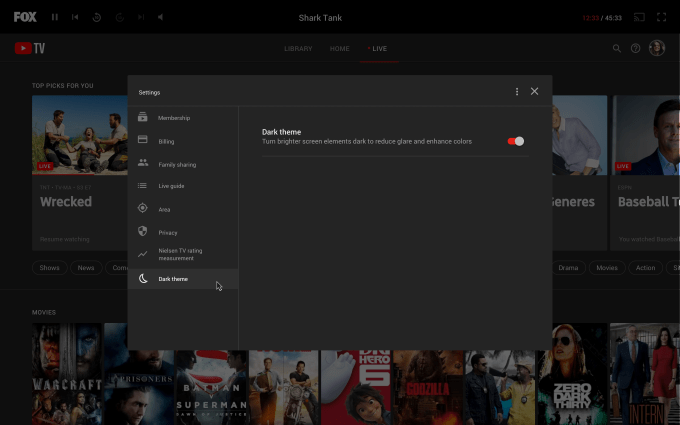
YouTube also officially announced this week a number of other changes that aren’t brand-new, but recent ones it hadn’t publicly noted yet – including the rollout of a Dark Theme on the desktop – similar to the one on YouTube proper; the ability to personalize its Live TV Guide by reordering networks and hiding others; and the ability to turn off spoilers to hide sports’ scores.

The streaming TV service is one of the newer ones to arrive, and still behind market leaders Sling TV and DirecTV Now, which have millions of subscribers. However, YouTube’s service is growing quickly, having gone from an estimated 300,000 paying customers in the beginning of 2018 to 800,000 this summer. With the DVR improvement, those numbers could grow even more quickly.

05 Oct 2018

Chinese investment into computer vision technology and AR surges as U.S. funding dries up

Last year 30 leading venture investors told us about a fundamental shift from early stage North American VR investment to later stage Chinese computer vision/AR investment — but they didn’t anticipate its ferocity.

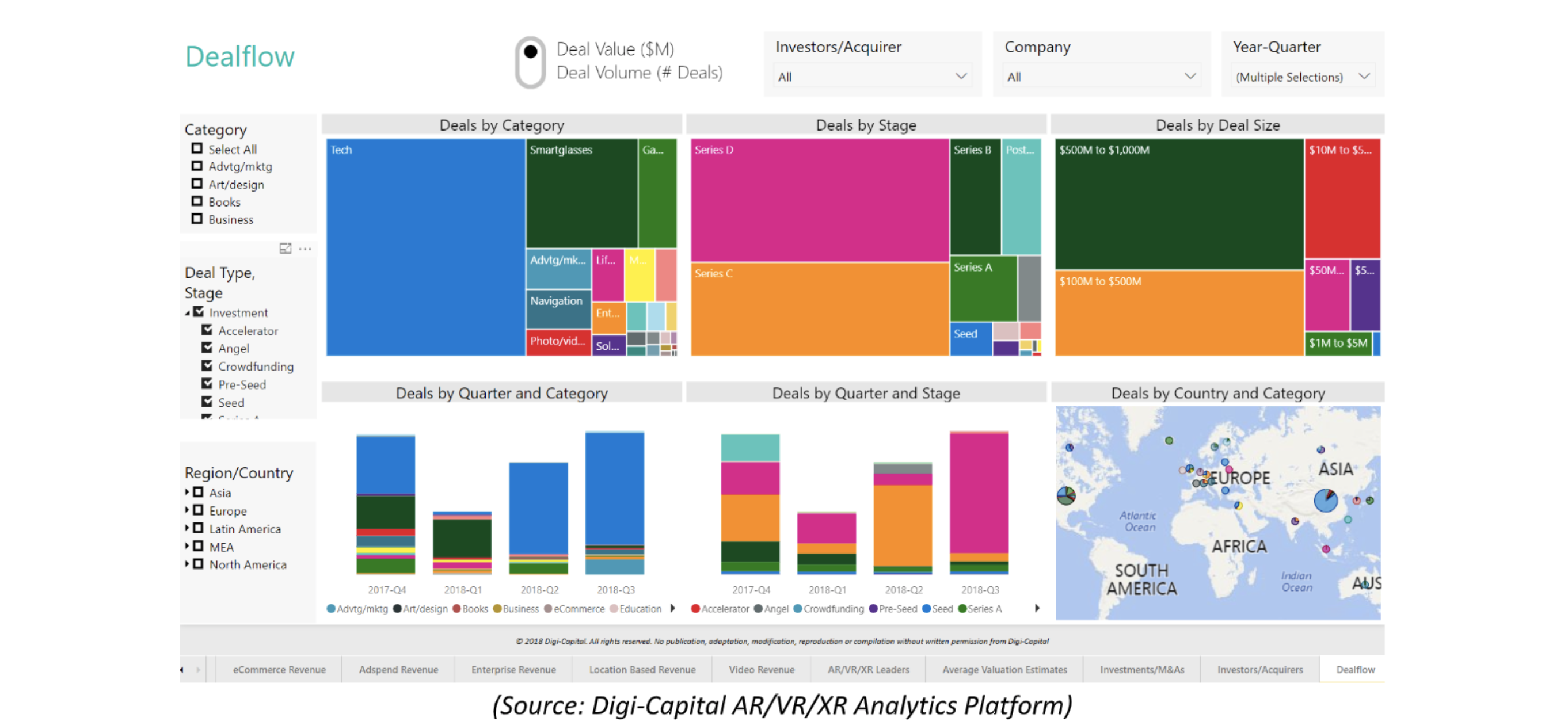
Digi-Capital’s AR/VR/XR Analytics Platform showed Chinese investments into computer vision and augmented reality technologies surging to $3.9 billion in the last 12 months, while North American augmented and virtual reality investment fell from nearly $1.5 billion in the fourth quarter of 2017 to less than $120 million in the third quarter of 2018. At the same time, VC sentiment on virtual reality softened significantly.

What a difference a year makes.

Dealflow (dollars)
What VCs said a year ago

When we spoke to venture capitalists least year, they had some pretty strong opinions.

Mobile augmented reality and Computer Vision/Machine Learning (“CV/ML”) are at opposite ends of the spectrum — one delivering new user experiences and user interfaces and the other powering a broad range of new applications (not just mobile augmented reality).

The market for mobile AR is very early stage, and could see $50 to $100 million exits in 2018/2019. Dominant companies will take time to emerge, and it will also take time for developers to learn what works and for consumers and businesses to adopt mobile AR at scale (note: Digi-Capital’s base case is mobile AR revenue won’t really take off until 2019, despite 900 million installed base by Q4 2018). Tech investors are most interested in native mobile AR with critical use cases, not ports from other platforms.

Computer vision and visual machine learning is more advanced than mobile AR, and could see dominant companies in the near-term. Here, investors love  startups with real-world solutions that are challenging established industries and business practices, not research projects. Firms are investing in more than 20 different mobile augmented reality and computer vision and visual machine learning sectors, but there is the potential for overfunding during the earliest stages of the market.

What VCs did in the last 12 months

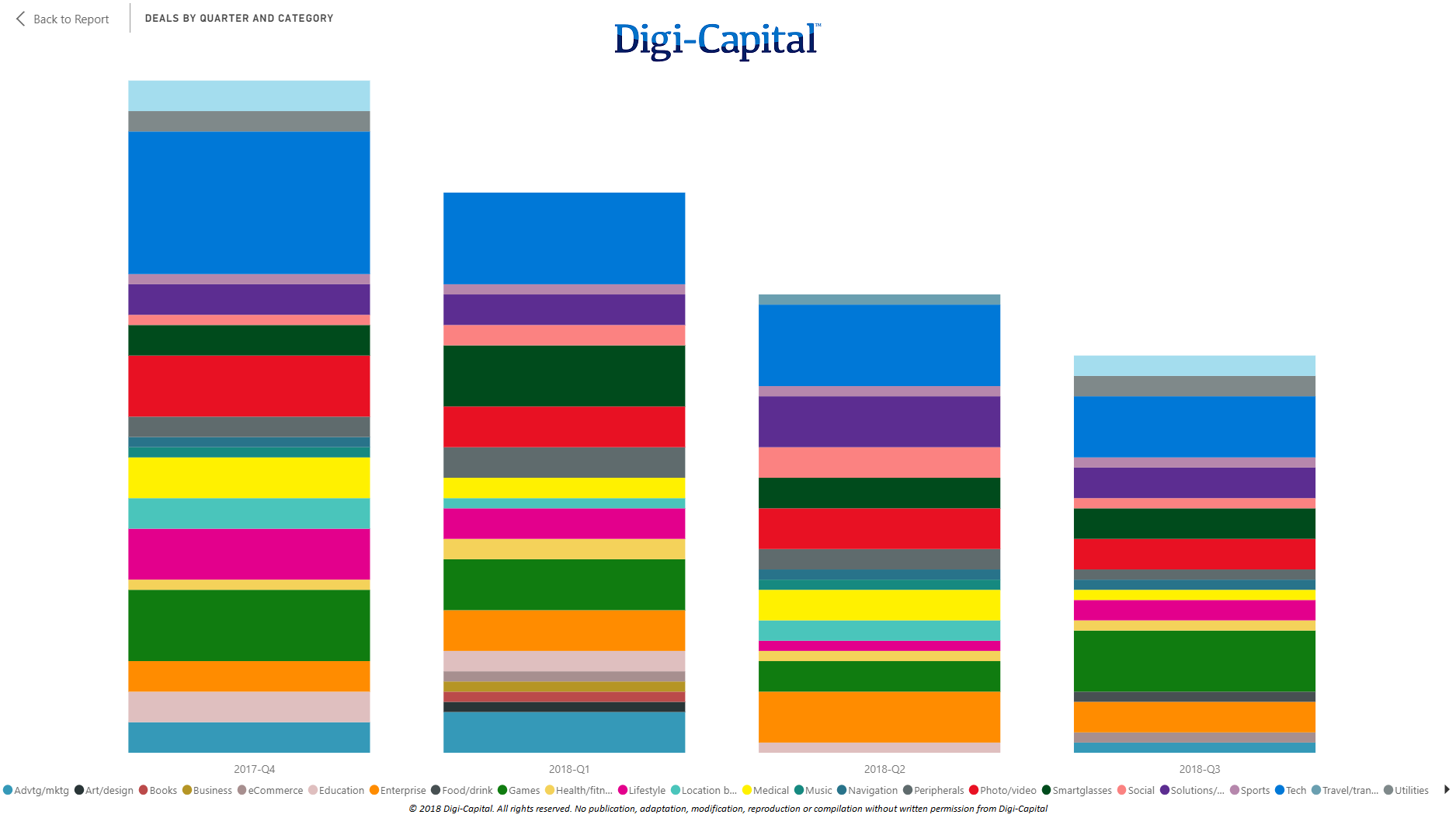
Perhaps the most crucial observation is the declining deal volumes over the last year.

Deal Volume (number of deals by category)
(Source: Digi-Capital AR/VR/XR Analytics Platform)

Deal volume (the number of deals) declined steadily by 10% per quarter over the last 12 months, and was around two-thirds the level in Q3 2018 that it was in Q4 2017. Most of the decline happened in the US and Europe, where VCs increasingly stayed on the sidelines by looking for short-term traction as a sign of long-term growth. (Note: data normalized excluding HTC ViveX accelerator Q4 2017, which skews the data)

Deal Volume (number of deals by stage)
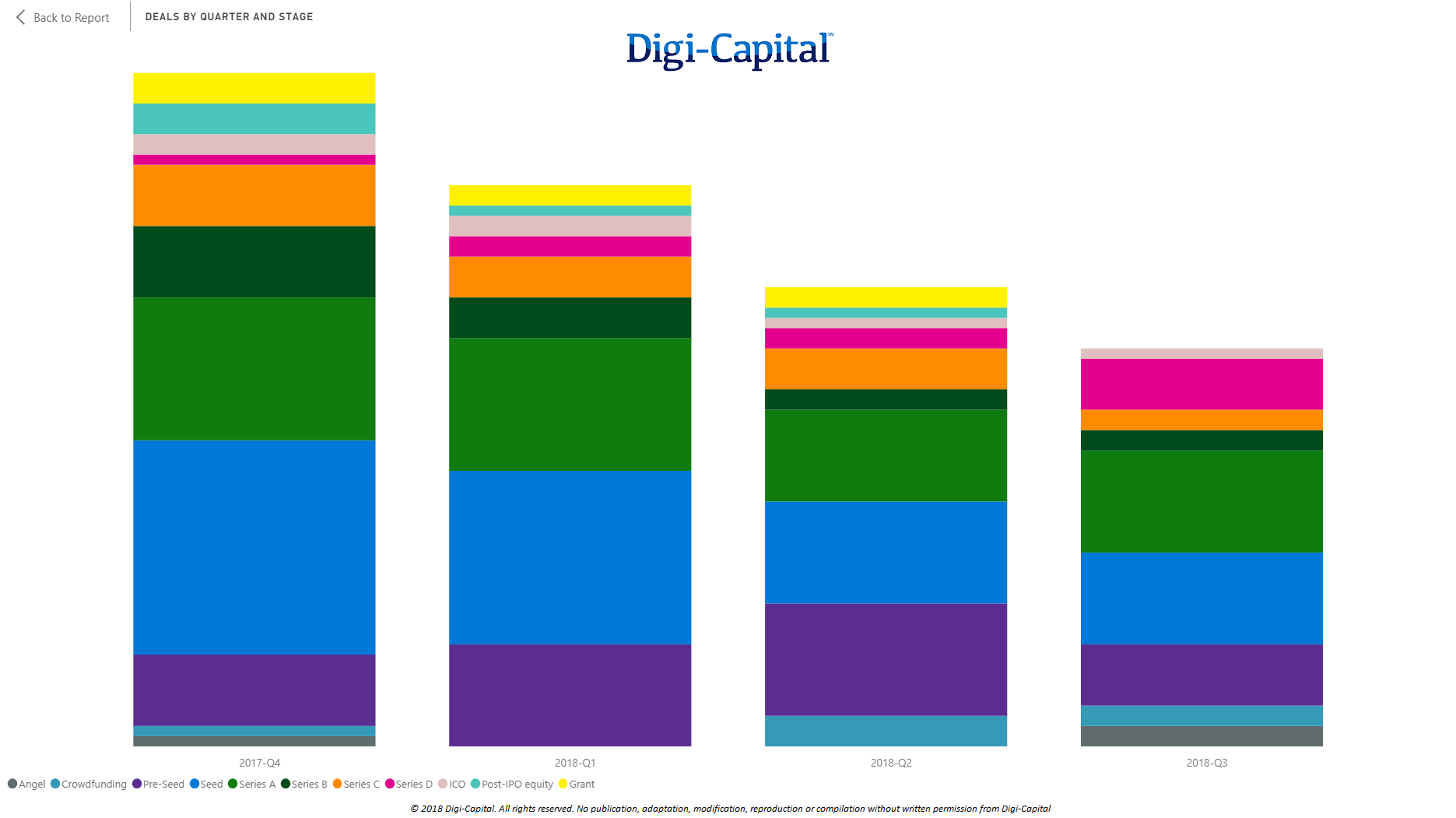
The biggest casualties of this short-termist approach have been early stage startups raising seed (deal volume down by more than half) and some series A (deal volume down by a quarter) rounds. This trend has been strongest in North America and Europe, but even Asia has not been entirely immune from some early stage deal volume decline.

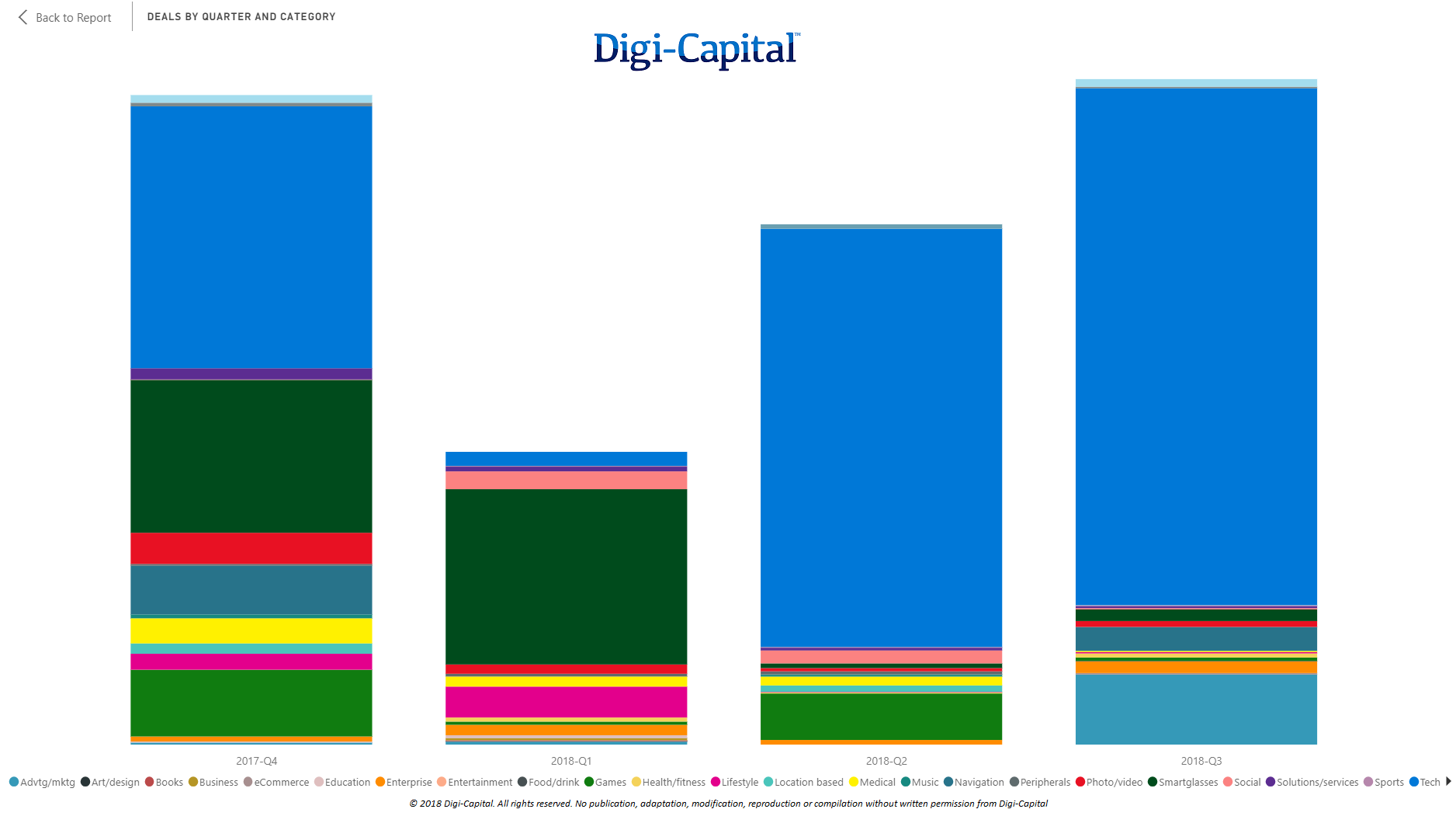
Deal Value (dollars)
(Source: Digi-Capital AR/VR/XR Analytics Platform)

While deal volume is a great indicator of early-stage investment market trends, deal value (dollars invested) gives a clearer picture of where the big money has been going over the last 12 months. (Note: investment means new VC money into startups, not internal corporate investment – which is a cost). Global investment hit its previous quarterly record over $2 billion in Q4 2017, driven by a few very large deals. It then dropped back to around $1 billion in the first quarter of this year. Since then deal value has steadily climbed quarter-on-quarter, to reach a new record high well over $2 billion in Q3 2018.

Over $4 billion of the total $7.2 billion in the last 12 months was invested in computer vision/AR tech, with well over $1 billion going into smartglasses (the bulk of that into Magic Leap) . The next largest sectors were games around $400 million and advertising/marketing at a quarter of a billion dollars. The remaining 22 industry sectors raised in the low hundreds of millions of dollars down to single digit millions in the last 12 months.

A tale of two markets

Deals by Country and Category (dollars)
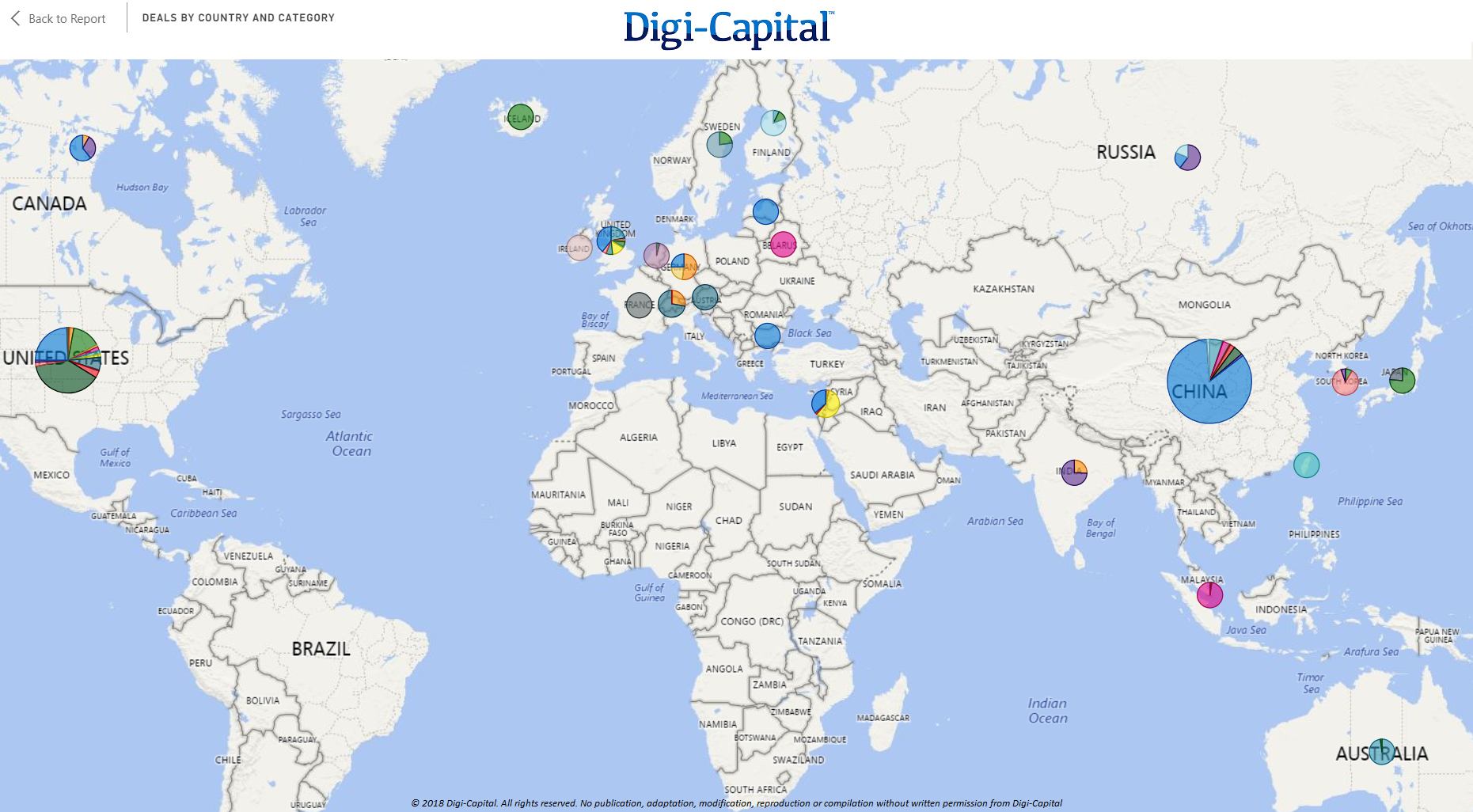
American and Chinese investment had an inverse relationship in the last 12 months. American investors increasingly chose to stay on the sidelines, while Chinese investor confidence grew to back up clear vision with long-term investments. The differences in the data couldn’t be more stark.

North American Deals (dollars)
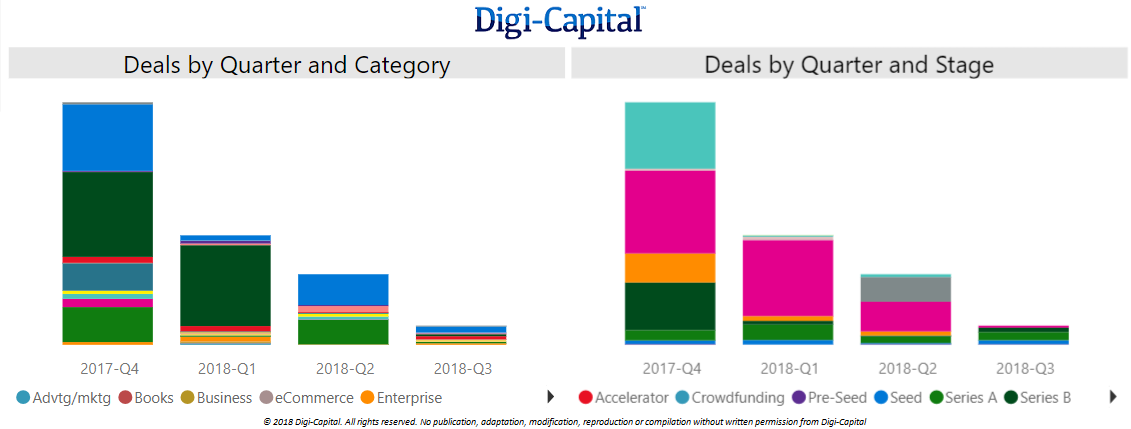
North American investment was almost triple Asian investment in Q4 2017, with a record high of nearly $1.5 billion dollars for the quarter. Despite 2018 being a transitional year for the market (Digi-Capital forecast that market revenue was unlikely to accelerate until 2019), North American quarterly investment fell over 90% to less than $120 million in Q3 2018. American VCs appear to have taken a long-term solution to a short-term problem.

China Deals (dollars)
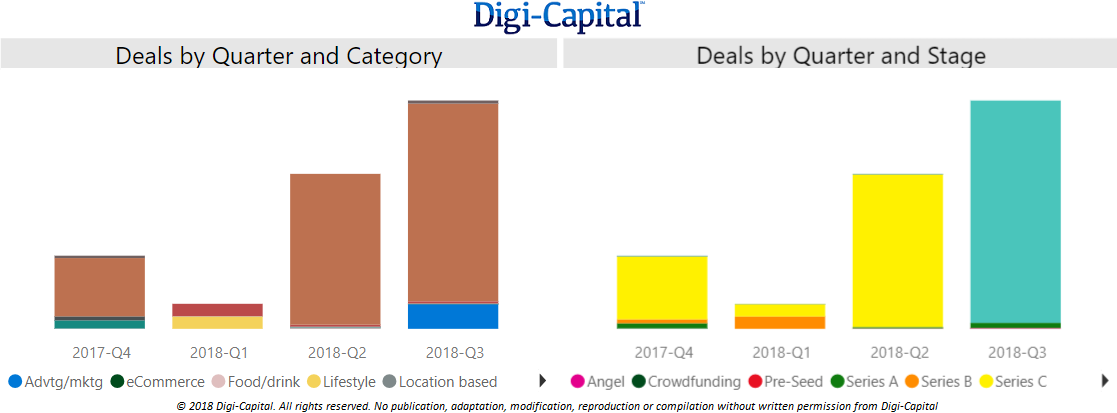
Meanwhile, Chinese VCs have been focused on the long-term potential of the intersection between computer vision and augmented reality, with later-stage Series C and Series D rounds raising hundreds of millions of dollars a time. This trend increased dramatically in the last 12 months, with SenseTime Group raising over $2 billion in multiple rounds and Megvii close behind at over $1 billion (also multiple rounds).

Smaller investments (by Chinese standards) in the hundreds of millions have gone into companies Westerners might not know, including Beijing Moviebook Technology, Kujiale and more. All this saw Chinese quarterly investment grow 3x in the last 12 months. (Note: some recent Western opinions about market investment trends were based on incomplete data)

Where to from here?

With our team’s investment banking background, experience shows that forecasting venture capital investment is a fool’s errand. Yet it is equally foolish to ignore hard data, and ongoing discussions with leading investors along Sand Hill Road and China indicate some trends to watch.

American tech investors might continue to wait for market traction before providing the fuel needed for that traction (even if that seems counterintuitive). While this could pose an existential threat to some early stage startups in North America, it’s also an opportunity for smart money with longer time horizons.

Conversely, Chinese VCs continue to back domestic companies which could dominate the future of computer vision/augmented reality. The next 6 months will determine if this is a long-term trend, but it is the current mental model.

If mobile AR revenue accelerates in 2019 as critical use cases and apps emerge (as in Digi-Capital’s base case), this could become a catalyst for renewed investment by American VCs. The big unknown is whether Apple enters the smartphone tethered smartglasses market in late 2020 (as Digi-Capital has forecast for the last few years). This could be the tipping point for the market as a whole (not just investment). However, Apple timing is hard to predict (because Apple), with any potential launch date known only to Tim Cook and his immediate circle.

Steve Jobs said, “You can’t connect the dots looking forward; you can only connect them looking backwards. So you have to trust that the dots will somehow connect in your future. You have to trust in something – your gut, destiny, life, karma, whatever. This approach has never let me down, and it has made all the difference in my life.”

Chinese investors embraced a Jobsian approach over the last 12 months, with Western VCs increasingly dot-connecting (or not). It will be interesting to see how this plays out for computer vision/AR investment over the next 12 months, so watch this space.


05 Oct 2018

Most iOS devices now run iOS 12 according to Mixpanel’s data

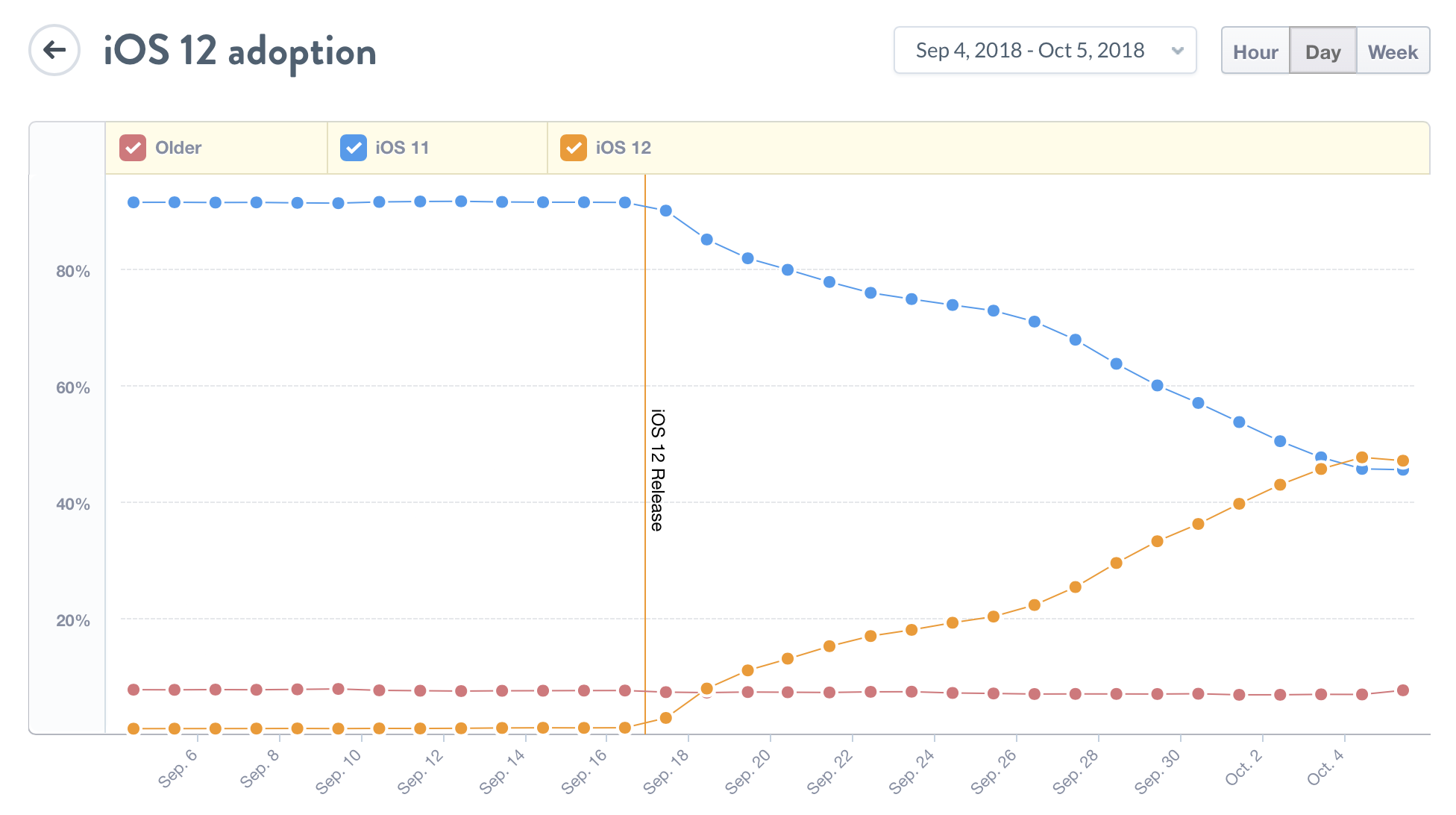
Analytics company Mixpanel is currently tracking the install base of iOS 12. And the latest version of iOS is quite popular as it’s already installed on roughly 47.6 percent of all iOS devices. 45.6 percent of devices still run iOS 11, and 6.9 percent of iOS users run an older version.

Adoption rate is an important metric for app developers. With major iOS releases, Apple also releases new frameworks. But developers still need to support old versions of iOS for a little bit before moving entirely to newer frameworks and drop support for old iOS versions.

But it’s interesting to see that you can already drop support for iOS 10 without losing too many customers. Chances are that users who don’t update their version of iOS don’t really care about having the latest version of your app anyway.

With iOS 11, it took much longer to reach that level. Last year, Apple announced on November 6th that iOS 11 was more popular than iOS 10. Sure, Mixpanel and Apple don’t have the exact same numbers, but you can already see that the trend is different this year.

iOS 12 focuses on performance. Apple has optimized this major release for older devices, such as the iPhone 6. All devices that run iOS 11 can update to iOS 12 as well. Basically, if you want a faster phone, you should update to iOS 12.

This is a bit counterintuitive as previous iOS releases had rendered older devices much slower. But it sounds like iOS users got the message based on the adoption rate.