Year: 2018

04 Oct 2018

Ask not for whom the bell Troncs — it Troncs for Tronc

So long, Tronc. We hardly Tronced you. Why, it seems like only yesterday you Tronced into our world as an utterly insane “Pixels to Pulitzers” marketing video that was somehow too satirical to be satire.

Today, Tronc confirmed rumors that its retrofuturist onomatopoetic name wasn’t long for this world. Soon, the company that owns the Chicago Tribune, Baltimore Sun, Hartford Courant, Orlando Sentinel, The New York Daily News and various others, will revert back to the Tribune Publishing Co.

The news of the DeTroncification was, fittingly, reported by The Chicago Tribune (nee Troncbune).

The company was notably excited to commence the UnTroncing. “We are excited about the company rebranding to Tribune Publishing,” a spokesperson said in a statement. “It’s a nod to our roots, and a reinforcement of the journalistic foundation on which all of our news brands stand.”

For now, it seems, our long national Troncmare is over. So long, and thanks for all the Tronc. 

04 Oct 2018

Instagram prototypes handing your location history to Facebook

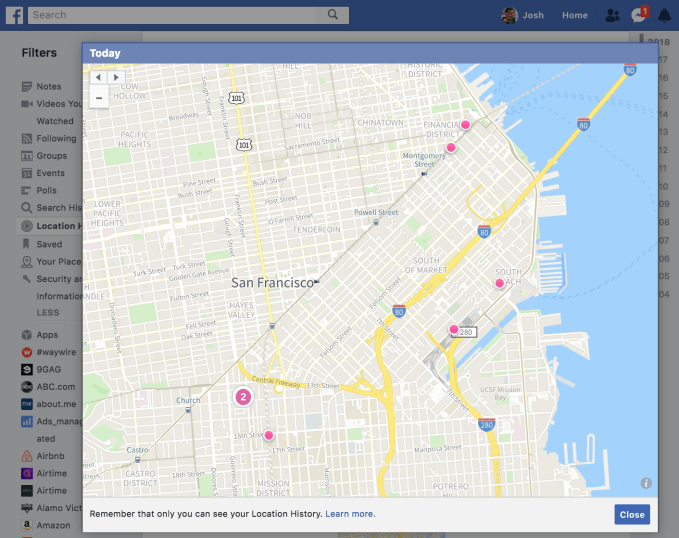
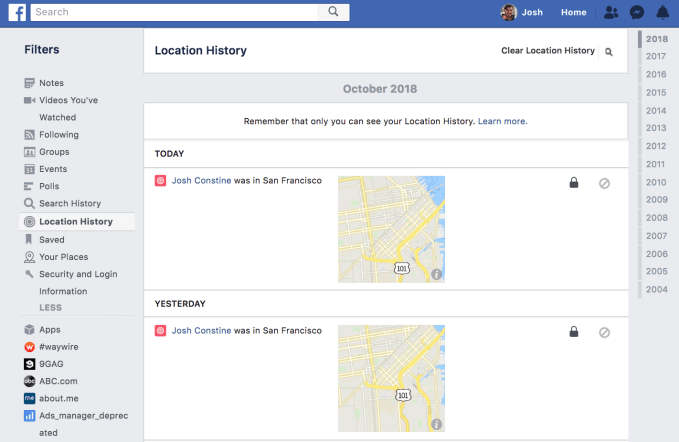
This is sure to exacerbate fears that Facebook will further exploit Instagram now that its founders have resigned. Instagram has been spotted prototyping a new privacy setting that would allow it to share your location history with Facebook. That means your exact GPS coordinates collected by Instagram, even when you’re not using the app, would help Facebook to target you with ads and recommend you relevant content. Worryingly, the Location History sharing setting was defaulted to On in the prototype. The geo-tagged data would appear to users in their Facebook Profile’s Activity Log, which include creepy daily maps of the places you been.

This commingling of data could upset users who want to limit Facebook’s surveillance of their lives. With Facebook installing its former VP of News Feed and close friend of Mark Zuckerberg, Adam Mosseri, as the head of Instagram, some critics have worried that Facebook would attempt to squeeze more value out of Instagram. Tat includes driving referral traffic to the main app via spammy notifications, inserting additional ads, or pulling in more data. Facebook was sued for breaking its promise to European regulators that it would not commingle WhatsApp and Facebook data, leading to an $122 million fine.


A Facebook spokesperson tells TechCrunch that “To confirm, we haven’t introduced updates to our location settings. As you know, we often work on ideas that may evolve over time or ultimately not be tested or released. Instagram does not currently store Location History; we’ll keep people updated with any changes to our location settings in the future.” That effectively confirms Location History sharing is something Instagram has prototyped, and that it’s considering launching but hasn’t yet.

The screenshots come courtesy of mobile researcher and frequent TechCrunch tipster Jane Manchun Wong. Her prior finds like prototypes of Instagram Video Calling and Music Stickers have drawn “no comments” from Instagram but then were officially launched in the following months. That lends credence to the idea that Instagram is serious about Location History.

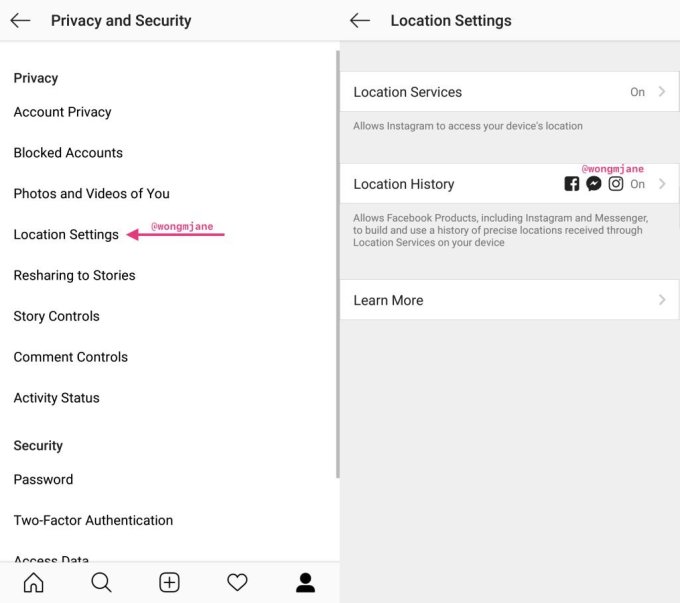
Located in the Privacy and Security settings, the Location History option “Allows Facebook Products, including Instagram and Messenger, to build and use a history of precise locations received through Location Services on your device.”

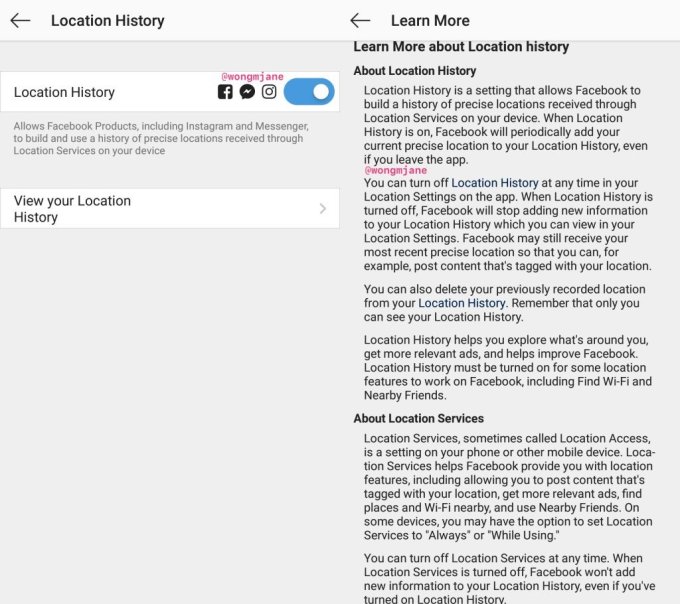
A ‘Learn More’ button provides additional info (emphasis mine):

“Location History is a setting that allows Facebook to build a history of precise locations received through Location Services on your device. When Location History is on, Facebook will periodically add your current precise location to your Location History even if you leave the app. You can turn off Location History at any time in your Location Settings on the app. When Location History is turned off, Facebook will stop adding new information to your Location History which you can view in your Location Settings. Facebook may still receive your most recent precise location so that you can, for example, post content that’s tagged with your location. Location History helps you explore what’s around you, get more relevant ads, and helps improve Facebook. Location History must be turned on for some location feature to work on Facebook, including Find Wi-Fi and Nearby Friends.”

As part of a 2011 settlement with the FTC over privacy violations, Facebook agreed that “Material retroactive changes to the audience that can view the information users have previously shared on Facebook” must now be opt-in. But since Location History is never visible to other users and only deals with data Facebook sees, it’s exempt from that agreement and could be quietly added. Most users might never dig deep enough into their privacy settings to turn the opt-out feature off.

Delivering the exact history of where Instagram users went could assist Facebook with targeting them with local ads across its family of apps. If users are found to visit certain businesses, countries, neighborhoods, or schools, Facebook could use that data to infer which products they might want to buy and promote them. It could even show ads for restaurants or shops close to where users spend their days. Just yesterday, we reported that Facebook was testing a redesign of its Nearby Friends feature that replaces the list view of friends’ locations with a map. Pulling in Location History from Instagram could help keep that map up to date.

Sources tell TechCrunch that Instagram founders Kevin Systrom and Mike Krieger left the company following increasing tensions with Zuckerberg about dwindling autonomy of their app within the Facebook corporation. Systrom apparently clashed with Zuckerberg over how Instagram was supposed to contribute to Facebook success, especially as younger users began abandoning the older social network for the newer visual media app. Facebook is under pressure to keep up revenue growth despite it running out of News Feed ad inventory and users switching to Stories that advertisers are still acclimating to. Facebook is in heated competition with Google for last-mile local advertising and will take any advantage it can get.

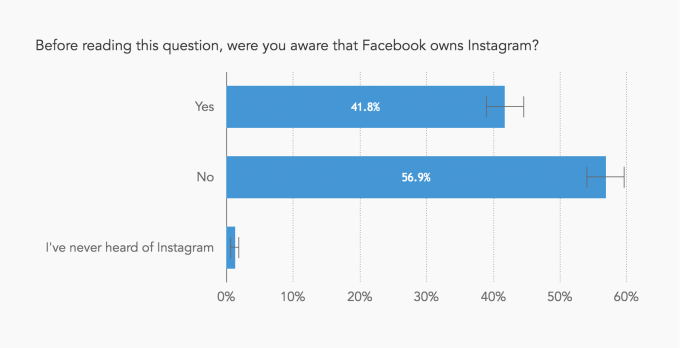
Instagram has served as a life raft for Facebook’s brand this year amidst an onslaught of scandals including fake news, election interference, social media addiction, and most recently, a security breach that gave hackers the access tokens for 50 million users that could have let them take over their accounts. A survey of 1,153 US adults conducted in March 2018 found that 57 percent of them didn’t know Instagram was owned by Facebook. But if Facebook treats Instagram as a source of data and traffic it can strip mine, the negative perceptions associated with the parent could spill over onto the child.

04 Oct 2018

San Francisco wants more data about gig economy workers

Cities all over the world have been hit with the rise of on-demand services like Lyft, Uber, DoorDash, Postmates, Caviar and so many others in recent years. Last year, there were 5.4 million on-demand workers in the country. This year, there are an estimated 6.8 million people working in the on-demand economy, according to now-former Kleiner Perkins Caufield and Byers analyst Mary Meeker’s state of the Internet report.

While San Francisco has found some success managing and regulating ride-hailing services, moped sharing, bike sharing and most recently, scooter sharing, it says it’s missing some critical data around the 1099 workers who deliver food, groceries and other items via tech startups. That’s why the San Francisco Municipal Transportation Agency is looking to better understand the role of these services through a new survey.

A significant concern in the city of San Francisco is traffic caused by all of these services. Earlier this year, San Francisco ranked the fifth in the world for the worst traffic congestion. But the SFMTA says the purpose of its survey is to “understand the challenges couriers experience while performing deliveries” in the city, as well as see what effect these courier networks have on the city’s transportation network. More specifically, it’s looking to answer a few questions, like:

  • How many couriers enter SF on a daily basis?
  • What time of the day do couriers complete most deliveries?
  • Where are the most deliveries made?

The survey asks questions about how far couriers have to travel to the delivery pickup location, how frequently they accept a new delivery, their primary mode of transportation and which service they deliver goods for. Based on one of the survey’s questions, it seems that the city is considering allowing couriers to use loading spaces for pickups and dropoffs.

“By learning about the challenges couriers experience when performing deliveries, the SFMTA will better understand the role on-demand delivery services play in San Francisco and their use of the overall transportation network,” the SFMTA wrote in a blog post. “The insights gained from this survey may also help to inform the city’s future transportation planning decisions.”

04 Oct 2018

Rethink Robotics closes after acquisition plans fall through

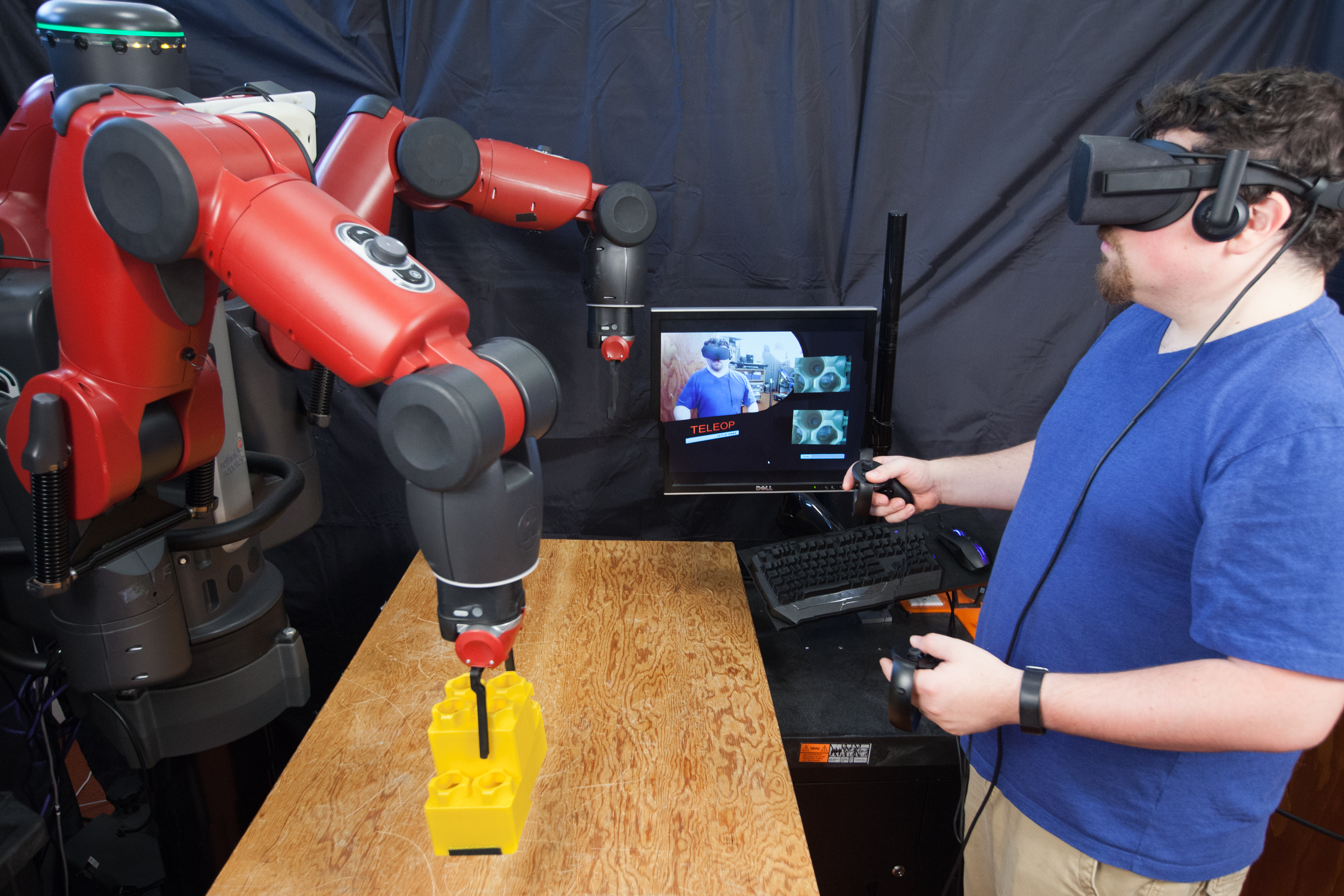
I’ve said it right here on these very pages: If hardware is hard, robotics are next to impossible. That truism is not better exemplified by this week’s closure of Rethink Robotics. A well-respected name in automation, the Boston-based company produced a pair of robotics that have become mainstays in research facilities and warehouse floors alike.

In a statement provided to TechCrunch, Rethink spells out its own demise in straightforward language. “Rethink Robotics closed its doors,” it reads. “We were early to market with a very innovative product that was ahead of its time, and unfortunately, we did not achieve the commercial success we had expected. A planned acquisition of the company fell through at the last moment. All of Rethink Robotics’ employees are being actively recruited for roles in other robotics firms.”

Rumors of the Rodney Brooks-led startup had been floating around the robotics industry for some time now, but that doesn’t make the closure any less impactful. In the company’s decade-long existence, it produced Baxter and Sawyer, two of the most iconic robots in the collaborative category.

“Rodney Brooks and Rethink Robotics are important pioneers in the collaborative robot sector,” Association for Advancing Automation/Robotic Industries Association President Jeff Burnstein said in a statement offered to TechCrunch. “Like start-ups in all sectors, not everything goes smoothly. Sometimes early products aren’t exactly as good as you would like, sometimes new ideas don’t receive immediate market acceptance, and sometimes other market players gain traction sooner. Some or all of these factors may have impacted Rethink.”

Given the difficulty of maintaining in the category, perhaps none of this ought to be a surprise. During its existence the 100-person team raised nearly $150 million by Crunchbase’s count, but that ultimately wasn’t enough for it to continue down its path. If this was 2012, perhaps Amazon might have eyed the company while building its own robotics wing atop Kiva systems.

Two years later, the company might have been a good fit for Andy Rubin’s nascent Google Robotics, which had its eyes firmly set on factory automation. Even now, SoftBank’s deep pockets could have gone a long ways toward keeping it afloat — after all, the financial giant was more than happy to take Boston Dynamics off Google’s hands, adding it to the portfolio that already included Pepper manufacturer, Aldebaran Robotics.

Ultimately, however, it sounds like the company’s demise was a confluence of factors. Certainly there appears to be some parallels that can be drawn to the 2014 closure of Bay Area-based Willow Garage, whose PR2 was previously a familiar sight in university robotics labs all over the world.

Certainly there’s hope to be found in Willow Garage’s legacy, from spin-offs like Redwood Robotics to employee led companies like Fetch, to the continued existence of the ROS, the Robot Operating System.

04 Oct 2018

VP Pence calls on Google to end work on a search engine for China

On Thursday, Vice President Mike Pence called for Google to end its development of a search engine custom built to accommodate China’s disposition for censorship.

Pence gave the speech at a conservative think tank in D.C., dipping into a range of anti-Beijing sentiments, from intellectual property concerns to tariffs and the trade war. Pence didn’t mince words, calling on Google to abandon its plans for a China-friendly mobile version of its otherwise ubiquitous search engine.

Pence accused any company with plans to work around Chinese internet restrictions of “abetting Beijing’s oppression” and didn’t hesitate to call the search giant out by name:

More business leaders are thinking beyond the next quarter, and thinking twice before diving into the Chinese market if it means turning over their intellectual property or abetting Beijing’s oppression. But more must follow suit. For example, Google should immediately end development of the “Dragonfly” app that will strengthen Communist Party censorship and compromise the privacy of Chinese customers…

More journalists are reporting the truth without fear or favor, and digging deep to find where China is interfering in our society, and why – and we hope that more American, and global, news organizations will join in this effort.

More scholars are speaking out forcefully and defending academic freedom, and more universities and think tanks are mustering the courage to turn away Beijing’s easy money, recognizing that every dollar comes with a corresponding demand. We’re confident that more will join their ranks.

And across the nation, the American people are growing in vigilance, with a newfound appreciation for our administration’s actions to re-set America’s economic and strategic relationship with China, to finally put America First.

Pence’s full remarks are available on the Hudson Institute’s website.

Google’s covert project, known as Dragonfly, is reportedly a version of the search engine that blocks forbidden sites like Facebook and Twitter, censors search terms like the Tiananmen Square massacre and cuts out prominent Western news sources like the BBC and The New York Times. The project, first reported by the Intercept, sparked internal turmoil at the company and a letter of protest from employees who felt too in the dark to make “ethically-informed decisions about our work, our projects, and our employment.”

Google drama aside, Pence’s tough talk on China might be politically expedient bluster, but it’s not without irony: The Trump administration has repeatedly expressed its outright contempt for a free press, a hallmark of an aggressively restrictive government like China. Pence’s derision of China’s “unparalleled surveillance state” is also fairly rich, given domestic policy on warrantless surveillance.

The vice president also took the opportunity to refresh controversial claims that China is “meddling” in the U.S. midterm elections, echoing language often used to describe Russia’s substantiated election interference efforts. President Trump suggested as much last week, claiming that China “has been attempting to interfere in our upcoming 2018 election, coming up in November, against my administration.” Yesterday, Department of Homeland Security Kirstjen Nielsen declined to endorse the president’s unsubstantiated claims, noting that China pursues a “holistic approach” to cultivating a positive image in the U.S.

04 Oct 2018

Bloomberg’s spy chip story reveals the murky world of national security reporting

Today’s bombshell Bloomberg story has the internet split: either the story is right, and reporters have uncovered one of the largest and jarring breaches of the U.S. tech industry by a foreign adversary… or it’s not, and a lot of people screwed up.

To recap, Chinese spies reportedly infiltrated the supply chain and installed tiny chips the size of a pencil tip on the motherboards built by Supermicro, which are used in data center servers across the U.S. tech industry — from Apple to Amazon. That chip can compromise data on the server, allowing China to spy on some of the world’s most wealthy and powerful countries.

Apple, Amazon and Supermicro — and the Chinese government — strenuously denied the allegations. Apple also released its own standalone statement later in the day, as did Supermicro. You don’t see that very often unless they think they have nothing to hide. You can — and should — read the statements for yourself.

Welcome to the murky world of national security reporting.

I’ve covered cybersecurity and national security for about five years, most recently at CBS, where I reported exclusively on several stories — including the U.S. government’s covert efforts to force tech companies to hand over their source code in an effort to find vulnerabilities and conduct surveillance. And last year I revealed that the National Security Agency had its fifth data breach in as many years, and classified documents showed that a government data collection program was far wider than first thought and was collecting data on U.S. citizens.

Even with this story, my gut is mixed.

Where reporters across any topic and beat try to seek the truth, tapping information from the intelligence community is near impossible. For spies and diplomats, it’s illegal to share classified information with anyone and can be — and is — punishable by time in prison.

As a security reporter, you’re either incredibly well sourced or downright lucky. More often than not it’s the latter.

Naturally, people are skeptical of this “spy chip” story. On one side you have Bloomberg’s decades-long stellar reputation and reporting acumen, a thoroughly researched story citing more than a dozen sources — some inside the government and out — and presenting enough evidence to present a convincing case.

On the other, the sources are anonymous — likely because the information they shared wasn’t theirs to share or it was classified, putting sources in risk of legal jeopardy. But that makes accountability difficult. No reporter wants to say “a source familiar with the matter” because it weakens the story. It’s the reason reporters will tag names to spokespeople or officials so that it holds the powers accountable for their words. And, the denials from the companies themselves — though transparently published in full by Bloomberg — are not bulletproof in outright rejection of the story’s claims. These statements go through legal counsel and are subject to government regulation. These statements become a counterbalance — turning the story from an evidence-based report into a “he said, she said” situation.

That puts the onus on the reader to judge Bloomberg’s reporting. Reporters can publish the truth all they want, but ultimately it’s down to the reader to believe it or not.

In fairness to Bloomberg, chief among Apple’s complaints is a claim that Bloomberg’s reporters were vague in their questioning. Given the magnitude of the story, you don’t want to reveal all of your cards — but still want to seek answers and clarifications without having the subject tip off another news agency — a trick sometimes employed by the government in the hope of lighter coverage.

Yet, to Apple — and Amazon and other companies implicated by the report — they too might also be in the dark. Assuming there was an active espionage investigation into the alleged actions of a foreign government, you can bet that only a handful of people at these companies will be even cursorily aware of the situation. U.S. surveillance and counter-espionage laws restrict who can be told about classified information or investigations. Only those who need to be in the know are kept in a very tight loop — typically a company’s chief counsel. Often their bosses, the chief executive or president, are not told to avoid making false or misleading statements to shareholders.

It’s worth casting your mind back to 2013, days after the first Edward Snowden documents were published.

In the aftermath of the disclosure of PRISM, the NSA’s data pulling program that implicated several tech companies — including Apple, but not Amazon — the companies came out fighting, vehemently denying any involvement or connection. Was it a failure of reporting? Partially, yes. But the companies also had plausible deniability by cherry picking what they rebuffed. Despite a claim by the government that PRISM had “direct access” to tech companies’ servers, the companies responded that this wasn’t true. They didn’t, however, refute indirect access — which the companies wouldn’t be allowed to say in any case.

Critics of Bloomberg’s story have rightfully argued for more information — such as more technical data on the chip, its design and its functionality. Rightfully so — it’s entirely reasonable to want to know more. Jake Williams, a former NSA hacker turned founder of Rendition Infosec, told me that the story is “credible,” but “even if it turns out to be untrue, the capability exists and you need to architect your networks to detect this.”

I was hesitant to cover this at first given the complexity of the allegations and how explosive the claims are without also seeking confirmation. That’s not easy to do in an hour when Bloomberg’s reporters have been working for the best part of a year. Assuming Bloomberg did everything right — a cover story on its magazine, no less, which would have gone through endless editing and fact-checking before going to print — the reporters likely hit a wall and had nothing more to report, and went to print.

But Bloomberg’s delivery could have been better. Just as The New York Times does — even as recently as its coverage of President Trump’s tax affairs, Bloomberg missed an opportunity to be more open and transparent in how it came to the conclusions that it did. Journalism isn’t proprietary. It should be open to as many people as possible. If you’re not transparent in how you report things, you lose readers’ trust.

That’s where the story rests on shaky ground. Admittedly, as detailed and as well-sourced as the story is, you — and I — have to put a lot of trust and faith in Bloomberg and its reporters.

And in this day and age where “fake news” is splashed around wrongly and unfairly, for the sake of journalism, my only hope is they’re not wrong.

04 Oct 2018

Elon Musk is trolling the SEC on Twitter

Tesla CEO Elon Musk trolled the U.S. Securities and Exchange Commission in a tweet Thursday afternoon, poking the bear that just days before had agreed to settle securities fraud charges against the billionaire entrepreneur.

The tweet, sent out at 1:16 pm PT Thursday, says:

“Just want to that the Shortseller Enrichment Commission is doing incredible work. And the name change is so on point!”

elon musk trolls sec twitter

The SEC declined to comment. Tesla has not yet responded to a request for comment.

Tesla shares, which closed down 4%, fell another 2.5% in after-hours trading.

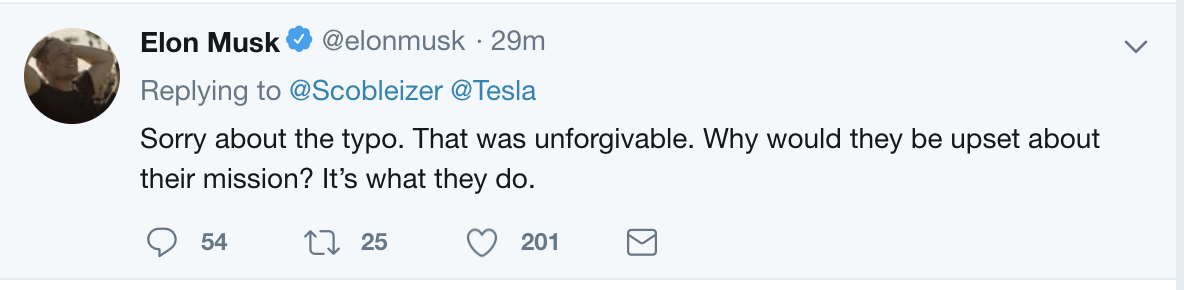
Musk later apologized. But not for the mocking tweet. Instead he doubled down on this trollery and apologized for the typo.

elon musk twitter sec typo tweet

Not all of his supporters appreciated the tweets, calling the CEO out for hurting the stock. Musk’s advice: “Hang in there. If you are truly long-term, it will be fine.”

Just days before, Musk settled a securities fraud complaint filed by the SEC that could have been disastrous for Tesla and its shareholders. Musk agreed, in a settlement reached on September 29, to step down as chairman of Tesla and pay a $20 million fine.

Despite the penalties, it has been largely viewed as a sweet deal that allowed Musk to keep his CEO position as well as a seat on the board. Musk didn’t have to admit or deny the SEC’s allegations either.

Musk is supposed to resign from his role as chairman of the Tesla board within 45 days of the agreement. He cannot seek reelection or accept an appointment as chairman for three years. An independent chairman will be appointed, under the settlement agreement.

Tesla agreed to pay a separate $20 million penalty, according to the SEC. The SEC said the charge and fine against Tesla is for failing to require disclosure controls and procedures relating to Musk’s tweets.

The SEC alleged in its complaint that Musk lied when he tweeted on August 7 that he had “funding secured” for a private takeover of the company at $420 per share. Federal securities regulators reportedly served Tesla with a subpoena just a week after the tweet. Charges were filed just six weeks later.

The charges were filed after Musk and Tesla’s board abruptly walked away from an agreement with the SEC. The board not only pulled out of the agreement, it issued a bold statement of support for Musk after the charges were filed. The NYT reported that Musk had given an ultimatum to the board and threatened to resign if the board pushed him to settle.

A settlement was eventually reached anyway, albeit with stiffer penalties than the original agreement.

Still, the agreement was treated as good news by Wall Street, which sent Tesla shares higher and erased previous losses caused by the SEC complaint.


04 Oct 2018

Mars Rover Curiosity is switching brains so it can fix itself

When you send something to space, it’s good to have redundancy. Sometimes you want to send two whole duplicate spacecraft just in case — as was the case with Voyager — but sometimes it’s good enough to have two of critical components. Mars Rover Curiosity is no exception, and it is now in the process of switching from one main “brain” to the other so it can do digital surgery on the first.

Curiosity landed on Mars with two central computing systems, Side-A and Side-B (not left brain and right brain — that would invite too much silliness). They’re perfect duplicates of each other, or were — it was something of a bumpy ride, after all, and cosmic radiation may flip a bit here and there.

The team was thankful to have made these preparations when, on sol 200 in February of 2013 (we’re almost to sol 2,200 now), the Side-A computer experienced a glitch that ended up taking the whole rover offline. The solution was to swap over to Side-B, which was up and running shortly afterwards and sending diagnostic data for its twin.

Having run for several years with no issues, Side-B is now, however, having its own problems. Since September 15 it has been unable to record mission data, and it doesn’t appear to be a problem that the computer can solve itself. Fortunately, in the intervening period, Side-A has been fixed up to working condition — though it has a bit less memory than it used to, since some corrupted sectors had to be quarantined.

“We spent the last week checking out Side A and preparing it for the swap,” said Steven Lee, deputy project manager of the Curiosity program at JPL, in a mission status report. “We are operating on Side A starting today, but it could take us time to fully understand the root cause of the issue and devise workarounds for the memory on Side B. It’s certainly possible to run the mission on the Side-A computer if we really need to. But our plan is to switch back to Side B as soon as we can fix the problem to utilize its larger memory size.”

No timeline just yet for how that will happen, but the team is confident that they’ll have things back on track soon. The mission isn’t in jeopardy — but this is a good example of how a good system of redundancies can add years to the life of space hardware.

04 Oct 2018

Startup accelerators helped spark Latin America’s tech boom

Five years ago, no startups from Latin America were participating in prestigious U.S. accelerators like 500 Startups or Y Combinator. In fact, no Latin American startup reached the renowned Silicon Valley accelerator, Y Combinator, until 2015, when Colombia’s Platzi was invited to join.

It seemed that Latin America was not yet on anyone’s radar at the big global accelerators. At the time, 500 Startups in Silicon Valley was one of the only global accelerators that was paying attention to Latin America. 500 Startups’ first Latin American startup investment was Chile’s Welcu in Batch 2 (2011), followed by Brazil’s ContaAzul in Batch 3 (2012) and Mexico’s Yogome and Brazil’s Ingresse in Batch 4 (2012). Alongside fashion platform Femeninas, we were one of the first startups based in Argentina to be accepted into the program in 2012.

500 Startups has since focused on forging partnerships and investing in startups in Brazil, Mexico, Argentina, Colombia, Chile and Peru.

Nowadays, dozens of Latin American startups, principally from Colombia, are joining U.S. accelerators. Since 2016, Rappi, UBits, Ropeo, Hogaru and Tributi have entered Y Combinator from Colombia, while RunaHR, Grin, BrainHi and Fintual have brought Mexico, Puerto Rico and Chile into the YC network, as well. Over the past five years, global and local accelerator programs have taken hold across Latin America. What’s more, we’re starting to see many specialized programs emerge and focus on accelerating companies in specific sectors, such as agtech, fintech and social impact. Here’s how the role of the accelerator is evolving in Latin America.

The inflection point: Start-Up Chile and NXTP Labs

When Start-Up Chile launched in 2010, it became the darling of the Latin American tech ecosystem. In dozens of articles, Start-Up Chile is known as the “spark that ignited Latin America’s startup ecosystem,” and is often identified as the inspiration for government acceleration programs worldwide. Among programs in Latin America that arose from the Start-Up Chile “spark” are Startup Peru, Parallel 18, IncuBAte, Startup Mexico, Ruta N and 21212.

However, there are two other local accelerator programs that arose around the same period, without as much global publicity as Start-Up Chile. 500 Startups Mexico City and NXTP Labs launched their local acceleration programs in 2010 and 2011, respectively, focusing on Spanish-speaking Latin American startups at a time when Start-Up Chile was still only focused on accelerating foreign enterprises. Of the 16 startups that graduated from NXTP Labs’ second group, 13 were from Latin America, 10 of which were specifically founded in Argentina.

Accelerators are now one of the top ways for Latin American startups to secure funding and reach international markets.

We went through NXTP Labs’ accelerator program in 2014, after they had successfully graduated dozens of local companies. But even before they became one of the region’s top private accelerators, NXTP Labs was one of the most active early-stage investors in Latin America. To date, there are still very few fully private venture capital funds in Latin America, including NXTP Labs, Magma Partners and Kaszek Ventures.

Since they began, Start-Up Chile, NXTP Labs and 500 Startups Latam have accelerated more than 2,000 startups in total, generating millions of dollars in revenue and investment, and creating hundreds of jobs across Latin America and beyond.

More importantly, they created the impetus for a steady wave of startup accelerators to enter the Latin American ecosystem.

The newcomers: industry-specific accelerators

In the past few years, accelerators of all kinds have cropped up in Latin America to provide mentorship, support and investment for startups as they grow. However, the regional trend has been to shift away from general support (i.e. the Start-Up Chile model) toward more specialized, industry-specific acceleration. Even NXTP Labs has pivoted its accelerator programs, focusing almost exclusively on fintech and agtech startups in Latin America, as they believe these two fields provide a competitive advantage in the local markets.

The new tendency toward specialization has led to the rise of programs such as The Yield Lab, an Argentine agtech accelerator, Chilean Bci Labs, focused on fintech, and Startupbootcamp’s new fintech program in Mexico City.

According to Gust’s Latin American accelerator report, more than half (58 percent) of startup accelerators in the region are focused on a specific vertical rather than trying to be a jack-of-all-trades.

Most of the government-funded accelerators, such as Startup Mexico, Parallel 18, Ruta N and Startup Peru, still support startups from every sector. MassChallenge Mexico also allows startups from any industry to apply for acceleration.

What’s next: bringing women into entrepreneurship

While fintech, agtech, blockchain and other hot industries have gotten their share of the limelight, there is still a massive elephant in the room (or the co-working space) in Latin America: the lack of women. A random sampling of 50 startups selected for accelerator programs this year in Latin America revealed just 28 percent had female founders.

A recent blog found just four incubator and accelerator programs that are specifically targeted toward enabling female founders in Latin America: Empoderando Mujeres in Mexico, Capital Abeja and The S Factory in Chile, and WIN Lab, which is actually based in Miami.

This vertical is one that is missing from the conversation in Latin America, and the world. Women make up just 17 percent of startup founders and receive only 2 percent of VC dollars, but it is estimated that fully incorporating women into entrepreneurship could boost the global GDP by US$12 trillion.

A lot has changed in Latin America since we launched our company and entered our first accelerator in 2012. Dozens of global accelerators and companies looking to support and invest in Latin American companies are joining the local accelerators that paved the way, such as Start-Up Chile and NXTP Labs.

More than ever before, the prestigious accelerator programs, such as Y Combinator in Silicon Valley and other programs across Europe and the U.S., are accepting startups from Latin America. Local accelerators are refining their strategies and focusing primarily on niche industries, such as agtech and fintech, to tap into Latin America’s competitive advantages. Accelerators are now one of the top ways for Latin American startups to secure funding and reach international markets. While there are still gaps to fill, it’s been rewarding to watch these programs develop and succeed in the region.


04 Oct 2018

Backstage Capital to launch accelerator in Detroit

On the heels of Backstage Capital’s announcement to launch an accelerator for startups led by underrepresented founders, the venture capital firm has selected its fourth location. Backstage Capital decided on three of the cities ahead of time and held a public vote to determine the fourth. Well, the results are in and Backstage Capital has landed on Detroit, Mich. for the accelerator’s fourth location.

“It’s a rising standout for entrepreneurs in the Midwest,” the firm writes on its site. “Innovation and technology in the city are booming, and Detroit startups are attracting capital from Silicon Valley as well as local investors and government.”

Backstage Capital is also going to run accelerators in Los Angeles, Philadelphia and London. Through Backstage Capital’s accelerator, the firm will invest $100,000 in each company in exchange for five percent equity. Unlike other Silicon Valley accelerators, there won’t be a demo day because it “seems a little like standardized testing,” Backstage Capital Founder and Managing Partner Arlan Hamilton said at TechCrunch Disrupt San Francisco last month. The deadline to apply is October 15.

Backstage Capital’s mission is to provide early seed funding to founders who are women, people of color, and/or LGBTQ — groups that are vastly underrepresented in Silicon Valley. A few months ago, Backstage Capital launched a $36 million fund. Since receiving its first check from a limited partner in 2015, Backstage Capital has invested in 100 companies — writing checks anywhere between $25,000 and $100,000. You can read more about the accelerator below.