Year: 2018

04 Oct 2018

Someone recreated Apple’s new campus with 85,000 LEGO bricks and it’s excellent

2018 has been a good year for ridiculous, gargantuan LEGO builds. Just weeks ago, there was that life size, driveable LEGO Bugatti.

Now someone has gone and built a mega-sized recreation of Apple’s new Cupertino “spaceship” campus – otherwise known as Apple Park.

Coming in at roughly 85,000 pieces, the build took designer Spencer_R a little over two years to complete, with many of those hours spent poring over drone footage of the campus’ construction. At 6.8×4.5 ft, it’s bigger than most kitchen tables. Spencer says it weighs around 78 pounds.

Beyond the massive circular building that serves as the build’s primary feature, tons and tons of tiny details accent the brick canvas: its got the glass-walled Steve Jobs Theater, the hundred-year old Glendenning Barn that was disassembled and rebuilt on the property, the employee parking garages, the visitor center, and even some tiny employee basketball/tennis courts for good measure.

Oh, and trees. Lots, and lots, and lots of trees. 1,646 trees in all, by Spencer’s count.

This is hardly Spencer’s first time recreating a mega building — he’s done custom creations of everything from the Eiffel Tower to the Rockefeller Center. With that said, he notes that Apple Park is “nearly as large as all of [his] other LEGO skyscraper builds combined”

[gallery ids="1726783,1726757,1726762,1726766,1726763,1726760"]

For more build details, you can tap through Spencer_R’s gallery/build notes here. Thank you to Fabrizio Costantini for letting us use these photos.

04 Oct 2018

Someone recreated Apple’s new campus with 85,000 LEGO bricks and it’s excellent

2018 has been a good year for ridiculous, gargantuan LEGO builds. Just weeks ago, there was that life size, driveable LEGO Bugatti.

Now someone has gone and built a mega-sized recreation of Apple’s new Cupertino “spaceship” campus – otherwise known as Apple Park.

Coming in at roughly 85,000 pieces, the build took designer Spencer_R a little over two years to complete, with many of those hours spent poring over drone footage of the campus’ construction. At 6.8×4.5 ft, it’s bigger than most kitchen tables. Spencer says it weighs around 78 pounds.

Beyond the massive circular building that serves as the build’s primary feature, tons and tons of tiny details accent the brick canvas: its got the glass-walled Steve Jobs Theater, the hundred-year old Glendenning Barn that was disassembled and rebuilt on the property, the employee parking garages, the visitor center, and even some tiny employee basketball/tennis courts for good measure.

Oh, and trees. Lots, and lots, and lots of trees. 1,646 trees in all, by Spencer’s count.

This is hardly Spencer’s first time recreating a mega building — he’s done custom creations of everything from the Eiffel Tower to the Rockefeller Center. With that said, he notes that Apple Park is “nearly as large as all of [his] other LEGO skyscraper builds combined”

[gallery ids="1726783,1726757,1726762,1726766,1726763,1726760"]

For more build details, you can tap through Spencer_R’s gallery/build notes here. Thank you to Fabrizio Costantini for letting us use these photos.

04 Oct 2018

GM’s Super Cruise just beat out Tesla’s Autopilot in Consumer Reports ranking

Tesla’s Autopilot is often touted as the most capable and advanced driver assistance system available on the market today. But in Consumer Reports’ view that honor actually goes to Cadillac’s Super Cruise.

The consumer organization gave Super Cruise the top spot in its first-ever ranking of partially automated driving systems because it is the best striking a balance between technical capabilities and ensuring drivers are paying attention and operating the vehicle safely.

That’s an important distinction that means CR is considering a lot more than simply the technical capabilities of any one system.

CR evaluated four systems: Super Cruise on the Cadillac CT6, Autopilot on Tesla Model S, X and 3 models, ProPilot Assist on Infiniti QX50 and Nissan Leaf, and Pilot Assist on Volvo XC40 and XC60 vehicles. The organization said it picked these systems because they’re considered the most capable and well known in the industry.

Testers looked at the capability and performance of the tech, how easy the system is to use, and how well it monitored and kept the driver engaged. Testers also looked at how the system responded if the driver ignored warnings.

Tesla Autopilot scored higher than any other system for capability and ease of use. But Cadillac did a better job of making it clear when it’s safe to use, keeping drivers engaged and reacting when someone is unresponsive to the warnings.

A partially automated driving system — some use the term semi-autonomous — typically uses sensors such as cameras and radar as well as mapping data combined with software to assist with some driving tasks in certain conditions and wi . For instance, these systems might provide lane keeping and adaptive cruise control on highways.

The ProPilot Assist system used by Nissan and Infiniti fell to third place and Volvo’s system brought up the rear with poor marks (compared to its competitors) in nearly every category.

The consumer organization is particularly wary of how these systems are marketed and believe that automakers can send “mixed messages” that suggest these systems have autonomous or self-driving capabilities.

CR’s tests appear to have already had an affect, in at least how these systems are marketed. CR said that Volvo changed the language used to describe Pilot Assist, which was listed on its website under autonomous driving. Volvo no longer connects Pilot Assist to autonomous driving.

04 Oct 2018

GM’s Super Cruise just beat out Tesla’s Autopilot in Consumer Reports ranking

Tesla’s Autopilot is often touted as the most capable and advanced driver assistance system available on the market today. But in Consumer Reports’ view that honor actually goes to Cadillac’s Super Cruise.

The consumer organization gave Super Cruise the top spot in its first-ever ranking of partially automated driving systems because it is the best striking a balance between technical capabilities and ensuring drivers are paying attention and operating the vehicle safely.

That’s an important distinction that means CR is considering a lot more than simply the technical capabilities of any one system.

CR evaluated four systems: Super Cruise on the Cadillac CT6, Autopilot on Tesla Model S, X and 3 models, ProPilot Assist on Infiniti QX50 and Nissan Leaf, and Pilot Assist on Volvo XC40 and XC60 vehicles. The organization said it picked these systems because they’re considered the most capable and well known in the industry.

Testers looked at the capability and performance of the tech, how easy the system is to use, and how well it monitored and kept the driver engaged. Testers also looked at how the system responded if the driver ignored warnings.

Tesla Autopilot scored higher than any other system for capability and ease of use. But Cadillac did a better job of making it clear when it’s safe to use, keeping drivers engaged and reacting when someone is unresponsive to the warnings.

A partially automated driving system — some use the term semi-autonomous — typically uses sensors such as cameras and radar as well as mapping data combined with software to assist with some driving tasks in certain conditions and wi . For instance, these systems might provide lane keeping and adaptive cruise control on highways.

The ProPilot Assist system used by Nissan and Infiniti fell to third place and Volvo’s system brought up the rear with poor marks (compared to its competitors) in nearly every category.

The consumer organization is particularly wary of how these systems are marketed and believe that automakers can send “mixed messages” that suggest these systems have autonomous or self-driving capabilities.

CR’s tests appear to have already had an affect, in at least how these systems are marketed. CR said that Volvo changed the language used to describe Pilot Assist, which was listed on its website under autonomous driving. Volvo no longer connects Pilot Assist to autonomous driving.

04 Oct 2018

As some pricey coding camps fade away, Codecademy barrels ahead with affordable paid offerings and a new mobile app

Between 2013 and last year, the number of boot camp schools tripled to more than 90 in the U.S. alone, according to Course Report, an outfit that tracks the industry. Some — including The Iron Yard and Dev Bootcamp — have since folded, unable to find enough eager recruits willing to pay top dollar to learn coding skills. (The average cost of a 14-week program last year was $11,400.)

At the same time, it has become apparent that when it comes to massive open online courses, a very high percentage of students don’t stay the course.

New York-based Codecademy, which began offering free coding courses at its outset, has managed to keep plugging away — and grow — despite these headwinds. In fact, the company today employs 85 people, up from 45 when we last sat down with cofounder and CEO Zach Sims in 2016. Its revenue is also up 65 percent year over year.

None of it has been a walk in the park, admits Sims, who dropped out of Columbia University in 2011 to start the company. “There’s been a ton of ups and downs,” he says, explaining that the company struggled for years with how to produce meaningful revenue before introducing two premium products in the last couple of years, both of which are affordable by design.

One of these is Codecademy Pro, meant to help users learn the fundamentals of coding, as well as develop a deeper knowledge (and receive certification from Codecademy) in up to 10 areas, including machine learning and data analysis. The cost is $20 per month, money that Pro users often see back in the form of a a $5,000 to $10,000 raise from their employer, insists Sims. He says the course “isn’t so much for those who are transition to full-time jobs but people who are learning skills to level up in their existing career.”

A second offering is Codecademy Pro Intensive, which is designed to immerse learners from six to 10 weeks (depending on the coursework), in either website development, programming, or data science. Students follow a structured, detailed syllabus that’s broken into focused units to organize the learning experience, which is synchronous but collaborative. To wit, users are placed in a moderated Slack group and can chat with people who are learning the same materials at the same time. They also receive unlimited access to a pool of 200 mentors who work with Codecademy, some of them “graduates” of Codecademy themselves.

Sims declines to talk about what percentage of the 45 million people who’ve taken a Codecademy course has paid the company, but he notes that the “macro trends in the market are going our way. People still need to find jobs, and tech is still an important skill to get them there.” Indeed, according to Code.org, a nonprofit that seeks to expand computer-science instruction in schools, there are more than 540,000 open computing jobs. At the same time, fewer than 50,000 computer-science majors graduated from school last year.

Sims also stresses the importance to Codecademy of ensuring its offerings remain “free and low cost everywhere in the world.” Toward that end, the company is today rolling out its newest product, a mobile app that enables users to learn on the go, though it is accessible to paying customers only after a seven-day trial for everyone. (No credit card is required.)

The idea, says Sims: “Lots of people use mobile phones, and we should be letting them practice whenever and whereve they want. They end doing twice as many exercises if they can learn on the subway, then pick up where they left off on the desktop later.”

How much of an accelerant the app will be remains to be seen, but certainly, Codecademy’s approach — catering to people who can’t take or aren’t interesting in expensive offline programs — seems as relevant as ever as some of its competitors fade into the distance.

“When we first started,” says Sims, “the skills gap was just making itself evident. There were tons of tech reports about tech jobs and not a lot of people to fill them. A lot of boot camps and other options emerged to fill that vacuum because, at the time, colleges weren’t equipped to handle [the knowledge gap]. Plus, student debt continued to be an issue, which made [underprivileged] students particularly ill-prepared for the workforce.”

What has changed since then is, well, not much, argues Sims. He notes that aside from a glut of hyped offerings to come and go, people still need ways to adapt to rapid-fire technological change, and with college costs as high as they’ve ever been — prices have soared upwards of 200 percent over the last 20 years —  they need affordable alternatives in particular.

If Codecademy requires more capital to continue providing as much, it isn’t saying. Asked about fundraising — Codecademy has raised $42.5 million to date, including Union Square Ventures and Naspers — Sims says it isn’t talking currently with VCs. “We’re pretty capital efficient. We still have the majority of our last round (raised in 2016) in the bank. And we’ve been able to grow pretty sustainably.

“If we see opportunities to accelerate growth down the line,” he adds, “we’ll go raise it.”

Asked if it can see a day where it works more closely with enterprise customers that want to help employees burnish their skills, he says that’s a high likelihood, too. But “so far,” he says, “we’ve seen pretty good consumer growth. It kind of comes down to how many things can you focus on.”


04 Oct 2018

As some pricey coding camps fade away, Codecademy barrels ahead with affordable paid offerings and a new mobile app

Between 2013 and last year, the number of boot camp schools tripled to more than 90 in the U.S. alone, according to Course Report, an outfit that tracks the industry. Some — including The Iron Yard and Dev Bootcamp — have since folded, unable to find enough eager recruits willing to pay top dollar to learn coding skills. (The average cost of a 14-week program last year was $11,400.)

At the same time, it has become apparent that when it comes to massive open online courses, a very high percentage of students don’t stay the course.

New York-based Codecademy, which began offering free coding courses at its outset, has managed to keep plugging away — and grow — despite these headwinds. In fact, the company today employs 85 people, up from 45 when we last sat down with cofounder and CEO Zach Sims in 2016. Its revenue is also up 65 percent year over year.

None of it has been a walk in the park, admits Sims, who dropped out of Columbia University in 2011 to start the company. “There’s been a ton of ups and downs,” he says, explaining that the company struggled for years with how to produce meaningful revenue before introducing two premium products in the last couple of years, both of which are affordable by design.

One of these is Codecademy Pro, meant to help users learn the fundamentals of coding, as well as develop a deeper knowledge (and receive certification from Codecademy) in up to 10 areas, including machine learning and data analysis. The cost is $20 per month, money that Pro users often see back in the form of a a $5,000 to $10,000 raise from their employer, insists Sims. He says the course “isn’t so much for those who are transition to full-time jobs but people who are learning skills to level up in their existing career.”

A second offering is Codecademy Pro Intensive, which is designed to immerse learners from six to 10 weeks (depending on the coursework), in either website development, programming, or data science. Students follow a structured, detailed syllabus that’s broken into focused units to organize the learning experience, which is synchronous but collaborative. To wit, users are placed in a moderated Slack group and can chat with people who are learning the same materials at the same time. They also receive unlimited access to a pool of 200 mentors who work with Codecademy, some of them “graduates” of Codecademy themselves.

Sims declines to talk about what percentage of the 45 million people who’ve taken a Codecademy course has paid the company, but he notes that the “macro trends in the market are going our way. People still need to find jobs, and tech is still an important skill to get them there.” Indeed, according to Code.org, a nonprofit that seeks to expand computer-science instruction in schools, there are more than 540,000 open computing jobs. At the same time, fewer than 50,000 computer-science majors graduated from school last year.

Sims also stresses the importance to Codecademy of ensuring its offerings remain “free and low cost everywhere in the world.” Toward that end, the company is today rolling out its newest product, a mobile app that enables users to learn on the go, though it is accessible to paying customers only after a seven-day trial for everyone. (No credit card is required.)

The idea, says Sims: “Lots of people use mobile phones, and we should be letting them practice whenever and whereve they want. They end doing twice as many exercises if they can learn on the subway, then pick up where they left off on the desktop later.”

How much of an accelerant the app will be remains to be seen, but certainly, Codecademy’s approach — catering to people who can’t take or aren’t interesting in expensive offline programs — seems as relevant as ever as some of its competitors fade into the distance.

“When we first started,” says Sims, “the skills gap was just making itself evident. There were tons of tech reports about tech jobs and not a lot of people to fill them. A lot of boot camps and other options emerged to fill that vacuum because, at the time, colleges weren’t equipped to handle [the knowledge gap]. Plus, student debt continued to be an issue, which made [underprivileged] students particularly ill-prepared for the workforce.”

What has changed since then is, well, not much, argues Sims. He notes that aside from a glut of hyped offerings to come and go, people still need ways to adapt to rapid-fire technological change, and with college costs as high as they’ve ever been — prices have soared upwards of 200 percent over the last 20 years —  they need affordable alternatives in particular.

If Codecademy requires more capital to continue providing as much, it isn’t saying. Asked about fundraising — Codecademy has raised $42.5 million to date, including Union Square Ventures and Naspers — Sims says it isn’t talking currently with VCs. “We’re pretty capital efficient. We still have the majority of our last round (raised in 2016) in the bank. And we’ve been able to grow pretty sustainably.

“If we see opportunities to accelerate growth down the line,” he adds, “we’ll go raise it.”

Asked if it can see a day where it works more closely with enterprise customers that want to help employees burnish their skills, he says that’s a high likelihood, too. But “so far,” he says, “we’ve seen pretty good consumer growth. It kind of comes down to how many things can you focus on.”

04 Oct 2018

Overstock’s investment arm funded blockchain for wine

Of all the things to add to the blockchain, wine makes a lot of sense. Given the need for provenance for every grape and barrel, it’s clear that the ancient industry could use a way to track ingredients from farm to glass. VinX, an Israeli company founded by Jacob Ner-david, is ready to give it a try.

According to a release, the plan is to create a “token-based digital wine futures platform based on the Bordeaux futures model” that lets you track wine from end to end “at a cost bearable to the industry.”

Investment banker Gil Picovsky joined Ner-david to build out the service.

“I was relating to Gil my frustrations with the way most wine is sold, and I had some early thoughts around using blockchain and tokens to radically remake the wine industry,” said Ner-david. “Together Gil and I developed the core concepts of VinX, and started to actively devote ourselves full time to VinX in November 2017.”

“VinX is democratizing the capital structure of the wine industry by bringing consumers in direct contact with producers early in the wine-making cycle,” said Ner-david. “We are riding the wave of direct-to-consumer. In addition, because we are registering all wine futures as tokens on a blockchain, we are bringing a powerful validating force that will go a long way toward reducing fraud.”

Overstock’s investment arm, Medici Ventures, is not reporting how much cash they are dumping into VinX but the company claims that “it is a seven-figure investment.”

The tool will help reduce the rate of fakery in winemaking. Experts estimate that 20 percent of all wine in the world is counterfeit. VinX will follow individual bottles from filling to drinking, ensuring a bottle is real.

Ner-david is also the co-founder of Jezreel Valley Winery, a boutique winery in Israel.

“We want to use modern technologies, including blockchain and tokening assets, in bringing consumers in direct contact with wineries around the world, humanizing the connection, and leaving more value in the hands of wineries and wine lovers,” he said.

04 Oct 2018

Rylo scores $20 million for its clever camera tech

You may recall Rylo from this time last year, when the imaging startup launched a creative take on the 360 camera. The company’s been fairly quiet in the six months since it launched some new software tricks, but a new round of funding should help the company take some key steps toward spreading the gospel.

This week, Rylo announced that it has secured a $20 million Series B, led by Icon Ventures. That brings its total up to $35 million, with help from Accel Partners and Sequoia Capital. Plans for the funding are pretty much what you’d expect.

“Securing Series B funding from this excellent group of investors will allow us to maximize our potential for growth and earn significantly more market share,” CEO Alex Karpenko said in a release tied to the news. “We have come a long way since our launch one year ago, and I’m excited to continue to drive Rylo’s growth through investments in marketing, sales and retail partnerships in the coming year.”

Rylo’s camera represents an interesting piece of tech that utilizes 360 videos to create some unorthodox camera tricks, like stabilizing images, following subjects and creating a number of interesting effects. The product also has solid distribution with more than 500 retail locations in the U.S., including Best Buy.

Marketing, however, is going to be key for the success of the $499 camera, whose initial appeal is not as immediately apparent as the likes of GoPro.

04 Oct 2018

Square sellers can now offer their customers payment plans

Square today launched a new service that will allow its small business sellers to offer financing to their customers. Square Installments, as the service is called, will be available at launch to sellers in 22 U.S. states for purchases between $250 and $10,000. Customers can apply to pay for their purchase over 3, 6, or 12 months’ time.

Interest rates for the purchases will range between 0 and 24%, Square says, and decisions on approvals will be made in real-time.

The company designed the process to be quick and transparent, only requiring a brief application process that can be done at any time – including either in the store or at home. When approved, Square also spells out what the total cost will be, and displays the monthly payment options available.

Square says it came to the decision to move into consumer lending services because of customer demand. A survey it ran indicated there was strong demand for more flexible payment options among U.S. consumers. It also cited research that found that 68% of consumers said they would be more likely to consider a small or local business if it offered financing options.

But many smaller businesses have not been able to offer payment programs, because they either have minimum sales requirements they can’t meet, or because set up time is too labor intensive or expensive, Square explains.

“We’re focused on removing the complexity associated with financial products, enabling more businesses to access incredible tools that can help them grow,” said Jacqueline Reses, Head of Square Capital, in a statement about the launch. “Square Installments delivers simple and quick financing to customers seeking greater flexibility as they make purchasing decisions.”

Square isn’t alone in addressing the needs of smaller sellers who want to offer payment programs.

A number of companies offer consumers alternative means of paying for purchases beyond just cash, check or charge these days. For example, Sezzle targets consumers with low FICO scores; London-based Divido is expanding to new markets after raising a Series A; Affirm now has over 1,000 retail partners; There’s also FuturePay, Afterpay, Klarna’s Slice, PayPal Credit, and many others.

However, not all are suitable for smaller sellers, like those who may run their businesses on Square.

The new Square Installments service is being run out of Square Capital, a subsidiary of Square that also offers cash advances to merchants. In the second quarter of 2018, Square Capital originated over 60,000 loans totally $390 million, up 22% from the second quarter last year.

Sellers who want to start offering Square Installments to their customers can go to squareup.com/installments, while customers who want to make a purchase using Square Installments can visit SquareInstallments.com.

04 Oct 2018

Uber will offer free rides to the polls on Election Day

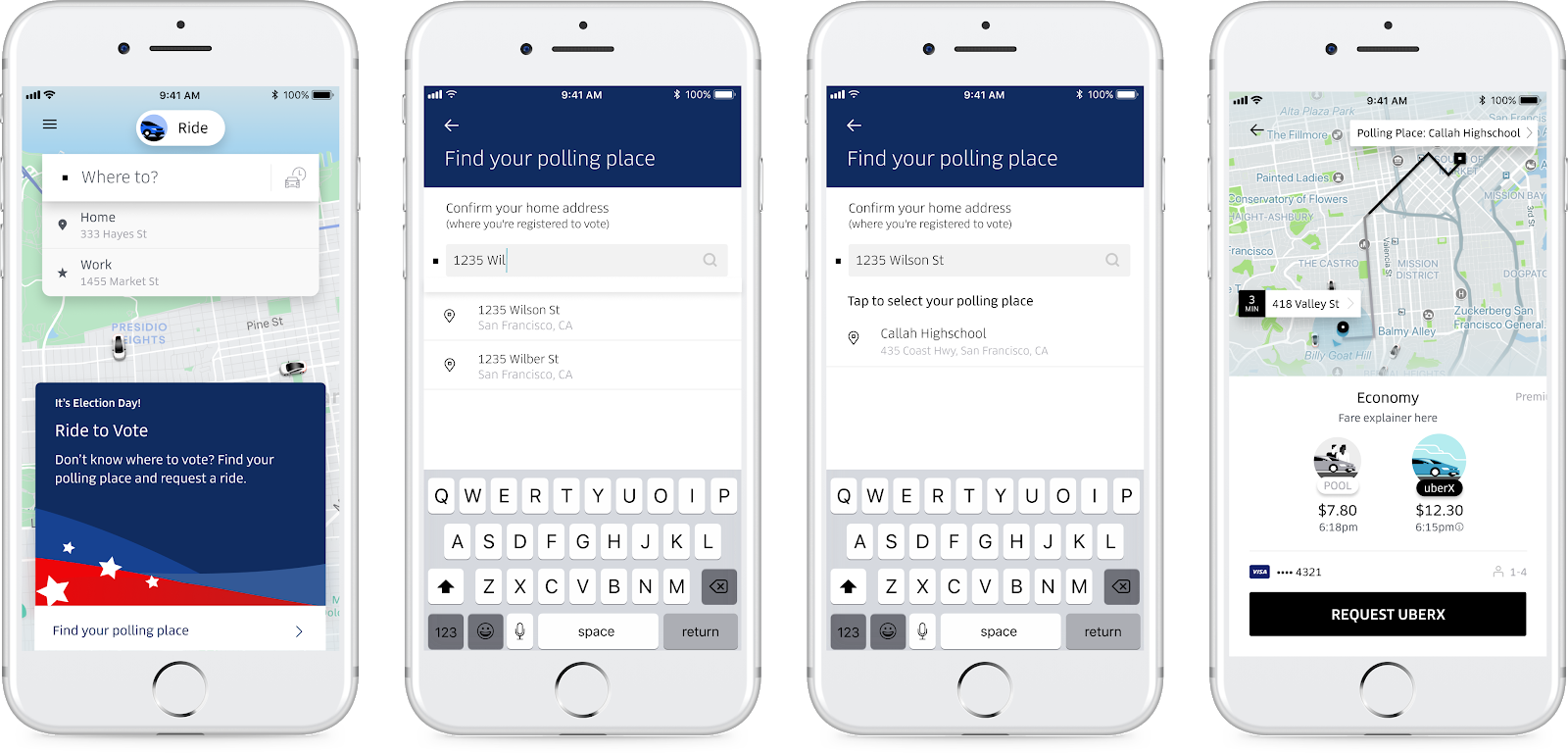
Uber no longer wants the barrier to transportation to be a deciding factor between voting and not voting. On Election Day, Uber is going to make it easy for people to find their local polling places and then get them a ride there for free.

On Nov. 6, 2018, Uber will offer U.S. riders the ability to quickly find their polling place and then book a free ride. Lyft is similarly offering half-priced and free rides to polling places on Election Day.

“Decisions get made by those who show up,” Uber CEO Dara Khosrowshahi wrote in a blog post. “This Election Day, Uber will be doing what we can to make it easier for people to do just that.”

In the 2016 election, 35 percent of youth surveyed cited a lack of transportation as the reason why they didn’t vote.

Uber is also working with non-profit organizations to help get both riders and drivers registered to vote before state deadlines. Between today and Election Day, Uber will also host voter registration drives at its 125+ driver hubs throughout the country.