Year: 2018

04 Oct 2018

Bird unveils custom electric scooters and delivery

Bird, the electric scooter sharing startup worth $2 billion, is further differentiating itself from the rest of the pack with the launch of custom, rugged electric scooters. These will roll out in the “coming weeks” post-beta testing in Los Angeles, Nashville, Atlanta, Baltimore, Austin and Salt Lake City.

Dubbed Bird Zero, the scooters have 60 percent more battery life, and better ride stability and durability than the original model. There’s also an integrated digital screen to display your speed.

“We call it Bird Zero because it’s the first vehicle we’ve designed and engineered ourselves specifically for the shared electric scooter space,” Bird CEO Travis VanderZanden told TechCrunch this morning.

Bird, in partnership with Okai, designed and manufactured the scooter from the ground up. Bird handled the design and Okai handled the manufacturing. But for now, the plan is to continue working with multiple vehicle manufacturers, VanderZanden said.

“What I will say is the Bird Zero is designed specifically for this use case so we’re going to keep watching and getting feedback from our rider and charger community,” he said.

Many electric scooter companies don’t actually build their own scooters. Instead, they’re slapping stickers and logos on scooters that have been around for years. Lime, Bird and Spin launched using scooters from Ninebot, a Chinese scooter company that has merged with Segway. Ninebot is backed by investors, including Sequoia Capital, Xiaomi and ShunWei. Lime, however, has since partnered with Segway to build scooters and Skip has said from day one that it plans to make its own.
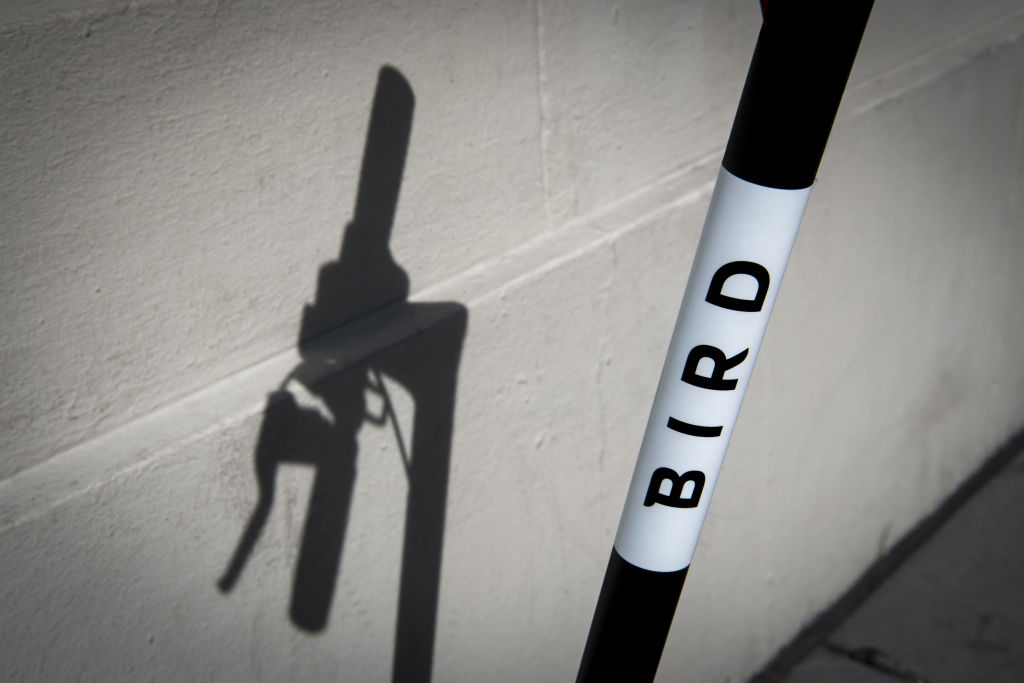
A Bird Rides Inc. shared electric scooter stands on the Embarcadero in San Francisco, California, U.S., on Thursday, May 3, 2018. Photographer: David Paul Morris/Bloomberg via Getty Images

The name of the game, VanderZanden said, is to be as customer-obsessed as possible. That’s where Bird Delivery, launching soon, comes in. With Bird Delivery, riders can request a Bird be delivered to their home or office by 8 a.m. From there, the rider can use it throughout the day.

“The city is a top customer but we’ve also been listening to the riders and figuring out what riders really want,” he said. “Riders really want a Bird delivered to them in the morning at their house. We think that’s a super magical experience. We’ll be rolling that out very soon. Not a lot of our riders live close to downtown areas, so there’s an equity component there that we think is very exciting.”

Bird has yet to determine the pricing but will announce it soon. What VanderZanden would share is that it will make “financial sense for you.” He hypothesizes that, while people could theoretically purchase their own scooters, they won’t because then they’d have to deal with charging, maintenance and storage.

Last month, Bird announced 10 million scooter rides since launching about one year ago. To date, Bird has raised $415 million in funding for shared electric scooters and operates in more than 100 cities.

04 Oct 2018

Nubank’s David Vélez and Cristina Junquiera to speak at Startup Battlefield Latin America

TechCrunch is pleased to announce that Nubank co-founder Cristina Junqueira and co-founder/CEO David Vélez will join us in a fireside chat at Startup Battlefield Latin America on November 8 at the Tomie Ohtake Institute in São Paulo, Brazil.

Nubank’s product is a no-fee credit card managed through a mobile app. Investors like Sequoia, Kaszek, Tiger Global and Goldman Sachs bet on the company’s potential to challenge Brazil’s big banks. The São Paulo-based company raised a total of $527.6M in funding over 8 rounds, making it the most recent business to reach unicorn status in the region. The fintech passed the milestone of 4 million credit card clients on its platform in May 2018, up from 3 million in late 2017.

Fueled by mega rounds from Western players like Andreessen, Sequoia, Accel and SoftBank, venture investment into Latin America doubled in 2017, reaching an all time high of $1.1 billion. The cash flow continued as more than $600M was invested into Latin American companies in the first quarter of 2018. Market conditions like rapid smartphone adoption in highly-populated countries like Brazil and a growing demand for digital services position Latin America for a big tech breakout.

Who better to speak to this trend and discuss the challenges and opportunities ahead for early stage companies in the region than one of the top-funded startups?

Before founding Nubank in 2013, Vélez was a Partner at Sequoia Capital, helping the firm scout opportunities to invest in Latin America. He previously worked in investment banking and growth equity at Goldman Sachs, Morgan Stanley and General Atlantic. Junqueira is the co-founder and VP of Branding and Business Development at Nubank. Prior to Nubank, she worked for many years at Itaú Unibanco dealing with product and marketing for the bank’s consumer loan and credit card businesses.

The pair will take the stage in what will surely be a fascinating talk about disrupting big banks, securing funding and what’s next for early stage startups in the Latin America region. You can catch the interview with Nubank’s founders, more panel discussions, and of course the Startup Battlefield competition at Startup Battlefield Latin America on November 8 at the Tomie Ohtake Institute in São Paulo, Brazil. Apply for your free spectator tickets here.

04 Oct 2018

Instagram launches scannable Nametags, tests school networks for teen growth

When your feed and Stories tray go stale, or your follower count stops rising, you drift away from Instagram . That’s why the app is rolling out two big new features designed to connect you to new people and diversify your graph so there’s alwasy something surprising to look at and like.

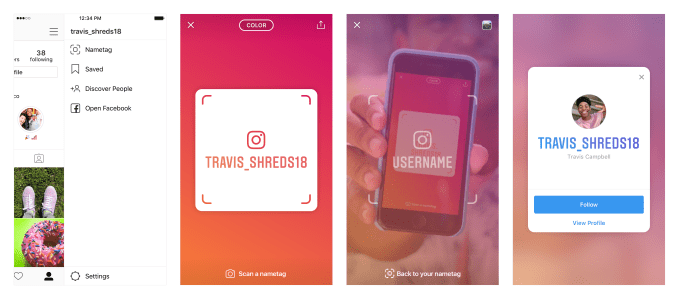
Today Instagram launches its QR Snapcode-style Nametags globally on iOS and Android, after TechCrunch broke the news on the feature back in March and April. Though not technically QR codes, they’re scanned like them to let you follow people you meet offline.

The customizable codes are accessible from the three-line hamburger menu on your profile. They can be scanned when other users tap and hold on your code through the Instagram Stories camera or Scan Nametag button on your own Nametag to instantly follow you. You can add colors, emojis, or AR-embellished selfies to your Instagram Nametag, show it off on your phone to help people follow you in person, put it on your website or social media, or message it to friends through SMS, WhatsApp, Messenger, and more.

It’s actually surprising it took this long for Instagram to copy Snapchat’s Snapcodes that debuted for profiles in 2015 and were later expanded to open websites and unlock AR filters. Facebook Messenger launched its own QR codes in April 2017, though never quite caught on. But they make a ton of sense on Instagram since it’s tougher to share links on the app, people often treat it as their primary presence on the web that they want to promote, and because businesses are increasingly relying on the app for commerce. It’s easy to imagine brands putting their Instagram Nametags on billboards and posters, or buying ads to promote them around the web.

Facebook Messenger and Snapchat’s QR codes

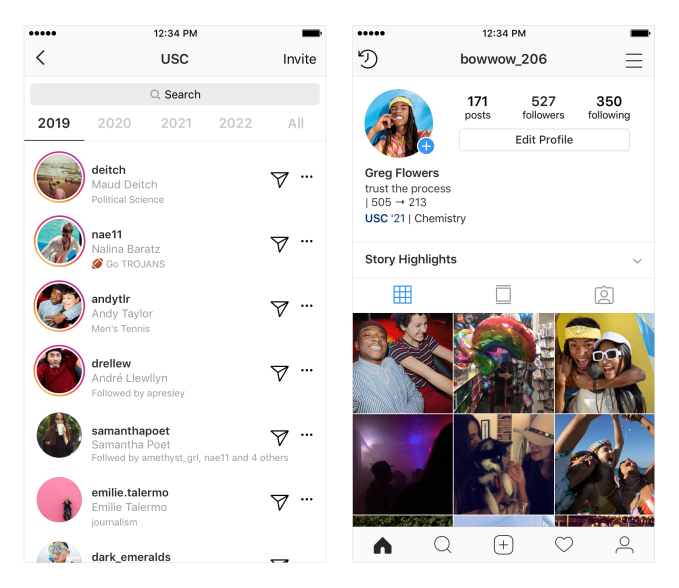
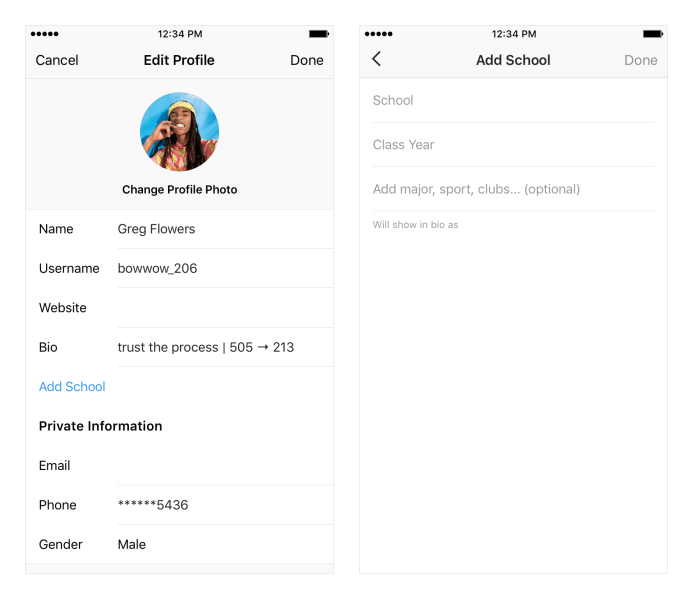
Secondly, Instagram is starting to test school communities in a variety of universities across the US. The allow you to join your university’s network to add a line to your profile listing your school, class year, and your major, sports team, or fraternity/sorority. You’ll show up in a directory listing everyone from your school that you can use to follow or message people, though those DMs may go to their pending inbox.

The school communities feature harkens back to Facebook’s origins when users could actually set their privacy to show all their content to everyone in their school. Here you won’t be able to instantly expose your private Instagram to everyone from your school. You could imagine a freshman in college going through their network to discover new potential friends to follow, or an alumni seeking out others from their Alma Mater in search of business or romance.

Instagram relies on info users have publicly shared about their school and the people they followed to verify if they were in fact a student or recent alumni of a university. Rather than actively signing up, users will get a notification prompting them to join the network. That’s a lot less reliable than using university email addresses for verification like Facebook used to, but also a lot simpler for users.

The company does provide a tool for alerting it to misuse of the school communities feature in case any sketchy older users are employing it as a stalking tool. Beside each user’s name is a three-dot button that opens a menu where users can report  Next to each user’s name is an overflow menu of 3 dots where people can report accounts they don’t think belong in a certain community.

The invite method is reminiscent of the growth hacks that teen Q&A app TBH that Facebook acquired was using. In what an internal memo called a “psychological trick”, TBH scraped Instagram user profiles for school names and looking at school location pages to find student accounts and invite them to join TBH. The teen sensation was eventually shut down due to low usage, the memo called the tactic too “scrappy” for a big public company, but now it’s found a home inside of Instagram.

Today’s launch is the first under Instagram’s new leader Adam Mosseri following the resignation of the company’s founders. Critics are watching to see if Mosseri, the former Facebook VP of News Feed and member of Mark Zuckerberg’s inner circle, will push harder to drive growth and monetization for Instagram. Given Instagram’s priority here is expanding its social graphs and keeping users engaged, it seems willing to trade occasionally allowing or disallowing the wrong people to reduce friction and juice growth.

04 Oct 2018

European Union approves content quota for streaming services

The European Parliament has voted in favor of a new quota for content on streaming services. Services, such as Netflix and Amazon Prime Video, will have to make sure that at least 30 percent of their catalogs in Europe come from European countries.

Many European countries already have quotas for movie theaters and TV networks. Quotas foster cultural diversity and ensure that movies with smaller budgets get a chance to compete with blockbuster franchises.

Other countries thought it was better to let the market decide and now it’s just Fantastic Four and The Emoji Movie on repeat because local production got crushed by Hollywood’s dollars.

Some European countries also set a tax on sales ticket to finance local movie production. With today’s new European agreement, streaming platforms will also have to contribute to local productions. They’ll be able to invest directly in local content or finance national funds. Netflix has already announced plans to open offices in Paris and Madrid to produce more content in those countries.

Streaming services will have to contribute proportionally to their revenues in each country. It’ll be a bit tough to calculate for Amazon as Amazon Prime Video is mixed with a bunch of services as part of the Prime subscription plan.

In other news, online video platforms at large (including YouTube, Facebook, Twitch…) will have to go further when it comes to taking down dangerous content. This time, the Parliament wants to protect minors from violence, hatred, terrorism and harmful advertising in particular.

Platforms will need to be transparent when it comes to their flagging and moderation mechanisms. And there are new rules on children content. Platforms can’t capture personal data of children for targeted advertising purposes.

04 Oct 2018

This autonomous spray-painting drone is a 21st-century tagger’s dream

Whenever I see an overpass or billboard that’s been tagged, I worry about the tagger and the danger they exposed themselves to in order to get that cherry spot. Perhaps this spray paint-toting drone developed by ETH Zurich and Disney Research will take some of the danger out of the hobby. It could also be used for murals and stuff, I guess.

Although it seems an obvious application in retrospect, there just isn’t a lot of drone-based painting being done out there. Consider: a company could shorten or skip the whole scaffolding phase of painting a building or advertisement, leaving the bulk of painting to a drone. Why not?

There just isn’t a lot of research into it yet, and like so many domain-specific applications, the problem is deceptively complex. This paper only establishes the rudiments of a system, but the potential is clearly there.

The drone used by the researchers is a DJI Matrice 1002, customized to have a sensing rig mounted on one side and a spraying assembly on the other, counterbalancing each other. The sprayer, notably, is not just a nozzle but a pan-and-tilt mechanism that allows details to be painted that the drone can’t be relied on to make itself. To be clear we’re still talking broad strokes here, but accurate to an inch rather than three or four.

It’s also been modified to use wired power and a constant supply of paint, which simplifies the physics and also reduces limits on the size of the surface to be painted. A drone lugging its own paint can wouldn’t be able to fly far, and its thrust would have to be constantly adjusted to account for the lost weight of sprayed paint. See? Complex.

The first step is to 3D scan the surface to be painted; this can be done manually or via drone. The mesh is then compared to the design to be painted and a system creates a proposed path for the drone.

Lastly the drone is set free to do its thing. It doesn’t go super fast in this prototype form, nor should it, since even the best drones can’t stop on a dime, and tend to swing about when they reduce speed or change direction. Slow and steady is the word, following a general path to put the nozzle in range of where it needs to shoot. All the while it is checking its location against the known 3D map of the surface so it doesn’t get off track.

In case you’re struggling to see the “bear,” it’s standing up with its paws on a tree. That took me a long time to see so I thought I’d spare you the trouble.

Let’s be honest: this thing isn’t going to do much more complicated than some line work or a fill. But for a lot of jobs that’s exactly what’s needed — and it’s often the type of work that’s the least suited to skilled humans, who would rather be doing stuff only they can do. A drone could fill in all the easy parts on a building and then the workers can do the painstaking work around the windows or add embellishments and details.

For now this is strictly foundational work — no one is going to hire this drone to draw a Matterhorn on their house — but there’s a lot of potential here if the engineering and control methods can be set down with confidence.

04 Oct 2018

Postmates Unlimited lowers minimum order size for free delivery

On the heels of a $300 million funding round valued at $1.2 billion, Postmates is making its Unlimited monthly subscription product a bit more economical. Postmates Unlimited, which costs $9.99 per month ( or $7.99 per month paid annually), is lowering its minimum order size from $20 to $15. That means in order to get free delivery, you have to spend at least $15.

The on-demand delivery startup first launched its Amazon Prime-style subscription service in March 2016. At the time, the minimum order fee was $30. Just a few months later, Postmates lowered the minimum cart size to $25.

Postmates says one of every three orders come via its Unlimited members. Postmates has also doubled the number of people subscribed to Unlimited, touting “hundreds of thousands” of Unlimited customers and 300 percent growth year over year.

Postmates competitor DoorDash similarly offers a subscription service for free delivery. In August, DoorDash unveiled DashPass to offer free deliveries for orders of at least $15. Starting today, DoorDash is offering free one-week trials of its service.

Overall, Postmates says it completes millions of deliveries a month and is profitable in 90 percent of its markets. Postmates is currently available in more than 400 U.S. cities, as well as in Mexico City.

04 Oct 2018

You can now use the Google Assistant to order an Uber or Lyft

If you ever wanted to use your Google Assistant to book you a ride with Uber or Lyft, your wishes have been heard. Starting today, you’ll be able to use your voice to ask Google’s virtual assistant to book you a car from Uber, Lyft, Ola, Grab, GO-JEK and similar services.

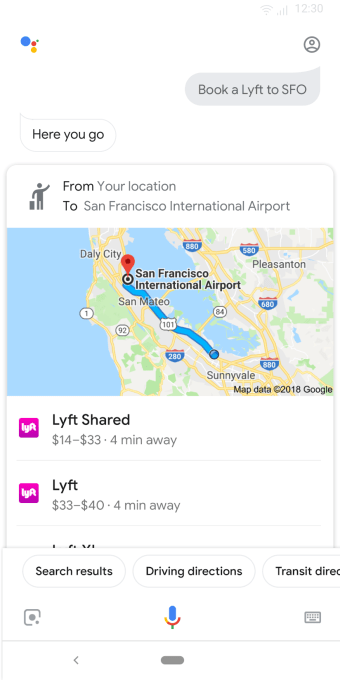
The new feature works with Google Assistant-enabled speakers and on phones. You can either request a car from a specific company or place a more generic request (“Hey Google, book a car to PDX”) and the assistant will return current pricing for all the supported ridesharing services in your area.

To actually book the ride, the Assistant will then hand you off to the ridesharing company’s mobile app, though.

Still, it’s a useful feature if you want to quickly compare prices or are frantically running around the house, trying to pack your suitcase for your next trip, and want to get a car quickly.

Lilian Rincon, Google’s director for the Assistant, told me that having a similar feature in Google Maps already made it easier to implement this in the Assistant, too.

“We think of the Google Assistant as highlighting the best of Google,” she said. “There is a ridesharing feature in Google Maps and we’ve been working very closely with that team to highlight this.”

It’s worth noting that Google announced a redesign of the visual side of the Google Assistant yesterday. This new feature isn’t directly linked to that as far as I can tell, but it does show some of that same focus on bringing more visual elements to the Assistant experience by showing you a list of prices and a map.

The new feature is now rolling out globally, but only in English. It’ll expand to other languages over time.

04 Oct 2018

Chinese chip spying report shows the supply chain remains the ultimate weakness

Thursday’s explosive story by Bloomberg reveals detailed allegations that the Chinese military embedded tiny chips into servers, which made their way into datacenters operated by dozens of major U.S. companies.

We covered the story earlier, including denials by Apple, Amazon and Supermicro — the server maker that was reportedly targeted by the Chinese government. Amazon said in a blog post that it “employs stringent security standards across our supply chain.” The FBI and the Office for the Director of National Intelligence did not comment, but denied comment to Bloomberg.

Much of the story can be summed up with this one line from a former U.S. official: “Attacking Supermicro motherboards is like attacking Windows. It’s like attacking the whole world.”

It’s a fair point. Supermicro is one of the biggest tech companies you’ve probably never heard of. It’s a computing supergiant based in San Jose, Calif. with global manufacturing operations across the world — including China, where it builds most of its motherboards. Those motherboards trickle throughout the rest of the world’s tech — and were used in Amazon’s datacenter servers that powers its Amazon Web Services cloud and Apple’s iCloud.

One government official speaking to Bloomberg said China’s goal was “long-term access to high-value corporate secrets and sensitive government networks,” which fits into the playbook of China’s long-running effort to steal intellectual property.

“No consumer data is known to have been stolen,” said Bloomberg.

Infiltrating Supermicro, if true, will have a long lasting ripple effect on the wider tech industry and how they approach their own supply chains. Make no mistake – introducing any kind of external tech in your datacenter isn’t taken lightly by any tech company. Fears of corporate and state-sponsored espionage has been rife for years. It’s chief among the reasons why the U.S. and Australia have effectively banned some Chinese telecom giants — like ZTE — from operating on its networks.

Having a key part of your manufacturing process infiltrated — effectively hacked — puts every believed-to-be-secure supply chain into question.

With nearly every consumer electronics or automobile, manufacturers have to procure different parts and components from various sources across the globe. Ensuring the integrity of each component is near impossible. But because so many components are sourced from or assembled in China, it’s far easier for Beijing than any other country to infiltrate without anyone noticing.

The big question now is how to secure the supply chain?

Companies have long seen supply chain threats as a major risk factor. Apple and Amazon are down more than 1 percent in early Thursday trading and Supermicro is down more than 35 percent (at the time of writing) following the news. But companies are acutely aware that pulling out of China will cost them more. Labor and assembly is far cheaper in China, and specialist parts and specific components often can’t be found elsewhere.

Instead, locking down the existing supply chain is the only viable option.

Security giant Crowdstrike recently found that the vast majority — nine out of ten companies — have suffered a software supply chain attack, where a supplier or part manufacturer was hit by ransomware, resulting in a shutdown of operations.

But protecting the hardware supply chain is a different task altogether — not least for the logistical challenge.

Several companies have already identified the risk of manufacturing attacks and taken steps to mitigate. BlackBerry was one of the first companies to introduce root of trust in its phones — a security feature that cryptographically signs the components in each device, effectively preventing the device’s hardware from tampering. Google’s new Titan security key tries to prevent manufacturing-level attacks by baking in the encryption in the hardware chips before the key is assembled.

Albeit at start, it’s not a one-size-fits-all solution. Former NSA hacker Jake Williams, founder of Rendition Infosec, said that even those hardware security mitigations may not have been enough to protect against the Chinese if the implanted chips had direct memory access.

“They can modify memory directly after the secure boot process is finished,” he told TechCrunch.

Some have even pointed to blockchain as a possible solution. By cryptographically signing — like in root of trust — each step of the manufacturing process, blockchain can be used to track goods, chips, and components throughout the chain.

Instead, manufacturers often have to act reactively and deal with threats as they emerge.

According to Bloomberg, “since the implanted chips were designed to ping anonymous computers on the internet for further instructions, operatives could hack those computers to identify others who’d been affected.”

Williams said that the report highlights the need for network security monitoring. “While your average organization lacks the resources to discover a hardware implant (such as those discovered to be used by the [Chinese government]), they can see evidence of attackers on the network,” he said.

“It’s important to remember that the malicious chip isn’t magic — to be useful, it must still communicate with a remote server to receive commands and exfiltrate data,” he said. “This is where investigators will be able to discover a compromise.”

The intelligence community is said to be still investigating after it first detected the Chinese spying effort, some three years after it first opened a probe. The investigation is believed to be classified — and no U.S. intelligence officials have yet to talk on the record — even to assuage fears.

04 Oct 2018

MoviePass’ parent just raised a bunch of money

As the summer of MoviePass quickly turned into the bummer of MoviePass, the company has been trying all manner of Hail Maries to keep the dream alive. And while the movie ticket startup has been burning through cash like crazy, securing funding apparently hasn’t been an issue.

This week, MoviePass’ parent company Helios & Matheson secured an additional $63 million in funding. MoviePass has since confirmed the funding with TechCrunch, but won’t go into any additional details regarding what it plans to do with the money.

Helios & Matheson CEO Ted Farnsworth was a bit more open — if not particularly specific — about what all this means. “We’re still here, and we’re not going anywhere,” he told The Wrap. “We’re doing M&A, we’re looking at all kinds of acquisitions at any given time and we’ll grow the company that way and I think you’ll see over the next few weeks,”

In the short term, at least, that means keeping the lights on over at MoviePass, as the service adjusts plans and expectations in hopes of retaining customers and becoming profitable. It’s a pretty massive mountain to climb, given how the product was positioned at the height of its powers.

“[T]echnically subscription alone right now is doing just fine, now it’s tacking on all the other things on top of it,” Farnsworth said. “What we’re doing now is we’re proving out our model.”

The plan includes creating original content in the vein of Netflix, though, the company’s first acquisition, Gotti, wasn’t exactly an auspicious beginning for those grand plans. 

04 Oct 2018

BlackBerry races ahead of security curve with quantum-resistant solution

Quantum computing represents tremendous promise to completely alter technology as we’ve known it, allowing operations that weren’t previously possible with traditional computing. The downside of these powerful machines is that they could be strong enough to break conventional cryptography schemes. Today, BlackBerry announced a new quantum-resistant code signing service to help battle that possibility.

The service is meant to anticipate a problem that doesn’t exist yet. Perhaps that’s why BlackBerry hedged its bets in the announcement saying,”The new solution will allow software to be digitally signed using a scheme that will be hard to break with a quantum computer.” Until we have fully functioning quantum computers capable of breaking current encryption, we probably won’t know for sure if this works.

But give BlackBerry credit for getting ahead of the curve and trying to solve a problem that has concerned technologists as quantum computers begin to evolve. The solution, which will be available next month, is actually the product a partnership between BlackBerry and Isara Corporation, a company whose mission is to build quantum-safe security solutions. BlackBerry is using Isara’s cryptographic libraries to help sign and protect code as security evolves.

“By adding the quantum-resistant code signing server to our cybersecurity tools, we will be able to address a major security concern for industries that rely on assets that will be in use for a long time. If your product, whether it’s a car or critical piece of infrastructure, needs to be functional 10-15 years from now, you need to be concerned about quantum computing attacks,” Charles Eagan BlackBerry’s Chief Technology Officer said in a statement.

While experts argue how long it could take to build a fully-functioning quantum computer, most agree that it will take between 50 and 100 qubit computers to begin realizing that vision. IBM released a 20 Qubit computer last year and introduced a 50 Qubit prototype. A Qubit represents a single unit of quantum information.

At TechCrunch Disrupt last month, Dario Gil, IBM’s vice president of artificial intelligence and quantum computing, and Chad Rigetti, a former IBM researcher who is founder and CEO at Rigetti Computing, predicted we could be just three years away from the point where a quantum computer surpasses traditional computing.

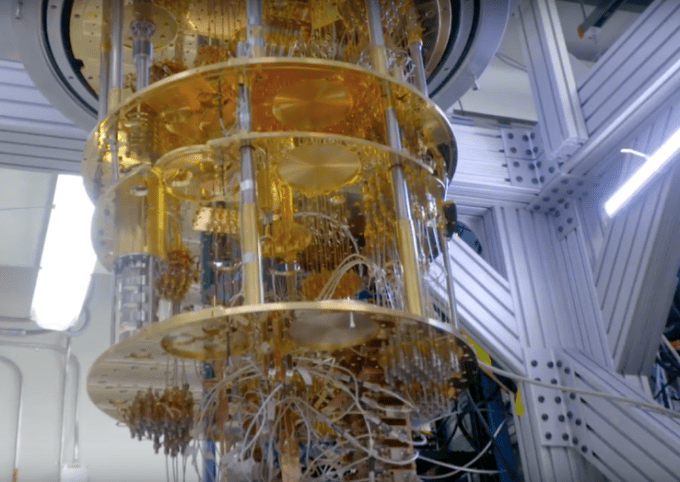
IBM Quantum Computer

IBM Quantum Computer. Photo: IBM

Whether it happens that quickly or not remains to be seen, but experts have been expressing security concerns around quantum computing as they grow more powerful, and BlackBerry is addressing that concern by coming up with a solution today, arguing that if you are creating critical infrastructure you need to future-proof your security.

BlackBerry, once known for highly secure phones, and one of the earliest popular, business smart phones, has pivoted to be more of a security company in recent years. This announcement, made at the BlackBerry Security Summit, is part of the company’s focus on keeping enterprises secure.